fuel VOLVO XC90 2009 Owner´s Manual
[x] Cancel search | Manufacturer: VOLVO, Model Year: 2009, Model line: XC90, Model: VOLVO XC90 2009Pages: 282, PDF Size: 8.76 MB
Page 178 of 282
07 Wheels and tiresTemporary spare
07178
The spare tire in your vehicle is called a "Tem-
porary Spare".
Recommended tire pressure (see the placard
on the B-pillar or on the fuel filler door) should
be maintained irrespective of which position on
the vehicle the temporary spare tire is used.
In the event of damage to this tire, a new one
can be purchased from your Volvo retailer.
WARNING
Current legislation prohibits the use of the
"Temporary Spare" tire other than as a tem-
porary replacement for a punctured tire. It
must be replaced as soon as possible by a
standard tire. Road holding and handling
may be affected with the "Temporary
Spare" in use. Do not exceed 50 mph
(80 km/h).
CAUTION
The vehicle must not be driven with wheels
of different dimensions or with a spare tire
other than the one that came with the vehi-
cle. The use of different size wheels can
seriously damage your vehicle's transmis-
sion.
Page 179 of 282
07 Wheels and tires
Tire rotation
07
179
G020325
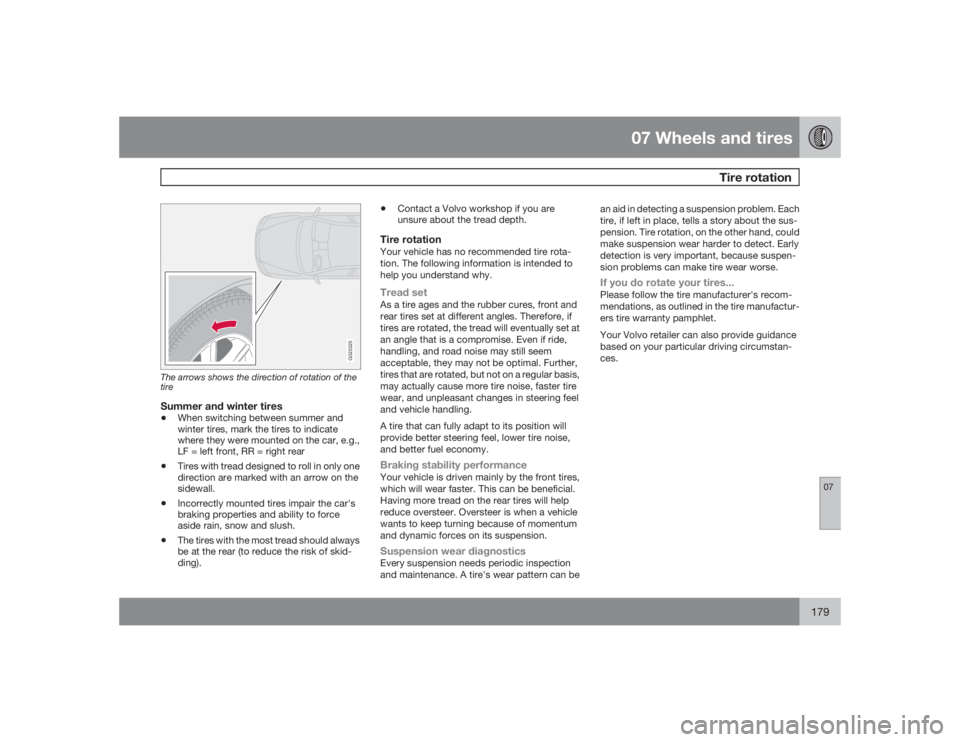
The arrows shows the direction of rotation of the
tireSummer and winter tires•
When switching between summer and
winter tires, mark the tires to indicate
where they were mounted on the car, e.g.,
LF = left front, RR = right rear
•
Tires with tread designed to roll in only one
direction are marked with an arrow on the
sidewall.
•
Incorrectly mounted tires impair the car's
braking properties and ability to force
aside rain, snow and slush.
•
The tires with the most tread should always
be at the rear (to reduce the risk of skid-
ding).
•
Contact a Volvo workshop if you are
unsure about the tread depth.
Tire rotationYour vehicle has no recommended tire rota-
tion. The following information is intended to
help you understand why.Tread setAs a tire ages and the rubber cures, front and
rear tires set at different angles. Therefore, if
tires are rotated, the tread will eventually set at
an angle that is a compromise. Even if ride,
handling, and road noise may still seem
acceptable, they may not be optimal. Further,
tires that are rotated, but not on a regular basis,
may actually cause more tire noise, faster tire
wear, and unpleasant changes in steering feel
and vehicle handling.
A tire that can fully adapt to its position will
provide better steering feel, lower tire noise,
and better fuel economy.Braking stability performanceYour vehicle is driven mainly by the front tires,
which will wear faster. This can be beneficial.
Having more tread on the rear tires will help
reduce oversteer. Oversteer is when a vehicle
wants to keep turning because of momentum
and dynamic forces on its suspension.Suspension wear diagnosticsEvery suspension needs periodic inspection
and maintenance. A tire's wear pattern can bean aid in detecting a suspension problem. Each
tire, if left in place, tells a story about the sus-
pension. Tire rotation, on the other hand, could
make suspension wear harder to detect. Early
detection is very important, because suspen-
sion problems can make tire wear worse.
If you do rotate your tires...Please follow the tire manufacturer's recom-
mendations, as outlined in the tire manufactur-
ers tire warranty pamphlet.
Your Volvo retailer can also provide guidance
based on your particular driving circumstan-
ces.
Page 190 of 282
07 Wheels and tiresTire Pressure Monitoring System (TPMS) – U.S. models only
07190
The tire pressure monitoring system uses sen-
sors mounted in the tire valves to check infla-
tion pressure levels. When the vehicle is
moving at a speed of approximately 20 mph
(30 km/h) or faster, these sensors transmit
inflation pressure data to a receiver located in
the vehicle.USA – FCC ID: MRXG403MA4
A
This device complies with part 15 of the FCC
rules. Operation is subject to the following
conditions: (1) This device may not cause
harmful interference, and (2) this device
must accept any interference received,
including interference that may cause unde-
sired operation.
When low inflation pressure is detected,
TPMS will light up the tire pressure warning
light (also referred to as a telltale) in the
instrument panel (see page 57), and will dis-
play a message in the text window. The
wording of this message is determined by
the degree of inflation pressure loss.AOn certain models, the FCC code is MRXTG315AM04
NOTE
If a fault occurs in TPMS, the tire pressure
warning light will flash for approximately
1 minute and
TIRE PRESS SYST
SERVICE REQUIRED
will be displayed.
Each tire, including the spare (if provided),
should be checked monthly when cold and
inflated to the inflation pressure recommended
by the vehicle manufacturer on the vehicle
placard or tire inflation pressure label. (If your
vehicle has tires of a different size than the size
indicated on the vehicle placard or tire inflation
pressure label, you should determine the
proper tire inflation pressure for those tires.)
As an added safety feature, your vehicle has
been equipped with a tire pressure monitoring
system (TPMS) that illuminates a low tire pres-
sure telltale when one or more of your tires is
significantly under-inflated. Accordingly, when
the low tire pressure telltale illuminates, you
should stop and check your tires as soon as
possible, and inflate them to the proper pres-
sure. Driving on a significantly under-inflated
tire causes the tire to overheat and can lead to
tire failure. Under-inflation also reduces fuel
efficiency and tire tread life, and may affect the
vehicle's handling and stopping ability.
Please note that the TPMS is not a substitute
for proper tire maintenance, and it is the driv-er's responsibility to maintain correct tire pres-
sure, even if under-inflation has not reached
the level to trigger illumination of the TPMS low
tire pressure telltale.
Your vehicle has also been equipped with a
TPMS malfunction indicator to indicate when
the system is not operating properly. The
TPMS malfunction indicator is combined with
the low tire pressure telltale. When the system
detects a malfunction, the telltale will flash for
approximately one minute and then remain
continuously illuminated. This sequence will
continue upon subsequent vehicle start-ups as
long as the malfunction exists. When the mal-
function indicator is illuminated, the system
may not be able to detect or signal low tire
pressure as intended. TPMS malfunctions may
occur for a variety of reasons, including the
installation of replacement or alternate tires or
wheels on the vehicle that prevent the TPMS
from functioning properly. Always check the
TPMS malfunction telltale after replacing one
or more tires or wheels on your vehicle to
ensure that the replacement or alternate tires
and wheels allow the TPMS to continue to
function properly.
Page 194 of 282
08 Car careWashing and cleaning the vehicle
08194
Washing•
The vehicle should be washed at regular
intervals since dirt, dust, insects and tar
spots adhere to the paint and may cause
damage. It is particularly important to wash
the vehicle frequently in the wintertime to
prevent corrosion, when salt has been
used on the roads.
•
When washing the vehicle, do not expose
it to direct sunlight. Use lukewarm water to
soften the dirt before you wash with a
sponge, and plenty of water, to avoid
scratching.
•
Bird droppings: Remove from paintwork as
soon as possible. Otherwise the finish may
be permanently damaged.
•
A detergent can be used to facilitate the
softening of dirt and oil.
•
A water-soluble grease solvent may be
used in cases of sticky dirt. However, use
a wash place equipped with a drainage
separator.CAUTION
Chromed wheels: Clean chrome-plated
wheels using the same detergents used for
the body of the vehicle. Aggressive wheel
cleaning agents can permanently stain
chrome-plated wheels.
•
Dry the vehicle with a clean chamois and
remember to clean the drain holes in the
doors and rocker panels.
•
Tar spots can be removed with kerosene
or tar remover after the vehicle has been
washed.
•
A stiff-bristle brush and lukewarm soapy
water can be used to clean the wiper
blades. Frequent cleaning of the wind-
shield and wiper blades improves visibility
considerably and also helps prolong the
service life of the wiper blades.
•
Wash off the dirt from the underside (wheel
housings, fenders, etc.).
•
In areas of high industrial fallout, more fre-
quent washing is recommended.
•
After cleaning the engine, the spark plug
wells should be inspected for water and
blown dry if necessary.
Suitable detergentsSpecial vehicle washing detergents should be
used. A suitable mixture is about 2.5 fl. oz.
(8.5 cl) of detergent to 2.6 US gal. (10 liters) of
warm water. After washing with a detergent the
vehicle should be well rinsed with clean water.
CAUTION
•
When washing or steam cleaning the
engine, avoid spraying water or steam
directly on the electrical components or
toward the rear side of the engine.
•
Dirt, snow, etc., on the headlights can
reduce lighting capacity considerably.
Clean the headlights regularly, for
example when refueling.
•
During high pressure washing, the
spray mouthpiece must never be closer
to the vehicle than 13 " (30 cm). Do not
spray into the locks.
Special moonroof cautions:
•
Always close the moonroof and sun
shade before washing your vehicle.
•
Never use abrasive cleaning agents on
the moonroof.
•
Never use wax on the rubber seals
around the moonroof.
Exterior componentsVolvo recommends the use of special cleaning
products, available at your Volvo retailer, for
cleaning colored plastic, rubber, or ornamental
components such as chromed strips on the
exterior of your vehicle. The instructions for
using these products should be followed care-
Page 203 of 282
09 Maintenance and servicing
Maintaining your vehicle
09``203 Owner maintenance
Periodic maintenance requirements and inter-
vals are described in your vehicle's Warranty
and Service Records Information booklet.
The following points can be carried out
between the normally scheduled maintenance
services.Each time the vehicle is refueled•
Check the engine oil level
•
Clean the windshield, windshield wipers,
headlights, and tail lights
Monthly•
Check cold tire pressure in all tires. Inspect
the tires for wear.
•
Check that engine coolant and other fluid
levels are between the indicated "min" and
"max" markings.
•
Clean interior glass surfaces with a glass
cleaner and soft paper towels.
•
Wipe driver information displays with a soft
cloth.
•
Visually inspect battery terminals for cor-
rosion. Corrosion may indicate a loose ter-
minal connector, or a battery near the end
of its useful service life. Consult a trained
and qualified Volvo service technician for
additional information.
As needed•
Wash the vehicle, including the undercar-
riage, to reduce wear that can be caused
by a buildup of dirt, and corrosion that can
be caused by salt residues.
•
Clean leaves and twigs from air intake
vents at the base of the windshield, and
from other places where they may collect.
•
Complete service information for qualified
technicians is available online for purchase
or subscription at www.volvote-
chinfo.com.
Emission inspection readinessWhat is an Onboard Diagnostic System
(OBD II)?OBD II is part of your vehicle's computerized
engine management system. It stores diagnos-
tic information about your vehicle's emission
controls. It can light the Check Engine light
(MIL) if it detects an emission control "fault." A
"fault" is a component or system that is not
performing within an expected range. A fault
may be permanent or temporary. OBD II will
store a message about any fault.How do states use OBD II for emission
inspections?Many states connect a computer directly to a
vehicle's OBD II system. The inspector can
then read "faults." In some states, this type ofinspection has replaced the tailpipe emission
test.
How can my vehicle fail OBD II emission
inspection?Your vehicle can fail OBD II emission inspec-
tion for any of the following reasons.•
If your Check Engine (MIL) light is lit, your
vehicle may fail inspection.
•
If your vehicle's Check Engine light was lit,
but went out without any action on your
part, OBD II will still have a recorded fault.
Your vehicle may pass or fail, depending
on the inspection practices in your area.
•
If you had recent service that required dis-
connecting the battery, OBD II diagnostic
information may be incomplete and "not
ready" for inspection. A vehicle that is not
ready may fail inspection.
How can I prepare for my next OBD II
emission inspection?•
If your Check Engine (MIL) light is lit – or
was lit but went out without service, have
your vehicle diagnosed and, if necessary,
serviced by a qualified Volvo technician.
•
If you recently had service for a lit Check
Engine light, or if you had service that
required disconnecting the battery, a
period of driving is necessary to bring the
OBD II system to "ready" for inspection. A
half-hour trip of mixed stop-and-go/high-
Page 208 of 282
09 Maintenance and servicingEngine oil
09208
Oil specificationsEngine oil must meet the minimum ILSAC
specification GF-4, API SL, or ACEA A1/B1.
Lower quality oils may not offer the same fuel
economy, engine performance, or engine pro-
tection.
Volvo recommends Castrol.
Depending on your driving habits, premium or
synthetic oils may provide superior fuel econ-
omy and engine protection. Consult your Volvo
retailer or a trained and qualified Volvo service
technician for recommendations on premium
or synthetic oils.
Oil additives must not be used.
NOTE
Synthetic oil is not used when the oil is
changed at the normal maintenance serv-
ices. This oil is only used at customer
request, at additional charge. Please con-
sult a trained and qualified Volvo service
technician.
Oil viscosity (stable ambient
temperatures)
G023491
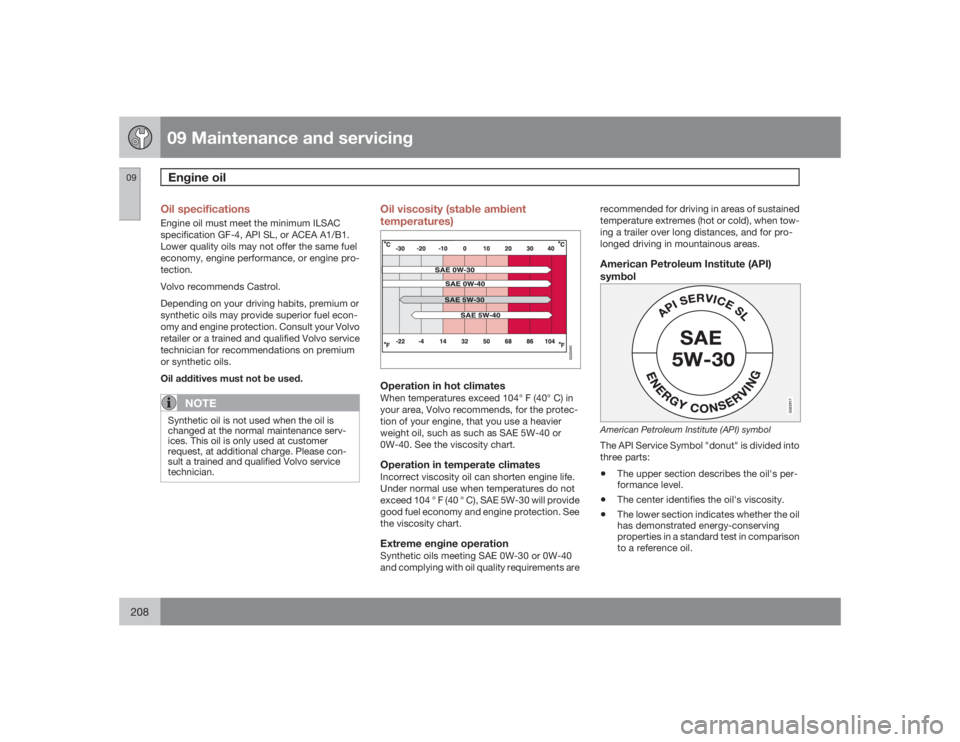
Operation in hot climatesWhen temperatures exceed 104° F (40° C) in
your area, Volvo recommends, for the protec-
tion of your engine, that you use a heavier
weight oil, such as such as SAE 5W-40 or
0W-40. See the viscosity chart.Operation in temperate climatesIncorrect viscosity oil can shorten engine life.
Under normal use when temperatures do not
exceed 104 ° F (40 ° C), SAE 5W-30 will provide
good fuel economy and engine protection. See
the viscosity chart.Extreme engine operationSynthetic oils meeting SAE 0W-30 or 0W-40
and complying with oil quality requirements arerecommended for driving in areas of sustained
temperature extremes (hot or cold), when tow-
ing a trailer over long distances, and for pro-
longed driving in mountainous areas.
American Petroleum Institute (API)
symbol
G022917
American Petroleum Institute (API) symbolThe API Service Symbol "donut" is divided into
three parts:•
The upper section describes the oil's per-
formance level.
•
The center identifies the oil's viscosity.
•
The lower section indicates whether the oil
has demonstrated energy-conserving
properties in a standard test in comparison
to a reference oil.
Page 209 of 282
09 Maintenance and servicing
Engine oil
09``209
NOTE
Volvo uses different systems to indicate a
low oil level or pressure. Some models have
an oil pressure sensor, in which case a
warning symbol (see page 56) is used to
indicate low oil pressure. Other models have
an oil level sensor, in which case the driver
is alerted by the warning symbol in the cen-
ter of the instrument panel and a text in the
information display. Some models use both
systems. Contact a trained and qualified
Volvo service technician for more informa-
tion.Changing engine oil and oil filterSee page 208 for oil specifications and page
268 for oil volumes. Refer to the Warranty and
Service Records Information booklet for infor-
mation on the oil change intervals.
NOTE
Volvo does not recommend the use of oil
additives.
Synthetic oil is not used when the oil is
changed at the normal maintenance inter-
vals except at owner request and at addi-
tional charge. Please consult a trained and
qualified Volvo service technician.
Checking and adding oil
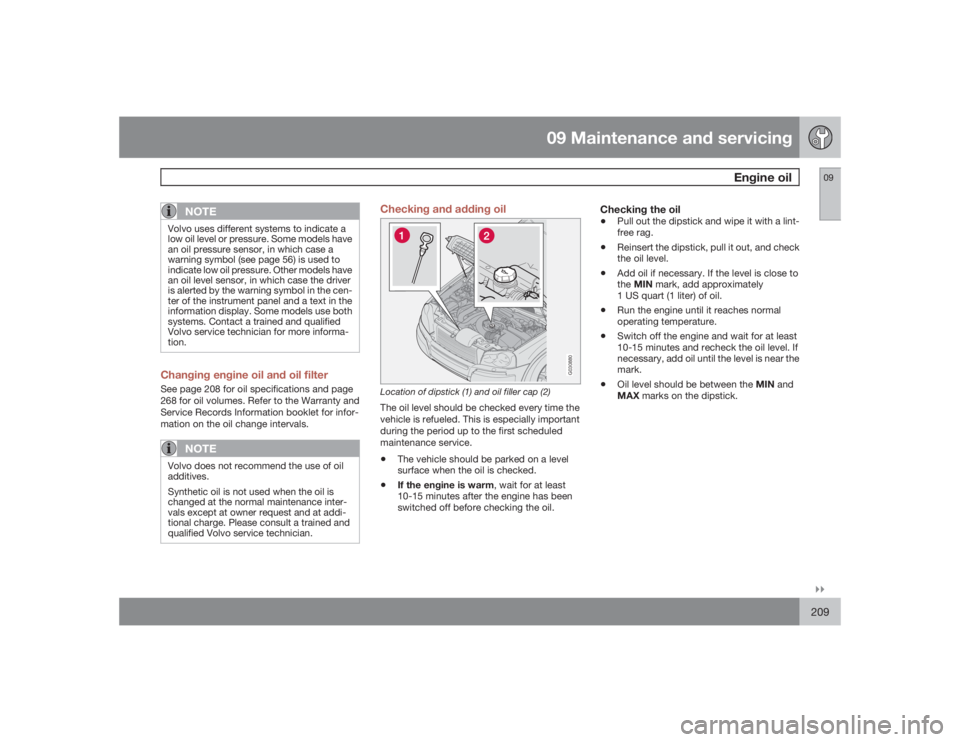
G030880
Location of dipstick (1) and oil filler cap (2)The oil level should be checked every time the
vehicle is refueled. This is especially important
during the period up to the first scheduled
maintenance service.•
The vehicle should be parked on a level
surface when the oil is checked.
•
If the engine is warm, wait for at least
10-15 minutes after the engine has been
switched off before checking the oil.
Checking the oil•
Pull out the dipstick and wipe it with a lint-
free rag.
•
Reinsert the dipstick, pull it out, and check
the oil level.
•
Add oil if necessary. If the level is close to
theMIN mark, add approximately
1 US quart (1 liter) of oil.
•
Run the engine until it reaches normal
operating temperature.
•
Switch off the engine and wait for at least
10-15 minutes and recheck the oil level. If
necessary, add oil until the level is near the
mark.
•
Oil level should be between the MIN and
MAX marks on the dipstick.
Page 225 of 282
09 Maintenance and servicing
Fuses
09``225 Fuses in the engine compartment
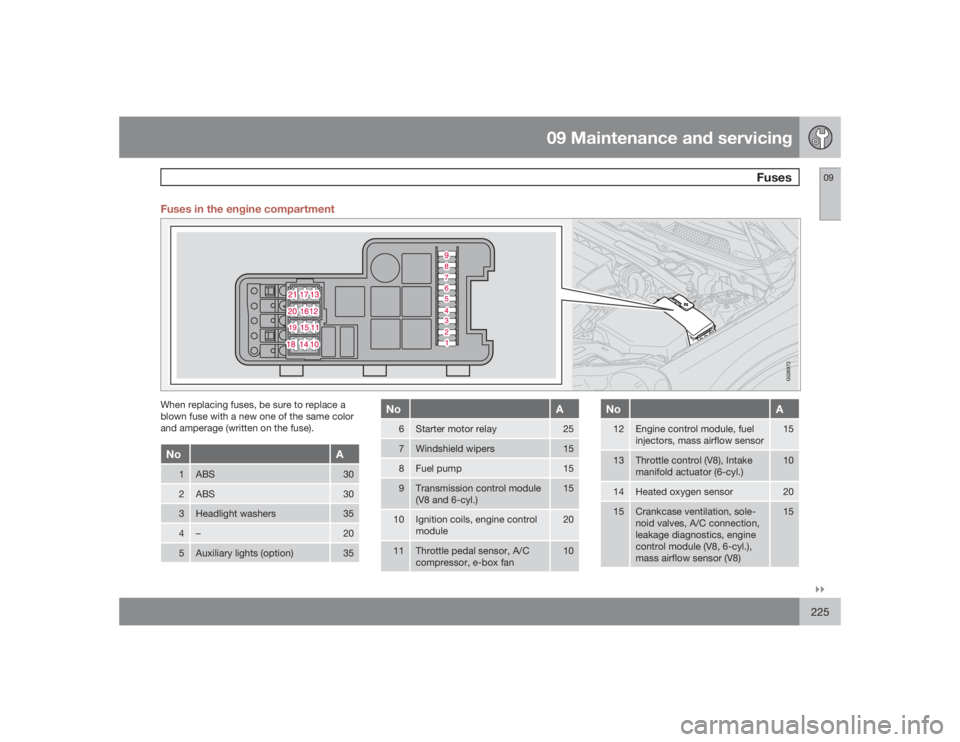
G026972
When replacing fuses, be sure to replace a
blown fuse with a new one of the same color
and amperage (written on the fuse).No
A
1
ABS
30
2
ABS
30
3
Headlight washers
35
4
–
20
5
Auxiliary lights (option)
35
No
A
6
Starter motor relay
25
7
Windshield wipers
15
8
Fuel pump
15
9
Transmission control module
(V8 and 6-cyl.)
15
10
Ignition coils, engine control
module
20
11
Throttle pedal sensor, A/C
compressor, e-box fan
10
No
A
12
Engine control module, fuel
injectors, mass airflow sensor
15
13
Throttle control (V8), Intake
manifold actuator (6-cyl.)
10
14
Heated oxygen sensor
20
15
Crankcase ventilation, sole-
noid valves, A/C connection,
leakage diagnostics, engine
control module (V8, 6-cyl.),
mass airflow sensor (V8)
15
Page 265 of 282
11 Specifications
Fluids
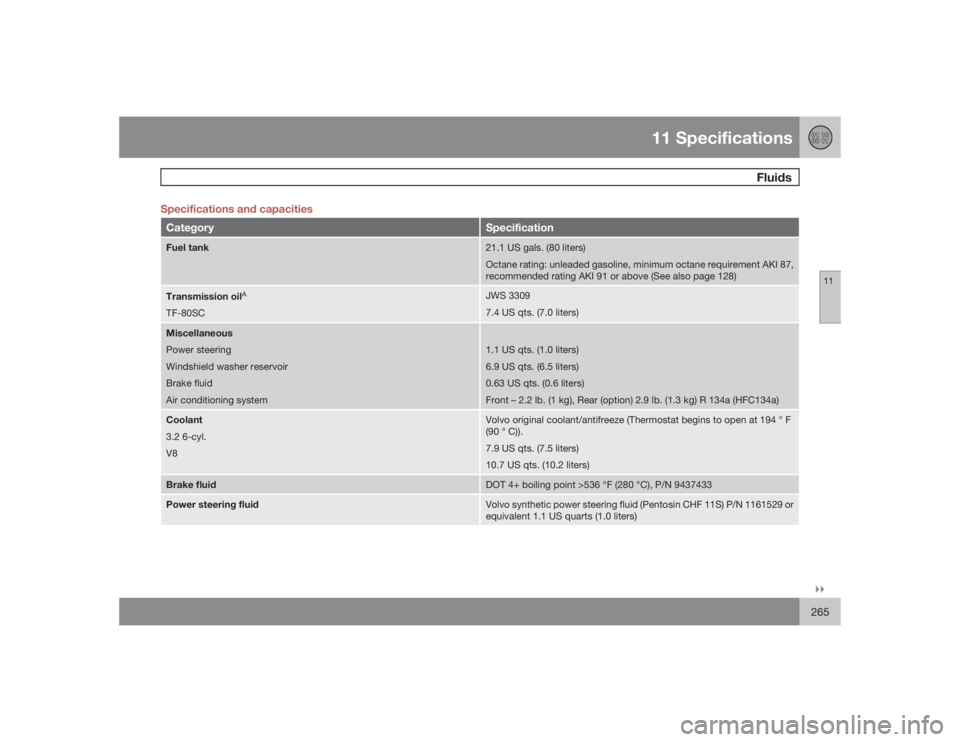
11``265 Specifications and capacities
Category
Specification
Fuel tank
21.1 US gals. (80 liters)
Octane rating: unleaded gasoline, minimum octane requirement AKI 87,
recommended rating AKI 91 or above (See also page 128)
Transmission oil
A
TF-80SC
JWS 3309
7.4 US qts. (7.0 liters)
Miscellaneous
Power steering
Windshield washer reservoir
Brake fluid
Air conditioning system
1.1 US qts. (1.0 liters)
6.9 US qts. (6.5 liters)
0.63 US qts. (0.6 liters)
Front – 2.2 lb. (1 kg), Rear (option) 2.9 lb. (1.3 kg) R 134a (HFC134a)
Coolant
3.2 6-cyl.
V8
Volvo original coolant/antifreeze (Thermostat begins to open at 194 ° F
(90 ° C)).
7.9 US qts. (7.5 liters)
10.7 US qts. (10.2 liters)
Brake fluid
DOT 4+ boiling point >536 °F (280 °C), P/N 9437433
Power steering fluid
Volvo synthetic power steering fluid (Pentosin CHF 11S) P/N 1161529 or
equivalent 1.1 US quarts (1.0 liters)
Page 268 of 282
11 SpecificationsEngine oil
11268
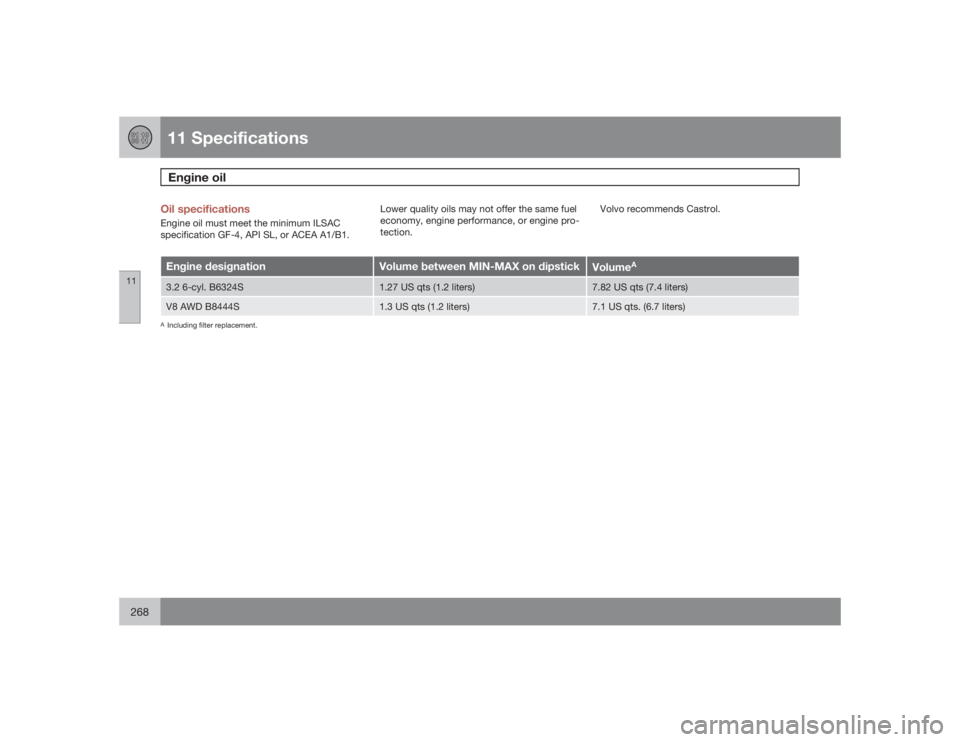
Oil specificationsEngine oil must meet the minimum ILSAC
specification GF-4, API SL, or ACEA A1/B1.Lower quality oils may not offer the same fuel
economy, engine performance, or engine pro-
tection.Volvo recommends Castrol.Engine designation
Volume between MIN-MAX on dipstick
Volume
A
3.2 6-cyl. B6324S
1.27 US qts (1.2 liters)
7.82 US qts (7.4 liters)
V8 AWD B8444S
1.3 US qts (1.2 liters)
7.1 US qts. (6.7 liters)
AIncluding filter replacement.