steering VOLVO XC90 2009 Owner´s Manual
[x] Cancel search | Manufacturer: VOLVO, Model Year: 2009, Model line: XC90, Model: VOLVO XC90 2009Pages: 282, PDF Size: 8.76 MB
Page 186 of 282
07 Wheels and tiresTire Sealing System
07186
WARNING
Please keep the following points in mind
when using the tire sealing system:•
The sealing compound bottle (no. 8 in
the illustration) contains 1.2-Ethanol
and natural rubber-latex. These sub-
stances are harmful if swallowed.
•
The contents of this bottle may cause
allergic skin reactions or otherwise be
potentially harmful to the skin, the cen-
tral nervous system, and the eyes.
Precautions:
•
Keep out of reach of children.
•
Do not ingest the contents.
•
Avoid prolonged or repeated contact
with the skin.
•
Hands should be washed thoroughly
after handling.
First aid:
•
Skin: Wash affected areas of skin with
soap and water. Get medical attention
if symptoms occur.
•
Eyes: Flush with plenty of water for least
15 minutes, occasionally lifting the
upper and lower eyelids. Get medical
attention if symptoms occur.
•
Inhalation: Move the person to fresh air.
If irritation persists, get medical atten-
tion.
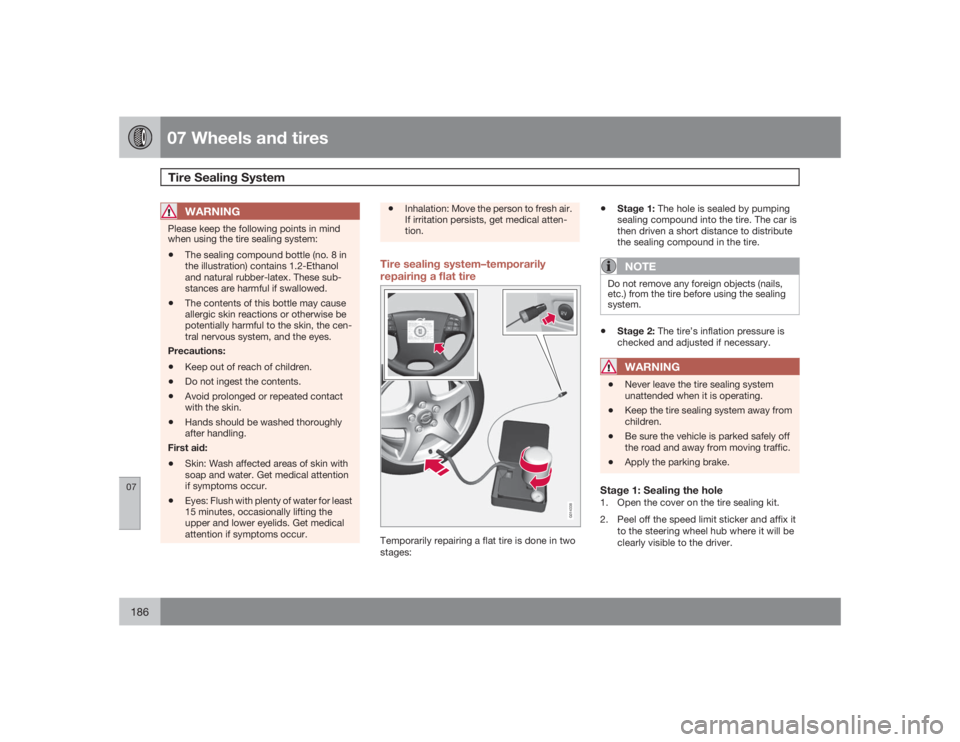
Tire sealing system–temporarily
repairing a flat tire
G014338
Temporarily repairing a flat tire is done in two
stages:
•
Stage 1: The hole is sealed by pumping
sealing compound into the tire. The car is
then driven a short distance to distribute
the sealing compound in the tire.NOTE
Do not remove any foreign objects (nails,
etc.) from the tire before using the sealing
system.•
Stage 2: The tire’s inflation pressure is
checked and adjusted if necessary.WARNING
•
Never leave the tire sealing system
unattended when it is operating.
•
Keep the tire sealing system away from
children.
•
Be sure the vehicle is parked safely off
the road and away from moving traffic.
•
Apply the parking brake.
Stage 1: Sealing the hole1. Open the cover on the tire sealing kit.
2. Peel off the speed limit sticker and affix it
to the steering wheel hub where it will be
clearly visible to the driver.
Page 188 of 282
07 Wheels and tiresTire Sealing System
07188
CAUTION
The compressor should not be used for
more than 10 minutes at a time to avoid
overheating.
WARNING
If the pressure remains below 22 psi (1.8
bar) after approximately seven minutes, turn
off the compressor. In this case, the hole is
too large to be sealed and the vehicle should
not be driven.12. Switch off the compressor and disconnect
the electrical wire from the 12-volt socket.
13. Unscrew the hose from the tire’s inflation
valve and reinstall the valve cap.
14. Immediately drive the vehicle for approxi-
mately 2 miles (3 km) at a maximum speed
of 50 mph (80 km/h) to distribute the seal-
ing compound in the tire.
NOTE
•
Safely stow the tire sealing system in a
convenient place as it will soon be used
again to check the tire’s inflation pres-
sure.
•
The empty bottle of sealing compound
cannot be removed from the bottle
holder. Consult a trained and qualified
Volvo service technician to have the
bottle removed and properly disposed
of.WARNING
If heavy vibrations, unsteady steering
behavior, or noises should occur while driv-
ing, reduce speed and park the vehicle in a
safe place. Recheck the tire for bumps,
cracks, or other visible damage, and
recheck its inflation pressure. If the pressure
is below 19 psi (1.3 bar), do not continue
driving. Have the vehicle towed to a trained
and qualified Volvo service technician.Stage 2: Checking inflation pressure1. Connect the tire sealing system as descri-
bed in stage 1.
2. Refer to the inflation pressure tablesfor the
correct inflation pressure. If the tire needs
to be inflated, start the tire sealing system’s
compressor. If necessary, release air fromthe tire by turning the air release knob
counterclockwise.
CAUTION
The compressor should not be used for
more than 10 minutes at a time to avoid
overheating.
WARNING
If you interrupt your trip for more than 1
hour, check the inflation pressure in the
damaged tire again before continuing.Replacing the sealing compound
containerThe sealing compound container must be
replaced if:•
the tire sealing system has been used to
repair a tire
•
the container’s expiration date has passed
(see the date on decal).
Page 206 of 282
09 Maintenance and servicingWorking on your vehicle
09206
Belt checkCheck the belt regularly to make sure it is in
good condition and is clean. A worn or dirty belt
can cause poor cooling and low alternator out-
put as well as impair the operation of the power
steering and the air conditioning unit.
NOTE
The drive belt is equipped with a self-ten-
sioning mechanism and requires no adjust-
ment between changes.
WARNING
The engine must not be running when this
check is performed.Check coolant levelThe cooling system must be filled with coolant
and not leak to operate at maximum efficiency.
Check the coolant level regularly. The level
should be between the MAX and MIN marks
on the expansion tank. The check should be
made with particular thoroughness when the
engine is new or when the cooling system has
been drained.
Do not remove the filler cap other than for top-
ping up with coolant. Frequent removal may
prevent coolant circulation between the engineand the expansion tank during engine warm up
and cooling.
Changing coolantNormally, the coolant does not need to be
changed. If the system must be drained, con-
sult a trained and qualified Volvo service tech-
nician.
Do not top off with water only. This reduces the
rust-protective and antifreeze qualities of the
coolant and has a lower boiling point. It can
also cause damage to the cooling system if it
should freeze. Top off with Volvo Genuine
Coolant/Antifreeze only (a 50/50 mix of water
and antifreeze.
CAUTION
The cooling system must always be kept
filled to the correct level. If it is not kept filled,
there can be high local temperatures in the
engine which could result in damage. Dif-
ferent types of antifreeze/coolant may not
be mixed.
WARNING
Never remove the radiator cap while the
engine is warm. Wait until the vehicle cools.
Page 207 of 282
09 Maintenance and servicing
Engine compartment
09
207
G027074
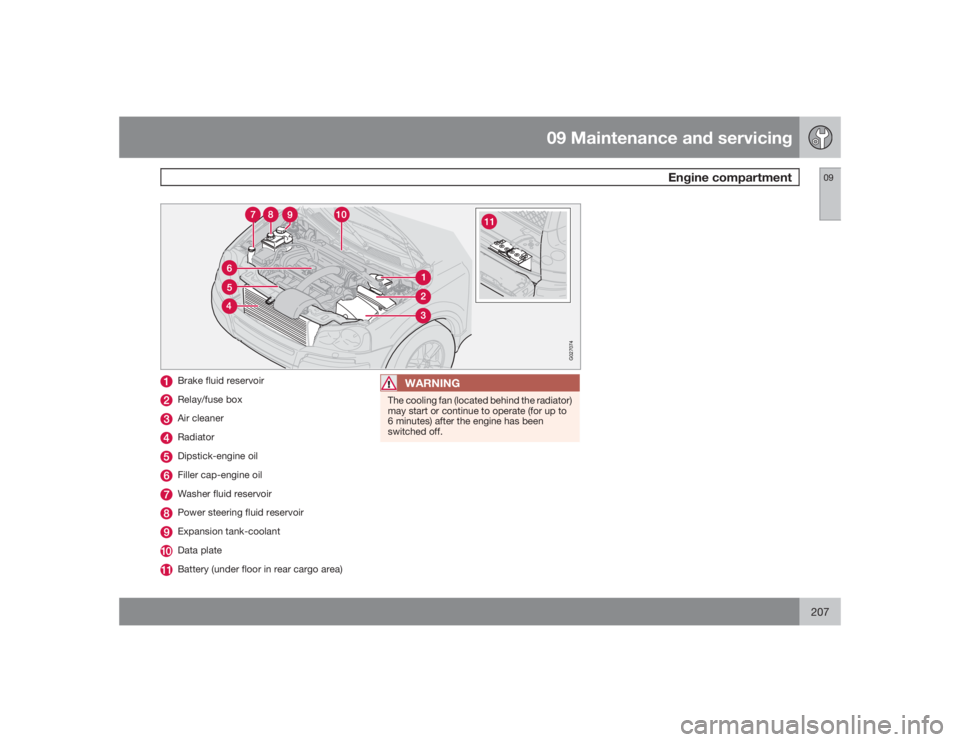
Brake fluid reservoirRelay/fuse boxAir cleanerRadiatorDipstick-engine oilFiller cap-engine oilWasher fluid reservoirPower steering fluid reservoirExpansion tank-coolantData plateBattery (under floor in rear cargo area)
WARNING
The cooling fan (located behind the radiator)
may start or continue to operate (for up to
6 minutes) after the engine has been
switched off.
Page 212 of 282
09 Maintenance and servicingFluids
09212
WARNING
•
Never remove the radiator cap while the
engine is warm. Wait until the vehicle
cools.
•
If it is necessary to top up the coolant
when the engine is warm, unscrew the
expansion tank cap slowly so that the
overpressure dissipates.
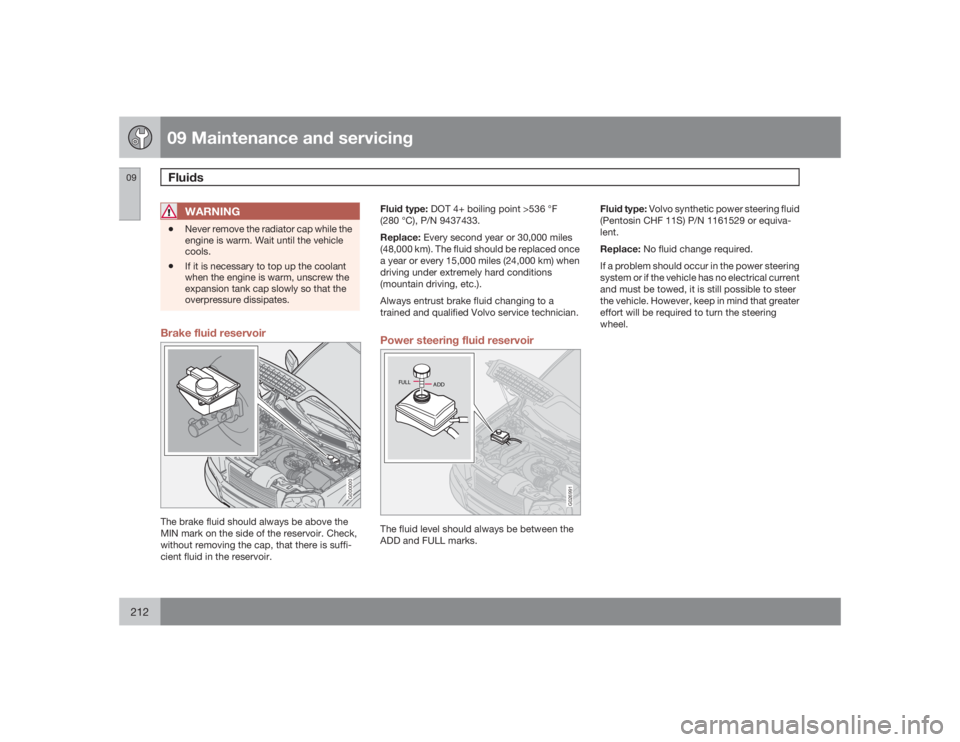
Brake fluid reservoir
G000000
The brake fluid should always be above the
MIN mark on the side of the reservoir. Check,
without removing the cap, that there is suffi-
cient fluid in the reservoir.Fluid type: DOT 4+ boiling point >536 °F
(280 °C), P/N 9437433.
Replace: Every second year or 30,000 miles
(48,000 km). The fluid should be replaced once
a year or every 15,000 miles (24,000 km) when
driving under extremely hard conditions
(mountain driving, etc.).
Always entrust brake fluid changing to a
trained and qualified Volvo service technician.
Power steering fluid reservoir
FULL
ADD
G026991
The fluid level should always be between the
ADD and FULL marks.Fluid type: Volvo synthetic power steering fluid
(Pentosin CHF 11S) P/N 1161529 or equiva-
lent.
Replace: No fluid change required.
If a problem should occur in the power steering
system or if the vehicle has no electrical current
and must be towed, it is still possible to steer
the vehicle. However, keep in mind that greater
effort will be required to turn the steering
wheel.
Page 227 of 282
09 Maintenance and servicing
Fuses
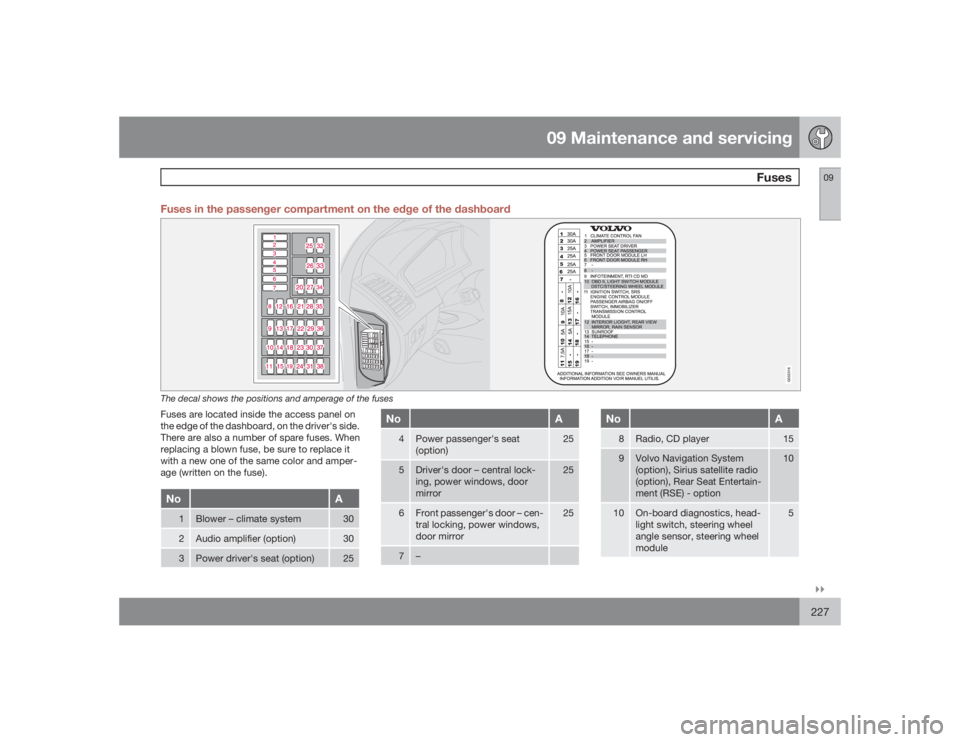
09``227 Fuses in the passenger compartment on the edge of the dashboard
G032316
The decal shows the positions and amperage of the fusesFuses are located inside the access panel on
the edge of the dashboard, on the driver's side.
There are also a number of spare fuses. When
replacing a blown fuse, be sure to replace it
with a new one of the same color and amper-
age (written on the fuse).No
A
1
Blower – climate system
30
2
Audio amplifier (option)
30
3
Power driver's seat (option)
25
No
A
4
Power passenger's seat
(option)
25
5
Driver's door – central lock-
ing, power windows, door
mirror
25
6
Front passenger's door – cen-
tral locking, power windows,
door mirror
25
7
–
No
A
8
Radio, CD player
15
9
Volvo Navigation System
(option), Sirius satellite radio
(option), Rear Seat Entertain-
ment (RSE) - option
10
10
On-board diagnostics, head-
light switch, steering wheel
angle sensor, steering wheel
module
5
Page 229 of 282
09 Maintenance and servicing
Fuses
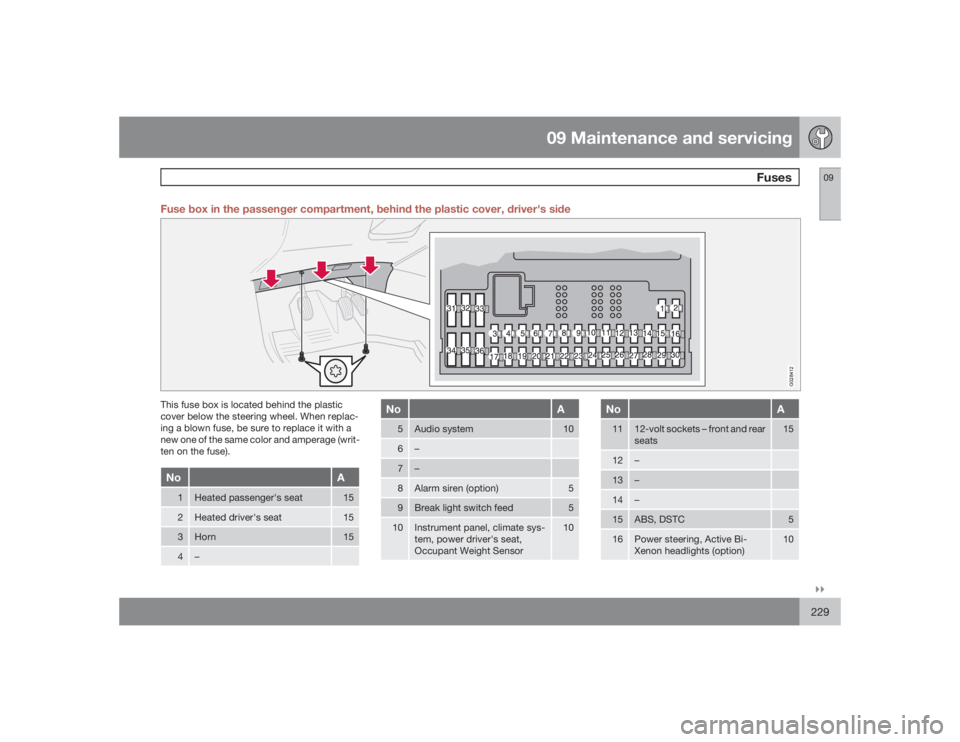
09``229 Fuse box in the passenger compartment, behind the plastic cover, driver's side
G028412
This fuse box is located behind the plastic
cover below the steering wheel. When replac-
ing a blown fuse, be sure to replace it with a
new one of the same color and amperage (writ-
ten on the fuse).No
A
1
Heated passenger's seat
15
2
Heated driver's seat
15
3
Horn
15
4
–
No
A
5
Audio system
10
6
–
7
–
8
Alarm siren (option)
5
9
Break light switch feed
5
10
Instrument panel, climate sys-
tem, power driver's seat,
Occupant Weight Sensor
10
No
A
11
12-volt sockets – front and rear
seats
15
12
–
13
–
14
–
15
ABS, DSTC
5
16
Power steering, Active Bi-
Xenon headlights (option)
10
Page 237 of 282
10 Audio
Audio system controls
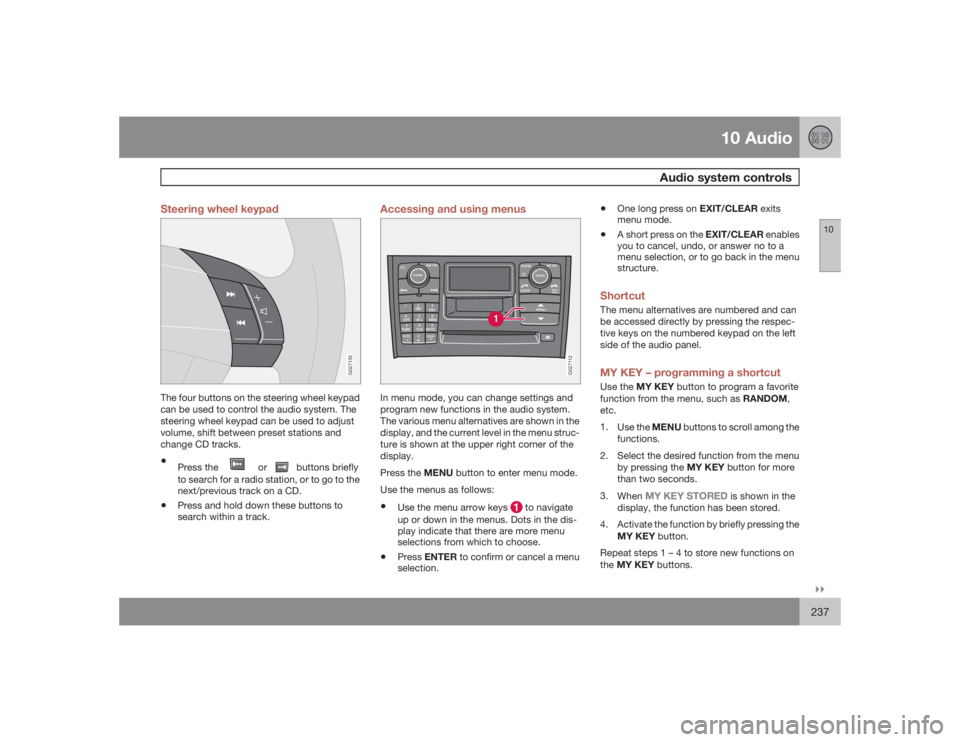
10``237 Steering wheel keypad
G027135
The four buttons on the steering wheel keypad
can be used to control the audio system. The
steering wheel keypad can be used to adjust
volume, shift between preset stations and
change CD tracks.•
Press the
or
buttons briefly
to search for a radio station, or to go to the
next/previous track on a CD.
•
Press and hold down these buttons to
search within a track.
Accessing and using menus
G027112
In menu mode, you can change settings and
program new functions in the audio system.
The various menu alternatives are shown in the
display, and the current level in the menu struc-
ture is shown at the upper right corner of the
display.
Press the MENU button to enter menu mode.
Use the menus as follows:•
Use the menu arrow keys
to navigate
up or down in the menus. Dots in the dis-
play indicate that there are more menu
selections from which to choose.
•
PressENTER to confirm or cancel a menu
selection.
•
One long press on EXIT/CLEAR exits
menu mode.
•
A short press on the EXIT/CLEAR enables
you to cancel, undo, or answer no to a
menu selection, or to go back in the menu
structure.
ShortcutThe menu alternatives are numbered and can
be accessed directly by pressing the respec-
tive keys on the numbered keypad on the left
side of the audio panel.MY KEY – programming a shortcutUse the MY KEY button to program a favorite
function from the menu, such as RANDOM,
etc.
1.
Use the MENU buttons to scroll among the
functions.
2. Select the desired function from the menu
by pressing the MY KEY button for more
than two seconds.
3.
When
MY KEY STORED
is shown in the
display, the function has been stored.
4. Activate the function by briefly pressing the
MY KEY button.
Repeat steps 1 – 4 to store new functions on
theMY KEY buttons.
Page 239 of 282
10 Audio
Audio system controls
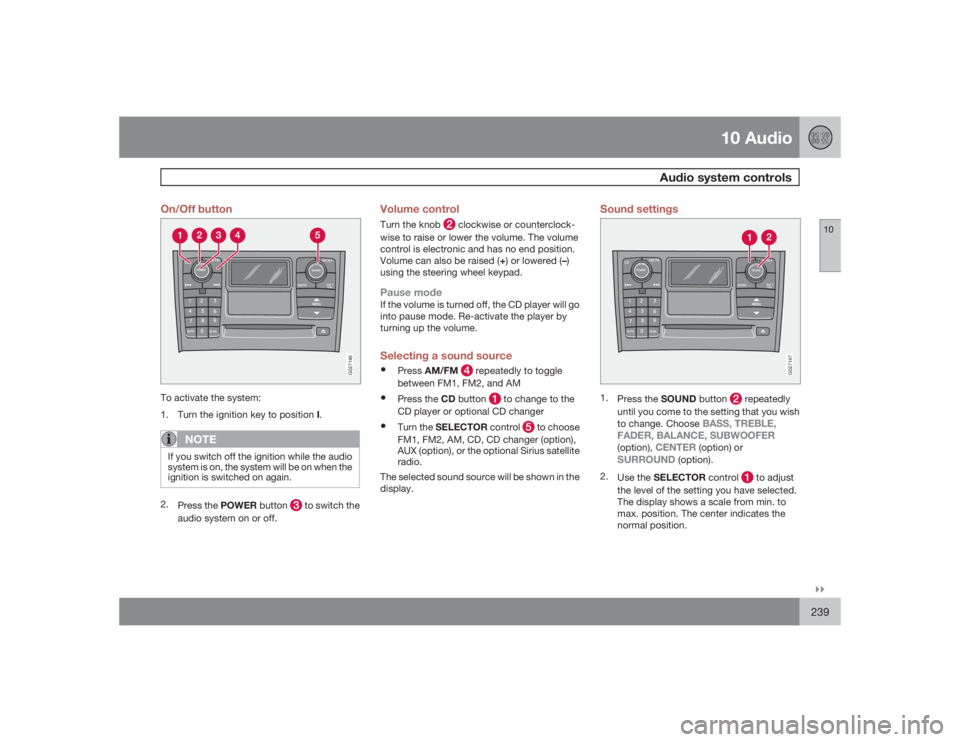
10``239 On/Off button
G027146
To activate the system:
1.
Turn the ignition key to position I.
NOTE
If you switch off the ignition while the audio
system is on, the system will be on when the
ignition is switched on again.2.
Press the POWER button
to switch the
audio system on or off.
Volume controlTurn the knob
clockwise or counterclock-
wise to raise or lower the volume. The volume
control is electronic and has no end position.
Volume can also be raised (+) or lowered (–)
using the steering wheel keypad.
Pause modeIf the volume is turned off, the CD player will go
into pause mode. Re-activate the player by
turning up the volume.Selecting a sound source•
PressAM/FM
repeatedly to toggle
between FM1, FM2, and AM
•
Press the CD button
to change to the
CD player or optional CD changer
•
Turn the SELECTOR control
to choose
FM1, FM2, AM, CD, CD changer (option),
AUX (option), or the optional Sirius satellite
radio.
The selected sound source will be shown in the
display.
Sound settings
G027147
1.
Press the SOUND button
repeatedly
until you come to the setting that you wish
to change. Choose
BASS, TREBLE,
FADER, BALANCE, SUBWOOFER
(option),
CENTER
(option) or
SURROUND
(option).
2.
Use the SELECTOR control
to adjust
the level of the setting you have selected.
The display shows a scale from min. to
max. position. The center indicates the
normal position.
Page 248 of 282
10 AudioAuxiliary equipment
10248
G027029
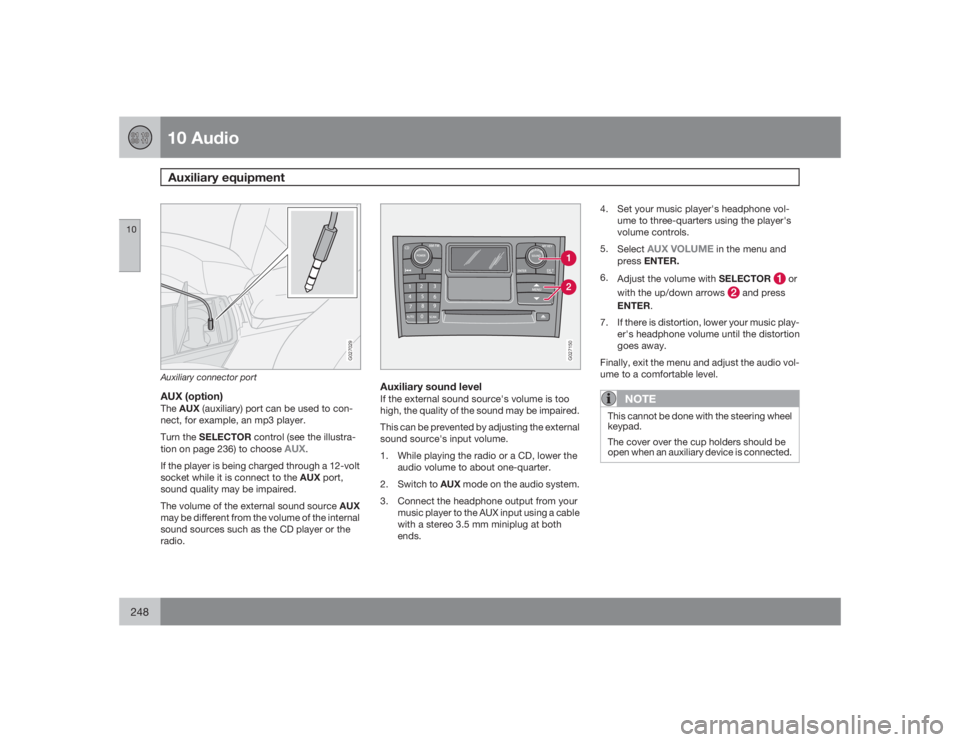
Auxiliary connector portAUX (option)TheAUX(auxiliary) port can be used to con-
nect, for example, an mp3 player.
Turn the SELECTOR control (see the illustra-
tion on page 236) to choose
AUX
.
If the player is being charged through a 12-volt
socket while it is connect to the AUX port,
sound quality may be impaired.
The volume of the external sound source AUX
may be different from the volume of the internal
sound sources such as the CD player or the
radio.
G027150
Auxiliary sound levelIf the external sound source's volume is too
high, the quality of the sound may be impaired.
This can be prevented by adjusting the external
sound source's input volume.
1. While playing the radio or a CD, lower the
audio volume to about one-quarter.
2.
Switch to AUX mode on the audio system.
3. Connect the headphone output from your
music player to the AUX input using a cable
with a stereo 3.5 mm miniplug at both
ends.4. Set your music player's headphone vol-
ume to three-quarters using the player's
volume controls.
5.
Select
AUX VOLUME
in the menu and
pressENTER.
6.
Adjust the volume with SELECTOR
or
with the up/down arrows
and press
ENTER.
7. If there is distortion, lower your music play-
er's headphone volume until the distortion
goes away.
Finally, exit the menu and adjust the audio vol-
ume to a comfortable level.
NOTE
This cannot be done with the steering wheel
keypad.
The cover over the cup holders should be
open when an auxiliary device is connected.