lock VOLVO XC90 2009 Owner´s Manual
[x] Cancel search | Manufacturer: VOLVO, Model Year: 2009, Model line: XC90, Model: VOLVO XC90 2009Pages: 282, PDF Size: 8.76 MB
Page 157 of 282
06 Starting and driving
Cold weather precautions
06
157
If you wish to check your vehicle before the
approach of cold weather, the following advice
is worth noting:•
Make sure that the engine coolant contains
50 percent antifreeze. Any other mixture
will reduce freeze protection. This gives
protection against freezing down to –31 °F
(–35 °C). See section "Coolant".
•
The use of "recycled" antifreeze is not
approved by Volvo. Different types of
antifreeze must not be mixed.
•
Volvo recommends using only genuine
Volvo antifreeze in your vehicle's radiator.
Your Volvo retailer stocks plenty of Volvo
engine coolant to protect your vehicle dur-
ing cold weather.
•
Try to keep the fuel tank well filled – this
prevents the formation of condensation in
the tank. In addition, in extremely cold
weather conditions it is worthwhile to add
fuel line de-icer before refueling.
•
The viscosity of the engine oil is important.
Oil with low viscosity (thinner oil) improves
cold-weather starting as well as decreas-
ing fuel consumption while the engine is
warming up. For winter use, 5W-30 oil, par-
ticularly the synthetic type
1, is recom-
mended. Be sure to use good quality oil but
do not use cold-weather oil for hard drivingor in warm weather. See section "Engine
oil" for more information.
•
The load placed on the battery is greater
during the winter since the windshield wip-
ers, lighting, etc. are used more often.
Moreover, the capacity of the battery
decreases as the temperature drops. In
very cold weather, a poorly charged bat-
tery can freeze and be damaged. It is there-
fore advisable to check the state of charge
more frequently and spray an antirust oil on
the battery posts.
•
Volvo recommends the use of snow tires
on all four wheels for winter driving – see
section "Wheels and tires."
•
To prevent the washer fluid reservoir
from freezing, add washer solvents con-
taining antifreeze (see page 211 for the
location of the washer fluid reservoir). This
is important since dirt is often splashed on
the windshield during winter driving,
requiring the frequent use of the washers
and wipers. Volvo Washer Solvent should
be diluted as follows:
•
Down to 14 ° F (–10 ° C): 1 part washer
solvent and 4 parts water
•
Down to 5 ° F (–15 ° C): 1 part washer sol-
vent and 3 parts water
•
Down to 0 ° F (–18 ° C):1 part washer sol-
vent and 2 parts water
•
Down to –18 ° F (–28 ° C): 1 part washer
solvent and 1 part water
•
Use Volvo Teflon Lock Spray in the locks.NOTE
Avoid the use of de-icing sprays as they can
cause damage to the locks.W – Winter/Wet driving mode – enhanced
vehicle traction•
Mode W will only function if the gear selec-
tor is in the (D)rive position.
•
Press the button at the base of the gear
selector to engage/disengage this driving
mode.
•
An LED in the button will light up to indicate
that W is engaged and this will also be dis-
played in the instrument panel (see
page 54).
•
This mode may be selected for starting/
moving off on slippery roads.
1Synthetic oil is not used when the oil is changed at the normal maintenance service intervals except at owner request and at additional charge. Please consult your Volvo retailer.
Page 162 of 282
06 Starting and drivingBlind Spot Information System
06162
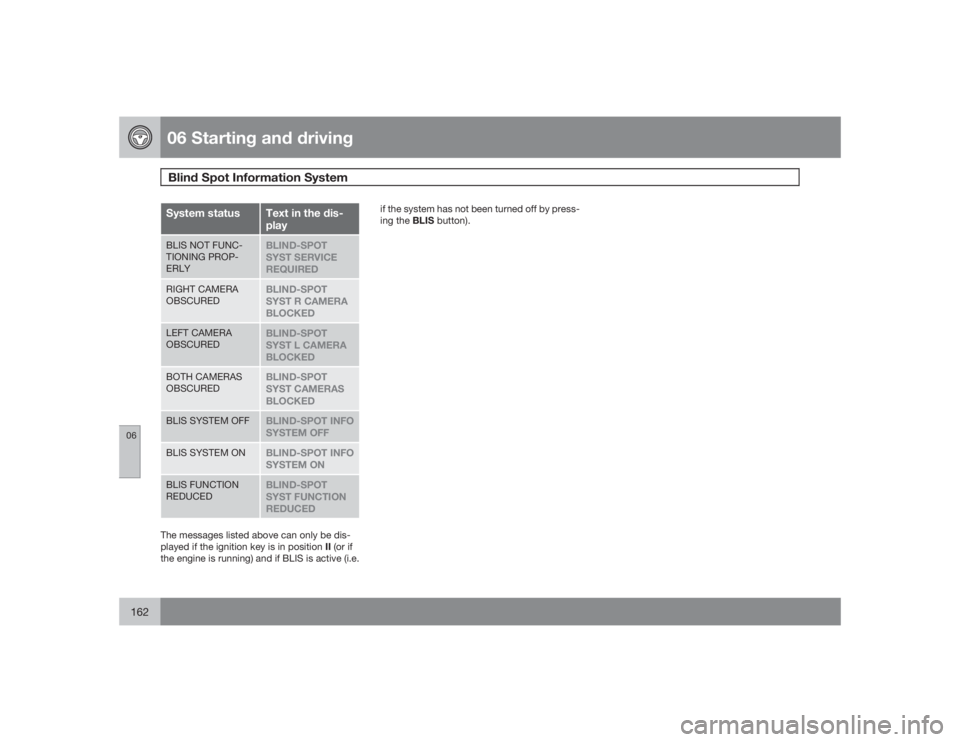
System status
Text in the dis-
play
BLIS NOT FUNC-
TIONING PROP-
ERLY
BLIND-SPOT
SYST SERVICE
REQUIRED
RIGHT CAMERA
OBSCURED
BLIND-SPOT
SYST R CAMERA
BLOCKED
LEFT CAMERA
OBSCURED
BLIND-SPOT
SYST L CAMERA
BLOCKED
BOTH CAMERAS
OBSCURED
BLIND-SPOT
SYST CAMERAS
BLOCKED
BLIS SYSTEM OFF
BLIND-SPOT INFO
SYSTEM OFF
BLIS SYSTEM ON
BLIND-SPOT INFO
SYSTEM ON
BLIS FUNCTION
REDUCED
BLIND-SPOT
SYST FUNCTION
REDUCED
The messages listed above can only be dis-
played if the ignition key is in position II (or if
the engine is running) and if BLIS is active (i.e.if the system has not been turned off by press-
ing the BLIS button).
Page 177 of 282
07 Wheels and tires
Snow chains, snow tires, studded tires
07
177 Snow chains
Snow chains can be used on your Volvo with
the following restrictions:•
Snow chains should be installed on front
wheels only. Use only Volvo approved
snow chains.
•
If accessory, aftermarket or "custom" tires
and wheels are installed and are of a size
different than the original tires and wheels,
chains in some cases CANNOT be used.
Sufficient clearances between chains and
brakes, suspension and body components
must be maintained.
•
Some strap-on type chains will interfere
with brake components and therefore
CANNOT be used.
•
All Wheel Drive models: Snow chains
should only be installed on the front
wheels. Only chains adapted for AWD
models should be used.
Consult your Volvo retailer for additional snow
chain information.
CAUTION
•
Check local regulations regarding the
use of snow chains before installing.
•
Always follow the chain manufacturer's
installation instructions carefully. Install
chains as tightly as possible and
retighten periodically.
•
Never exceed the chain manufacturer's
specified maximum speed limit. (Under
no circumstances should you exceed
31 mph (50 km/h)).
•
Avoid bumps, holes or sharp turns
when driving with snow chains.
•
The handling of the vehicle can be
adversely affected when driving with
chains. Avoid fast or sharp turns as well
as locked wheel braking.
Snow tires, studded tires
1
Tires for winter use:•
Owners who live in or regularly commute
through areas with sustained periods of
snow or icy driving conditions are strongly
advised to fit suitable winter tires to help
retain the highest degree of traction.
•
It is important to install winter tires on all
four wheels to help retain traction duringcornering, braking, and accelerating. Fail-
ure to do so could reduce traction to an
unsafe level or adversely affect handling.
•
Do not mix tires of different design as this
could also negatively affect overall tire road
grip.
•
Winter tires wear more quickly on dry roads
in warm weather. They should be removed
when the winter driving season has ended.
•
Studded tires should be run-in
300-600 miles (500-1000 km) during which
the vehicle should be driven as smoothly
as possible to give the studs the opportu-
nity to seat properly in the tires. The tires
should have the same rotational direction
throughout their entire lifetime.NOTE
Please consult state or provincial regula-
tions restricting the use of studded winter
tires before installing such tires.
1Where permitted
Page 181 of 282
07 Wheels and tires
Changing wheels
07``181
If the vehicle is equipped with the optional gro-
cery bag holder: Fold up the rear section of the
cargo area floor, disconnect the grocery bag
holder's retaining cords and fold up the lower
section of the floor.
CAUTION
Seven-seat models: Do not store objects
in the area for the rear seat cushions (when
the backrests are to be folded down). This
could damage the cushions.Lowering the spare wheelThe spare wheel is located under the floor of
the rear cargo compartment. It can be lowered
using the crank (see previous page for loca-
tion).
WARNING
When raising or lowering the spare wheel,
please keep in mind that components in the
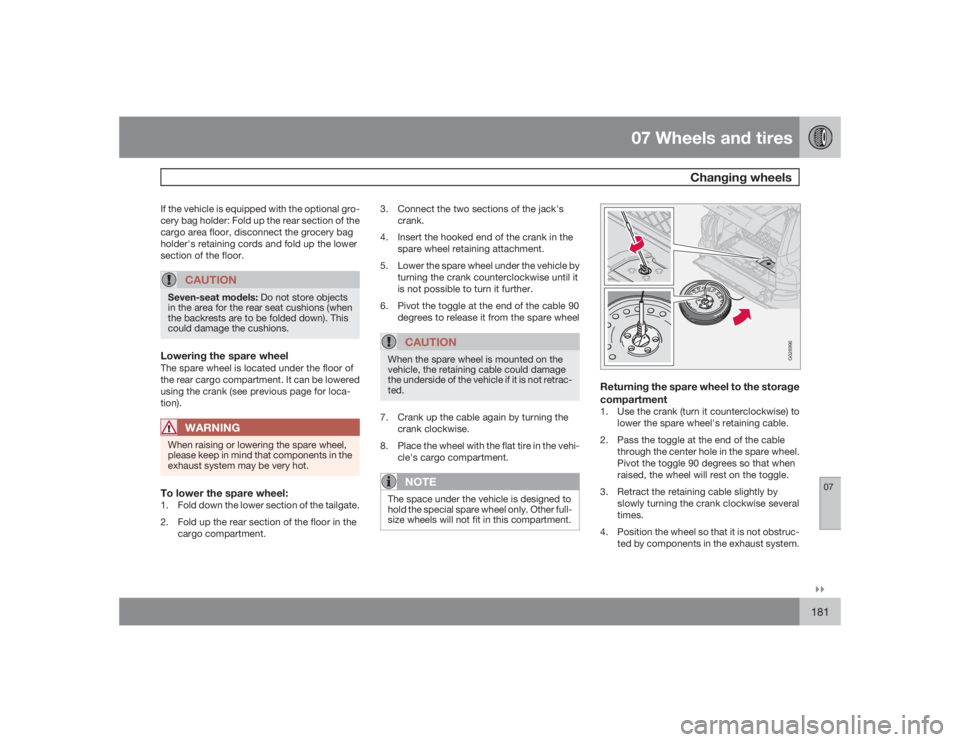
exhaust system may be very hot.To lower the spare wheel:1. Fold down the lower section of the tailgate.
2. Fold up the rear section of the floor in the
cargo compartment.3. Connect the two sections of the jack's
crank.
4. Insert the hooked end of the crank in the
spare wheel retaining attachment.
5. Lower the spare wheel under the vehicle by
turning the crank counterclockwise until it
is not possible to turn it further.
6. Pivot the toggle at the end of the cable 90
degrees to release it from the spare wheel
CAUTION
When the spare wheel is mounted on the
vehicle, the retaining cable could damage
the underside of the vehicle if it is not retrac-
ted.7. Crank up the cable again by turning the
crank clockwise.
8. Place the wheel with the flat tire in the vehi-
cle's cargo compartment.
NOTE
The space under the vehicle is designed to
hold the special spare wheel only. Other full-
size wheels will not fit in this compartment.
G026996
Returning the spare wheel to the storage
compartment1. Use the crank (turn it counterclockwise) to
lower the spare wheel's retaining cable.
2. Pass the toggle at the end of the cable
through the center hole in the spare wheel.
Pivot the toggle 90 degrees so that when
raised, the wheel will rest on the toggle.
3. Retract the retaining cable slightly by
slowly turning the crank clockwise several
times.
4. Position the wheel so that it is not obstruc-
ted by components in the exhaust system.
Page 182 of 282
07 Wheels and tiresChanging wheels
07182
5. Continue to raise the wheel by turning the
crank clockwise. Raise the wheel a little bit
at a time and guide it around the rear axle
until it is securely seated in the storage
area.
6. When it is no longer possible to turn the
crank any further, check that the spare
wheel is securely in position in the storage
compartment.
G026997
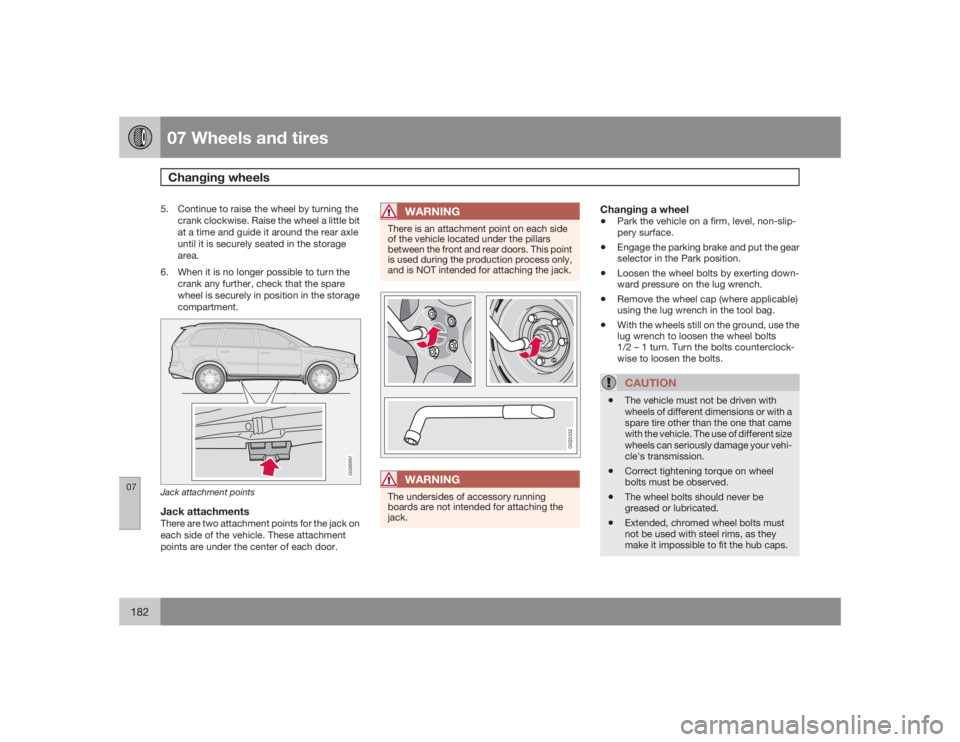
Jack attachment pointsJack attachmentsThere are two attachment points for the jack on
each side of the vehicle. These attachment
points are under the center of each door.
WARNING
There is an attachment point on each side
of the vehicle located under the pillars
between the front and rear doors. This point
is used during the production process only,
and is NOT intended for attaching the jack.
G020332
WARNING
The undersides of accessory running
boards are not intended for attaching the
jack.
Changing a wheel•
Park the vehicle on a firm, level, non-slip-
pery surface.
•
Engage the parking brake and put the gear
selector in the Park position.
•
Loosen the wheel bolts by exerting down-
ward pressure on the lug wrench.
•
Remove the wheel cap (where applicable)
using the lug wrench in the tool bag.
•
With the wheels still on the ground, use the
lug wrench to loosen the wheel bolts
1/2 – 1 turn. Turn the bolts counterclock-
wise to loosen the bolts.CAUTION
•
The vehicle must not be driven with
wheels of different dimensions or with a
spare tire other than the one that came
with the vehicle. The use of different size
wheels can seriously damage your vehi-
cle's transmission.
•
Correct tightening torque on wheel
bolts must be observed.
•
The wheel bolts should never be
greased or lubricated.
•
Extended, chromed wheel bolts must
not be used with steel rims, as they
make it impossible to fit the hub caps.
Page 184 of 282
07 Wheels and tiresChanging wheels
07184
WARNING
•
The jack must correctly engage the bar
in the jack attachment. The vehicle's
weight must not rest on the jack attach-
ment. See illustration "Attaching the
jack" on the previous page.
•
Be sure the jack is on a firm, level, non-
slippery surface.
•
Never allow any part of your body to be
extended under a vehicle supported by
a jack.
•
Use the jack intended for the vehicle
when replacing a wheel. For any other
job, use stands to support the side of
the vehicle being worked on.
•
Apply the parking brake and put the
gear selector in the (P)ark position.
•
Block the wheels standing on the
ground, use rigid wooden blocks or
large stones.
•
The jack should be kept well-greased
and clean, and should not be damaged.
•
No objects should be placed between
the base of jack and the ground, or
between the jack and the attachment
bar on the vehicle.
The jack and tools should be returned to their
storage spaces. The jack should be cranked
down fully so that it fits into the intended space.
Page 188 of 282
07 Wheels and tiresTire Sealing System
07188
CAUTION
The compressor should not be used for
more than 10 minutes at a time to avoid
overheating.
WARNING
If the pressure remains below 22 psi (1.8
bar) after approximately seven minutes, turn
off the compressor. In this case, the hole is
too large to be sealed and the vehicle should
not be driven.12. Switch off the compressor and disconnect
the electrical wire from the 12-volt socket.
13. Unscrew the hose from the tire’s inflation
valve and reinstall the valve cap.
14. Immediately drive the vehicle for approxi-
mately 2 miles (3 km) at a maximum speed
of 50 mph (80 km/h) to distribute the seal-
ing compound in the tire.
NOTE
•
Safely stow the tire sealing system in a
convenient place as it will soon be used
again to check the tire’s inflation pres-
sure.
•
The empty bottle of sealing compound
cannot be removed from the bottle
holder. Consult a trained and qualified
Volvo service technician to have the
bottle removed and properly disposed
of.WARNING
If heavy vibrations, unsteady steering
behavior, or noises should occur while driv-
ing, reduce speed and park the vehicle in a
safe place. Recheck the tire for bumps,
cracks, or other visible damage, and
recheck its inflation pressure. If the pressure
is below 19 psi (1.3 bar), do not continue
driving. Have the vehicle towed to a trained
and qualified Volvo service technician.Stage 2: Checking inflation pressure1. Connect the tire sealing system as descri-
bed in stage 1.
2. Refer to the inflation pressure tablesfor the
correct inflation pressure. If the tire needs
to be inflated, start the tire sealing system’s
compressor. If necessary, release air fromthe tire by turning the air release knob
counterclockwise.
CAUTION
The compressor should not be used for
more than 10 minutes at a time to avoid
overheating.
WARNING
If you interrupt your trip for more than 1
hour, check the inflation pressure in the
damaged tire again before continuing.Replacing the sealing compound
containerThe sealing compound container must be
replaced if:•
the tire sealing system has been used to
repair a tire
•
the container’s expiration date has passed
(see the date on decal).
Page 189 of 282
07 Wheels and tires
Tire Sealing System
07
189
NOTE
•
After use, the sealing compound bottle,
the hose, and certain other system
components must be replaced. Please
consult your Volvo retailer for replace-
ment parts.
•
If the sealing compound bottle’s expi-
ration date has passed, please take it to
a Volvo retailer or a recycling station
that can properly dispose of harmful
substances.
Inflating tiresThe tire sealing system can be used to inflate
the tires. To do so:
1. Park the car in a safe place.
2. The compressor should be switched off.
Ensure that the on/off switch is in position
0 (the 0 side of the switch should be
pressed down).
3. Take out the electrical wire and hose.
4. Remove the valve cap from the tire’s infla-
tion valve and screw the hose connector
onto the valve as tightly as possible by
hand.
5. Connect the electrical wire to the nearest
12-volt socket in the vehicle.6. Start the vehicle’s engine.
WARNING
•The vehicle’s engine should be running
when the tire sealing system is used to
avoid battery drain. Therefore, be sure
the vehicle is parked in a well ventilated
place, or outdoors, before using the sys-
tem.•Children should never be left unattended
in the vehicle when the engine is running.
7. Check the tire’s inflation pressure on the
gauge. Switch off the compressor briefly to
get a clear reading from the pressure
gauge.
8. Refer to the tire inflation tables for the cor-
rect inflation pressure. If the tire needs to
be inflated, start the tire sealing system’s
compressor (press the on/off switch to
position I). If necessary, release air from the
tire by turning the air release knob coun-
terclockwise.
CAUTION
The compressor should not be used for
more than 10 minutes at a time to avoid
overheating.
9. Turn off the compressor (press the on/off
switch to position 0) when the correct infla-
tion pressure has been reached.
10. Unscrew the hose from the tire’s inflation
valve and reinstall the valve cap.
11. Disconnect the electrical wire from the 12-
volt socket.
Page 194 of 282
08 Car careWashing and cleaning the vehicle
08194
Washing•
The vehicle should be washed at regular
intervals since dirt, dust, insects and tar
spots adhere to the paint and may cause
damage. It is particularly important to wash
the vehicle frequently in the wintertime to
prevent corrosion, when salt has been
used on the roads.
•
When washing the vehicle, do not expose
it to direct sunlight. Use lukewarm water to
soften the dirt before you wash with a
sponge, and plenty of water, to avoid
scratching.
•
Bird droppings: Remove from paintwork as
soon as possible. Otherwise the finish may
be permanently damaged.
•
A detergent can be used to facilitate the
softening of dirt and oil.
•
A water-soluble grease solvent may be
used in cases of sticky dirt. However, use
a wash place equipped with a drainage
separator.CAUTION
Chromed wheels: Clean chrome-plated
wheels using the same detergents used for
the body of the vehicle. Aggressive wheel
cleaning agents can permanently stain
chrome-plated wheels.
•
Dry the vehicle with a clean chamois and
remember to clean the drain holes in the
doors and rocker panels.
•
Tar spots can be removed with kerosene
or tar remover after the vehicle has been
washed.
•
A stiff-bristle brush and lukewarm soapy
water can be used to clean the wiper
blades. Frequent cleaning of the wind-
shield and wiper blades improves visibility
considerably and also helps prolong the
service life of the wiper blades.
•
Wash off the dirt from the underside (wheel
housings, fenders, etc.).
•
In areas of high industrial fallout, more fre-
quent washing is recommended.
•
After cleaning the engine, the spark plug
wells should be inspected for water and
blown dry if necessary.
Suitable detergentsSpecial vehicle washing detergents should be
used. A suitable mixture is about 2.5 fl. oz.
(8.5 cl) of detergent to 2.6 US gal. (10 liters) of
warm water. After washing with a detergent the
vehicle should be well rinsed with clean water.
CAUTION
•
When washing or steam cleaning the
engine, avoid spraying water or steam
directly on the electrical components or
toward the rear side of the engine.
•
Dirt, snow, etc., on the headlights can
reduce lighting capacity considerably.
Clean the headlights regularly, for
example when refueling.
•
During high pressure washing, the
spray mouthpiece must never be closer
to the vehicle than 13 " (30 cm). Do not
spray into the locks.
Special moonroof cautions:
•
Always close the moonroof and sun
shade before washing your vehicle.
•
Never use abrasive cleaning agents on
the moonroof.
•
Never use wax on the rubber seals
around the moonroof.
Exterior componentsVolvo recommends the use of special cleaning
products, available at your Volvo retailer, for
cleaning colored plastic, rubber, or ornamental
components such as chromed strips on the
exterior of your vehicle. The instructions for
using these products should be followed care-
Page 216 of 282
09 Maintenance and servicingBattery
09216
1. Switch off the ignition.
2.
Wait at least 5 minutes after switching
off the ignition before disconnecting the
battery so that all information in the vehi-
cle's electrical system can be stored in the
control modules.
3. Remove the retaining bracket and unscrew
the cover over the battery. Wait at least
5 minutes after switching off the ignition
before disconnecting the battery so that all
information in the vehicle's electrical sys-
tem can be stored in the control modules.
4. Disconnect the negative (ground) cable
first.
G027075
5. Disconnect the positive cable and pull the
ventilation hose from the battery.
6. Lift out the old battery and put a new bat-
tery into place.
7. Connect the positive cable first.
8. Connect the negative (ground) cable.
9. Be sure that the ventilation hose (see right
column) is securely connected to the bat-
tery and that the other end of the hose is
properly routed through the ventilation
opening in the floor of the battery compart-
ment.
G030884
Ventilation hose
10. Reinstall the cover and retaining bracket
and screw it securely in place.
NOTE
After the battery has been disconnected or
replaced, lock and unlock the vehicle with
the central locking system's remote control
to reactivate such features as the power
windows, moonroof, courtesy lighting, etc.
WARNING
•
The battery generates hydrogen gas,
which is flammable and explosive. The
battery is fitted with a ventilation hose
which vents hydrogen gas out of the
battery compartment through a ventila-
tion opening in the bottom of this com-
partment. If the battery must be
replaced, it is essential that the ventila-
tion hose is properly connected to the
battery and that it is routed through the
ventilation opening provided (see illus-
tration).
•
Be sure the ventilation hose is free of
debris.
•
Only use replacement batteries equip-
ped with a ventilation hose. Consult a
trained and qualified Volvo service tech-
nician.