tires VOLVO XC90 2010 Owner´s Manual
[x] Cancel search | Manufacturer: VOLVO, Model Year: 2010, Model line: XC90, Model: VOLVO XC90 2010Pages: 288, PDF Size: 8.35 MB
Page 6 of 288
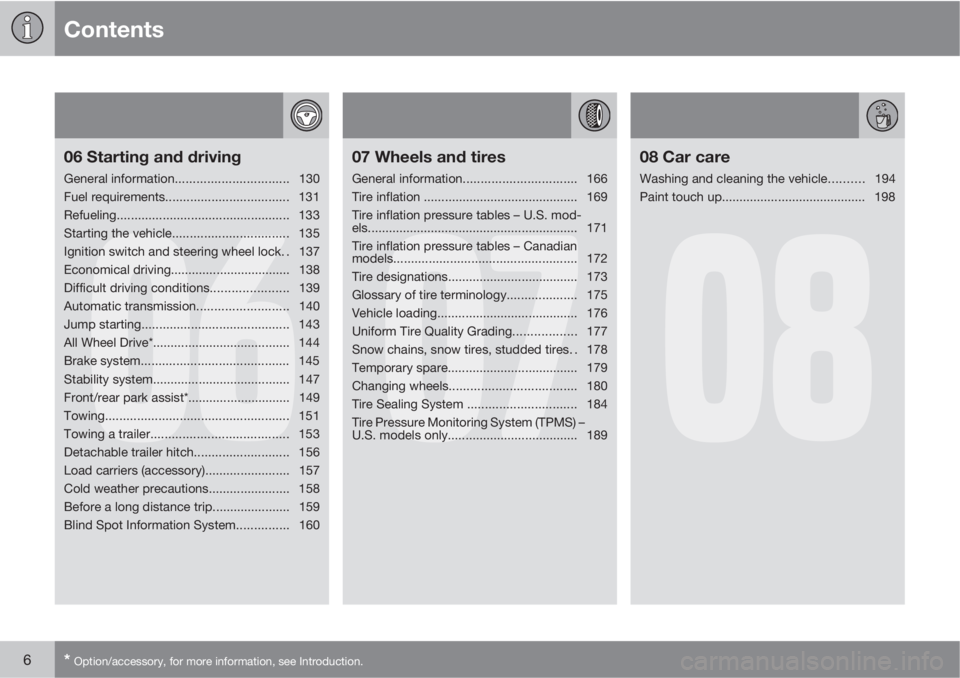
Contents
6* Option/accessory, for more information, see Introduction.
06
06 Starting and driving
General information................................130
Fuel requirements................................... 131
Refueling................................................. 133
Starting the vehicle................................. 135
Ignition switch and steering wheel lock. . 137
Economical driving.................................. 138
Difficult driving conditions...................... 139
Automatic transmission..........................140
Jump starting.......................................... 143
All Wheel Drive*....................................... 144
Brake system.......................................... 145
Stability system....................................... 147
Front/rear park assist*............................. 149
Towing.................................................... 151
Towing a trailer....................................... 153
Detachable trailer hitch........................... 156
Load carriers (accessory)........................ 157
Cold weather precautions....................... 158
Before a long distance trip...................... 159
Blind Spot Information System...............160
07
07 Wheels and tires
General information................................166
Tire inflation ............................................ 169
Tire inflation pressure tables – U.S. mod-
els............................................................ 171
Tire inflation pressure tables – Canadian
models.................................................... 172
Tire designations..................................... 173
Glossary of tire terminology.................... 175
Vehicle loading........................................ 176
Uniform Tire Quality Grading.................. 177
Snow chains, snow tires, studded tires. . 178
Temporary spare..................................... 179
Changing wheels....................................180
Tire Sealing System ............................... 184
Tire Pressure Monitoring System (TPMS) –
U.S. models only..................................... 189
08
08 Car care
Washing and cleaning the vehicle.......... 194
Paint touch up......................................... 198
Page 12 of 288
Introduction
Volvo and the environment
12
WARNING
CALIFORNIA proposition 65
Engine exhaust, some of its constituents,
and certain vehicle components contain or
emit chemicals known to the state of Cali-
fornia to cause cancer, and birth defects or
other reproductive harm. In addition, certain
fluids contained in vehicles and certain
products of component wear contain or
emit chemicals known to the State of Cali-
fornia to cause cancer, and birth defects or
other reproductive harm.
Volvo is committed to the well being of its cus-
tomers. As a natural part of this commitment,
we care about the environment in which we all
live. Caring for the environment means an
everyday involvement in reducing our environ-
mental impact. Volvo's environmental activities
are based on a holistic view, which means we
consider the overall environmental impact of a
product throughout its complete life cycle. In
this context, design, production, product use,
and recycling are all important considerations.
In production, Volvo has partly or completely
phased out several chemicals including CFCs,
lead chromates, asbestos, and cadmium; and
reduced the number of chemicals used in our
plants 50% since 1991.
Volvo was the first in the world to introduce into
production a three-way catalytic converter witha Lambda sond, now called the heated oxygen
sensor, in 1976. The current version of this
highly efficient system reduces emissions of
harmful substances (CO, HC, NOx) from the
exhaust pipe by approximately 95-99% and
the search to eliminate the remaining emis-
sions continues. Volvo is the only automobile
manufacturer to offer CFC-free retrofit kits for
the air conditioning system of all models as far
back as the 1975 model 240. Advanced elec-
tronic engine controls and cleaner fuels are
bringing us closer to our goal. After Volvo vehi-
cles and parts have fulfilled their use, recycling
is the next critical step in completing the life
cycle. The metal content is about 75% of the
total weight of a vehicle, which makes the vehi-
cle among the most recycled industrial prod-
ucts. In order to have efficient and well-con-
trolled recycling, dismantling information is
available for all Volvo models. For Volvo, all
homogeneous plastic parts weighing more
than 3.4 oz. (100 grams) are marked with inter-
national symbols that indicate how the com-
ponent is to be sorted for recycling. In addition
to continuous environmental refinement of
conventional gasoline-powered internal com-
bustion engines, Volvo is actively looking at
advanced technology alternative-fuel vehicles.
When you drive a Volvo, you become our part-
ner in the work to lessen the car's impact onthe environment. To reduce your vehicle's
environmental impact, you can:
•Maintain proper air pressure in your tires.
Tests have shown decreased fuel econ-
omy with improperly inflated tires.
•Follow the recommended maintenance
schedule in your Warranty and Service
Records Information booklet.
•Drive at a constant speed whenever pos-
sible.
•See a trained and qualified Volvo service
technician as soon as possible for inspec-
tion if the check engine (malfunction indi-
cator) light illuminates, or stays on after the
vehicle has started.
•Properly dispose of any vehicle-related
waste such as used motor oil, used batter-
ies, brake pads, etc.
•When cleaning your vehicle, please use
genuine Volvo car care products. All Volvo
car care products are formulated to be
environmentally friendly.
For additional information regarding the envi-
ronmental activities in which Volvo Cars of
North America, LLC and Volvo Car Corporation
are involved, visit our Internet home page at:
http://www.volvocars.us.
Page 72 of 288
02 Instruments and controls
Trip computer
02
72
6. Current speed in miles per hour
(Canadian models only)
This function provides the driver with an instan-
taneous conversion of the vehicle's current
speed from km/h to mph.
NOTE
Trip computer readings may vary slightly
depending on the circumference of the tires
on the vehicle and driving style.
Page 114 of 288
04 Interior
Securing cargo
04
114
G027031
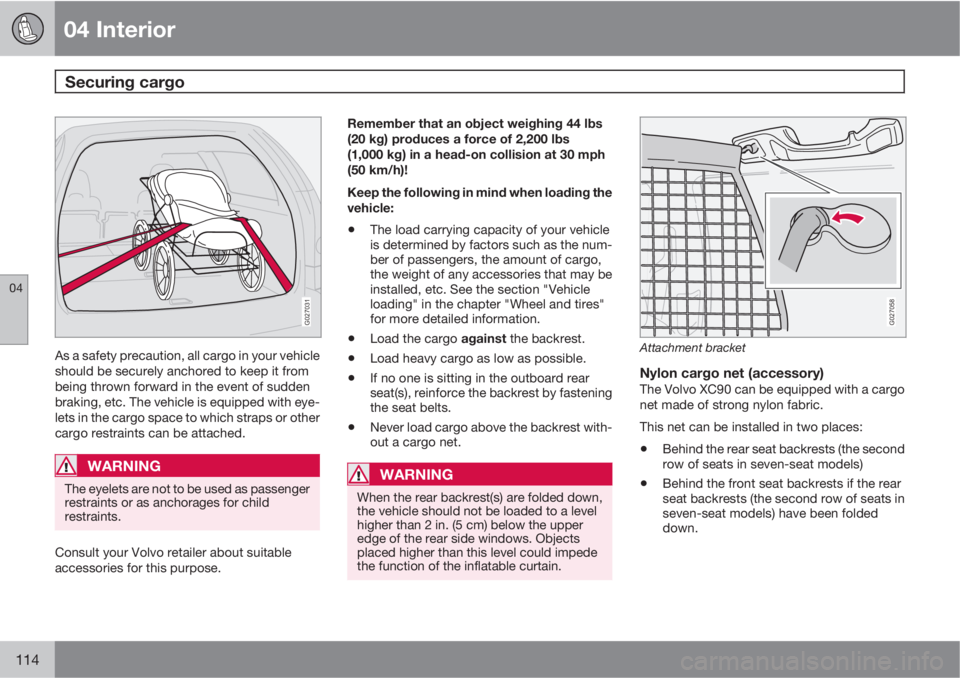
As a safety precaution, all cargo in your vehicle
should be securely anchored to keep it from
being thrown forward in the event of sudden
braking, etc. The vehicle is equipped with eye-
lets in the cargo space to which straps or other
cargo restraints can be attached.
WARNING
The eyelets are not to be used as passenger
restraints or as anchorages for child
restraints.
Consult your Volvo retailer about suitable
accessories for this purpose.Remember that an object weighing 44 lbs
(20 kg) produces a force of 2,200 lbs
(1,000 kg) in a head-on collision at 30 mph
(50 km/h)!
Keep the following in mind when loading the
vehicle:
•The load carrying capacity of your vehicle
is determined by factors such as the num-
ber of passengers, the amount of cargo,
the weight of any accessories that may be
installed, etc. See the section "Vehicle
loading" in the chapter "Wheel and tires"
for more detailed information.
•Load the cargo against the backrest.
•Load heavy cargo as low as possible.
•If no one is sitting in the outboard rear
seat(s), reinforce the backrest by fastening
the seat belts.
•Never load cargo above the backrest with-
out a cargo net.
WARNING
When the rear backrest(s) are folded down,
the vehicle should not be loaded to a level
higher than 2 in. (5 cm) below the upper
edge of the rear side windows. Objects
placed higher than this level could impede
the function of the inflatable curtain.
G027058
Attachment bracket
Nylon cargo net (accessory)The Volvo XC90 can be equipped with a cargo
net made of strong nylon fabric.
This net can be installed in two places:
•Behind the rear seat backrests (the second
row of seats in seven-seat models)
•Behind the front seat backrests if the rear
seat backrests (the second row of seats in
seven-seat models) have been folded
down.
Page 132 of 288
06 Starting and driving
Fuel requirements
06
132
WARNING
Driving with the tailgate open: Driving with
the tailgate open could lead to poisonous
exhaust gases entering the passenger com-
partment.
•If the tailgate must be kept open for any
reason, proceed as follows:
•Close the windows
•Set the ventilation system control to air
flow to floor, windshield and side win-
dows and blower control to its highest
setting.
Weight distribution affects handlingAt the specified curb weight your vehicle has a
tendency to understeer, which means that the
steering wheel has to be turned more than
might seem appropriate for the curvature of a
bend.
This ensures good stability and reduces the
risk of rear wheel skid. Remember that these
properties can alter with the vehicle load.
The heavier the load in the cargo area, the less
the tendency to understeer.
Handling, roadholdingVehicle load, tire design and inflation pressure
all affect vehicle handling. Therefore, check
that the tires are inflated to the recommendedpressure according to the vehicle load. See
"Tire pressure" section.
Loads should be distributed so that capacity
weight or maximum permissible axle loads are
not exceeded.
Conserving electrical currentKeep the following in mind to help minimize
battery drain:
•When the engine is not running, avoid turn-
ing the ignition key to position II (see
page 137). Many electrical systems (the
audio system, the optional infotainment/
navigation systems, power windows, etc)
will function with the ignition key in position
I. This position reduces drain on the bat-
tery.
•Please keep in mind that using systems,
accessories, etc that consume a great deal
of current when the engine is not running
could result in the battery being completely
drained.
NOTE
A warning message will be displayed in the
text window in the instrument panel when
the battery charge is low.
Page 138 of 288
06 Starting and driving
Economical driving
06
138
Economical driving conserves natural
resources
Better driving economy may be obtained by
thinking ahead, avoiding rapid starts and stops
and adjusting the speed of your vehicle to
immediate traffic conditions. Observe the fol-
lowing rules:
•Bring the engine to normal operating tem-
perature as soon as possible by driving
with a light foot on the accelerator pedal for
the first few minutes of operation. A cold
engine uses more fuel and is subject to
increased wear.
•Whenever possible, avoid using the vehicle
for driving short distances. This does not
allow the engine to reach normal operating
temperature.
•Drive carefully and avoid rapid acceleration
and hard braking.
•Use the transmission's D (Drive) position
as often as possible and avoid using "kick-
down" to help improve fuel economy.
•Do not exceed posted speed limits.
•Avoid carrying unnecessary items (extra
load) in the vehicle.
•Maintain correct tire pressure. Check tire
pressure regularly (when tires are cold).
•Remove snow tires when threat of snow or
ice has ended.
•Note that roof racks, ski racks, etc,
increase air resistance and also fuel con-
sumption.
•At highway driving speeds, fuel consump-
tion will be lower with the air conditioning
on and the windows closed than with the
air conditioning off and the windows open.
•Using the onboard trip computer's fuel
consumption modes can help you learn
how to drive more economically.
Other factors that decrease gas mileage
are:
•Dirty air cleaner
•Dirty engine oil and clogged oil filter
•Dragging brakes
•Incorrect front end alignment.
Some of the above mentioned items and others
are checked at the standard Maintenance
Service intervals.
CAUTION
Drive slowly and carefully if going through
standing water (i.e. flooded roadways, etc.).
Damage to the engine could result if excess
water is drawn in through the air intake sys-
tem. Never drive the vehicle in water deeper
than 18 inches (48 cm).
Page 144 of 288
06 Starting and driving
All Wheel Drive*
06
144* Option/accessory, for more information, see Introduction.
All Wheel Drive (AWD) – general
information
Your Volvo can be equipped with an electron-
ically controlled All Wheel Drive system*, which
means that power is distributed automatically
between the front and rear wheels. Under nor-
mal driving conditions, most of the engine's
power is directed to the front wheels. However,
if there is any tendency for the front wheels to
spin, an electronically controlled coupling dis-
tributes power to the wheels that have the best
traction.
Tire dimensionsVolvo recommends that you always drive on
tires of the same brand, size, construction
(radial), tread pattern, load-, speed-, traction-,
temperature-, and treadwear rating. Never
drive on mixed tires, except for brief periods
when the temporary spare tire is in use.
Always use properly inflated tires of correct
dimensions. Tire size and inflation pressures
are shown on the tire inflation pressure plac-
ards, located on the driver's side B-pillar (the
structural member at the side of the vehicle, at
the rear of the driver's door opening), or on the
inside of the fuel filler door on Canadian mod-
els.
Temporary SpareThe temporary spare tire is for temporary, low-
speed, short-distance use only. Replace it with
a full-sized tire as soon as possible. Do not
drive on the temporary spare at speeds above
50 m.p.h. (80 km/h).
NOTE
Never install snow chains on a temporary
spare.
Page 150 of 288
06 Starting and driving
Front/rear park assist*
06
150* Option/accessory, for more information, see Introduction.
NOTE
•Front park assist is disengaged auto-
matically when the parking brake is
applied.
•If the vehicle is equipped with front and
rear park assist, both systems will be
deactivated by pressing the button.
Audible signals from the park assist
system
The Park Assist system uses an intermittent
tone that pulses faster as you come close to an
object, and becomes constant when you are
within approximately 1 ft (30 cm) of an object
in front of or behind the vehicle. If the volume
of another source from the audio system is
high, this will be automatically lowered.
If there are objects within this distance both
behind and in front of the vehicle, the signal
alternates between front and rear speakers.
Faults in the system
If the yellow warning symbol illu-
minates and PARK ASSIST
SERVICE REQUIRED is shown
on the information display, this
indicates that the system is not
functioning properly and has been disengaged.
Consult a trained and qualified Volvo service
technician.
CAUTION
In certain circumstances, the park assist
system may give unexpected warning sig-
nals that can be caused by external sound
sources that use the same ultrasound fre-
quencies as the system. This may include
such things as the horns of other vehicles,
wet tires on asphalt, pneumatic brakes,
motorcycle exhaust pipes, etc. This does
not indicate a fault in the system.
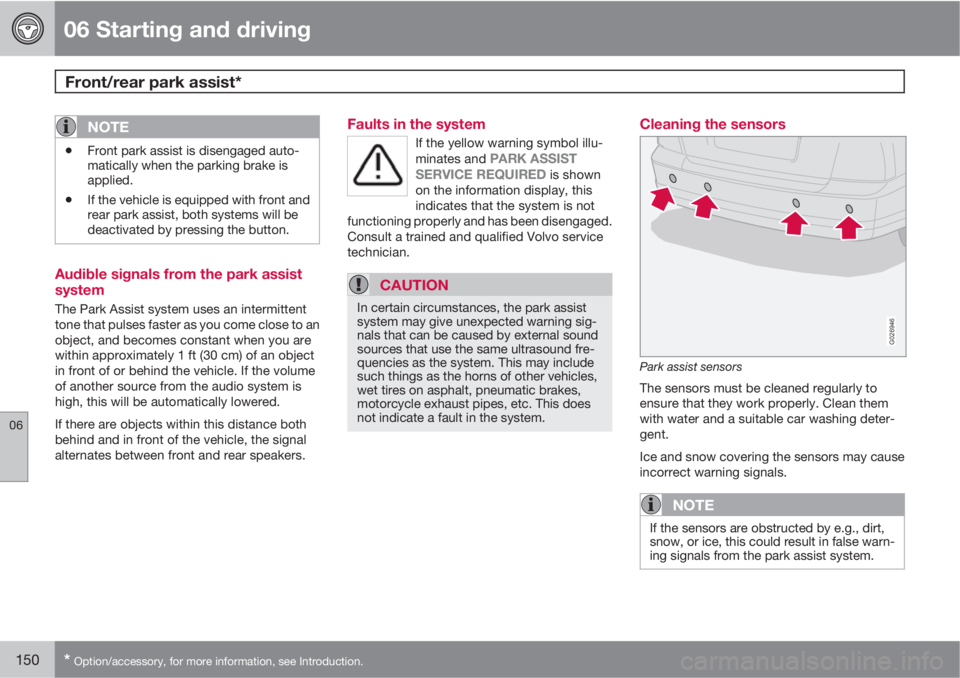
Cleaning the sensors
G026946
Park assist sensors
The sensors must be cleaned regularly to
ensure that they work properly. Clean them
with water and a suitable car washing deter-
gent.
Ice and snow covering the sensors may cause
incorrect warning signals.
NOTE
If the sensors are obstructed by e.g., dirt,
snow, or ice, this could result in false warn-
ing signals from the park assist system.
Page 154 of 288
06 Starting and driving
Towing a trailer
06
154
Points to keep in mind when towing a
trailer
•When towing trailers without brakes, the
maximum permissible trailer weight is
1,700 lbs (750 kg).
•If necessary, redistribute the weight of any
cargo in the trailer to avoid excessive
weight on the trailer hitch.
•The maximum trailer weight listed in the
table for All Wheel Drive models, 5,000 lbs
(2250 kg) is only applicable when there are
not more than two occupants in the vehi-
cle, in the front seats, with a combined
weight of 300 lbs (135 kg), with no other
cargo in the vehicle.
•The maximum weight listed for Front
Wheel Drive models, 4,000 lbs (1800 kg) is
only applicable when there are not more
than four occupants in the vehicle, in the
front seats and second row of seats, with
a combined weight of 600 lbs (270 kg), with
no other cargo in the vehicle.
•Vehicles used for towing a trailer on a reg-
ular basis, or for long-distance highway
towing should be equipped with an auto-
matic transmission oil cooler and Volvo's
automatic self-leveling system for the rear
suspension. Consult your Volvo retailer.
•Volvo recommends the use of Volvo trailer
hitches that are specially designed for the
vehicle.
•All Volvo models are equipped with
energy-absorbing shock-mounted bump-
ers. Trailer hitch installation should not
interfere with the proper operation of this
bumper system.
•Increase tire pressure to recommended full
inflation pressure. See chapter "Wheels
and tires."
•When your vehicle is new, avoid towing
heavy trailers during the first 620 miles
(1,000 km).
•Engine and transmission are subject to
increased loads. Therefore, engine coolant
temperature should be closely watched
when driving in hot climates or hilly terrain.
Use a lower gear and turn off the air con-
ditioner if the temperature gauge needle
enters the red range.
•If the automatic transmission begins to
overheat, a message will be displayed in
the text window.
•Hauling a trailer affects handling, durabil-
ity, and economy.
•It is necessary to balance trailer brakes
with the towing vehicle brakes to provide a
safe stop (check and observe state/local
regulations).
•Do not connect the trailer's brake system
directly to the vehicle's brake system.
•Remove the ball and drawbar assembly
when the hitch is not being used.
•Volvo recommends the use of synthetic
engine oil when towing a trailer over long
distances or in mountainous areas.
NOTE
•When parking the vehicle with a trailer
on a hill, apply the parking brake before
putting the gear selector in P. When
starting on a hill, put the gear selector in
D before releasing the parking brake.
Always follow the trailer manufacturer's
recommendations for wheel chocking.
•If you use the manual (Geartronic) shift
positions while towing a trailer, make
sure the gear you select does not put
too much strain on the engine (using too
high a gear).
Page 158 of 288
06 Starting and driving
Cold weather precautions
06
158
If you wish to check your vehicle before the
approach of cold weather, the following advice
is worth noting:
•Make sure that the engine coolant contains
50 percent antifreeze. Any other mixture
will reduce freeze protection. This gives
protection against freezing down to –31 °F
(–35 °C). See section "Coolant".
•The use of "recycled" antifreeze is not
approved by Volvo. Different types of
antifreeze must not be mixed.
•Volvo recommends using only genuine
Volvo antifreeze in your vehicle's radiator.
Your Volvo retailer stocks plenty of Volvo
engine coolant to protect your vehicle dur-
ing cold weather.
•Try to keep the fuel tank well filled – this
prevents the formation of condensation in
the tank. In addition, in extremely cold
weather conditions it is worthwhile to add
fuel line de-icer before refueling.
•The viscosity of the engine oil is important.
Oil with low viscosity (thinner oil) improves
cold-weather starting as well as decreas-
ing fuel consumption while the engine is
warming up. For winter use, 5W-30 oil, par-
ticularly the synthetic type
1, is recom-
mended. Be sure to use good quality oil but
do not use cold-weather oil for hard drivingor in warm weather. See section "Engine
oil" for more information.
•The load placed on the battery is greater
during the winter since the windshield wip-
ers, lighting, etc. are used more often.
Moreover, the capacity of the battery
decreases as the temperature drops. In
very cold weather, a poorly charged bat-
tery can freeze and be damaged. It is there-
fore advisable to check the state of charge
more frequently and spray an antirust oil on
the battery posts.
•Volvo recommends the use of snow tires
on all four wheels for winter driving – see
section "Wheels and tires."
•To prevent the washer fluid reservoir
from freezing, add washer solvents con-
taining antifreeze (see page 211 for the
location of the washer fluid reservoir). This
is important since dirt is often splashed on
the windshield during winter driving,
requiring the frequent use of the washers
and wipers. Volvo Washer Solvent should
be diluted as follows:
•Down to 14 ° F (–10 ° C): 1 part washer
solvent and 4 parts water
•Down to 5 ° F (–15 ° C): 1 part washer sol-
vent and 3 parts water
•Down to 0 ° F (–18 ° C):1 part washer sol-
vent and 2 parts water
•Down to –18 ° F (–28 ° C): 1 part washer
solvent and 1 part water
•Use Volvo Teflon Lock Spray in the locks.
NOTE
Avoid the use of de-icing sprays as they can
cause damage to the locks.
W – Winter/Wet driving mode – enhanced
vehicle traction
•Mode W will only function if the gear selec-
tor is in the (D)rive position.
•Press the button at the base of the gear
selector to engage/disengage this driving
mode.
•An LED in the button will light up to indicate
that W is engaged and this will also be dis-
played in the instrument panel (see
page 54).
•This mode may be selected for starting/
moving off on slippery roads.
1Synthetic oil is not used when the oil is changed at the normal maintenance service intervals except at owner request and at additional charge. Please consult your Volvo retailer.