Vehicle Identification Number VOLVO XC90 2012 Owner´s Manual
[x] Cancel search | Manufacturer: VOLVO, Model Year: 2012, Model line: XC90, Model: VOLVO XC90 2012Pages: 302, PDF Size: 8.43 MB
Page 178 of 302
07 Wheels and tires
Tire designations
07
178
1
2
3
4
5
6
12
11
10
8
79
G026442
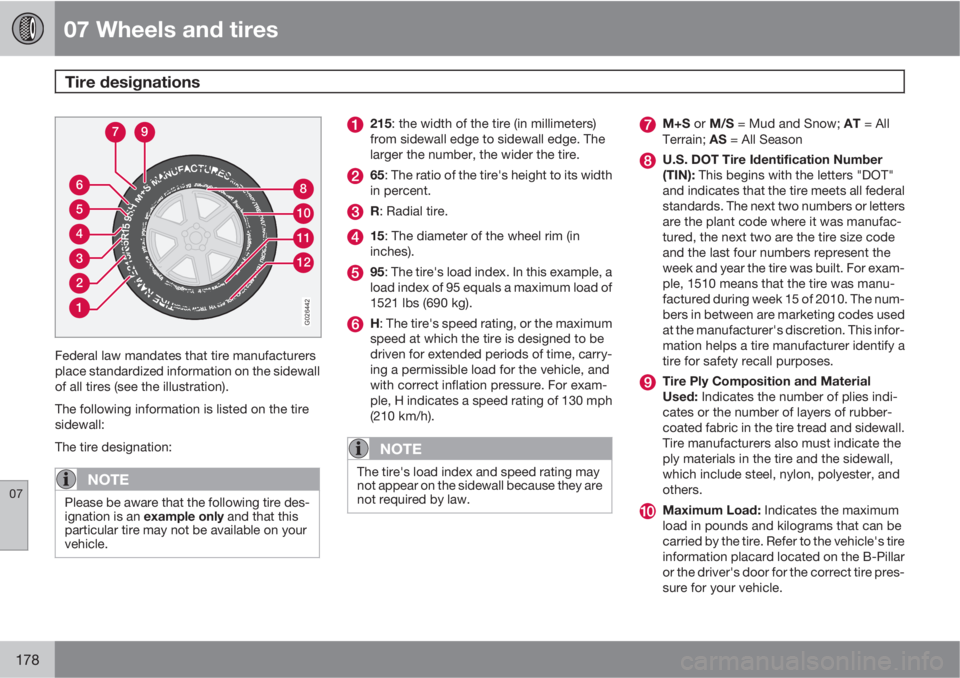
Federal law mandates that tire manufacturers
place standardized information on the sidewall
of all tires (see the illustration).
The following information is listed on the tire
sidewall:
The tire designation:
NOTE
Please be aware that the following tire des-
ignation is an example only and that this
particular tire may not be available on your
vehicle.
215: the width of the tire (in millimeters)
from sidewall edge to sidewall edge. The
larger the number, the wider the tire.
65: The ratio of the tire's height to its width
in percent.
R: Radial tire.
15: The diameter of the wheel rim (in
inches).
95: The tire's load index. In this example, a
load index of 95 equals a maximum load of
1521 lbs (690 kg).
H: The tire's speed rating, or the maximum
speed at which the tire is designed to be
driven for extended periods of time, carry-
ing a permissible load for the vehicle, and
with correct inflation pressure. For exam-
ple, H indicates a speed rating of 130 mph
(210 km/h).
NOTE
The tire's load index and speed rating may
not appear on the sidewall because they are
not required by law.
M+S or M/S = Mud and Snow; AT = All
Terrain; AS = All Season
U.S. DOT Tire Identification Number
(TIN): This begins with the letters "DOT"
and indicates that the tire meets all federal
standards. The next two numbers or letters
are the plant code where it was manufac-
tured, the next two are the tire size code
and the last four numbers represent the
week and year the tire was built. For exam-
ple, 1510 means that the tire was manu-
factured during week 15 of 2010. The num-
bers in between are marketing codes used
at the manufacturer's discretion. This infor-
mation helps a tire manufacturer identify a
tire for safety recall purposes.
Tire Ply Composition and Material
Used: Indicates the number of plies indi-
cates or the number of layers of rubber-
coated fabric in the tire tread and sidewall.
Tire manufacturers also must indicate the
ply materials in the tire and the sidewall,
which include steel, nylon, polyester, and
others.
Maximum Load: Indicates the maximum
load in pounds and kilograms that can be
carried by the tire. Refer to the vehicle's tire
information placard located on the B-Pillar
or the driver's door for the correct tire pres-
sure for your vehicle.
Page 180 of 302
07 Wheels and tires
Glossary of tire terminology
07
180
•Tire information placard: A placard
showing the OE (Original Equipment) tire
sizes, recommended inflation pressure,
and the maximum weight the vehicle can
carry.
•Tire Identification Number (TIN): A num-
ber on the sidewall of each tire providing
information about the tire brand and man-
ufacturing plant, tire size and date of man-
ufacturer.
•Inflation pressure: A measure of the
amount of air in a tire.
•Standard load: A class of P-metric or Met-
ric tires designed to carry a maximum load
at 35 psi [37 psi (2.5 bar) for Metric tires].
Increasing the inflation pressure beyond
this pressure will not increase the tires load
carrying capability.
•Extra load: A class of P-metric or Metric
tires designed to carry a heavier maximum
load at 41 psi [43 psi (2.9 bar) for Metric
tires]. Increasing the inflation pressure
beyond this pressure will not increase the
tires load carrying capability.
•kPa: Kilopascal, a metric unit of air pres-
sure.
•PSI: Pounds per square inch, a standard
unit of air pressure.
•B-pillar: The structural member at the side
of the vehicle behind the front door.
•Bead area of the tire: Area of the tire next
to the rim.
•Sidewall of the tire: Area between the
bead area and the tread.
•Tread area of the tire: Area of the perim-
eter of the tire that contacts the road when
mounted on the vehicle.
•Rim: The metal support (wheel) for a tire or
a tire and tube assembly upon which the
tire beads are seated.
•Maximum load rating: a figure indicating
the maximum load in pounds and kilo-
grams that can be carried by the tire. This
rating is established by the tire manufac-
turer.
•Maximum permissible inflation pres-
sure: the greatest amount of air pressure
that should ever be put in the tire. This limit
is set by the tire manufacturer.
•Recommended tire inflation pressure:
inflation pressure, established by Volvo,
which is based on the type of tires that are
mounted on a vehicle at the factory. This
information can be found on the tire infla-
tion placard(s) located on the driver's side
B-pillar and in the tire inflation table in this
chapter.
•Cold tires: The tires are considered to be
cold when they have the same temperature
as the surrounding (ambient) air. This tem-perature is normally reached after the vehi-
cle has been parked for at least 3 hours.
Page 279 of 302
11 Specifications
Label information
11
279
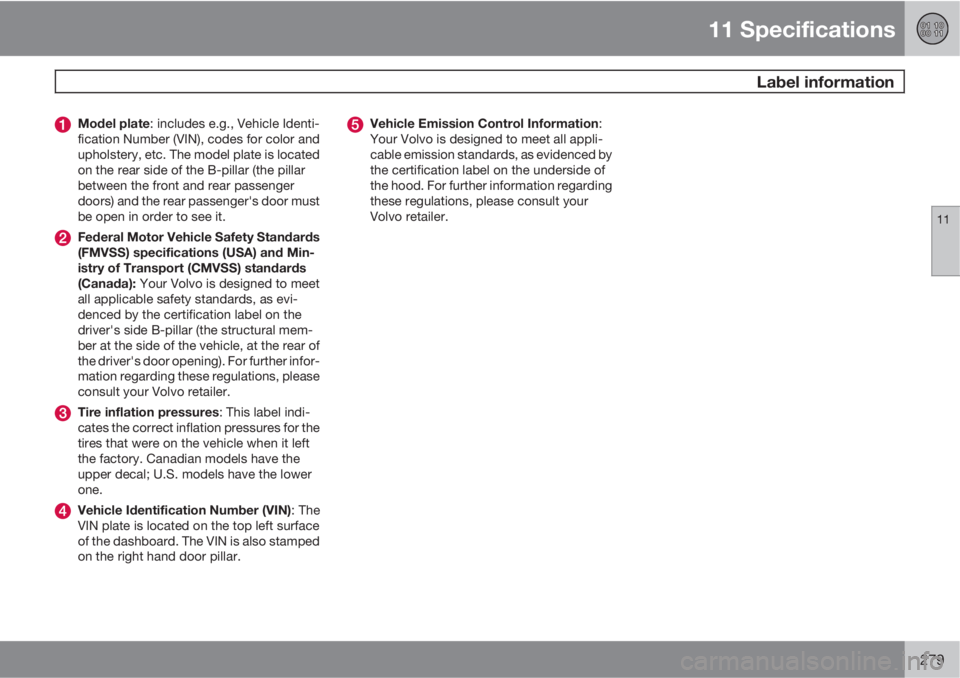
Model plate: includes e.g., Vehicle Identi-
fication Number (VIN), codes for color and
upholstery, etc. The model plate is located
on the rear side of the B-pillar (the pillar
between the front and rear passenger
doors) and the rear passenger's door must
be open in order to see it.
Federal Motor Vehicle Safety Standards
(FMVSS) specifications (USA) and Min-
istry of Transport (CMVSS) standards
(Canada): Your Volvo is designed to meet
all applicable safety standards, as evi-
denced by the certification label on the
driver's side B-pillar (the structural mem-
ber at the side of the vehicle, at the rear of
the driver's door opening). For further infor-
mation regarding these regulations, please
consult your Volvo retailer.
Tire inflation pressures: This label indi-
cates the correct inflation pressures for the
tires that were on the vehicle when it left
the factory. Canadian models have the
upper decal; U.S. models have the lower
one.
Vehicle Identification Number (VIN): The
VIN plate is located on the top left surface
of the dashboard. The VIN is also stamped
on the right hand door pillar.
Vehicle Emission Control Information:
Your Volvo is designed to meet all appli-
cable emission standards, as evidenced by
the certification label on the underside of
the hood. For further information regarding
these regulations, please consult your
Volvo retailer.
Page 299 of 302
12 Index
12
299
TIME FOR REGULAR SERVICE................. 62
Tire inflation pressure..............................177
Tire Pressure Monitoring System (TPMS) 194
Tires.........................................................172
age...................................................... 172
changing............................................. 190
changing from summer to winter........ 173
designations....................................... 178
improving economy............................ 172
inflation............................................... 175
inflation pressure, checking................ 175
inflation pressure table.......................177
load ratings......................................... 176
rotation............................................... 173
spare................................................... 184
speed ratings...................................... 176
storing................................................. 173
tire sealing system.............................. 185
tread wear indicator............................ 174
Tire sealing system.................................. 185
Towing a trailer........................................ 159
Towing - cars with All Wheel Drive.......... 158
Towing the vehicle................................... 157
Trailer hitch - detachable......................... 162
Trailer towing........................................... 159
Transmission, automatic.......................... 144Tread wear indicator................................ 174
Treble....................................................... 249
Trip computer............................................ 75
Trip odometer............................................ 58
Turn signals............................................... 70
U
Uniform Tire Quality Grading...................182
Unlocking fuel filler door............................ 68
Unlocking the car..................................... 128
Unpaved roads, driving on...................... 143
V
Vanity mirror............................................ 112
Vehicle dimensions.................................. 280
Vehicle Event Data..................................... 13
Vehicle Identification Number (VIN)......... 279
Vehicle loading........................................ 181
Vehicle maintenance................................ 208
Vehicle weights........................................ 282Ventilated seats......................................... 97
Volvo and the environment........................ 14
Volvo maintenance.................................. 208
Volvo On Call Roadside Assistance........ 293
W
Warning symbol......................................... 58
Warning symbol in center of dashboard.... 58
Warranties................................................ 208
Washer fluid reservoir......................213, 217
Washing the vehicle................................. 200
Water, driving through............................. 143
Waxing..................................................... 201
Weights.................................................... 282
Wheels.....................................................172
storing................................................. 173
Windshield
IR coating............................................. 73
Windshield washer fluid reservoir............217
Windshield wipers.................................... 219
Winter/Wet driving mode......................... 164
Wipers...................................................... 219