ESP VOLVO XC90 2013 Owner´s Manual
[x] Cancel search | Manufacturer: VOLVO, Model Year: 2013, Model line: XC90, Model: VOLVO XC90 2013Pages: 310, PDF Size: 8.62 MB
Page 132 of 310
05 Locks and alarm
Locking and unlocking
05
130
G029646
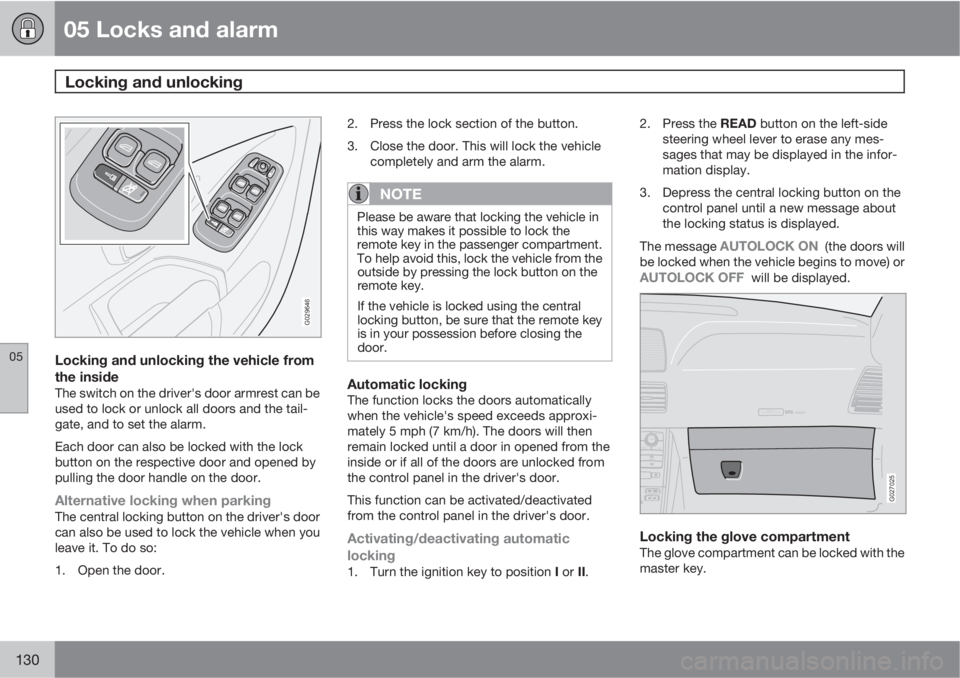
Locking and unlocking the vehicle from
the inside
The switch on the driver's door armrest can be
used to lock or unlock all doors and the tail-
gate, and to set the alarm.
Each door can also be locked with the lock
button on the respective door and opened by
pulling the door handle on the door.
Alternative locking when parkingThe central locking button on the driver's door
can also be used to lock the vehicle when you
leave it. To do so:
1. Open the door.2. Press the lock section of the button.
3. Close the door. This will lock the vehicle
completely and arm the alarm.
NOTE
Please be aware that locking the vehicle in
this way makes it possible to lock the
remote key in the passenger compartment.
To help avoid this, lock the vehicle from the
outside by pressing the lock button on the
remote key.
If the vehicle is locked using the central
locking button, be sure that the remote key
is in your possession before closing the
door.
Automatic lockingThe function locks the doors automatically
when the vehicle's speed exceeds approxi-
mately 5 mph (7 km/h). The doors will then
remain locked until a door in opened from the
inside or if all of the doors are unlocked from
the control panel in the driver's door.
This function can be activated/deactivated
from the control panel in the driver's door.
Activating/deactivating automatic
locking
1.
Turn the ignition key to position I or II.2.
Press the READ button on the left-side
steering wheel lever to erase any mes-
sages that may be displayed in the infor-
mation display.
3. Depress the central locking button on the
control panel until a new message about
the locking status is displayed.
The message
AUTOLOCK ON (the doors will
be locked when the vehicle begins to move) or
AUTOLOCK OFF will be displayed.
ATTENTIONPakjdskdl ioiuip kjöpp opoodidåuswi
CSOUND
MENU
80
ENTERLSEEEXITMY KEYRTO
AIRBAG
G027025
Locking the glove compartmentThe glove compartment can be locked with the
master key.
Page 134 of 310
05 Locks and alarm
Child safety locks
05
132* Option/accessory, for more information, see Introduction.
G021513
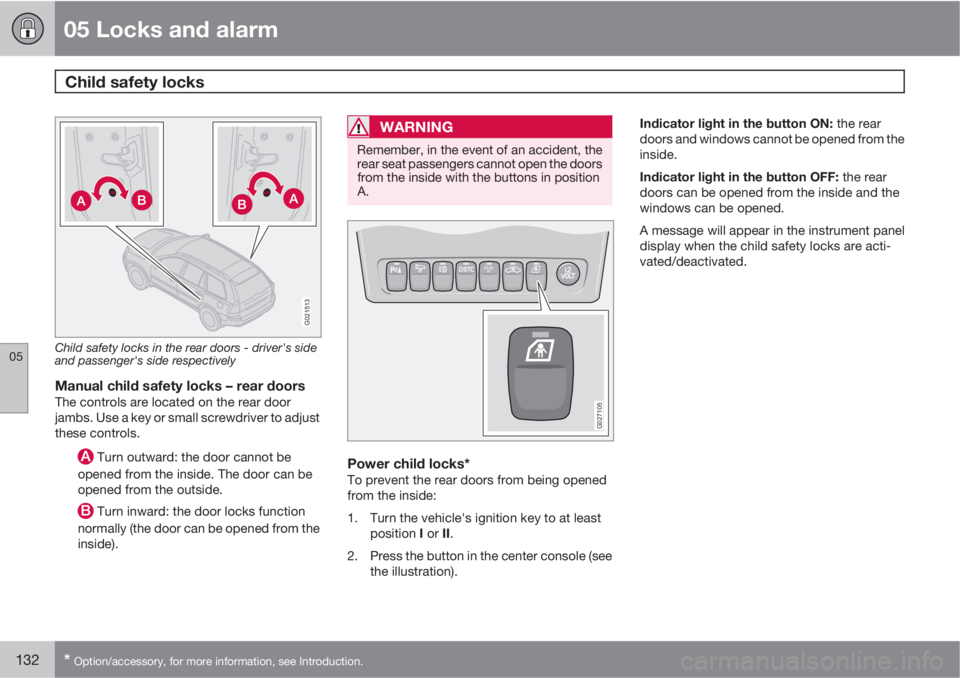
Child safety locks in the rear doors - driver's side
and passenger's side respectively
Manual child safety locks – rear doorsThe controls are located on the rear door
jambs. Use a key or small screwdriver to adjust
these controls.
Turn outward: the door cannot be
opened from the inside. The door can be
opened from the outside.
Turn inward: the door locks function
normally (the door can be opened from the
inside).
WARNING
Remember, in the event of an accident, the
rear seat passengers cannot open the doors
from the inside with the buttons in position
A.
REAR
AC
G027105
Power child locks*To prevent the rear doors from being opened
from the inside:
1. Turn the vehicle's ignition key to at least
position I or II.
2. Press the button in the center console (see
the illustration).Indicator light in the button ON: the rear
doors and windows cannot be opened from the
inside.
Indicator light in the button OFF: the rear
doors can be opened from the inside and the
windows can be opened.
A message will appear in the instrument panel
display when the child safety locks are acti-
vated/deactivated.
Page 140 of 310
06 Starting and driving
General information
06
138
Engine oil
Although some oil consumption occurs during
normal engine operation, more oil is consumed
when the engine is new as the internal parts
generate higher friction while wearing-in to
each other. From the time the engine is new
until the first maintenance is performed, the oil
consumption could be higher than normal. For
this reason, it is especially important to check
the oil regularly during this period, see
page 220.
Fuel requirements
Deposit control gasoline (detergent
additives)
Volvo recommends the use of detergent gas-
oline to control engine deposits. Detergent
gasoline is effective in keeping injectors and
intake valves clean. Consistent use of deposit
control gasolines will help ensure good driva-
bility and fuel economy. If you are not sure
whether the gasoline contains deposit control
additives, check with the service station oper-
ator.
NOTE
Volvo does not recommend the use of exter-
nal fuel injector cleaning systems.
Unleaded fuelEach Volvo has a three-way catalytic converter
and must use only unleaded gasoline. U.S. and
Canadian regulations require that pumps deliv-
ering unleaded gasoline be labelled "UNLEA-
DED". Only these pumps have nozzles which
fit your vehicle's filler inlet. It is unlawful to dis-
pense leaded fuel into a vehicle labelled
"unleaded gasoline only". Leaded gasoline
damages the three-way catalytic converter and
the heated oxygen sensor system. Repeated
use of leaded gasoline will lessen the effective-
ness of the emission control system and could
result in loss of emission warranty coverage.
State and local vehicle inspection programs
will make detection of misfueling easier, pos-
sibly resulting in emission test failure for mis-
fueled vehicles.
NOTE
Some U.S. and Canadian gasolines contain
an octane enhancing additive called methyl-
cyclopentadienyl manganese tricarbonyl
(MMT). If such fuels are used, your Emission
Control System performance may be affec-
ted, and the Check Engine Light (malfunc-
tion indicator lamp) located on your instru-
ment panel may light. If this occurs, please
return your vehicle to a trained and qualified
Volvo service technician for maintenance.
Gasoline containing alcohol and ethers"Oxygenated fuels"
Some fuel suppliers sell gasoline containing
"oxygenates" which are usually alcohols or
ethers. In some areas, state or local laws
require that the service pump be marked indi-
cating use of alcohols or ethers. However,
there are areas in which the pumps are
unmarked. If you are not sure whether there is
alcohol or ethers in the gasoline you buy, check
with the service station operator. To meet sea-
sonal air quality standards, some areas require
the use of "oxygenated" fuel.
Volvo allows the use of the following "oxygen-
ated" fuels; however, the octane ratings listed
on page 139 must still be met.
Alcohol – Ethanol: Fuels containing up to 10%
ethanol by volume may be used. Ethanol may
also be referred to as Ethyl alcohol, or "Gaso-
hol".
Ethers – MTBE: Fuels containing up to 15%
MTBE may be used.
Page 145 of 310
06 Starting and driving
Starting the vehicle
06
143 Starting the engine
WARNING
Before starting, check that the seat, steering
wheel and mirrors are adjusted properly.
Make sure the brake pedal can be
depressed completely. Adjust the seat if
necessary, see page 104.
1. Fasten the seat belt.
2. Apply the parking brake (hand brake) if not
already set. The gear selector is locked in
the P position (SHIFTLOCK).
3. Without touching the accelerator pedal,
turn the ignition key
1 to the starting posi-
tion. Allow the starter to operate for up to
10 seconds. Release the key as soon as
the engine starts
2. If the engine fails to
start, repeat this step.
CAUTION
If the engine does not start after the third try,
wait for approximately 3 minutes before try-
ing to start it again to give the battery time
to recover its starting capacity.
WARNING
•Never use more than one floor mat at a
time on the driver's floor. An extra mat
on the driver's floor can cause the
accelerator and/or brake pedal to
catch. Check that the movement of
these pedals is not impeded.
•Volvo's floor mats are specially manu-
factured for your car. They must be
firmly secured in the clips on the floor so
that they cannot slide and become trap-
ped under the pedals on the driver's
side.
NOTE
•If the key blade section of the remote is
not fully folded out when starting the
vehicle, the immobilizer function may
make it impossible to start the engine.
•After a cold start, idle speed may be
noticeably higher than normal for a
short period. This is done to help bring
components in the emission control
system to their normal operating tem-
perature as quickly as possible, which
enables them to control emissions and
help reduce the vehicle's impact on the
environment.
•To release the gear selector from the P
(Park) position, the engine must be run-
ning (or the ignition key must be in posi-
tion II) and the brake pedal must be
depressed.
•Select the desired gear. The gear
engages after a very slight delay which
is especially noticeable when selecting
R.
1If two of the keys to your vehicle are close together, e.g. on the same key ring when you try to start the vehicle, this could cause interference in the immobilizer system and result in the vehicle not
starting. If this should occur, remove one of the keys from the key ring before trying to start the vehicle again.
2On vehicles equipped with the autostart feature, release the key immediately. See also page 145.
Page 160 of 310
06 Starting and driving
Stability system
06
158
DSTC-related messages in the text
window
•TRACTION CONTROL TEMPORARILY
OFF : The system has been temporarily
switched off due to high brake temperature
and will automatically switch on again
when the brakes have cooled.
•ANTI-SKID SERVICE REQUIRED: The
system has been automatically disen-
gaged due to a fault. A trained and qualified
Volvo service technician should check the
system.
Symbols in the instrument panel
The Stability Control indicator lightThis light indicates different condi-
tions, depending on how it illumi-
nates.
The Stability Control indicator light
illuminates for approximately 2 seconds
This indicates that the system is performing a
self-diagnostic test when the ignition is
switched on.
The Stability Control indicator light
flashes
This indicates that the stability system is
actively functioning to help counteract wheel
spin and/or a skid.
The Stability Control indicator light
glows steadily
ANTI-SKID SERVICE REQUIRED will be dis-
played in the text window at the same time.
A fault is indicated in the stability system.
•Stop the vehicle in a safe place and switch
off the engine.
•Restart the engine.
•If the indicator light goes out, the fault was
temporary and no further action is
required.
•If the indicator light remains on, drive to an
authorized Volvo workshop as soon as
possible to have the system checked.
The Stability Control indicator light
glows steadily
If DSTC SPIN CONTROL OFF is displayed in
the text window at the same time, this is a
reminder that spin control has been disabled
by the driver.
The warning symbolThe warning symbol glows
steadily yellow
The system has been temporarily switched off
due to high brake temperature. TRACTIONCONTROL TEMPORARILY OFF
will be dis-
played. The system will automatically switch
on again when the brakes have cooled.
WARNING
The stability system is intended to help
improve driving safety. It supplements, but
can never replace, the driver's judgement
and responsibility when operating the vehi-
cle. Speed and driving style should always
be adapted to traffic and road conditions.
Page 172 of 310
06 Starting and driving
Blind Spot Information System*
06
170* Option/accessory, for more information, see Introduction.
G020295
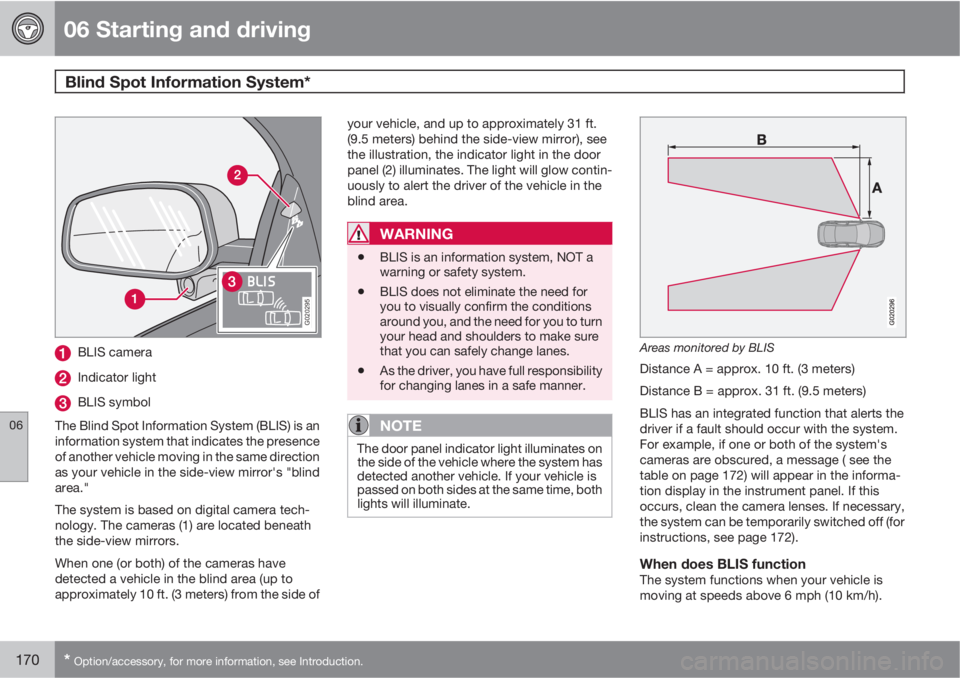
BLIS camera
Indicator light
BLIS symbol
The Blind Spot Information System (BLIS) is an
information system that indicates the presence
of another vehicle moving in the same direction
as your vehicle in the side-view mirror's "blind
area."
The system is based on digital camera tech-
nology. The cameras (1) are located beneath
the side-view mirrors.
When one (or both) of the cameras have
detected a vehicle in the blind area (up to
approximately 10 ft. (3 meters) from the side ofyour vehicle, and up to approximately 31 ft.
(9.5 meters) behind the side-view mirror), see
the illustration, the indicator light in the door
panel (2) illuminates. The light will glow contin-
uously to alert the driver of the vehicle in the
blind area.
WARNING
•BLIS is an information system, NOT a
warning or safety system.
•BLIS does not eliminate the need for
you to visually confirm the conditions
around you, and the need for you to turn
your head and shoulders to make sure
that you can safely change lanes.
•As the driver, you have full responsibility
for changing lanes in a safe manner.
NOTE
The door panel indicator light illuminates on
the side of the vehicle where the system has
detected another vehicle. If your vehicle is
passed on both sides at the same time, both
lights will illuminate.
Areas monitored by BLIS
Distance A = approx. 10 ft. (3 meters)
Distance B = approx. 31 ft. (9.5 meters)
BLIS has an integrated function that alerts the
driver if a fault should occur with the system.
For example, if one or both of the system's
cameras are obscured, a message ( see the
table on page 172) will appear in the informa-
tion display in the instrument panel. If this
occurs, clean the camera lenses. If necessary,
the system can be temporarily switched off (for
instructions, see page 172).
When does BLIS functionThe system functions when your vehicle is
moving at speeds above 6 mph (10 km/h).
Page 180 of 310
07 Wheels and tires
General information
07
178
•The tires with the most tread should always
be at the rear (to reduce the risk of skid-
ding).
•Contact a Volvo workshop if you are
unsure about the tread depth.
Storing wheels and tiresWhen storing complete wheels (tires mounted
on rims), they should be suspended off the
floor or placed on their sides on the floor.
Tires not mounted on rims should be stored on
their sides or standing upright, but should not
be suspended.
CAUTION
Tires should preferably be stored in a cool,
dry, dark place, and should never be stored
in close proximity to solvents, gasoline, oils,
etc.
WARNING
•The wheel and tire sizes for your Volvo
are specified to meet stringent stability
and handling requirements. Unap-
proved wheel/tire size combinations
can negatively affect your vehicle's sta-
bility and handling.
•Any damage caused by installation of
unapproved wheel/tire size combina-
tions will not be covered by your new
vehicle warranty. Volvo assumes no
responsibility for death, injury, or
expenses that may result from such
installations.
Page 181 of 310
07 Wheels and tires
Tire inflation
07
179 Inflation placard
G032513
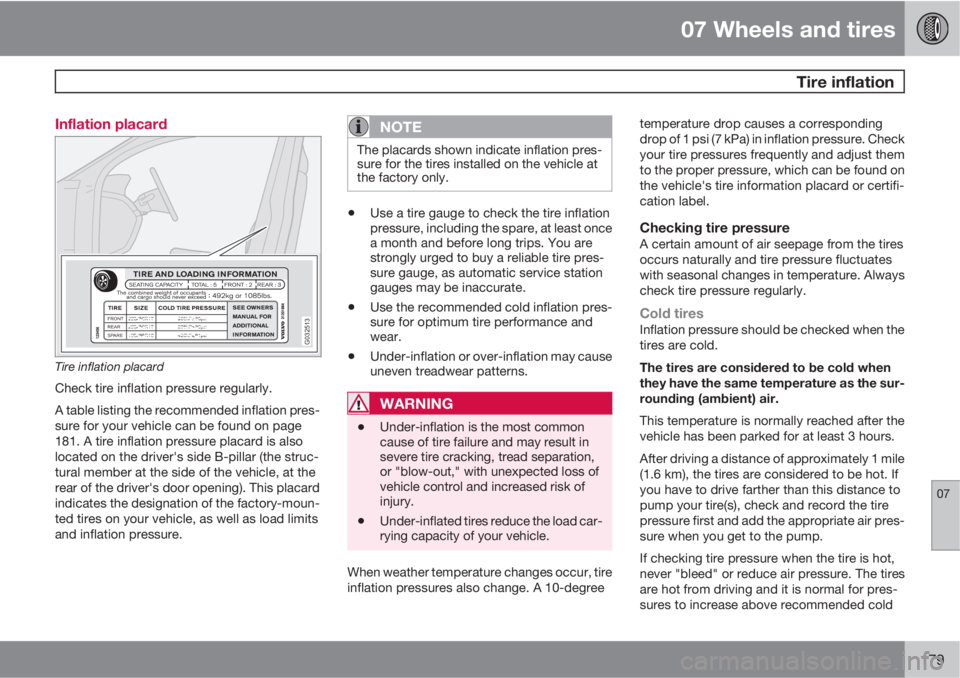
Tire inflation placard
Check tire inflation pressure regularly.
A table listing the recommended inflation pres-
sure for your vehicle can be found on page
181. A tire inflation pressure placard is also
located on the driver's side B-pillar (the struc-
tural member at the side of the vehicle, at the
rear of the driver's door opening). This placard
indicates the designation of the factory-moun-
ted tires on your vehicle, as well as load limits
and inflation pressure.
NOTE
The placards shown indicate inflation pres-
sure for the tires installed on the vehicle at
the factory only.
•Use a tire gauge to check the tire inflation
pressure, including the spare, at least once
a month and before long trips. You are
strongly urged to buy a reliable tire pres-
sure gauge, as automatic service station
gauges may be inaccurate.
•Use the recommended cold inflation pres-
sure for optimum tire performance and
wear.
•Under-inflation or over-inflation may cause
uneven treadwear patterns.
WARNING
•Under-inflation is the most common
cause of tire failure and may result in
severe tire cracking, tread separation,
or "blow-out," with unexpected loss of
vehicle control and increased risk of
injury.
•Under-inflated tires reduce the load car-
rying capacity of your vehicle.
When weather temperature changes occur, tire
inflation pressures also change. A 10-degreetemperature drop causes a corresponding
drop of 1 psi (7 kPa) in inflation pressure. Check
your tire pressures frequently and adjust them
to the proper pressure, which can be found on
the vehicle's tire information placard or certifi-
cation label.
Checking tire pressureA certain amount of air seepage from the tires
occurs naturally and tire pressure fluctuates
with seasonal changes in temperature. Always
check tire pressure regularly.
Cold tiresInflation pressure should be checked when the
tires are cold.
The tires are considered to be cold when
they have the same temperature as the sur-
rounding (ambient) air.
This temperature is normally reached after the
vehicle has been parked for at least 3 hours.
After driving a distance of approximately 1 mile
(1.6 km), the tires are considered to be hot. If
you have to drive farther than this distance to
pump your tire(s), check and record the tire
pressure first and add the appropriate air pres-
sure when you get to the pump.
If checking tire pressure when the tire is hot,
never "bleed" or reduce air pressure. The tires
are hot from driving and it is normal for pres-
sures to increase above recommended cold
Page 188 of 310
07 Wheels and tires
Uniform Tire Quality Grading
07
186
ALL PASSENGER VEHICLE TIRES MUST
CONFORM TO FEDERAL SAFETY
REQUIREMENTS IN ADDITION TO THESE
GRADES
Quality grades can be found, where appli-
cable, on the tire sidewall between the tread
shoulder and maximum section width. For
example:
Treadwear 200 Traction AA Temperature A
TREADWEARThe treadwear grade is a comparative rating
based on the wear rate of the tire when tested
under controlled conditions on a specified gov-
ernment test course. For example, a tire gra-
ded 150 would wear one and one half (1 1/2)
times as well on the government course as a
tire graded 100. The relative performance of
tires depends upon the actual conditions of
their use, however, and many depart signifi-
cantly from the norm due to variation in driving
habits, maintenance practices and differences
in road characteristics and climate.
TRACTIONThe traction grades, from highest to lowest, are
AA, A, B, and C, as measured under controlled
conditions on specified government test sur-
faces of asphalt and concrete. A tire marked C
may have poor traction performance.
WARNING
The traction grade assigned to this tire is
based on braking (straight-ahead) traction
tests and is not a measure of cornering
(turning) traction.
TEMPERATUREThe temperature grades are A (the highest), B,
and C, representing the tire's resistance to the
generation of heat and its ability to dissipate
heat when tested under controlled conditions
on a specified indoor laboratory test wheel.
Sustained high temperature can cause the
material of the tire to degenerate and reduce
tire life, and excessive temperature can lead to
sudden tire failure. The grade C corresponds
to a minimum level of performance that all pas-
senger vehicle tires must meet under the Fed-
eral Motor Safety Standard No. 109. Grades B
and A represent higher levels of performance
on the laboratory test wheel than the minimum
required by law.
WARNING
The temperature grade for this tire is estab-
lished for a tire that is properly inflated and
not overloaded. Excessive speed, under-
inflation, or excessive loading, either sepa-
rately or in combination, can cause heat
buildup and tire failure.
Page 190 of 310
07 Wheels and tires
Temporary spare
07
188
The spare tire in your vehicle1 is called a "Tem-
porary Spare".
Recommended tire pressure (see the placard
on the B-pillar or on the fuel filler door) should
be maintained irrespective of which position on
the vehicle the temporary spare tire is used.
In the event of damage to this tire, a new one
can be purchased from your Volvo retailer.
WARNING
Current legislation prohibits the use of the
"Temporary Spare" tire other than as a tem-
porary replacement for a punctured tire. It
must be replaced as soon as possible by a
standard tire. Road holding and handling
may be affected with the "Temporary
Spare" in use. Do not exceed 50 mph
(80 km/h).
CAUTION
The vehicle must not be driven with wheels
of different dimensions or with a spare tire
other than the one that came with the vehi-
cle. The use of different size wheels can
seriously damage your vehicle's transmis-
sion.
1Not on models equipped with the Tire sealing system.