airbag VOLVO XC90 2013 Owner´s Manual
[x] Cancel search | Manufacturer: VOLVO, Model Year: 2013, Model line: XC90, Model: VOLVO XC90 2013Pages: 310, PDF Size: 8.62 MB
Page 32 of 310
01 Safety
Occupant Weight Sensor 01
30
This condition reflects limitations of the OWS
classification capability. It does not indicate
OWS malfunction.
ModificationsIf you are considering modifying your vehicle in
any way to accommodate a disability, for
example by altering or adapting the driver's or
front passenger's seat(s) and/or airbag sys-
tems, please contact Volvo at:
In the USA
Volvo Cars of North America, LLC
Customer Care Center
1 Volvo Drive
P.O. Box 914 Rockleigh,
New Jersey 07647
1-800-458-1552
In Canada
Volvo Cars of Canada Corp.
National Customer Service
175 Gordon Baker Road
North York, Ontario M2H 2N7
1-800-663-8255
WARNING
•No objects that add to the total weight
on the seat should be placed on the
front passenger's seat. If a child is
seated in the front passenger's seat
with any additional weight, this extra
weight could cause the OWS system to
enable the airbag, which might cause it
to deploy in the event of a collision,
thereby injuring the child.
•The seat belt should never be wrapped
around an object on the front passeng-
er's seat. This could interfere with the
OWS system's function.
•The front passenger's seat belt should
never be used in a way that exerts more
pressure on the passenger than normal.
This could increase the pressure exer-
ted on the weight sensor by a child, and
could result in the airbag being enabled,
which might cause it to deploy in the
event of a collision, thereby injuring the
child.
WARNING
Keep the following points in mind with
respect to the OWS system. Failure to follow
these instructions could adversely affect the
system's function and result in serious injury
to the occupant of the front passenger's
seat:
•The full weight of the front seat passen-
ger should always be on the seat cush-
ion. The passenger should never lift
him/herself off the seat cushion using
the armrest in the door or the center
console, by pressing the feet on the
floor, by sitting on the edge of the seat
cushion, or by pressing against the
backrest in a way that reduces pressure
on the seat cushion. This could cause
OWS to disable the front passenger's
side airbag.
•Do not place any type of object on the
front passenger's seat in such a way
that jamming, pressing, or squeezing
occurs between the object and the front
seat, other than as a direct result of the
correct use of the Automatic Locking
Retractor/Emergency Locking Retrac-
tor (ALR/ELR) seat belt (see page 38).
•No objects should be placed under the
front passenger's seat. This could inter-
fere with the OWS system's function.
Page 33 of 310
01 Safety
Side impact protection airbags01
31 Side impact airbags – front seats only
G020118
Location of the side impact (SIPS) airbag
As an enhancement to the structural side
impact protection built into your vehicle, the
vehicle is also equipped with Side Impact Pro-
tection System (SIPS) airbags.
The SIPS airbag system is designed to help
increase occupant protection in the event of
certain side impact collisions. The SIPS air-
bags are designed to deploy only during cer-
tain side-impact collisions, depending on the
crash severity, angle, speed and point of
impact.
G025315
Driver's side SIPS airbag
G025316
Passenger's side SIPS airbag
NOTE
SIPS airbag deployment (one airbag) occurs
only on the side of the vehicle affected by
the impact. The airbags are not designed to
deploy in all side impact situations.
Components in the SIPS airbag systemThis SIPS airbag system consists of gas gen-
erators and side airbag modules built into the
outboard sides of both front seat backrests.
Page 34 of 310
01 Safety
Side impact protection airbags 01
32
WARNING
•The SIPS airbag system is a supple-
ment to the structural Side Impact Pro-
tection System and the three-point seat
belt system. It is not designed to deploy
during collisions from the front or rear of
the vehicle or in rollover situations.
•The use of seat covers on the front seats
may impede SIPS airbag deployment.
•No objects, accessory equipment or
stickers may be placed on, attached to
or installed near the SIPS airbag system
or in the area affected by SIPS airbag
deployment.
•Never try to open or repair any compo-
nents of the SIPS airbag system. This
should be done only by a trained and
qualified Volvo service technician.
•In order for the SIPS airbag to provide
its best protection, both front seat
occupants should sit in an upright posi-
tion with the seat belt properly fastened.
•Failure to follow these instructions can
result in injury to the occupants of the
vehicle in the event of an accident.
Page 35 of 310
01 Safety
Inflatable Curtain01
33 The Inflatable Curtain (IC)
G027047
This system consists of inflatable curtains
located along the sides of the roof liners,
stretching from the front side windows to the
rear edge of the rear side windows. It is
designed to help protect the heads of the occu-
pants of the front seats and the occupants of
the outboard rear seating positions, including
the outboard passenger in the third row of
seats in certain side impact collisions.
G027048
The inflatable curtains in the Volvo XC90 are
also designed to help protect the occupants of
the vehicle in a roll-over situation, and to help
prevent them from being thrown from the vehi-
cle if a roll-over occurs.
NOTE
The Inflatable Curtains extend to protect all
three rows of seats.
By design, the IC system deploys only on the
side of the vehicle affected by the impact.
However, in certain side impacts, or in a roll-
over situation, BOTH the Inflatable Curtains
and the Side Impact Airbag System (SIPS-bag)will deploy, whereas, in some cases, ONLY the
Inflatable Curtain will deploy. In cases where
BOTH the Inflatable Curtain and the SIPS-bag
deploy, deployment will occur simultaneously.
NOTE
If the Inflatable Curtain deploys, it remains
inflated for approximately 5 seconds.
WARNING
•The IC system is a supplement to the
Side Impact Protection System. It is not
designed to deploy during collisions
from the front or the rear of the vehicle.
•Never try to open or repair any compo-
nents of the IC system. This should be
done only by a trained and qualified
Volvo service technician.
•Never hang heavy items from the ceiling
handles. This could impede deployment
of the Inflatable curtain.
Page 40 of 310
01 Safety
Child safety 01
38
WARNING
•Do not use child safety seats or child
booster cushions/backrests in the front
passenger's seat. We also recommend
that children under 4 feet 7 inches
(140 cm) in height who have outgrown
these devices sit in the rear seat with the
seat belt fastened.
•On hot days, the temperature in the
vehicle interior can rise very quickly.
Exposure to these high temperatures
for even a short period of time can
cause heat-related injury or death.
Small children are particularly at risk.
Child seat should always be registered. See
page 39 for more information.
Automatic Locking Retractor/
Emergency Locking Retractor (ALR/
ELR)
To make child seat installation easier, each
seat belt (except for the driver's belt) is equip-
ped with a locking mechanism to help keep the
seat belt taut.
When attaching the seat belt to a child
seat:
1. Attach the seat belt to the child seat
according to the child seat manufacturer's
instructions.
2. Pull the seat belt out as far as possible.
3. Insert the seat belt latch plate into the
buckle (lock) in the usual way.
4. Release the seat belt and pull it taut around
the child seat.
A sound from the seat belt retractor will be
audible at this time and is normal. The belt will
now be locked in place. This function is auto-
matically disabled when the seat belt is
unlocked and the belt is fully retracted.
WARNING
Do not use child safety seats or child
booster cushions/backrests in the front
passenger's seat. We also recommend that
children who have outgrown these devices
sit in the rear seat with the seat belt properly
fastened.
Volvo's recommendations
Why does Volvo believe that no child should sit
in the front seat of a car? It's quite simple really.
A front airbag is a very powerful device
designed, by law, to help protect an adult.
Because of the size of the airbag and its speed
of inflation, a child should never be placed in
the front seat, even if he or she is properly bel-
ted or strapped into a child safety seat. Volvo
has been an innovator in safety for over sev-
enty-five years, and we'll continue to do our
part. But we need your help. Please remember
to put your children in the back seat, and
buckle them up.
Volvo has some very specific
recommendations:
•Always wear your seat belt.
•Airbags are a SUPPLEMENTAL safety
device which, when used with a three-
point seat belt can help reduce serious
injuries during certain types of accidents.
Volvo recommends that you do not dis-
connect the airbag system in your vehicle.
•Volvo strongly recommends that everyone
in the vehicle be properly restrained.
•Volvo recommends that ALL occupants
(adults and children) shorter than 4 feet
7 inches (140 cm) be seated in the back
Page 41 of 310
01 Safety
Child safety01
39
seat of any vehicle with a front passenger
side airbag.
•Drive safely!
Child restraint registration and recalls
Registering a child restraintChild restraints could be recalled for safety
reasons. You must register your child restraint
to be reached in a recall. To stay informed
about child safety seat recalls, be sure to fill out
and return the registration card that comes
with new child restraints.
Child restraint recall information is readily avail-
able in both the U.S. and Canada. For recall
information in the U.S., call the U.S. Govern-
ment's Auto Safety Hotline at 1-800-424-9393.
In Canada, visit Transport Canada's Child
Safety website at http://www.tc.gc.ca/
roadsafety/childsafety/menu.htm.
Page 42 of 310
01 Safety
Child restraint systems 01
40
Child restraints
G026491
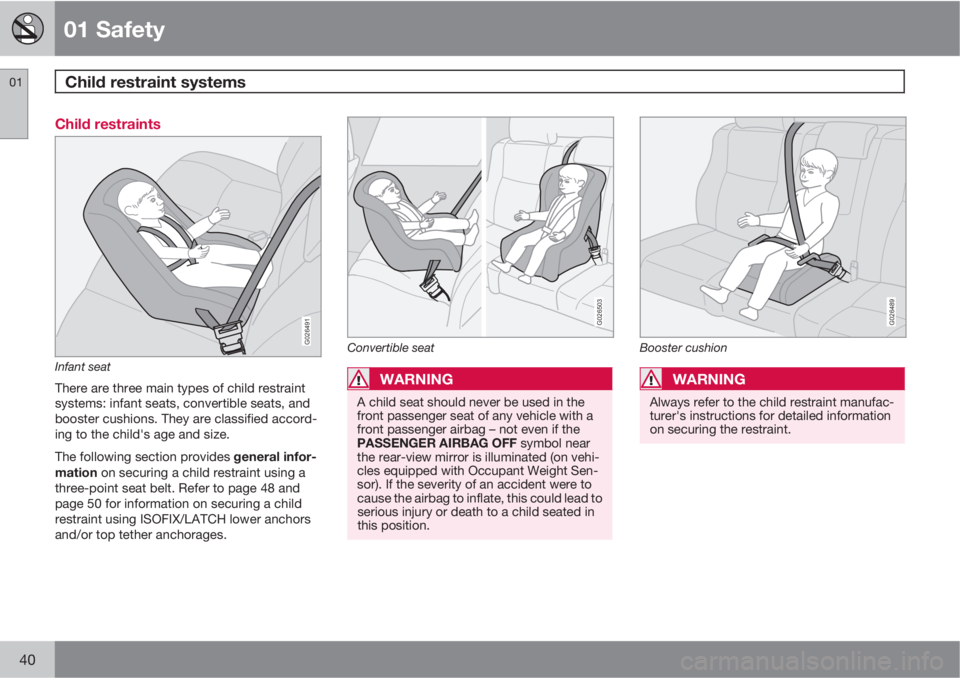
Infant seat
There are three main types of child restraint
systems: infant seats, convertible seats, and
booster cushions. They are classified accord-
ing to the child's age and size.
The following section provides general infor-
mation on securing a child restraint using a
three-point seat belt. Refer to page 48 and
page 50 for information on securing a child
restraint using ISOFIX/LATCH lower anchors
and/or top tether anchorages.
G026503
Convertible seat
WARNING
A child seat should never be used in the
front passenger seat of any vehicle with a
front passenger airbag – not even if the
PASSENGER AIRBAG OFF symbol near
the rear-view mirror is illuminated (on vehi-
cles equipped with Occupant Weight Sen-
sor). If the severity of an accident were to
cause the airbag to inflate, this could lead to
serious injury or death to a child seated in
this position.
G026489
Booster cushion
WARNING
Always refer to the child restraint manufac-
turer's instructions for detailed information
on securing the restraint.
Page 44 of 310
01 Safety
Infant seats 01
42
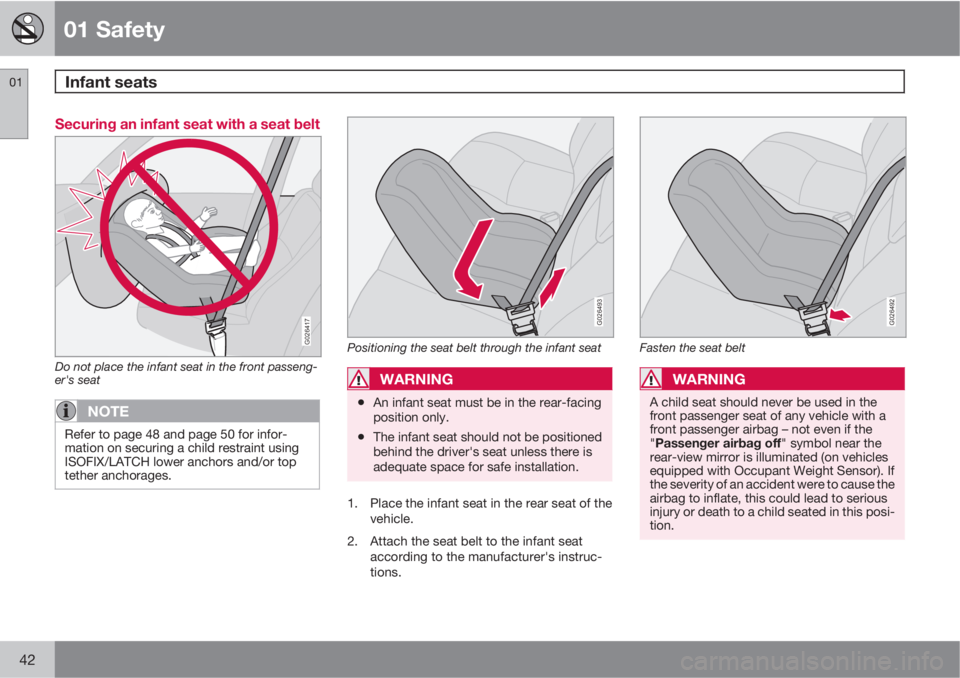
Securing an infant seat with a seat belt
G026417
Do not place the infant seat in the front passeng-
er's seat
NOTE
Refer to page 48 and page 50 for infor-
mation on securing a child restraint using
ISOFIX/LATCH lower anchors and/or top
tether anchorages.
G026493
Positioning the seat belt through the infant seat
WARNING
•An infant seat must be in the rear-facing
position only.
•The infant seat should not be positioned
behind the driver's seat unless there is
adequate space for safe installation.
1. Place the infant seat in the rear seat of the
vehicle.
2. Attach the seat belt to the infant seat
according to the manufacturer's instruc-
tions.
G026492
Fasten the seat belt
WARNING
A child seat should never be used in the
front passenger seat of any vehicle with a
front passenger airbag – not even if the
"Passenger airbag off" symbol near the
rear-view mirror is illuminated (on vehicles
equipped with Occupant Weight Sensor). If
the severity of an accident were to cause the
airbag to inflate, this could lead to serious
injury or death to a child seated in this posi-
tion.
Page 48 of 310
01 Safety
Convertible seats 01
46
WARNING
A child seat should never be used in the
front passenger seat of any vehicle with a
front passenger airbag – not even if the
PASSENGER AIRBAG OFF symbol near
the rear-view mirror is illuminated (on vehi-
cles equipped with Occupant Weight Sen-
sor). If the severity of an accident were to
cause the airbag to inflate, this could lead to
serious injury or death to a child seated in
this position.
Page 62 of 310
02 Instruments and controls
Instrument panel
02
60
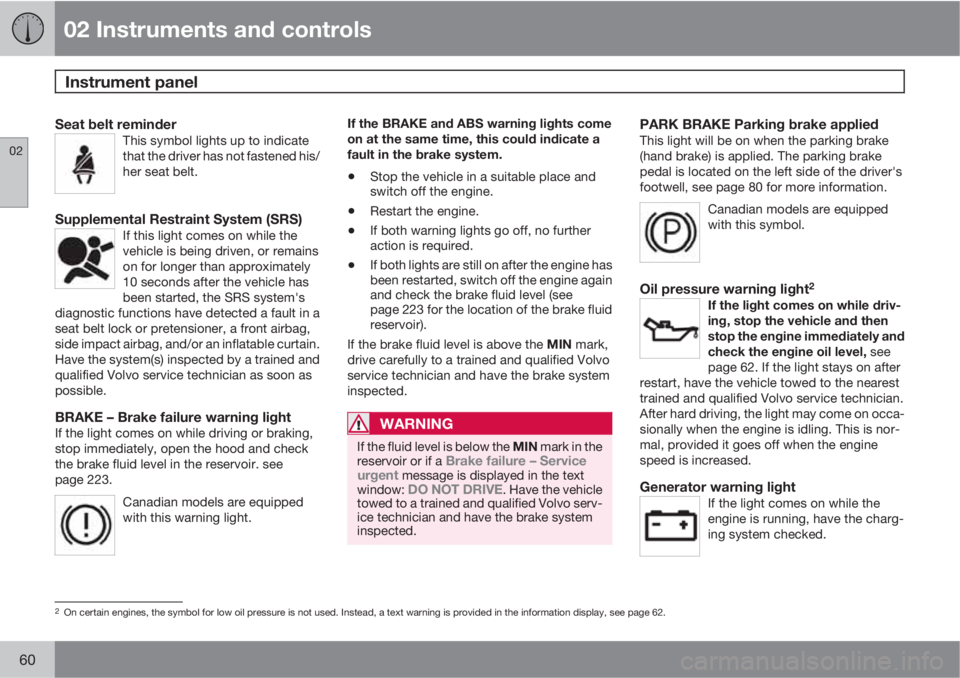
Seat belt reminderThis symbol lights up to indicate
that the driver has not fastened his/
her seat belt.
Supplemental Restraint System (SRS)If this light comes on while the
vehicle is being driven, or remains
on for longer than approximately
10 seconds after the vehicle has
been started, the SRS system's
diagnostic functions have detected a fault in a
seat belt lock or pretensioner, a front airbag,
side impact airbag, and/or an inflatable curtain.
Have the system(s) inspected by a trained and
qualified Volvo service technician as soon as
possible.
BRAKE – Brake failure warning lightIf the light comes on while driving or braking,
stop immediately, open the hood and check
the brake fluid level in the reservoir. see
page 223.
Canadian models are equipped
with this warning light.
If the BRAKE and ABS warning lights come
on at the same time, this could indicate a
fault in the brake system.
•Stop the vehicle in a suitable place and
switch off the engine.
•Restart the engine.
•If both warning lights go off, no further
action is required.
•If both lights are still on after the engine has
been restarted, switch off the engine again
and check the brake fluid level (see
page 223 for the location of the brake fluid
reservoir).
If the brake fluid level is above the MIN mark,
drive carefully to a trained and qualified Volvo
service technician and have the brake system
inspected.
WARNING
If the fluid level is below the MIN mark in the
reservoir or if a Brake failure – Service
urgent message is displayed in the text
window: DO NOT DRIVE. Have the vehicle
towed to a trained and qualified Volvo serv-
ice technician and have the brake system
inspected.
PARK BRAKE Parking brake appliedThis light will be on when the parking brake
(hand brake) is applied. The parking brake
pedal is located on the left side of the driver's
footwell, see page 80 for more information.
Canadian models are equipped
with this symbol.
Oil pressure warning light2
If the light comes on while driv-
ing, stop the vehicle and then
stop the engine immediately and
check the engine oil level, see
page 62. If the light stays on after
restart, have the vehicle towed to the nearest
trained and qualified Volvo service technician.
After hard driving, the light may come on occa-
sionally when the engine is idling. This is nor-
mal, provided it goes off when the engine
speed is increased.
Generator warning lightIf the light comes on while the
engine is running, have the charg-
ing system checked.
2On certain engines, the symbol for low oil pressure is not used. Instead, a text warning is provided in the information display, see page 62.