brake light VOLVO XC90 2013 Owner´s Manual
[x] Cancel search | Manufacturer: VOLVO, Model Year: 2013, Model line: XC90, Model: VOLVO XC90 2013Pages: 310, PDF Size: 8.62 MB
Page 148 of 310
06 Starting and driving
Economical driving
06
146
Economical driving conserves natural
resources
Better driving economy may be obtained by
thinking ahead, avoiding rapid starts and stops
and adjusting the speed of your vehicle to
immediate traffic conditions. Observe the fol-
lowing rules:
•Bring the engine to normal operating tem-
perature as soon as possible by driving
with a light foot on the accelerator pedal for
the first few minutes of operation. A cold
engine uses more fuel and is subject to
increased wear.
•Whenever possible, avoid using the vehicle
for driving short distances. This does not
allow the engine to reach normal operating
temperature.
•Drive carefully and avoid rapid acceleration
and hard braking.
•Use the transmission's D (Drive) position
as often as possible and avoid using "kick-
down" to help improve fuel economy.
•Do not exceed posted speed limits.
•Avoid carrying unnecessary items (extra
load) in the vehicle.
•Maintain correct tire pressure. Check tire
pressure regularly (when tires are cold).
•Remove snow tires when threat of snow or
ice has ended.
•Note that roof racks, ski racks, etc,
increase air resistance and also fuel con-
sumption.
•At highway driving speeds, fuel consump-
tion will be lower with the air conditioning
on and the windows closed than with the
air conditioning off and the windows open.
•Using the onboard trip computer's fuel
consumption modes can help you learn
how to drive more economically.
Other factors that decrease gas mileage
are:
•Dirty air cleaner
•Dirty engine oil and clogged oil filter
•Dragging brakes
•Incorrect front end alignment.
Some of the above mentioned items and others
are checked at the standard Maintenance
Service intervals.
CAUTION
Drive slowly and carefully if going through
standing water (i.e. flooded roadways, etc.).
Damage to the engine could result if excess
water is drawn in through the air intake sys-
tem. Never drive the vehicle in water deeper
than 18 inches (48 cm).
Page 149 of 310
06 Starting and driving
Difficult driving conditions
06
147 Driving on rough/unpaved surfaces
The Volvo XC90 is designed primarily for on-
road driving, and it has excellent handling cha-
racteristics on very rough or unpaved roads.
When driving on poorly maintained or unpaved
roads, please keep the following in mind:
•Reduce speed on rough surfaces to mini-
mize possible damage to the vehicle's
underbody.
•When driving on soft surfaces such as dry
sand or snow, try to avoid stopping if at all
possible.
WARNING
•Avoid driving diagonally across steep
inclines as this could increase the risk of
a roll-over. Try to drive straight up or
down the slope.
•If the road is very steep, avoid turning
the vehicle around to help avoid the risk
of rolling over. Back the vehicle up or
down the incline instead.
NOTE
Avoid driving on steep inclines if the fuel
tank is nearly empty. If the flow of fuel to the
engine is interrupted due to the vehicle's
angle of inclination, this could result in dam-
age to the three-way catalytic converter. We
recommend keeping the fuel tank at least
half full when driving on steep inclines.
Driving through water
The vehicle can be driven through water up to
a depth of approximately 16 inches (40 cm), at
a maximum speed of 6 mph (10 km/h).
Take particular care when driving through flow-
ing water.
Clean the electrical connections for trailer wir-
ing after driving in mud or water.
When driving through water, maintain low
speed and do not stop in the water.
WARNING
After driving through water, press lightly on
the brake pedal to ensure that the brakes
are functioning normally. Water or mud can
make the brake linings slippery, resulting in
delayed braking effect.
CAUTION
•Engine damage will occur if water is
drawn into the air cleaner.
•If the vehicle is driven through water
deeper than 18 in (48 cm), water may
enter the differential and the transmis-
sion. This reduces the oil's lubricating
capacity and may shorten the service
life of these components.
•Do not allow the vehicle to stand in
water up to the door sills longer than
absolutely necessary. This could result
in electrical malfunctions.
•If the engine has been stopped while the
car is in water, do not attempt to restart
the engine. Have the car towed out of
the water.
Page 155 of 310
06 Starting and driving
Brake system
06
* Option/accessory, for more information, see Introduction.153 BRAKE Brake circuit malfunction
The brake system is a hydraulic system con-
sisting of two master cylinders and two sepa-
rate brake circuits. If a problem should occur in
one of these circuits, it is still possible to stop
the vehicle with the other brake circuit.
If the brake pedal must be depressed farther
than normal and requires greater foot pressure,
the stopping distance will be longer.
A warning light in the instrument panel will light
up to warn the driver that a fault has occurred.
If this light comes on while driving or braking,
stop immediately and check the brake fluid
level in the reservoir.
NOTE
Press the brake pedal hard and maintain
pressure on the pedal – do not pump the
brakes.
WARNING
If the fluid level is below the MIN mark in the
reservoir or if a BRAKE FAILURE STOP
SAFELY message is displayed in the text
window: DO NOT DRIVE. Have the vehicle
towed to a trained and qualified Volvo serv-
ice technician and have the brake system
inspected.
NOTE
When the vehicle is at a standstill and the
engine is idling, e.g. at a traffic light and the
brake pedal is depressed, the pedal may go
down slightly. This is a normal function of
the power-assisted brake system.
Brake pad inspectionOn vehicles equipped with a jack*, the condi-
tion of the brake pads can be checked by rais-
ing the vehicle (see page 195 for information
about using the jack and removing a wheel)
and performing a visual inspection of the brake
pads.
WARNING
•If the vehicle has been driven immedi-
ately prior to a brake pad inspection, the
wheel hub, brake components, etc., will
be very hot. Allow time for these com-
ponents to cool before carrying out the
inspection.
•Apply the parking brake and put the
gear selector in the Park (P) position.
•Block the wheels standing on the
ground, use rigid wooden blocks or
large stones.
WARNING
•Use the jack intended for the vehicle
when changing a tire. For any other job,
use stands to support the vehicle.
•The jack should be kept well-greased
and clean, and should not be damaged.
•Be sure the jack is on a firm, level, non-
slippery surface.
•No objects should be placed between
the base of jack and the ground, or
between the jack and the attachment
bar on the vehicle.
•The jack must correctly engage the jack
attachment.
•Never allow any part of your body to be
extended under a vehicle supported by
a jack.
Power brakes function only when the
engine is running
The power brakes utilize vacuum pressure
which is only created when the engine is run-
ning. Never let the vehicle roll to a stop with the
engine switched off.
If the power brakes are not working, consider-
ably higher pressure will be required on the
brake pedal to compensate for the lack of
power assistance. This can happen for exam-
ple when towing your vehicle or if the engine is
Page 156 of 310
06 Starting and driving
Brake system
06
154
switched off when the vehicle is rolling. The
brake pedal feels harder than usual.
Water on brake discs and brake pads
affects braking
Driving in rain and slush or passing through an
automatic car wash can cause water to collect
on the brake discs and pads. This will cause a
delay in braking effect when the pedal is
depressed. To avoid such a delay when the
brakes are needed, depress the pedal occa-
sionally when driving through rain, slush etc.
This will remove the water from the brakes.
Check that brake application feels normal. This
should also be done after washing or starting
in very damp or cold weather.
Severe strain on the brake systemThe brakes will be subject to severe strain
when driving in mountains or hilly areas, or
when towing a trailer. Vehicle speed is usually
slower, which means that the cooling of the
brakes is less efficient than when driving on
level roads. To reduce the strain on the brakes,
shift into a lower gear and let the engine help
with the braking. Do not forget that, if you are
towing a trailer, the brakes will be subjected to
a greater than normal load.
Anti-lock brakes (ABS)If the ABS warning lamp lights up there is a
malfunction in the ABS system (the standardbraking system will however function) and the
vehicle should be driven cautiously to a trained
and qualified Volvo service technician for
inspection. The Anti-lock Braking System
(ABS) helps to improve vehicle control (stop-
ping and steering) during severe braking con-
ditions by limiting brake lockup. When the sys-
tem "senses" impending lockup, braking pres-
sure is automatically modulated in order to help
prevent lockup, which could lead to a skid.
The system performs a self-diagnostic test
when the engine is started and when the
vehicle first reaches a speed of approxi-
mately 12 mph (20 km/h). The brake pedal will
pulsate several times and a sound may be
audible from the ABS control module. This is
normal.
To obtain optimal effect from the ABS system,
constant pressure should be kept on the brake
pedal. Do not pump the brake pedal.
The switching of the ABS modulator will be
audible and the brake pedal will pulsate during
braking. Please be aware that ABS does not
increase the absolute braking potential of the
vehicle. While control will be enhanced, ABS
will not shorten stopping distances on slippery
surfaces.
ABS with EBD (Electronic Brake Force
Distribution)
EBD is an integrated part of the ABS system.
EBD regulates the hydraulic pressure to the
rear brakes to help provide optimal braking
capacity. The brake pedal will pulsate during
braking, which is normal.
If the BRAKE and ABS warning lights come on
at the same time, this could indicate a fault in
the brake system.
1. Stop the vehicle in a suitable place and
switch off the engine.
2. Restart the engine.
•If both warning lights go off, no further
action is required.
•If both lights are still on after the engine has
been restarted, switch off the engine again
and check the brake fluid level (see
page 223 for the location of the brake fluid
reservoir).
WARNING
If the fluid level is below the MIN mark in the
reservoir or if a Brake failure – Service
urgent message is displayed in the text
window: DO NOT DRIVE. Have the vehicle
towed to a trained and qualified Volvo serv-
ice technician and have the brake system
inspected.
Page 158 of 310
06 Starting and driving
Parking brake
06
156
G026992
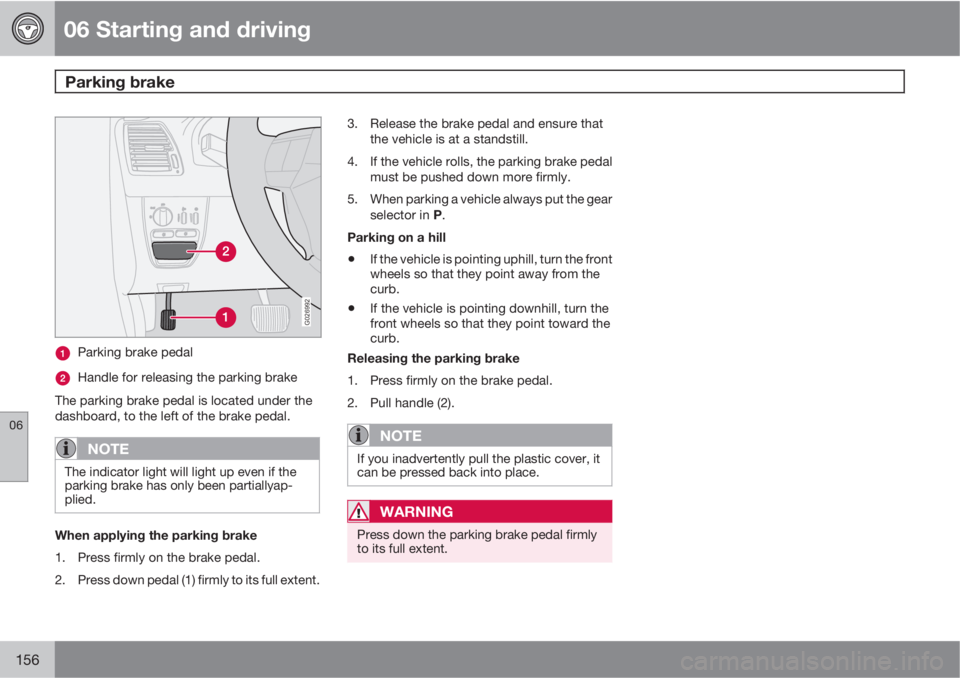
Parking brake pedal
Handle for releasing the parking brake
The parking brake pedal is located under the
dashboard, to the left of the brake pedal.
NOTE
The indicator light will light up even if the
parking brake has only been partiallyap-
plied.
When applying the parking brake
1. Press firmly on the brake pedal.
2. Press down pedal (1) firmly to its full extent.3. Release the brake pedal and ensure that
the vehicle is at a standstill.
4. If the vehicle rolls, the parking brake pedal
must be pushed down more firmly.
5. When parking a vehicle always put the gear
selector in P.
Parking on a hill
•If the vehicle is pointing uphill, turn the front
wheels so that they point away from the
curb.
•If the vehicle is pointing downhill, turn the
front wheels so that they point toward the
curb.
Releasing the parking brake
1. Press firmly on the brake pedal.
2. Pull handle (2).
NOTE
If you inadvertently pull the plastic cover, it
can be pressed back into place.
WARNING
Press down the parking brake pedal firmly
to its full extent.
Page 160 of 310
06 Starting and driving
Stability system
06
158
DSTC-related messages in the text
window
•TRACTION CONTROL TEMPORARILY
OFF : The system has been temporarily
switched off due to high brake temperature
and will automatically switch on again
when the brakes have cooled.
•ANTI-SKID SERVICE REQUIRED: The
system has been automatically disen-
gaged due to a fault. A trained and qualified
Volvo service technician should check the
system.
Symbols in the instrument panel
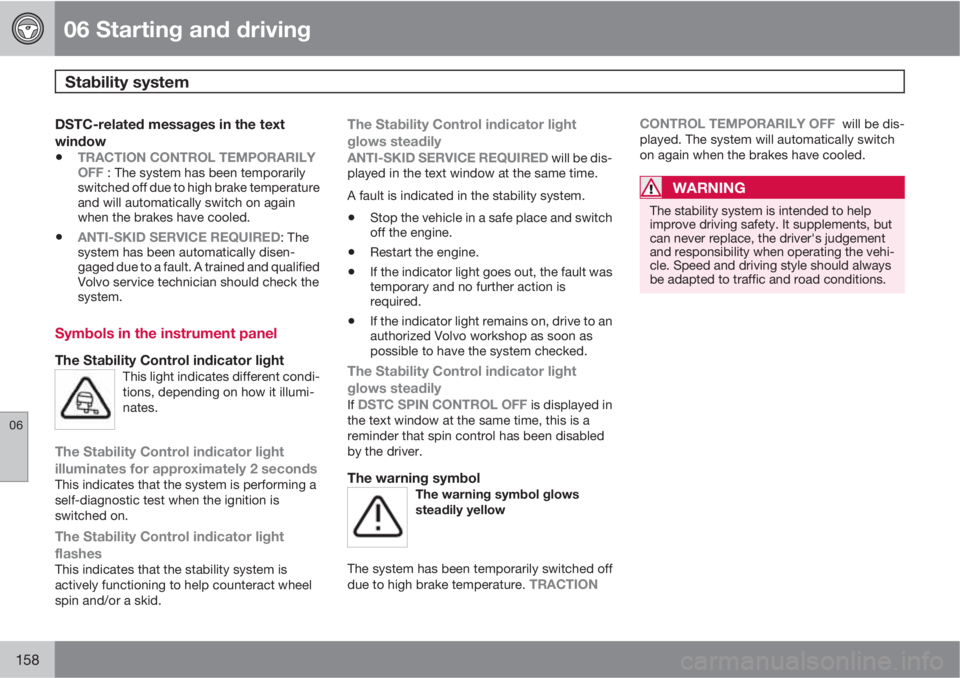
The Stability Control indicator lightThis light indicates different condi-
tions, depending on how it illumi-
nates.
The Stability Control indicator light
illuminates for approximately 2 seconds
This indicates that the system is performing a
self-diagnostic test when the ignition is
switched on.
The Stability Control indicator light
flashes
This indicates that the stability system is
actively functioning to help counteract wheel
spin and/or a skid.
The Stability Control indicator light
glows steadily
ANTI-SKID SERVICE REQUIRED will be dis-
played in the text window at the same time.
A fault is indicated in the stability system.
•Stop the vehicle in a safe place and switch
off the engine.
•Restart the engine.
•If the indicator light goes out, the fault was
temporary and no further action is
required.
•If the indicator light remains on, drive to an
authorized Volvo workshop as soon as
possible to have the system checked.
The Stability Control indicator light
glows steadily
If DSTC SPIN CONTROL OFF is displayed in
the text window at the same time, this is a
reminder that spin control has been disabled
by the driver.
The warning symbolThe warning symbol glows
steadily yellow
The system has been temporarily switched off
due to high brake temperature. TRACTIONCONTROL TEMPORARILY OFF
will be dis-
played. The system will automatically switch
on again when the brakes have cooled.
WARNING
The stability system is intended to help
improve driving safety. It supplements, but
can never replace, the driver's judgement
and responsibility when operating the vehi-
cle. Speed and driving style should always
be adapted to traffic and road conditions.
Page 164 of 310
06 Starting and driving
Towing
06
162
CAUTION
Vehicles with AWD (All Wheel Drive) with the
front wheels off the ground should not be
towed at speeds above 50 mph (70 km/h) or
for distances longer than 30 miles (50 km).
CAUTION
•Please check with state and local
authorities before attempting this type
of towing, as vehicles being towed are
subject to regulations regarding maxi-
mum towing speed, length and type of
towing device, lighting, etc.
•If the vehicle's battery is dead, do not
attempt to start the vehicle by pushing
or pulling it as this will damage the
three-way catalytic converter(s). The
engine must be jump started using an
auxiliary battery (see page 151).
•If the vehicle is being towed on a flat bed
truck, the towing eyelets must not be
used to pull the vehicle up onto the flat
bed or to secure the vehicle on the flat
bed. Consult the tow truck operator.
WARNING
•The power brakes and power steering
will not function when the engine is not
running. Approximately 5 times more
pressure will be required on the brake
pedal and the steering wheel will be
considerably harder to turn.
•The towing eyelets must not be used for
pulling the vehicle out of a ditch or for
any similar purpose involving severe
strain. Do not use the towing eyelets to
pull the vehicle up onto a flat bed tow
truck.
G030862
Towing vehicles with front wheel drive/
All Wheel Drive
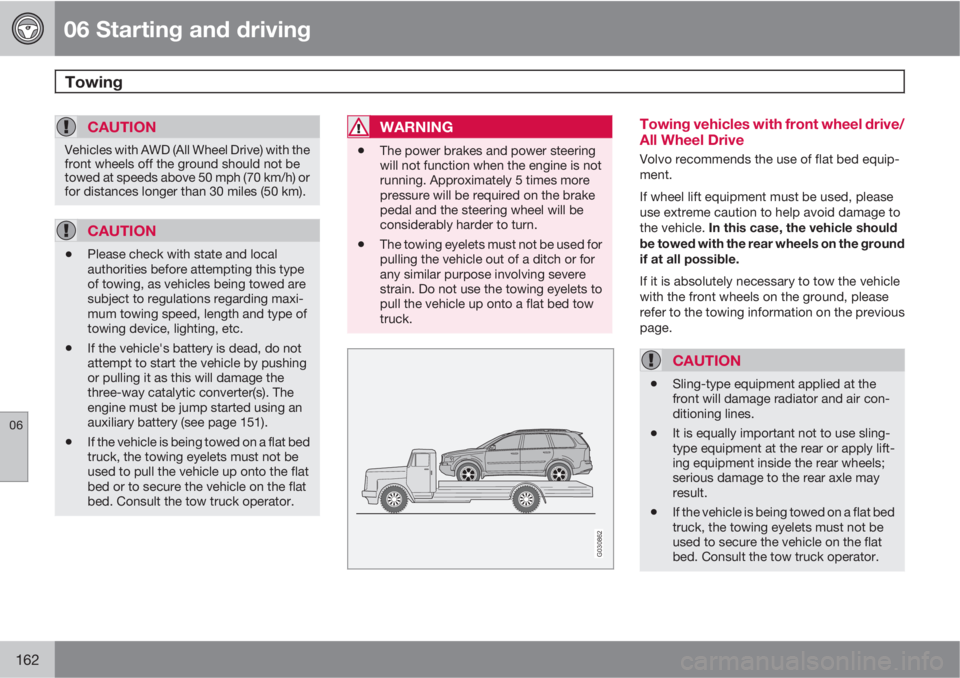
Volvo recommends the use of flat bed equip-
ment.
If wheel lift equipment must be used, please
use extreme caution to help avoid damage to
the vehicle. In this case, the vehicle should
be towed with the rear wheels on the ground
if at all possible.
If it is absolutely necessary to tow the vehicle
with the front wheels on the ground, please
refer to the towing information on the previous
page.
CAUTION
•Sling-type equipment applied at the
front will damage radiator and air con-
ditioning lines.
•It is equally important not to use sling-
type equipment at the rear or apply lift-
ing equipment inside the rear wheels;
serious damage to the rear axle may
result.
•If the vehicle is being towed on a flat bed
truck, the towing eyelets must not be
used to secure the vehicle on the flat
bed. Consult the tow truck operator.
Page 167 of 310
06 Starting and driving
Towing a trailer
06
165
WARNING
•Bumper-attached trailer hitches must
not be used on Volvos, nor should
safety chains be attached to the
bumper.
•Trailer hitches attaching to the vehicle
rear axle must not be used.
•Never connect a trailer's hydraulic
brake system directly to the vehicle
brake system, nor a trailer's lighting
system directly to the vehicle lighting
system. Consult a trained and qualified
Volvo service technician for correct
installation.
•When towing a trailer, the trailer's safety
wire must be correctly fastened to the
hole or hook provided in the trailer hitch
on the vehicle. The safety wire should
never be fastened to or wound around
the drawbar ball.
LevelingIf your vehicle is equipped with automatic lev-
eling, the rear suspension always retains the
correct ride height regardless of the load.
•The system adjusts the rear suspension to
the correct level after the vehicle has been
driven a short distance.
•When the vehicle is stationary, the rear
suspension lowers, which is normal.
Page 171 of 310

06 Starting and driving
Before a long distance trip
06
169
It is always worthwhile to have your vehicle
checked by a trained and qualified Volvo serv-
ice technician before driving long distances.
Your retailer or service technician will also be
able to supply you with bulbs, fuses, spark
plugs and wiper blades for your use in the event
that problems occur.
As a minimum, the following items should be
checked before any long trip:
•Check that engine runs smoothly and that
fuel consumption is normal.
•Check for fuel, oil, and fluid leakage.
•Check transmission oil level1.
•Check condition of drive belts.
•Check state of the battery's charge.
•Examine tires carefully (the spare tire as
well), and replace those that are worn.
Check tire pressures.
•The brakes, front wheel alignment, and
steering gear should be checked by a
trained and qualified Volvo service techni-
cian only.
•Check all lights, including high beams.
•Reflective warning triangles are legally
required in some states/provinces.
•Have a word with your Volvo retailer if you
intend to drive in countries where it may be
difficult to obtain the correct fuel.
•Consider your destination. If you will be
driving through an area where snow or ice
are likely to occur, consider snow tires.
1To prevent injury from contact with hot surfaces, do not inspect your vehicle’s transmission fluid yourself. Have your vehicle’s transmission fluid level inspected by a qualified Volvo service technician.
Page 209 of 310
08 Car care
Washing and cleaning the vehicle
08
207
CAUTION
•Avoid waxing or polishing plastic or rub-
ber components
•Polishing chromed strips can wear
away or damage the surface
•Polishes containing abrasive sub-
stances should not be used
NOTE
When washing the vehicle, remember to
remove dirt from the drain holes in the doors
and sills.
WARNING
•When the vehicle is driven immediately
after being washed, apply the brakes
several times in order to remove any
moisture from the brake linings.
•Engine cleaning agents should not be
used when the engine is warm. This
constitutes a fire risk.
Automatic washing – simple and quick
•We do NOT recommend washing your
vehicle in an automatic wash during thefirst few months (because the paint will not
have hardened sufficiently).
•An automatic wash is a simple and quick
way to clean your vehicle, but it is worth
remembering that it may not be as thor-
ough as when you yourself go over the
vehicle with sponge and water. Keeping
the underbody clean is most important,
especially in the winter. Some automatic
washers do not have facilities for washing
the underbody.
•Before driving into an automatic car wash,
make sure that side view mirrors, auxiliary
lamps, etc, are secure, and that any
antenna(s) are retracted or removed. Oth-
erwise there is risk of the machine dislodg-
ing them.
Exterior lightingCondensation may form temporarily on the
inside of the lenses of exterior lights such as
headlights, fog lights, or tail lights. This is nor-
mal and the lights are designed to withstand
moisture. Normally, condensation will dissi-
pate after the lights have been on for a short
time.
Polishing and waxing
•Normally, polishing is not required during
the first year after delivery, however, wax-
ing may be beneficial.
•Before applying polish or wax the vehicle
must be washed and dried. Tar spots can
be removed with kerosene or tar remover.
Difficult spots may require a fine rubbing
compound.
•After polishing use liquid or paste wax.
•Several commercially available products
contain both polish and wax.
•Waxing alone does not substitute for pol-
ishing a dull surface.
•A wide range of polymer-based car waxes
can be purchased today. These waxes are
easy to use and produce a long-lasting,
high-gloss finish that protects the body-
work against oxidation, road dirt and fad-
ing.
•Do not polish or wax your vehicle in direct
sunlight (the surface of the vehicle should
not be warmer than 113° F (45° C).