instrument panel VOLVO XC90 2013 Owner´s Manual
[x] Cancel search | Manufacturer: VOLVO, Model Year: 2013, Model line: XC90, Model: VOLVO XC90 2013Pages: 310, PDF Size: 8.62 MB
Page 142 of 310
06 Starting and driving
Fuel requirements
06
140
Gasoline containing alcohol and ethers,
"Oxygenated fuels"
Some fuel suppliers sell gasoline containing
"oxygenates" which are usually alcohols or
ethers. In some areas, state or local laws
require that the service pump be marked indi-
cating use of alcohols or ethers. However,
there are areas in which the pumps are
unmarked. If you are not sure whether there is
alcohol or ethers in the gasoline you buy, check
with the service station operator. To meet sea-
sonal air quality standards, some areas require
the use of "oxygenated" fuel.
Volvo allows the use of the following "oxygen-
ated" fuels; however, the octane ratings listed
on page 139 must still be met.
Alcohol – EthanolFuels containing up to 10% ethanol by volume
may be used. Ethanol may also be referred to
as Ethyl alcohol, or "Gasohol".
Ethers – MTBE: Fuels containing up to
15% MTBE may be used.
MethanolDo not use gasolines containing methanol
(methyl alcohol, wood alcohol). This practice
can result in vehicle performance deterioration
and can damage critical parts in the fuel sys-
tem. Such damage may not be covered under
the New Vehicle Limited Warranty.
Weight distribution affects handlingAt the specified curb weight your vehicle has a
tendency to understeer, which means that the
steering wheel has to be turned more than
might seem appropriate for the curvature of a
bend.
This ensures good stability and reduces the
risk of rear wheel skid. Remember that these
properties can alter with the vehicle load.
The heavier the load in the cargo area, the less
the tendency to understeer.
Handling, roadholdingVehicle load, tire design and inflation pressure
all affect vehicle handling. Therefore, check
that the tires are inflated to the recommended
pressure according to the vehicle load. See
"Tire pressure" section.
Loads should be distributed so that capacity
weight or maximum permissible axle loads are
not exceeded.
Conserving electrical currentKeep the following in mind to help minimize
battery drain:
•When the engine is not running, avoid turn-
ing the ignition key to position II (see
page 145). Many electrical systems (the
audio system, the optional infotainment/
navigation systems, power windows, etc)
will function with the ignition key in positionI. This position reduces drain on the bat-
tery.
•Please keep in mind that using systems,
accessories, etc that consume a great deal
of current when the engine is not running
could result in the battery being completely
drained. Driving or having the engine run-
ning for approximately 15 minutes will help
keep the battery charged.
NOTE
A warning message will be displayed in the
text window in the instrument panel when
the battery charge is low.
Page 150 of 310
06 Starting and driving
Automatic transmission
06
148
G026990
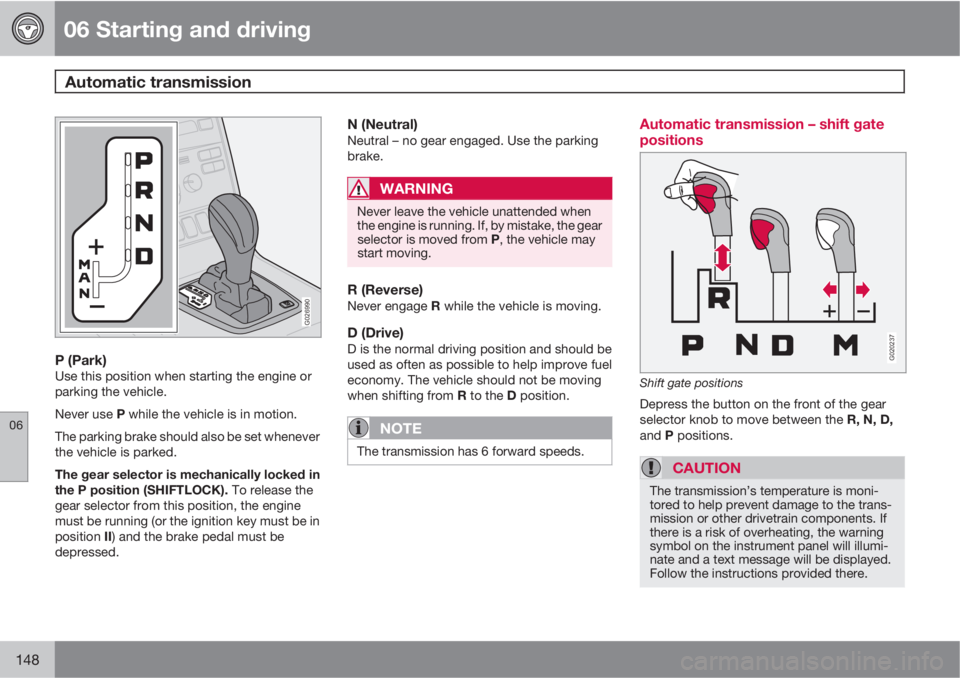
P (Park)Use this position when starting the engine or
parking the vehicle.
Never use P while the vehicle is in motion.
The parking brake should also be set whenever
the vehicle is parked.
The gear selector is mechanically locked in
the P position (SHIFTLOCK). To release the
gear selector from this position, the engine
must be running (or the ignition key must be in
position II) and the brake pedal must be
depressed.
N (Neutral)Neutral – no gear engaged. Use the parking
brake.
WARNING
Never leave the vehicle unattended when
the engine is running. If, by mistake, the gear
selector is moved from P, the vehicle may
start moving.
R (Reverse)Never engage R while the vehicle is moving.
D (Drive)D is the normal driving position and should be
used as often as possible to help improve fuel
economy. The vehicle should not be moving
when shifting from R to the D position.
NOTE
The transmission has 6 forward speeds.
Automatic transmission – shift gate
positions
G020237
Shift gate positions
Depress the button on the front of the gear
selector knob to move between the R, N, D,
and P positions.
CAUTION
The transmission’s temperature is moni-
tored to help prevent damage to the trans-
mission or other drivetrain components. If
there is a risk of overheating, the warning
symbol on the instrument panel will illumi-
nate and a text message will be displayed.
Follow the instructions provided there.
Page 151 of 310
06 Starting and driving
Automatic transmission
06
149
KickdownAutomatic shift to a lower gear (kickdown) is
achieved by depressing the accelerator pedal
fully and briskly. An upshift will occur when
approaching the top speed for a particular gear
or by releasing the accelerator pedal slightly.
Kickdown can be used for maximum acceler-
ation or when passing at highway speeds.
NOTE
The gear selector must be in the D (Drive)
position for kickdown to function.
Manual shifting – Geartronic
You can move the gear selector freely between
the MAN (Manual) and D (Drive) positions to
select forward gears while driving. Gears 3, 4,
5, and 6 have a "lock-up" function which
reduces engine speed and helps save fuel.
NOTE
Reverse, Neutral, and Park cannot be
selected in Geartronic mode.
•A "lock-up" feature1 reduces engine speed
and help saves fuel.The currently selected gear will be displayed in
the instrument panel (see page 58).
•To access the MAN shifting position from
D, move the gear selector to the left to
MAN.
•To return to the D positions from MAN,
move the gear selector to the right.
While driving
If you select the MAN position while driving, the
gear that was being used in the D position will
also initially be selected in MAN position.
•Move the gear selector forward (toward
"+") to shift to a higher gear or rearward
(toward "– ") to shift to a lower gear.
•If you hold the gear selector toward "–", the
transmission will downshift one gear and
will utilize the braking power of the engine.
If the current speed is too high for using a
lower gear, the downshift will not occur
until the speed has decreased enough to
allow the lower gear to be used.
•If you slow down to a very low speed, the
transmission will automatically shift down.
•When starting in the MAN position, 3rd
gear is the highest gear that may be
selected.
W – Winter/Wet driving mode –
enhanced vehicle traction
G030859
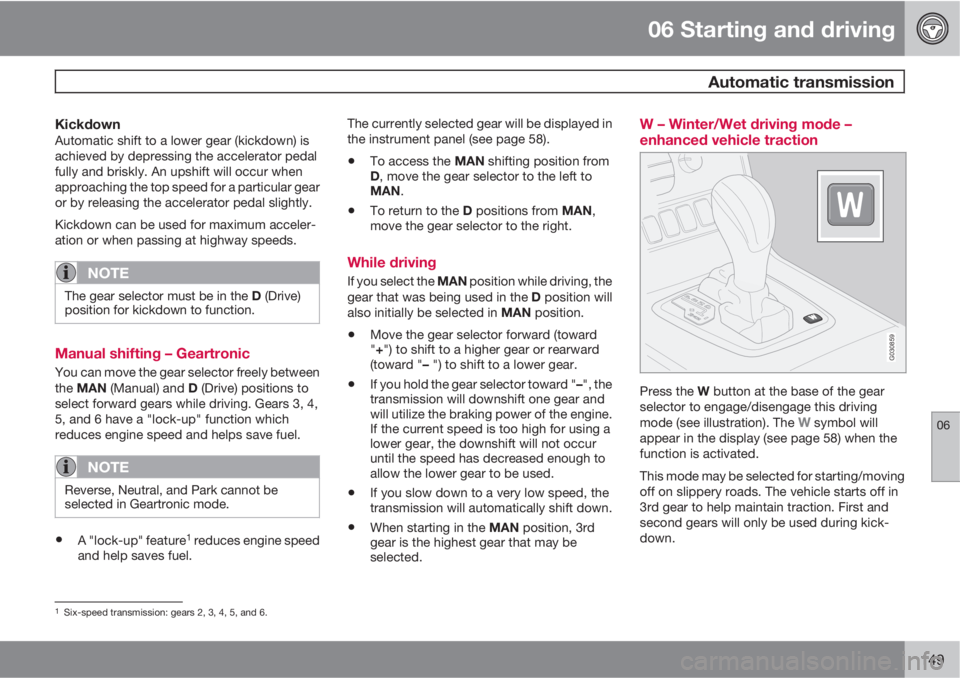
Press the W button at the base of the gear
selector to engage/disengage this driving
mode (see illustration). The
W symbol will
appear in the display (see page 58) when the
function is activated.
This mode may be selected for starting/moving
off on slippery roads. The vehicle starts off in
3rd gear to help maintain traction. First and
second gears will only be used during kick-
down.
1Six-speed transmission: gears 2, 3, 4, 5, and 6.
Page 155 of 310
06 Starting and driving
Brake system
06
* Option/accessory, for more information, see Introduction.153 BRAKE Brake circuit malfunction
The brake system is a hydraulic system con-
sisting of two master cylinders and two sepa-
rate brake circuits. If a problem should occur in
one of these circuits, it is still possible to stop
the vehicle with the other brake circuit.
If the brake pedal must be depressed farther
than normal and requires greater foot pressure,
the stopping distance will be longer.
A warning light in the instrument panel will light
up to warn the driver that a fault has occurred.
If this light comes on while driving or braking,
stop immediately and check the brake fluid
level in the reservoir.
NOTE
Press the brake pedal hard and maintain
pressure on the pedal – do not pump the
brakes.
WARNING
If the fluid level is below the MIN mark in the
reservoir or if a BRAKE FAILURE STOP
SAFELY message is displayed in the text
window: DO NOT DRIVE. Have the vehicle
towed to a trained and qualified Volvo serv-
ice technician and have the brake system
inspected.
NOTE
When the vehicle is at a standstill and the
engine is idling, e.g. at a traffic light and the
brake pedal is depressed, the pedal may go
down slightly. This is a normal function of
the power-assisted brake system.
Brake pad inspectionOn vehicles equipped with a jack*, the condi-
tion of the brake pads can be checked by rais-
ing the vehicle (see page 195 for information
about using the jack and removing a wheel)
and performing a visual inspection of the brake
pads.
WARNING
•If the vehicle has been driven immedi-
ately prior to a brake pad inspection, the
wheel hub, brake components, etc., will
be very hot. Allow time for these com-
ponents to cool before carrying out the
inspection.
•Apply the parking brake and put the
gear selector in the Park (P) position.
•Block the wheels standing on the
ground, use rigid wooden blocks or
large stones.
WARNING
•Use the jack intended for the vehicle
when changing a tire. For any other job,
use stands to support the vehicle.
•The jack should be kept well-greased
and clean, and should not be damaged.
•Be sure the jack is on a firm, level, non-
slippery surface.
•No objects should be placed between
the base of jack and the ground, or
between the jack and the attachment
bar on the vehicle.
•The jack must correctly engage the jack
attachment.
•Never allow any part of your body to be
extended under a vehicle supported by
a jack.
Power brakes function only when the
engine is running
The power brakes utilize vacuum pressure
which is only created when the engine is run-
ning. Never let the vehicle roll to a stop with the
engine switched off.
If the power brakes are not working, consider-
ably higher pressure will be required on the
brake pedal to compensate for the lack of
power assistance. This can happen for exam-
ple when towing your vehicle or if the engine is
Page 160 of 310
06 Starting and driving
Stability system
06
158
DSTC-related messages in the text
window
•TRACTION CONTROL TEMPORARILY
OFF : The system has been temporarily
switched off due to high brake temperature
and will automatically switch on again
when the brakes have cooled.
•ANTI-SKID SERVICE REQUIRED: The
system has been automatically disen-
gaged due to a fault. A trained and qualified
Volvo service technician should check the
system.
Symbols in the instrument panel
The Stability Control indicator lightThis light indicates different condi-
tions, depending on how it illumi-
nates.
The Stability Control indicator light
illuminates for approximately 2 seconds
This indicates that the system is performing a
self-diagnostic test when the ignition is
switched on.
The Stability Control indicator light
flashes
This indicates that the stability system is
actively functioning to help counteract wheel
spin and/or a skid.
The Stability Control indicator light
glows steadily
ANTI-SKID SERVICE REQUIRED will be dis-
played in the text window at the same time.
A fault is indicated in the stability system.
•Stop the vehicle in a safe place and switch
off the engine.
•Restart the engine.
•If the indicator light goes out, the fault was
temporary and no further action is
required.
•If the indicator light remains on, drive to an
authorized Volvo workshop as soon as
possible to have the system checked.
The Stability Control indicator light
glows steadily
If DSTC SPIN CONTROL OFF is displayed in
the text window at the same time, this is a
reminder that spin control has been disabled
by the driver.
The warning symbolThe warning symbol glows
steadily yellow
The system has been temporarily switched off
due to high brake temperature. TRACTIONCONTROL TEMPORARILY OFF
will be dis-
played. The system will automatically switch
on again when the brakes have cooled.
WARNING
The stability system is intended to help
improve driving safety. It supplements, but
can never replace, the driver's judgement
and responsibility when operating the vehi-
cle. Speed and driving style should always
be adapted to traffic and road conditions.
Page 170 of 310
06 Starting and driving
Cold weather precautions
06
168
If you wish to check your vehicle before the
approach of cold weather, the following advice
is worth noting:
•Make sure that the engine coolant contains
50 percent antifreeze. Any other mixture
will reduce freeze protection. This gives
protection against freezing down to –31 °F
(–35 °C). See section "Coolant".
•The use of "recycled" antifreeze is not
approved by Volvo. Different types of
antifreeze must not be mixed.
•Volvo recommends using only genuine
Volvo antifreeze in your vehicle's radiator.
Your Volvo retailer stocks plenty of Volvo
engine coolant to protect your vehicle dur-
ing cold weather.
•Try to keep the fuel tank well filled – this
prevents the formation of condensation in
the tank. In addition, in extremely cold
weather conditions it is worthwhile to add
fuel line de-icer before refueling.
•The viscosity of the engine oil is important.
Oil with low viscosity (thinner oil) improves
cold-weather starting as well as decreas-
ing fuel consumption while the engine is
warming up. 0W-30 oil is recommended for
driving in areas with sustained low temper-
atures.
•The load placed on the battery is greater
during the winter since the windshield wip-
ers, lighting, etc. are used more often.Moreover, the capacity of the battery
decreases as the temperature drops. In
very cold weather, a poorly charged bat-
tery can freeze and be damaged. It is there-
fore advisable to check the state of charge
more frequently and spray an antirust oil on
the battery posts.
•Volvo recommends the use of snow tires
on all four wheels for winter driving – see
section "Wheels and tires."
•To prevent the washer fluid reservoir
from freezing, add washer solvents con-
taining antifreeze (see page 222 for the
location of the washer fluid reservoir). This
is important since dirt is often splashed on
the windshield during winter driving,
requiring the frequent use of the washers
and wipers. Volvo Washer Solvent should
be diluted as follows:
•Down to 14 ° F (–10 ° C): 1 part washer
solvent and 4 parts water
•Down to 5 ° F (–15 ° C): 1 part washer sol-
vent and 3 parts water
•Down to 0 ° F (–18 ° C):1 part washer sol-
vent and 2 parts water
•Down to –18 ° F (–28 ° C): 1 part washer
solvent and 1 part water
•Use Volvo Teflon Lock Spray in the locks.
NOTE
Avoid the use of de-icing sprays as they can
cause damage to the locks.
W – Winter/Wet driving mode – enhanced
vehicle traction
•Mode W will only function if the gear selec-
tor is in the (D)rive position.
•Press the button at the base of the gear
selector to engage/disengage this driving
mode.
•An LED in the button will light up to indicate
that W is engaged and this will also be dis-
played in the instrument panel (see
page 58).
•This mode may be selected for starting/
moving off on slippery roads.
Page 172 of 310
06 Starting and driving
Blind Spot Information System*
06
170* Option/accessory, for more information, see Introduction.
G020295
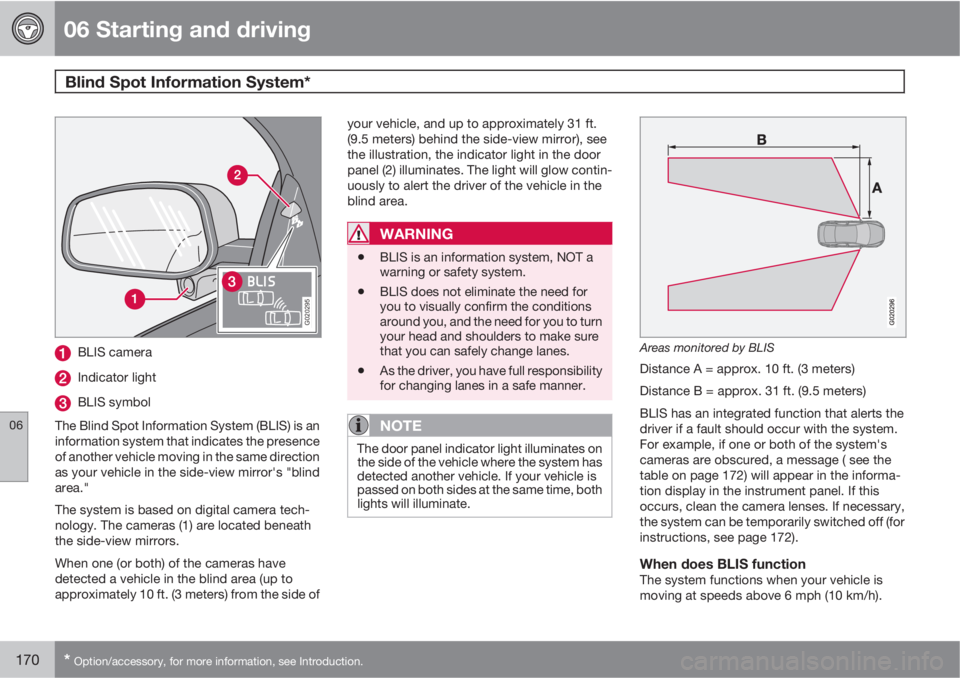
BLIS camera
Indicator light
BLIS symbol
The Blind Spot Information System (BLIS) is an
information system that indicates the presence
of another vehicle moving in the same direction
as your vehicle in the side-view mirror's "blind
area."
The system is based on digital camera tech-
nology. The cameras (1) are located beneath
the side-view mirrors.
When one (or both) of the cameras have
detected a vehicle in the blind area (up to
approximately 10 ft. (3 meters) from the side ofyour vehicle, and up to approximately 31 ft.
(9.5 meters) behind the side-view mirror), see
the illustration, the indicator light in the door
panel (2) illuminates. The light will glow contin-
uously to alert the driver of the vehicle in the
blind area.
WARNING
•BLIS is an information system, NOT a
warning or safety system.
•BLIS does not eliminate the need for
you to visually confirm the conditions
around you, and the need for you to turn
your head and shoulders to make sure
that you can safely change lanes.
•As the driver, you have full responsibility
for changing lanes in a safe manner.
NOTE
The door panel indicator light illuminates on
the side of the vehicle where the system has
detected another vehicle. If your vehicle is
passed on both sides at the same time, both
lights will illuminate.
Areas monitored by BLIS
Distance A = approx. 10 ft. (3 meters)
Distance B = approx. 31 ft. (9.5 meters)
BLIS has an integrated function that alerts the
driver if a fault should occur with the system.
For example, if one or both of the system's
cameras are obscured, a message ( see the
table on page 172) will appear in the informa-
tion display in the instrument panel. If this
occurs, clean the camera lenses. If necessary,
the system can be temporarily switched off (for
instructions, see page 172).
When does BLIS functionThe system functions when your vehicle is
moving at speeds above 6 mph (10 km/h).
Page 202 of 310
07 Wheels and tires
Tire Pressure Monitoring System (TPMS)
07
200
The tire pressure monitoring system1 uses sen-
sors mounted in the tire valves to check infla-
tion pressure levels. When the vehicle is mov-
ing at a speed of approximately 20 mph
(30 km/h) or faster, these sensors transmit
inflation pressure data to a receiver located in
the vehicle.
USA – FCC ID: MRXG403MA4A
This device complies with part 15 of the FCC
rules. Operation is subject to the following
conditions: (1) This device may not cause
harmful interference, and (2) this device
must accept any interference received,
including interference that may cause unde-
sired operation.
When low inflation pressure is detected,
TPMS will light up the tire pressure warning
light (also referred to as a telltale) in the
instrument panel (see page 61), and will dis-
play a message in the text window. The
wording of this message is determined by
the degree of inflation pressure loss.
AOn certain models, the FCC code is MRXTG315AM04
When low inflation pressure is detected, TPMS
will light up the tire pressure warning light
(also referred to as a telltale) in the instrumentpanel and will display one of the following mes-
sages in the text window:
LOW TIRE PRESS.
CHECK TIRES or VERY LOW TIRE
PRESSURE.
NOTE
If a fault occurs in TPMS, the tire pressure
warning light will flash for approximately
1 minute and
TIRE PRESS SYST
SERVICE REQUIRED will be displayed.
Each tire, including the spare (if provided),
should be checked monthly when cold and
inflated to the inflation pressure recommended
by the vehicle manufacturer on the vehicle
placard or tire inflation pressure label. (If your
vehicle has tires of a different size than the size
indicated on the vehicle placard or tire inflation
pressure label, you should determine the
proper tire inflation pressure for those tires.)
As an added safety feature, your vehicle has
been equipped with a tire pressure monitoring
system (TPMS) that illuminates a low tire pres-
sure telltale when one or more of your tires is
significantly under-inflated. Accordingly, when
the low tire pressure telltale illuminates, you
should stop and check your tires as soon as
possible, and inflate them to the proper pres-
sure. Driving on a significantly under-inflatedtire causes the tire to overheat and can lead to
tire failure. Under-inflation also reduces fuel
efficiency and tire tread life, and may affect the
vehicle's handling and stopping ability.
Please note that the TPMS is not a substitute
for proper tire maintenance, and it is the driv-
er's responsibility to maintain correct tire pres-
sure, even if under-inflation has not reached
the level to trigger illumination of the TPMS low
tire pressure telltale.
Your vehicle has also been equipped with a
TPMS malfunction indicator to indicate when
the system is not operating properly. The
TPMS malfunction indicator is combined with
the low tire pressure telltale. When the system
detects a malfunction, the telltale will flash for
approximately one minute and then remain
continuously illuminated. This sequence will
continue upon subsequent vehicle start-ups as
long as the malfunction exists. When the mal-
function indicator is illuminated, the system
may not be able to detect or signal low tire
pressure as intended. TPMS malfunctions may
occur for a variety of reasons, including the
installation of replacement or alternate tires or
wheels on the vehicle that prevent the TPMS
from functioning properly. Always check the
TPMS malfunction telltale after replacing one
or more tires or wheels on your vehicle to
1This system is standard on U.S. models and optional on Canadian models
Page 204 of 310
07 Wheels and tires
Tire Pressure Monitoring System (TPMS)
07
202* Option/accessory, for more information, see Introduction.
Activating/deactivating TPMS (Canadian
models only)
1. Switch off the engine.
2.
Turn the ignition key to position I or II.
3.
Press and hold the Reset button on the
left-side steering wheel lever until
TIRE
PRESS SYST OFF is displayed.
Repeat steps 1-3 to turn TPMS on again.
Self-supporting run flat tires (SST)*
Self-supporting run flat tires are available as
optional equipment. The vehicle must be
equipped with the Tire Pressure Monitoring
System (TPMS) if tires of this type are installed.
Tires of this type have specially reinforced
sidewalls that make it possible to continue
driving to a limited extent even though the tire
has lost some or all of its inflation pressure.
These tires are mounted on special rims (nor-
mal tires can also be mounted on these rims).
If an SST tire loses inflation pressure, the yel-
low TPMS symbol illuminates in the instrument
panel and a text message is also displayed. If
this happens, reduce speed to not more than
50 mph (80 km/h). The tire should be replaced
as soon as possible.Drive carefully; it may be difficult to determine
which tire is damaged. To find the damaged
tire, check the inflation pressure in all four tires.
WARNING
•SST tires should only be mounted by
service technicians who are familiar
with tires of this type.
•SST tires may only be mounted on vehi-
cles equipped with TPMS.
•Do not drive faster than 50 mph
(80 km/h) if TPMS indicates that a tire
has lost inflation pressure.
•Do not drive farther than 50 miles
(80 km) before replacing a damaged
SST tire.
•Drive carefully and avoid e.g., hard
braking or fast turns.
•SST tires must be replaced if they are
damaged. A tire of this type cannot be
repaired.
Page 222 of 310
09 Maintenance and servicing
Engine oil 09
220
Oil specifications
Engine oil must meet the minimum
ACEA A5/B5. Lower quality oils may not offer
the same fuel economy, engine performance,
or engine protection.
Oil additives must not be used.
Oil viscosityIncorrect viscosity oil can shorten engine life
under normal use. SAE 5W-30 will provide
good fuel economy and engine protection. See
the viscosity chart.
Viscosity chart
Extreme engine operationSAE 0W-30 oil meeting ACEA A5/B5 require-
ments is recommended for driving in areas with
sustained low temperatures.
NOTE
Volvo uses different systems to indicate a
low oil level or pressure. Some models have
an oil pressure sensor, in which case a
warning symbol (see page 60) is used to
indicate low oil pressure. Other models have
an oil level sensor, in which case the driver
is alerted by the warning symbol in the cen-
ter of the instrument panel and a text in the
information display. Some models use both
systems. Contact a trained and qualified
Volvo service technician for more informa-
tion.
Changing engine oil and oil filter
See page 293 for oil volumes. Refer to the
Warranty and Service Records Information
booklet for information on the oil change inter-
vals.
NOTE
Volvo does not recommend the use of oil
additives.
Checking and adding oil
G030880
Location of dipstick (1) and oil filler cap (2)
The oil level should be checked at regular inter-
vals, particularly during the period up to the
first scheduled maintenance service.
•The vehicle should be parked on a level
surface when the oil is checked.
•If the engine is warm, wait for at least
10-15 minutes after the engine has been
switched off before checking the oil.