maintenance VOLVO XC90 2013 Owner´s Manual
[x] Cancel search | Manufacturer: VOLVO, Model Year: 2013, Model line: XC90, Model: VOLVO XC90 2013Pages: 310, PDF Size: 8.62 MB
Page 7 of 310
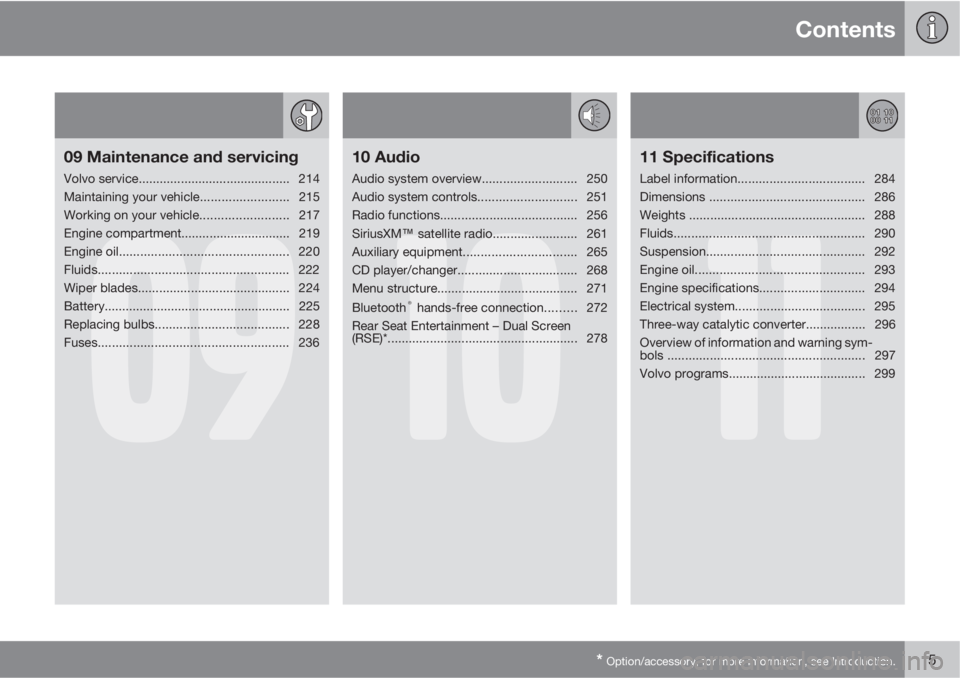
Contents
* Option/accessory, for more information, see Introduction.5
09
09 Maintenance and servicing
Volvo service........................................... 214
Maintaining your vehicle.........................215
Working on your vehicle......................... 217
Engine compartment............................... 219
Engine oil................................................ 220
Fluids...................................................... 222
Wiper blades........................................... 224
Battery..................................................... 225
Replacing bulbs...................................... 228
Fuses...................................................... 236
10
10 Audio
Audio system overview........................... 250
Audio system controls............................251
Radio functions....................................... 256
SiriusXM
E satellite radio........................ 261
Auxiliary equipment................................265
CD player/changer.................................. 268
Menu structure........................................ 271
Bluetooth
® hands-free connection......... 272
Rear Seat Entertainment – Dual Screen
(RSE)*......................................................278
11
11 Specifications
Label information.................................... 284
Dimensions ............................................ 286
Weights .................................................. 288
Fluids...................................................... 290
Suspension............................................. 292
Engine oil................................................ 293
Engine specifications.............................. 294
Electrical system..................................... 295
Three-way catalytic converter................. 296
Overview of information and warning sym-
bols ........................................................297
Volvo programs....................................... 299
Page 15 of 310
Introduction
Environment
13 Volvo and the environment
Volvo is committed to the well being of its cus-
tomers. As a natural part of this commitment,
we care about the environment in which we all
live. Caring for the environment means an
everyday involvement in reducing our environ-
mental impact. Volvo's environmental activities
are based on a holistic view, which means we
consider the overall environmental impact of a
product throughout its complete life cycle. In
this context, design, production, product use,
and recycling are all important considerations.
In production, Volvo has partly or completely
phased out several chemicals including CFCs,
lead chromates, asbestos, and cadmium; and
reduced the number of chemicals used in our
plants 50% since 1991.
Volvo was the first in the world to introduce into
production a three-way catalytic converter with
a Lambda sond, now called the heated oxygen
sensor, in 1976. The current version of this
highly efficient system reduces emissions of
harmful substances (CO, HC, NOx) from the
exhaust pipe by approximately 95 – 99% and
the search to eliminate the remaining emis-
sions continues. Volvo is the only automobile
manufacturer to offer CFC-free retrofit kits for
the air conditioning system of all models as far
back as the 1975 model 240. Advanced elec-
tronic engine controls and cleaner fuels are
bringing us closer to our goal. In addition tocontinuous environmental refinement of con-
ventional gasoline-powered internal combus-
tion engines, Volvo is actively looking at
advanced technology alternative-fuel vehicles.
When you drive a Volvo, you become our part-
ner in the work to lessen the car's impact on
the environment. To reduce your vehicle's
environmental impact, you can:
•Maintain proper air pressure in your tires.
Tests have shown decreased fuel econ-
omy with improperly inflated tires.
•Follow the recommended maintenance
schedule in your Warranty and Service
Records Information booklet.
•Drive at a constant speed whenever pos-
sible.
•See a trained and qualified Volvo service
technician as soon as possible for inspec-
tion if the check engine (malfunction indi-
cator) light illuminates, or stays on after the
vehicle has started.
•Properly dispose of any vehicle-related
waste such as used motor oil, used batter-
ies, brake pads, etc.
•When cleaning your vehicle, please use
genuine Volvo car care products. All Volvo
car care products are formulated to be
environmentally friendly.
RecyclingAs part of Volvo’s commitment to the environ-
ment, it is essential for the vehicle to be recy-
cled in an environmentally sound way. Almost
the entire vehicle can be recycled and for that
reason, the vehicle’s final owner is requested
to contact a Volvo retailer for information about
approved and certified recycling facilities.
FSCŸŸ
The FSCŸ (Forest Stewardship CouncilŸ) sym-
bol indicates that the wood pulp used in this
publication comes from FSC
Ÿ certified forests
and other responsible sources.
Page 24 of 310
01 Safety
Seat belts 01
22
steering wheel). Within this context, they
should strive to position the seat with as large
a distance as possible between their belly and
the steering wheel.
Child seatsPlease see page 38 for information on secur-
ing child seats with the seat belts.
Seat belt maintenanceCheck periodically that the seat belts are in
good condition. Use water and a mild deter-
gent for cleaning. Check seat belt mechanism
function as follows: attach the seat belt and pull
rapidly on the strap.
Page 31 of 310
01 Safety
Occupant Weight Sensor01
29
WARNING
•If a fault in the system is detected and
indicated as explained, be aware that
the passenger's side front airbag will
not deploy in the event of a collision.
•In this case, the safety systems and
Occupant Weight Sensor should be
inspected by a trained and qualified
Volvo service technician as soon as
possible.
WARNING
•Never try to open, remove, or repair any
components in the OWS system. This
could result in system malfunction.
Maintenance or repairs should only be
carried out by a trained and qualified
Volvo service technician.
•The front passenger's seat should not
be modified in any way. This could
reduce pressure on the seat cushion,
which might interfere with the OWS sys-
tem's function.
The OWS is designed to disable (will not inflate)
the passenger's side front airbag when a rear
facing infant seat, a forward-facing child
restraint, or a booster seat is detected. The
PASSENGER AIRBAG OFF indicator lamp willilluminate and stay on to remind you that the
passenger's side front airbag is disabled (see
the following table).
Passeng-
er's seat
occu-
pancy sta-
tusOWS indi-
cator light
statusPasseng-
er's side
front air-
bag status
Seat unoc-
cupiedOWS indica-
tor light
is not
lit
Passenger's
side front
airbag disa-
bled
Seat occu-
pied by low
weight
occupant/
object
A
OWS indica-
tor light
lights
up
Passenger's
side front
airbag disa-
bled
Seat occu-
pied by
heavy occu-
pant/objectOWS indica-
tor light
is not
lit
Passenger's
side front
airbag ena-
bled
AVolvo recommends that children always be properly
restrained in appropriate child restraints in the rear seats.In
rare situations when the seat belt is not properly fastened,
some child restraints may not be detected by the OWS
because there is very little weight on the vehicle seat cush-
ion. In these cases the passenger's side front airbag may be
disabled, but the PASSENGER AIRBAG OFF indicator lamp
will not be lit. Do not assume that the passenger's side front
airbag is disabled unless the PASSENGER AIRBAG OFFindicator lamp is lit. Make sure the child restraint is properly
installed (turn the vehicle off, remove the child restraint from
the vehicle and reinstall the restraint following the child
restraint manufacturer's instructions) and that the
PASSENGER AIRBAG OFF indicator lamp is on, or move
the child restraint to the rear seat.
The OWS is designed to enable (may inflate)
the passenger's side front airbag in the event
of a collision anytime the system senses that a
person of adult size is sitting properly in the
front passenger's seat. The PASSENGER
AIRBAG OFF indicator lamp will be off and
remain off.
If a person of adult size is sitting in the front
passenger's seat, but the PASSENGER
AIRBAG OFF indicator lamp is on, it is possible
that the person isn't sitting properly in the seat.
If this happens:
1. Turn the vehicle off and ask the person to
place the seat back in an upright position.
2. Have the person sit upright in the seat,
centered on the seat cushion, with the per-
son's legs comfortably extended.
3. Restart the vehicle and have the person
remain in this position for about two
minutes. This will allow the system to
detect that person and enable the pas-
senger's frontal airbag.
4.
If the PASSENGER AIRBAG OFF indicator
lamp remains on even after this, the person
should be advised to ride in the rear seat.
Page 64 of 310
02 Instruments and controls
Information display
02
62
Message in the text windows
G026979
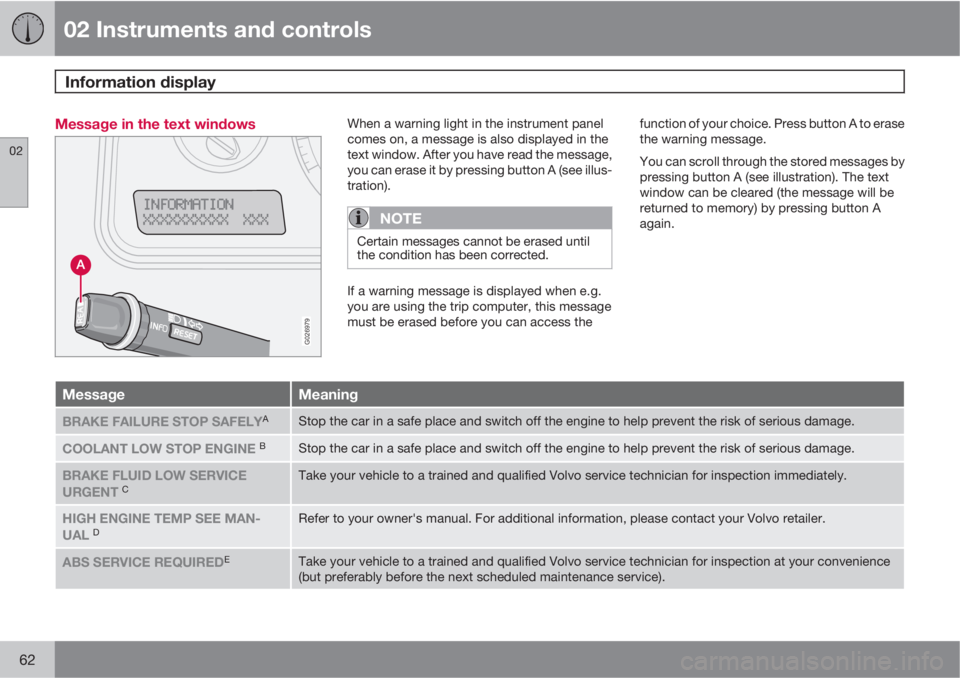
When a warning light in the instrument panel
comes on, a message is also displayed in the
text window. After you have read the message,
you can erase it by pressing button A (see illus-
tration).
NOTE
Certain messages cannot be erased until
the condition has been corrected.
If a warning message is displayed when e.g.
you are using the trip computer, this message
must be erased before you can access thefunction of your choice. Press button A to erase
the warning message.
You can scroll through the stored messages by
pressing button A (see illustration). The text
window can be cleared (the message will be
returned to memory) by pressing button A
again.
MessageMeaning
BRAKE FAILURE STOP SAFELYAStop the car in a safe place and switch off the engine to help prevent the risk of serious damage.
COOLANT LOW STOP ENGINE BStop the car in a safe place and switch off the engine to help prevent the risk of serious damage.
BRAKE FLUID LOW SERVICE
URGENT CTake your vehicle to a trained and qualified Volvo service technician for inspection immediately.
HIGH ENGINE TEMP SEE MAN-
UAL DRefer to your owner's manual. For additional information, please contact your Volvo retailer.
ABS SERVICE REQUIREDETake your vehicle to a trained and qualified Volvo service technician for inspection at your convenience
(but preferably before the next scheduled maintenance service).
Page 96 of 310
03 Climate
Climate control system – general information
03
94* Option/accessory, for more information, see Introduction.
Condensation on the inside of the
windows
Keeping the insides of the windows clean will
help reduce the amount of condensation that
forms on the windows. Use a commercial win-
dow cleaning agent to clean the windows.
Ice and snow
Always keep the air intake grille at the base of
the windshield free of snow.
Cabin air filter
Replace the cabin air filter with a new one at
the recommended intervals. Please refer to
your Warranty and Service Records Informa-
tion booklet, or consult a trained and qualified
Volvo service technician for these intervals.
The filter should be replaced more often when
driving under dirty and dusty conditions. The
filter cannot be cleaned and therefore should
always be replaced with a new one.
Sensors
The sunlight sensor on the dashboard and pas-
senger compartment temperature sensor in
the ECC control panel should not be covered
in any way as this could cause incorrect infor-
mation to be sent to the ECC system.
Parking the vehicle in warm weather
If your vehicle has been parked in the sun in
warm weather, opening the windows and
moonroof* for several minutes before driving
will help release the warm air from the passen-
ger compartment. When the engine is running,
close the windows and moonroof and use the
recirculation function for several minutes to
enable the air conditioning to cool the com-
partment as quickly as possible.
Windows and optional moonroof
The ECC system will function best if the win-
dows and optional moonroof are closed. If you
drive with the moonroof open, we recommend
that you manually adjust the temperature and
blower control (the LED in the AUTO switch
should be off).
Acceleration
The air conditioning is momentarily disen-
gaged during full-throttle acceleration.
Climate control maintenance
Special tools and equipment are required to
maintain and carry out repairs on the climate
system. Work of this type should only be done
by a trained and qualified Volvo service tech-
nician.
Refrigerant
Volvo cares about the environment. The air
conditioning system in your vehicle contains a
CFC-free refrigerant – R134a (HFC134a). This
substance will not deplete the ozone layer. The
approximate amount of R134a contained in the
system is a follows:
6-cylinder engine
Single A/C system: 1.5 lbs (700 g)
Dual
1 A/C system: 2.2 lbs (1000 g)
The system also uses PAG oil.
1Includes the optional rear A/C system
Page 140 of 310
06 Starting and driving
General information
06
138
Engine oil
Although some oil consumption occurs during
normal engine operation, more oil is consumed
when the engine is new as the internal parts
generate higher friction while wearing-in to
each other. From the time the engine is new
until the first maintenance is performed, the oil
consumption could be higher than normal. For
this reason, it is especially important to check
the oil regularly during this period, see
page 220.
Fuel requirements
Deposit control gasoline (detergent
additives)
Volvo recommends the use of detergent gas-
oline to control engine deposits. Detergent
gasoline is effective in keeping injectors and
intake valves clean. Consistent use of deposit
control gasolines will help ensure good driva-
bility and fuel economy. If you are not sure
whether the gasoline contains deposit control
additives, check with the service station oper-
ator.
NOTE
Volvo does not recommend the use of exter-
nal fuel injector cleaning systems.
Unleaded fuelEach Volvo has a three-way catalytic converter
and must use only unleaded gasoline. U.S. and
Canadian regulations require that pumps deliv-
ering unleaded gasoline be labelled "UNLEA-
DED". Only these pumps have nozzles which
fit your vehicle's filler inlet. It is unlawful to dis-
pense leaded fuel into a vehicle labelled
"unleaded gasoline only". Leaded gasoline
damages the three-way catalytic converter and
the heated oxygen sensor system. Repeated
use of leaded gasoline will lessen the effective-
ness of the emission control system and could
result in loss of emission warranty coverage.
State and local vehicle inspection programs
will make detection of misfueling easier, pos-
sibly resulting in emission test failure for mis-
fueled vehicles.
NOTE
Some U.S. and Canadian gasolines contain
an octane enhancing additive called methyl-
cyclopentadienyl manganese tricarbonyl
(MMT). If such fuels are used, your Emission
Control System performance may be affec-
ted, and the Check Engine Light (malfunc-
tion indicator lamp) located on your instru-
ment panel may light. If this occurs, please
return your vehicle to a trained and qualified
Volvo service technician for maintenance.
Gasoline containing alcohol and ethers"Oxygenated fuels"
Some fuel suppliers sell gasoline containing
"oxygenates" which are usually alcohols or
ethers. In some areas, state or local laws
require that the service pump be marked indi-
cating use of alcohols or ethers. However,
there are areas in which the pumps are
unmarked. If you are not sure whether there is
alcohol or ethers in the gasoline you buy, check
with the service station operator. To meet sea-
sonal air quality standards, some areas require
the use of "oxygenated" fuel.
Volvo allows the use of the following "oxygen-
ated" fuels; however, the octane ratings listed
on page 139 must still be met.
Alcohol – Ethanol: Fuels containing up to 10%
ethanol by volume may be used. Ethanol may
also be referred to as Ethyl alcohol, or "Gaso-
hol".
Ethers – MTBE: Fuels containing up to 15%
MTBE may be used.
Page 148 of 310
06 Starting and driving
Economical driving
06
146
Economical driving conserves natural
resources
Better driving economy may be obtained by
thinking ahead, avoiding rapid starts and stops
and adjusting the speed of your vehicle to
immediate traffic conditions. Observe the fol-
lowing rules:
•Bring the engine to normal operating tem-
perature as soon as possible by driving
with a light foot on the accelerator pedal for
the first few minutes of operation. A cold
engine uses more fuel and is subject to
increased wear.
•Whenever possible, avoid using the vehicle
for driving short distances. This does not
allow the engine to reach normal operating
temperature.
•Drive carefully and avoid rapid acceleration
and hard braking.
•Use the transmission's D (Drive) position
as often as possible and avoid using "kick-
down" to help improve fuel economy.
•Do not exceed posted speed limits.
•Avoid carrying unnecessary items (extra
load) in the vehicle.
•Maintain correct tire pressure. Check tire
pressure regularly (when tires are cold).
•Remove snow tires when threat of snow or
ice has ended.
•Note that roof racks, ski racks, etc,
increase air resistance and also fuel con-
sumption.
•At highway driving speeds, fuel consump-
tion will be lower with the air conditioning
on and the windows closed than with the
air conditioning off and the windows open.
•Using the onboard trip computer's fuel
consumption modes can help you learn
how to drive more economically.
Other factors that decrease gas mileage
are:
•Dirty air cleaner
•Dirty engine oil and clogged oil filter
•Dragging brakes
•Incorrect front end alignment.
Some of the above mentioned items and others
are checked at the standard Maintenance
Service intervals.
CAUTION
Drive slowly and carefully if going through
standing water (i.e. flooded roadways, etc.).
Damage to the engine could result if excess
water is drawn in through the air intake sys-
tem. Never drive the vehicle in water deeper
than 18 inches (48 cm).
Page 188 of 310
07 Wheels and tires
Uniform Tire Quality Grading
07
186
ALL PASSENGER VEHICLE TIRES MUST
CONFORM TO FEDERAL SAFETY
REQUIREMENTS IN ADDITION TO THESE
GRADES
Quality grades can be found, where appli-
cable, on the tire sidewall between the tread
shoulder and maximum section width. For
example:
Treadwear 200 Traction AA Temperature A
TREADWEARThe treadwear grade is a comparative rating
based on the wear rate of the tire when tested
under controlled conditions on a specified gov-
ernment test course. For example, a tire gra-
ded 150 would wear one and one half (1 1/2)
times as well on the government course as a
tire graded 100. The relative performance of
tires depends upon the actual conditions of
their use, however, and many depart signifi-
cantly from the norm due to variation in driving
habits, maintenance practices and differences
in road characteristics and climate.
TRACTIONThe traction grades, from highest to lowest, are
AA, A, B, and C, as measured under controlled
conditions on specified government test sur-
faces of asphalt and concrete. A tire marked C
may have poor traction performance.
WARNING
The traction grade assigned to this tire is
based on braking (straight-ahead) traction
tests and is not a measure of cornering
(turning) traction.
TEMPERATUREThe temperature grades are A (the highest), B,
and C, representing the tire's resistance to the
generation of heat and its ability to dissipate
heat when tested under controlled conditions
on a specified indoor laboratory test wheel.
Sustained high temperature can cause the
material of the tire to degenerate and reduce
tire life, and excessive temperature can lead to
sudden tire failure. The grade C corresponds
to a minimum level of performance that all pas-
senger vehicle tires must meet under the Fed-
eral Motor Safety Standard No. 109. Grades B
and A represent higher levels of performance
on the laboratory test wheel than the minimum
required by law.
WARNING
The temperature grade for this tire is estab-
lished for a tire that is properly inflated and
not overloaded. Excessive speed, under-
inflation, or excessive loading, either sepa-
rately or in combination, can cause heat
buildup and tire failure.
Page 202 of 310
07 Wheels and tires
Tire Pressure Monitoring System (TPMS)
07
200
The tire pressure monitoring system1 uses sen-
sors mounted in the tire valves to check infla-
tion pressure levels. When the vehicle is mov-
ing at a speed of approximately 20 mph
(30 km/h) or faster, these sensors transmit
inflation pressure data to a receiver located in
the vehicle.
USA – FCC ID: MRXG403MA4A
This device complies with part 15 of the FCC
rules. Operation is subject to the following
conditions: (1) This device may not cause
harmful interference, and (2) this device
must accept any interference received,
including interference that may cause unde-
sired operation.
When low inflation pressure is detected,
TPMS will light up the tire pressure warning
light (also referred to as a telltale) in the
instrument panel (see page 61), and will dis-
play a message in the text window. The
wording of this message is determined by
the degree of inflation pressure loss.
AOn certain models, the FCC code is MRXTG315AM04
When low inflation pressure is detected, TPMS
will light up the tire pressure warning light
(also referred to as a telltale) in the instrumentpanel and will display one of the following mes-
sages in the text window:
LOW TIRE PRESS.
CHECK TIRES or VERY LOW TIRE
PRESSURE.
NOTE
If a fault occurs in TPMS, the tire pressure
warning light will flash for approximately
1 minute and
TIRE PRESS SYST
SERVICE REQUIRED will be displayed.
Each tire, including the spare (if provided),
should be checked monthly when cold and
inflated to the inflation pressure recommended
by the vehicle manufacturer on the vehicle
placard or tire inflation pressure label. (If your
vehicle has tires of a different size than the size
indicated on the vehicle placard or tire inflation
pressure label, you should determine the
proper tire inflation pressure for those tires.)
As an added safety feature, your vehicle has
been equipped with a tire pressure monitoring
system (TPMS) that illuminates a low tire pres-
sure telltale when one or more of your tires is
significantly under-inflated. Accordingly, when
the low tire pressure telltale illuminates, you
should stop and check your tires as soon as
possible, and inflate them to the proper pres-
sure. Driving on a significantly under-inflatedtire causes the tire to overheat and can lead to
tire failure. Under-inflation also reduces fuel
efficiency and tire tread life, and may affect the
vehicle's handling and stopping ability.
Please note that the TPMS is not a substitute
for proper tire maintenance, and it is the driv-
er's responsibility to maintain correct tire pres-
sure, even if under-inflation has not reached
the level to trigger illumination of the TPMS low
tire pressure telltale.
Your vehicle has also been equipped with a
TPMS malfunction indicator to indicate when
the system is not operating properly. The
TPMS malfunction indicator is combined with
the low tire pressure telltale. When the system
detects a malfunction, the telltale will flash for
approximately one minute and then remain
continuously illuminated. This sequence will
continue upon subsequent vehicle start-ups as
long as the malfunction exists. When the mal-
function indicator is illuminated, the system
may not be able to detect or signal low tire
pressure as intended. TPMS malfunctions may
occur for a variety of reasons, including the
installation of replacement or alternate tires or
wheels on the vehicle that prevent the TPMS
from functioning properly. Always check the
TPMS malfunction telltale after replacing one
or more tires or wheels on your vehicle to
1This system is standard on U.S. models and optional on Canadian models