battery VOLVO XC90 2014 Owner´s Manual
[x] Cancel search | Manufacturer: VOLVO, Model Year: 2014, Model line: XC90, Model: VOLVO XC90 2014Pages: 308, PDF Size: 13.31 MB
Page 154 of 308
06 Starting and driving
Jump starting
06
152
G030860
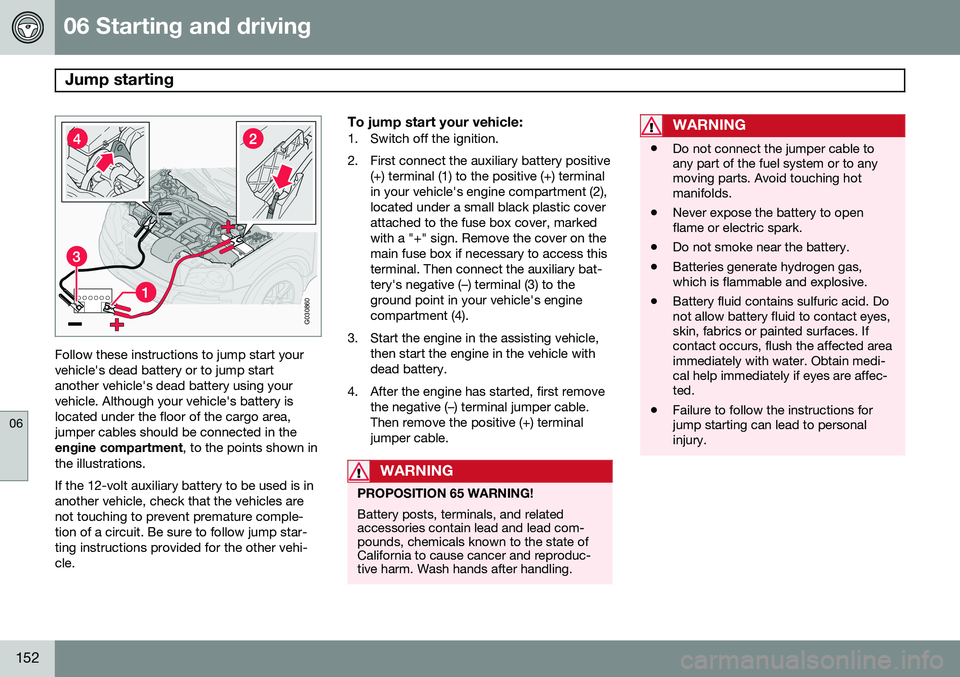
Follow these instructions to jump start your vehicle's dead battery or to jump startanother vehicle's dead battery using yourvehicle. Although your vehicle's battery islocated under the floor of the cargo area,jumper cables should be connected in theengine compartment, to the points shown in
the illustrations. If the 12-volt auxiliary battery to be used is in another vehicle, check that the vehicles arenot touching to prevent premature comple-tion of a circuit. Be sure to follow jump star-ting instructions provided for the other vehi-cle.
To jump start your vehicle:1. Switch off the ignition.
2. First connect the auxiliary battery positive (+) terminal (1) to the positive (+) terminal in your vehicle's engine compartment (2),located under a small black plastic coverattached to the fuse box cover, markedwith a "+" sign. Remove the cover on themain fuse box if necessary to access thisterminal. Then connect the auxiliary bat-tery's negative (–) terminal (3) to theground point in your vehicle's enginecompartment (4).
3. Start the engine in the assisting vehicle, then start the engine in the vehicle withdead battery.
4. After the engine has started, first remove the negative (–) terminal jumper cable.Then remove the positive (+) terminaljumper cable.
WARNING
PROPOSITION 65 WARNING! Battery posts, terminals, and related accessories contain lead and lead com-pounds, chemicals known to the state ofCalifornia to cause cancer and reproduc-tive harm. Wash hands after handling.
WARNING
•Do not connect the jumper cable to any part of the fuel system or to anymoving parts. Avoid touching hotmanifolds.
• Never expose the battery to openflame or electric spark.
• Do not smoke near the battery.
• Batteries generate hydrogen gas,which is flammable and explosive.
• Battery fluid contains sulfuric acid. Donot allow battery fluid to contact eyes,skin, fabrics or painted surfaces. Ifcontact occurs, flush the affected areaimmediately with water. Obtain medi-cal help immediately if eyes are affec-ted.
• Failure to follow the instructions forjump starting can lead to personalinjury.
Page 165 of 308
06 Starting and driving
Towing
06
163
CAUTION
Vehicles with AWD (All Wheel Drive) with the front wheels off the ground should notbe towed at speeds above 50 mph(70 km/h) or for distances longer than30 miles (50 km).
CAUTION
•Please check with state and local authorities before attempting this typeof towing, as vehicles being towed aresubject to regulations regarding maxi-mum towing speed, length and type oftowing device, lighting, etc.
• If the vehicle's battery is dead, do notattempt to start the vehicle by pushingor pulling it as this will damage thethree-way catalytic converter(s). Theengine must be jump started using anauxiliary battery (see page 152).
• If the vehicle is being towed on a flatbed truck, the towing eyelets must notbe used to pull the vehicle up onto theflat bed or to secure the vehicle on theflat bed. Consult the tow truck opera-tor.
WARNING
•The power brakes and power steering will not function when the engine is notrunning. Approximately 5 times morepressure will be required on the brakepedal and the steering wheel will beconsiderably harder to turn.
• The towing eyelets must not be usedfor pulling the vehicle out of a ditch orfor any similar purpose involvingsevere strain.
G030862
Towing vehicles with front wheel drive/All Wheel Drive
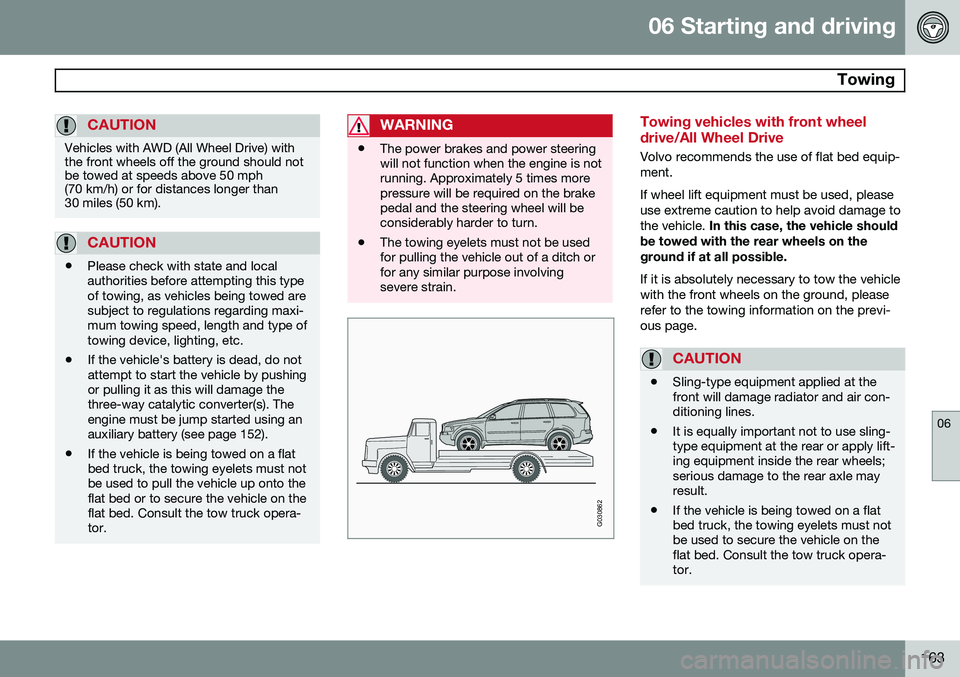
Volvo recommends the use of flat bed equip- ment. If wheel lift equipment must be used, please use extreme caution to help avoid damage tothe vehicle.
In this case, the vehicle should
be towed with the rear wheels on theground if at all possible. If it is absolutely necessary to tow the vehicle with the front wheels on the ground, pleaserefer to the towing information on the previ-ous page.
CAUTION
• Sling-type equipment applied at the front will damage radiator and air con-ditioning lines.
• It is equally important not to use sling-type equipment at the rear or apply lift-ing equipment inside the rear wheels;serious damage to the rear axle mayresult.
• If the vehicle is being towed on a flatbed truck, the towing eyelets must notbe used to secure the vehicle on theflat bed. Consult the tow truck opera-tor.
Page 171 of 308
06 Starting and driving
Cold weather precautions
06
169
If you wish to check your vehicle before the approach of cold weather, the followingadvice is worth noting:
• Make sure that the engine coolant con- tains 50 percent antifreeze. Any othermixture will reduce freeze protection. Thisgives protection against freezing down to–31 °F (–35 °C). See section "Coolant".
• The use of "recycled" antifreeze is notapproved by Volvo. Different types ofantifreeze must not be mixed.
• Volvo recommends using only genuineVolvo antifreeze in your vehicle's radiator.Your Volvo retailer stocks plenty of Volvoengine coolant to protect your vehicleduring cold weather.
• Try to keep the
fuel tank well filled – this
prevents the formation of condensation inthe tank. In addition, in extremely coldweather conditions it is worthwhile to addfuel line de-icer before refueling.
• The viscosity of the engine oil is impor-tant. Oil with low viscosity (thinner oil)improves cold-weather starting as well asdecreasing fuel consumption while theengine is warming up. Full synthetic0W-30 oil is recommended for driving inareas with sustained low temperatures.
• The load placed on the
battery is greater
during the winter since the windshieldwipers, lighting, etc. are used more often. Moreover, the capacity of the batterydecreases as the temperature drops. Invery cold weather, a poorly charged bat-tery can freeze and be damaged. It istherefore advisable to check the state ofcharge more frequently and spray an anti-rust oil on the battery posts.
• Volvo recommends the use of
snow tires
on all four wheels for winter driving – seesection "Wheels and tires."
• To prevent the
washer fluid reservoir
from freezing, add washer solvents con-taining antifreeze (see page 224 for thelocation of the washer fluid reservoir).This is important since dirt is oftensplashed on the windshield during winterdriving, requiring the frequent use of thewashers and wipers. Volvo Washer Sol-vent should be diluted as follows:
• Down to 14 ° F (–10 ° C):
1 part washer
solvent and 4 parts water
• Down to 5 ° F (–15 ° C):
1 part washer
solvent and 3 parts water
• Down to 0 ° F (–18 ° C):
1 part washer
solvent and 2 parts water
• Down to –18 ° F (–28 ° C):
1 part washer
solvent and 1 part water
• Use Volvo Teflon Lock Spray in the locks.
NOTE
Avoid the use of de-icing sprays as they can cause damage to the locks.
W – Winter/Wet driving mode – enhanced vehicle traction
•Mode W will only function if the gear selector is in the (
D)rive position.
• Press the button at the base of the gearselector to engage/disengage this drivingmode.
• An LED in the button will light up to indi-cate that W is engaged and this will alsobe displayed in the instrument panel (seepage 58).
• This mode may be selected for starting/moving off on slippery roads.
Page 172 of 308
06 Starting and driving
Before a long distance trip
06
170
It is always worthwhile to have your vehicle checked by a trained and qualified Volvoservice technician before driving long dis-tances. Your retailer or service technician willalso be able to supply you with bulbs, fuses,spark plugs and wiper blades for your use inthe event that problems occur. As a minimum, the following items should be checked before any long trip:• Check that engine runs smoothly and that fuel consumption is normal.
• Check for fuel, oil, and fluid leakage.
• Check transmission oil level 1
.
• Check condition of drive belts.
• Check state of the battery's charge.
• Examine tires carefully (the spare tire aswell), and replace those that are worn.Check tire pressures.
• The brakes, front wheel alignment, andsteering gear should be checked by atrained and qualified Volvo service techni-cian only.
• Check all lights, including high beams.
• Reflective warning triangles are legallyrequired in some states/provinces. •
Have a word with your Volvo retailer ifyou intend to drive in countries where itmay be difficult to obtain the correct fuel.
• Consider your destination. If you will bedriving through an area where snow or iceare likely to occur, consider snow tires.
1
To prevent injury from contact with hot surfaces, do not inspect your vehicle’s transmission fluid yourself. Have your vehicle’s transmission fluid level inspected by a qualified Volvo service techni- cian.
Page 198 of 308
07 Wheels and tires
Tire Sealing System
07
196
system’s compressor. If necessary, release air from the tire by turning the airrelease knob counterclockwise.
CAUTION
The compressor should not be used for more than 10 minutes at a time to avoidoverheating.
WARNING
If you interrupt your trip for more than 1 hour, check the inflation pressure in thedamaged tire again before continuing.
Replacing the sealing compound container
The sealing compound container must be replaced if:• the tire sealing system has been used to repair a tire
• the container’s expiration date haspassed (see the date on decal).
NOTE
• After use, the sealing compound bot- tle, the hose, and certain other systemcomponents must be replaced. Pleaseconsult your Volvo retailer for replace-ment parts.
• If the sealing compound bottle’s expi-ration date has passed, please take itto a Volvo retailer or a recycling stationthat can properly dispose of harmfulsubstances.
Inflating tires
The tire sealing system can be used to inflate the tires. To do so:
1. Park the car in a safe place.
2. The compressor should be switched off.
Ensure that the on/off switch is in position 0 (the 0 side of the switch should be
pressed down).
3. Take out the electrical wire and hose.
4. Remove the valve cap from the tire’s inflation valve and screw the hose con- nector onto the valve as tightly as possi-ble by hand.
5. Connect the electrical wire to the nearest 12-volt socket in the vehicle. 6. Start the vehicle’s engine.
WARNING
•
The vehicle’s engine should be running when the tire sealing system is used toavoid battery drain. Therefore, be surethe vehicle is parked in a well ventilatedplace, or outdoors, before using thesystem. The parking brake should besecurely applied and the gear selectorshould be in the
P (park) position.
• Children should never be left unatten-ded in the vehicle when the engine isrunning.
7. Check the tire’s inflation pressure on the
gauge. Switch off the compressor briefly to get a clear reading from the pressuregauge.
8. Refer to the tire inflation tables for the correct inflation pressure. If the tire needsto be inflated, start the tire sealing sys-tem’s compressor (press the on/offswitch to position I). If necessary, releaseair from the tire by turning the air releaseknob counterclockwise.
Page 216 of 308
214
Volvo service......................................................................................... 216
Maintaining your vehicle....................................................................... 217
Working on your vehicle........................................................................ 219
Engine compartment............................................................................. 221Engine oil............................................................................................... 222Fluids..................................................................................................... 224Wiper blades......................................................................................... 226Battery................................................................................................... 227
Replacing bulbs.................................................................................... 230Fuses..................................................................................................... 238
Page 219 of 308
09 Maintenance and servicing
Maintaining your vehicle09
}}
217
Owner maintenance
Periodic maintenance requirements and inter- vals are described in your vehicle's Warrantyand Service Records Information booklet. The following points can be carried out between the normally scheduled maintenanceservices.
Each time the vehicle is refueled
•Check the engine oil level
• Clean the windshield, windshield wipers, headlights, and tail lights
Monthly
•Check cold tire pressure in all tires.Inspect the tires for wear.
• Check that engine coolant and other fluidlevels are between the indicated "
min"
and " max" markings.
• Clean interior glass surfaces with a glasscleaner and soft paper towels.
• Wipe driver information displays with asoft cloth.
• Visually inspect battery terminals for cor-rosion. Corrosion may indicate a looseterminal connector, or a battery near theend of its useful service life. Consult atrained and qualified Volvo service techni-cian for additional information.
As needed
•
Wash the vehicle, including the undercar-riage, to reduce wear that can be causedby a buildup of dirt, and corrosion thatcan be caused by salt residues.
• Clean leaves and twigs from air intakevents at the base of the windshield, andfrom other places where they may collect.
• Complete service information for qualifiedtechnicians is available online for pur-chase or subscription at www.volvote-chinfo.com.
Emission inspection readiness
What is an Onboard Diagnostic System
(OBD II)?
OBD II is part of your vehicle's computerized engine management system. It stores diag-nostic information about your vehicle's emis-sion controls. It can light the Check Enginelight (MIL) if it detects an emission control"fault." A "fault" is a component or systemthat is not performing within an expectedrange. A fault may be permanent or tempo-rary. OBD II will store a message about anyfault.
How do states use OBD II for emission
inspections?
Many states connect a computer directly to avehicle's OBD II system. The inspector can then read "faults." In some states, this type ofinspection has replaced the tailpipe emissiontest.
How can my vehicle fail OBD II emission
inspection?
Your vehicle can fail OBD II emission inspec-tion for any of the following reasons.
• If your Check Engine (MIL) light is lit, your vehicle may fail inspection.
• If your vehicle's Check Engine light waslit, but went out without any action onyour part, OBD II will still have a recordedfault. Your vehicle may pass or fail,depending on the inspection practices inyour area.
• If you had recent service that requireddisconnecting the battery, OBD II diag-nostic information may be incompleteand "not ready" for inspection. A vehiclethat is not ready may fail inspection.
How can I prepare for my next OBD II
emission inspection?
• If your Check Engine (MIL) light is lit – orwas lit but went out without service, haveyour vehicle diagnosed and, if necessary,serviced by a qualified Volvo technician.
• If you recently had service for a lit CheckEngine light, or if you had service thatrequired disconnecting the battery, aperiod of driving is necessary to bring the
Page 221 of 308
09 Maintenance and servicing
Working on your vehicle09
219
Note the following before you begin work- ing on your vehicle:
Battery
•
Ensure that the battery cables are cor- rectly connected and tightened.
• Never disconnect the battery when theengine is running (e.g., when replacingthe battery).
• Never use a fast charger to charge thebattery. The battery cables should be dis-connected when recharging.
• The battery contains acid that is both cor-rosive and poisonous. It is important thatthe battery is handled in an environmen-tally friendly way. See page 227 for moreinformation on handling the battery.
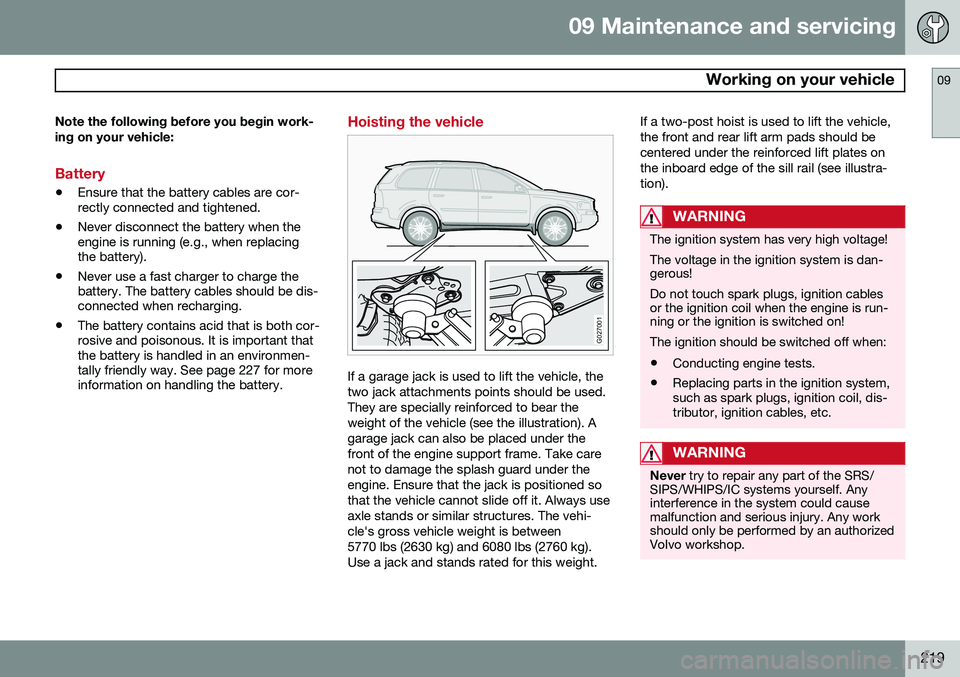
Hoisting the vehicle
G027001
If a garage jack is used to lift the vehicle, the two jack attachments points should be used.They are specially reinforced to bear theweight of the vehicle (see the illustration). Agarage jack can also be placed under thefront of the engine support frame. Take carenot to damage the splash guard under theengine. Ensure that the jack is positioned sothat the vehicle cannot slide off it. Always useaxle stands or similar structures. The vehi-cle's gross vehicle weight is between5770 lbs (2630 kg) and 6080 lbs (2760 kg).Use a jack and stands rated for this weight. If a two-post hoist is used to lift the vehicle,the front and rear lift arm pads should becentered under the reinforced lift plates onthe inboard edge of the sill rail (see illustra-tion).
WARNING
The ignition system has very high voltage! The voltage in the ignition system is dan- gerous! Do not touch spark plugs, ignition cables or the ignition coil when the engine is run-ning or the ignition is switched on! The ignition should be switched off when: •
Conducting engine tests.
• Replacing parts in the ignition system, such as spark plugs, ignition coil, dis-tributor, ignition cables, etc.
WARNING
Never
try to repair any part of the SRS/
SIPS/WHIPS/IC systems yourself. Any interference in the system could causemalfunction and serious injury. Any workshould only be performed by an authorizedVolvo workshop.
Page 223 of 308
09 Maintenance and servicing
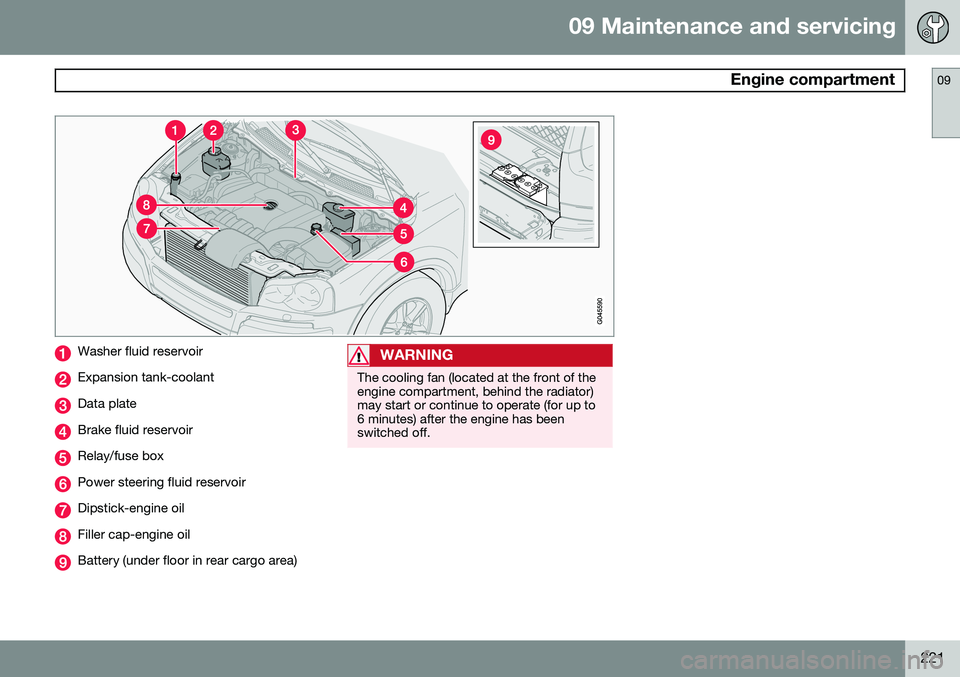
Engine compartment09
221
Washer fluid reservoir
Expansion tank-coolant
Data plate
Brake fluid reservoir
Relay/fuse box
Power steering fluid reservoir
Dipstick-engine oil
Filler cap-engine oil
Battery (under floor in rear cargo area)
WARNING
The cooling fan (located at the front of the engine compartment, behind the radiator)may start or continue to operate (for up to6 minutes) after the engine has beenswitched off.
Page 229 of 308
09 Maintenance and servicing
Battery09
227
Battery maintenance
The battery in your vehicle is located under the floor of the cargo compartment. Driving habits and conditions, climate, the number of starts, etc. all affect the service lifeand function of the battery. In order for yourbattery to perform satisfactorily, keep the fol-lowing in mind:
• Use a screw driver to open the caps or cover and a flashlight to inspect the level.
• If necessary, add distilled water. The levelshould never be above the indicator.
• The fluid level should be checked if thebattery has been recharged.
• After inspection, be sure the cap overeach battery cell or the cover is securelyin place.
• Check that the battery cables are cor-rectly connected and properly tightened.
• Never disconnect the battery when theengine is running, or when the key is inthe ignition. This could damage the vehi-cle's electrical system.
• The battery should be disconnected fromthe vehicle when a battery charger isused directly on the battery.
• To help keep the battery in good condi-tion, the vehicle should be driven for atleast 15 minutes a week or connected to a charger with an automatic chargingfunction.
• If the battery is fully discharged a numberof times, this may shorten its service life.Keeping the battery fully charged helpsprolong its service life.
• The service life of a battery is affected byfactors such as driving conditions and cli-mate. Extreme cold may also furtherdecrease the battery’s starting capacity.
• Because the battery’s starting capacitydecreases with time, it may be necessaryto recharge it if the vehicle is not drivenfor an extended period of time or if thevehicle is usually only driven short dis-tances.
•
WARNING
PROPOSITION 65 WARNING! Battery posts, terminals, and related accessories contain lead and lead com-pounds, chemicals known to the state ofCalifornia to cause cancer and reproduc-tive harm. Wash hands after handling.
WARNING
• Never expose the battery to open flame or electric spark.
• Do not smoke near the battery.
• Battery fluid contains sulfuric acid. Donot allow battery fluid to contact eyes,skin, fabrics or painted surfaces. Ifcontact occurs, flush the affected areaimmediately with water. Obtain medi-cal help immediately if eyes are affec-ted.
NOTE
Used batteries should be properly dis- posed of at a recycling station or similarfacility, or taken to your Volvo retailer.