tailgate VOLVO XC90 2014 Owner´s Manual
[x] Cancel search | Manufacturer: VOLVO, Model Year: 2014, Model line: XC90, Model: VOLVO XC90 2014Pages: 308, PDF Size: 13.31 MB
Page 133 of 308
05 Locks and alarm
Locking and unlocking
05
131
G028485
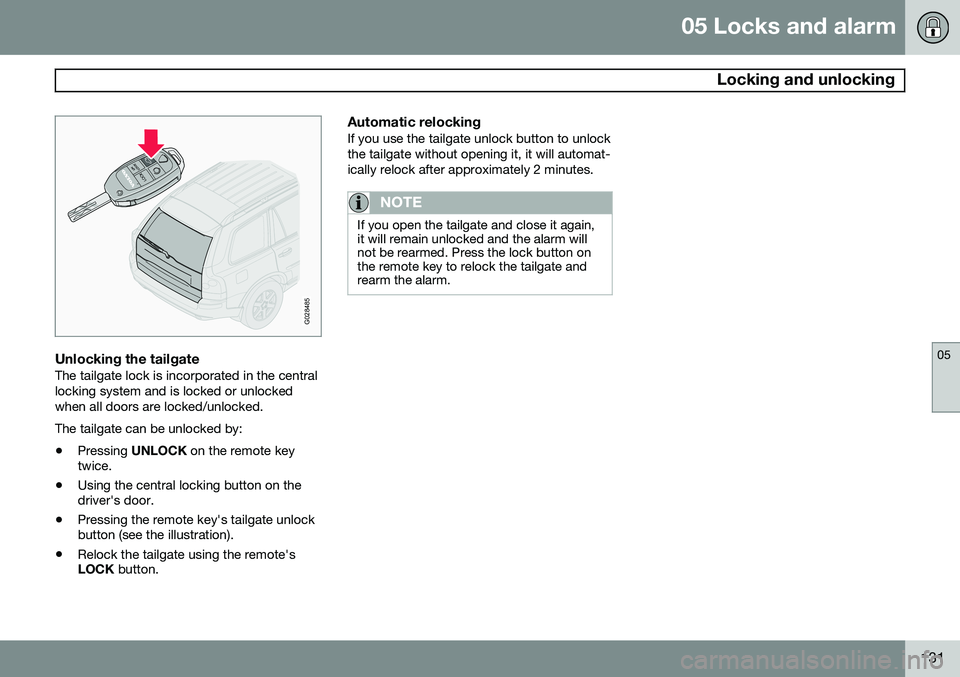
Unlocking the tailgateThe tailgate lock is incorporated in the central locking system and is locked or unlockedwhen all doors are locked/unlocked. The tailgate can be unlocked by:
• Pressing
UNLOCK on the remote key
twice.
• Using the central locking button on the driver's door.
• Pressing the remote key's tailgate unlockbutton (see the illustration).
• Relock the tailgate using the remote'sLOCK
button.
Automatic relockingIf you use the tailgate unlock button to unlock the tailgate without opening it, it will automat-ically relock after approximately 2 minutes.
NOTE
If you open the tailgate and close it again, it will remain unlocked and the alarm willnot be rearmed. Press the lock button onthe remote key to relock the tailgate andrearm the alarm.
Page 135 of 308
05 Locks and alarm
Alarm
05
* Option/accessory, for more information, see Introduction.133
The alarm is automatically armed whenever you lock your vehicle. When armed, the alarm continuously moni- tors a number of points on the vehicle. Thefollowing conditions will set off the alarm: •
The hood is forced open.
• The tailgate is forced open.
• A door is forced open.
• The ignition switch is tampered with.
• If there is movement in the passenger compartment (if the vehicle is equippedwith the optional movement sensor).
• The vehicle is lifted or towed (if the vehi-cle is equipped with the optional inclina-tion sensor).
• The battery is disconnected (while thealarm is armed).
• The siren is disconnected when the alarmis disarmed.
Arming the alarm1. Press the
LOCK button on the remote
key.
2. Lock the vehicle using the key blade in the driver's door or press the central lock button on the driver's door with the dooropen.
One long flash of the turn signals will confirmthat the alarm is armed.
Movement sensor*In addition to triggering the alarm if there ismovement in the passenger compartment,currents of air may also affect the movementsensor. This means that locking the vehiclewith the windows or the moonroof open, orusing an accessory portable passenger com-partment heater, could trigger the alarm. To help avoid this, close the windows and moonroof before locking the vehicle. If a pas-senger compartment heater is used when thevehicle is locked, direct airflow from the heat-er's vent(s) so that it isn't directed upward inthe passenger compartment.
Disarming the alarmPress the UNLOCK button on the remote key
or unlock the doors with the key blade.
Turning off (stopping) the alarmIf the alarm is sounding, it can be stopped bypressing the UNLOCK button on the remote
key or by unlocking the driver's door with thekey blade.
Visual alarm signalThe visual alarm signal is given by flashing allturn signals and turning on the interior lightingfor approximately 5 minutes.
Audible alarm signalAn audible alarm signal is given by a batterypowered siren. One alarm cycle lasts for25 seconds.
"Panic" buttonIn an emergency situation, this feature can beused to attract attention. Activate the "panic" button by pressing the red button on the remote key ( see page 127for illustration) for at least 3 seconds or bypressing this button twice within 3 seconds.The turn signals will flash, and the vehicle'shorn will sound. The function can be turned off by pressing any of the buttons on the remote key or willstop automatically after 25 seconds. When abutton is pressed, there is a 5 second delaybefore the panic alarm is deactivated.
NOTE
This button will NOT unlock the vehicle.
LED alarm status signalsThe status of the alarm system is indicated by the red LED at the top of the dash: • LED off – the alarm is not armed
• LED flashes once per second – the alarm is armed
Page 136 of 308
05 Locks and alarm
Alarm
05
134
•LED flashes rapidly before the ignition is switched on – the alarm has been trig-gered
• Fault in the alarm system:
If a fault has
been detected in the alarm system, amessage will be displayed in the text win-dow. Contact a trained and qualifiedVolvo service technician.
Automatic re-lock/re-arm systemIf the vehicle is unlocked with the remote, the vehicle will re-lock and the alarm will re-armafter 2 minutes unless a door or the tailgatehas been opened.
Page 142 of 308
06 Starting and driving
Fuel requirements
06
140
WARNING
Driving with the tailgate open: Driving
with the tailgate open could lead to poi- sonous exhaust gases entering the pas-senger compartment.
• If the tailgate must be kept open for any reason, proceed as follows:
• Close the windows
• Set the ventilation system control to airflow to floor, windshield and side win-dows and blower control to its highestsetting.
Gasoline containing alcohol and ethers, "Oxygenated fuels"
Some fuel suppliers sell gasoline containing "oxygenates" which are usually alcohols orethers. In some areas, state or local lawsrequire that the service pump be marked indi-cating use of alcohols or ethers. However,there are areas in which the pumps areunmarked. If you are not sure whether there isalcohol or ethers in the gasoline you buy,check with the service station operator. Tomeet seasonal air quality standards, someareas require the use of "oxygenated" fuel. Volvo allows the use of the following "oxy- genated" fuels; however, the octane ratingslisted on page 139 must still be met.
Alcohol – EthanolFuels containing up to 10% ethanol by vol- ume may be used. Ethanol may also be refer-red to as Ethyl alcohol, or "Gasohol". Ethers – MTBE: Fuels containing up to 15% MTBE may be used.
MethanolDo not use gasolines containing methanol(methyl alcohol, wood alcohol). This practicecan result in vehicle performance deteriora-tion and can damage critical parts in the fuelsystem. Such damage may not be coveredunder the New Vehicle Limited Warranty.
Weight distribution affects handlingAt the specified curb weight your vehicle hasa tendency to understeer, which means thatthe steering wheel has to be turned morethan might seem appropriate for the curva-ture of a bend. This ensures good stability and reduces the risk of rear wheel skid. Remember that theseproperties can alter with the vehicle load. The heavier the load in the cargo area, the less the tendency to understeer.
Handling, roadholdingVehicle load, tire design and inflation pres-sure all affect vehicle handling. Therefore,check that the tires are inflated to the recom- mended pressure according to the vehicleload. See "Tire pressure" section. Loads should be distributed so that capacity weight or maximum permissible axle loadsare not exceeded.
Conserving electrical currentKeep the following in mind to help minimizebattery drain:
• When the engine is not running, avoid turning the ignition key to position
II (see
page 145). Many electrical systems (theaudio system, the optional infotainment/navigation systems, power windows, etc)will function with the ignition key in posi-tion I. This position reduces drain on the
battery.
• Please keep in mind that using systems,accessories, etc that consume a greatdeal of current when the engine is notrunning could result in the battery beingcompletely drained. Driving or having theengine running for approximately15 minutes will help keep the batterycharged.
NOTE
A warning message will be displayed in the text window in the instrument panel whenthe battery charge is low.
Page 143 of 308
06 Starting and driving
Refueling
06
141
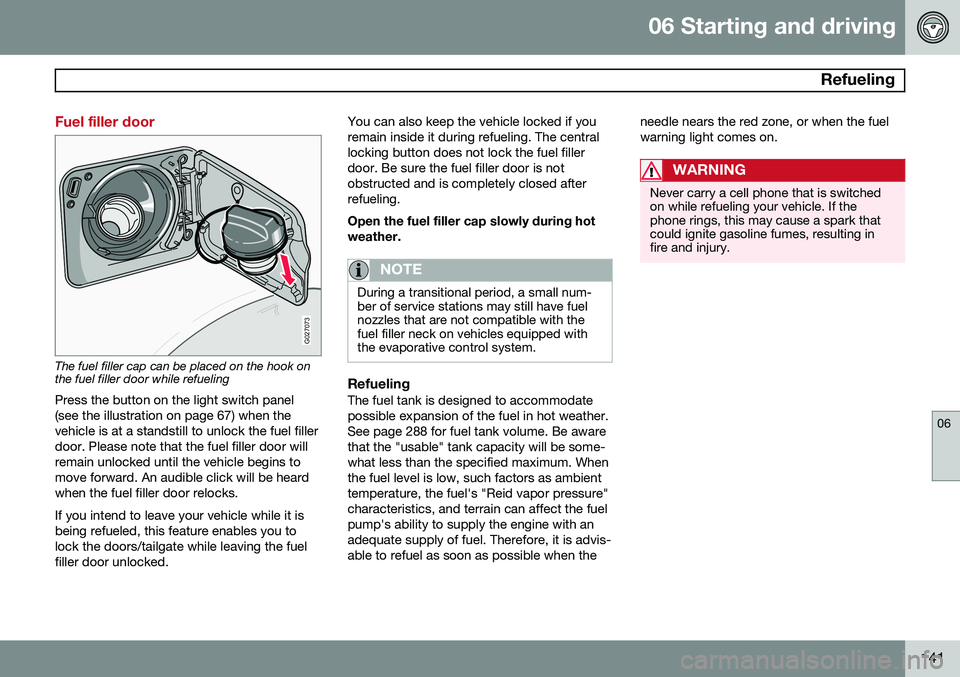
Fuel filler door
G027073
The fuel filler cap can be placed on the hook on the fuel filler door while refuelingPress the button on the light switch panel (see the illustration on page 67) when thevehicle is at a standstill to unlock the fuel fillerdoor. Please note that the fuel filler door willremain unlocked until the vehicle begins tomove forward. An audible click will be heardwhen the fuel filler door relocks. If you intend to leave your vehicle while it is being refueled, this feature enables you tolock the doors/tailgate while leaving the fuelfiller door unlocked. You can also keep the vehicle locked if youremain inside it during refueling. The centrallocking button does not lock the fuel fillerdoor. Be sure the fuel filler door is notobstructed and is completely closed afterrefueling. Open the fuel filler cap slowly during hot weather.
NOTE
During a transitional period, a small num- ber of service stations may still have fuelnozzles that are not compatible with thefuel filler neck on vehicles equipped withthe evaporative control system.
RefuelingThe fuel tank is designed to accommodate possible expansion of the fuel in hot weather.See page 288 for fuel tank volume. Be awarethat the "usable" tank capacity will be some-what less than the specified maximum. Whenthe fuel level is low, such factors as ambienttemperature, the fuel's "Reid vapor pressure"characteristics, and terrain can affect the fuelpump's ability to supply the engine with anadequate supply of fuel. Therefore, it is advis-able to refuel as soon as possible when the
needle nears the red zone, or when the fuelwarning light comes on.
WARNING
Never carry a cell phone that is switched on while refueling your vehicle. If thephone rings, this may cause a spark thatcould ignite gasoline fumes, resulting infire and injury.
Page 228 of 308
09 Maintenance and servicing
Wiper blades 09
226
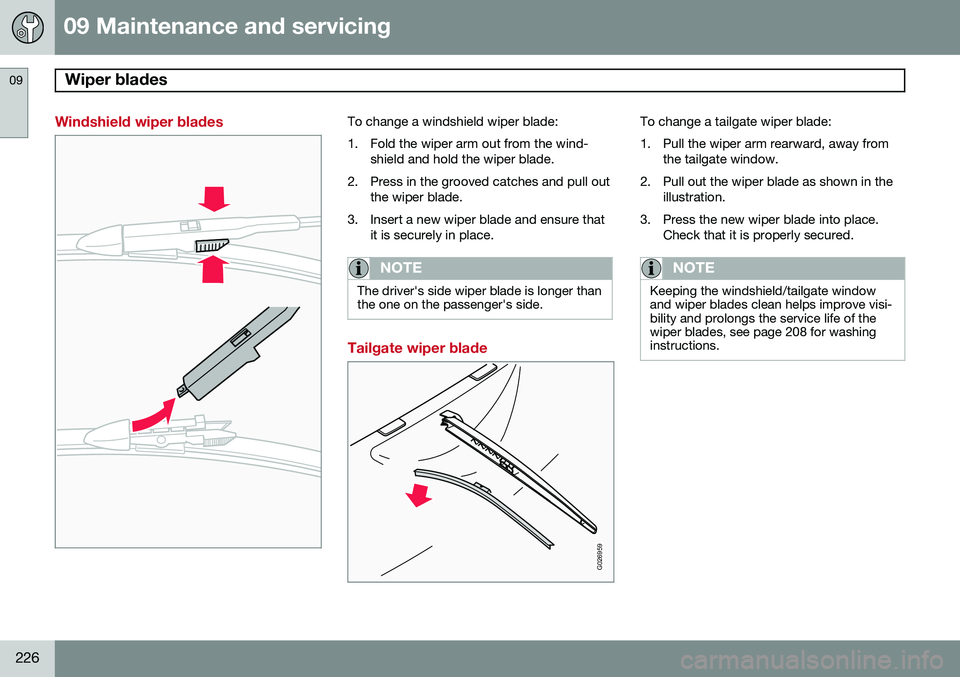
Windshield wiper bladesTo change a windshield wiper blade:
1. Fold the wiper arm out from the wind-shield and hold the wiper blade.
2. Press in the grooved catches and pull out the wiper blade.
3. Insert a new wiper blade and ensure that it is securely in place.
NOTE
The driver's side wiper blade is longer than the one on the passenger's side.
Tailgate wiper blade
G026959
To change a tailgate wiper blade:
1. Pull the wiper arm rearward, away from the tailgate window.
2. Pull out the wiper blade as shown in the illustration.
3. Press the new wiper blade into place. Check that it is properly secured.
NOTE
Keeping the windshield/tailgate window and wiper blades clean helps improve visi-bility and prolongs the service life of thewiper blades, see page 208 for washinginstructions.
Page 247 of 308
09 Maintenance and servicing
Fuses09
}}
* Option/accessory, for more information, see Introduction.245
NoA
17Driver's side daytime running light (DRL)7.5
18Passenger's side daytime run- ning light (DRL)7.5
19–
20–
21Transmission control module10
22Driver's side high beam10
23Passenger's side high beam10
24–
25–
26–
27–
28Power passenger's seat*, Rear Seat Entertainment system* A5
29Fuel pump7.5
30Blind Spot Information System*5
31–
32–
NoA
33Vacuum pump20
34Pump – windshield and tailgate washers15
35–
36–
A
See also fuse 8 in the previous section "Fuses in the pas- senger compartment on the edge of the dashboard"
Page 249 of 308
09 Maintenance and servicing
Fuses09
}}
* Option/accessory, for more information, see Introduction.247
NoA
14Rear air conditioning system*15
15–
16–
17Accessory audio5
18–
19Tailgate window wiper15
20Trailer wiring (15-feed)*20
21–
22–
23All Wheel Drive (AWD)7.5
24–
25–
26Park assist*5
27Main fuse: trailer wiring, park assist, All Wheel Drive30
28Central locking system15
29Driver's side trailer lighting: parking lights, turn signal*25
NoA
30Passenger's side trailer light- ing: brake light, rear fog light,turn signal*25
31Main fuse: fuses 37 and 3840
32–
33–
34–
35–
36–
37Heated rear window20
38Heated rear window20
Page 304 of 308
12 Index
12
302
Radio functions........................................ 255HD digital radio................................... 260
Rain sensor - windshield wipers................ 73
Rear fog light............................................. 69
Rear suspension...................................... 289
Rearview mirror with compass.................. 84
Rear window defroster.............................. 75
Recalls, child restraints.............................. 40
Recirculation.............................................. 99
REDUCE SPEED........................................ 62
Refrigerant (A/C system)............................ 94
Refrigerator (XC90 Executive).................. 118
Registering child restraints........................ 40
Remote key.............................................. 127 replacing the battery........................... 129
Reporting safety defects............................ 19
S
Safety defects, reporting........................... 19
Safety locks, child.................................... 132
Seat belt..................................................... 20 Seat belts
Automatic locking retractor/Emer-
gency locking retractor......................... 39
Seats........................................................ 104
Shiftlock............................................. 11, 143 override................................................. 23
Side impact protection (SIPS) airbags....... 32SiriusXM ™ satellite radio......................... 263
Snow chains............................................ 190
Snow tires................................................ 190
Spare tire................................................. 191
Spare tire – accessing............................. 198
Spare wheel, lowering............................. 198
Speedometer............................................. 58
Starting the car........................................ 143
Start inhibitor (immobilizer)...................... 126
Steering wheel lock................................. 145
Stone chips, touching up......................... 213
Storage compartments............ 114, 116, 117
Studded tires........................................... 190
Sun visor.................................................... 88
Symbols, overview................................... 294
T
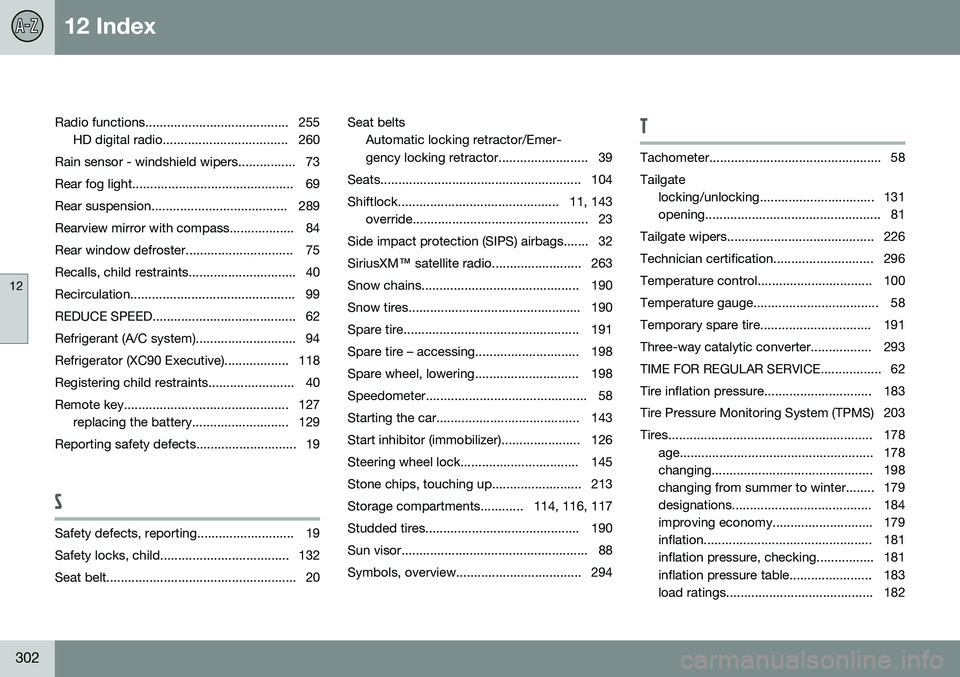
Tachometer................................................ 58 Tailgate locking/unlocking................................ 131
opening................................................. 81
Tailgate wipers......................................... 226
Technician certification............................ 296
Temperature control................................ 100
Temperature gauge................................... 58
Temporary spare tire............................... 191
Three-way catalytic converter................. 293
TIME FOR REGULAR SERVICE................. 62
Tire inflation pressure.............................. 183
Tire Pressure Monitoring System (TPMS) 203
Tires......................................................... 178 age...................................................... 178
changing............................................. 198
changing from summer to winter........ 179
designations....................................... 184
improving economy............................ 179
inflation............................................... 181
inflation pressure, checking................ 181
inflation pressure table....................... 183
load ratings......................................... 182