towing VOLVO XC90 2014 Owner´s Manual
[x] Cancel search | Manufacturer: VOLVO, Model Year: 2014, Model line: XC90, Model: VOLVO XC90 2014Pages: 308, PDF Size: 13.31 MB
Page 167 of 308
06 Starting and driving
Towing a trailer
06
165
Points to keep in mind when towing a trailer
•When towing trailers
without brakes, the
maximum permissible trailer weight is 1,700 lbs (750 kg).
• If necessary, redistribute the weight ofany cargo in the trailer to avoid excessiveweight on the trailer hitch.
• The maximum trailer weight listed in thetable for All Wheel Drive models,5,000 lbs (2250 kg) is only applicablewhen there are not more than two occu-pants in the vehicle, in the front seats,with a combined weight of 300 lbs(135 kg), with no other cargo in the vehi-cle.
• The maximum weight listed for FrontWheel Drive models, 4,000 lbs (1800 kg)is only applicable when there are notmore than four occupants in the vehicle,in the front seats and second row ofseats, with a combined weight of 600 lbs(270 kg), with no other cargo in the vehi-cle.
• Vehicles used for towing a trailer on aregular basis, or for long-distance high-way towing should be equipped with anautomatic transmission oil cooler andVolvo's automatic self-leveling system forthe rear suspension. Consult your Volvoretailer. •
Volvo recommends the use of Volvotrailer hitches that are specially designedfor the vehicle.
• All Volvo models are equipped withenergy-absorbing shock-mounted bump-ers. Trailer hitch installation should notinterfere with the proper operation of thisbumper system.
• Increase tire pressure to recommendedfull inflation pressure. See chapter"Wheels and tires."
• When your vehicle is new, avoid towingheavy trailers during the first 620 miles(1,000 km).
• Engine and transmission are subject toincreased loads. Therefore, engine cool-ant temperature should be closelywatched when driving in hot climates orhilly terrain. Use a lower gear and turn offthe air conditioner if the temperaturegauge needle enters the red range.
• If the automatic transmission begins tooverheat, a message will be displayed inthe text window.
• Hauling a trailer affects handling, durabil-ity, and economy.
• It is necessary to balance trailer brakeswith the towing vehicle brakes to providea safe stop (check and observe state/local regulations). •
Do not connect the trailer's brake systemdirectly to the vehicle's brake system.
• Remove the ball and drawbar assemblywhen the hitch is not being used.
• Volvo recommends the use of syntheticengine oil when towing a trailer over longdistances or in mountainous areas.
NOTE
•When parking the vehicle with a trailer on a hill, apply the parking brakebefore putting the gear selector in
P.
When starting on a hill, put the gearselector in D before releasing the park-
ing brake. Always follow the trailermanufacturer's recommendations forwheel chocking.
• If you use the manual (Geartronic) shiftpositions while towing a trailer, makesure the gear you select does not puttoo much strain on the engine (usingtoo high a gear).
Page 168 of 308
06 Starting and driving
Towing a trailer
06
166
WARNING
•Bumper-attached trailer hitches must not be used on Volvos, nor shouldsafety chains be attached to thebumper.
• Trailer hitches attaching to the vehiclerear axle must not be used.
• Never connect a trailer's hydraulicbrake system directly to the vehiclebrake system, nor a trailer's lightingsystem directly to the vehicle lightingsystem. Consult a trained and qualifiedVolvo service technician for correctinstallation.
• When towing a trailer, the trailer'ssafety wire must be correctly fastenedto the hole or hook provided in thetrailer hitch on the vehicle. The safetywire should never be fastened to orwound around the drawbar ball.
LevelingIf your vehicle is equipped with automatic lev- eling, the rear suspension always retains thecorrect ride height regardless of the load.
• The system adjusts the rear suspension to the correct level after the vehicle hasbeen driven a short distance.
• When the vehicle is stationary, the rearsuspension lowers, which is normal.
Page 174 of 308
06 Starting and driving
Blind Spot Information System*
06
172* Option/accessory, for more information, see Introduction.
When you pass another vehicle: The system reacts when you pass another vehicle at a speed of up to 6 mph (10 km/h)faster than that vehicle. When you are passed by another vehicle:The system reacts if your vehicle is passed by another vehicle at a speed of up to 43 mph(70 km/h) faster than your vehicle.
WARNING
• BLIS does not function in sharp curves.
• BLIS does not function when yourvehicle is backing up.
• If you are towing a wide trailer, thismay prevent the BLIS cameras fromdetecting other vehicles in adjacentlanes.
How BLIS functions in daylight and darkness
Daylight BLIS reacts to the
shape of surrounding vehi-
cles. The system is designed to help detect motor vehicles such as cars, trucks, buses,motorcycles, etc. Darkness BLIS reacts to the
headlights of surrounding
vehicles. In order to be detected by BLIS, a vehicle in the blind area must have its head-lights on. This means, for example, that thesystem will not detect a trailer without head-lights that is being towed behind a car ortruck.
WARNING
• BLIS does not react to cyclists or mopeds.
• BLIS does not react to vehicles thatare standing still.
• The BLIS cameras have the same limi-tation as the human eye. In otherwords, their "vision is impaired" byadverse weather conditions such asheavy snowfall, intense light directlyinto the camera, dense fog, etc.
Cleaning the BLIS camera lensesIn order to function optimally, the BLIS cam- era lenses must be kept clean. They can bewiped clean with a soft cloth or wet sponge.
CAUTION
• Clean the lenses carefully to avoid scratching.
• The lenses are electrically heated tohelp melt ice or snow. If necessary,gently brush away snow from the len-ses.
LimitationsIn certain situations, the BLIS indicator light(s) may illuminate even when there are no othervehicles in the area monitored by the system.
NOTE
If the BLIS indicator lights illuminate occa- sionally even when there are no other vehi-cles in the blind area, this does not indi-cate a fault in the system. In the event of a fault,
Blind spot syst.
service required will be displayed.
The following are several examples of situa- tions in which the BLIS indicator light(s) mayilluminate even when there are no other vehi-cles in the area monitored by the system.
Page 189 of 308
07 Wheels and tires
Vehicle loading
07
187
Properly loading your vehicle will provide maximum return of vehicle design perform-ance. Before loading your vehicle, familiarize your- self with the following terms for determiningyour vehicle's weight ratings, with or withouta trailer, from the vehicle's Federal/ CanadianMotor Vehicle Safety Standards (FMVSS/CMVSS) label, and the vehicle's tire informa-tion placard.
Curb weightThe weight of the vehicle including a full tankof fuel and all standard equipment. It doesnot include passengers, cargo, or optionalequipment.
Capacity weightAll weight added to the curb weight, includingcargo and optional equipment. When towing,trailer hitch tongue load is also part of cargoweight.
NOTE
For trailer towing information, please refer to the section "Towing a trailer."
Permissible axle weightThe maximum allowable weight that can be carried by a single axle (front or rear). Thesenumbers are shown on the Federal/CanadianMotor Vehicle Safety Standards (FMVSS/CMVSS) label. The total load on each axlemust never exceed its maximum permissibleweight.
Gross vehicle weight (GVW)The vehicle's curb weight + cargo + passen-gers. A table listing important weight limits for your vehicle, is in chapter "Dimension andweights". For the location of the various labels in your vehicle, see page 282
Steps for Determining Correct Load Limit
•
Locate the statement "the combined weight of occupants and cargo shouldnever exceed XXX pounds" on your vehi-cle's placard.
• Determine the combined weight of thedriver and passengers that will be ridingin your vehicle. •
Subtract the combined weight of thedriver and passengers from XXX kilo-grams or XXX pounds.
• The resulting figure equals the availableamount of cargo and luggage loadcapacity. For example, if the "XXX"amount equals 1400 lbs. and there will befive 150 lb. passengers in your vehicle,the amount of available cargo and lug-gage load capacity is 650 lbs. (1400-750(5 x 150) = 650 lbs.)
• Determine the combined weight of lug-gage and cargo being loaded on the vehi-cle. That weight may not safely exceedthe available cargo and luggage loadcapacity calculated in Step 4.
• If your vehicle will be towing a trailer, loadfrom your trailer will be transferred to your vehicle. Consult this manual 1
to deter-
mine how this reduces the available cargo and luggage load capacity of yourvehicle.
1 For "Towing a trailer" see page 164.
Page 196 of 308
07 Wheels and tires
Tire Sealing System
07
194
WARNING
•Never leave the tire sealing system unattended when it is operating.
• Keep the tire sealing system awayfrom children.
• Be sure the vehicle is parked safely offthe road and away from moving traffic.
• Apply the parking brake.
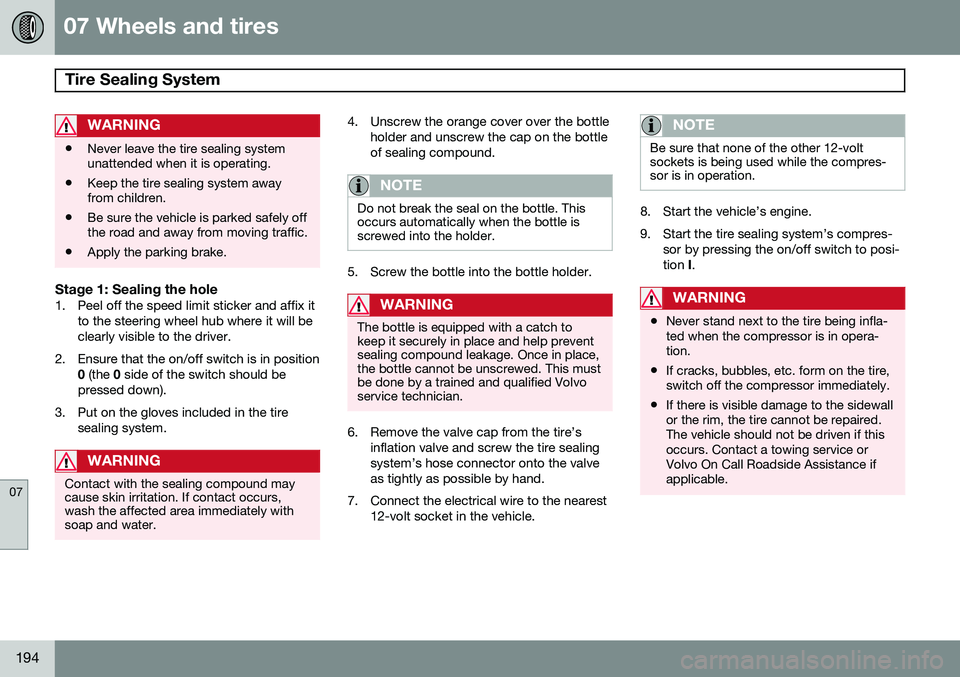
Stage 1: Sealing the hole1. Peel off the speed limit sticker and affix it
to the steering wheel hub where it will be clearly visible to the driver.
2. Ensure that the on/off switch is in position 0 (the 0 side of the switch should be
pressed down).
3. Put on the gloves included in the tire sealing system.
WARNING
Contact with the sealing compound may cause skin irritation. If contact occurs,wash the affected area immediately withsoap and water.
4. Unscrew the orange cover over the bottleholder and unscrew the cap on the bottle of sealing compound.
NOTE
Do not break the seal on the bottle. This occurs automatically when the bottle isscrewed into the holder.
5. Screw the bottle into the bottle holder.
WARNING
The bottle is equipped with a catch to keep it securely in place and help preventsealing compound leakage. Once in place,the bottle cannot be unscrewed. This mustbe done by a trained and qualified Volvoservice technician.
6. Remove the valve cap from the tire’sinflation valve and screw the tire sealing system’s hose connector onto the valveas tightly as possible by hand.
7. Connect the electrical wire to the nearest 12-volt socket in the vehicle.
NOTE
Be sure that none of the other 12-volt sockets is being used while the compres-sor is in operation.
8. Start the vehicle’s engine.
9. Start the tire sealing system’s compres- sor by pressing the on/off switch to posi- tion I.
WARNING
• Never stand next to the tire being infla- ted when the compressor is in opera-tion.
• If cracks, bubbles, etc. form on the tire,switch off the compressor immediately.
• If there is visible damage to the sidewallor the rim, the tire cannot be repaired.The vehicle should not be driven if thisoccurs. Contact a towing service orVolvo On Call Roadside Assistance ifapplicable.
Page 290 of 308
11 Specifications
Fluids
11
288* Option/accessory, for more information, see Introduction.
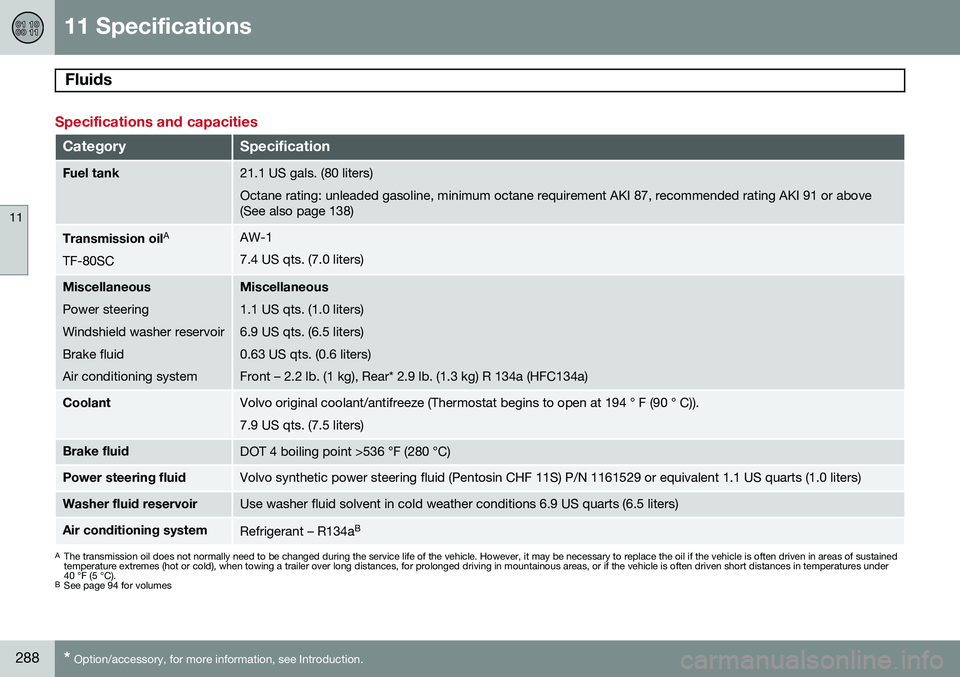
Specifications and capacities
CategorySpecification
Fuel tank21.1 US gals. (80 liters) Octane rating: unleaded gasoline, minimum octane requirement AKI 87, recommended rating AKI 91 or above (See also page 138)
Transmission oil A
TF-80SCAW-1 7.4 US qts. (7.0 liters)
Miscellaneous Power steering Windshield washer reservoirBrake fluidAir conditioning systemMiscellaneous 1.1 US qts. (1.0 liters) 6.9 US qts. (6.5 liters)0.63 US qts. (0.6 liters)Front – 2.2 lb. (1 kg), Rear* 2.9 lb. (1.3 kg) R 134a (HFC134a)
CoolantVolvo original coolant/antifreeze (Thermostat begins to open at 194 ° F (90 ° C)). 7.9 US qts. (7.5 liters)
Brake fluidDOT 4 boiling point >536 °F (280 °C)
Power steering fluidVolvo synthetic power steering fluid (Pentosin CHF 11S) P/N 1161529 or equivalent 1.1 US quarts (1.0 liters)
Washer fluid reservoirUse washer fluid solvent in cold weather conditions 6.9 US quarts (6.5 liters)
Air conditioning systemRefrigerant – R134a B
A
The transmission oil does not normally need to be changed during the service life of the vehicle. However, it may be necessary to replace the oil if the vehicle is often driven in areas of sustained temperature extremes (hot or cold), when towing a trailer over long distances, for prolonged driving in mountainous areas, or if the vehicle is often driven short distances in temperatures under40 °F (5 °C).
B See page 94 for volumes
Page 300 of 308
12 Index
12
298
1, 2, 3 ...
12-volt sockets.......................................... 80
A
A/C (air conditioning)........................... 98, 99
ABS.......................................................... 155Accessory installation warning.................. 14
Airbag system............................................ 23
Air cleaner................................................ 221
Air conditioning.......................................... 94
Air distribution...................................... 96, 99
Air quality sensor....................................... 98
Air vents..................................................... 96
Alarm........................................................ 133
All Wheel Drive......................................... 153
All Wheel Drive – towing.......................... 163Anti-lock brake system warning light......................................... 60
Anti-lock Brake System (ABS)................. 155
Ashtray..................................................... 115 Audio
system introduction............................ 252
Audio system Bluetooth streaming audio................. 268
HD digital radio................................... 260SiriusXM ™ satellite radio.................... 263
AUTO (climate control)....................... 99, 100
Automatic locking retractor....................... 39
Automatic transmission........................... 149 shiftlock override.................................. 23
Autostart.......................................... 143, 145
AUX (audio system)................................. 267
Average speed........................................... 76
AWD......................................................... 153
B
Bass......................................................... 255
Battery..................................................... 219 maintenance....................................... 227
specifications...................................... 292
Battery – replacing................................... 228
Belt check................................................ 220
Blind Spot Information System (BLIS)..... 171 Blower (fan).............................................. 100
Bluetooth cell phone connection............. 274Booster cushion
accessory............................................. 48
integrated.............................................. 52
Brake fluid................................................ 225
Brake system........................................... 154 Brake pad inspection.......................... 154
Bulbs........................................................ 230 specifications...................................... 236
Bulbs, replacing....................................... 230
C
Capacities, fluids..................................... 288
Capacity weight....................................... 187
Cargo area cover..................................... 122
Cargo grid................................................ 121
Cargo net................................................. 119
Catalytic converter, three-way................. 293
CD Pause................................................. 270
Cell phone, hands-free connection......... 274
Center console buttons............................. 64
Page 305 of 308
12 Index
12
303
rotation............................................... 178
Self-supporting run flat tires (SST)..... 205
spare................................................... 191
speed ratings...................................... 182
storing................................................. 180
tire sealing system.............................. 192
tread wear indicator............................ 179
Tire sealing system.................................. 192
Towing a trailer........................................ 164
Towing - cars with All Wheel Drive.......... 163
Towing the vehicle................................... 162
Trailer hitch - detachable......................... 167
Trailer towing........................................... 164Transmission shiftlock override.................................. 23
Transmission, automatic.......................... 149
Tread wear indicator................................ 179
Treble....................................................... 255
Trip computer............................................ 76
Trip odometer............................................ 58
Turn signals............................................... 71
U
Uniform Tire Quality Grading................... 189
Unlocking fuel filler door............................ 69
Unlocking the car..................................... 130 Unpaved roads, driving on...................... 147
V
Vanity mirror............................................ 112
Vehicle dimensions.................................. 284
Vehicle Identification Number (VIN)......... 283
Vehicle loading........................................ 187
Vehicle maintenance................................ 216
Vehicle weights........................................ 286
Ventilated seats......................................... 97
Volvo and the environment........................ 13
Volvo maintenance.................................. 216
Volvo On Call Roadside Assistance........ 296
W
Warning symbol......................................... 58
Warning symbol in center of dashboard.... 58
Warranties................................................ 216
Washer fluid reservoir...................... 221, 224
Washing the vehicle................................. 208
Water, driving through............................. 147
Waxing..................................................... 209
Weights.................................................... 286
Wheels..................................................... 178 storing................................................. 180
Windshield IR coating............................................. 74
Windshield washer fluid reservoir............ 224
Windshield wipers.................................... 226
Winter/Wet driving mode......................... 169
Wipers...................................................... 226
W – Winter............................................... 150