transmission VOLVO XC90 2014 Owner´s Manual
[x] Cancel search | Manufacturer: VOLVO, Model Year: 2014, Model line: XC90, Model: VOLVO XC90 2014Pages: 308, PDF Size: 13.31 MB
Page 147 of 308
06 Starting and driving
Ignition switch and steering wheel lock
06
145
Ignition switch and steering wheel lock
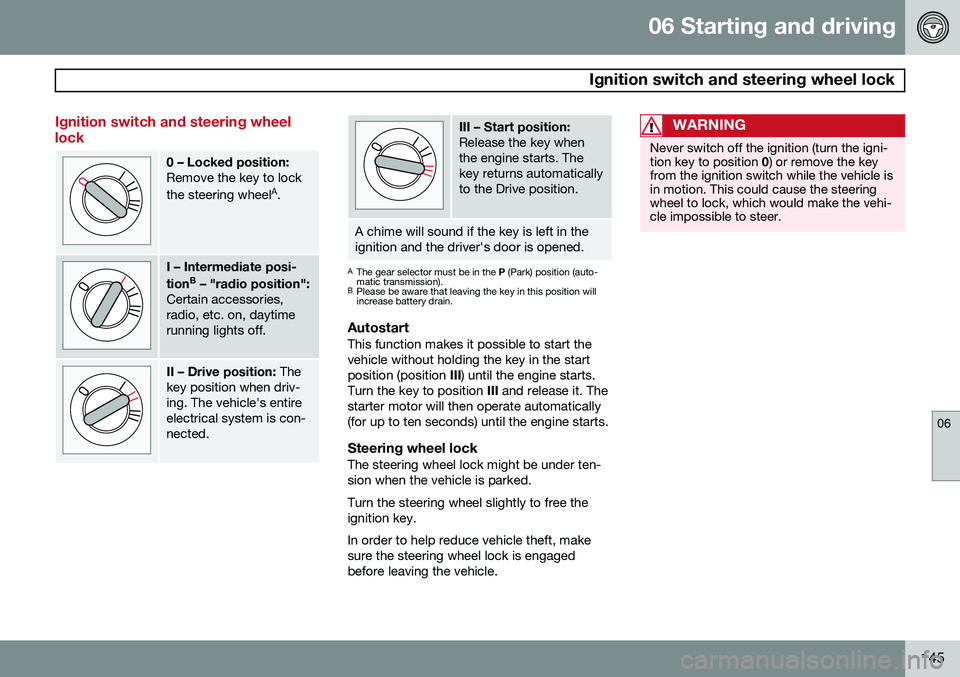
0 – Locked position: Remove the key to lock the steering wheelA
.
I – Intermediate posi- tion B
– "radio position":
Certain accessories, radio, etc. on, daytimerunning lights off.
II – Drive position: The
key position when driv- ing. The vehicle's entireelectrical system is con-nected.
III – Start position: Release the key when the engine starts. Thekey returns automaticallyto the Drive position.
A chime will sound if the key is left in the ignition and the driver's door is opened.
A The gear selector must be in the P (Park) position (auto-
matic transmission).
B Please be aware that leaving the key in this position will increase battery drain.
AutostartThis function makes it possible to start the vehicle without holding the key in the startposition (position III) until the engine starts.
Turn the key to position III and release it. The
starter motor will then operate automatically(for up to ten seconds) until the engine starts.
Steering wheel lockThe steering wheel lock might be under ten-sion when the vehicle is parked. Turn the steering wheel slightly to free the ignition key. In order to help reduce vehicle theft, make sure the steering wheel lock is engagedbefore leaving the vehicle.
WARNING
Never switch off the ignition (turn the igni- tion key to position 0) or remove the key
from the ignition switch while the vehicle isin motion. This could cause the steeringwheel to lock, which would make the vehi-cle impossible to steer.
Page 148 of 308
06 Starting and driving
Economical driving
06
146
Economical driving conserves natural resources
Better driving economy may be obtained by thinking ahead, avoiding rapid starts andstops and adjusting the speed of your vehicleto immediate traffic conditions. Observe thefollowing rules:
• Bring the engine to normal operating tem- perature as soon as possible by drivingwith a light foot on the accelerator pedalfor the first few minutes of operation. Acold engine uses more fuel and is subjectto increased wear.
• Whenever possible, avoid using the vehi-cle for driving short distances. This doesnot allow the engine to reach normaloperating temperature.
• Drive carefully and avoid rapid accelera-tion and hard braking.
• Use the transmission's
D (Drive) position
as often as possible and avoid using"kickdown" to help improve fuel econ-omy.
• Do not exceed posted speed limits.
• Avoid carrying unnecessary items (extraload) in the vehicle.
• Maintain correct tire pressure. Check tirepressure regularly (when tires are cold).
• Remove snow tires when threat of snowor ice has ended. •
Note that roof racks, ski racks, etc,increase air resistance and also fuel con-sumption.
• At highway driving speeds, fuel consump-tion will be lower with the air conditioningon and the windows closed than with theair conditioning off and the windowsopen.
• Using the onboard trip computer's fuelconsumption modes can help you learnhow to drive more economically.
Other factors that decrease gas mileage are: • Dirty air cleaner
• Dirty engine oil and clogged oil filter
• Dragging brakes
• Incorrect front end alignment.
Some of the above mentioned items and oth- ers are checked at the standard MaintenanceService intervals.
CAUTION
Drive slowly and carefully if going through standing water (i.e. flooded roadways,etc.). Damage to the engine could result ifexcess water is drawn in through the airintake system. Never drive the vehicle inwater deeper than 18 inches (48 cm).
Page 151 of 308
06 Starting and driving
Automatic transmission
06
149
G026990
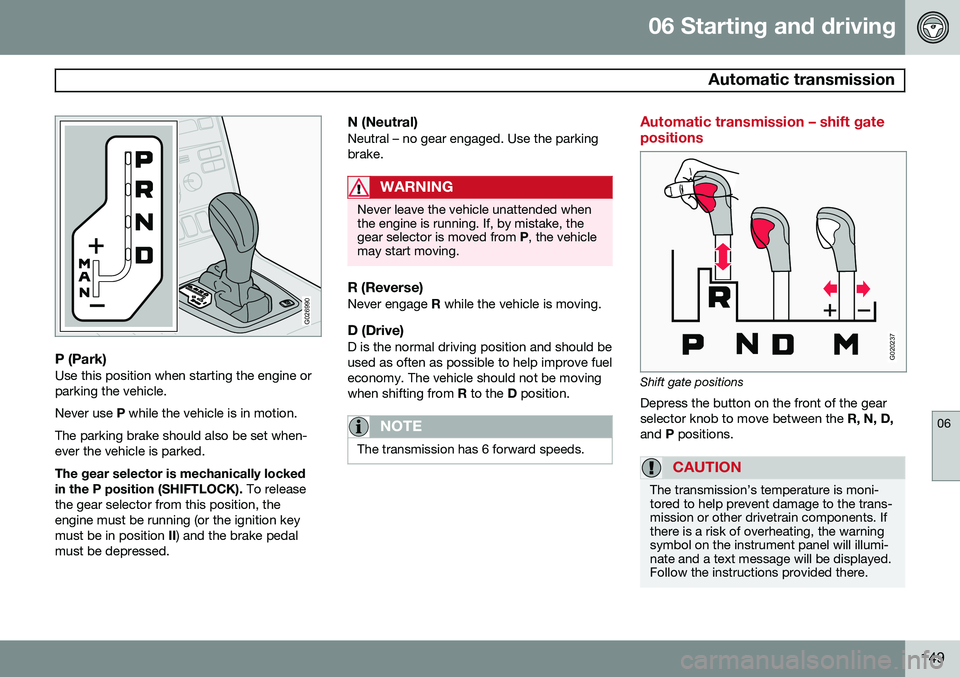
P (Park)Use this position when starting the engine or parking the vehicle. Never use P while the vehicle is in motion.
The parking brake should also be set when- ever the vehicle is parked. The gear selector is mechanically locked in the P position (SHIFTLOCK). To release
the gear selector from this position, the engine must be running (or the ignition keymust be in position II) and the brake pedal
must be depressed.
N (Neutral)Neutral – no gear engaged. Use the parkingbrake.
WARNING
Never leave the vehicle unattended when the engine is running. If, by mistake, thegear selector is moved from P, the vehicle
may start moving.
R (Reverse)Never engage R while the vehicle is moving.
D (Drive)D is the normal driving position and should be used as often as possible to help improve fueleconomy. The vehicle should not be movingwhen shifting from R to the D position.
NOTE
The transmission has 6 forward speeds.
Automatic transmission – shift gate positions
G020237
Shift gate positions
Depress the button on the front of the gear selector knob to move between the R, N, D,
and P positions.
CAUTION
The transmission’s temperature is moni- tored to help prevent damage to the trans-mission or other drivetrain components. Ifthere is a risk of overheating, the warningsymbol on the instrument panel will illumi-nate and a text message will be displayed.Follow the instructions provided there.
Page 152 of 308
06 Starting and driving
Automatic transmission
06
150
KickdownAutomatic shift to a lower gear (kickdown) is achieved by depressing the accelerator pedalfully and briskly. An upshift will occur whenapproaching the top speed for a particulargear or by releasing the accelerator pedalslightly. Kickdown can be used for maximum acceler- ation or when passing at highway speeds.
NOTE
The gear selector must be in the D (Drive)
position for kickdown to function.
Manual shifting – Geartronic
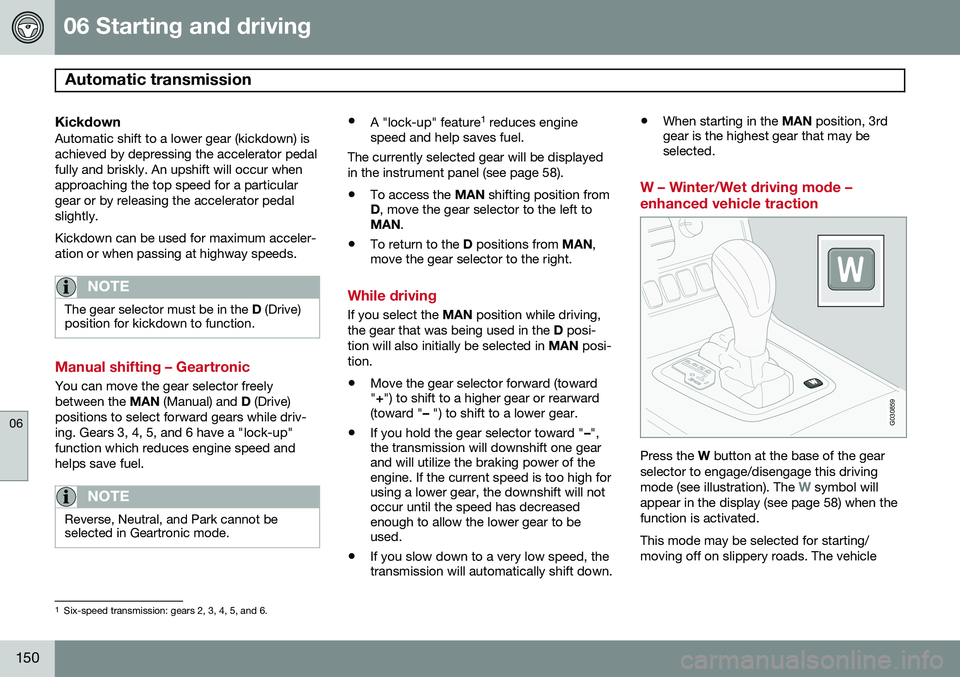
You can move the gear selector freely between the MAN (Manual) and D (Drive)
positions to select forward gears while driv-ing. Gears 3, 4, 5, and 6 have a "lock-up"function which reduces engine speed andhelps save fuel.
NOTE
Reverse, Neutral, and Park cannot be selected in Geartronic mode.
• A "lock-up" feature 1
reduces engine
speed and help saves fuel.
The currently selected gear will be displayed in the instrument panel (see page 58). • To access the
MAN shifting position from
D , move the gear selector to the left to
MAN .
• To return to the
D positions from MAN,
move the gear selector to the right.
While driving
If you select the MAN position while driving,
the gear that was being used in the D posi-
tion will also initially be selected in MAN posi-
tion. • Move the gear selector forward (toward "
+ ") to shift to a higher gear or rearward
(toward " – ") to shift to a lower gear.
• If you hold the gear selector toward "
–",
the transmission will downshift one gearand will utilize the braking power of theengine. If the current speed is too high forusing a lower gear, the downshift will notoccur until the speed has decreasedenough to allow the lower gear to beused.
• If you slow down to a very low speed, thetransmission will automatically shift down. •
When starting in the
MAN position, 3rd
gear is the highest gear that may beselected.
W – Winter/Wet driving mode – enhanced vehicle traction
G030859
Press the W button at the base of the gear
selector to engage/disengage this driving mode (see illustration). The
W symbol will
appear in the display (see page 58) when the function is activated. This mode may be selected for starting/ moving off on slippery roads. The vehicle
1 Six-speed transmission: gears 2, 3, 4, 5, and 6.
Page 153 of 308
06 Starting and driving
Automatic transmission
06
151
starts off in 3rd gear to help maintain traction. First and second gears will only be used dur-ing kickdown.
NOTE
Mode
W can be chosen regardless of the
postion of the gear selector but will only function when the gear selector is in the D
(drive) position.
Page 167 of 308
06 Starting and driving
Towing a trailer
06
165
Points to keep in mind when towing a trailer
•When towing trailers
without brakes, the
maximum permissible trailer weight is 1,700 lbs (750 kg).
• If necessary, redistribute the weight ofany cargo in the trailer to avoid excessiveweight on the trailer hitch.
• The maximum trailer weight listed in thetable for All Wheel Drive models,5,000 lbs (2250 kg) is only applicablewhen there are not more than two occu-pants in the vehicle, in the front seats,with a combined weight of 300 lbs(135 kg), with no other cargo in the vehi-cle.
• The maximum weight listed for FrontWheel Drive models, 4,000 lbs (1800 kg)is only applicable when there are notmore than four occupants in the vehicle,in the front seats and second row ofseats, with a combined weight of 600 lbs(270 kg), with no other cargo in the vehi-cle.
• Vehicles used for towing a trailer on aregular basis, or for long-distance high-way towing should be equipped with anautomatic transmission oil cooler andVolvo's automatic self-leveling system forthe rear suspension. Consult your Volvoretailer. •
Volvo recommends the use of Volvotrailer hitches that are specially designedfor the vehicle.
• All Volvo models are equipped withenergy-absorbing shock-mounted bump-ers. Trailer hitch installation should notinterfere with the proper operation of thisbumper system.
• Increase tire pressure to recommendedfull inflation pressure. See chapter"Wheels and tires."
• When your vehicle is new, avoid towingheavy trailers during the first 620 miles(1,000 km).
• Engine and transmission are subject toincreased loads. Therefore, engine cool-ant temperature should be closelywatched when driving in hot climates orhilly terrain. Use a lower gear and turn offthe air conditioner if the temperaturegauge needle enters the red range.
• If the automatic transmission begins tooverheat, a message will be displayed inthe text window.
• Hauling a trailer affects handling, durabil-ity, and economy.
• It is necessary to balance trailer brakeswith the towing vehicle brakes to providea safe stop (check and observe state/local regulations). •
Do not connect the trailer's brake systemdirectly to the vehicle's brake system.
• Remove the ball and drawbar assemblywhen the hitch is not being used.
• Volvo recommends the use of syntheticengine oil when towing a trailer over longdistances or in mountainous areas.
NOTE
•When parking the vehicle with a trailer on a hill, apply the parking brakebefore putting the gear selector in
P.
When starting on a hill, put the gearselector in D before releasing the park-
ing brake. Always follow the trailermanufacturer's recommendations forwheel chocking.
• If you use the manual (Geartronic) shiftpositions while towing a trailer, makesure the gear you select does not puttoo much strain on the engine (usingtoo high a gear).
Page 172 of 308
06 Starting and driving
Before a long distance trip
06
170
It is always worthwhile to have your vehicle checked by a trained and qualified Volvoservice technician before driving long dis-tances. Your retailer or service technician willalso be able to supply you with bulbs, fuses,spark plugs and wiper blades for your use inthe event that problems occur. As a minimum, the following items should be checked before any long trip:• Check that engine runs smoothly and that fuel consumption is normal.
• Check for fuel, oil, and fluid leakage.
• Check transmission oil level 1
.
• Check condition of drive belts.
• Check state of the battery's charge.
• Examine tires carefully (the spare tire aswell), and replace those that are worn.Check tire pressures.
• The brakes, front wheel alignment, andsteering gear should be checked by atrained and qualified Volvo service techni-cian only.
• Check all lights, including high beams.
• Reflective warning triangles are legallyrequired in some states/provinces. •
Have a word with your Volvo retailer ifyou intend to drive in countries where itmay be difficult to obtain the correct fuel.
• Consider your destination. If you will bedriving through an area where snow or iceare likely to occur, consider snow tires.
1
To prevent injury from contact with hot surfaces, do not inspect your vehicle’s transmission fluid yourself. Have your vehicle’s transmission fluid level inspected by a qualified Volvo service techni- cian.
Page 203 of 308
07 Wheels and tires
Changing wheels
07
201
the vehicle, check that the jack is still cor- rectly positioned in the attachment.
7. Raise the vehicle until the wheel to be changed is lifted off the ground.
8. Unscrew the wheel bolts completely and carefully remove the wheel so as not todamage the threads on the studs.
NOTE
To avoid excessive wear and the necessity of rebalancing, mark and reinstall wheelsin the same location and position as beforeremoval. To lessen the chance of imbal-ance, each wheel hub is equipped with aguide stud to ensure that a removed wheelcan be reinstalled in its original position (aswhen changing over to winter tires/wheels).
CAUTION
•The vehicle must not be driven with wheels of different dimensions or witha spare tire other than the one thatcame with the vehicle. The use of dif-ferent size wheels can seriously dam-age your vehicle's transmission.
• Correct tightening torque on wheelbolts must be observed.
• The wheel bolts should never begreased or lubricated.
• Extended, chromed wheel bolts mustnot be used with steel rims, as theymake it impossible to fit the hub caps.
Installing the wheel1. Clean the contact surfaces on the wheel
and hub.
2. Lift the wheel and place it on the hub.
3. Install the wheel bolts and tighten hand- tight. Using the lug wrench, tighten cross- wise until all bolts are snug.
4. Lower the vehicle to the ground and alter- nately tighten the bolts crosswise to103 ft.lbs. (140 Nm).
5. Install the wheel cover (where applicable).
WARNING
• The jack must correctly engage the bar in the jack attachment. The vehicle'sweight must not rest on the jackattachment. See illustration "Attachingthe jack" on the previous page.
• Be sure the jack is on a firm, level,non-slippery surface.
• Never allow any part of your body tobe extended under a vehicle suppor-ted by a jack.
• Use the jack intended for the vehiclewhen replacing a wheel. For any otherjob, use stands to support the side ofthe vehicle being worked on.
• Apply the parking brake and put thegear selector in the (
P)ark position.
• Block the wheels standing on theground, use rigid wooden blocks orlarge stones.
• The jack should be kept well-greasedand clean, and should not be dam-aged.
• No objects should be placed betweenthe base of jack and the ground, orbetween the jack and the attachmentbar on the vehicle.
Page 242 of 308
09 Maintenance and servicing
Fuses 09
240* Option/accessory, for more information, see Introduction.
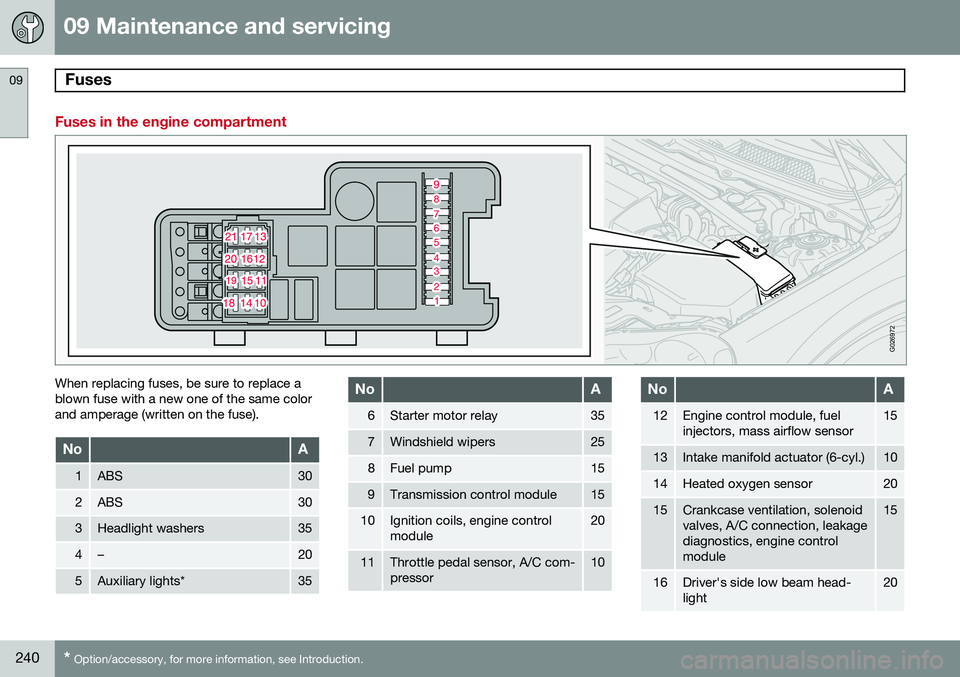
Fuses in the engine compartment
G026972
When replacing fuses, be sure to replace a blown fuse with a new one of the same colorand amperage (written on the fuse).
NoA
1ABS30
2ABS30
3Headlight washers35
4–20
5Auxiliary lights*35
NoA
6Starter motor relay35
7Windshield wipers25
8Fuel pump15
9Transmission control module15
10Ignition coils, engine control module20
11Throttle pedal sensor, A/C com- pressor10
NoA
12Engine control module, fuel injectors, mass airflow sensor15
13Intake manifold actuator (6-cyl.)10
14Heated oxygen sensor20
15Crankcase ventilation, solenoid valves, A/C connection, leakagediagnostics, engine controlmodule15
16Driver's side low beam head- light20
Page 244 of 308
09 Maintenance and servicing
Fuses 09
242* Option/accessory, for more information, see Introduction.
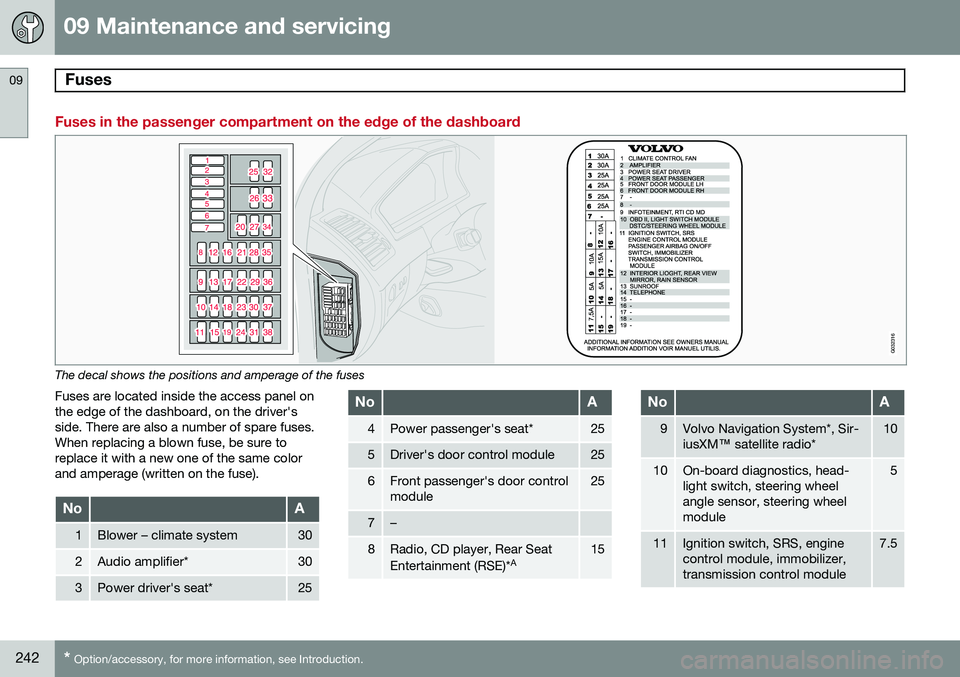
Fuses in the passenger compartment on the edge of the dashboard
G032316
The decal shows the positions and amperage of the fuses
Fuses are located inside the access panel on the edge of the dashboard, on the driver'sside. There are also a number of spare fuses.When replacing a blown fuse, be sure toreplace it with a new one of the same colorand amperage (written on the fuse).
NoA
1Blower – climate system30
2Audio amplifier*30
3Power driver's seat*25
NoA
4Power passenger's seat*25
5Driver's door control module25
6Front passenger's door control module25
7–
8Radio, CD player, Rear Seat Entertainment (RSE)* A15
NoA
9Volvo Navigation System*, Sir- iusXM
™ satellite radio*10
10On-board diagnostics, head- light switch, steering wheelangle sensor, steering wheelmodule5
11Ignition switch, SRS, engine control module, immobilizer,transmission control module7.5