engine VOLVO XC90 2014 Owner´s Manual
[x] Cancel search | Manufacturer: VOLVO, Model Year: 2014, Model line: XC90, Model: VOLVO XC90 2014Pages: 308, PDF Size: 13.31 MB
Page 215 of 308
08 Car care
Paint touch up
08
213
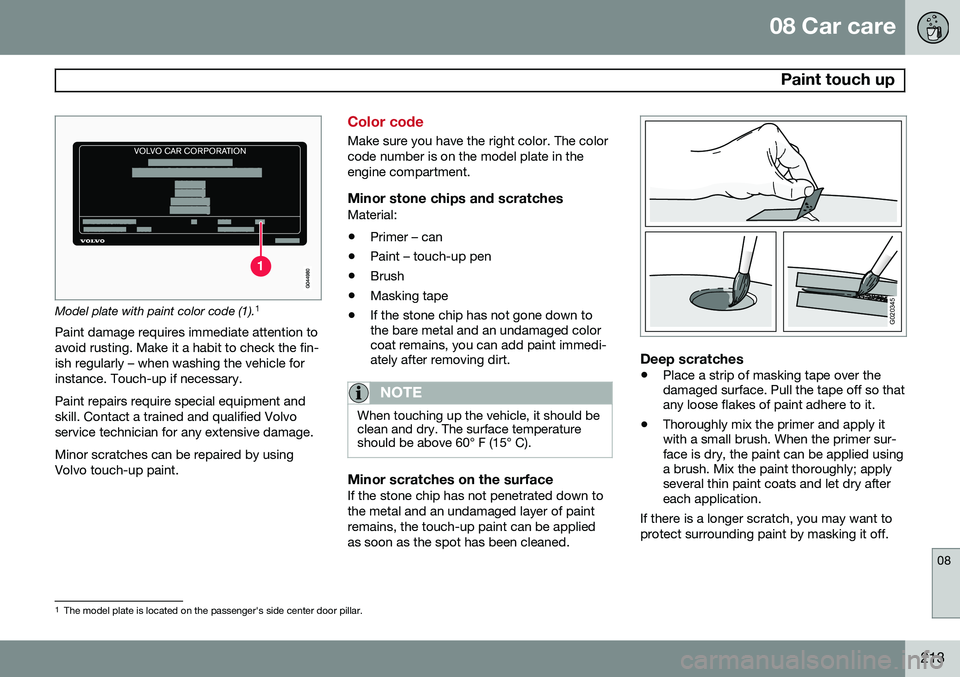
Model plate with paint color code (1).1
Paint damage requires immediate attention to avoid rusting. Make it a habit to check the fin-ish regularly – when washing the vehicle forinstance. Touch-up if necessary. Paint repairs require special equipment and skill. Contact a trained and qualified Volvoservice technician for any extensive damage. Minor scratches can be repaired by using Volvo touch-up paint.
Color code
Make sure you have the right color. The color code number is on the model plate in theengine compartment.
Minor stone chips and scratchesMaterial:
• Primer – can
• Paint – touch-up pen
• Brush
• Masking tape
• If the stone chip has not gone down to the bare metal and an undamaged colorcoat remains, you can add paint immedi-ately after removing dirt.
NOTE
When touching up the vehicle, it should be clean and dry. The surface temperatureshould be above 60° F (15° C).
Minor scratches on the surfaceIf the stone chip has not penetrated down to the metal and an undamaged layer of paintremains, the touch-up paint can be appliedas soon as the spot has been cleaned.
G020345
Deep scratches
• Place a strip of masking tape over the damaged surface. Pull the tape off so thatany loose flakes of paint adhere to it.
• Thoroughly mix the primer and apply itwith a small brush. When the primer sur-face is dry, the paint can be applied usinga brush. Mix the paint thoroughly; applyseveral thin paint coats and let dry aftereach application.
If there is a longer scratch, you may want to protect surrounding paint by masking it off.
1 The model plate is located on the passenger's side center door pillar.
Page 216 of 308
214
Volvo service......................................................................................... 216
Maintaining your vehicle....................................................................... 217
Working on your vehicle........................................................................ 219
Engine compartment............................................................................. 221Engine oil............................................................................................... 222Fluids..................................................................................................... 224Wiper blades......................................................................................... 226Battery................................................................................................... 227
Replacing bulbs.................................................................................... 230Fuses..................................................................................................... 238
Page 219 of 308
09 Maintenance and servicing
Maintaining your vehicle09
}}
217
Owner maintenance
Periodic maintenance requirements and inter- vals are described in your vehicle's Warrantyand Service Records Information booklet. The following points can be carried out between the normally scheduled maintenanceservices.
Each time the vehicle is refueled
•Check the engine oil level
• Clean the windshield, windshield wipers, headlights, and tail lights
Monthly
•Check cold tire pressure in all tires.Inspect the tires for wear.
• Check that engine coolant and other fluidlevels are between the indicated "
min"
and " max" markings.
• Clean interior glass surfaces with a glasscleaner and soft paper towels.
• Wipe driver information displays with asoft cloth.
• Visually inspect battery terminals for cor-rosion. Corrosion may indicate a looseterminal connector, or a battery near theend of its useful service life. Consult atrained and qualified Volvo service techni-cian for additional information.
As needed
•
Wash the vehicle, including the undercar-riage, to reduce wear that can be causedby a buildup of dirt, and corrosion thatcan be caused by salt residues.
• Clean leaves and twigs from air intakevents at the base of the windshield, andfrom other places where they may collect.
• Complete service information for qualifiedtechnicians is available online for pur-chase or subscription at www.volvote-chinfo.com.
Emission inspection readiness
What is an Onboard Diagnostic System
(OBD II)?
OBD II is part of your vehicle's computerized engine management system. It stores diag-nostic information about your vehicle's emis-sion controls. It can light the Check Enginelight (MIL) if it detects an emission control"fault." A "fault" is a component or systemthat is not performing within an expectedrange. A fault may be permanent or tempo-rary. OBD II will store a message about anyfault.
How do states use OBD II for emission
inspections?
Many states connect a computer directly to avehicle's OBD II system. The inspector can then read "faults." In some states, this type ofinspection has replaced the tailpipe emissiontest.
How can my vehicle fail OBD II emission
inspection?
Your vehicle can fail OBD II emission inspec-tion for any of the following reasons.
• If your Check Engine (MIL) light is lit, your vehicle may fail inspection.
• If your vehicle's Check Engine light waslit, but went out without any action onyour part, OBD II will still have a recordedfault. Your vehicle may pass or fail,depending on the inspection practices inyour area.
• If you had recent service that requireddisconnecting the battery, OBD II diag-nostic information may be incompleteand "not ready" for inspection. A vehiclethat is not ready may fail inspection.
How can I prepare for my next OBD II
emission inspection?
• If your Check Engine (MIL) light is lit – orwas lit but went out without service, haveyour vehicle diagnosed and, if necessary,serviced by a qualified Volvo technician.
• If you recently had service for a lit CheckEngine light, or if you had service thatrequired disconnecting the battery, aperiod of driving is necessary to bring the
Page 221 of 308
09 Maintenance and servicing
Working on your vehicle09
219
Note the following before you begin work- ing on your vehicle:
Battery
•
Ensure that the battery cables are cor- rectly connected and tightened.
• Never disconnect the battery when theengine is running (e.g., when replacingthe battery).
• Never use a fast charger to charge thebattery. The battery cables should be dis-connected when recharging.
• The battery contains acid that is both cor-rosive and poisonous. It is important thatthe battery is handled in an environmen-tally friendly way. See page 227 for moreinformation on handling the battery.
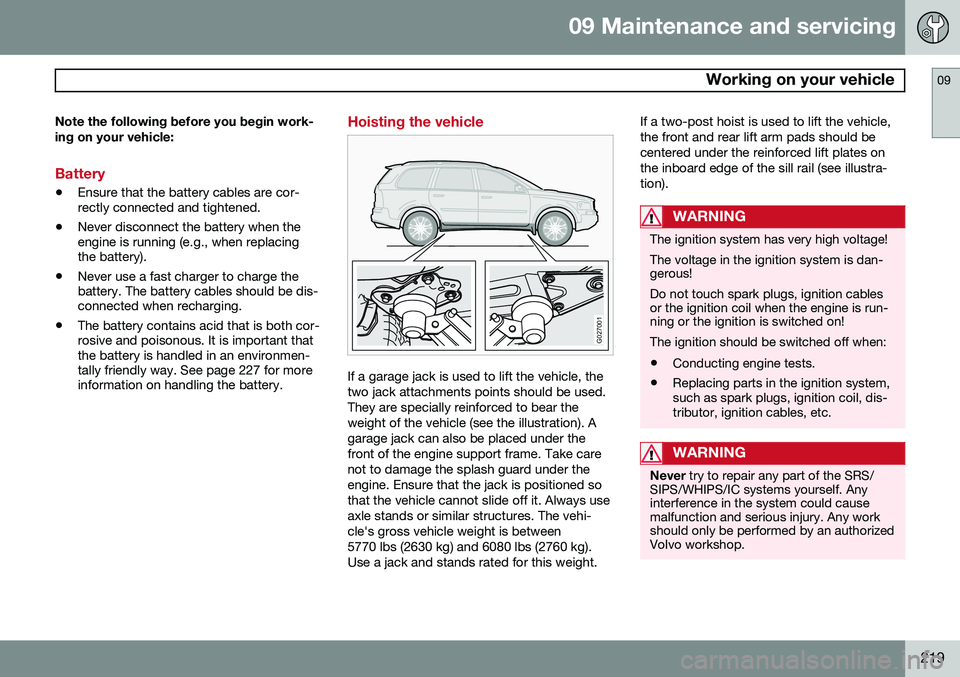
Hoisting the vehicle
G027001
If a garage jack is used to lift the vehicle, the two jack attachments points should be used.They are specially reinforced to bear theweight of the vehicle (see the illustration). Agarage jack can also be placed under thefront of the engine support frame. Take carenot to damage the splash guard under theengine. Ensure that the jack is positioned sothat the vehicle cannot slide off it. Always useaxle stands or similar structures. The vehi-cle's gross vehicle weight is between5770 lbs (2630 kg) and 6080 lbs (2760 kg).Use a jack and stands rated for this weight. If a two-post hoist is used to lift the vehicle,the front and rear lift arm pads should becentered under the reinforced lift plates onthe inboard edge of the sill rail (see illustra-tion).
WARNING
The ignition system has very high voltage! The voltage in the ignition system is dan- gerous! Do not touch spark plugs, ignition cables or the ignition coil when the engine is run-ning or the ignition is switched on! The ignition should be switched off when: •
Conducting engine tests.
• Replacing parts in the ignition system, such as spark plugs, ignition coil, dis-tributor, ignition cables, etc.
WARNING
Never
try to repair any part of the SRS/
SIPS/WHIPS/IC systems yourself. Any interference in the system could causemalfunction and serious injury. Any workshould only be performed by an authorizedVolvo workshop.
Page 222 of 308
09 Maintenance and servicing
Working on your vehicle 09
220
Belt check
Check the belt regularly to make sure it is in good condition and is clean. A worn or dirtybelt can cause poor cooling and low alterna-tor output as well as impair the operation ofthe power steering and the air conditioningunit.
NOTE
The drive belt is equipped with a self-ten- sioning mechanism and requires noadjustment between changes.
WARNING
The engine must not be running when this check is performed.
Check coolant level
The cooling system must be filled with cool- ant and not leak to operate at maximum effi-ciency. Check the coolant level regularly. Thelevel should be between the MAX and MIN
marks on the expansion tank. The checkshould be made with particular thoroughnesswhen the engine is new or when the coolingsystem has been drained. Do not remove the filler cap other than for topping up with coolant. Frequent removalmay prevent coolant circulation between the engine and the expansion tank during enginewarm up and cooling.
Changing coolant
Normally, the coolant does not need to be changed. If the system must be drained, con-sult a trained and qualified Volvo servicetechnician. Do not top off with water only. This reduces the rust-protective and antifreeze qualities ofthe coolant and has a lower boiling point. Itcan also cause damage to the cooling systemif it should freeze. Top off with Volvo GenuineCoolant/Antifreeze only (a 50/50 mix of waterand antifreeze.
CAUTION
The cooling system must always be kept filled to the correct level. If it is not keptfilled, there can be high local temperaturesin the engine which could result in dam-age. Different types of antifreeze/coolantmay not be mixed.
WARNING
•
Never remove the expansion tank cap while the engine is warm. Wait until theengine cools.
• If it is necessary to top off the coolantwhen the engine is warm, unscrew theexpansion tank cap slowly so that theoverpressure dissipates.
Page 223 of 308
09 Maintenance and servicing
Engine compartment09
221
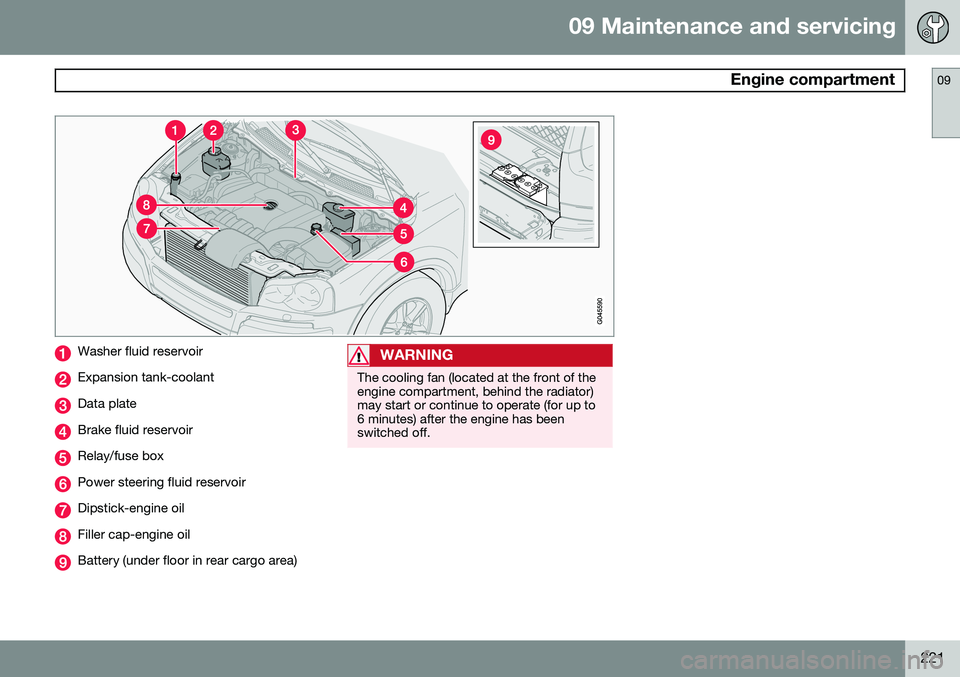
Washer fluid reservoir
Expansion tank-coolant
Data plate
Brake fluid reservoir
Relay/fuse box
Power steering fluid reservoir
Dipstick-engine oil
Filler cap-engine oil
Battery (under floor in rear cargo area)
WARNING
The cooling fan (located at the front of the engine compartment, behind the radiator)may start or continue to operate (for up to6 minutes) after the engine has beenswitched off.
Page 224 of 308
09 Maintenance and servicing
Engine oil 09
222
Oil specifications
Full synthetic engine oil meeting the minimum ACEA A5/B5 must be used. Lower quality oilsmay not offer the same fuel economy, engineperformance, or engine protection. Refer to the Warranty and Service Records information booklet for information on oilchange intervals and oil type requirements.
NOTE
This vehicle comes from the factory with synthetic oil.
Oil additives must not be used.
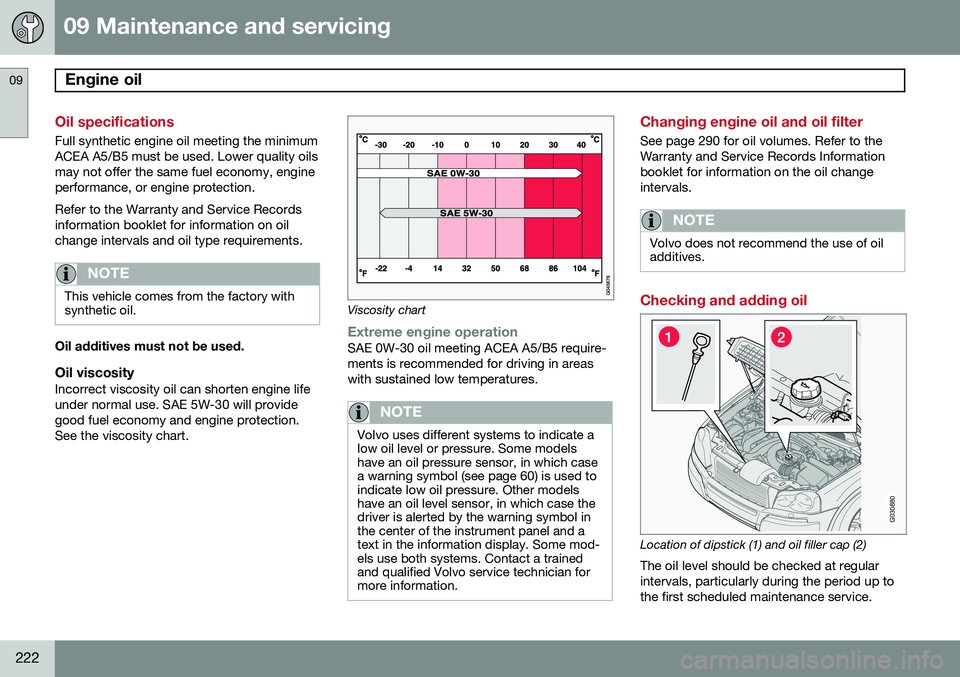
Oil viscosityIncorrect viscosity oil can shorten engine life under normal use. SAE 5W-30 will providegood fuel economy and engine protection.See the viscosity chart.
Viscosity chart
Extreme engine operationSAE 0W-30 oil meeting ACEA A5/B5 require- ments is recommended for driving in areaswith sustained low temperatures.
NOTE
Volvo uses different systems to indicate a low oil level or pressure. Some modelshave an oil pressure sensor, in which casea warning symbol (see page 60) is used toindicate low oil pressure. Other modelshave an oil level sensor, in which case thedriver is alerted by the warning symbol inthe center of the instrument panel and atext in the information display. Some mod-els use both systems. Contact a trainedand qualified Volvo service technician formore information.
Changing engine oil and oil filter
See page 290 for oil volumes. Refer to the Warranty and Service Records Informationbooklet for information on the oil changeintervals.
NOTE
Volvo does not recommend the use of oil additives.
Checking and adding oil
G030880
Location of dipstick (1) and oil filler cap (2)
The oil level should be checked at regular intervals, particularly during the period up tothe first scheduled maintenance service.
Page 225 of 308
09 Maintenance and servicing
Engine oil09
223
•
The vehicle should be parked on a level surface when the oil is checked.
• If the engine is warm
, wait for at least
10-15 minutes after the engine has beenswitched off before checking the oil.
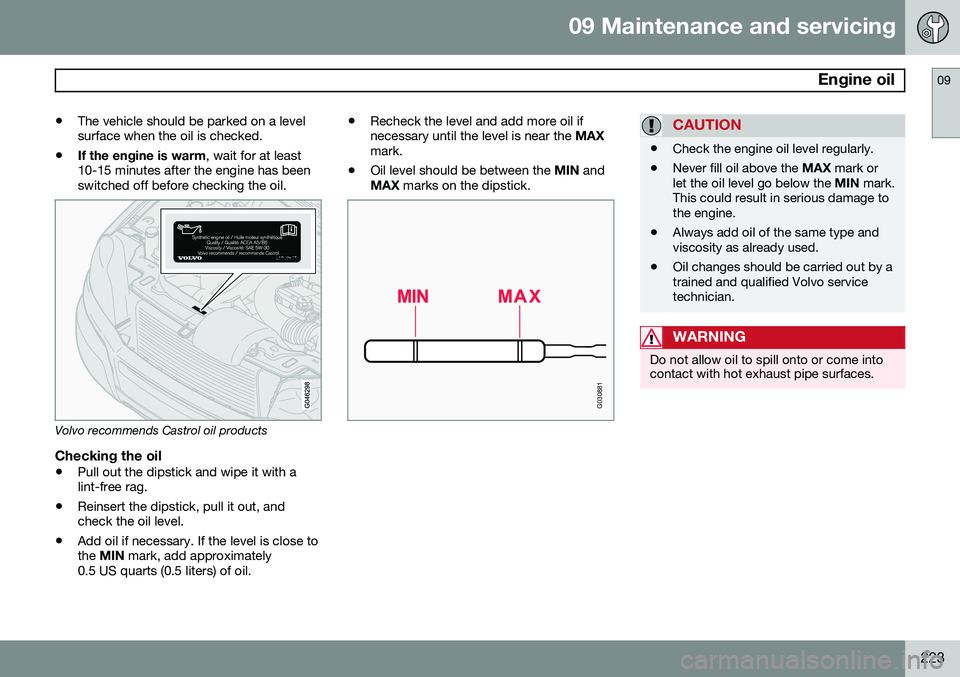
Volvo recommends Castrol oil products
Checking the oil
• Pull out the dipstick and wipe it with a lint-free rag.
• Reinsert the dipstick, pull it out, andcheck the oil level.
• Add oil if necessary. If the level is close tothe
MIN mark, add approximately
0.5 US quarts (0.5 liters) of oil. •
Recheck the level and add more oil ifnecessary until the level is near the
MAX
mark.
• Oil level should be between the
MIN and
MAX marks on the dipstick.
G030881
CAUTION
•Check the engine oil level regularly.
• Never fill oil above the
MAX mark or
let the oil level go below the MIN mark.
This could result in serious damage to the engine.
• Always add oil of the same type andviscosity as already used.
• Oil changes should be carried out by atrained and qualified Volvo servicetechnician.
WARNING
Do not allow oil to spill onto or come into contact with hot exhaust pipe surfaces.
Page 226 of 308
09 Maintenance and servicing
Fluids 09
224
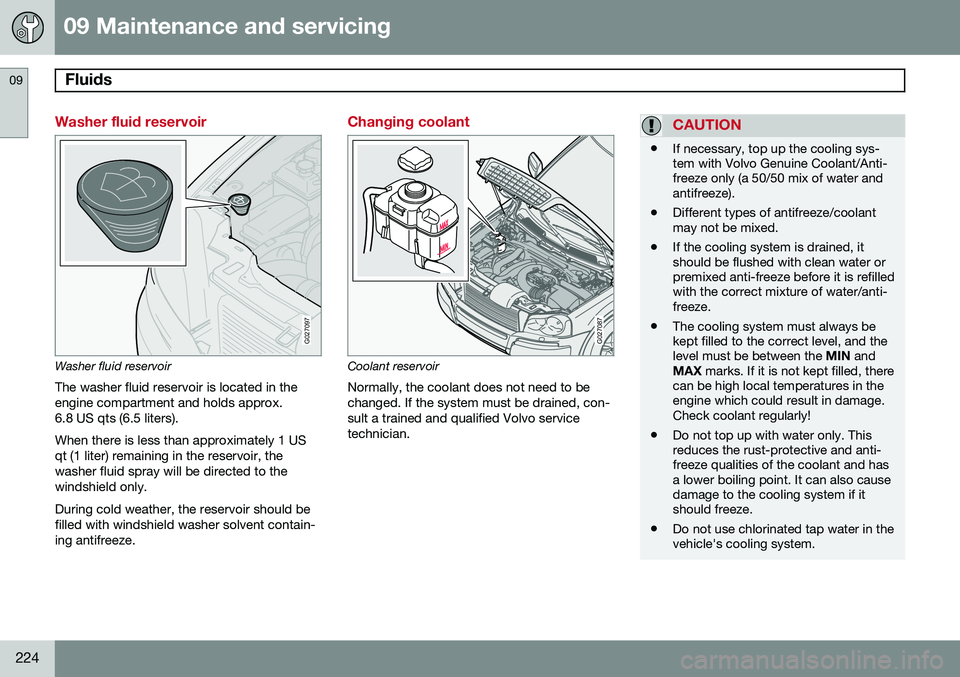
Washer fluid reservoir
G027097
Washer fluid reservoirThe washer fluid reservoir is located in the engine compartment and holds approx.6.8 US qts (6.5 liters). When there is less than approximately 1 US qt (1 liter) remaining in the reservoir, thewasher fluid spray will be directed to thewindshield only. During cold weather, the reservoir should be filled with windshield washer solvent contain-ing antifreeze.
Changing coolant
G027087
Coolant reservoir
Normally, the coolant does not need to be changed. If the system must be drained, con-sult a trained and qualified Volvo servicetechnician.
CAUTION
• If necessary, top up the cooling sys- tem with Volvo Genuine Coolant/Anti-freeze only (a 50/50 mix of water andantifreeze).
• Different types of antifreeze/coolantmay not be mixed.
• If the cooling system is drained, itshould be flushed with clean water orpremixed anti-freeze before it is refilledwith the correct mixture of water/anti-freeze.
• The cooling system must always bekept filled to the correct level, and thelevel must be between the
MIN and
MAX marks. If it is not kept filled, there
can be high local temperatures in theengine which could result in damage.Check coolant regularly!
• Do not top up with water only. Thisreduces the rust-protective and anti-freeze qualities of the coolant and hasa lower boiling point. It can also causedamage to the cooling system if itshould freeze.
• Do not use chlorinated tap water in thevehicle's cooling system.
Page 227 of 308
09 Maintenance and servicing
Fluids09
225
WARNING
•Never remove the coolant reservoir cap while the engine is warm. Waituntil the engine cools.
• If it is necessary to top up the coolantwhen the engine is warm, unscrew thecoolant reservoir cap slowly so thatthe overpressure dissipates.
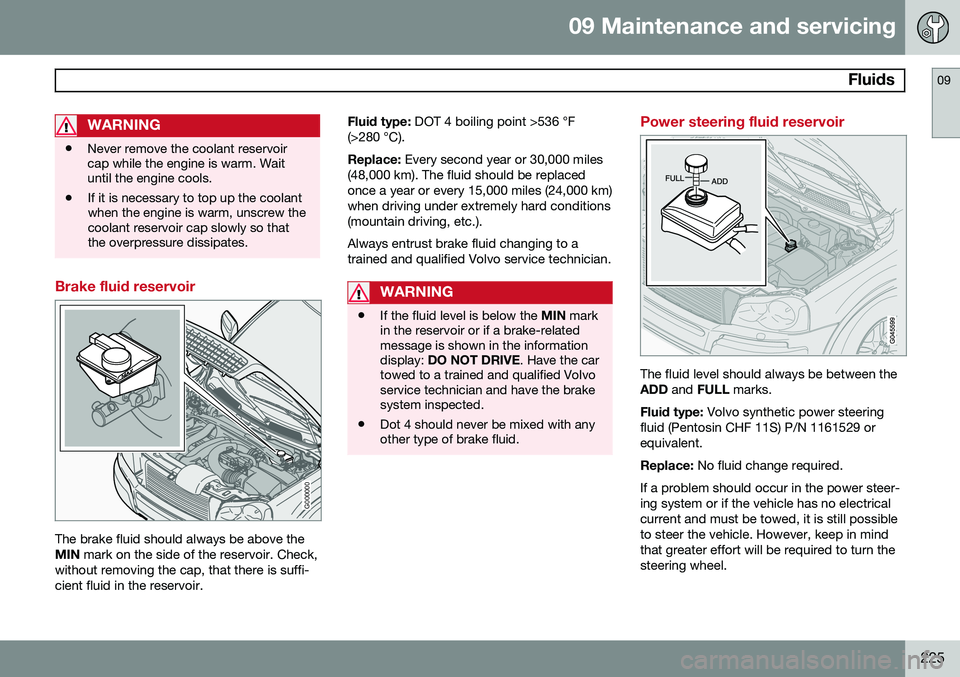
Brake fluid reservoir
G000000
The brake fluid should always be above the MIN
mark on the side of the reservoir. Check,
without removing the cap, that there is suffi-cient fluid in the reservoir. Fluid type:
DOT 4 boiling point >536 °F
(>280 °C). Replace: Every second year or 30,000 miles
(48,000 km). The fluid should be replaced once a year or every 15,000 miles (24,000 km)when driving under extremely hard conditions(mountain driving, etc.). Always entrust brake fluid changing to a trained and qualified Volvo service technician.
WARNING
• If the fluid level is below the
MIN mark
in the reservoir or if a brake-related message is shown in the informationdisplay: DO NOT DRIVE . Have the car
towed to a trained and qualified Volvoservice technician and have the brakesystem inspected.
• Dot 4 should never be mixed with anyother type of brake fluid.
Power steering fluid reservoir
The fluid level should always be between the ADD
and FULL marks.
Fluid type: Volvo synthetic power steering
fluid (Pentosin CHF 11S) P/N 1161529 orequivalent. Replace: No fluid change required.
If a problem should occur in the power steer- ing system or if the vehicle has no electricalcurrent and must be towed, it is still possibleto steer the vehicle. However, keep in mindthat greater effort will be required to turn thesteering wheel.