brake light VOLVO XC90 2014 Owner´s Manual
[x] Cancel search | Manufacturer: VOLVO, Model Year: 2014, Model line: XC90, Model: VOLVO XC90 2014Pages: 308, PDF Size: 13.31 MB
Page 13 of 308
Introduction
Important information
11
ShiftlockWhen your vehicle is parked, the gear selec- tor is locked in the P (Park) position. To
release the selector from this position, turnthe ignition key to position II (or start theengine), depress the brake pedal, press thebutton on the front side of the gear selectorand move the selector from P (Park).
KeylockWhen you switch off the ignition, the gearselector must be in the P (Park) position
before the key can be removed from the igni-tion switch.
Anti-lock Brake System (ABS)The ABS system in your vehicle performs aself-diagnostic test when the vehicle first rea-ches the speed of approximately 12 mph(20 km/h). The brake pedal will pulsate sev-eral times and a sound may be audible fromthe ABS control module. This is normal.
Fuel filler doorPress the button on the light switch panel(see the illustration on page 67) when thevehicle is at a standstill to unlock the fuel fillerdoor. Please note that the fuel filler door willremain unlocked until the vehicle begins tomove forward. An audible click will be heardwhen the fuel filler door relocks.
Points to keep in mind
• Do not export your Volvo to another country before investigating that coun-try's applicable safety and exhaust emis-sion requirements. In some cases it maybe difficult or impossible to comply withthese requirements. Modifications to theemission control system(s) may renderyour Volvo not certifiable for legal opera-tion in the U.S., Canada and other coun-tries.
• All information, illustrations and specifica-tions contained in this manual are basedon the latest product information availa-ble at the time of publication. Please notethat some vehicles may be equipped dif-ferently, depending on special legalrequirements. Optional equipment descri-bed in this manual may not be available inall markets.
• Some of the illustrations shown aregeneric and may not depict the exactmodel for which this manual is intended.
• Volvo reserves the right to make modelchanges at any time, or to change speci-fications or design without notice andwithout incurring obligation.
Volvo Structural Parts Statement
Volvo has always been and continues to be a leader in automotive safety. Volvo engineersand manufactures vehicles designed to helpprotect vehicle occupants in the event of acollision. Volvos are designed to absorb the impact of a collision. This energy absorption systemincluding, but not limited to, structural com-ponents such as bumper reinforcement bars,bumper energy absorbers, frames, rails,fender aprons, A-pillars, B-pillars and bodypanels must work together to maintain cabinintegrity and protect the vehicle occupants. The supplemental restraint system including but not limited to air bags, side curtain airbags, and deployment sensors work togetherwith the above components to provide propertiming for air bag deployment. Due to the above, Volvo Cars of North Amer- ica does not support the use of aftermarket,alternative or anything other than originalVolvo parts for collision repair. In addition Volvo does not support the use or re-use of structural components from anexisting vehicle that has been previouslydamaged. Although these parts may appearequivalent, it is difficult to tell if the parts havebeen previously replaced with non-OE partsor if the part has been damaged as a result of
Page 15 of 308
Introduction
Environment
13
Volvo and the environment
Volvo is committed to the well being of its customers. As a natural part of this commit-ment, we care about the environment inwhich we all live. Caring for the environmentmeans an everyday involvement in reducingour environmental impact. Volvo's environ-mental activities are based on a holistic view,which means we consider the overall environ-mental impact of a product throughout itscomplete life cycle. In this context, design,production, product use, and recycling are allimportant considerations. In production,Volvo has partly or completely phased outseveral chemicals including CFCs, lead chro-mates, asbestos, and cadmium; and reducedthe number of chemicals used in ourplants 50% since 1991. Volvo was the first in the world to introduce into production a three-way catalytic con-verter with a Lambda sond, now called theheated oxygen sensor, in 1976. The currentversion of this highly efficient system reducesemissions of harmful substances (CO, HC,NOx) from the exhaust pipe by approximately95 – 99% and the search to eliminate theremaining emissions continues. Volvo is theonly automobile manufacturer to offer CFC-free retrofit kits for the air conditioning systemof all models as far back as the 1975model 240. Advanced electronic engine con-trols and cleaner fuels are bringing us closerto our goal. In addition to continuous environ-mental refinement of conventional gasoline-powered internal combustion engines, Volvois actively looking at advanced technologyalternative-fuel vehicles. When you drive a Volvo, you become our partner in the work to lessen the car's impacton the environment. To reduce your vehicle'senvironmental impact, you can: •
Maintain proper air pressure in your tires. Tests have shown decreased fuel econ-omy with improperly inflated tires.
• Follow the recommended maintenanceschedule in your Warranty and ServiceRecords Information booklet.
• Drive at a constant speed whenever pos-sible.
• See a trained and qualified Volvo servicetechnician as soon as possible forinspection if the check engine (malfunc-tion indicator) light illuminates, or stayson after the vehicle has started.
• Properly dispose of any vehicle-relatedwaste such as used motor oil, used bat-teries, brake pads, etc.
• When cleaning your vehicle, please usegenuine Volvo car care products. AllVolvo car care products are formulated tobe environmentally friendly.
FSC®
The FSC ®
(Forest Stewardship Council ®
)
symbol indicates that the wood pulp used in this publication comes from FSC ®
certified
forests and other responsible sources.
Page 25 of 308
01 Safety
Supplemental Restraint System01
23
Supplemental Restraint System (SRS)
G027284
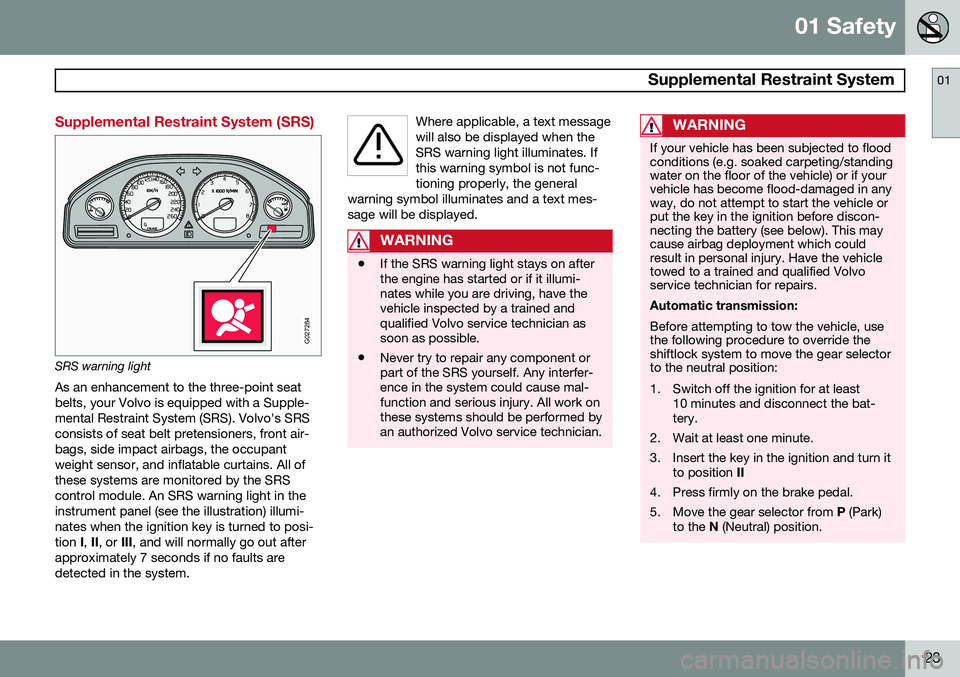
SRS warning lightAs an enhancement to the three-point seat belts, your Volvo is equipped with a Supple-mental Restraint System (SRS). Volvo's SRSconsists of seat belt pretensioners, front air-bags, side impact airbags, the occupantweight sensor, and inflatable curtains. All ofthese systems are monitored by the SRScontrol module. An SRS warning light in theinstrument panel (see the illustration) illumi-nates when the ignition key is turned to posi-tion I, II , or III, and will normally go out after
approximately 7 seconds if no faults aredetected in the system. Where applicable, a text messagewill also be displayed when theSRS warning light illuminates. Ifthis warning symbol is not func-tioning properly, the general
warning symbol illuminates and a text mes-sage will be displayed.
WARNING
• If the SRS warning light stays on after the engine has started or if it illumi-nates while you are driving, have thevehicle inspected by a trained andqualified Volvo service technician assoon as possible.
• Never try to repair any component orpart of the SRS yourself. Any interfer-ence in the system could cause mal-function and serious injury. All work onthese systems should be performed byan authorized Volvo service technician.
WARNING
If your vehicle has been subjected to flood conditions (e.g. soaked carpeting/standingwater on the floor of the vehicle) or if yourvehicle has become flood-damaged in anyway, do not attempt to start the vehicle orput the key in the ignition before discon-necting the battery (see below). This maycause airbag deployment which couldresult in personal injury. Have the vehicletowed to a trained and qualified Volvoservice technician for repairs. Automatic transmission: Before attempting to tow the vehicle, use the following procedure to override theshiftlock system to move the gear selectorto the neutral position:
1. Switch off the ignition for at least
10 minutes and disconnect the bat- tery.
2. Wait at least one minute.
3. Insert the key in the ignition and turn it to position II
4. Press firmly on the brake pedal.
5. Move the gear selector from P (Park)
to the N (Neutral) position.
Page 59 of 308
02 Instruments and controls
Instrument overview
02
* Option/accessory, for more information, see Introduction.57
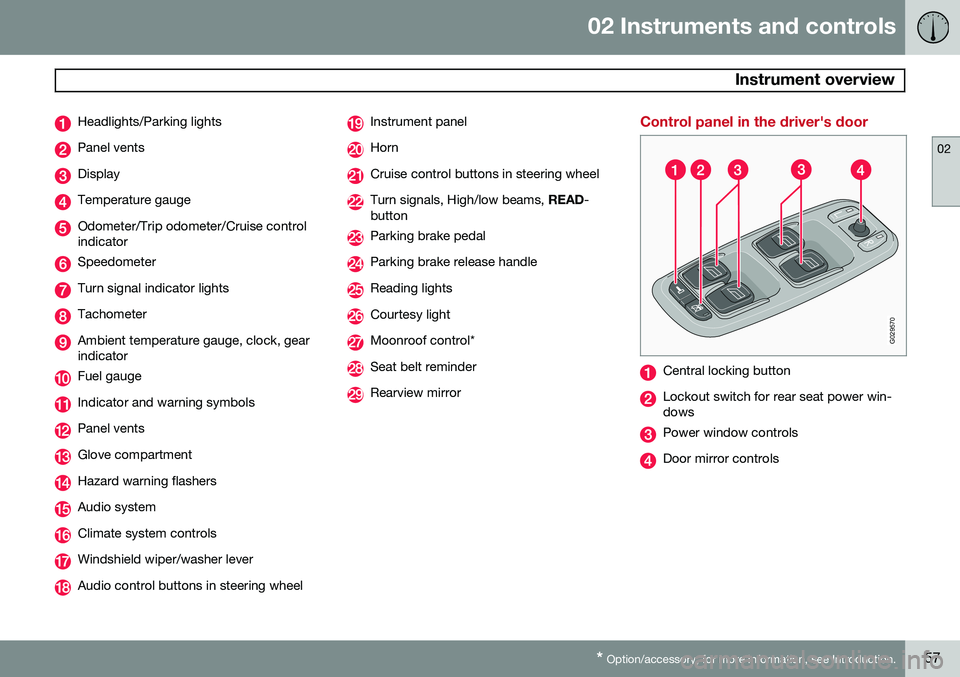
Headlights/Parking lights
Panel vents
Display
Temperature gauge
Odometer/Trip odometer/Cruise control indicator
Speedometer
Turn signal indicator lights
Tachometer
Ambient temperature gauge, clock, gear indicator
Fuel gauge
Indicator and warning symbols
Panel vents
Glove compartment
Hazard warning flashers
Audio system
Climate system controls
Windshield wiper/washer lever
Audio control buttons in steering wheel
Instrument panel
Horn
Cruise control buttons in steering wheel
Turn signals, High/low beams, READ-
button
Parking brake pedal
Parking brake release handle
Reading lights
Courtesy light
Moonroof control*
Seat belt reminder
Rearview mirror
Control panel in the driver's door
G029570
Central locking button
Lockout switch for rear seat power win- dows
Power window controls
Door mirror controls
Page 61 of 308
02 Instruments and controls
Instrument panel
02
59
Gear and driving mode indicator – The currently selected driving mode is dis-played here. If you use the Geartronicfunction on the automatic transmission,the currently selected gear will be dis-played.
Ambient temperature gauge – This dis- play indicates the air temperature outsideyour vehicle. A "snowflake" symbol in thetext window is displayed when the tem-perature is in the range of 23 – 36 °F (–5 –+2 °C). Please note that this symbol doesnot indicate a fault with your vehicle. Atlow speeds or when the vehicle is notmoving, the temperature readings may beslightly higher than the actual ambienttemperature.
Clock/set button – Turn the button to set the clock.
Fuel gauge – see page 288 for fuel tank volume. When the warning light in thegauge comes on, the vehicle should berefueled as soon as possible. The tripcomputer section (see page 76) pro-vides more information on fuel level andconsumption.
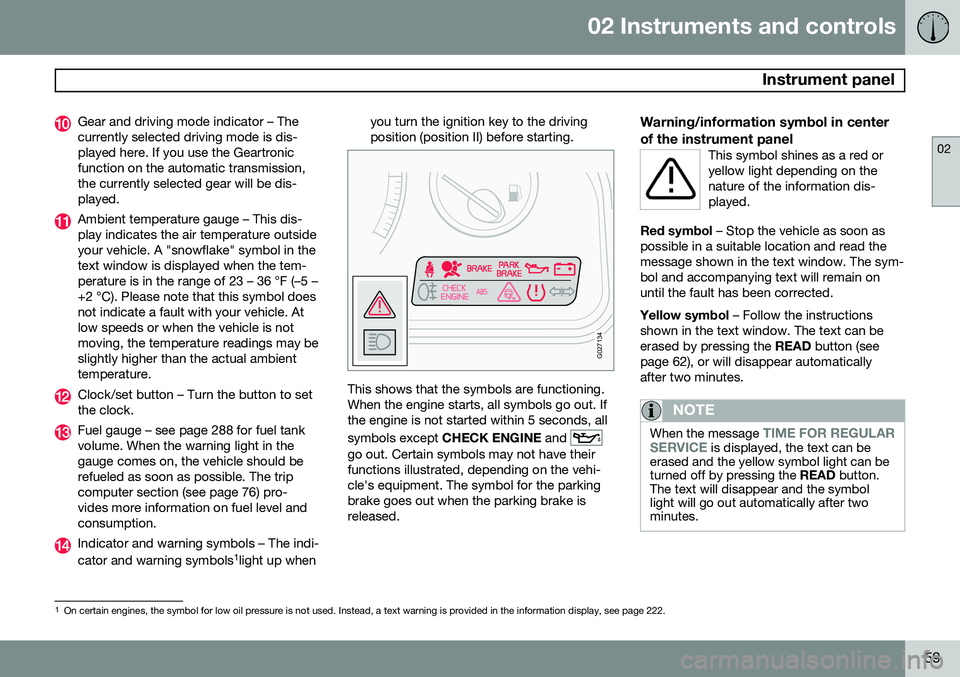
Indicator and warning symbols – The indi- cator and warning symbols1
light up when you turn the ignition key to the driving position (position II) before starting.
G027134
This shows that the symbols are functioning. When the engine starts, all symbols go out. Ifthe engine is not started within 5 seconds, all symbols except
CHECK ENGINE and
go out. Certain symbols may not have their functions illustrated, depending on the vehi-cle's equipment. The symbol for the parkingbrake goes out when the parking brake isreleased.
Warning/information symbol in center of the instrument panel
This symbol shines as a red or yellow light depending on thenature of the information dis-played.
Red symbol – Stop the vehicle as soon as
possible in a suitable location and read the message shown in the text window. The sym-bol and accompanying text will remain onuntil the fault has been corrected. Yellow symbol – Follow the instructions
shown in the text window. The text can be erased by pressing the READ button (see
page 62), or will disappear automaticallyafter two minutes.
NOTE
When the message TIME FOR REGULAR
SERVICE is displayed, the text can be
erased and the yellow symbol light can be turned off by pressing the READ button.
The text will disappear and the symbollight will go out automatically after twominutes.
1 On certain engines, the symbol for low oil pressure is not used. Instead, a text warning is provided in the information display, see page 222.
Page 62 of 308
02 Instruments and controls
Instrument panel
02
60
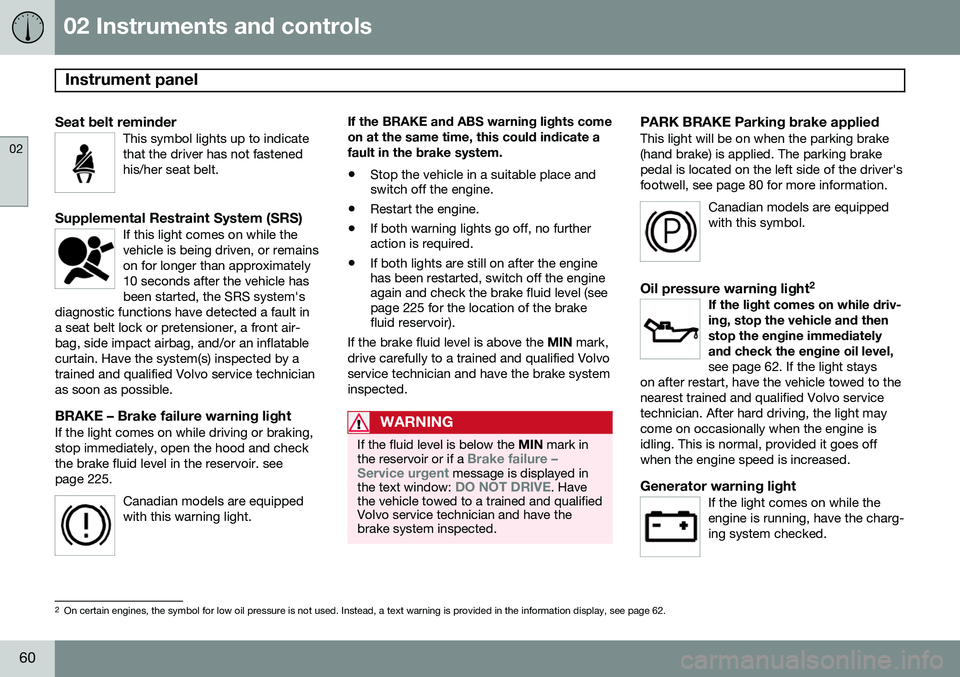
Seat belt reminderThis symbol lights up to indicate that the driver has not fastenedhis/her seat belt.
Supplemental Restraint System (SRS)If this light comes on while the vehicle is being driven, or remainson for longer than approximately10 seconds after the vehicle hasbeen started, the SRS system's
diagnostic functions have detected a fault ina seat belt lock or pretensioner, a front air-bag, side impact airbag, and/or an inflatablecurtain. Have the system(s) inspected by atrained and qualified Volvo service technicianas soon as possible.
BRAKE – Brake failure warning lightIf the light comes on while driving or braking, stop immediately, open the hood and checkthe brake fluid level in the reservoir. seepage 225.
Canadian models are equippedwith this warning light.
If the BRAKE and ABS warning lights come on at the same time, this could indicate afault in the brake system.
• Stop the vehicle in a suitable place and switch off the engine.
• Restart the engine.
• If both warning lights go off, no furtheraction is required.
• If both lights are still on after the enginehas been restarted, switch off the engineagain and check the brake fluid level (seepage 225 for the location of the brakefluid reservoir).
If the brake fluid level is above the MIN mark,
drive carefully to a trained and qualified Volvo service technician and have the brake systeminspected.
WARNING
If the fluid level is below the MIN mark in
the reservoir or if a Brake failure –
Service urgent message is displayed in
the text window: DO NOT DRIVE. Have
the vehicle towed to a trained and qualified Volvo service technician and have thebrake system inspected.
PARK BRAKE Parking brake appliedThis light will be on when the parking brake (hand brake) is applied. The parking brakepedal is located on the left side of the driver'sfootwell, see page 80 for more information.
Canadian models are equippedwith this symbol.
Oil pressure warning light 2If the light comes on while driv- ing, stop the vehicle and thenstop the engine immediatelyand check the engine oil level, see page 62. If the light stays
on after restart, have the vehicle towed to the nearest trained and qualified Volvo servicetechnician. After hard driving, the light maycome on occasionally when the engine isidling. This is normal, provided it goes offwhen the engine speed is increased.
Generator warning lightIf the light comes on while the engine is running, have the charg-ing system checked.
2 On certain engines, the symbol for low oil pressure is not used. Instead, a text warning is provided in the information display, see page 62.
Page 63 of 308
02 Instruments and controls
Instrument panel
02
61
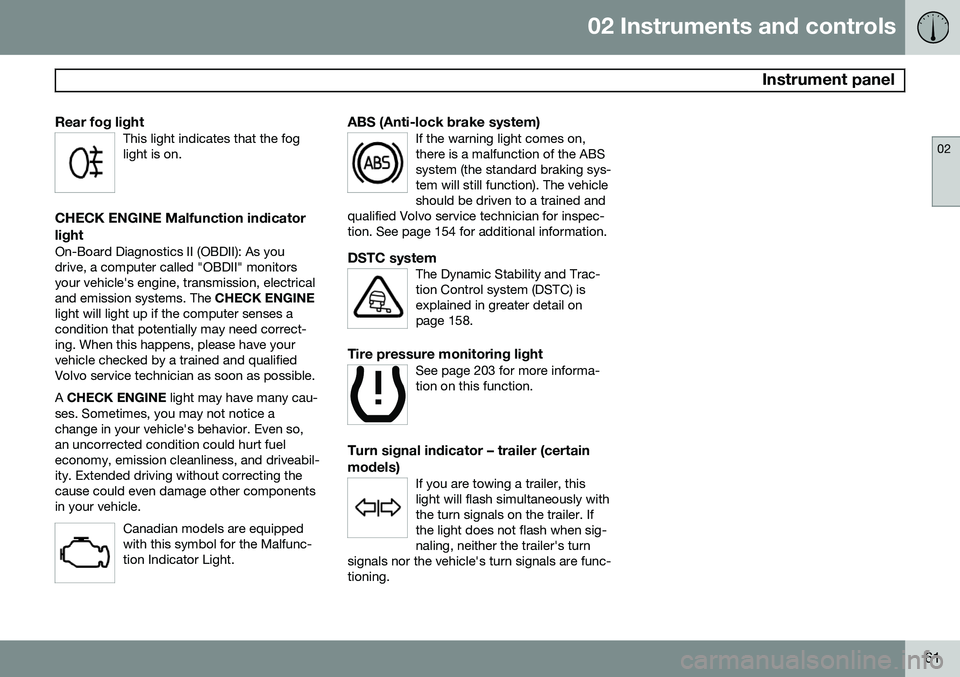
Rear fog lightThis light indicates that the fog light is on.
CHECK ENGINE Malfunction indicator light
On-Board Diagnostics II (OBDII): As you drive, a computer called "OBDII" monitorsyour vehicle's engine, transmission, electricaland emission systems. The CHECK ENGINE
light will light up if the computer senses acondition that potentially may need correct-ing. When this happens, please have yourvehicle checked by a trained and qualifiedVolvo service technician as soon as possible. A CHECK ENGINE light may have many cau-
ses. Sometimes, you may not notice a change in your vehicle's behavior. Even so,an uncorrected condition could hurt fueleconomy, emission cleanliness, and driveabil-ity. Extended driving without correcting thecause could even damage other componentsin your vehicle.
Canadian models are equippedwith this symbol for the Malfunc-tion Indicator Light.
ABS (Anti-lock brake system)If the warning light comes on, there is a malfunction of the ABSsystem (the standard braking sys-tem will still function). The vehicleshould be driven to a trained and
qualified Volvo service technician for inspec-tion. See page 154 for additional information.
DSTC systemThe Dynamic Stability and Trac- tion Control system (DSTC) isexplained in greater detail onpage 158.
Tire pressure monitoring lightSee page 203 for more informa- tion on this function.
Turn signal indicator – trailer (certain models)
If you are towing a trailer, this light will flash simultaneously withthe turn signals on the trailer. Ifthe light does not flash when sig-naling, neither the trailer's turn
signals nor the vehicle's turn signals are func-tioning.
Page 64 of 308
02 Instruments and controls
Information display
02
62
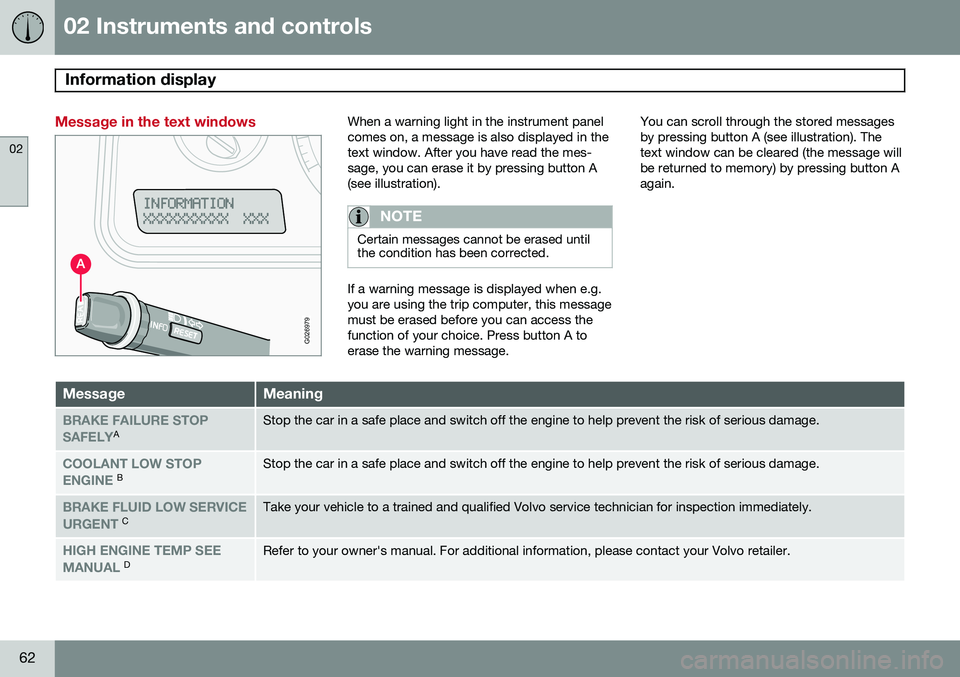
Message in the text windows
G026979
When a warning light in the instrument panel comes on, a message is also displayed in thetext window. After you have read the mes-sage, you can erase it by pressing button A(see illustration).
NOTE
Certain messages cannot be erased until the condition has been corrected.
If a warning message is displayed when e.g. you are using the trip computer, this messagemust be erased before you can access thefunction of your choice. Press button A toerase the warning message.You can scroll through the stored messagesby pressing button A (see illustration). Thetext window can be cleared (the message willbe returned to memory) by pressing button Aagain.
MessageMeaning
BRAKE FAILURE STOP SAFELYAStop the car in a safe place and switch off the engine to help prevent the risk of serious damage.
COOLANT LOW STOP ENGINE BStop the car in a safe place and switch off the engine to help prevent the risk of serious damage.
BRAKE FLUID LOW SERVICE URGENT CTake your vehicle to a trained and qualified Volvo service technician for inspection immediately.
HIGH ENGINE TEMP SEE MANUAL DRefer to your owner's manual. For additional information, please contact your Volvo retailer.
Page 145 of 308

06 Starting and driving
Starting the vehicle
06
143
Starting the engine
WARNING
Before starting, check that the seat, steer- ing wheel and mirrors are adjusted prop-erly. Make sure the brake pedal can bedepressed completely. Adjust the seat ifnecessary, see page 104.
1. Fasten the seat belt.
2. Apply the parking brake (hand brake) ifnot already set. The gear selector is locked in the P position (SHIFTLOCK).
3. Without touching the accelerator pedal, turn the ignition key 1
to the starting posi-
tion. Allow the starter to operate for up to10 seconds. Release the key as soon as the engine starts 2
. If the engine fails to
start, repeat this step.
CAUTION
If the engine does not start after the third try, wait for approximately 3 minutesbefore trying to start it again to give thebattery time to recover its startingcapacity.
WARNING
• Never use more than one floor mat at a time on the driver's floor. An extramat on the driver's floor can cause theaccelerator and/or brake pedal tocatch. Check that the movement ofthese pedals is not impeded.
• Volvo's floor mats are specially manu-factured for your car. They must befirmly secured in the clips on the floorso that they cannot slide and becometrapped under the pedals on the driv-er's side.
NOTE
•If the key blade section of the remote is not fully folded out when starting thevehicle, the immobilizer function maymake it impossible to start the engine.
• After a cold start, idle speed may benoticeably higher than normal for ashort period. This is done to help bringcomponents in the emission controlsystem to their normal operating tem-perature as quickly as possible, whichenables them to control emissions andhelp reduce the vehicle's impact onthe environment.
• To release the gear selector from the
P
(Park) position, the engine must berunning (or the ignition key must be inposition II) and the brake pedal must
be depressed.
• Select the desired gear. The gearengages after a very slight delay whichis especially noticeable when selecting R.
1
If two of the keys to your vehicle are close together, e.g. on the same key ring when you try to start the vehicle, this could cause interference in the immobilizer system and result in the vehicle not starting. If this should occur, remove one of the keys from the key ring before trying to start the vehicle again.
2 On vehicles equipped with the autostart feature, release the key immediately. See also page 145.
Page 146 of 308
06 Starting and driving
Starting the vehicle
06
144
NOTE
Your vehicle is equipped with a KEYLOCK
system. When the engine is switched off, the gear selector must be in the P position
before the key can be removed from theignition switch. When starting in cold weather, the trans- mission may shift up at slightly higherengine speeds than normal until the auto-matic transmission fluid reaches normaloperating temperature.
NOTE
Do not race a cold engine immediately after starting. Oil flow may not reach somelubrication points fast enough to preventengine damage.
WARNING
Always place the gear selector in Park and apply the parking brake before leaving thevehicle. Never leave the vehicle unatten-ded with the engine running.
• Always open garage doors fully before starting the engine inside a garage toensure adequate ventilation. Theexhaust gases contain carbon monox-ide, which is invisible and odorless butvery poisonous.
CAUTION
Automatic transmission
• The engine should be idling when you move the gear selector. Never acceler-ate until after you feel the transmissionengage! Accelerating immediately afterselecting a gear will cause harshengagement and premature transmis-sion wear.
• Selecting
P or N when idling at a
standstill for prolonged periods of timewill help prevent overheating of theautomatic transmission fluid.