airbag VOLVO XC90 2015 Owner's Manual
[x] Cancel search | Manufacturer: VOLVO, Model Year: 2015, Model line: XC90, Model: VOLVO XC90 2015Pages: 570, PDF Size: 12.44 MB
Page 137 of 570

INSTRUMENTS AND CONTROLS
135
SymbolMeaning
Airbags Stop the vehicle in a safe place and do not continue driving. If this light comes on while the vehicle is being driven, or remainson after the vehicle has beenstarted, the airbag system's diag-nostic functions have detected afault. Have the system(s) inspec-ted by a trained and qualifiedVolvo service technician as soonas possible.
A
B
Brake system If this symbol illuminates, the brake fluid level may be too low.Stop the vehicle in a safe placeand check the level in the brakefluid reservoir. See also the warn-ing following this table.
SymbolMeaning
A
B
Parking brake This symbol flashes while the parking brake is being applied andthen glows steadily when theparking brake has been set. If the symbol flashes in any other situation, this indicates a fault. Seethe text message in the instru-ment panel.
SymbolMeaning
Oil pressure If the symbol illuminates during driving, stop the vehicle, theengine oil level is too low. Stop theengine immediately and check theengine oil level. Add oil if neces-sary. If the oil level is normal andthe symbol remains illuminated,have the vehicle towed to thenearest authorized Volvo work-shop or trained and qualified Volvoservice technician.
Generator not charging This symbol illuminates during driving if a fault has occurred inthe electrical system. Contact anauthorized Volvo workshop ortrained and qualified Volvo servicetechnician.
AUS models
B Canadian models
Page 335 of 570
STARTING AND DRIVING
333
When Auto-hold is off, Hill Start Assist (HSA) will be activated to help prevent the vehicle from roll-ing backwards when starting up a hill.
Instrument panel symbol
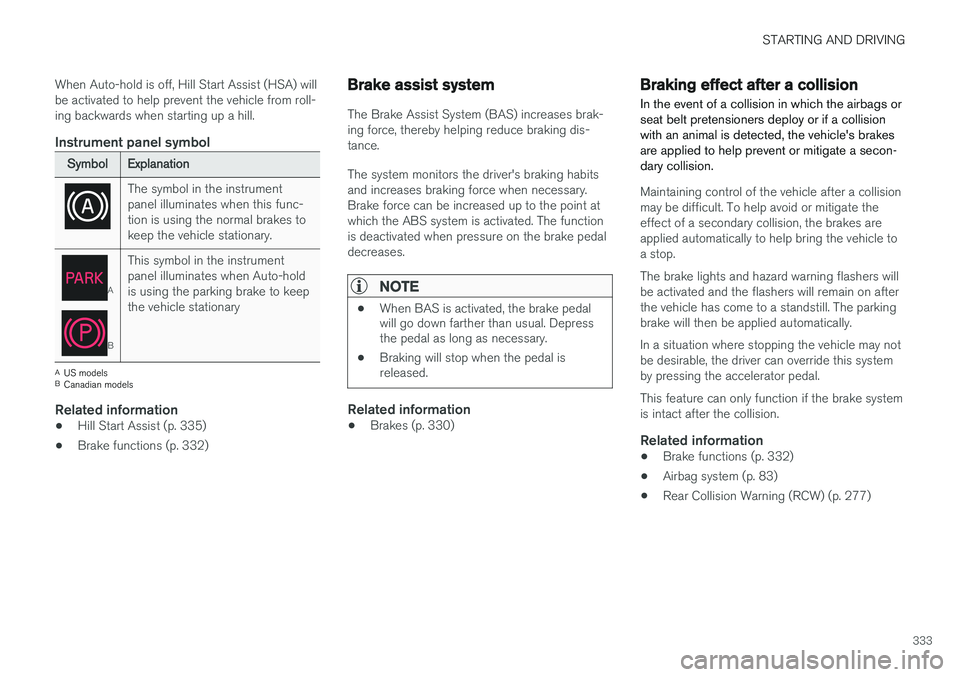
SymbolExplanation
The symbol in the instrument panel illuminates when this func-tion is using the normal brakes tokeep the vehicle stationary.
A
B
This symbol in the instrument panel illuminates when Auto-holdis using the parking brake to keepthe vehicle stationary
A
US models
B Canadian models
Related information
• Hill Start Assist (p. 335)
• Brake functions (p. 332)
Brake assist system
The Brake Assist System (BAS) increases brak- ing force, thereby helping reduce braking dis-tance. The system monitors the driver's braking habits and increases braking force when necessary.Brake force can be increased up to the point atwhich the ABS system is activated. The functionis deactivated when pressure on the brake pedaldecreases.
NOTE
•When BAS is activated, the brake pedal will go down farther than usual. Depressthe pedal as long as necessary.
• Braking will stop when the pedal isreleased.
Related information
•Brakes (p. 330)
Braking effect after a collision
In the event of a collision in which the airbags or seat belt pretensioners deploy or if a collisionwith an animal is detected, the vehicle's brakesare applied to help prevent or mitigate a secon-dary collision.
Maintaining control of the vehicle after a collision may be difficult. To help avoid or mitigate theeffect of a secondary collision, the brakes areapplied automatically to help bring the vehicle toa stop. The brake lights and hazard warning flashers will be activated and the flashers will remain on afterthe vehicle has come to a standstill. The parkingbrake will then be applied automatically. In a situation where stopping the vehicle may not be desirable, the driver can override this systemby pressing the accelerator pedal. This feature can only function if the brake system is intact after the collision.
Related information
• Brake functions (p. 332)
• Airbag system (p. 83)
• Rear Collision Warning (RCW) (p. 277)
Page 346 of 570

STARTING AND DRIVING
344
Towing recommendations
Always check with state and local authorities before attempting to tow another vehiclebecause this type of towing is subject to regula-tions regarding maximum towing speed, lengthand type of towing device, lighting, etc.
Towing your vehicle behind another
vehicle
1. After securely attaching the towing line to both vehicles, put the gear selector in posi- tion N and release the parking brake.
2. Put the ignition in mode II by turning the
start knob to START (without depressing
the brake pedal) and hold it in this position
for approx. 4 seconds. Release the knob.
3. Put the gear selector in position N and
release the parking brake.
4. The towing vehicle can now begin driving.
5. Keep the tow rope taut when the towing vehicle slows down by applying light pressure on the brake pedal. This will help prevent jar-ring movements of the vehicle being towed.
6. Be prepared to apply the brakes to stop the vehicle being towed.
CAUTION
General towing precautions:
• If the vehicle's battery is dead, an auxiliary battery will be necessary to provide cur-rent for releasing the electric parkingbrake and to move the gear selector from the
P position to N. If this is not possible,
use the shiftlock override procedure tomanually release the gear selector from P
and move it to N.
• Maximum speed: 50 mph (80 km/h). Do not exceed the maximum allowable tow-ing speed.
• Maximum distance with front wheels onground: 50 miles (80 km).
• The vehicle should only be towed in theforward direction.
WARNING
• When the vehicle is being towed, the igni- tion should be in mode
II (in mode I, all of
the vehicle's airbags are deactivated).
• The remote key must remain inside the vehicle.
• The power brakes and power steering willnot function when the engine is not run-ning. Approximately 5 times more pres-sure will be required on the brake pedaland the steering wheel will be considera-bly harder to turn.
• The towing eyelets must not be used forpulling the vehicle out of a ditch or forany similar purpose involving severestrain.
Page 416 of 570
VOLVO ON CALL WITH SENSUS CONNECT *
* Option/accessory, for more information, see Introduction.
414
Volvo On Call (VOC) *
VOC is an integrated, subscription-based sys-
tem that provides emergency, roadside assis- tance and security services.
VOC is connected to the vehicle's airbag and alarm systems. The vehicle has an integratedGlobal System for Mobile Communications(GSM) module that handles communicationbetween the vehicle and the VOC customer serv-ice center.
AvailabilityVOC uses the Global Navigation Satellite System(GNSS) to locate the vehicle and its integratedGSM module to enable communication with theVOC customer service center and the VOCmobile app. From the time that the remote key has been removed from the vehicle, VOC's functionsremain available for 5 full days and subsequentlyonce an hour for the following 17 days. Afterthree weeks have elapsed, the system will remainswitched off until the engine is started.
WARNING
The system can only function in areas where there is adequate cellular network coverage. Just as in the case of cell phones, atmos- pheric disturbances or areas with relativelyfew GSM transmitters can make it impossiblefor VOC to make a connection, for example, inrural areas.
SubscriptionsA free, limited-time trial subscription is initiated when the vehicle is purchased and VOC is acti-vated. The subscription can be extended by con-tacting your Volvo retailer.
Information on the InternetFor additional information about Volvo On Call, goto: United States http://www.volvocars.com/us/support Canada English: http://support.volvocars.com/en-CA French: http://support.volvocars.com/fr-CA
Related information
• Volvo On Call convenience services (p. 416)
• Volvo On Call safety services (p. 424)
• Volvo On Call security services (p. 425)
• Using Volvo On Call (p. 414)
• Volvo ID (p. 27)
Using Volvo On Call
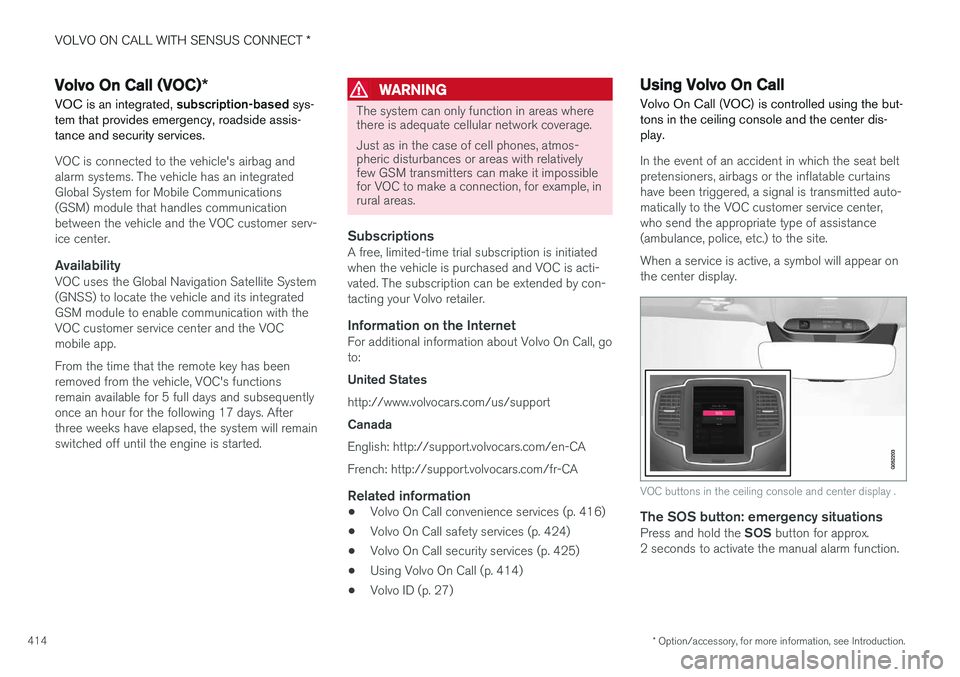
Volvo On Call (VOC) is controlled using the but- tons in the ceiling console and the center dis-play.
In the event of an accident in which the seat belt pretensioners, airbags or the inflatable curtainshave been triggered, a signal is transmitted auto-
matically to the VOC customer service center,who send the appropriate type of assistance(ambulance, police, etc.) to the site. When a service is active, a symbol will appear on the center display.
VOC buttons in the ceiling console and center display .
The SOS button: emergency situationsPress and hold the SOS button for approx.
2 seconds to activate the manual alarm function.
Page 422 of 570
VOLVO ON CALL WITH SENSUS CONNECT *
* Option/accessory, for more information, see Introduction.
420
Personal information Personal information is gathered for use with the Volvo On Call (VOC) service.
Volvo's sales companies are responsible for pro- cessing and storing VOC-related information.This information is treated according to legisla-tion and regulations pertaining to data of thistype.
CountrySales company
United StatesVolvo Cars of North America, LLC
CanadaVolvo Cars of Canada
Why information is gatheredPersonal information is used by Volvo and its partners to provide and develop the VOC service.
Types of personal information gatheredThe primary types of personal information gath-ered for VOC-related purposes are:
• Personal information that the customer pro- vides in connection with the activation of theVOC service and during other contact withVolvo, including name, address, telephonenumber, type of service and the duration ofthe service.
• When information about a specific VOC-rela-ted event is automatically transmitted fromthe vehicle. A message of this type contains:the vehicle identification number (VIN), time when the service is used, type of service, ifairbags have been triggered, if the seat belttensioners have been triggered, current fuellevel, current temperature inside and outsidethe vehicle, whether the doors are lockedand windows are closed and the vehicle'slast six locations, including speed and direc-tion.
• Other information associated with theowner/driver, such as telephone calls withpeople in the vehicle, the customer servicecenter that provided the service and notesmade by the customer service operator.
Access to my personal informationVolvo uses sub-contractors to provide the service. These sub-contractors work on behalf of Volvoand may only process personal information to theextent necessary to provide service. All sub-con-tractors are bound by agreements requiring themto observe strict confidentiality and to treat per-sonal details in accordance with applicable legis-lation.
Deleting personal informationThe personal details required to provide the VOCservice are stored during the subscription periodand thereafter for as long as necessary in orderfor Volvo to fulfil its obligations according to leg-islation and other regulations. Information gener-ated during events covered by the VOC service isdeleted three months after an event has occur-red.
Corrections and register extractsPrivate persons have the right to request correc-tions of incorrect information and to obtain anextract showing the personal information that hasbeen processed. Requests for extracts from theregister must be submitted in writing and signedby the applicant and include name, address andcustomer number. The request should be postedto: Volvo Cars of North America, LLC Customer Care Center 1 Volvo Drive,P.O. Box 914Rockleigh, New Jersey 07647Phone: 1-800-458-1552 Volvo Cars of Canada National Customer Service 9130 Leslie Street, Suite 101Richmond Hill, Ontario L4B 0B9Phone: 1-800-663-8255
Consent to gather VOC-related personal
information
By activating a VOC subscription in accordance with the instructions in this document, the useragrees to the collection of VOC-related personalinformation.
Page 426 of 570
VOLVO ON CALL WITH SENSUS CONNECT *
* Option/accessory, for more information, see Introduction.
424
Changing ownership of a vehicle with Volvo On Call
If the vehicle changes owners, the Volvo On Call (VOC) service should be cancelled.
Cancelling the VOC serviceIf your vehicle changes owners, contact your Volvo retailer to cancel the VOC service. The sub-scription will be terminated and the service his-tory will be erased. When the vehicle changes owners, all personal settings should be reset to the factory defaults,see the owner's manual supplement.
Starting the VOC serviceIf you purchase a previously owned Volvo withVOC: The new owner should contact his/her Volvo retailer to transfer the remaining period of theVOC subscription. All contact information mustbe updated in order for VOC to function and toensure that the previous owner is no longerauthorized to use VOC services in the vehicle.The new owner will be given a 4-digit personalcode, which is used to identify him/her as beingauthorized to approve certain VOC services.
Related information
• Volvo On Call (VOC)
* (p. 414)
• Volvo On Call PIN code (p. 418)
• Resetting user data when the vehicle changes owners (p. 112)
Volvo On Call manual safety service Contact the Volvo On Call (VOC) customer service center in emergency situations.
To contact the VOC customer service center manually: 1.
Press SOS to contact the customer service
center for help in emergency situations such as illness, injury, a threat, etc.
2. An emergency signal is transmitted to the VOC customer service center with informa-tion about the vehicle's location.
3. The VOC customer service center attempts to establish voice contact with the driver todetermine the extent of the accident and/orthe need for assistance.
If voice contact is not possible, the VOC cus- tomer service then contacts the emergency serv-ices for appropriate action.
Related information
• Volvo On Call safety services (p. 424)
• Volvo On Call roadside assistance (p. 425)
• Using Volvo On Call (p. 414)
Volvo On Call safety services
The Volvo On Call (VOC) manual or automatic safety services are intended for use in emer-gency situations.
Automatic alarmIn the event of certain types of accidents, a signal is transmitted automatically to the VOC customerservice center, who take appropriate actionaccording to the information that they receive. The following occurs if the seat belt pretension- ers, airbags or the inflatable curtains have beentriggered:
1. A signal is transmitted automatically to the VOC customer service center with informa- tion about the vehicle's location and that anairbag, etc., has been triggered.
2. The VOC customer service center attempts to establish voice contact with the driver todetermine the extent of the accident and theneed for assistance.
3. The VOC customer service center then con- tacts the appropriate emergency service(police, ambulance, towing, etc.).
If voice contact is not possible, the VOC cus- tomer service then contacts the emergency serv-ices for appropriate action.
Manual alarmPress SOS to contact the customer service cen-
ter for help in emergency situations, see also thearticle "VOC manual safety service."
Page 510 of 570

MAINTENANCE AND SERVICING
* Option/accessory, for more information, see Introduction.
508
Fuses in the cargo compartment The fuses in the cargo compartment help pro- tect electrical components such as power seats *, airbags and seat belt tensioners.
The fuse box is under the storage compartment on the right side
Positions
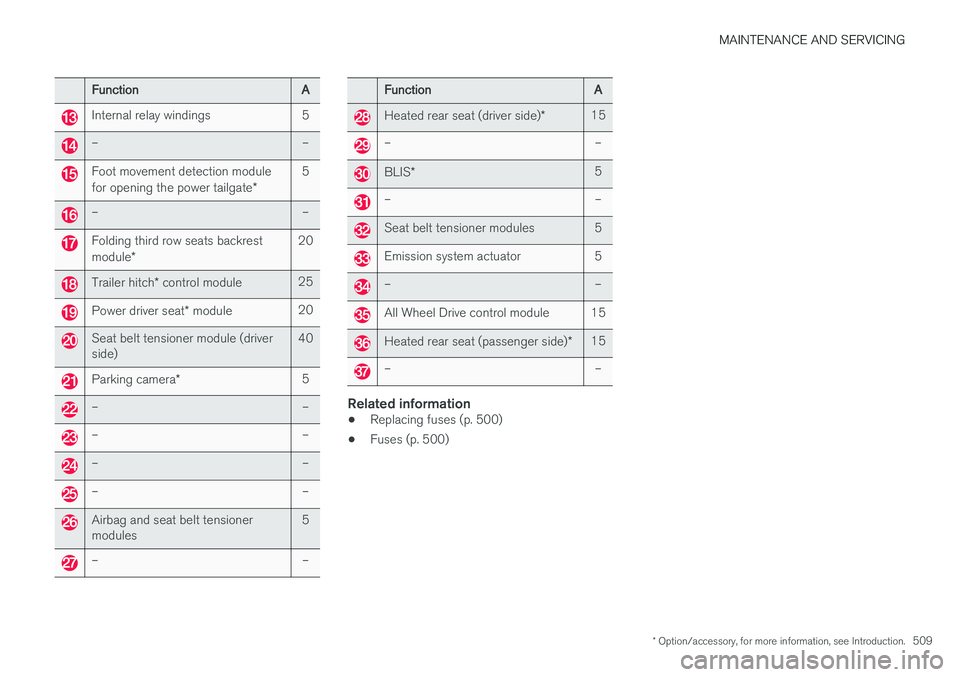
• Fuses 13–17 and 21–36 are called "Micro".
• Fuses 1–12, 18–20 and 37 are called "MCase" and should only be replaced by atrained and qualified Volvo service technician.
FunctionA
Heated tailgate window30
––
FunctionA
Pneumatic suspension
* compressor40
Heated rear seat (passenger side) *30
––
Heated rear seat (driver side)*30
––
FunctionA
––
Power tailgate*25
Power passenger seat * module20
Trailer hitch * control module40
Seat belt tensioner module (pas- senger side)40
Page 511 of 570
MAINTENANCE AND SERVICING
* Option/accessory, for more information, see Introduction.509
FunctionA
Internal relay windings5
––
Foot movement detection module for opening the power tailgate*5
––
Folding third row seats backrest module*20
Trailer hitch * control module25
Power driver seat * module20
Seat belt tensioner module (driver side)40
Parking camera *5
––
––
––
––
Airbag and seat belt tensioner modules5
––
FunctionA
Heated rear seat (driver side) *15
––
BLIS*5
––
Seat belt tensioner modules5
Emission system actuator5
––
All Wheel Drive control module15
Heated rear seat (passenger side) *15
––
Related information
•Replacing fuses (p. 500)
• Fuses (p. 500)
Page 557 of 570
555
INDEX
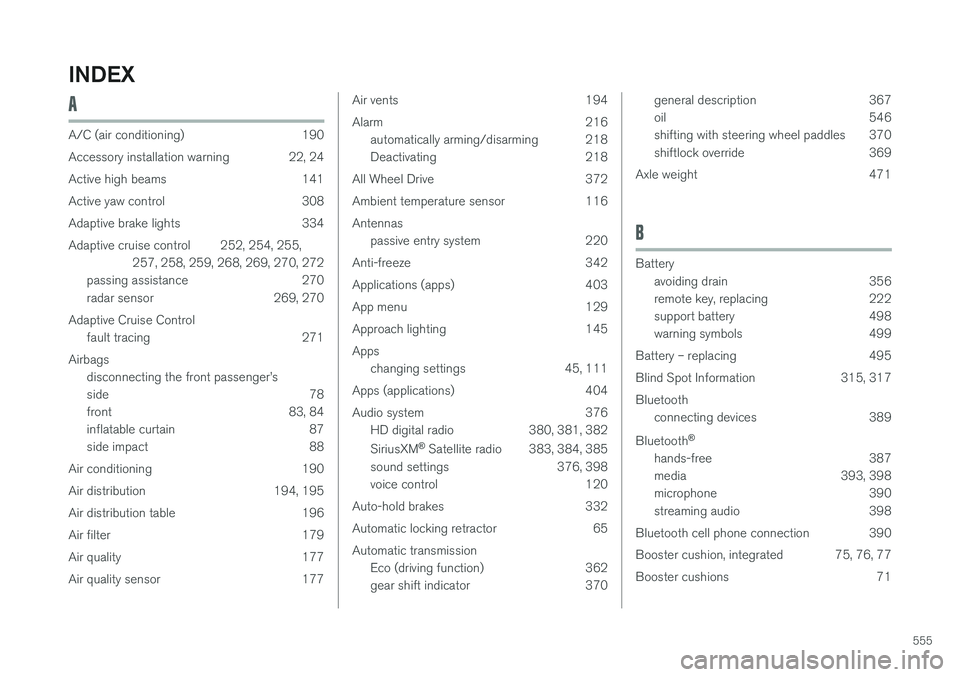
A
A/C (air conditioning) 190
Accessory installation warning 22, 24
Active high beams 141
Active yaw control 308
Adaptive brake lights 334
Adaptive cruise control 252, 254, 255,257, 258, 259, 268, 269, 270, 272
passing assistance 270
radar sensor 269, 270
Adaptive Cruise Control fault tracing 271
Airbags disconnecting the front passenger
Page 560 of 570
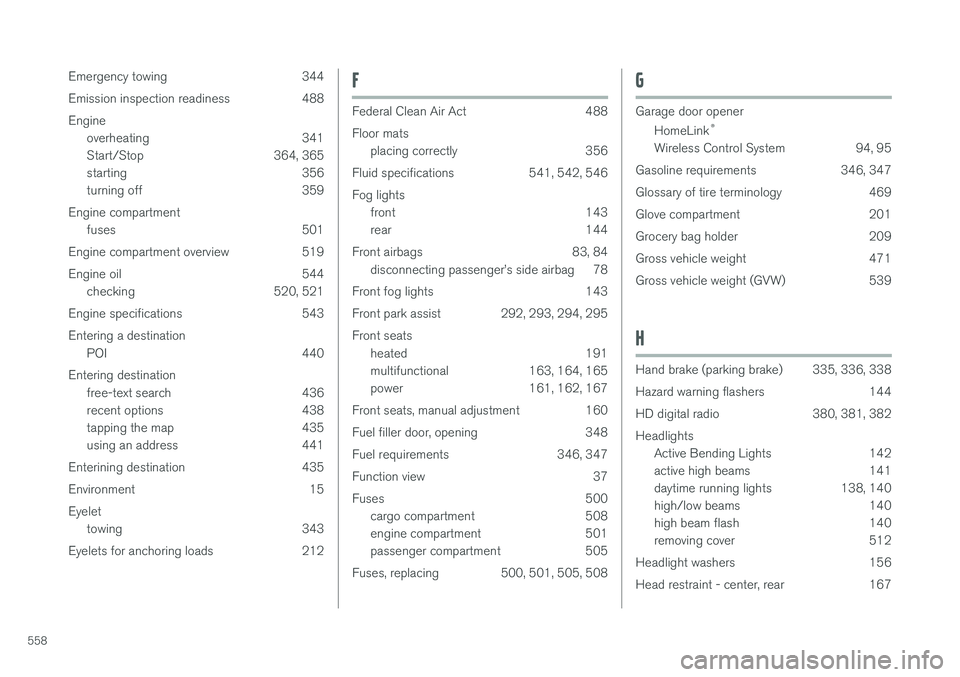
558Emergency towing 344
Emission inspection readiness 488Engine
overheating 341
Start/Stop 364, 365
starting 356
turning off 359
Engine compartment fuses 501
Engine compartment overview 519
Engine oil 544 checking 520, 521
Engine specifications 543Entering a destination POI 440
Entering destination free-text search 436
recent options 438
tapping the map 435
using an address 441
Enterining destination 435
Environment 15Eyelet towing 343
Eyelets for anchoring loads 212
F
Federal Clean Air Act 488 Floor mats placing correctly 356
Fluid specifications 541, 542, 546Fog lights front 143
rear 144
Front airbags 83, 84 disconnecting passenger