steering wheel VOLVO XC90 2018 Owner´s Manual
[x] Cancel search | Manufacturer: VOLVO, Model Year: 2018, Model line: XC90, Model: VOLVO XC90 2018Pages: 666, PDF Size: 11.32 MB
Page 7 of 666
5
SEATS AND STEERING WHEEL
Manual front seats188
Power front seats *
189
Adjusting the power front seats *
189
Storing memory settings in power front seats * 190
Using stored memory in a powered front seat 191
Front seat massage settings *
192
Adjusting front seat massage settings *
192
Adjusting front seat cushion length 193
Adjusting front seat side bolster settings *
194
Adjusting front seat lumbar support *
194
Adjusting the passenger seat from the driver's seat * 195
Folding the second row backrests 196
Adjusting the second row head restraints 198
Moving the second row seats for-ward/rearward * 199
Adjusting the second row backrest tilt 200
Getting into and out of the third rowof seats * 201
Folding the third row backrests *
202
Steering wheel controls and horn 203
Adjusting the steering wheel 203
CLIMATE CONTROL
Climate206
Climate zones 206
Climate control sensors 207
Perceived temperature 207
Climate control system voice commands 208
Air quality 209
Clean Zone *
209
Clean Zone Interior Package *
210
Interior Air Quality System *
210
Activating and deactivating the air quality sensor * 211
Passenger compartment air filter 211
Air distribution 212
Adjusting air distribution 212
Opening, closing and directing air vents 213
Air distribution options 214
Climate system controls 217
Activating and deactivating powerfront seats * 219
Activating and deactivating theheated front seat * 220
Activating and deactivating theheated rear seats * 220
Activating and deactivating front seatventilation * 221
Activating and deactivating the heated steering wheel
*222
Activating and deactivating automaticsteering wheel heating *223
Activating auto climate control 223
Activating and deactivating recirculation 224
Activating and deactivating the recir- culation timer setting 224
Activating and deactivating max defroster 225
Activating and deactivating the heated windshield * 226
Activating and deactivating automaticwindshield heating * 227
Activating and deactivating the heated rear window and door mirrors 227
Automatically activating and deacti-vating the heated rear window anddoor mirrors 228
Setting the blower speed for thefront seats 228
Setting the blower speed for the rear seats * 229
Setting the temperature for the front seats 230
Setting the temperature for the rear seats * 231
Synchronize temperature 232
Activating and deactivating air condi- tioning 233
Page 9 of 666
7
DRIVER SUPPORT
Driver support systems270
Speed-dependent steering wheel resistance 270
Stability system Roll Stability Control 271
Electronic Stability Control 272
Electronic Stability Control Sport mode 273
Activating/deactivating Sport modein Electronic Stability Control 273
Electronic Stability Control Sportmode limitations 274
Electronic Stability Control symbolsand messages 275
Speed limiter 276
Activating and starting Speed Limiter 277
Managing Speed Limiter speed 277
Deactivating and putting Speed Lim-iter in standby mode 278
Reactivating Speed Limiter fromstandby mode 279
Turning off Cruise Control 279
Cruise Control limitations 280
Automatic Speed Limiter 280
Activating/deactivating AutomaticSpeed Limiter 282
Changing Automatic Speed Limitertolerance 283
Automatic Speed Limiter limitations 283
Cruise control284
Activating and starting Cruise Control 285
Managing Cruise Control speed 286
Deactivating and putting Cruise Con- trol in standby mode 287
Reactivating Cruise Control fromstandby mode 288
Switching off Cruise Control 288
Distance Alert *
289
Head-up display for Distance Alert 290
Activating/deactivating Distance Alert 291
Setting a time interval for Distance Alert 291
Distance Alert limitations 292
Adaptive Cruise Control *
293
Adaptive Cruise Control and collisionwarning 296
Head-up display for Adaptive CruiseControl with collision warning 297
Activating and starting AdaptiveCruise Control 297
Managing Adaptive Cruise Control speed 298
Setting Adaptive Cruise Control timeintervals 299
Deactivating/reactivating AdaptiveCruise Control 300
Passing assistance with AdaptiveCruise Control 302
Starting passing assistance with Adaptive Cruise Control302
Limitations of passing assistancewith Adaptive Cruise Control 303
Switching target vehicles with Adap-tive Cruise Control 303
Automatic braking with AdaptiveCruise Control 304
Adaptive Cruise Control limitations 305
Switching between Cruise Controland Adaptive Cruise Control 305
Symbols and messages for AdaptiveCruise Control 307
Pilot Assist 309
Pilot Assist and collision warning 312
Head-up display for Pilot Assist dur-ing collision risks 313
Activating and starting Pilot Assist 313
Managing Pilot Assist speed 314
Setting a time interval for Pilot Assist 315
Deactivating/reactivating Pilot Assist 317
Passing assistance with Pilot Assist 319
Starting passing assistance withPilot Assist 319
Passing assistance with Pilot Assistlimitations 319
Switching target vehicles with Pilot Assist 320
Automatic braking with Pilot Assist 320
Page 12 of 666
10
Using the steering wheel paddles* to
shift 419
Shiftlock 421
Deactivating the automatic shiftlock 421
The kickdown function 422
Gear indicator *
422
All Wheel Drive (AWD) *
423
Drive modes *
423
Changing drive mode *
425
ECO drive mode 426
Activating and deactivating ECO drive mode using the function button 428
Start/Stop function 428
Driving with the Start/Stop function 428
Temporarily deactivating the Start/Stop function 430
Conditions for the Start/Stop function 430
Leveling control * and suspension
432
Leveling control settings *
435
Low Speed Control *
435
Activating and deactivating Low Speed Control * using the function button 436
Hill Descent Control *
437
Activating and deactivating HillDescent Control * using the function
button 438
Economical driving
438
Preparing for a long trip 439
Winter driving 440
Driving through standing water 441
Opening/closing the fuel filler door 441
Refueling 442
Fuel 442
Octane rating 443
Emission controls 445
Overheating of engine and transmission 446
Battery drain 447
Jump starting using another battery 447
Detachable towbar *
448
Driving with a trailer 449
Trailer Stability Assist *
451
Checking trailer lights 452
Towing using a towline 453
Attaching and removing the towing eyelet 454
Recovery 455
HomeLink ®
* 456
Programming HomeLink ®
* 457
Using HomeLink 458
Type approval for HomeLink ®
* 459
Compass 459
Activating and deactivating the compass460
Calibrating the compass 460
Page 15 of 666
13
LOADING, STORAGE AND
PASSENGER COMPARTMENT
Passenger compartment interior558
Tunnel console 559
Electrical outlets 560
Using the electrical outlets 562
Using the glove compartment 563
Sun visors 564
Cargo compartment 564
Loading recommendations 564
Roof loads and load carriers 566
Grocery bag holders 566
Load anchoring eyelets 567
Installing and removing the cargo compartment cover * 567
Operating the cargo compartment cover *
568
Installing and removing the steelcargo grid * 570
Installing and removing the cargo net *
571
MAINTENANCE AND SERVICE
Volvo's service program
576
Data transfer between vehicle and workshop over Wi-Fi 578
Download Center 579
Handling system updates via Down-load Center 579
Vehicle status 580
Scheduling service and repairs 580
Sending vehicle information to theworkshop 582
Hoisting the vehicle 583
Opening and closing the hood 585
Climate control system service 586
Replacing a windshield with head-up display * 586
Engine compartment overview 587
Engine oil 587
Checking and filling engine oil 588
Refilling coolant 590
Replacing bulbs 591
Removing the plastic cover to replace bulbs 593
Removing the rectangular headlightcover 593
Location of exterior lights 594
Replacing the low beam headlight bulbs 595
Replacing the high beam headlight bulbs595
Replacing daytime running lights/ front parking light bulbs 596
Replacing front turn signal bulbs 597
Bulb specifications 597
Start battery 598
Support battery 601
Battery symbols 602
Fuses and fuseboxes 603
Replacing fuses 604
Fuses in the engine compartment 605
Fuses under the glove compartment 608
Fuses in the cargo compartment 611
Cleaning the interior 615
Cleaning the center display 615
Cleaning the head-up display *
616
Cleaning fabric upholstery and ceil-ing liner 617
Cleaning the seat belt 617
Cleaning floor mats and inlay mats 617
Cleaning leather upholstery 618
Cleaning the leather steering wheel 619
Cleaning interior plastic, metal andwood surfaces 620
Cleaning the exterior 620
Page 33 of 666
YOUR VOLVO
}}
* Option/accessory.31
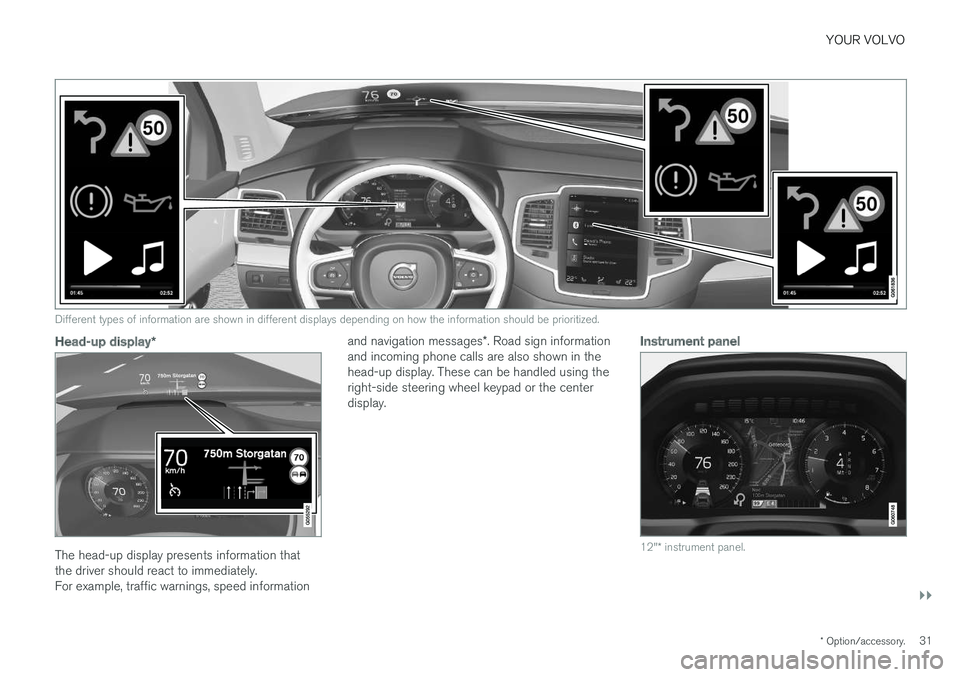
Different types of information are shown in different displays depending on how the information should be prioritized.
Head-up display*
The head-up display presents information that the driver should react to immediately.For example, traffic warnings, speed information and navigation messages
*. Road sign information
and incoming phone calls are also shown in thehead-up display. These can be handled using theright-side steering wheel keypad or the centerdisplay.
Instrument panel
12" * instrument panel.
Page 37 of 666
YOUR VOLVO
35
Important information onaccessories and extra equipment
Incorrectly connected or installed accessories or extra equipment may have an adverse effect onthe vehicle's electronics.
We strongly recommend that Volvo owners use only genuine, Volvo-approved accessories, andthat accessory installations be performed only bya trained and qualified Volvo service technician.Certain accessories only work when the associ-ated software is installed in the vehicle's com-puter system. The equipment described in the Owner's Manual is not available in all vehicles. Vehicles may beequipped differently depending on marketrequirements and national or local laws and regu-lations. Optional or accessory equipment may not be available in all countries or markets. Please notethat some vehicles may be equipped differently,depending on special legal requirements. Formore information on which equipment is standardand which is an option or accessory, please con-tact your Volvo retailer.
NOTE
Do not export your Volvo to another country before investigating that country's applicablesafety and exhaust emission requirements. Insome cases it may be difficult or impossibleto comply with these requirements. Modifica-tions to the emission control system(s) mayrender your Volvo not certifiable for legaloperation in the U.S., Canada and other coun-tries.
WARNING
CALIFORNIA proposition 65 Engine exhaust, some of its constituents, and certain vehicle components contain or emitchemicals known to the state of California tocause cancer, and birth defects or otherreproductive harm. In addition, certain fluidscontained in vehicles and certain products ofcomponent wear contain or emit chemicalsknown to the State of California to cause can-cer, and birth defects or other reproductiveharm.
WARNING
Certain of the vehicle's components, such as airbag modules, seat belt tensioners, adjusta-ble steering wheel columns and button cellbatteries, may contain perchlorate materials.Special handling may apply for service or vehi-cle end of life disposal. See www.dtsc.ca.gov/hazardouswaste/ perchlorate.
WARNING
The driver is always responsible for operating the vehicle in a safe manner and for comply-ing with current statutes and regulations. It is also essential to maintain and service the vehicle according to Volvo's recommendationsas stated in the owner's information and theservice and warranty booklet. If the on-board information differs from the printed owner's manual, the printed informa-tion always takes precedence.
Related information
• Accessory installation (p. 36)
• Connecting equipment to the vehicle's data link connector (p. 36)
• Using the Owner's Manual (p. 21)
Page 45 of 666
SAFETY
}}
* Option/accessory.43
Safety during pregnancy It is important that seat belts are worn correctly during pregnancy and that pregnant driversadjust their seating position accordingly.
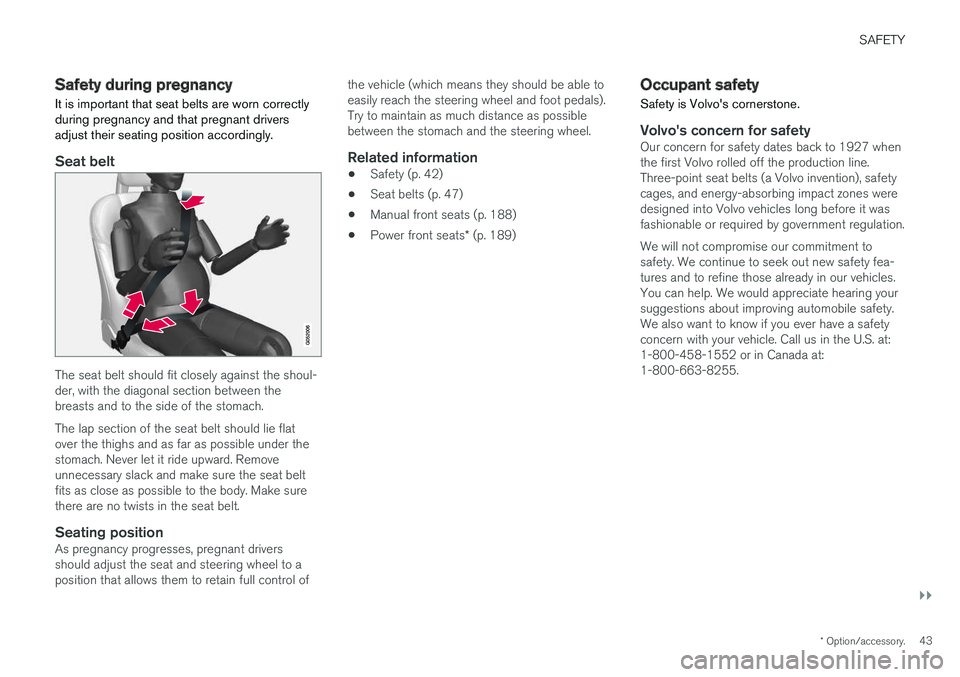
Seat belt
The seat belt should fit closely against the shoul- der, with the diagonal section between thebreasts and to the side of the stomach. The lap section of the seat belt should lie flat over the thighs and as far as possible under thestomach. Never let it ride upward. Removeunnecessary slack and make sure the seat beltfits as close as possible to the body. Make surethere are no twists in the seat belt.
Seating positionAs pregnancy progresses, pregnant driversshould adjust the seat and steering wheel to aposition that allows them to retain full control of the vehicle (which means they should be able toeasily reach the steering wheel and foot pedals).Try to maintain as much distance as possiblebetween the stomach and the steering wheel.
Related information
•
Safety (p. 42)
• Seat belts (p. 47)
• Manual front seats (p. 188)
• Power front seats
* (p. 189)
Occupant safety Safety is Volvo's cornerstone.
Volvo's concern for safetyOur concern for safety dates back to 1927 when the first Volvo rolled off the production line.Three-point seat belts (a Volvo invention), safetycages, and energy-absorbing impact zones weredesigned into Volvo vehicles long before it wasfashionable or required by government regulation. We will not compromise our commitment to safety. We continue to seek out new safety fea-tures and to refine those already in our vehicles. You can help. We would appreciate hearing your suggestions about improving automobile safety. We also want to know if you ever have a safety concern with your vehicle. Call us in the U.S. at: 1-800-458-1552 or in Canada at: 1-800-663-8255.
Page 53 of 666
SAFETY
}}
51
When a critical situation has passed, the seat belt and the electric seat belt tensioner are resetautomatically. However, they can also be resetmanually.
WARNING
Never attempt to alter or repair the seat belt on your own. Volvo recommends contactingan authorized Volvo workshop. If the seat belt has been exposed to extreme forces, e.g. in conjunction with a collision, theentire seat belt must be replaced. Even if theseat belt appears undamaged, some of itsprotective properties may have been lost. Alsoreplace the seat belt if it is worn or damaged.The new seat belt must be type approved andintended for the same seating position as thereplaced seat belt.
Related information
•
Seat belts (p. 47)
• Buckling and unbuckling seat belts (p. 48)
• Resetting the electric seat belt tensioners (p. 51)
• City Safety
™ (p. 333)
• Rear Collision Warning (p. 345)
Resetting the electric seat belttensioners
The electric seat belt tensioners are designed to be reset automatically, but if the seat beltremains taut it can be reset manually.
1. Stop the vehicle in a safe location.
2. Unbuckle the seat belt and then rebuckle it.
> The seat belt and the electric seat belttensioner will be reset.
WARNING
Never attempt to alter or repair the seat belt on your own. Volvo recommends contactingan authorized Volvo workshop. If the seat belt has been exposed to extreme forces, e.g. in conjunction with a collision, theentire seat belt must be replaced. Even if theseat belt appears undamaged, some of itsprotective properties may have been lost. Alsoreplace the seat belt if it is worn or damaged.The new seat belt must be type approved andintended for the same seating position as thereplaced seat belt.
Related information
• Seat belt tensioners (p. 50)
• Seat belts (p. 47)
Door and seat belt reminders
This system is intended to remind occupants to buckle their seat belts and to alert the driver if adoor or the hood, tailgate or fuel filler door isopen.
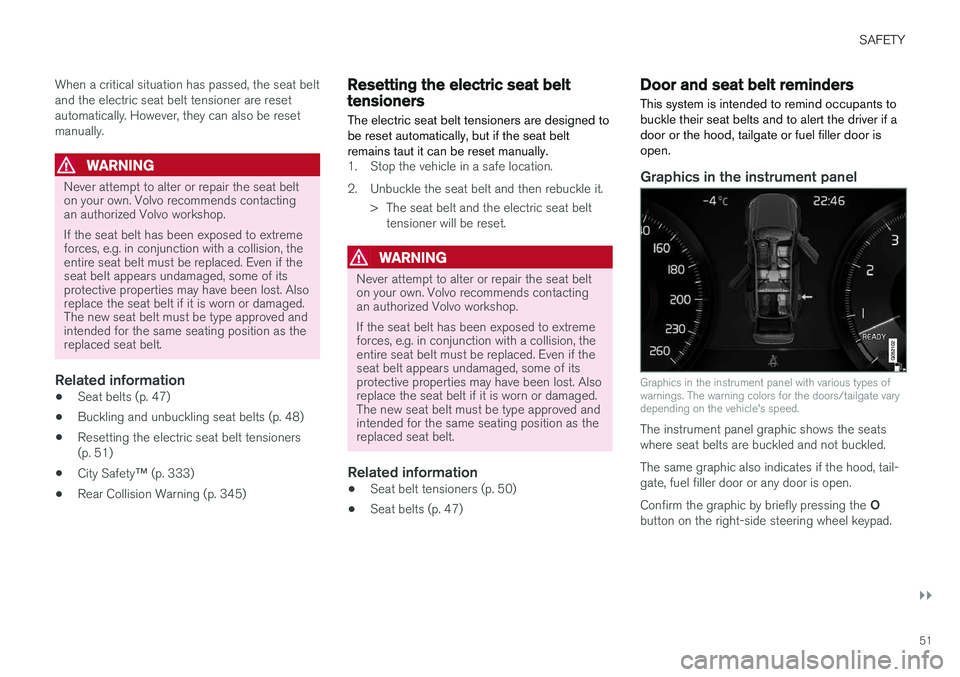
Graphics in the instrument panel
Graphics in the instrument panel with various types of warnings. The warning colors for the doors/tailgate varydepending on the vehicle's speed.
The instrument panel graphic shows the seats where seat belts are buckled and not buckled. The same graphic also indicates if the hood, tail- gate, fuel filler door or any door is open. Confirm the graphic by briefly pressing the O
button on the right-side steering wheel keypad.
Page 56 of 666
||
SAFETY
54sors that activate the gas generators, causing the airbags to be inflated with nitrogen gas. As the movement of the seats' occupants com- presses the airbags, some of the gas is expelledat a controlled rate to provide better cushioning.Both seat belt tensioners also deploy, minimizingseat belt slack. The entire process, from inflationto deflation of the airbag, occurs within tenths ofa second. The location of the front airbags is indicated by SRS AIRBAG
embossed on the steering wheel
pad and above the glove compartment, and by decals on both sun visors and on the front andfar right side of the dash. The driver's side front airbag is folded and
located in the steering wheel hub.The knee airbag is folded on the underside of
the dashboard on the driver's side. The text AIRBAG is embossed on the panel.
The passenger's side front airbag is folded
behind a panel located above the glove compart- ment.
WARNING
• The airbags in the vehicle are designed to be a SUPPLEMENT to-not a replacementfor-the three-point seat belts. For maxi-mum protection, wear seat belts at alltimes. Be aware that no system can pre-vent all possible injuries that may occur inan accident.
• Never drive with your hands on the steer-ing wheel pad/airbag housing.
• The front airbags are designed to helpprevent serious injury. Deployment occursvery quickly and with considerable force.During normal deployment and depend-ing on variables such as seating position,one may experience abrasions, bruises,swellings, or other injuries as a result ofdeployment of one or both of the airbags.
• When installing any accessory equipment,make sure that the front airbag system isnot damaged. Any interference in the sys-tem could cause malfunction.
Front airbag deployment
• The front airbags are designed to deploy dur-ing certain frontal or front-angular collisions,impacts, or decelerations, depending on thecrash severity, angle, speed and objectimpacted. The airbags may also deploy in certain non-frontal collisions where rapiddeceleration occurs.
• The airbag system sensors, which trigger thefront airbags, are designed to react to boththe impact of the collision and the inertialforces generated by it, and to determine ifthe intensity of the collision is sufficient forthe seat belt tensioners and/or airbags to bedeployed.
However, not all frontal collisions activate thefront airbags.
• If the collision involves a nonrigid object (e.g.,a snow drift or bush), or a rigid, fixed objectat a low speed, the front airbags will not nec-essarily deploy.
• Front airbags do not normally deploy in aside impact collision, in a collision from therear or in a rollover situation.
• The amount of damage to the bodyworkdoes not reliably indicate if the airbagsshould have deployed or not.
Page 58 of 666
||
SAFETY
56
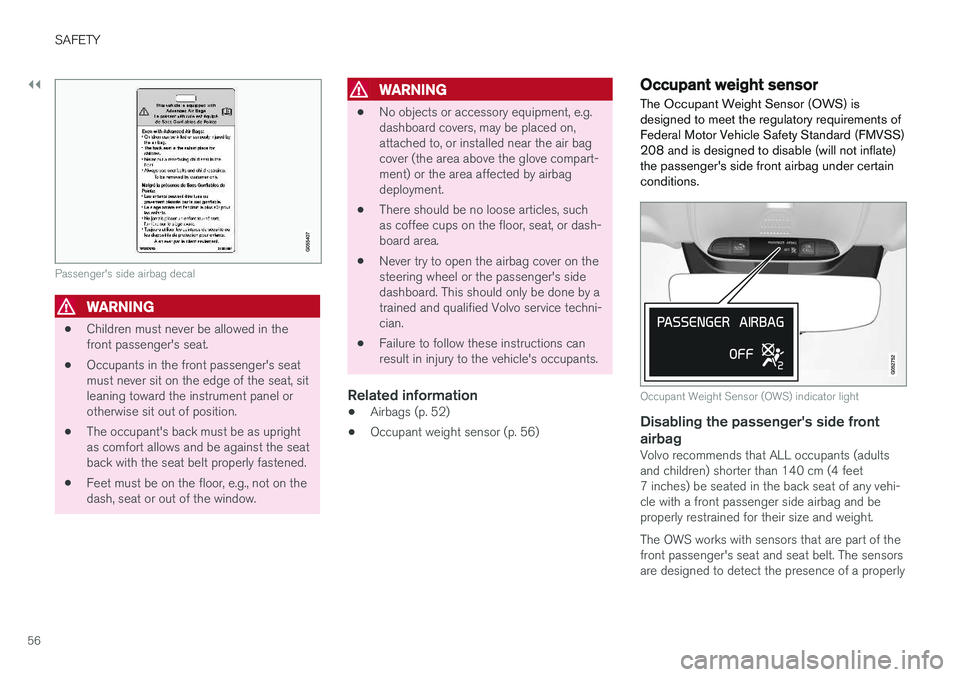
Passenger's side airbag decal
WARNING
•Children must never be allowed in the front passenger's seat.
• Occupants in the front passenger's seatmust never sit on the edge of the seat, sitleaning toward the instrument panel orotherwise sit out of position.
• The occupant's back must be as uprightas comfort allows and be against the seatback with the seat belt properly fastened.
• Feet must be on the floor, e.g., not on thedash, seat or out of the window.
WARNING
• No objects or accessory equipment, e.g. dashboard covers, may be placed on,attached to, or installed near the air bagcover (the area above the glove compart-ment) or the area affected by airbagdeployment.
• There should be no loose articles, suchas coffee cups on the floor, seat, or dash-board area.
• Never try to open the airbag cover on thesteering wheel or the passenger's sidedashboard. This should only be done by atrained and qualified Volvo service techni-cian.
• Failure to follow these instructions canresult in injury to the vehicle's occupants.
Related information
• Airbags (p. 52)
• Occupant weight sensor (p. 56)
Occupant weight sensor
The Occupant Weight Sensor (OWS) is designed to meet the regulatory requirements ofFederal Motor Vehicle Safety Standard (FMVSS)208 and is designed to disable (will not inflate)the passenger's side front airbag under certainconditions.
Occupant Weight Sensor (OWS) indicator light
Disabling the passenger's side front airbag
Volvo recommends that ALL occupants (adults and children) shorter than 140 cm (4 feet7 inches) be seated in the back seat of any vehi-cle with a front passenger side airbag and beproperly restrained for their size and weight. The OWS works with sensors that are part of the front passenger's seat and seat belt. The sensors are designed to detect the presence of a properly