fold seats VOLVO XC90 T8 2018 Owner´s Manual
[x] Cancel search | Manufacturer: VOLVO, Model Year: 2018, Model line: XC90 T8, Model: VOLVO XC90 T8 2018Pages: 686, PDF Size: 11.51 MB
Page 199 of 686
SEATS AND STEERING WHEEL
* Option/accessory.197
WARNING
•Adjust the seat and ensure it locks into position before driving. Use caution whenadjusting the seat. Uncontrolled or care-less adjustments could lead to injury.
• Long objects must always be securelytied down to help prevent injury or dam-age in the event of sudden braking.
• Always turn off the engine and apply theparking brake when loading or unloadingthe vehicle.
• Put the gear selector in
P to help prevent
the gear selector from being inadvertentlymoved.
Related information
• Folding the second row backrests (p. 192)
• Adjusting the second row head restraints(p. 194)
• Moving the second row seats forward/rear- ward
* (p. 195)
• Getting into and out of the third row ofseats
* (p. 197)
• Folding the third row backrests
* (p. 198)
Getting into and out of the third row
of seats *
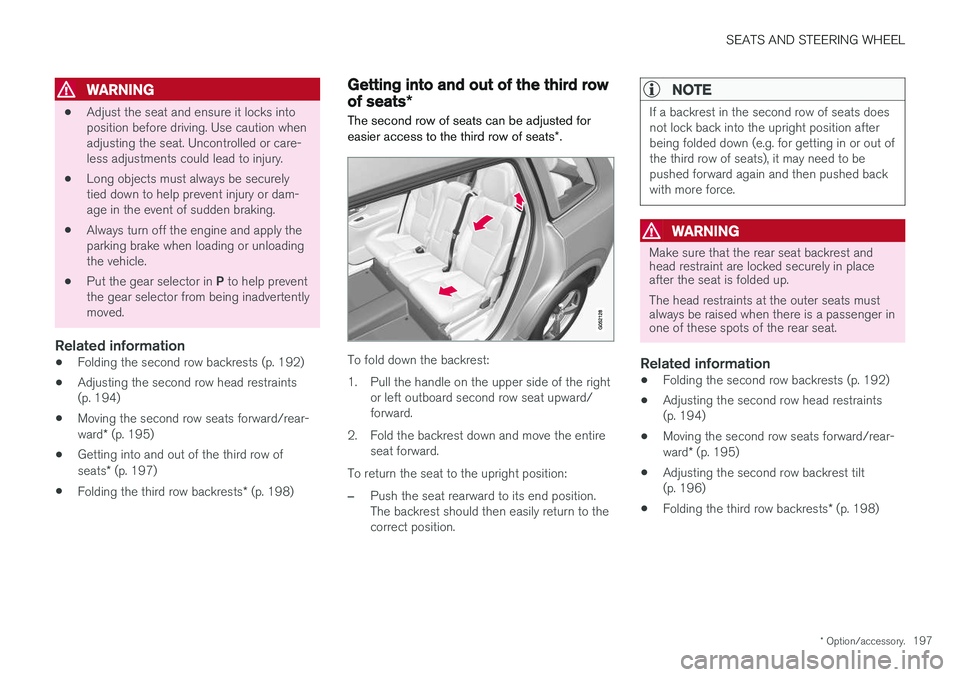
The second row of seats can be adjusted for easier access to the third row of seats *.
To fold down the backrest:
1. Pull the handle on the upper side of the right
or left outboard second row seat upward/ forward.
2. Fold the backrest down and move the entire seat forward.
To return the seat to the upright position:
–Push the seat rearward to its end position. The backrest should then easily return to thecorrect position.
NOTE
If a backrest in the second row of seats does not lock back into the upright position afterbeing folded down (e.g. for getting in or out ofthe third row of seats), it may need to bepushed forward again and then pushed backwith more force.
WARNING
Make sure that the rear seat backrest and head restraint are locked securely in placeafter the seat is folded up. The head restraints at the outer seats must always be raised when there is a passenger inone of these spots of the rear seat.
Related information
• Folding the second row backrests (p. 192)
• Adjusting the second row head restraints (p. 194)
• Moving the second row seats forward/rear- ward
* (p. 195)
• Adjusting the second row backrest tilt (p. 196)
• Folding the third row backrests
* (p. 198)
Page 200 of 686
SEATS AND STEERING WHEEL
* Option/accessory.
198
Folding the third row backrests *
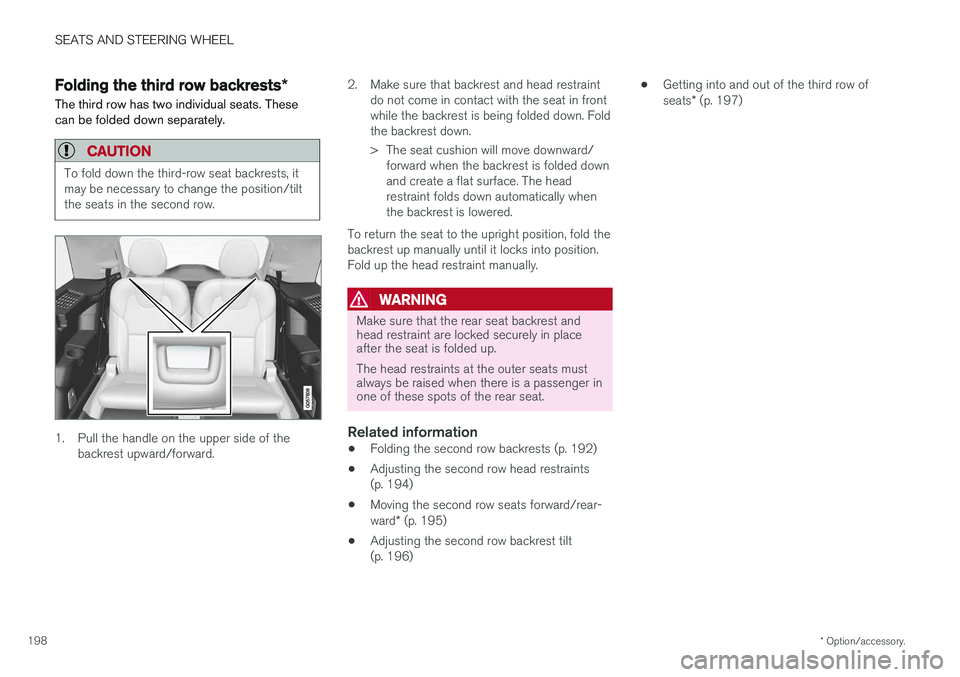
The third row has two individual seats. These can be folded down separately.
CAUTION
To fold down the third-row seat backrests, it may be necessary to change the position/tiltthe seats in the second row.
1. Pull the handle on the upper side of the backrest upward/forward. 2. Make sure that backrest and head restraint
do not come in contact with the seat in front while the backrest is being folded down. Foldthe backrest down.
> The seat cushion will move downward/forward when the backrest is folded down and create a flat surface. The headrestraint folds down automatically whenthe backrest is lowered.
To return the seat to the upright position, fold thebackrest up manually until it locks into position.Fold up the head restraint manually.
WARNING
Make sure that the rear seat backrest and head restraint are locked securely in placeafter the seat is folded up. The head restraints at the outer seats must always be raised when there is a passenger inone of these spots of the rear seat.
Related information
• Folding the second row backrests (p. 192)
• Adjusting the second row head restraints (p. 194)
• Moving the second row seats forward/rear- ward
* (p. 195)
• Adjusting the second row backrest tilt (p. 196) •
Getting into and out of the third row of seats
* (p. 197)
Page 573 of 686
WHEELS AND TIRES
}}
571
Snow tires
Snow tires are designed for winter driving.
Volvo recommends snow tires with specific dimensions. The tire dimensions vary dependingon engine type. When driving with snow tires, thecorrect type of tires must be mounted on all fourwheels.
NOTE
Contact a Volvo dealer for advice on the best choice of rims and tires.
Tips for changing snow tiresWhen switching between regular tires and snow tires, mark the tires according to which side they were mounted on, e.g. L for left and R for right.
Studded tiresStudded tires should be broken in by driving 500–1000 km (300–600 miles) slowly and gen-tly to help the studs settle properly in the tires.This gives the tire, and especially the studs, alonger service life.
NOTE
Regulations regarding the use of studded tires vary from country to country.
Tread depthRoad conditions with ice, slush and low tempera- tures place considerably higher demands on tiresthan summer conditions. Volvo therefore recom-mends not driving on snow tires that have a treaddepth of less than 4 mm (0.15 inch).
Related information
• When changing wheels (p. 564)
• Winter driving (p. 461)
• Tread wear indicator (p. 553)
Snow chains
Using snow chains and/or snow tires can help improve traction in winter driving conditions.
WARNING
Use Volvo genuine snow chains or equivalent snow chains that are suitable for the vehicle model and the tire and wheel sizes. Only one-
sided snow chains are permitted.
If uncertain about snow chains, Volvo recom- mends contacting an authorized Volvo work-shop. Use of the wrong snow chains couldcause serious damage to the vehicle andresult in an accident.
12 The backrest in the third row of seats * must be folded down.
Page 588 of 686
LOADING, STORAGE AND PASSENGER COMPARTMENT
* Option/accessory.
586
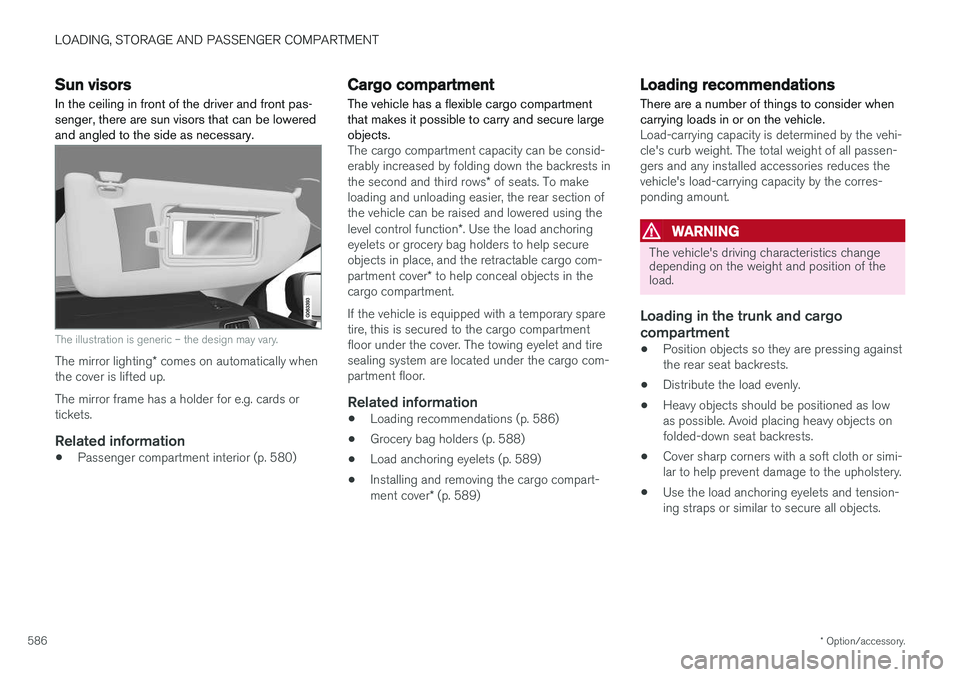
Sun visors In the ceiling in front of the driver and front pas- senger, there are sun visors that can be loweredand angled to the side as necessary.
The illustration is generic – the design may vary.
The mirror lighting * comes on automatically when
the cover is lifted up. The mirror frame has a holder for e.g. cards or tickets.
Related information
• Passenger compartment interior (p. 580)
Cargo compartment The vehicle has a flexible cargo compartment that makes it possible to carry and secure largeobjects.
The cargo compartment capacity can be consid- erably increased by folding down the backrests in the second and third rows
* of seats. To make
loading and unloading easier, the rear section of the vehicle can be raised and lowered using the level control function *. Use the load anchoring
eyelets or grocery bag holders to help secure objects in place, and the retractable cargo com- partment cover * to help conceal objects in the
cargo compartment. If the vehicle is equipped with a temporary spare tire, this is secured to the cargo compartmentfloor under the cover. The towing eyelet and tiresealing system are located under the cargo com-partment floor.
Related information
• Loading recommendations (p. 586)
• Grocery bag holders (p. 588)
• Load anchoring eyelets (p. 589)
• Installing and removing the cargo compart- ment cover
* (p. 589)
Loading recommendations
There are a number of things to consider when carrying loads in or on the vehicle.
Load-carrying capacity is determined by the vehi- cle's curb weight. The total weight of all passen-gers and any installed accessories reduces thevehicle's load-carrying capacity by the corres-ponding amount.
WARNING
The vehicle's driving characteristics change depending on the weight and position of theload.
Loading in the trunk and cargo compartment
• Position objects so they are pressing against the rear seat backrests.
• Distribute the load evenly.
• Heavy objects should be positioned as lowas possible. Avoid placing heavy objects onfolded-down seat backrests.
• Cover sharp corners with a soft cloth or simi-lar to help prevent damage to the upholstery.
• Use the load anchoring eyelets and tension-ing straps or similar to secure all objects.
Page 589 of 686
LOADING, STORAGE AND PASSENGER COMPARTMENT
* Option/accessory.587
WARNING
In a head-on collision at a speed of 50 km/h (30 mph), an unsecured object weighing 20kg (44 pounds) can reach a projectile weightequivalent to 1000 kg (2200 pounds).
WARNING
If objects are loaded higher than the upper edge of the side windows, leave a 10 cm (4in.) space between the objects and the win-dow. Objects placed closer to this couldimpede the function of the inflatable curtainconcealed inside the headlining.
WARNING
Always secure the load. Otherwise, it may shift during heavy braking and injure people in thevehicle. Cover sharp edges and sharp corners with something soft. Turn off the engine and apply the parking brake when loading/unloading long objects.Otherwise, it is possible for the load to reachthe gear lever or gear selector and move it toa drive position – which could cause the vehi-cle to begin rolling.
Extra cargo space
The rear seat backrests can be folded down to increase cargo compartment space and simplifyloading. If the rear seat backrests are folded down, make sure that no objects loaded into thevehicle prevent the WHIPS system for the frontseats from functioning correctly.
Raising/lowering the rear end of the vehicle
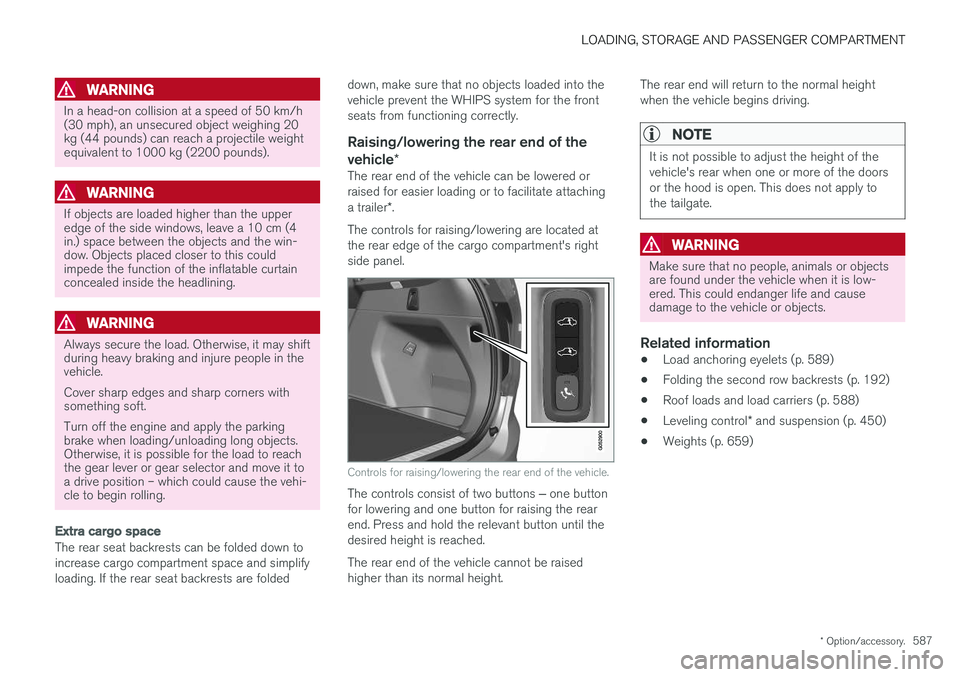
*
The rear end of the vehicle can be lowered or raised for easier loading or to facilitate attaching a trailer*.
The controls for raising/lowering are located at the rear edge of the cargo compartment's rightside panel.
Controls for raising/lowering the rear end of the vehicle.
The controls consist of two buttons ‒ one button
for lowering and one button for raising the rear end. Press and hold the relevant button until thedesired height is reached. The rear end of the vehicle cannot be raised higher than its normal height. The rear end will return to the normal heightwhen the vehicle begins driving.
NOTE
It is not possible to adjust the height of the vehicle's rear when one or more of the doorsor the hood is open. This does not apply tothe tailgate.
WARNING
Make sure that no people, animals or objects are found under the vehicle when it is low-ered. This could endanger life and causedamage to the vehicle or objects.
Related information
•
Load anchoring eyelets (p. 589)
• Folding the second row backrests (p. 192)
• Roof loads and load carriers (p. 588)
• Leveling control
* and suspension (p. 450)
• Weights (p. 659)
Page 594 of 686
LOADING, STORAGE AND PASSENGER COMPARTMENT
* Option/accessory.
592
Installing and removing the steel
cargo grid *
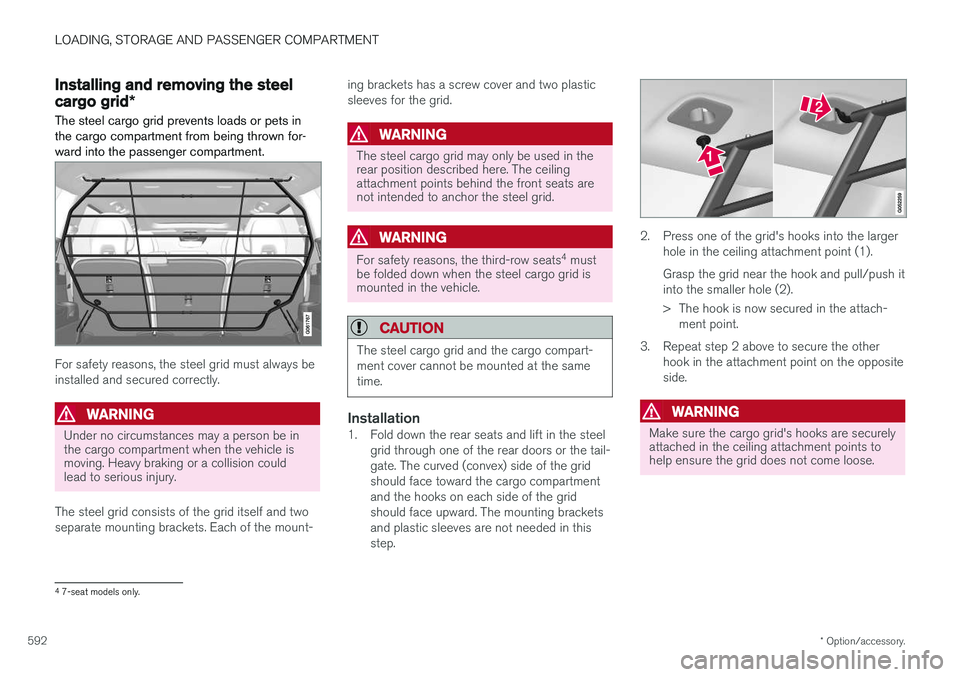
The steel cargo grid prevents loads or pets in the cargo compartment from being thrown for-ward into the passenger compartment.
For safety reasons, the steel grid must always be installed and secured correctly.
WARNING
Under no circumstances may a person be in the cargo compartment when the vehicle ismoving. Heavy braking or a collision couldlead to serious injury.
The steel grid consists of the grid itself and two separate mounting brackets. Each of the mount- ing brackets has a screw cover and two plasticsleeves for the grid.
WARNING
The steel cargo grid may only be used in the rear position described here. The ceilingattachment points behind the front seats arenot intended to anchor the steel grid.
WARNING
For safety reasons, the third-row seats
4
must
be folded down when the steel cargo grid is mounted in the vehicle.
CAUTION
The steel cargo grid and the cargo compart- ment cover cannot be mounted at the sametime.
Installation1. Fold down the rear seats and lift in the steel
grid through one of the rear doors or the tail- gate. The curved (convex) side of the gridshould face toward the cargo compartmentand the hooks on each side of the gridshould face upward. The mounting bracketsand plastic sleeves are not needed in thisstep.
2. Press one of the grid's hooks into the largerhole in the ceiling attachment point (1). Grasp the grid near the hook and pull/push it into the smaller hole (2).
> The hook is now secured in the attach-ment point.
3. Repeat step 2 above to secure the other hook in the attachment point on the opposite side.
WARNING
Make sure the cargo grid's hooks are securely attached in the ceiling attachment points tohelp ensure the grid does not come loose.
47-seat models only.
Page 596 of 686
||
LOADING, STORAGE AND PASSENGER COMPARTMENT
594
WARNING
Objects in the cargo compartment must always be securely anchored, even with a cor-rectly installed cargo net.
Installing the cargo net
WARNING
All of the cargo net's upper consoles, hooks and straps must be securely mounted andattached before the net is used. Never use the net if it is damaged.
NOTE
With front mounting, the cargo net is most easily installed via a rear door.
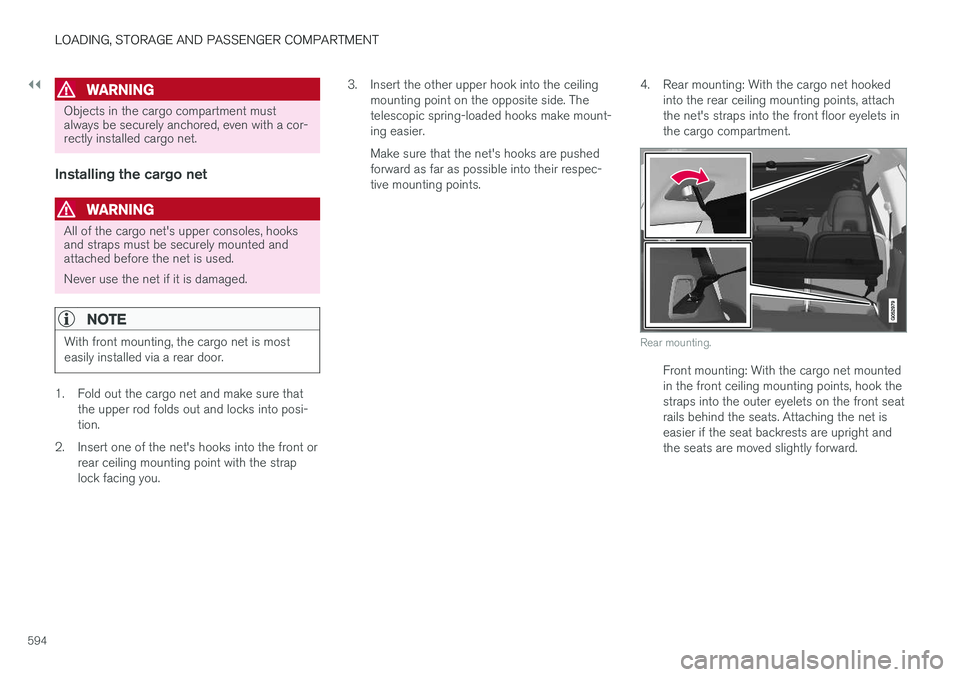
1. Fold out the cargo net and make sure thatthe upper rod folds out and locks into posi- tion.
2. Insert one of the net's hooks into the front or rear ceiling mounting point with the straplock facing you. 3. Insert the other upper hook into the ceiling
mounting point on the opposite side. Thetelescopic spring-loaded hooks make mount-ing easier. Make sure that the net's hooks are pushed forward as far as possible into their respec-tive mounting points. 4. Rear mounting: With the cargo net hooked
into the rear ceiling mounting points, attachthe net's straps into the front floor eyelets inthe cargo compartment.
Rear mounting.
Front mounting: With the cargo net mounted in the front ceiling mounting points, hook thestraps into the outer eyelets on the front seatrails behind the seats. Attaching the net iseasier if the seat backrests are upright andthe seats are moved slightly forward.
Page 633 of 686
MAINTENANCE AND SERVICE
}}
* Option/accessory.631
Positions
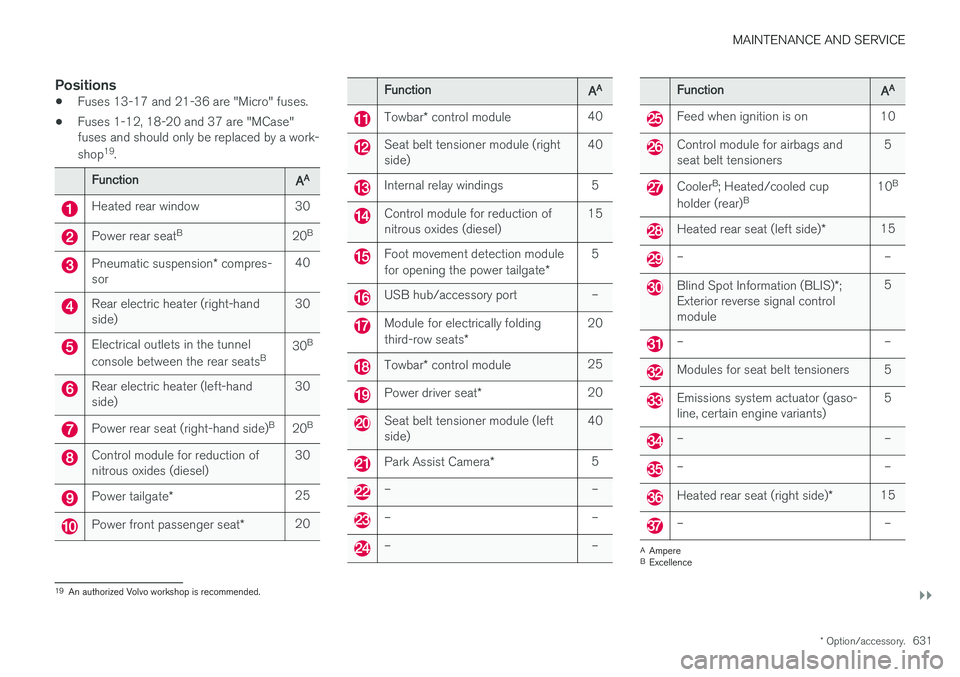
•Fuses 13-17 and 21-36 are "Micro" fuses.
• Fuses 1-12, 18-20 and 37 are "MCase" fuses and should only be replaced by a work- shop 19
.
FunctionAA
Heated rear window 30
Power rear seat B
20B
Pneumatic suspension
* compres-
sor 40
Rear electric heater (right-hand side)
30
Electrical outlets in the tunnel console between the rear seats
B30
B
Rear electric heater (left-hand side) 30
Power rear seat (right-hand side)
B
20B
Control module for reduction of nitrous oxides (diesel) 30
Power tailgate
* 25
Power front passenger seat
*20
FunctionAA
Towbar
* control module 40
Seat belt tensioner module (right side) 40
Internal relay windings 5
Control module for reduction of nitrous oxides (diesel)15
Foot movement detection module for opening the power tailgate
*5
USB hub/accessory port –
Module for electrically folding third-row seats
* 20
Towbar
* control module 25
Power driver seat
* 20
Seat belt tensioner module (left side) 40
Park Assist Camera
*5
– –
– –
– –
FunctionAA
Feed when ignition is on 10
Control module for airbags and seat belt tensioners 5
Cooler
B
; Heated/cooled cup
holder (rear) B 10
B
Heated rear seat (left side)
*15
– –
Blind Spot Information (BLIS)
*;
Exterior reverse signal control module 5
– –
Modules for seat belt tensioners 5
Emissions system actuator (gaso- line, certain engine variants)
5
– –
– –
Heated rear seat (right side)
*15
– –
A
Ampere
B Excellence
19 An authorized Volvo workshop is recommended.
Page 660 of 686
||
SPECIFICATIONS
658
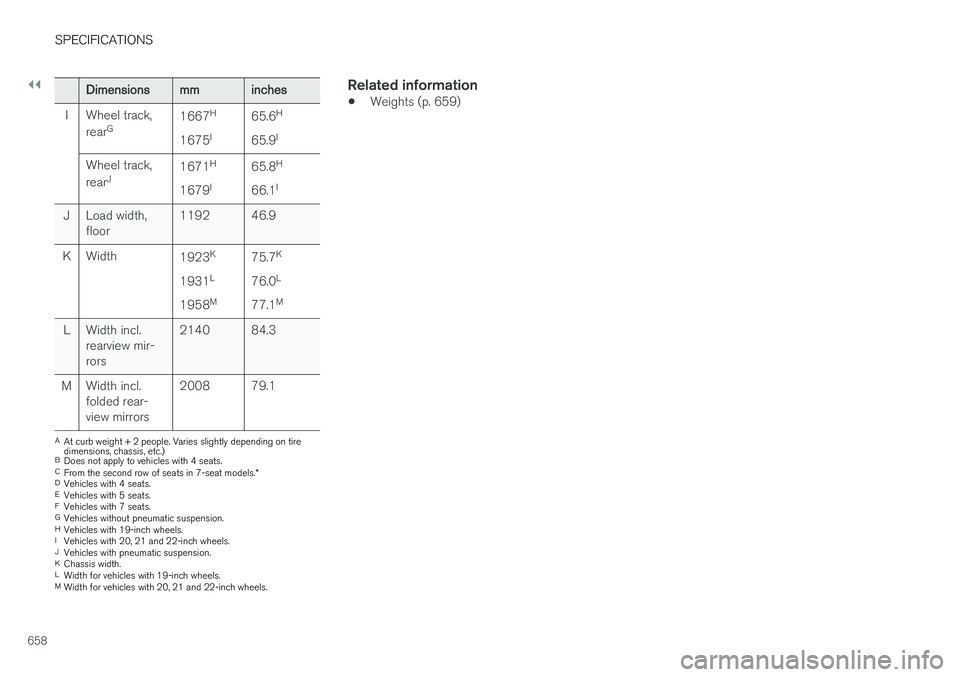
Dimensionsmminches
I Wheel track, rear G 1667
H
1675 I 65.6
H
65.9 I
Wheel track, rear J 1671
H
1679 I 65.8
H
66.1 I
J Load width, floor 1192 46.9
K Width 1923K
1931 L
1958 M 75.7
K
76.0 L
77.1 M
L Width incl. rearview mir- rors 2140 84.3
M Width incl. folded rear-view mirrors 2008 79.1
A
At curb weight + 2 people. Varies slightly depending on tire dimensions, chassis, etc.)
B Does not apply to vehicles with 4 seats.
C From the second row of seats in 7-seat models. *
D Vehicles with 4 seats.
E Vehicles with 5 seats.
F Vehicles with 7 seats.
G Vehicles without pneumatic suspension.
H Vehicles with 19-inch wheels.
I Vehicles with 20, 21 and 22-inch wheels.
J Vehicles with pneumatic suspension.
K Chassis width.
L Width for vehicles with 19-inch wheels.
M Width for vehicles with 20, 21 and 22-inch wheels.
Related information
• Weights (p. 659)
Page 677 of 686
INDEX
675
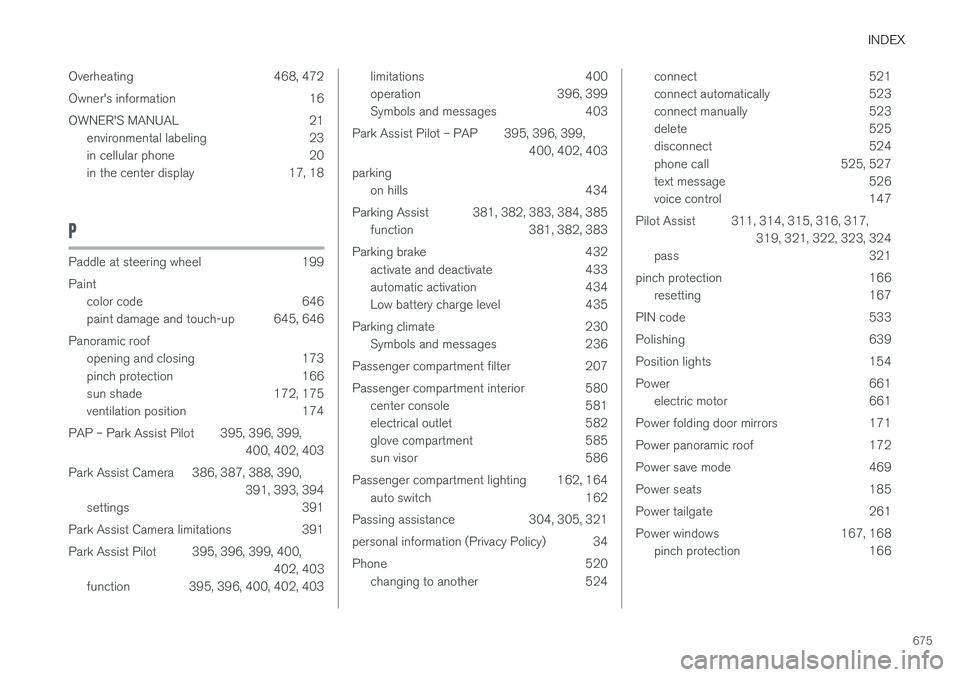
Overheating 468, 472
Owner's information 16
OWNER'S MANUAL 21
environmental labeling 23
in cellular phone 20
in the center display 17, 18
P
Paddle at steering wheel 199 Paint
color code 646
paint damage and touch-up 645, 646
Panoramic roof opening and closing 173
pinch protection 166
sun shade 172, 175
ventilation position 174
PAP – Park Assist Pilot 395, 396, 399, 400, 402, 403
Park Assist Camera 386, 387, 388, 390, 391, 393, 394
settings 391
Park Assist Camera limitations 391
Park Assist Pilot 395, 396, 399, 400, 402, 403
function 395, 396, 400, 402, 403
limitations 400
operation 396, 399
Symbols and messages 403
Park Assist Pilot – PAP 395, 396, 399, 400, 402, 403
parking on hills 434
Parking Assist 381, 382, 383, 384, 385 function 381, 382, 383
Parking brake 432 activate and deactivate 433
automatic activation 434
Low battery charge level 435
Parking climate 230 Symbols and messages 236
Passenger compartment filter 207
Passenger compartment interior 580 center console 581
electrical outlet 582
glove compartment 585
sun visor 586
Passenger compartment lighting 162, 164 auto switch 162
Passing assistance 304, 305, 321
personal information (Privacy Policy) 34
Phone 520 changing to another 524connect 521
connect automatically 523
connect manually 523
delete 525
disconnect 524
phone call 525, 527
text message 526
voice control 147
Pilot Assist 311, 314, 315, 316, 317, 319, 321, 322, 323, 324
pass 321
pinch protection 166 resetting 167
PIN code 533
Polishing 639
Position lights 154
Power 661 electric motor 661
Power folding door mirrors 171
Power panoramic roof 172
Power save mode 469
Power seats 185
Power tailgate 261
Power windows 167, 168 pinch protection 166