615 VOLVO XC90 T8 2018 Owner´s Manual
[x] Cancel search | Manufacturer: VOLVO, Model Year: 2018, Model line: XC90 T8, Model: VOLVO XC90 T8 2018Pages: 686, PDF Size: 11.51 MB
Page 15 of 686
13
LOADING, STORAGE AND
PASSENGER COMPARTMENT
Passenger compartment interior580
Tunnel console 581
Electrical outlets 582
Using the electrical outlets 584
Using the glove compartment 585
Sun visors 586
Cargo compartment 586
Loading recommendations 586
Roof loads and load carriers 588
Grocery bag holders 588
Load anchoring eyelets 589
Installing and removing the cargo compartment cover * 589
Operating the cargo compartment cover *
590
Installing and removing the steelcargo grid * 592
Installing and removing the cargo net *
593
MAINTENANCE AND SERVICE
Volvo's service program
598
Data transfer between vehicle and workshop over Wi-Fi 600
Download Center 601
Handling system updates via Down-load Center 601
Vehicle status 602
Scheduling service and repairs 603
Sending vehicle information to theworkshop 604
Hoisting the vehicle 605
Opening and closing the hood 607
Climate control system service 608
Replacing a windshield with head-up display * 608
Engine compartment overview 609
Engine oil 610
Checking and filling engine oil 611
Refilling coolant 612
Replacing bulbs 613
Bulb specifications 614
Start battery 615
Hybrid battery 619
Battery symbols 620
Fuses and fuseboxes 620
Replacing fuses 621
Fuses in the engine compartment622
Fuses under the glove compartment 626
Fuses in the cargo compartment 629
Cleaning the interior 633
Cleaning the center display 633
Cleaning the head-up display *
634
Cleaning fabric upholstery and ceil- ing liner 635
Cleaning the seat belt 635
Cleaning floor mats and inlay mats 635
Cleaning leather upholstery 636
Cleaning the leather steering wheel 637
Cleaning interior plastic, metal andwood surfaces 638
Cleaning the exterior 638
Polishing and waxing 639
Hand washing 639
Automatic car washes 641
High-pressure washing 642
Cleaning the wiper blades 642
Cleaning exterior plastic, rubber andtrim components 643
Cleaning rims 644
Corrosion protection 644
Paintwork 645
Page 437 of 686
STARTING AND DRIVING
435
Parking brake malfunctionIf you are unable to deactivate or activate the parking brake after several attempts, contact anauthorized Volvo workshop.
A audible warning signal will sound if the parking brake is applied while the vehicle is being driven. If the vehicle must be parked before the problem is rectified, turn the wheels as when parking on an incline and put the gear selector in P.
Low battery charge levelIf the battery charge level is too low, it will not be possible to apply or release the parking brake.Connect an auxiliary battery to the vehicle if thebattery is discharged.
Replacing brake padsDue to the design of the electric parking brake,the rear brake pads must be replaced by a work-shop. An authorized Volvo workshop is recom-mended.
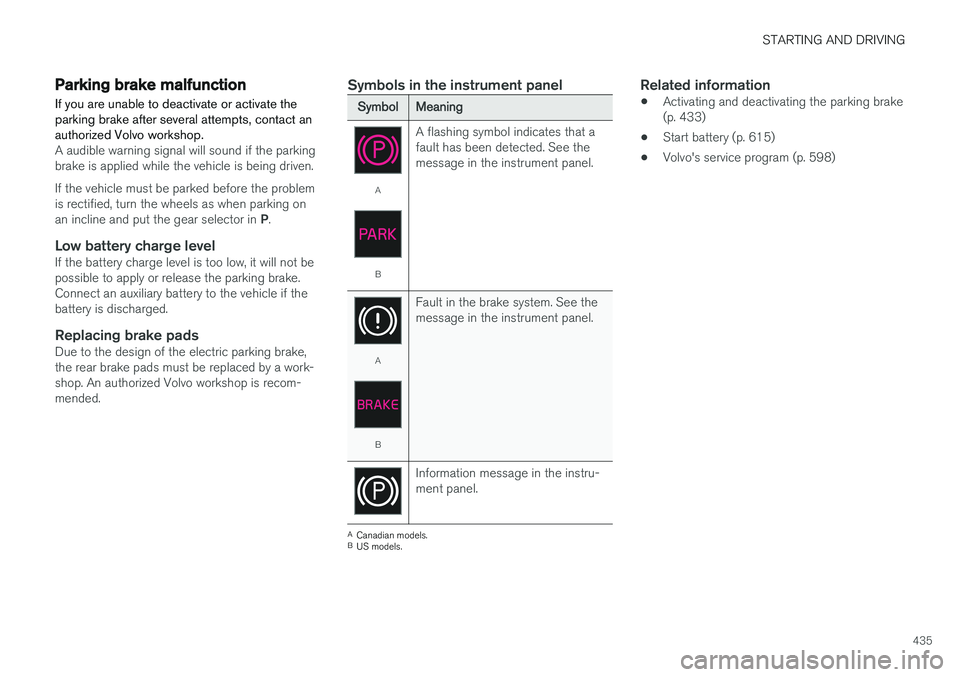
Symbols in the instrument panel
SymbolMeaning
A
B A flashing symbol indicates that a fault has been detected. See themessage in the instrument panel.
A
B
Fault in the brake system. See the message in the instrument panel.
Information message in the instru- ment panel.
A
Canadian models.
B US models.
Related information
• Activating and deactivating the parking brake (p. 433)
• Start battery (p. 615)
• Volvo's service program (p. 598)
Page 463 of 686
STARTING AND DRIVING
461
•
Speed limiter (p. 278)
• Tire sealing system (p. 572)
Winter driving
It is important to check the vehicle before driving in cold/snowy conditions to make sure it can bedriven safely.
Before the cold season arrives:
• Make sure the engine coolant contains 50% antifreeze. This mixture helps protect theengine from frost erosion down toapprox. -35 °C (-31 °F). Do not mix differenttypes of antifreeze as this could pose ahealth risk.
• Keep the fuel tank well filled to prevent con-densation from forming.
• Check the viscosity of the engine oil. Oil withlow viscosity (thinner oil) improves cold-weather starting and reduces fuel consump-tion when driving with a cold engine.
CAUTION
Low-viscosity oil should not be used with hard driving or in hot weather.
•
Check the condition and charge level of the start battery. Cold weather places greaterdemands on the start battery and reduces itscapacity.
• Use washer fluid containing antifreeze tohelp prevent ice from forming in the washerfluid reservoir.
Slippery driving conditionsFor optimal traction and roadholding, Volvo rec-ommends using snow tires on all wheels when-ever there is a risk of snow or ice on the road.
NOTE
Certain countries require use of winter tires by law. Not all countries permit the use ofstudded tires.
Practice driving on slippery surfaces under con- trolled conditions to learn how the vehicle reacts.
Related information
•Snow tires (p. 571)
• Snow chains (p. 571)
• Braking on salted roads (p. 431)
• Braking on wet roads (p. 431)
• Filling washer fluid (p. 650)
• Start battery (p. 615)
• Replacing windshield wiper blades (p. 648)
• Changing rear window wipers (p. 647)
• Refilling coolant (p. 612)
Page 471 of 686
STARTING AND DRIVING
}}
469
Battery drain The electrical functions in the vehicle drain the battery to varying degrees. Avoid using ignitionmode II when the engine is switched off. Use
ignition mode I instead, as this uses less electri-
cal current.
Note that certain accessories may also drain power from the electrical system. Do not usefunctions that use a lot of electrical current whenthe engine is turned off. Examples of such func-tions are:
• blower
• headlights
• windshield wipers
• audio system (especially at high volume).
If the starter battery voltage is low, a message isshown in the driver display. The vehicle's energy-saving function will then turn off or reduce certainfunctions, such as the blower and/or the audio system.
–Charge the battery by starting the engine and let it run for at least 15 minutes (drivingcharges the battery faster than letting theengine idle).
Related information
• Start battery (p. 615)
• Ignition modes (p. 427)
Jump starting using another battery
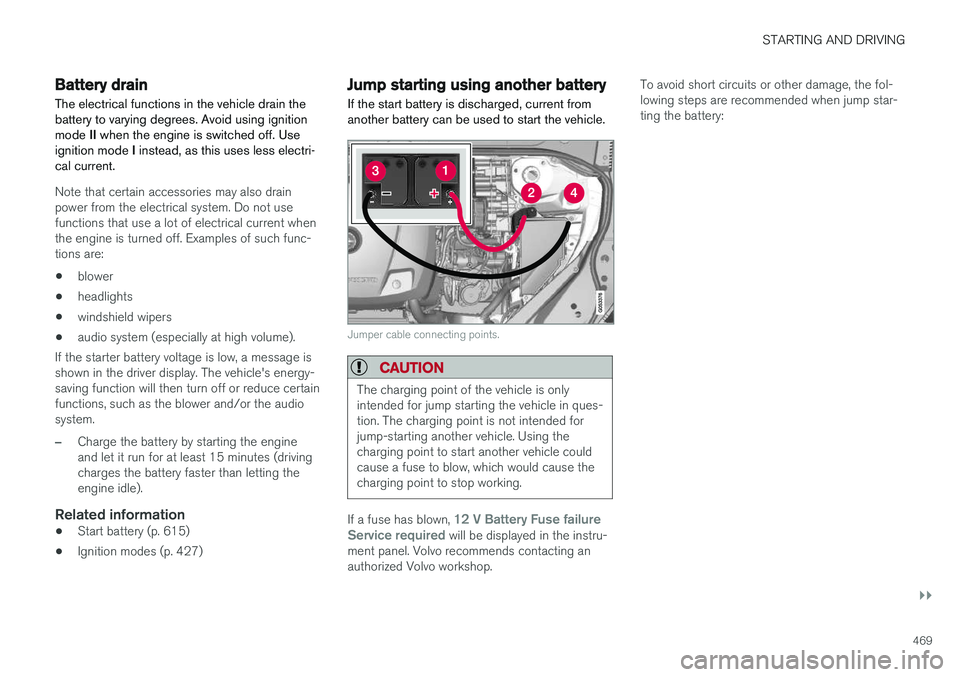
If the start battery is discharged, current from another battery can be used to start the vehicle.
Jumper cable connecting points.
CAUTION
The charging point of the vehicle is only intended for jump starting the vehicle in ques-tion. The charging point is not intended forjump-starting another vehicle. Using thecharging point to start another vehicle couldcause a fuse to blow, which would cause thecharging point to stop working.
If a fuse has blown, 12 V Battery Fuse failure
Service required will be displayed in the instru-
ment panel. Volvo recommends contacting an authorized Volvo workshop. To avoid short circuits or other damage, the fol-lowing steps are recommended when jump star-ting the battery:
Page 617 of 686
MAINTENANCE AND SERVICE
}}
615
Start battery
The vehicle has a single-pole electrical system that uses the chassis and engine mount as con-ductors. The start battery is used to start the electrical system and power electrical equipment in thevehicle. The hybrid battery is used to start thecombustion engine. The start battery should only be replaced by a workshop 15
.
The start battery is a 12 V AGM (Absorbed Glass Mat) battery, dimensioned for regenerative charg-ing and to support the function of the vehicle'svarious systems. The service life and performance of the start bat- tery are affected by factors such as driving style,driving conditions, climate, battery discharges,number of starts, etc.
• Never disconnect the start battery while theengine is running.
• Make sure the cables to the start battery arecorrectly connected and the clamps aresecurely tightened.
WARNING
•Batteries generate hydrogen gas, which is flammable and explosive.
• Do not connect the jumper cable to anypart of the fuel system or to any movingparts. Avoid touching hot manifolds.
• Battery fluid contains sulfuric acid. Do notallow battery fluid to contact eyes, skin,fabrics or painted surfaces.
• If contact occurs, flush the affected areaimmediately with water. Obtain medicalhelp immediately if eyes are affected.
• Never expose the battery to open flameor electric spark. Do not smoke near thebattery. Failure to follow the instructionsfor jump starting can lead to injury.
Connection points
WARNING
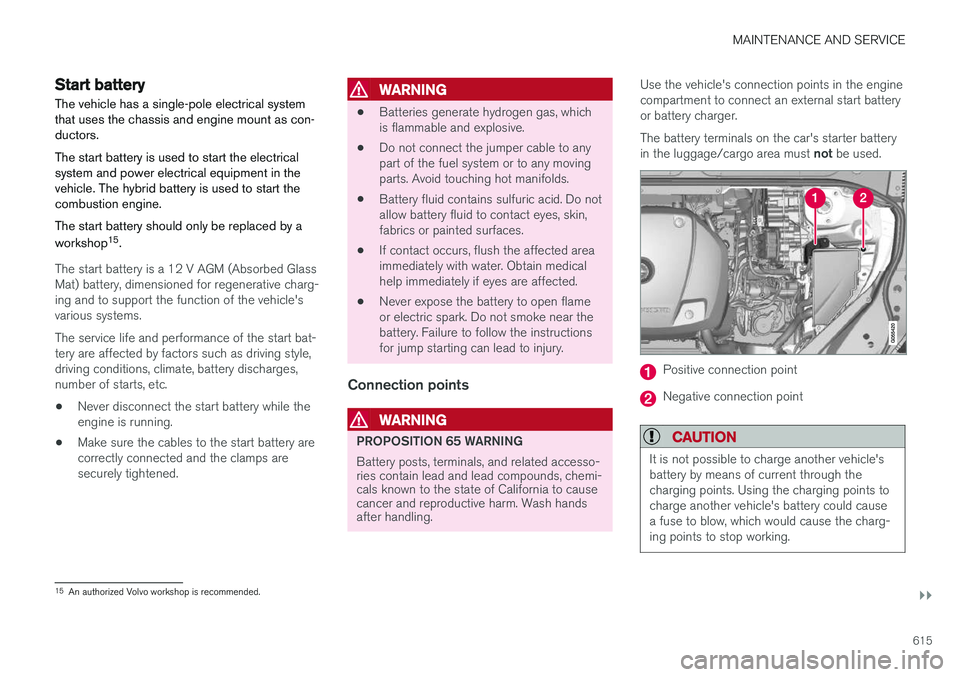
PROPOSITION 65 WARNING Battery posts, terminals, and related accesso- ries contain lead and lead compounds, chemi-cals known to the state of California to causecancer and reproductive harm. Wash handsafter handling. Use the vehicle's connection points in the engine compartment to connect an external start batteryor battery charger. The battery terminals on the car's starter battery in the luggage/cargo area must
not be used.
Positive connection point
Negative connection point
CAUTION
It is not possible to charge another vehicle's battery by means of current through thecharging points. Using the charging points tocharge another vehicle's battery could causea fuse to blow, which would cause the charg-ing points to stop working.
15
An authorized Volvo workshop is recommended.
Page 621 of 686
MAINTENANCE AND SERVICE
619
Hybrid battery
The vehicle's electric motor is powered by a rechargeable, maintenance-free, lithium-ionhybrid battery.
NOTE
The vehicle cannot be started if the hybrid battery is discharged.
NOTE
If both the starter battery and the hybrid bat- tery are discharged, both batteries must be
charged. In such cases, it is not possible to charge only the hybrid battery first. The starter battery must have a certain level of charge for it to be possible to charge thehybrid battery.
WARNING
Hybrid battery replacement may only be per- formed by a workshop – an authorized Volvoworkshop is recommended.
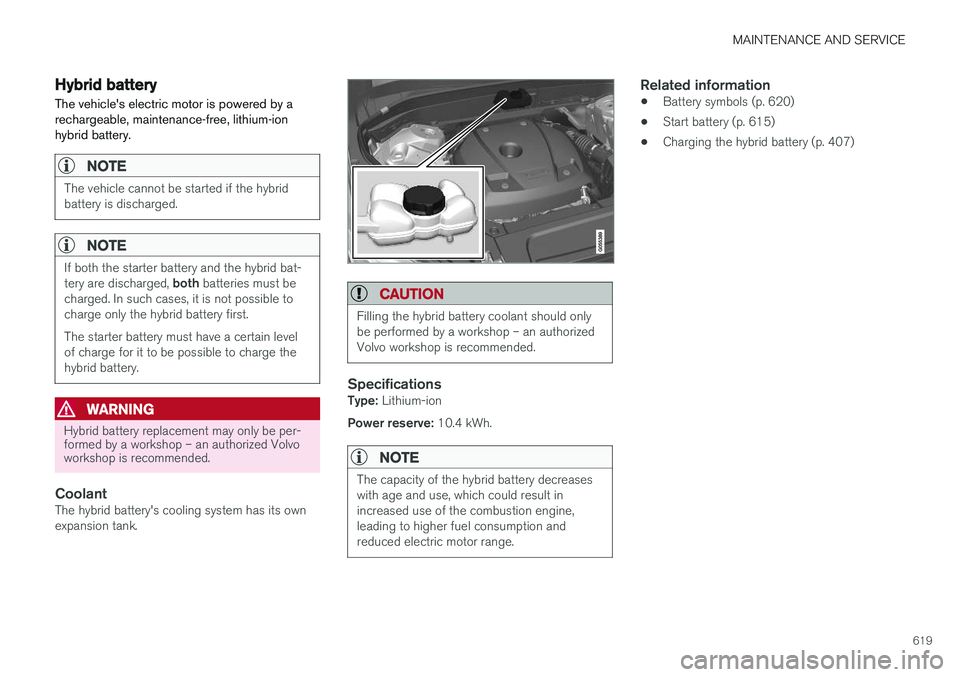
CoolantThe hybrid battery's cooling system has its own expansion tank.
CAUTION
Filling the hybrid battery coolant should only be performed by a workshop – an authorizedVolvo workshop is recommended.
SpecificationsType: Lithium-ion
Power reserve: 10.4 kWh.
NOTE
The capacity of the hybrid battery decreases with age and use, which could result inincreased use of the combustion engine,leading to higher fuel consumption andreduced electric motor range.
Related information
•Battery symbols (p. 620)
• Start battery (p. 615)
• Charging the hybrid battery (p. 407)
Page 622 of 686
MAINTENANCE AND SERVICE
620
Battery symbols
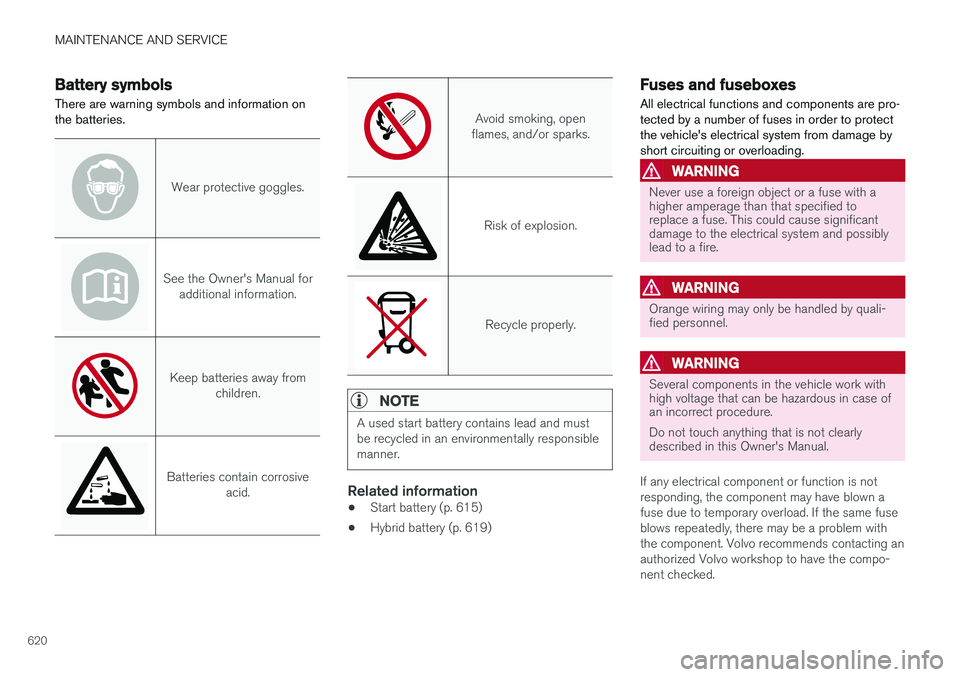
There are warning symbols and information on the batteries.
Wear protective goggles.
See the Owner's Manual for additional information.
Keep batteries away from children.
Batteries contain corrosive acid.
Avoid smoking, open
flames, and/or sparks.
Risk of explosion.
Recycle properly.
NOTE
A used start battery contains lead and must be recycled in an environmentally responsiblemanner.
Related information
• Start battery (p. 615)
• Hybrid battery (p. 619)
Fuses and fuseboxes
All electrical functions and components are pro- tected by a number of fuses in order to protectthe vehicle's electrical system from damage byshort circuiting or overloading.
WARNING
Never use a foreign object or a fuse with a higher amperage than that specified toreplace a fuse. This could cause significantdamage to the electrical system and possiblylead to a fire.
WARNING
Orange wiring may only be handled by quali- fied personnel.
WARNING
Several components in the vehicle work with high voltage that can be hazardous in case ofan incorrect procedure. Do not touch anything that is not clearly described in this Owner's Manual.
If any electrical component or function is not responding, the component may have blown afuse due to temporary overload. If the same fuse blows repeatedly, there may be a problem with the component. Volvo recommends contacting anauthorized Volvo workshop to have the compo-nent checked.
Page 670 of 686
INDEX
668
B
Backrestfront seat, adjusting 184, 185, 188, 189 , 190
rear seat, adjusting 196, 197
rear seat, folding 192, 197, 198
Battery Hybrid 619
jump-start 469
Maintenance 615
start 615
symbols on the battery 620
warning symbols 620
BLIS 348, 349, 350, 351 Blower adjusting 224, 225
air distribution 208
air vents 209
Bluetooth connect 513
connecting vehicle to Internet 531
phone 520
settings 529
Book service and repair 603
Booster cushions 71 Brake assist after collision 437
Brake fluid
grade 663
Brake functions 429
Brake light 160
Brake position 439
Brakes 429 anti-lock brakes, ABS 429
automatic when stationary 436
Brake Assist System, BAS 431
brake lights 160
brake system 429
emergency brake lights 160
handbrake 432
Maintenance 432
on salted roads 431
on wet roads 431
brake system fluid 663
C
Camera sensor 344
Camera unit 331
Capacity weight 578, 659
Cargo compartment 586 attachment points 589
cargo net 593
electrical outlet 582, 584
Lighting 163
Cargo compartment cover 589, 590
cargo net 593
Car wash 638, 639, 641, 642, 643, 644
Catalytic converter 467 recovery 476
CD player 511
Cell phone, see Phone 521
Center console 581Center display change appearance 131
cleaning 633
climate controls 213
Function view 122
keyboard 126
messages 140, 141, 142
operation 112, 115, 119, 124
overview 109
settings 132, 133, 134
switch off and change volume 131
symbols in status bar 124
views 115
Central locking 257
Change of owner 134
Changing a wheel 564
Page 672 of 686
INDEX
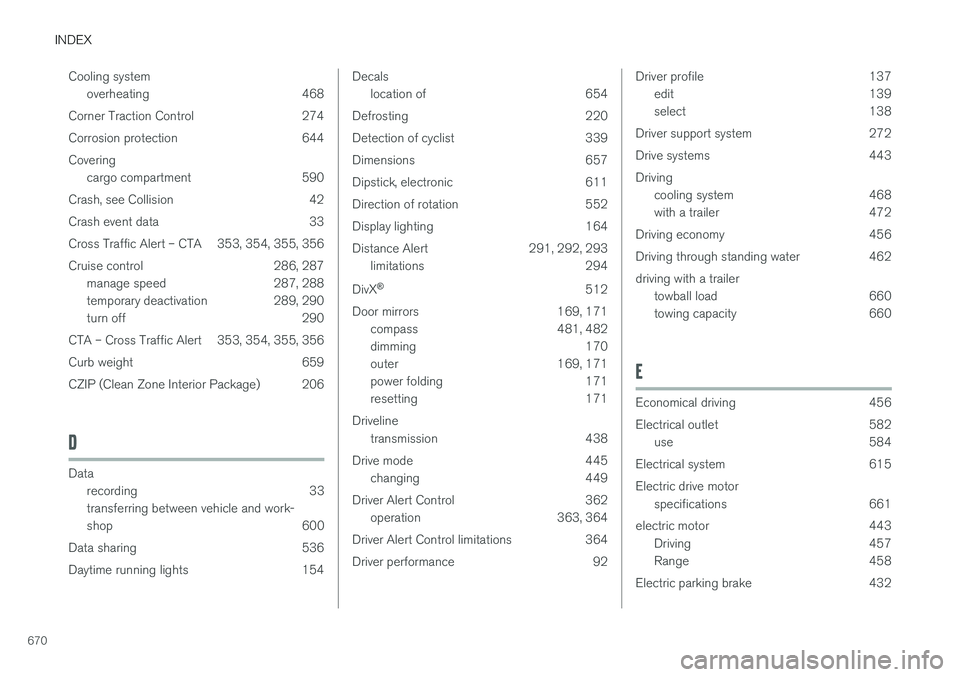
670Cooling system
overheating 468
Corner Traction Control 274
Corrosion protection 644Covering cargo compartment 590
Crash, see Collision 42
Crash event data 33
Cross Traffic Alert – CTA 353, 354, 355, 356
Cruise control 286, 287 manage speed 287, 288
temporary deactivation 289, 290
turn off 290
CTA – Cross Traffic Alert 353, 354, 355, 356
Curb weight 659
CZIP (Clean Zone Interior Package) 206
D
Data recording 33 transferring between vehicle and work-
shop 600
Data sharing 536
Daytime running lights 154
Decals location of 654
Defrosting 220
Detection of cyclist 339
Dimensions 657
Dipstick, electronic 611
Direction of rotation 552
Display lighting 164
Distance Alert 291, 292, 293 limitations 294
DivX ®
512
Door mirrors 169, 171 compass 481, 482
dimming 170
outer 169, 171
power folding 171
resetting 171
Driveline transmission 438
Drive mode 445 changing 449
Driver Alert Control 362 operation 363, 364
Driver Alert Control limitations 364
Driver performance 92Driver profile 137 edit 139
select 138
Driver support system 272
Drive systems 443Driving cooling system 468
with a trailer 472
Driving economy 456
Driving through standing water 462 driving with a trailer towball load 660
towing capacity 660
E
Economical driving 456
Electrical outlet 582
use 584
Electrical system 615 Electric drive motor specifications 661
electric motor 443 Driving 457
Range 458
Electric parking brake 432
Page 680 of 686
INDEX
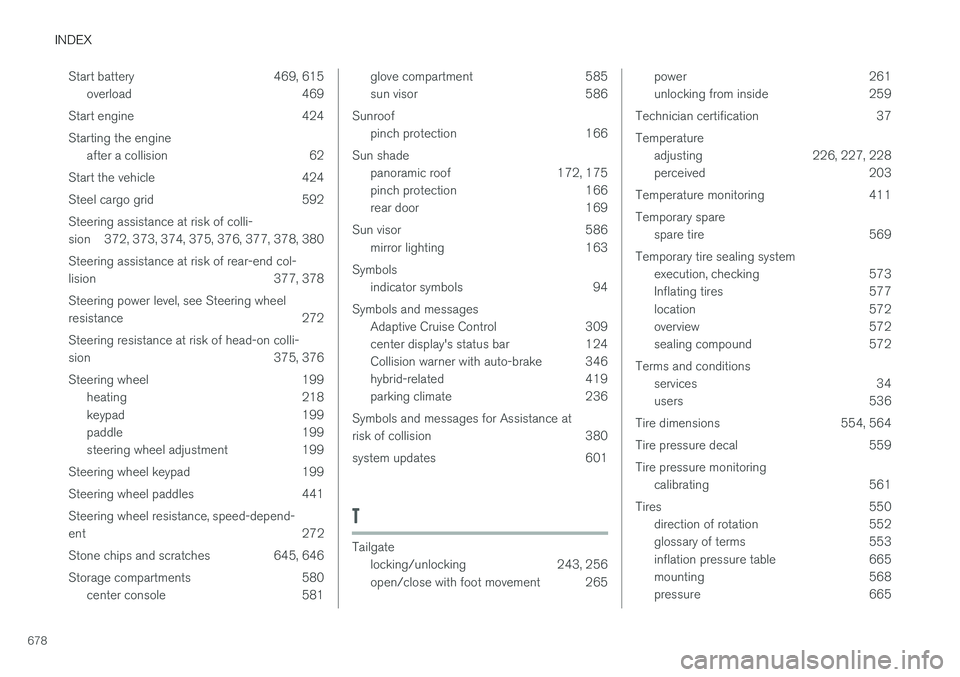
678Start battery 469, 615
overload 469
Start engine 424 Starting the engine after a collision 62
Start the vehicle 424
Steel cargo grid 592Steering assistance at risk of colli-
sion 372, 373, 374, 375, 376, 377, 378, 380 Steering assistance at risk of rear-end col-
lision 377, 378 Steering power level, see Steering wheel
resistance 272 Steering resistance at risk of head-on colli-
sion 375, 376
Steering wheel 199 heating 218
keypad 199
paddle 199
steering wheel adjustment 199
Steering wheel keypad 199
Steering wheel paddles 441Steering wheel resistance, speed-depend- ent 272
Stone chips and scratches 645, 646
Storage compartments 580 center console 581
glove compartment 585
sun visor 586
Sunroof pinch protection 166
Sun shade panoramic roof 172, 175
pinch protection 166
rear door 169
Sun visor 586 mirror lighting 163
Symbols indicator symbols 94
Symbols and messages Adaptive Cruise Control 309
center display's status bar 124
Collision warner with auto-brake 346
hybrid-related 419
parking climate 236
Symbols and messages for Assistance at
risk of collision 380
system updates 601
T
Tailgate locking/unlocking 243, 256
open/close with foot movement 265
power 261
unlocking from inside 259
Technician certification 37 Temperature adjusting 226, 227, 228
perceived 203
Temperature monitoring 411 Temporary spare spare tire 569
Temporary tire sealing system execution, checking 573
Inflating tires 577
location 572
overview 572
sealing compound 572
Terms and conditions services 34
users 536
Tire dimensions 554, 564
Tire pressure decal 559Tire pressure monitoring calibrating 561
Tires 550 direction of rotation 552
glossary of terms 553
inflation pressure table 665
mounting 568
pressure 665