tow VOLVO XC90 T8 2018 Owner´s Manual
[x] Cancel search | Manufacturer: VOLVO, Model Year: 2018, Model line: XC90 T8, Model: VOLVO XC90 T8 2018Pages: 686, PDF Size: 11.51 MB
Page 12 of 686
10
STARTING AND DRIVING
Starting the vehicle424
Switching off the vehicle 426
Ignition modes 427
Selecting ignition mode 428
Brake functions 429
Brakes 429
Brake Assist System 431
Braking on wet roads 431
Braking on salted roads 431
Maintenance of the brake system 432
Parking brake 432
Activating and deactivating the park- ing brake 433
Settings for automatically activatingthe parking brake 434
Parking on a hill 434
Parking brake malfunction 435
Auto-hold brakes 436
Activating and deactivating Auto-hold at a standstill 436
Hill Start Assist 437
Braking assist after a collision 437
Transmission 438
Gear selector positions for automatictransmissions 439
Using the steering wheel paddles
* to
shift 441
Shiftlock 442
The kickdown function 442
Gear indicator *
442
All Wheel Drive (AWD) 443
Drive systems 443
Starting and stopping the combus- tion engine in Twin Engine vehicles 444
Drive modes 445
Changing drive mode 449
Leveling control * and suspension
450
Leveling control settings *
453
Low Speed Control 453
Activating and deactivating LowSpeed Control using the function button 454
Hill Descent Control 454
Activating and deactivating HillDescent Control using the functionbutton 455
Economical driving 456
Using the electric motor only 457
Factors affecting electric motor range 458
"Hold" and "Charge" functions 459
Preparing for a long trip 460
Winter driving 461
Driving through standing water462
Opening/closing the fuel filler door 462
Refueling 463
Fuel 464
Octane rating 465
Emission controls 467
Overheating of engine and transmission 468
Battery drain 469
Jump starting using another battery 469
Detachable towbar *
471
Driving with a trailer 472
Trailer Stability Assist *
474
Checking trailer lights 475
Towing using a towline 476
Attaching and removing the towing eyelet 476
Recovery 477
HomeLink ®
* 478
Programming HomeLink ®
* 479
Using HomeLink 480
Type approval for HomeLink ®
* 481
Compass 481
Activating and deactivating the compass 482
Calibrating the compass 482
Page 16 of 686
14
Touching up minor paint damage645
Color codes 646
Changing rear window wipers 647
Replacing windshield wiper blades 648
Windshield wipers in the service position 649
Filling washer fluid 650
SPECIFICATIONS
Type designations654
Dimensions 657
Weights 659
Towing capacity and tongue weight 660
Engine specifications 661
Engine oil specifications 662
Coolant specifications 663
Transmission fluid specifications 663
Brake fluid specifications 663
Fuel tank volume 664
Air conditioning specifications 664
Approved tire pressure 665
INDEX
Index 667
Page 51 of 686
SAFETY
}}
49
2. Buckle the seat belt by pushing the latch
plate into the receptacle.
> A distinct "click" indicates that the belt islocked into place.
WARNING
Always insert the seat belt latch plate into the belt buckle on the correct side. Failure to doso could cause the seat belts and belt buck-les to malfunction in a collision. There is a riskof serious injury. 3. The height of the seat belts in the front seats
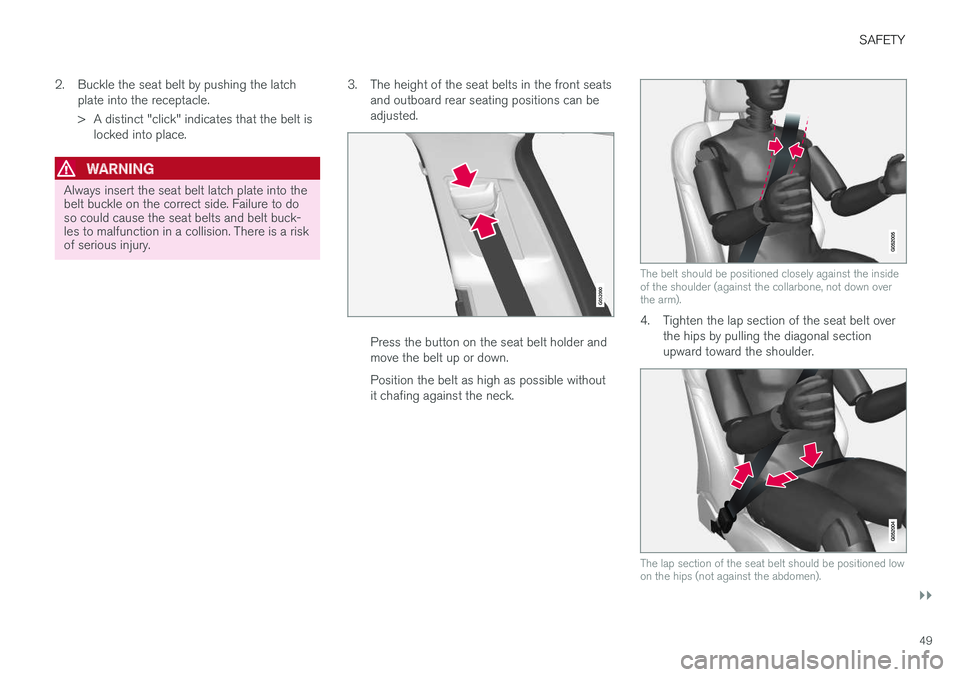
and outboard rear seating positions can be adjusted.
Press the button on the seat belt holder and move the belt up or down. Position the belt as high as possible without it chafing against the neck.
The belt should be positioned closely against the inside of the shoulder (against the collarbone, not down overthe arm).
4. Tighten the lap section of the seat belt overthe hips by pulling the diagonal section upward toward the shoulder.
The lap section of the seat belt should be positioned low on the hips (not against the abdomen).
Page 55 of 686
SAFETY
}}
53
WARNING
If your vehicle has become water-damaged in any way (e.g., soaked floor mats/standingwater on the floor of the vehicle), do notattempt to start the engine. This may causeairbag deployment, which could result in seri-ous injury. Volvo recommends towing thevehicle directly to an authorized Volvo work-shop. Before attempting to tow the vehicle:
1. Switch off the ignition for at least 10minutes and disconnect the battery.
2. Follow the instructions for manually over- riding the shiftlock system.
Deployed airbags
WARNING
If any of the airbags have deployed:
• Do not attempt to drive the vehicle. Have it towed to an authorized workshop.
• If necessary, seek medical attention.
Related information
•
Safety (p. 42)
• Driver/passenger-side airbags (p. 53)
• Side airbags (p. 60)
• Inflatable curtain (p. 60)
Driver/passenger-side airbags
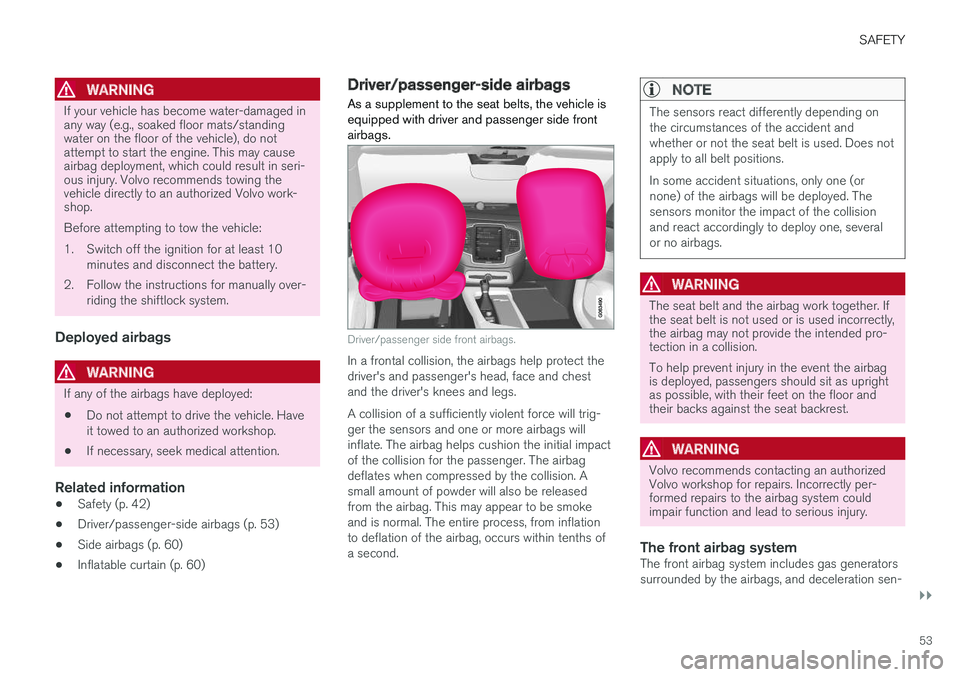
As a supplement to the seat belts, the vehicle is equipped with driver and passenger side frontairbags.
Driver/passenger side front airbags.
In a frontal collision, the airbags help protect the driver's and passenger's head, face and chestand the driver's knees and legs. A collision of a sufficiently violent force will trig- ger the sensors and one or more airbags willinflate. The airbag helps cushion the initial impactof the collision for the passenger. The airbagdeflates when compressed by the collision. Asmall amount of powder will also be releasedfrom the airbag. This may appear to be smokeand is normal. The entire process, from inflationto deflation of the airbag, occurs within tenths ofa second.
NOTE
The sensors react differently depending on the circumstances of the accident andwhether or not the seat belt is used. Does notapply to all belt positions. In some accident situations, only one (or none) of the airbags will be deployed. Thesensors monitor the impact of the collisionand react accordingly to deploy one, severalor no airbags.
WARNING
The seat belt and the airbag work together. If the seat belt is not used or is used incorrectly,the airbag may not provide the intended pro-tection in a collision. To help prevent injury in the event the airbag is deployed, passengers should sit as uprightas possible, with their feet on the floor andtheir backs against the seat backrest.
WARNING
Volvo recommends contacting an authorized Volvo workshop for repairs. Incorrectly per-formed repairs to the airbag system couldimpair function and lead to serious injury.
The front airbag systemThe front airbag system includes gas generators surrounded by the airbags, and deceleration sen-
Page 58 of 686
||
SAFETY
56
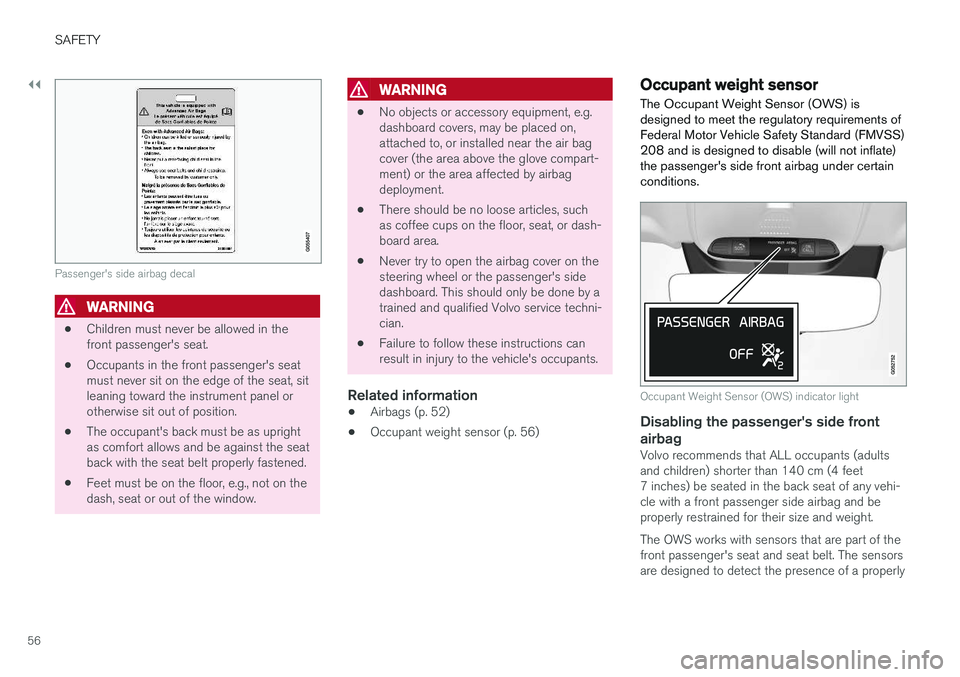
Passenger's side airbag decal
WARNING
•Children must never be allowed in the front passenger's seat.
• Occupants in the front passenger's seatmust never sit on the edge of the seat, sitleaning toward the instrument panel orotherwise sit out of position.
• The occupant's back must be as uprightas comfort allows and be against the seatback with the seat belt properly fastened.
• Feet must be on the floor, e.g., not on thedash, seat or out of the window.
WARNING
• No objects or accessory equipment, e.g. dashboard covers, may be placed on,attached to, or installed near the air bagcover (the area above the glove compart-ment) or the area affected by airbagdeployment.
• There should be no loose articles, suchas coffee cups on the floor, seat, or dash-board area.
• Never try to open the airbag cover on thesteering wheel or the passenger's sidedashboard. This should only be done by atrained and qualified Volvo service techni-cian.
• Failure to follow these instructions canresult in injury to the vehicle's occupants.
Related information
• Airbags (p. 52)
• Occupant weight sensor (p. 56)
Occupant weight sensor
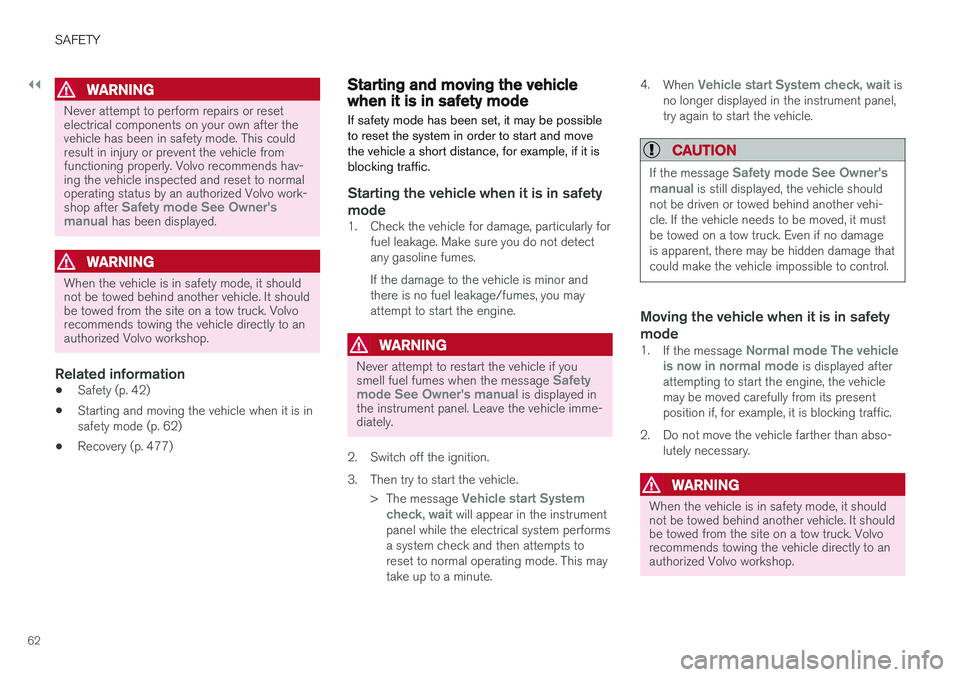
The Occupant Weight Sensor (OWS) is designed to meet the regulatory requirements ofFederal Motor Vehicle Safety Standard (FMVSS)208 and is designed to disable (will not inflate)the passenger's side front airbag under certainconditions.
Occupant Weight Sensor (OWS) indicator light
Disabling the passenger's side front airbag
Volvo recommends that ALL occupants (adults and children) shorter than 140 cm (4 feet7 inches) be seated in the back seat of any vehi-cle with a front passenger side airbag and beproperly restrained for their size and weight. The OWS works with sensors that are part of the front passenger's seat and seat belt. The sensors are designed to detect the presence of a properly
Page 64 of 686
||
SAFETY
62
WARNING
Never attempt to perform repairs or reset electrical components on your own after thevehicle has been in safety mode. This couldresult in injury or prevent the vehicle fromfunctioning properly. Volvo recommends hav-ing the vehicle inspected and reset to normaloperating status by an authorized Volvo work- shop after
Safety mode See Owner's
manual has been displayed.
WARNING
When the vehicle is in safety mode, it should not be towed behind another vehicle. It shouldbe towed from the site on a tow truck. Volvorecommends towing the vehicle directly to anauthorized Volvo workshop.
Related information
• Safety (p. 42)
• Starting and moving the vehicle when it is in safety mode (p. 62)
• Recovery (p. 477)
Starting and moving the vehiclewhen it is in safety mode If safety mode has been set, it may be possible to reset the system in order to start and movethe vehicle a short distance, for example, if it isblocking traffic.
Starting the vehicle when it is in safety mode
1. Check the vehicle for damage, particularly for
fuel leakage. Make sure you do not detect any gasoline fumes. If the damage to the vehicle is minor and there is no fuel leakage/fumes, you mayattempt to start the engine.
WARNING
Never attempt to restart the vehicle if you smell fuel fumes when the message Safety
mode See Owner's manual is displayed in
the instrument panel. Leave the vehicle imme- diately.
2. Switch off the ignition.
3. Then try to start the vehicle. >The message
Vehicle start System
check, wait will appear in the instrument
panel while the electrical system performs a system check and then attempts toreset to normal operating mode. This maytake up to a minute. 4.
When
Vehicle start System check, wait is
no longer displayed in the instrument panel, try again to start the vehicle.
CAUTION
If the message Safety mode See Owner's
manual is still displayed, the vehicle should
not be driven or towed behind another vehi- cle. If the vehicle needs to be moved, it mustbe towed on a tow truck. Even if no damageis apparent, there may be hidden damage thatcould make the vehicle impossible to control.
Moving the vehicle when it is in safety mode
1. If the message Normal mode The vehicle
is now in normal mode is displayed after
attempting to start the engine, the vehicle may be moved carefully from its presentposition if, for example, it is blocking traffic.
2. Do not move the vehicle farther than abso- lutely necessary.
WARNING
When the vehicle is in safety mode, it should not be towed behind another vehicle. It shouldbe towed from the site on a tow truck. Volvorecommends towing the vehicle directly to anauthorized Volvo workshop.
Page 80 of 686
||
SAFETY
* Option/accessory.
78
WARNING
DEATH or SERIOUS INJURY can occur •
Follow all instructions on this child restraint and in the vehicle'sowner's manual.
• Make sure the booster cushion issecurely locked before the childis seated.
• Only use for children who weigh between 15-36 kg (33-80 lbs) and who arebetween 97-137 cm (38-54 tum) inheight. In Canada: 18 kg (40 lbs) is theminimum weight requirement for a childusing booster cushions according to theCanadian regulation CMVSS 213.4
• Use only the vehicle's lap and shoulderbelt system when restraining the child inthis booster cushion.
• In the event of a collision while the inte-grated booster cushion was occupied, theentire booster cushion and seat belt mustbe replaced. The booster cushion shouldalso be replaced if it is badly worn ordamaged in any way. This work should beperformed by a trained and qualifiedVolvo service technician only.
Related information
•
Integrated booster cushion
* (p. 76)
• Folding down the integrated booster cush- ion
* (p. 78)
Folding down the integrated
booster cushion *
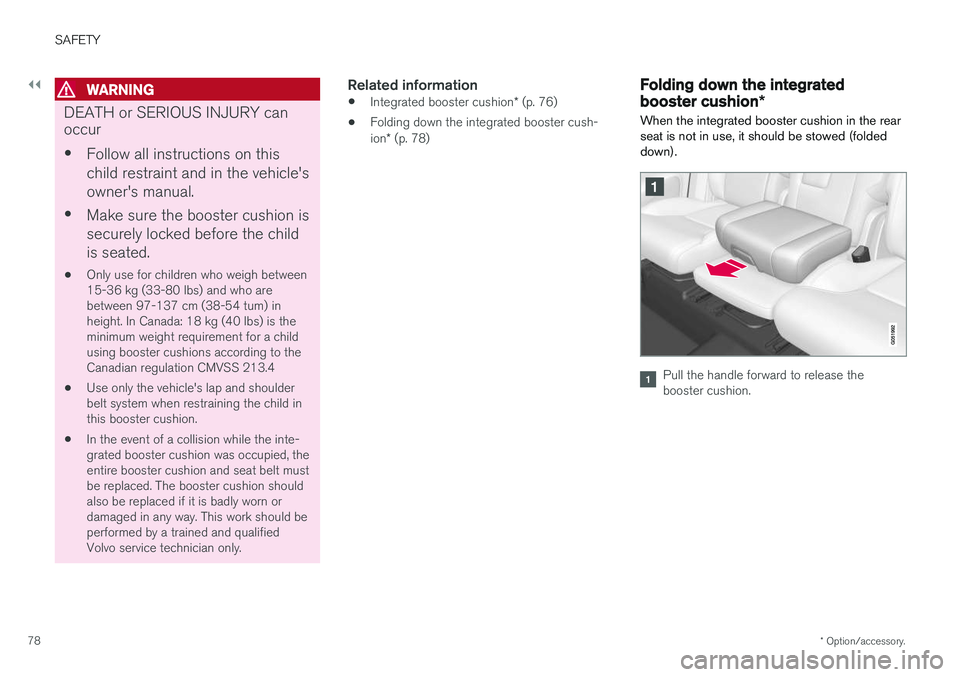
When the integrated booster cushion in the rear seat is not in use, it should be stowed (foldeddown).
Pull the handle forward to release the booster cushion.
Page 81 of 686
SAFETY
* Option/accessory.79
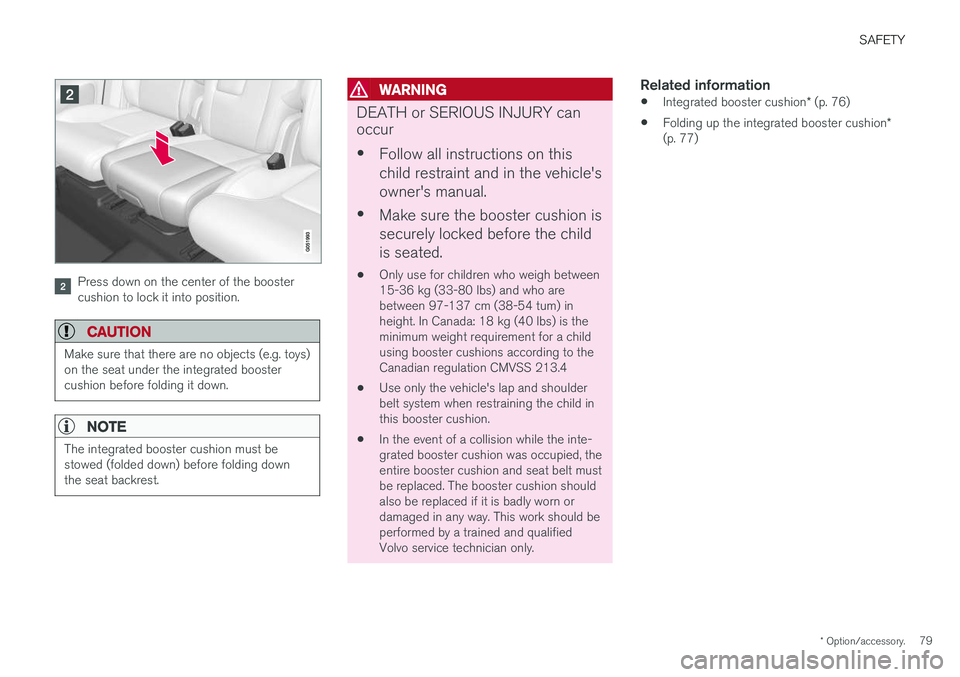
Press down on the center of the booster cushion to lock it into position.
CAUTION
Make sure that there are no objects (e.g. toys) on the seat under the integrated boostercushion before folding it down.
NOTE
The integrated booster cushion must be stowed (folded down) before folding downthe seat backrest.
WARNING
DEATH or SERIOUS INJURY can occur •
Follow all instructions on this child restraint and in the vehicle'sowner's manual.
• Make sure the booster cushion issecurely locked before the childis seated.
• Only use for children who weigh between 15-36 kg (33-80 lbs) and who arebetween 97-137 cm (38-54 tum) inheight. In Canada: 18 kg (40 lbs) is theminimum weight requirement for a childusing booster cushions according to theCanadian regulation CMVSS 213.4
• Use only the vehicle's lap and shoulderbelt system when restraining the child inthis booster cushion.
• In the event of a collision while the inte-grated booster cushion was occupied, theentire booster cushion and seat belt mustbe replaced. The booster cushion shouldalso be replaced if it is badly worn ordamaged in any way. This work should beperformed by a trained and qualifiedVolvo service technician only.
Related information
•
Integrated booster cushion
* (p. 76)
• Folding up the integrated booster cushion
*
(p. 77)
Page 163 of 686
LIGHTING
* Option/accessory.161
Hazard warning flashers
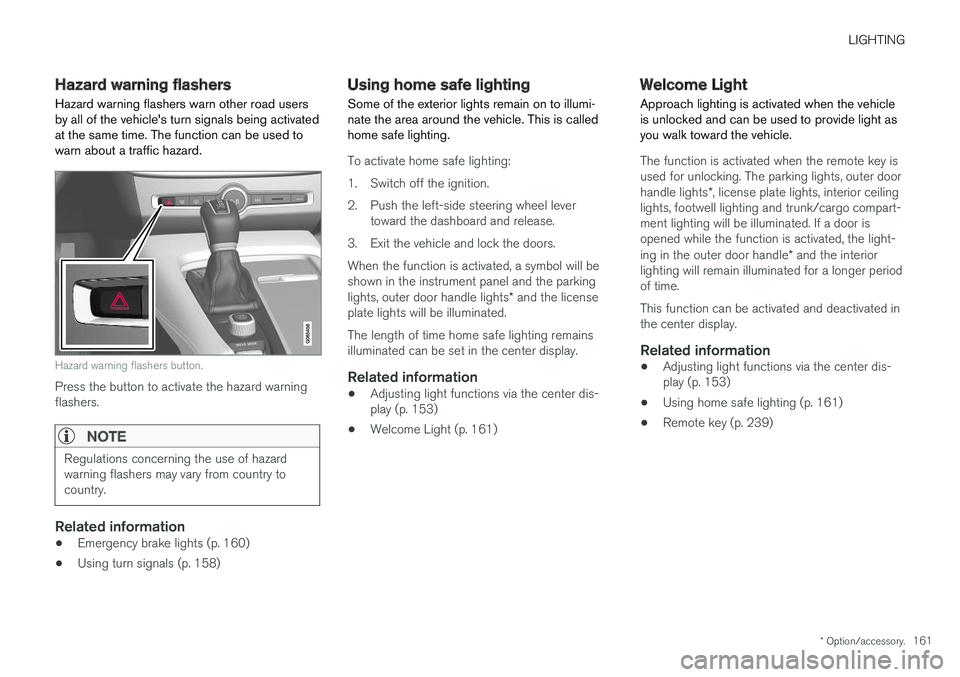
Hazard warning flashers warn other road users by all of the vehicle's turn signals being activatedat the same time. The function can be used towarn about a traffic hazard.
Hazard warning flashers button.
Press the button to activate the hazard warning flashers.
NOTE
Regulations concerning the use of hazard warning flashers may vary from country tocountry.
Related information
• Emergency brake lights (p. 160)
• Using turn signals (p. 158)
Using home safe lighting
Some of the exterior lights remain on to illumi- nate the area around the vehicle. This is calledhome safe lighting.
To activate home safe lighting:
1. Switch off the ignition.
2. Push the left-side steering wheel lever toward the dashboard and release.
3. Exit the vehicle and lock the doors.When the function is activated, a symbol will be shown in the instrument panel and the parking lights, outer door handle lights * and the license
plate lights will be illuminated. The length of time home safe lighting remains illuminated can be set in the center display.
Related information
• Adjusting light functions via the center dis-play (p. 153)
• Welcome Light (p. 161)
Welcome Light Approach lighting is activated when the vehicle is unlocked and can be used to provide light asyou walk toward the vehicle.
The function is activated when the remote key is used for unlocking. The parking lights, outer door handle lights
*, license plate lights, interior ceiling
lights, footwell lighting and trunk/cargo compart- ment lighting will be illuminated. If a door isopened while the function is activated, the light- ing in the outer door handle * and the interior
lighting will remain illuminated for a longer period of time. This function can be activated and deactivated in the center display.
Related information
• Adjusting light functions via the center dis-play (p. 153)
• Using home safe lighting (p. 161)
• Remote key (p. 239)
Page 168 of 686
WINDOWS, GLASS AND MIRRORS
* Option/accessory.
166
Windows, glass and mirrors
The vehicle is equipped with controls for win- dows, glass and mirrors. Some of the windowsin the car are laminated.
Laminated glass
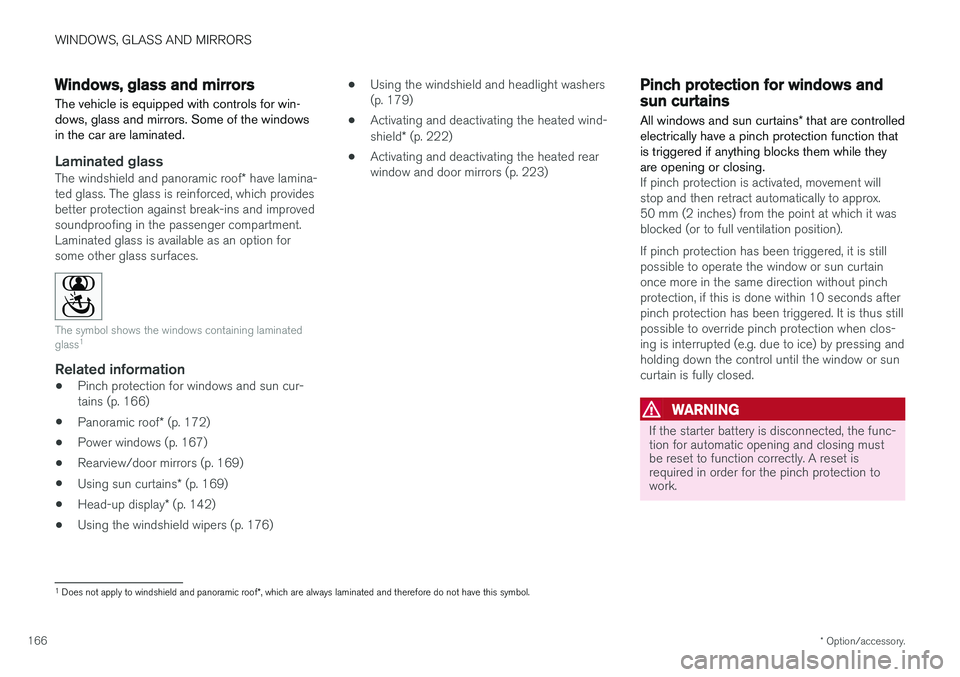
The windshield and panoramic roof * have lamina-
ted glass. The glass is reinforced, which provides better protection against break-ins and improvedsoundproofing in the passenger compartment.Laminated glass is available as an option forsome other glass surfaces.
The symbol shows the windows containing laminated glass 1
Related information
•
Pinch protection for windows and sun cur- tains (p. 166)
• Panoramic roof
* (p. 172)
• Power windows (p. 167)
• Rearview/door mirrors (p. 169)
• Using sun curtains
* (p. 169)
• Head-up display
* (p. 142)
• Using the windshield wipers (p. 176) •
Using the windshield and headlight washers(p. 179)
• Activating and deactivating the heated wind- shield
* (p. 222)
• Activating and deactivating the heated rear window and door mirrors (p. 223)
Pinch protection for windows andsun curtains
All windows and sun curtains * that are controlled
electrically have a pinch protection function that is triggered if anything blocks them while theyare opening or closing.
If pinch protection is activated, movement will stop and then retract automatically to approx.50 mm (2 inches) from the point at which it wasblocked (or to full ventilation position). If pinch protection has been triggered, it is still possible to operate the window or sun curtainonce more in the same direction without pinchprotection, if this is done within 10 seconds afterpinch protection has been triggered. It is thus stillpossible to override pinch protection when clos-ing is interrupted (e.g. due to ice) by pressing andholding down the control until the window or suncurtain is fully closed.
WARNING
If the starter battery is disconnected, the func- tion for automatic opening and closing mustbe reset to function correctly. A reset isrequired in order for the pinch protection towork.
1 Does not apply to windshield and panoramic roof *, which are always laminated and therefore do not have this symbol.