catalytic converter VOLVO XC90 TWIN ENGINE 2018 Owners Manual
[x] Cancel search | Manufacturer: VOLVO, Model Year: 2018, Model line: XC90 TWIN ENGINE, Model: VOLVO XC90 TWIN ENGINE 2018Pages: 686, PDF Size: 17 MB
Page 29 of 686
YOUR VOLVO
}}
* Option/accessory.27
Creating and registering a Volvo ID
A Volvo ID can be created in two ways. If yourVolvo ID was created with the Volvo On Callapp, the Volvo IDmust also be registered to thevehicle to enable access to the Volvo ID serv-ices.
Creating a Volvo ID using the app
1.Download the Volvo ID app from DownloadCenter in the center display's App view.
2.Start the app and register a personal emailaddress.
3. Follow the instructions that will be sent auto-matically to this email address.
> A Volvo ID has now been created and isautomatically registered to the vehicle.The Volvo ID services can now be used.
Creating a Volvo ID using the Volvo On Call
app 3
1. Download the latest version of the Volvo OnCall app from a smartphone, via e.g. AppStore, Windows Phone or Google Play.
2. On the app's start page, create a Volvo IDand enter a personal email address.
3. Follow the instructions that will be sent auto-matically to this email address.
> A Volvo ID has now been created. Seebelow for information on how the ID isregistered to the vehicle.
Registering your Volvo ID to the vehicle
If your Volvo ID was created using the Volvo OnCall app, follow these steps to register the ID tothe vehicle:
1. If you have not already done so, downloadthe Volvo ID app from Download Center inApp view.
NOTE
To download apps the vehicle must be con-nected to the internet.
2. Start the app and enter your Volvo ID/emailaddress.
3.Follow the instructions that will be automati-cally sent to the email address connected toyour Volvo ID.
> Your Volvo ID has now been registered tothe vehicle. The Volvo ID services can nowbe used.
Related information
•Volvo ID (p. 26)
•Download apps (p. 488)
•Handling system updates via Download Cen-ter (p. 601)
•Internet-connected vehicle* (p. 529)
Drive-E ‒ purer driving pleasure
Volvo is committed to the well-being of its cus-tomers. As a natural part of this commitment, wecare about the environment in which we all live.Concern for the environment means an everydayinvolvement in reducing our environmentalimpact.Volvo's environmental activities are based on aholistic view, which means we consider the over-all environmental impact of a product throughoutits complete life cycle. In this context, design, pro-duction, product use, and recycling are all impor-tant considerations. In production, Volvo haspartly or completely phased out several chemicalsincluding CFCs, lead chromates, asbestos, andcadmium; and reduced the number of chemicalsused in our plants 50% since 1991.
Volvo was the first in the world to introduce intoproduction a three-way catalytic converter with aLambda sond, now called the heated oxygen sen-sor, in 1976. The current version of this highlyefficient system reduces emissions of harmfulsubstances (CO, HC, NOx) from the exhaust pipeby approximately 95 - 99% and the search toeliminate the remaining emissions continues.Volvo is the only automobile manufacturer tooffer CFC-free retrofit kits for the air conditioningsystem of all models as far back as the 1975model 240. Advanced electronic engine controlsand cleaner fuels are bringing us closer to our
3
Vehicles with Volvo On Call.
Page 446 of 686
||STARTING AND DRIVING
444
Can provide the combustion engine with
extra electrical current.
Electric motor - Powers the vehicle using
electricity. Can provide extra torque and
power during acceleration. Provides electrical
all-wheel drive functionality. Regenerates
braking energy into electrical current.
Related information
•
General information about Twin Engine
(p. 406)
• Starting and stopping the combustion engine
in Twin Engine vehicles (p. 444)
• Drive modes (p. 445)
• Transmission (p. 438)
• Factors affecting electric motor range
(p. 458) Starting and stopping the
combustion engine in Twin Engine
vehicles
An advanced control system determines the dis-
tance that the vehicle can be driven on the com-
bustion engine, electric motor, or both at the
same time. When driving on only the electric
motor, the vehicle may automatically start the
combustion engine due to outside circumstan-
ces, e.g. low ambient temperatures. This is com-
pletely normal. The combustion engine will also
always start when the hybrid battery is nearly
fully discharged.
Climate settings at low temperaturesAt low ambient temperatures, the combustion
engine will sometimes start automatically to help
achieve the desired passenger compartment
temperature and air quality. The amount of time
the combustion engine is running can be affec-
ted by:
• lowering the temperature
• reducing blower speed
• activating Pure drive mode.
Using the electric motor in hot or cold
weather
At very low or high ambient temperatures, the
electric motor's driving range and power may be
reduced and affect how often the combustion
engine automatically starts.
Emission control systemTo help ensure that the emission control system
functions optimally, the combustion engine will
run for several minutes after it is started. The
amount of time the combustion engine needs to
be used varies depending on the temperature of
the three-way catalytic converter.
Related information
• Drive systems (p. 443)
• Economical driving (p. 456)
• Using the electric motor only (p. 457)
• Drive modes (p. 445)
Page 466 of 686
||STARTING AND DRIVING
464
Refueling is done as follows.
1. Turn off the engine and open the fuel filler
door.
NOTE Refueling must be done within approximately
10 minutes of opening the fuel filler door.
After this time, the valve opened by pushing
the button will close and it will no longer be
possible to refuel without the pump's nozzle
switching off.
If the valve is closed before refueling is com-
plete - press the button again and wait until
the driver display shows the message
Fuel
tank Ready for refueling. 2. Select a fuel approved for use in the vehicle.
For more information on approved fuels, see
the section on "Gasoline".
3.
Insert the pump's nozzle into the fuel filler
pipe's opening. There are two flaps just
inside the fuel filler pipe and the pump's noz-
zle must push both of these flaps open
before fuel can be added. 4. Avoid overfilling the tank. Do not press the
handle on the filler nozzle again after it has
initially stopped pumping.
> The fuel tank is now filled.
NOTE An over-full tank may overflow in hot weather.
CAUTION
Avoid spilling gasoline during refueling. In
addition to causing damage to the environ-
ment, gasolines containing alcohol can cause
damage to painted surfaces, which may not
be covered under the New Vehicle Limited
Warranty.
Refueling from a fuel containerWhen filling from a fuel container, use the funnel
provided in a foam block under the floor hatch in
the cargo compartment.
1. Open the fuel filler door.
2. Insert the funnel into the fuel filler pipe's
opening. There are two flaps just inside the
fuel filler pipe and the tube section of the
funnel must push both of these flaps open
before fuel can be added.
Related information
• Opening/closing the fuel filler door (p. 462) Fuel
Volvo recommends the use of detergent gaso-
line to control engine deposits.
Deposit control gasoline (gasoline with
detergent additives)
Detergent gasoline is effective in keeping injec-
tors and intake valves clean. Consistent use of
deposit control gasolines will help ensure good
driveability and fuel economy. If you are not sure
whether the gasoline contains deposit control
additives, check with the service station operator.
NOTE
Volvo recommends not using external fuel
injector cleaning systems, e.g. do not add
detergent additives to gasoline before or after
refueling.
Unleaded fuelAll Volvo vehicles have a three-way catalytic con-
verter and must only use unleaded gasoline. US
and Canadian regulations require that pumps
delivering unleaded gasoline are labeled
"UNLEADED". Only the nozzles of these pumps
will fit in your vehicle's fuel filler inlet. It is unlaw-
ful to dispense leaded fuel into a vehicle labeled
"unleaded gasoline only". Leaded gasoline dam-
ages the three-way catalytic converter and the
heated oxygen sensor system. Repeated use of
leaded gasoline will lessen the effectiveness of
Page 469 of 686

STARTING AND DRIVING
467
WARNINGCarbon monoxide is a poisonous, colorless,
and odorless gas. It is present in all exhaust
gases. If you ever smell exhaust fumes inside
the vehicle, make sure the passenger com-
partment is ventilated, and immediately return
the vehicle to a trained and qualified Volvo
service technician for correction.
Demanding drivingIn demanding driving conditions, e.g. when driving
in a hot climates, driving with a trailer or driving
for longer periods at higher altitudes (mountain
landscapes) than normal, it is recommended
switching to a higher octane fuel than AKI 91
6
or
changing gasoline brand to take full advantage of
your car's engine capacity and obtain the opti-
mum driving force.
Related information
• Fuel (p. 464)
• Emission controls (p. 467) Emission controls
Three-way catalytic converter
•
Keep your engine properly tuned. Certain
engine malfunctions, particularly involving the
electrical, fuel or distributor ignition systems,
may cause unusually high three-way catalytic
converter temperatures. Do not continue to
operate your vehicle if you detect engine
misfire, noticeable loss of power or other
unusual operating conditions, such as engine
overheating or backfiring. A properly tuned
engine will help avoid malfunctions that
could damage the three-way catalytic con-
verter.
• Do not park your vehicle over combustible
materials, such as grass or leaves, which can
come into contact with the hot exhaust sys-
tem and cause such materials to ignite under
certain wind and weather conditions.
• Excessive starter cranking (in excess of one
minute), or an intermittently firing or flooded
engine can cause three-way catalytic con-
verter or exhaust system overheating.
• Remember that tampering or unauthorized
modifications to the engine, the Engine Con-
trol Module, or the vehicle may be illegal and
can cause three-way catalytic converter or
exhaust system overheating. This includes:
altering fuel injection settings or compo-
nents, altering emission system components or location or removing components, and/or
repeated use of leaded fuel.NOTE Unleaded fuel is required for vehicles with
three-way catalytic converters.
Heated oxygen sensorsThe heated oxygen sensors monitor the oxygen
content of the exhaust gases. Readings are fed
into a control module that continuously monitors
engine functions and controls fuel injection. The
ratio of fuel to air into the engine is continuously
adjusted for efficient combustion to help reduce
harmful emissions.
Related information
•
Octane rating (p. 465)
• Fuel (p. 464) 6
AKI (Anti Knock Index) is an average value of RON (Research Octane Nu\
mber) and MON (Motor Octane Number) - (RON)+(MON)/2
Page 478 of 686
STARTING AND DRIVING
476Towing using a towline
This section refers to one vehicle being towed
behind another using a towline.
Twin Engine vehicles may not be towed behind
another vehicle due to the risk of damage to the
electric motor. If the vehicle cannot be driven and
needs to be moved, it must be transported on a
tow truck with all four wheels on the bed of the
truck.
Towing another vehicleTowing another vehicle requires a lot of power -
use the AWD drive mode. This helps charge the
hybrid battery and improve the vehicle's driving
and roadholding characteristics.
Before towing another vehicle, check applicable
speed limit regulations.
Jump startingDo not tow the vehicle to start the engine. Use an
auxiliary battery if the start battery's charge level
is so low that the engine cannot be started.
CAUTION Attempts to tow-start the vehicle could cause
damage to the electrical drive motor and
three-way catalytic converter.
Related information
•
Attaching and removing the towing eyelet
(p. 476)
• Hazard warning flashers (p. 161)
• Recovery (p. 477)
• Jump starting using another battery (p. 469)
• Selecting ignition mode (p. 428) Attaching and removing the towing
eyelet
Use the towing eyelet to tow another vehicle.
Screw the towing eyelet securely into place in
the threaded outlet behind the cover on the
right-hand side of the rear bumper.
NOTE If the vehicle is equipped with a towbar, there
is no rear attachment for the towing eye.
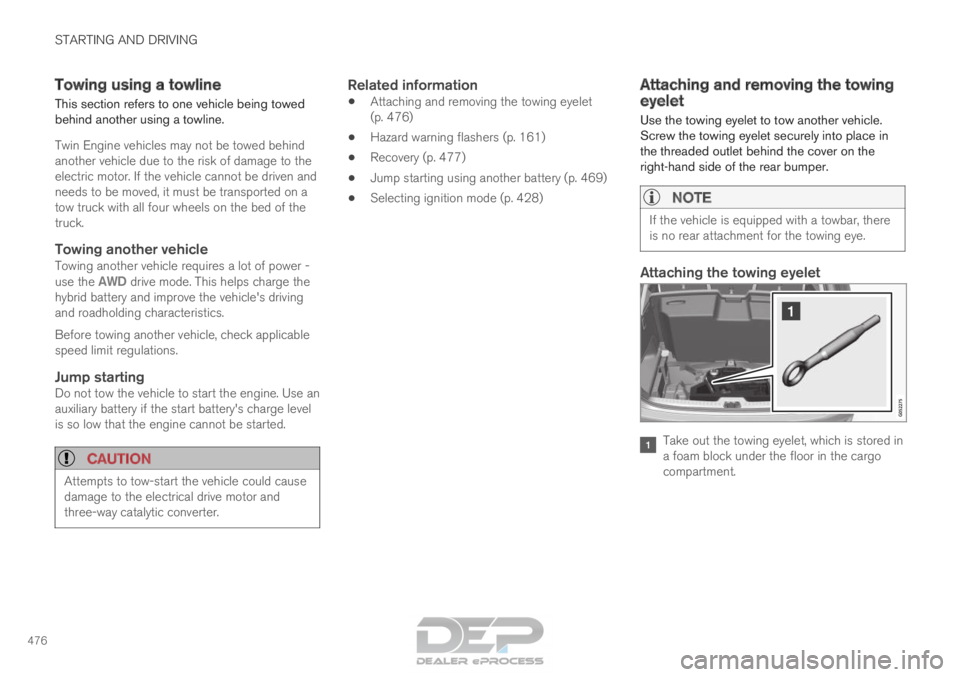
Attaching the towing eyelet
Take out the towing eyelet, which is stored in
a foam block under the floor in the cargo
compartment.
Page 670 of 686

INDEX
668B Backrest
front seat, adjusting
184, 185, 188,
189, 190
rear seat, adjusting 196, 197
rear seat, folding 192, 197, 198
Battery Hybrid 619
jump-start 469
Maintenance 615
start 615
symbols on the battery 620
warning symbols 620
BLIS 348, 349, 350, 351
Blower adjusting 224, 225
air distribution 208
air vents 209
Bluetooth connect 513
connecting vehicle to Internet 531
phone 520
settings 529
Book service and repair 603
Booster cushions 71
Brake assist after collision 437 Brake fluid
grade
663
Brake functions 429
Brake light 160
Brake position 439
Brakes 429
anti-lock brakes, ABS 429
automatic when stationary 436
Brake Assist System, BAS 431
brake lights 160
brake system 429
emergency brake lights 160
handbrake 432
Maintenance 432
on salted roads 431
on wet roads 431
brake system fluid 663
C Camera sensor
344
Camera unit
331
Capacity weight 578, 659
Cargo compartment 586 attachment points 589
cargo net 593 electrical outlet
582, 584
Lighting
163
Cargo compartment cover 589, 590
cargo net 593
Car wash 638, 639, 641, 642, 643, 644
Catalytic converter 467
recovery 476
CD player 511
Cell phone, see Phone 521
Center console 581
Center display change appearance 131
cleaning 633
climate controls 213
Function view 122
keyboard 126
messages 140, 141, 142
operation 112, 115, 119, 124
overview 109
settings 132, 133, 134
switch off and change volume 131
symbols in status bar 124
views 115
Central locking 257
Change of owner 134
Changing a wheel 564