engine VOLVO XC90 TWIN ENGINE 2019 Owners Manual
[x] Cancel search | Manufacturer: VOLVO, Model Year: 2019, Model line: XC90 TWIN ENGINE, Model: VOLVO XC90 TWIN ENGINE 2019Pages: 697, PDF Size: 10.33 MB
Page 597 of 697

LOADING, STORAGE AND PASSENGER COMPARTMENT
595Status indicator light
Cause Action
Steady green light
The outlet is providing electrical current to a connected device. None.
Flashing orange light The outlet's voltage converter is too hot (e.g. if the device draws \
too much cur- rent or if the temperature in the passenger compartment is very high). Unplug the device, let the voltage converter cool
down and plug in the device again.
The connected device is drawing too much current (at the moment or con-\
stantly) or is not functioning properly. None. The device cannot be used in the outlet.
Indicator light off The outlet has not detected a device plugged into the outlet. Make sure the device is correctly plugged into
the outlet.
The outlet is not active. Make sure the vehicle's ignition is in at least
mode I.
The outlet has been active but has been deactivated. Start the engine and/or charge the start battery.
Related information
Passenger compartment interior (p. 592)
Using the electrical outlets (p. 596)
Page 598 of 697

LOADING, STORAGE AND PASSENGER COMPARTMENT
* Option/accessory.
596 Using the electrical outlets
The 12 V outlet can be used for devices
intended for this such as MP3 players, coolers
and cellular phones.
The high-voltage outlet* can be used for devices
intended for this, such as chargers, laptops, etc.
The ignition must be in at least mode I for the
outlets to supply current. The outlets will then be
active as long as there is sufficient charge in the
start battery.
If the engine is turned off and the vehicle is
locked, the outlets will be deactivated. If the
engine is turned off and the vehicle remains
unlocked, the sockets will remain active for up to
7 minutes.
NOTE Bear in mind that using the electrical outlets
when the engine is off could cause the starter
battery to have too low of a charge level,
which could limit other functionality.
Accessories connected to the electrical out-
lets can be activated even when the vehicle
electrical system is off or if preconditioning is
used. For this reason, disconnect plugs when
they are not in use to prevent the starter bat-
tery from becoming discharged.
WARNING
Do not use accessories with large or
heavy plugs – they could damage the out-
let or come loose while you are driving.
Do not use accessories that could cause
disruptions to e.g. the vehicle's radio
receiver or electrical system.
Position the accessory so that there is no
risk of it injuring the driver or passengers
in the event of heavy braking or a colli-
sion.
Pay attention to connected accessories
as they can generate heat that could burn
passengers or the interior.
Using 12 V outlets1. Remove the stopper (tunnel console) or fold
down the cover (trunk/cargo compartment)
over the socket and plug in the device.
2. Unplug the device and put the stopper back in (tunnel console) or fold up the cover
(trunk/cargo compartment) when the socket
is not in use or left unattended.
CAUTION The maximum power is 120 W (10 A) per
outlet.
Using high-voltage outletsThe ignition must be in at least mode I for outlets
to supply current. The outlets will then be active
as long as there is sufficient charge in the start
battery.
1. Slide down the cover over the outlet and plug
in the device.
>
The LED 2
light on the outlet will indicate
its status.
2. The outlet is supplying electrical current when the light is glowing steadily green.
3. Disconnect the device by pulling out the plug (do not pull on the cord).
Pull up the cover when the outlet is not in
use or is left unattended.
CAUTION The maximum power is 150 W.
WARNING
Do not attempt to alter or repair the high-volt-
age outlet on your own. Volvo recommends
contacting an authorized Volvo workshop.
2
LED (Light Emitting Diode)
Page 599 of 697

LOADING, STORAGE AND PASSENGER COMPARTMENT
597
WARNING
Only use accessories that are not dam-
aged or malfunctioning. The accessories
must be designed for 120 V and 60 Hz,
with plugs intended for the outlet. The
accessories must be CE marked, UL
marked or have an equivalent safety
marking.
New let outlets, plugs or accessories
come into contact with water or another
fluid. Do not touch or use the outlet if it
appears damaged or has been in contact
with water or another fluid.
Do not connect power strips, adapters or
extension cords to the outlet has this
could cause the outlet's safety functions
to malfunction.
The outlet is equipped with a pet guard.
Make sure that no one picks at or dam-
ages the outlet in such a way that the
guard is disabled. Children should not be
left unsupervised in the vehicle when the
outlet is active.
Failure to follow the above could lead to
severe or fatal electrical shocks.
Related information
Electrical outlets (p. 594)
Passenger compartment interior (p. 592) Using the glove compartment
The glove compartment is located on the pas-
senger side. The glove compartment can be
used to store the Owner's Manual, maps, etc.
There is also room for a pen and a card holder. Glove compartment and opening button on the center
console.
The glove compartment is opened by pressing
the opening button in the center console.
Locking and unlocking the glove box
The glove compartment can be locked ("private
locking") when the vehicle is left at a workshop,
hotel, etc. When private locking is activated, the
tailgate is also locked.
Using the glove box as a cooled area
The glove compartment can be used to cool e.g.
drinks or food. Cooling is possible when the cli-mate system is active (i.e. when the ignition is in
mode II or when the engine is running).
The illustration is generic – the design may vary.
Activate cooling
Deactivate cooling
– Activate or deactivate cooling by moving the
control as far as possible toward the passen-
ger compartment/glove compartment.
Related information
Passenger compartment interior (p. 592)
Private Locking (p. 271)
Page 601 of 697
LOADING, STORAGE AND PASSENGER COMPARTMENT
* Option/accessory.599
WARNINGIn a head-on collision at a speed of 50 km/h
(30 mph), an unsecured object weighing 20
kg (44 pounds) can reach a projectile weight
equivalent to 1000 kg (2200 pounds).
WARNING
If objects are loaded higher than the upper
edge of the side windows, leave a 10 cm (4
in.) space between the objects and the win-
dow. Objects placed closer to this could
impede the function of the inflatable curtain
concealed inside the headlining.
WARNING
Always secure the load. Otherwise, it may shift
during heavy braking and injure people in the
vehicle.
Cover sharp edges and sharp corners with
something soft.
Turn off the engine and apply the parking
brake when loading/unloading long objects.
Otherwise, it is possible for the load to reach
the gear lever or gear selector and move it to
a drive position – which could cause the vehi-
cle to begin rolling.
Extra cargo space
The rear seat backrests can be folded down to
increase cargo compartment space and simplify
loading. If the rear seat backrests are folded down, make sure that no objects loaded into the
vehicle prevent the WHIPS system for the front
seats from functioning correctly.
Raising/lowering the rear end of the
vehicle*
The rear end of the vehicle can be lowered or
raised for easier loading or to facilitate attaching
a trailer*.
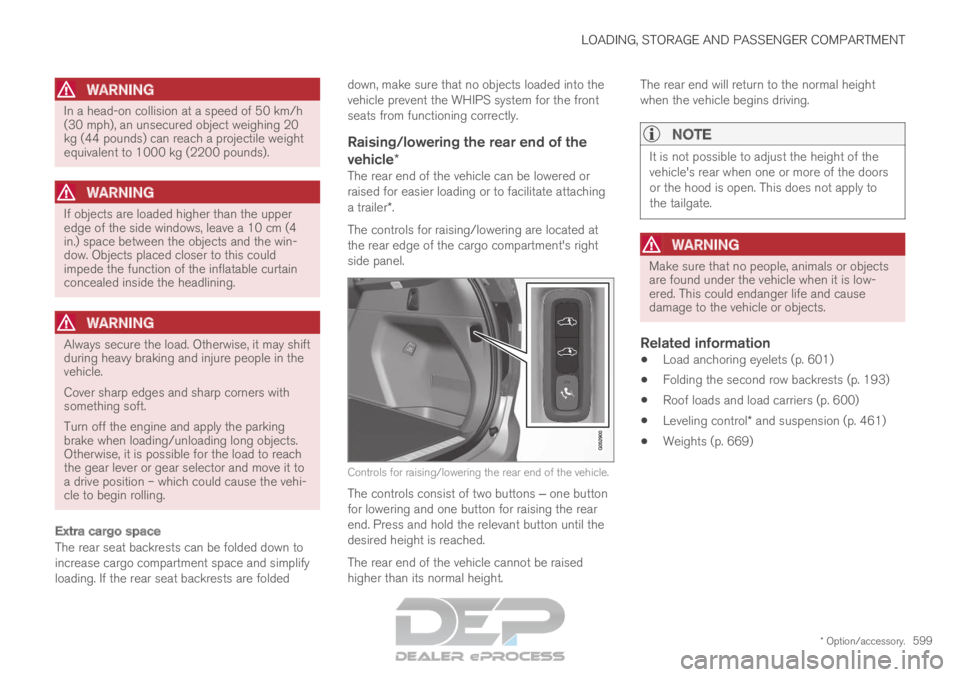
The controls for raising/lowering are located at
the rear edge of the cargo compartment's right
side panel. Controls for raising/lowering the rear end of the vehicle.
The controls consist of two buttons ‒ one button
for lowering and one button for raising the rear
end. Press and hold the relevant button until the
desired height is reached.
The rear end of the vehicle cannot be raised
higher than its normal height. The rear end will return to the normal height
when the vehicle begins driving.
NOTE It is not possible to adjust the height of the
vehicle's rear when one or more of the doors
or the hood is open. This does not apply to
the tailgate.
WARNING
Make sure that no people, animals or objects
are found under the vehicle when it is low-
ered. This could endanger life and cause
damage to the vehicle or objects.
Related information
Load anchoring eyelets (p. 601)
Folding the second row backrests (p. 193)
Roof loads and load carriers (p. 600)
Leveling control* and suspension (p. 461)
Weights (p. 669)
Page 612 of 697
MAINTENANCE AND SERVICE
610Volvo's service program
To keep the vehicle as safe and reliable as pos-
sible, follow the Volvo service schedule speci-
fied in the Warranty and Maintenance Records
Information booklet.
WARNING California Proposition 65
Operating, servicing and maintaining a pas-
senger vehicle can expose you to chemicals
including engine exhaust, carbon monoxide,
phthalates, and lead, which are known to the
State of California to cause cancer and birth
defects or other reproductive harm. To mini-
mize exposure, avoid breathing exhaust, do
not idle the engine except as necessary, serv-
ice your vehicle in a well ventilated area and
wear gloves or wash your hands frequently
when servicing your vehicle. For more infor-
mation go to www.P65Warnings.ca.gov/
passenger-vehicle.
Volvo recommends having an authorized Volvo
workshop perform service and maintenance.
Volvo workshops have the staff, service literature
and special tools to guarantee the highest quality
of service.
CAUTION To ensure the Volvo warranty is not invalida-
ted, check and follow the Service and War-
ranty Booklet.
Service and repairsService the vehicle regularly. Follow Volvo's rec-
ommended service intervals.
Detailed inspection and repairs may only be per-
formed by an authorized workshop.
WARNING Do not make any repairs on this vehicle your-
self. Electrical cables and/or components that
have come loose may only be corrected by an
authorized workshop – an authorized Volvo
workshop is recommended.
IntroductionThe maintenance services contain several checks
that require special instruments and tools and
therefore must be performed by a qualified tech-
nician. To keep your Volvo in top condition, spec-
ify time-tested and proven Genuine Volvo Parts
and Accessories.
The Federal Clean Air Act - U.S.
The Federal Clean Air Act requires vehicle manu-
facturers to furnish written instructions to the ulti-
mate purchaser to assure the proper servicing
and function of the components that control
emissions. These services, which are listed in the
"Warranty and Service Records Information"
booklet, are not covered by the warranty. You will
be required to pay for labor and material used.
Maintenance
Your Volvo passed several major inspections
before it was delivered to you, in accordance with
Volvo specifications. The maintenance proce-
dures outlined in the Warranty and Service
Records Information booklet, many of which will
positively affect your vehicle's emissions, should
be performed as indicated. It is recommended
that receipts for vehicle emission maintenance be
retained in case questions arise concerning
maintenance. Inspection and maintenance should
also be performed anytime a malfunction is
observed or suspected.
Applicable warranties - U.S./Canada
In accordance with applicable U.S. and Canadian
regulations, the following list of warranties is pro-
vided.
New Vehicle Limited Warranty
Parts and Accessories Limited Warranty
Corrosion Protection Limited Warranty
Seat Belt and Supplemental Restraint Sys-
tems Limited Warranty
Emission Design and Defect Warranty
Emission Performance Warranty
These are federal warranties; other warranties are
provided as required by state/provincial law.
Refer to your separate Warranty and Service
Records Information booklet for detailed informa-
tion concerning each of the warranties.
Page 613 of 697
MAINTENANCE AND SERVICE
}}
611
Periodic maintenance helps minimize
emissions
NOTE
Refer to your Service and Warranty Book-
let for a comprehensive service and main-
tenance schedule up to 240,000 km
(150,000 miles). This program contains
inspections and services necessary for
the proper function of your vehicle and
includes components that affect vehicle
emissions.
The Warranty and Service Records Infor-
mation booklet also contains detailed
information concerning the warranties
that apply to your vehicle.
On-board Diagnostic SystemOBD II is part of your vehicle's computerized
engine management system. It stores diagnostic
information about your vehicle's emission con-
trols. It can light the Check Engine light (MIL) if it
detects an emission control "fault." A "fault" is a
component or system that is not performing
within an expected range. A fault may be perma-
nent or temporary. OBD II will store a message
about any fault.
Emission inspection readiness
How do states use OBD II for emission
inspections?
Many states connect a computer directly to a
vehicle's OBD II system. The inspector can then
read "faults." In some states, this type of inspec-
tion has replaced the tailpipe emission test.
How can my vehicle fail OBD II emission
inspection?
Your vehicle can fail OBD II emission inspection
for any of the following reasons:
If your Check Engine (MIL) light is lit, your
vehicle may fail inspection.
If your vehicle's Check Engine light was lit,
but went out without any action on your part,
OBD II will still have a recorded fault. Your
vehicle may pass or fail, depending on the
inspection practices in your area.
If you had recent service that required dis-
connecting the battery, OBD II diagnostic
information may be incomplete and "not
ready" for inspection. A vehicle that is not
ready may fail inspection.
How can I prepare for my next
OBD II
emission inspection?
If your Check Engine (MIL) light is lit or was
lit but went out without service, have your vehicle diagnosed and, if necessary, serviced
by a qualified Volvo technician.
If you recently had service for a lit Check
Engine light, or if you had service that
required disconnecting the battery, a period
of driving is necessary to bring the OBD II
system to "ready" for inspection. Two half-
hour trips of mixed stop-and-go/highway
driving are typically needed to allow OBD II to
reach readiness. Your Volvo retailer can pro-
vide you with more information on planning a
trip.
Maintain your vehicle in accordance with your
vehicle's maintenance schedule.
Owner maintenancePeriodic maintenance requirements and intervals
are described in your vehicle's Warranty and
Service Records Information booklet.
The following points can be carried out between
the normally scheduled maintenance services.
Each time the car is refueled:
Check the engine oil level.
Clean the windshield, windshield wipers,
headlights, and taillights.
Page 614 of 697
||MAINTENANCE AND SERVICE
612
Monthly:
Check cold tire pressure in all tires. Inspect
the tires for wear.
Check that engine coolant and other fluid
levels are between the indicated "min" and
"max" markings.
Clean interior glass surfaces with a glass
cleaner and soft paper towels.
Wipe driver information displays with a soft
cloth.
Visually inspect battery terminals for corro-
sion. Corrosion may indicate a loose terminal
connector, or a battery near the end of its
useful service life. Consult your Volvo retailer
for additional information.
As needed:
Wash the car, including the undercarriage, to
reduce wear that can be caused by a buildup of
dirt, and corrosion that can be caused by salt res-
idues.
Clean leaves and twigs from air intake vents at
the base of the windshield, and from other places
where they may collect.
NOTE Complete service information for qualified
technicians is available online for purchase or
subscription at www.volvotechinfo.com.
Related information
Vehicle status (p. 614)
Scheduling service and repairs (p. 615)
Connecting equipment to the vehicle's data
link connector (p. 37)
Technician certification (p. 38)
Climate control system service (p. 621)
Maintenance of the brake system (p. 442)
Engine compartment overview (p. 622) Data transfer between vehicle and
workshop over Wi-Fi
Volvo workshops have a designated Wi-Fi net-
work for secure data transfer between your vehi-
cle and the workshop. Your visit to the workshop
will be easier and more effective when diagnos-
tics information and software can be transferred
over the workshop's network.
When you arrive at the workshop, your service
technician can connect your vehicle to the work-
shop's Wi-Fi network to perform troubleshooting
and download software. For this type of commu-
nication, the vehicle only connects to a work-
shop's network. It is not possible to connect the
vehicle to another Wi-Fi network (e.g. your home
network) in the same way as to a workshop's net-
work.
Connecting with remote keyConnection is usually managed by the service
technician, who will use the remote key buttons. It
is therefore important to bring a key with buttons
with you when you visit the workshop. Pressing
the lock button on the remote key three times will
connect the vehicle to the workshop's Wi-Fi net-
work.
When the car is connected to a Wi-Fi network,
the symbol appears in the center display.
Page 617 of 697
MAINTENANCE AND SERVICE
}}
* Option/accessory. 615
Messages - status messages
Status – checking engine oil level and
AdBlue level 4
TPMS - tire inflation pressure check
Appointments - appointment information
and vehicle information 3
.
Related information
Handling messages saved from the instru-
ment panel (p. 107)
Checking and filling engine oil (p. 624)
Tire pressure monitoring system* (p. 569)
Scheduling service and repairs (p. 615)
Sending vehicle information to the workshop
(p. 616)
Navigating in the center display's views
(p. 115) Scheduling service and repairs
5
This service offers a convenient way to schedule
service and workshop appoints directly from the
vehicle.
When it is time for service, and in certain cases if
the vehicle requires repairs, a message will be
displayed in the instrument panel and at the top
of the center display. The time for service is
determined by how much time has elapsed, the
number of hours the engine has run, or the dis-
tance driven since the last service.
To use the service
Create a Volvo ID and register it to the vehi-
cle.
To select a Volvo retailer you would like to
contact, go to www.volvocars.com and log in.
To send and receive appointment informa-
tion, the vehicle must be connected to the
Internet 6
.
Book serviceBook a service request when desired or when a
message is displayed indicating that service or
repairs are needed. 1.
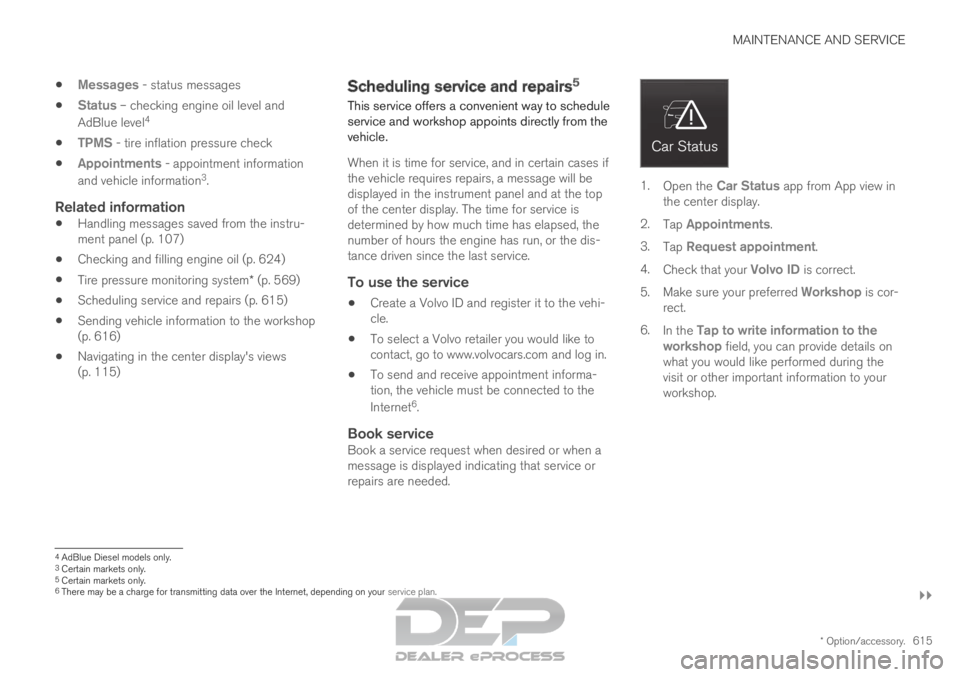
Open the Car Status app from App view in
the center display.
2. Tap Appointments.
3. Tap Request appointment.
4. Check that your Volvo ID is correct.
5. Make sure your preferred Workshop is cor-
rect.
6. In the Tap to write information to the
workshop field, you can provide details on what you would like performed during the
visit or other important information to your
workshop. 4
AdBlue Diesel models only.
3 Certain markets only.
5 Certain markets only.
6 There may be a charge for transmitting data over the Internet, depending\
on your service plan.
Page 623 of 697
MAINTENANCE AND SERVICE
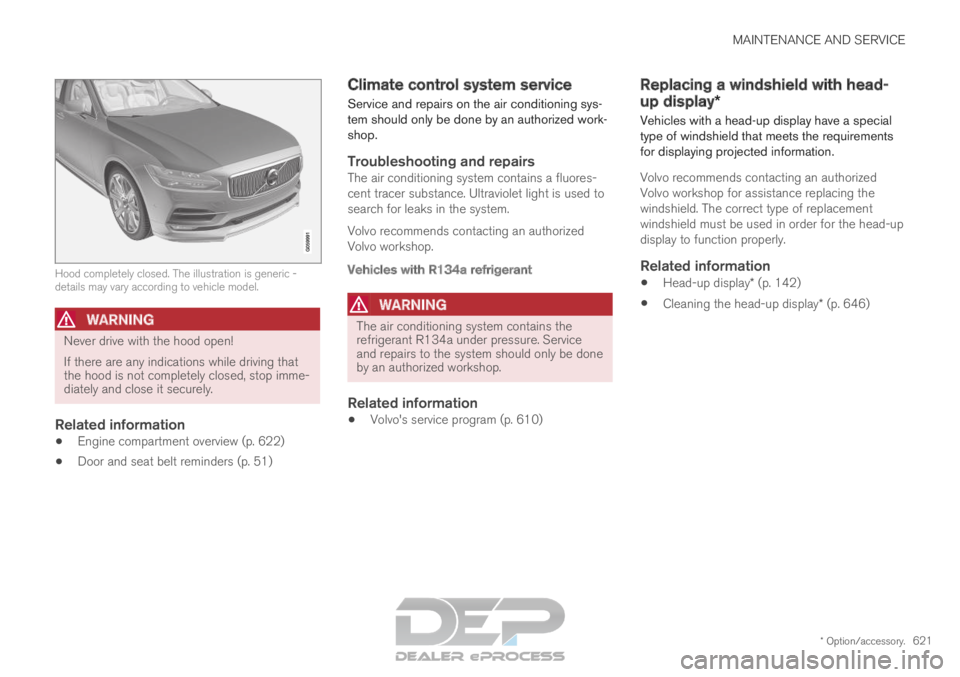
* Option/accessory.621Hood completely closed. The illustration is generic -
details may vary according to vehicle model.
WARNING
Never drive with the hood open!
If there are any indications while driving that
the hood is not completely closed, stop imme-
diately and close it securely.
Related information
Engine compartment overview (p. 622)
Door and seat belt reminders (p. 51) Climate control system service
Service and repairs on the air conditioning sys-
tem should only be done by an authorized work-
shop.
Troubleshooting and repairsThe air conditioning system contains a fluores-
cent tracer substance. Ultraviolet light is used to
search for leaks in the system.
Volvo recommends contacting an authorized
Volvo workshop.
Vehicles with R134a refrigerant
WARNING
The air conditioning system contains the
refrigerant R134a under pressure. Service
and repairs to the system should only be done
by an authorized workshop.
Related information
Volvo's service program (p. 610) Replacing a windshield with head-
up display*
Vehicles with a head-up display have a special
type of windshield that meets the requirements
for displaying projected information.
Volvo recommends contacting an authorized
Volvo workshop for assistance replacing the
windshield. The correct type of replacement
windshield must be used in order for the head-up
display to function properly.
Related information
Head-up display* (p. 142)
Cleaning the head-up display* (p. 646)
Page 624 of 697
MAINTENANCE AND SERVICE
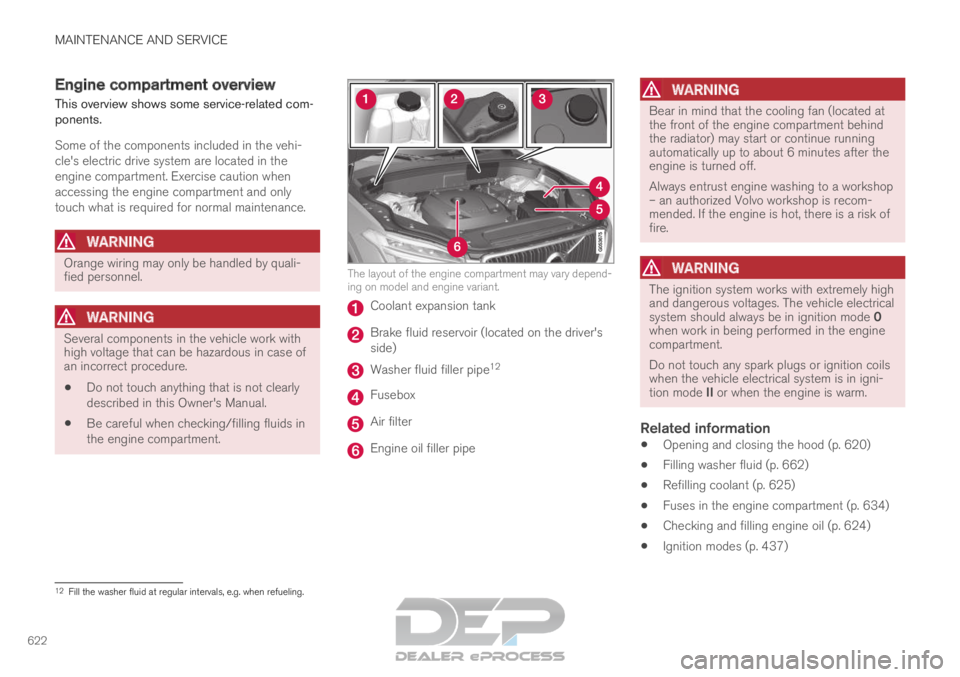
622Engine compartment overview
This overview shows some service-related com-
ponents.
Some of the components included in the vehi-
cle's electric drive system are located in the
engine compartment. Exercise caution when
accessing the engine compartment and only
touch what is required for normal maintenance.
WARNING Orange wiring may only be handled by quali-
fied personnel.
WARNING
Several components in the vehicle work with
high voltage that can be hazardous in case of
an incorrect procedure.
Do not touch anything that is not clearly
described in this Owner's Manual.
Be careful when checking/filling fluids in
the engine compartment. The layout of the engine compartment may vary depend-
ing on model and engine variant.
Coolant expansion tank
Brake fluid reservoir (located on the driver's
side)
Washer fluid filler pipe
12 Fusebox
Air filter
Engine oil filler pipe
WARNING Bear in mind that the cooling fan (located at
the front of the engine compartment behind
the radiator) may start or continue running
automatically up to about 6 minutes after the
engine is turned off.
Always entrust engine washing to a workshop
– an authorized Volvo workshop is recom-
mended. If the engine is hot, there is a risk of
fire.
WARNING
The ignition system works with extremely high
and dangerous voltages. The vehicle electrical
system should always be in ignition mode 0
when work in being performed in the engine
compartment.
Do not touch any spark plugs or ignition coils
when the vehicle electrical system is in igni-
tion mode II or when the engine is warm.
Related information
Opening and closing the hood (p. 620)
Filling washer fluid (p. 662)
Refilling coolant (p. 625)
Fuses in the engine compartment (p. 634)
Checking and filling engine oil (p. 624)
Ignition modes (p. 437) 12
Fill the washer fluid at regular intervals, e.g. when refueling.