cooling VOLVO XC90 TWIN ENGINE 2019 User Guide
[x] Cancel search | Manufacturer: VOLVO, Model Year: 2019, Model line: XC90 TWIN ENGINE, Model: VOLVO XC90 TWIN ENGINE 2019Pages: 697, PDF Size: 10.33 MB
Page 387 of 697
DRIVER SUPPORT
385
Related information
Steering assistance at risk of collision
(p. 380)
Steering assistance during collision risks
from oncoming traffic (p. 383) Limitations of steering assistance
during collision risks from
oncoming traffic
The function may have limited functionality in
certain situations and not intervene, e.g.:
for smaller vehicles such as motorcycles
on roads that do not have clear lane mark-
ings
if more than half of your vehicle has moved
into the adjacent lane
outside the speed range 60-140 km/h
(37-87 mph)
when the power steering works at reduced
power - e.g. during cooling due to overheat-
ing (see section "Speed-dependent steering
force").
Functionality may also be reduced in other situa-
tions, such as:
road work
winter driving conditions
narrow roads
poor road surfaces
a very sporty driving style
bad weather with reduced visibility.
In these demanding driving conditions, the func-
tion may not be able to properly assist the driver. In these situations, it is recommended that it is
turned off.
NOTE The function uses the vehicle's combined
camera and radar unit, which has certain gen-
eral limitations; see sections "Camera limita-
tions" and "Radar sensor limitations".
Related information
Steering assistance at risk of collision
(p. 380)
Steering assistance during collision risks
from oncoming traffic (p. 383)
Speed-dependent steering wheel resistance
(p. 278)
Camera limitations (p. 338)
Radar sensor limitations (p. 333)
Page 389 of 697
DRIVER SUPPORT
}}
* Option/accessory. 387
Activating/deactivating Steering
assistance during collision risks
from behind*
The driver can choose to have this function On
or Off.
Use this button in the center
display's Function view to turn
the function On and Off.
NOTEWhen the Collision avoidance assistance
function is deactivated, all subfunctions of the
following are deactivated:
Steering assistance at risk of run-off
Steering assistance at risk of head-on
collision
Steering assistance during collision risks
from behind*
Although it is possible to deactivate the func-
tion, the driver is advised to keep it activated
since it can help improve driving safety in
most cases.
Related information
Steering assistance at risk of collision
(p. 380)
Steering assistance during collision risks
from behind* (p. 386) Limitations of steering assistance
during collision risks from behind
The function may have limited functionality in
certain situations and not intervene, e.g.:
for smaller vehicles such as motorcycles
if more than half of your vehicle has moved
into the adjacent lane
on roads/lanes with indistinct or no side lane
markings
outside the speed range 60-140 km/h
(37-87 mph)
when the power steering works at reduced
power - e.g. during cooling due to overheat-
ing (see section "Speed-dependent steering
force").
Functionality may also be reduced in other situa-
tions, such as:
road work
winter driving conditions
narrow roads
poor road surfaces
a very sporty driving style
bad weather with reduced visibility.
In these demanding driving conditions, the func-
tion may not be able to properly assist the driver.
In these situations, it is recommended that it is
turned off.
Page 414 of 697

||DRIVER SUPPORT
412
The parking sequence is cancelledA parking sequence will be cancelled if:
the driver moves the steering wheel
the vehicle's speed exceeds 7 km/h (4 mph)
the driver taps
Cancel in the center display
when the anti-lock brakes or the Electronic
stability control are engaged - e.g. when a
wheel loses grip on a slippery road
when the power steering works at reduced
power - e.g. during cooling due to overheat-
ing (see section "Speed-dependent steering
force").
A message in the center display will explain why
the parking sequence was cancelled.
CAUTION Under certain circumstances, PAP may not be
able to find parking spaces – one reason may
be that the sensors are disrupted by external
sound sources that emit the same ultrasonic
frequencies that the system works with.
Examples of such sources include horns, wet
tires on asphalt, pneumatic brakes, exhaust
noise from motorcycles, etc.
NOTE Dirt, ice and snow covering the sensors
reduce their function and can make measure-
ment impossible.
Driver responsibilityThe driver should keep in mind that PAP is a
parking aid ‒ not an infallible fully automatic sys-
tem. The driver must always be prepared to take
control and cancel a parking sequence if neces-
sary.
There are a number of things to keep in mind
when parking, including:
The driver is always responsible for determin-
ing if the space suggested by PAP is suita-
ble for parking.
Do not use PAP when using snow chains or
a temporary spare tire.
Do not use PAP if there are any objects pro-
truding from the vehicle.
Heavy rain or snowfall may inhibit PAP's abil-
ity to accurately measure a parking space.
While searching and measuring the parking
space, PAP may be unable to detect objects
located far into the space.
PAP may not suggest parking spaces on
narrow streets if it does not detect sufficient
space for maneuvering the vehicle.
Use approved tires 126
inflated to the correct
tire pressure because this affects PAP's abil-
ity to provide parking assistance.
PAP's function is based on the way the vehi-
cles are parked behind and in front of your
parking space. If they are, for example,
parked too close to the curb, there is a risk
that your vehicle's tires or wheel rims could
be damaged by the curb during the parking
procedure.
Perpendicular parking spaces may not be
detected or may be suggested unnecessarily
if a parked vehicle is sticking out more than
other parked vehicles.
PAP is intended to provide parking assis-
tance on straight streets, not sections of
street with sharp curves or bends. Always
make sure that your vehicle is parallel to rel-
evant parking spaces when PAP is measur-
ing the parking space.
CAUTION Switching to another approved wheel and/or
tire dimension could change the tire circum-
ference, which would then require the PAP
system to be updated. Consult a workshop –
an authorized Volvo workshop is recom-
mended.
126
"Approved tires" refers to tires of the same type and make as the vehicl\
e's original, factory-installed tires.
Page 426 of 697

||HYBRID INFORMATION
424
Open the charger door and remove the
charging socket's protective cover. Push the
charging handle all the way into the vehicle's
socket.
3.
The charging cable handle will lock into
place and charging will begin within
5 seconds. When charging starts, the green
LED light in the charging socket will begin to
flash. The approximate remaining charging
time or the charging status will be displayed
in the instrument panel.
Charging may be temporarily interrupted if
the vehicle is unlocked:
and a door is open ‒ charging will restart
within a few minutes.
if no door is opened ‒ the vehicle will
automatically relock. Charging will resume
after 1 minute.
CAUTION Never detach the charging cable from the
120/240 V outlet (AC, alternating current)
while charging is in progress – the
120/240 V outlet could be damaged in such
circumstances. Always interrupt charging first
and then disconnect the charging cable – first
from the vehicle's charging socket and then
from the 120/240 V outlet.
During charging, condensation from the air con-
ditioning may form under the vehicle. This is nor-
mal and is caused by the hybrid battery cooling.
Related information
Charging the hybrid battery (p. 417)
Opening and closing the charging socket
cover (p. 422)
Charging status in the vehicle's charging
socket (p. 425)
Charging status in the instrument panel
(p. 427)
Charging status in the charging cable's
charging module (p. 425)
Stopping hybrid battery charging (p. 429)
Page 457 of 697
STARTING AND DRIVING
}}
455
Available drive modes
WARNING Keep in mind that the vehicle does not emit
any engine noise when using the electric
motor and may therefore be difficult to detect
for children, pedestrians, cyclists or animals.
This is particularly true at low speeds, e.g. in
parking lots.
WARNING
Do not leave the vehicle in an unventilated
area with a drive mode activated and the com-
bustion engine switched off. The engine will
start automatically if the charge level in the
hybrid battery is low and the resulting exhaust
gases can be very harmful to people and ani-
mals.
HYBRID
This is the default mode in which the electric
motor and combustion engine work together.
The vehicle starts in Hybrid mode. The control
system uses both the electric motor and the gas-
oline engine - separately or in tandem - and cal-
culates optimal utilization with regard to perform-
ance, fuel consumption and comfort. At high
speeds, ground clearance is automatically low-
ered 3
to reduce air resistance. Driving capacity on
the electric motor alone is determined by factors such as the hybrid battery's charge level, the
need for heat/cooling in the passenger compart-
ment, etc.
If there is sufficient charge in the battery, it is
possible to drive solely on electric power. When
the accelerator pedal is pressed, only the electric
motor will be activated until the battery reaches a
certain charge level. Above this level, the current
in the battery cannot supply the power requested
by the accelerator pedal and the combustion
engine will start.
When the hybrid battery's charge level is low, the
combustion engine will start more frequently to
save the remaining current in the battery. Charge
the hybrid battery from a 120-240 volt outlet
using a charging cable, or activate
Charge in
Function view to reset the option of only using
the electric motor.
This drive mode is designed for low energy con-
sumption with an optimized mix between the
electric motor and gasoline engine, without com-
promising on climate comfort or driving experi-
ence. When faster acceleration is requested by
the driver, the electric driveline will be utilized to
help provide maximum additional power. The
vehicle also monitors the driving conditions and
automatically engages all-wheel drive if neces-
sary. All-wheel drive and extra electric power are
always available regardless of the battery's
charging status.
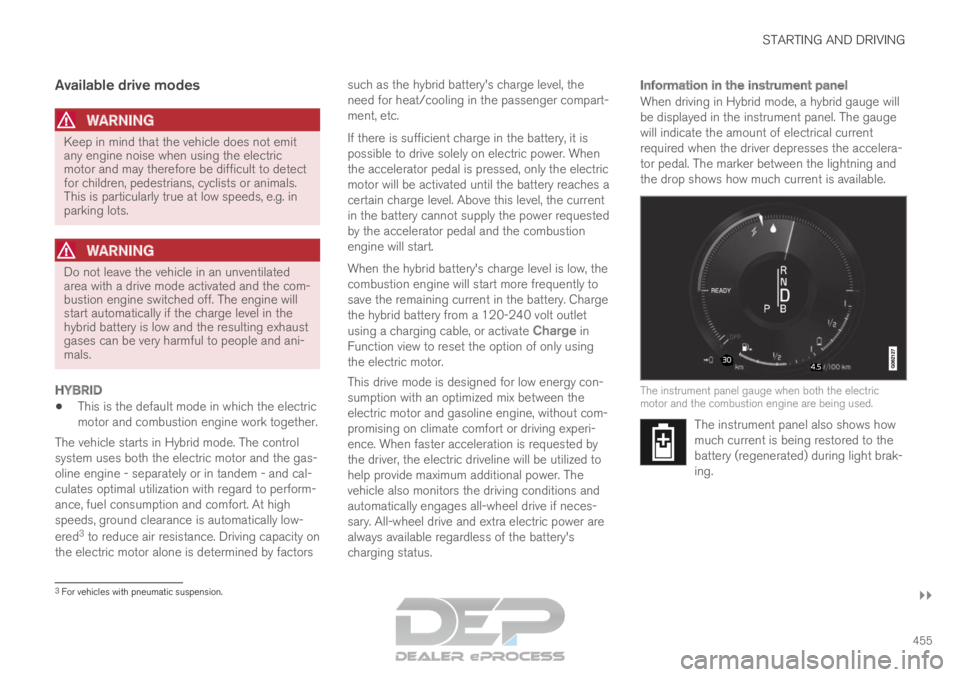
Information in the instrument panel
When driving in Hybrid mode, a hybrid gauge will
be displayed in the instrument panel. The gauge
will indicate the amount of electrical current
required when the driver depresses the accelera-
tor pedal. The marker between the lightning and
the drop shows how much current is available. The instrument panel gauge when both the electric
motor and the combustion engine are being used.
The instrument panel also shows how
much current is being restored to the
battery (regenerated) during light brak-
ing. 3
For vehicles with pneumatic suspension.
Page 480 of 697
||STARTING AND DRIVING
478
NOTE
When switching to higher octane fuel or
changing gasoline brands, it may be neces-
sary to fill the tank more than once before a
difference in engine operation is noticeable.
Fuel FormulationsDo not use gasoline that contains lead or manga-
nese as a knock inhibitor, and do not use lead
additives. Besides damaging the exhaust emis-
sion control systems on your vehicle, lead has
been strongly linked to certain forms of cancer.
Many fuels contain benzene as a solvent.
Unburned benzene has been strongly linked to
certain forms of cancer. If you live in an area
where you must fill your own gas tank, take pre-
cautions. These may include:
standing upwind away from the filler nozzle
while refueling
refueling only at gas stations with vapor
recovery systems that fully seal the mouth of
the filler neck during refueling
wearing neoprene gloves while handling a
fuel filler nozzle.
Use of AdditivesWith the exception of gas line antifreeze during
winter months, do not add solvents, thickeners, or other store-bought additives to your vehicle's
fuel, cooling, or lubricating systems. Overuse may
damage your engine, and some of these additives
contain organically volatile chemicals. Do not
needlessly expose yourself to these chemicals.
WARNING Never carry a cell phone that is switched on
while refueling your vehicle. If the phone rings,
this may cause a spark that could ignite gaso-
line fumes, resulting in fire and injury.
WARNING
Carbon monoxide is a poisonous, colorless,
and odorless gas. It is present in all exhaust
gases. If you ever smell exhaust fumes inside
the vehicle, make sure the passenger com-
partment is ventilated, and immediately return
the vehicle to a trained and qualified Volvo
service technician for correction.
Demanding drivingIn demanding driving conditions, such as when
towing a trailer or driving in hot weather or for
prolonged periods at high altitudes, it may be a
good idea to switch to a higher-octane fuel (AKI
6
91 or higher) or to switch to another brand of
gasoline in order to fully utilize the vehicle's
engine capacity and optimize traction.
Related information
Fuel (p. 476)
Emission controls (p. 479) 6
AKI (Anti Knock Index) is an average value of RON (Research Octane Nu\
mber) and MON (Motor Octane Number) - (RON)+(MON)/2
Page 481 of 697
STARTING AND DRIVING
}}
479
Emission controls
Three-way catalytic converter
Keep your engine properly tuned. Certain
engine malfunctions, particularly involving the
electrical, fuel or distributor ignition systems,
may cause unusually high three-way catalytic
converter temperatures. Do not continue to
operate your vehicle if you detect engine
misfire, noticeable loss of power or other
unusual operating conditions, such as engine
overheating or backfiring. A properly tuned
engine will help avoid malfunctions that
could damage the three-way catalytic con-
verter.
Do not park your vehicle over combustible
materials, such as grass or leaves, which can
come into contact with the hot exhaust sys-
tem and cause such materials to ignite under
certain wind and weather conditions.
Excessive starter cranking (in excess of one
minute), or an intermittently firing or flooded
engine can cause three-way catalytic con-
verter or exhaust system overheating.
Remember that tampering or unauthorized
modifications to the engine, the Engine Con-
trol Module, or the vehicle may be illegal and
can cause three-way catalytic converter or
exhaust system overheating. This includes:
altering fuel injection settings or compo-
nents, altering emission system components or location or removing components, and/or
repeated use of leaded fuel.NOTE Unleaded fuel is required for vehicles with
three-way catalytic converters.
Heated oxygen sensorsThe heated oxygen sensors monitor the oxygen
content of the exhaust gases. Readings are fed
into a control module that continuously monitors
engine functions and controls fuel injection. The
ratio of fuel to air into the engine is continuously
adjusted for efficient combustion to help reduce
harmful emissions.
Related information
Octane rating (p. 477)
Fuel (p. 476) Overheating of engine and
transmission
In demanding driving conditions, such as driving
in mountainous areas or hot weather, there is a
risk of the engine or transmission overheating,
especially when carrying heavy loads.
Engine power may be temporarily limited.
Remove any auxiliary lights mounted in front
of the grille when driving in hot weather.
If the temperature in the engine's cooling
system becomes too high, a warning symbol
will appear in the instrument panel along with
the message Engine temperature High
temperature Stop safely. Pull over to a safe location and let the engine idle for a few
minutes to cool down.
If the message
Engine temperature High
temperature Turn off engine or Engine
coolant Level low, turn off engine is dis- played, stop the vehicle and turn off the
engine.
If the transmission begins to overheat, an
alternative gear shifting program will be
selected. An integrated protective function
will also be activated, the warning symbol will
illuminate and the message Transmission
warm
Reduce speed to lower
temperature or Transmission hot Stop
safely, wait for cooling will be displayed in the instrument panel. Follow the recommen-
dations given by reducing speed or stopping
Page 482 of 697
||STARTING AND DRIVING
480
the vehicle safely and letting the engine idle
for a few minutes to let the transmission
cool.
If the vehicle begins to overheat, the air con-
ditioning may be temporarily switched off.
After a prolonged period of driving in
demanding conditions, do not turn off the
engine immediately after stopping.
NOTE It is normal for the engine's cooling fan to
operate for a short time after the engine is
switched off.
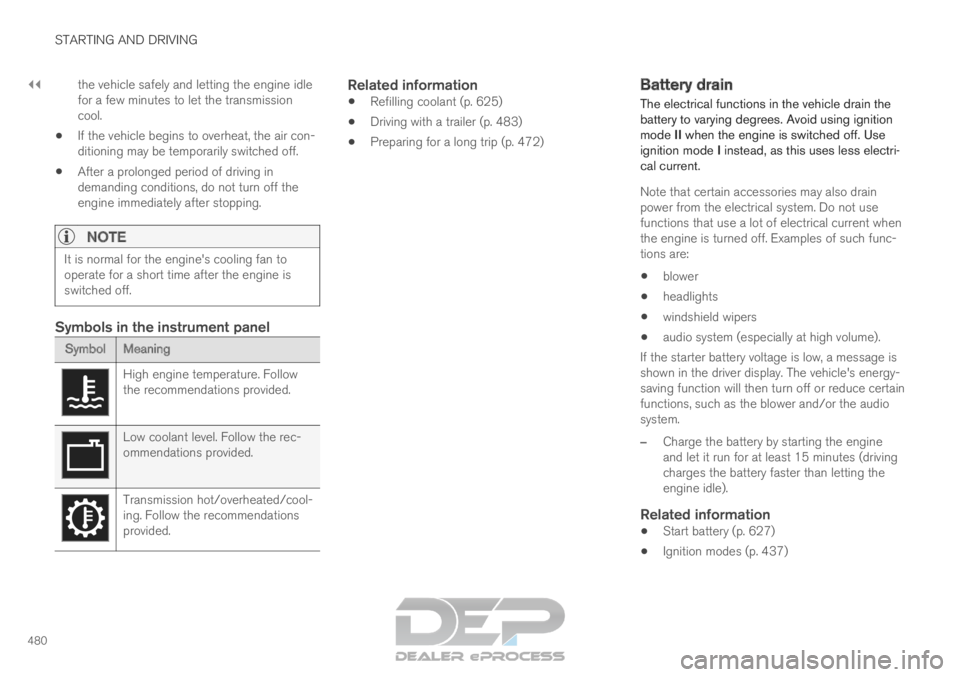
Symbols in the instrument panel
Symbol
Meaning High engine temperature. Follow
the recommendations provided.
Low coolant level. Follow the rec-
ommendations provided.
Transmission hot/overheated/cool-
ing. Follow the recommendations
provided.
Related information
Refilling coolant (p. 625)
Driving with a trailer (p. 483)
Preparing for a long trip (p. 472) Battery drain
The electrical functions in the vehicle drain the
battery to varying degrees. Avoid using ignition
mode II when the engine is switched off. Use
ignition mode I instead, as this uses less electri-
cal current.
Note that certain accessories may also drain
power from the electrical system. Do not use
functions that use a lot of electrical current when
the engine is turned off. Examples of such func-
tions are: blower
headlights
windshield wipers
audio system (especially at high volume).
If the starter battery voltage is low, a message is
shown in the driver display. The vehicle's energy-
saving function will then turn off or reduce certain
functions, such as the blower and/or the audio
system.
– Charge the battery by starting the engine
and let it run for at least 15 minutes (driving
charges the battery faster than letting the
engine idle).
Related information
Start battery (p. 627)
Ignition modes (p. 437)
Page 599 of 697

LOADING, STORAGE AND PASSENGER COMPARTMENT
597
WARNING
Only use accessories that are not dam-
aged or malfunctioning. The accessories
must be designed for 120 V and 60 Hz,
with plugs intended for the outlet. The
accessories must be CE marked, UL
marked or have an equivalent safety
marking.
New let outlets, plugs or accessories
come into contact with water or another
fluid. Do not touch or use the outlet if it
appears damaged or has been in contact
with water or another fluid.
Do not connect power strips, adapters or
extension cords to the outlet has this
could cause the outlet's safety functions
to malfunction.
The outlet is equipped with a pet guard.
Make sure that no one picks at or dam-
ages the outlet in such a way that the
guard is disabled. Children should not be
left unsupervised in the vehicle when the
outlet is active.
Failure to follow the above could lead to
severe or fatal electrical shocks.
Related information
Electrical outlets (p. 594)
Passenger compartment interior (p. 592) Using the glove compartment
The glove compartment is located on the pas-
senger side. The glove compartment can be
used to store the Owner's Manual, maps, etc.
There is also room for a pen and a card holder. Glove compartment and opening button on the center
console.
The glove compartment is opened by pressing
the opening button in the center console.
Locking and unlocking the glove box
The glove compartment can be locked ("private
locking") when the vehicle is left at a workshop,
hotel, etc. When private locking is activated, the
tailgate is also locked.
Using the glove box as a cooled area
The glove compartment can be used to cool e.g.
drinks or food. Cooling is possible when the cli-mate system is active (i.e. when the ignition is in
mode II or when the engine is running).
The illustration is generic – the design may vary.
Activate cooling
Deactivate cooling
– Activate or deactivate cooling by moving the
control as far as possible toward the passen-
ger compartment/glove compartment.
Related information
Passenger compartment interior (p. 592)
Private Locking (p. 271)
Page 624 of 697
MAINTENANCE AND SERVICE
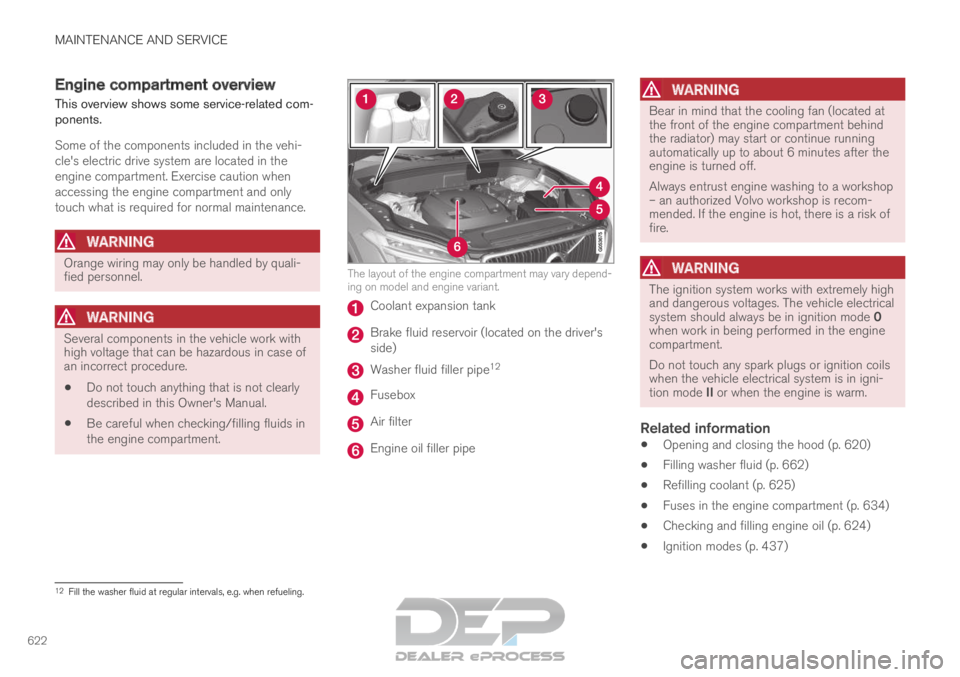
622Engine compartment overview
This overview shows some service-related com-
ponents.
Some of the components included in the vehi-
cle's electric drive system are located in the
engine compartment. Exercise caution when
accessing the engine compartment and only
touch what is required for normal maintenance.
WARNING Orange wiring may only be handled by quali-
fied personnel.
WARNING
Several components in the vehicle work with
high voltage that can be hazardous in case of
an incorrect procedure.
Do not touch anything that is not clearly
described in this Owner's Manual.
Be careful when checking/filling fluids in
the engine compartment. The layout of the engine compartment may vary depend-
ing on model and engine variant.
Coolant expansion tank
Brake fluid reservoir (located on the driver's
side)
Washer fluid filler pipe
12 Fusebox
Air filter
Engine oil filler pipe
WARNING Bear in mind that the cooling fan (located at
the front of the engine compartment behind
the radiator) may start or continue running
automatically up to about 6 minutes after the
engine is turned off.
Always entrust engine washing to a workshop
– an authorized Volvo workshop is recom-
mended. If the engine is hot, there is a risk of
fire.
WARNING
The ignition system works with extremely high
and dangerous voltages. The vehicle electrical
system should always be in ignition mode 0
when work in being performed in the engine
compartment.
Do not touch any spark plugs or ignition coils
when the vehicle electrical system is in igni-
tion mode II or when the engine is warm.
Related information
Opening and closing the hood (p. 620)
Filling washer fluid (p. 662)
Refilling coolant (p. 625)
Fuses in the engine compartment (p. 634)
Checking and filling engine oil (p. 624)
Ignition modes (p. 437) 12
Fill the washer fluid at regular intervals, e.g. when refueling.