traction control VOLVO XC90 TWIN ENGINE 2019 User Guide
[x] Cancel search | Manufacturer: VOLVO, Model Year: 2019, Model line: XC90 TWIN ENGINE, Model: VOLVO XC90 TWIN ENGINE 2019Pages: 697, PDF Size: 10.33 MB
Page 466 of 697
STARTING AND DRIVING
* Option/accessory.
464 Leveling control settings*
Turn off leveling control before lifting the vehicle
with a jack to help avoid problems with the
pneumatic suspension.
The vehicle can be lowered or raised to make it
easier to load or for passengers to get in and
out.
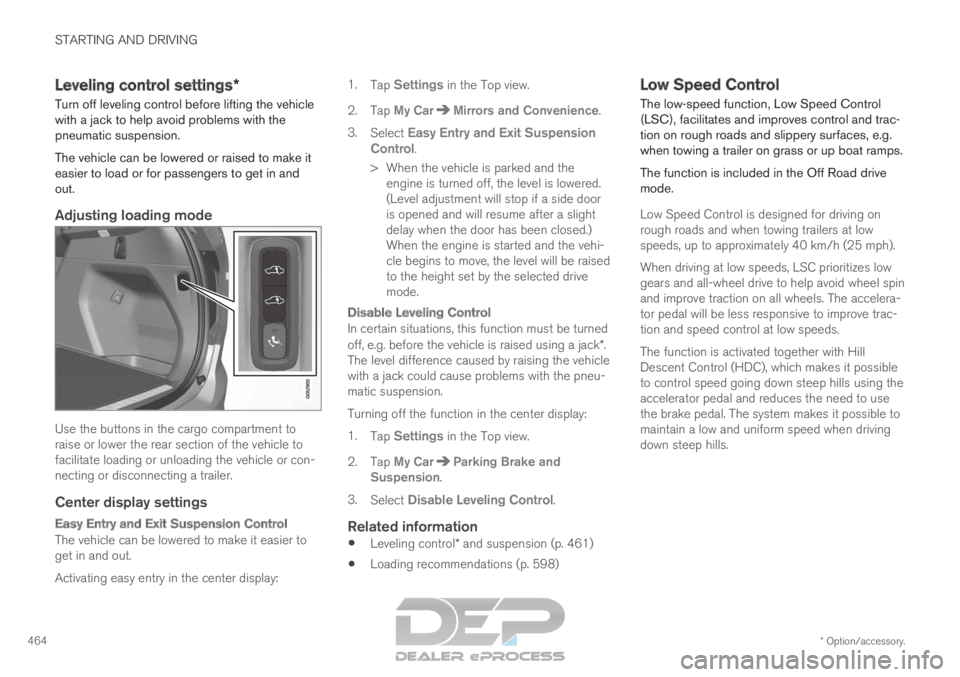
Adjusting loading mode Use the buttons in the cargo compartment to
raise or lower the rear section of the vehicle to
facilitate loading or unloading the vehicle or con-
necting or disconnecting a trailer.
Center display settings
Easy Entry and Exit Suspension Control
The vehicle can be lowered to make it easier to
get in and out.
Activating easy entry in the center display: 1.
Tap Settings in the Top view.
2.
Tap My Car Mirrors and Convenience
.
3. Select Easy Entry and Exit Suspension
Control.
>
When the vehicle is parked and the
engine is turned off, the level is lowered.
(Level adjustment will stop if a side door
is opened and will resume after a slight
delay when the door has been closed.)
When the engine is started and the vehi-
cle begins to move, the level will be raised
to the height set by the selected drive
mode.
Disable Leveling Control
In certain situations, this function must be turned
off, e.g. before the vehicle is raised using a jack*.
The level difference caused by raising the vehicle
with a jack could cause problems with the pneu-
matic suspension.
Turning off the function in the center display:
1. Tap Settings in the Top view.
2.
Tap My Car Parking Brake and
Suspension .
3. Select Disable Leveling Control.
Related information
Leveling control* and suspension (p. 461)
Loading recommendations (p. 598) Low Speed Control
The low-speed function, Low Speed Control
(LSC), facilitates and improves control and trac-
tion on rough roads and slippery surfaces, e.g.
when towing a trailer on grass or up boat ramps.
The function is included in the Off Road drive
mode.
Low Speed Control is designed for driving on
rough roads and when towing trailers at low
speeds, up to approximately 40 km/h (25 mph).
When driving at low speeds, LSC prioritizes low
gears and all-wheel drive to help avoid wheel spin
and improve traction on all wheels. The accelera-
tor pedal will be less responsive to improve trac-
tion and speed control at low speeds.
The function is activated together with Hill
Descent Control (HDC), which makes it possible
to control speed going down steep hills using the
accelerator pedal and reduces the need to use
the brake pedal. The system makes it possible to
maintain a low and uniform speed when driving
down steep hills.
Page 468 of 697
STARTING AND DRIVING
466Hill Descent Control
The function for assisting when driving downhill,
Hill Descent Control (HDC), is a low-speed
function with increased engine braking. The
function makes it possible to increase or
decrease the vehicle's speed on steep downhill
gradients by only using the accelerator pedal,
without applying the brakes.
The function is included in the Off Road drive
mode.
HDC is designed for driving on rough roads at
low speeds and downhill gradients with slippery
or otherwise difficult road surfaces. The driver
does not need to use the brake pedal but can
instead focus on steering.
WARNING
HDC is only intended to be a supplementary
braking aid and it does not function in all sit-
uations.
The driver is always ultimately responsible for
operating the vehicle in a safe manner.
FunctionHill Descent Control allows the vehicle to move
forward or backward at very low speeds assisted
by the brake system. The driver can increase the
speed by pressing the accelerator pedal. When
the accelerator pedal is released, the vehicle will
return to very low speed regardless of how steep the hill is and without the brakes needing to be
applied. The brake lights will illuminate when the
function is activated.
The driver can brake to stop or slow the vehicle
at any time by depressing the brake pedal.
HDC is activated along with Low Speed Control
(LSC), which facilitates and improves traction and
control on rough and slippery surfaces. The sys-
tem is intended to be used at low speeds, up to
approximately 40 km/h (25 mph).
To keep in mind when using HDC
If the function is switched off while driving on
a steep downhill gradient, braking effect will
be gradually reduced.
HDC can be used in gear positions D and R,
and in manual gears 1 or 2.
It is not possible to manually shift to third
gear or higher when HDC is active.
NOTE When LSC with HDC is activated in the OFF
ROAD drive mode, the feel of the accelerator
pedal and engine response will change.
NOTE
This drive mode is not designed to be used
for normal street driving.
NOTE The function is deactivated when driving at
high speeds and must be reactivated at lower
speeds if so desired.
Related information
Activating and deactivating Hill Descent Con-
trol using the function button (p. 467)
Changing drive mode (p. 459)
Low Speed Control (p. 464)
All Wheel Drive (AWD) (p. 452)
Page 475 of 697
STARTING AND DRIVING
473
Slippery driving conditionsFor optimal traction and roadholding, Volvo rec-
ommends using snow tires on all wheels when-
ever there is a risk of snow or ice on the road.
NOTECertain countries require use of winter tires
by law. Not all countries permit the use of
studded tires.
Practice driving on slippery surfaces under con-
trolled conditions to learn how the vehicle reacts.
Related information
Snow tires (p. 581)
Snow chains (p. 581)
Braking on salted roads (p. 441)
Braking on wet roads (p. 441)
Filling washer fluid (p. 662)
Start battery (p. 627)
Replacing windshield wiper blades (p. 660)
Changing rear window wipers (p. 659)
Refilling coolant (p. 625) Driving through standing water
Driving the vehicle through a deep pool of stand-
ing water on a water-covered roadway is called
fording. This must be done with great caution.
To prevent damage to the vehicle when driving
through water (e.g. on flooded roads):
Do not drive in water higher than the floor of
the vehicle. If possible, check the depth of
the water at its deepest point before driving
through it. Be particularly careful when driv-
ing through flowing water.
Always select the
Off Road drive mode
before driving in water to ensure the gasoline
engine is running.
Do not drive faster than walking speed.
Do not stop the vehicle in the water. Drive
carefully forward or back the vehicle out of
the water.
Remember that waves created by passing
vehicles could cause the water level to rise
above the vehicle's floor level.
Avoid driving through salt water to help avoid
the risk of corrosion.
CAUTION Parts of the vehicle (e.g. engine, transmission,
driveline, electrical components, etc.) can be
damaged if the vehicle is driven through water
higher than its floor level. Damage to any
components caused by flooding, vapor lock or
insufficient oil is not covered under warranty.
If the engine stalls while the vehicle is in
water, do not attempt to restart it. Have the
vehicle towed on the bed of a tow truck to a
workshop - an authorized Volvo workshop is
recommended.
CAUTION
Because it can be difficult to determine the
water depth, avoid driving through standing or
running water.
When you have passed the water, press lightly on
the brake pedal and check that the brakes are
functioning properly. Water, mud, slush, etc. can
make the brake linings slippery, resulting in
delayed braking effect.
If the vehicle is equipped with a trailer coupling
contact, clean the contact after driving in water or
mud.
Related information
Recovery (p. 489)
Low Speed Control (p. 464)
Page 480 of 697
||STARTING AND DRIVING
478
NOTE
When switching to higher octane fuel or
changing gasoline brands, it may be neces-
sary to fill the tank more than once before a
difference in engine operation is noticeable.
Fuel FormulationsDo not use gasoline that contains lead or manga-
nese as a knock inhibitor, and do not use lead
additives. Besides damaging the exhaust emis-
sion control systems on your vehicle, lead has
been strongly linked to certain forms of cancer.
Many fuels contain benzene as a solvent.
Unburned benzene has been strongly linked to
certain forms of cancer. If you live in an area
where you must fill your own gas tank, take pre-
cautions. These may include:
standing upwind away from the filler nozzle
while refueling
refueling only at gas stations with vapor
recovery systems that fully seal the mouth of
the filler neck during refueling
wearing neoprene gloves while handling a
fuel filler nozzle.
Use of AdditivesWith the exception of gas line antifreeze during
winter months, do not add solvents, thickeners, or other store-bought additives to your vehicle's
fuel, cooling, or lubricating systems. Overuse may
damage your engine, and some of these additives
contain organically volatile chemicals. Do not
needlessly expose yourself to these chemicals.
WARNING Never carry a cell phone that is switched on
while refueling your vehicle. If the phone rings,
this may cause a spark that could ignite gaso-
line fumes, resulting in fire and injury.
WARNING
Carbon monoxide is a poisonous, colorless,
and odorless gas. It is present in all exhaust
gases. If you ever smell exhaust fumes inside
the vehicle, make sure the passenger com-
partment is ventilated, and immediately return
the vehicle to a trained and qualified Volvo
service technician for correction.
Demanding drivingIn demanding driving conditions, such as when
towing a trailer or driving in hot weather or for
prolonged periods at high altitudes, it may be a
good idea to switch to a higher-octane fuel (AKI
6
91 or higher) or to switch to another brand of
gasoline in order to fully utilize the vehicle's
engine capacity and optimize traction.
Related information
Fuel (p. 476)
Emission controls (p. 479) 6
AKI (Anti Knock Index) is an average value of RON (Research Octane Nu\
mber) and MON (Motor Octane Number) - (RON)+(MON)/2
Page 498 of 697
AUDIO, MEDIA AND INTERNET
* Option/accessory.
496 Audio, media and Internet
The audio and media system consists of a media
player and a radio. A cellular phone can also be
connected through Bluetooth to use hands-free
functions or play music in the vehicle. When the
vehicle is connected to the Internet, it is also
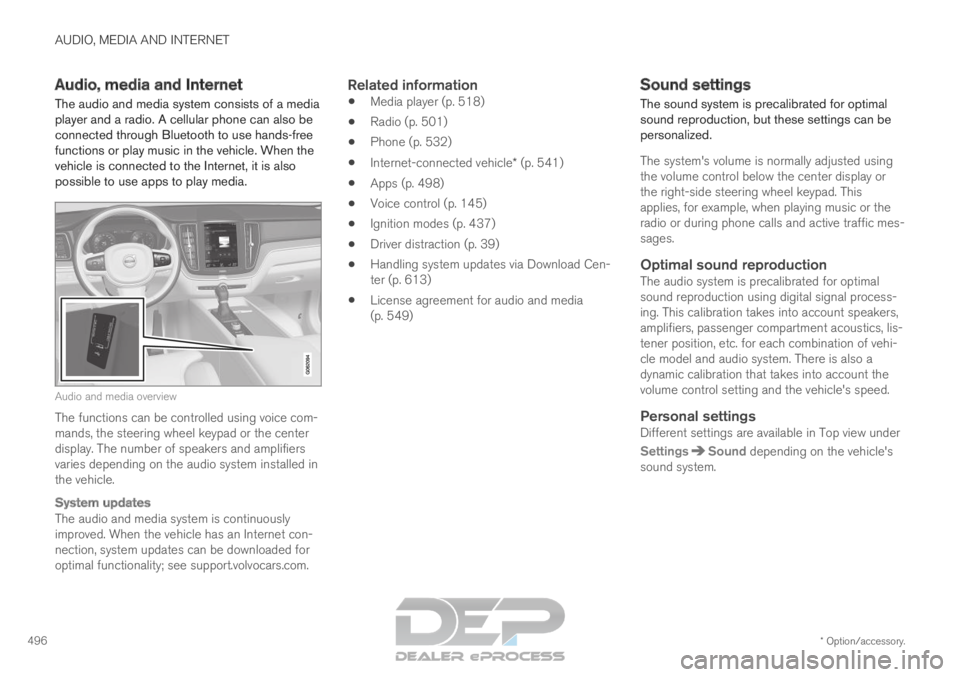
possible to use apps to play media. Audio and media overview
The functions can be controlled using voice com-
mands, the steering wheel keypad or the center
display. The number of speakers and amplifiers
varies depending on the audio system installed in
the vehicle.
System updates
The audio and media system is continuously
improved. When the vehicle has an Internet con-
nection, system updates can be downloaded for
optimal functionality; see support.volvocars.com.
Related information
Media player (p. 518)
Radio (p. 501)
Phone (p. 532)
Internet-connected vehicle* (p. 541)
Apps (p. 498)
Voice control (p. 145)
Ignition modes (p. 437)
Driver distraction (p. 39)
Handling system updates via Download Cen-
ter (p. 613)
License agreement for audio and media
(p. 549) Sound settings
The sound system is precalibrated for optimal
sound reproduction, but these settings can be
personalized.
The system's volume is normally adjusted using
the volume control below the center display or
the right-side steering wheel keypad. This
applies, for example, when playing music or the
radio or during phone calls and active traffic mes-
sages.
Optimal sound reproductionThe audio system is precalibrated for optimal
sound reproduction using digital signal process-
ing. This calibration takes into account speakers,
amplifiers, passenger compartment acoustics, lis-
tener position, etc. for each combination of vehi-
cle model and audio system. There is also a
dynamic calibration that takes into account the
volume control setting and the vehicle's speed.
Personal settingsDifferent settings are available in Top view under
Settings Sound
depending on the vehicle's
sound system.
Page 562 of 697
WHEELS AND TIRES
560Tires
The function of the tires is to carry loads, provide
traction on road surfaces, reduce vibrations and
protect the wheels from wear.
The tires significantly influence the vehicle's driv-
ing characteristics. The type, dimensions, tire
pressure and speed rating have a considerable
impact on how the vehicle performs.
Your vehicle is equipped with tires according to
the vehicle's tire information placard on the B-pil-
lar (the structural member at the side of the vehi-
cle, at the rear of the driver's door opening).
WARNING A damaged tire could cause the driver to lose
control of the vehicle.
CAUTION Some Volvo models are equipped with an
Ultra High Performance tire and wheel com-
bination designed to provide maximum dry
pavement performance with consideration for
hydroplaning resistance. They may be more
susceptible to road hazard damage and,
depending on driving conditions, may achieve
a tread life of less than 30,000 km (20,000
miles). Even if this vehicle is equipped with
Volvo's advanced AWD or stability system,
these tires are not designed for winter driving,
and should be replaced with winter tires when
weather conditions dictate.
The tires have good road holding characteristics
and offer good handling on dry and wet surfaces.
It should be noted however that the tires have
been developed to give these features on snow/
ice-free surfaces.
Most models are equipped with "all-season" tires,
which provide a somewhat higher degree of road-
holding on slippery road surfaces than tires with-
out the "all-season" rating. However, for optimal
roadholding on icy or snow-covered roads, Volvo
recommends snow tires on all four wheels.
When replacing tires, be sure that the new tires
are the same size designation, type (radial) and
preferably from the same manufacturer, on allfour wheels. Otherwise there is a risk of altering
the vehicle's roadholding and handling characte-
ristics.
Recommended tiresOn delivery, the car is equipped with Volvo origi-
nal tires that have the VOL
1
marking on the side
of the tires. These tires have been designed spe-
cifically for your vehicle. It is therefore important
when replacing tires that the new tires have this
same marking to help maintain the vehicle's driv-
ing characteristics, comfort and fuel consumption.
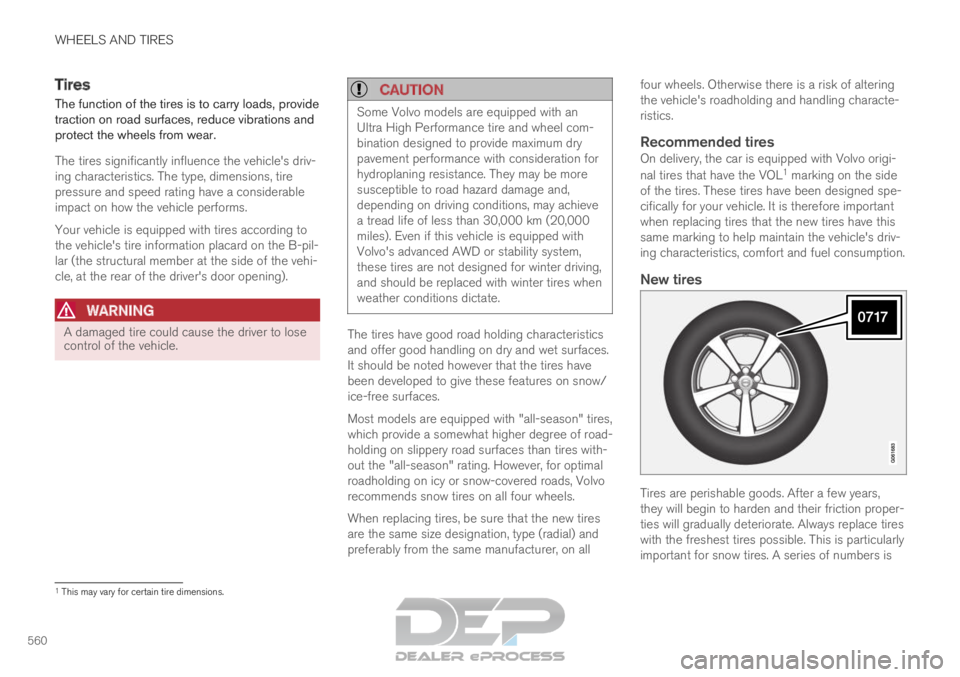
New tires Tires are perishable goods. After a few years,
they will begin to harden and their friction proper-
ties will gradually deteriorate. Always replace tires
with the freshest tires possible. This is particularly
important for snow tires. A series of numbers is
1
This may vary for certain tire dimensions.
Page 568 of 697
WHEELS AND TIRES
566Uniform Tire Quality Grading
ALL PASSENGER VEHICLE TIRES MUST
CONFORM TO FEDERAL SAFETY REQUIRE-
MENTS IN ADDITION TO THESE GRADES.
Quality grades can be found, where applica-
ble, on the tire sidewall between the tread
shoulder and maximum section width. For
example:
Treadwear 200 Traction AA Temperature A
TREADWEARThe treadwear grade is a comparative rating
based on the wear rate of the tire when tested
under controlled conditions on a specified gov-
ernment test course. For example, a tire graded
150 would wear one and one half (1 ½) times as
well on the government course as a tire graded
100. The relative performance of tires depends
upon the actual conditions of their use, however,
and many depart significantly from the norm due
to variation in driving habits, maintenance practi-
ces and differences in road characteristics and
climate.
TRACTIONThe traction grades, from highest to lowest, are
AA, A, B, and C, as measured under controlled
conditions on specified government test surfaces
of asphalt and concrete. A tire marked C may
have poor traction performance.
WARNING The traction grade assigned to this tire is
based on braking (straight-ahead) traction
tests and is not a measure of cornering (turn-
ing) traction.
TEMPERATUREThe temperature grades are A (the highest), B,
and C, representing the tire's resistance to the
generation of heat and its ability to dissipate heat
when tested under controlled conditions on a
specified indoor laboratory test wheel. Sustained
high temperature can cause the material of the
tire to degenerate and reduce tire life, and exces-
sive temperature can lead to sudden tire failure.
The grade C corresponds to a minimum level of
performance that all passenger vehicle tires must
meet under the Federal Motor Safety Standard
No. 109. Grades B and A represent higher levels
of performance on the laboratory test wheel than
the minimum required by law.
WARNING
The temperature grade for this tire is estab-
lished for a tire that is properly inflated and
not overloaded. Excessive speed, under-infla-
tion, or excessive loading, either separately or
in combination, can cause heat buildup and
tire failure.
Related information
Tires (p. 560)
Tire sidewall designations (p. 564)
Page 682 of 697

INDEX
680Cooling system
overheating 479
Corner Traction Control 279
Corrosion protection 656
Covering cargo compartment 602
Crash, see Collision 42
Crash event data 33
Cross Traffic Alert – CTA 360, 361, 362, 363
Cruise control 291, 292 manage speed 292, 293
temporary deactivation 294, 295
turn off 296
CTA – Cross Traffic Alert 360, 361, 362, 363
Curb weight 669
Customer Privacy Policy 35
CZIP (Clean Zone Interior Package) 208
D Data
recording
33
transferring between vehicle and work-
shop 612
Data sharing 548
Daytime running lights 154 Decals
location
664
Defrosting 222
Detection of cyclist 345
Dimensions 667
Dipstick, electronic 624
Direction of rotation 562
Display driver information 84
Display lighting 164
Distance Alert 296, 297, 298
limitations 299
DivX ®
523
Door mirrors 169, 171
compass 493
dimming 170
outer 169, 171
power folding 171
resetting 171
store position 186, 187
Driveline transmission 448
Drive mode 454
changing 459
Driver Alert Control 370
operation 371, 372
Driver Alert Control limitations 372 Driver performance
92, 93
Driver profile 136
edit 137, 138, 139
select 137
Driver support system 278
Drive systems 453
Driving cooling system 479
with a trailer 483
Driving economy 467
Driving through standing water 473
driving with a trailer towball load 670
towing capacity 670
E Economical driving
467
Electrical outlet
594
use 596
Electrical system 627
Electric drive motor specifications 671
electric motor 453 Driving 469
Range 469
Page 690 of 697
INDEX
688Sound settings 496, 539
phone 540
playing media 518, 520
text message 539
Spare tire 579, 580
Speed camera 368
Speed Limiter 283, 286, 287, 291 getting started 284
shut down 286
temporary deactivation 285
Speed symbols, tires 564
Spin control 279
Stability and traction control system 279, 282 operation 281
Stability system 279
Stains 645, 647, 648, 649, 650
Start and lock system type designations 257
Start battery 481, 627 overload 480
Start engine 434
Starting the engine after a collision 62
Start the vehicle 434
Steel cargo grid 604 Steering assistance at risk of colli-
sion
380, 381, 382, 383, 384, 385, 386, 387, 389
Steering assistance at risk of rear-end col-
lision 386, 387
Steering power level, see Steering wheel
resistance 278
Steering resistance at risk of head-on colli-
sion 383, 384, 385
Steering wheel 200, 201
heating 219, 220
keypad 200
paddle 200
steering wheel adjustment 201
Steering wheel keypad 200
Steering wheel paddles 451
Steering wheel resistance, speed-depend-
ent 278
Stone chips and scratches 657, 658
Storage compartments 592
center console 593
glove compartment 597
sun visor 598
Sunroof pinch protection 166 Sun shade
panoramic roof 172, 175
pinch protection 166
rear door 169
Sun visor 598
mirror lighting 163
Symbols indicator symbols 94
warning symbols 97
Symbols and messages Adaptive Cruise Control 314
center display's status bar 124
Collision warner with auto-brake 353
hybrid-related 430
parking climate 238
Symbols and messages for Assistance at
risk of collision 389
system updates 613
T Tailgate
locking/unlocking
247, 261
open/close with foot movement 270
power 266
unlocking from inside 264
Technician certification 38
Page 691 of 697
INDEX
689
Temperature
adjusting 228, 229
perceived 205
Temperature monitoring 422
Temporary spare spare tire 579
Temporary tire sealing system execution, checking 583
Inflating tires 587
location 582
overview 582
sealing compound 582
Terms and conditions services 35
users 548
Tire dimensions 564, 574
Tire pressure monitoring calibrating 571
Tires 560 direction of rotation 562
glossary of terms 563
inflation pressure table 675
mounting 578
pressure 675
removal 576
rotation 561
specifications 564, 675
storage 560
tire pressure monitoring 569 tire sealing
582
Tread depth
581
tread wear indicator 563
winter tires 581
Tire sealing system 583
Tire tread 563
Tools 574
Top tether anchors (child restraint sys-
tems) 72
Top view 132
Total airing function 243
Towbar 482 removable, attaching, installing, mount-
ing 482
removable, removing, detaching 482
Towing 487
Towing capacity and towball load 670
Towing eyelet 488
TPMS - Tire Pressure Monitoring System 569
Traction control 279
Traffic information 504
Trailer 485 driving with a trailer 483
Lamps 486
swaying 485 Trailer Stability Assist
485
trailer 485
Trailer stabilizer 280
Trailer towing trailer hitch 482
Transmission 448 automatic 449
Transmission fluid grade 673
Travel Link 512 Fuel 516
Notifications 515
Sports 517
weather 514
Tread depth 563, 581
Tread wear indicator 563
Trip computer 89, 91
Trip odometer 89
Trip odometer resetting 92
Trip statistics 92
Troubleshooting Adaptive Cruise Control 312
Troubleshooting the camera sensor 338, 341
TSA - Trailer Stability Assist 280, 485
Tunnel detection 155
Turn off engine 436