trailer VOLVO XC90 TWIN ENGINE 2019 User Guide
[x] Cancel search | Manufacturer: VOLVO, Model Year: 2019, Model line: XC90 TWIN ENGINE, Model: VOLVO XC90 TWIN ENGINE 2019Pages: 697, PDF Size: 10.33 MB
Page 361 of 697

DRIVER SUPPORT
* Option/accessory.359
BLIS messages
A number of messages related to BLIS 81
may
be displayed in the instrument panel.
Some examples of symbols and messages are shown in the table below. Message
Meaning
Blind spot sensor
Service required The system is not functioning as intended. Contact a workshop ‒ an authorized Volvo workshop is recommended.
Blind spot system off
Trailer attached BLIS and CTA have been deactivated because a trailer has been connected \
to the vehicle's electrical system.A text message can be erased by briefly pressing
the
button in the center of the right-side
steering wheel keypad.
If the message persists: Contact a workshop ‒ an
authorized Volvo workshop is recommended.
Related information
BLIS* (p. 355) 81
Blind Spot Information
Page 364 of 697
||DRIVER SUPPORT
* Option/accessory.
362
Examples of further limitations
Dirt, ice and snow covering the sensors may
reduce functionality and prevent the system
from providing warnings. For additional infor-
mation, see the section "Recommended
maintenance for Cross Traffic Alert".
CTA is automatically deactivated if a trailer,
bicycle holder or similar is connected to the
vehicle's electrical system.
For CTA to function optimally, bicycle hold-
ers, luggage racks or similar should not be
mounted on the vehicle's towbar.
Related information
Cross Traffic Alert* (p. 360)
Recommended maintenance for Cross
Traffic Alert (p. 362) Recommended maintenance for
Cross Traffic Alert
For optimal performance, it is important to
keep the areas in front of the sensors clean.
Do not attach any objects, tape or decals to
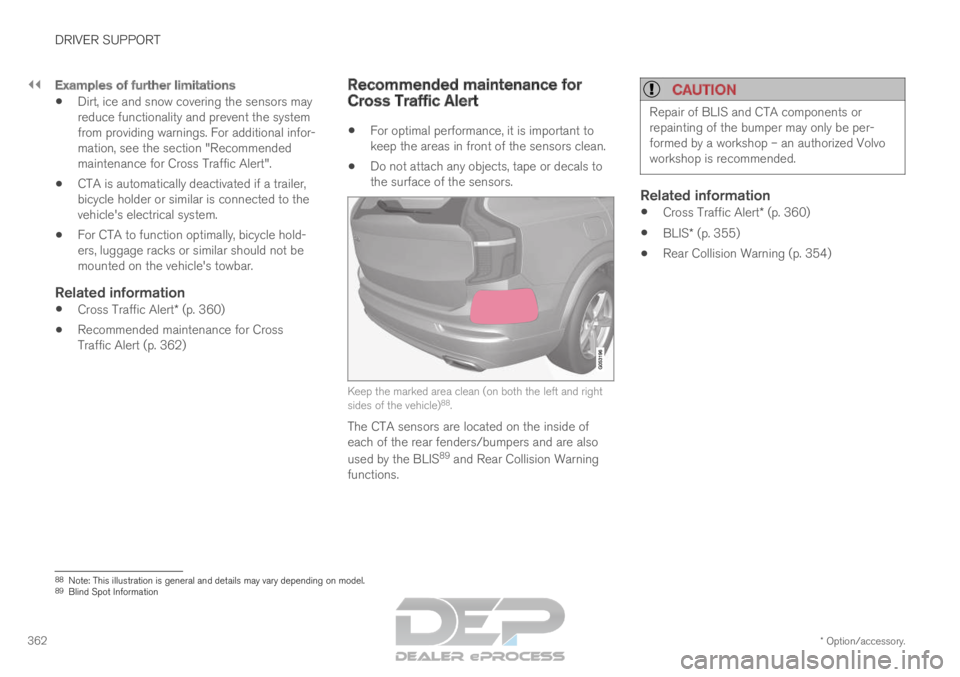
the surface of the sensors. Keep the marked area clean (on both the left and right
sides of the vehicle)
88
.
The CTA sensors are located on the inside of
each of the rear fenders/bumpers and are also
used by the BLIS 89
and Rear Collision Warning
functions.
CAUTION Repair of BLIS and CTA components or
repainting of the bumper may only be per-
formed by a workshop – an authorized Volvo
workshop is recommended.
Related information
Cross Traffic Alert* (p. 360)
BLIS* (p. 355)
Rear Collision Warning (p. 354) 88
Note: This illustration is general and details may vary depending on mod\
el.
89 Blind Spot Information
Page 365 of 697

DRIVER SUPPORT
* Option/accessory.363
Cross Traffic Alert messages
A number of messages related to CTA 90
may be
displayed in the instrument panel.
Some examples of symbols and messages are shown in the table below. Message
Meaning
Blind spot sensor
Service required The system is not functioning as intended. Contact a workshop ‒ an authorized Volvo workshop is recommended.
Blind spot system off
Trailer attached BLIS and CTA have been deactivated because a trailer has been connected \
to the vehicle's electrical system.A text message can be erased by briefly pressing
the
button in the center of the right-side
steering wheel keypad.
If the message persists: Contact a workshop ‒ an
authorized Volvo workshop is recommended.
Related information
Cross Traffic Alert* (p. 360) 90
Cross Traffic Alert
Page 371 of 697

DRIVER SUPPORT
}}
* Option/accessory. 369
For more information on Speed Warnings in con-
junction with speed cameras, also see “Road
Sign Information with Speed Warning and Set-
tings” and “Road Sign Information limitations”.
NOTE
For an audible alert to be provided if the
speed is exceeded, the
Speed Limit
Warning function must be activated and
the
Road Sign Audio Warning sub-
function must be On. Audible alerts are
provided if the vehicle's speed exceeds
the speed displayed by RSI in the instru-
ment panel.
It is possible to receive an audible alert
for speed cameras regardless of the vehi-
cle's speed, whether or not the speed
limit is exceeded, and even if the
Road
Sign Audio Warning function is deacti- vated: See heading "Speed camerawarning On/Off" in section "Road Sign
Information with Speed Warning and set-
tings" and select Speed Camera Audio
Warning there.
Information about speed cameras on the
navigation map is not available for all
markets/areas.
Related information
Road Sign Information* (p. 364)
Road Sign Information with Speed Warning
and Settings (p. 367)
Road Sign Information limitations (p. 369) Road Sign Information limitations
Road Sign Information (RSI 101
) functionality may
be reduced in certain situations.
RSI could have reduced functionality due to e.g.:
faded road signs
signs located in a curve in the road
twisted or damaged signs
signs positioned high above the road
fully/partially obstructed or poorly positioned
signs
signs partially or fully covered by frost, snow
and/or dirt
digital road maps 102
that are outdated, incor-
rect or do not contain speed information 103
.
NOTE Certain types of bike carriers that are con-
nected to the trailer socket may be interpre-
ted as a connected trailer by the RSI function.
In such cases, the instrument panel may indi-
cate incorrect speed information.
101
Road Sign Information
102 Vehicles equipped with Sensus Navigation*.
103 Map data and speed information is not available for all areas.
Page 393 of 697
DRIVER SUPPORT
}}
391
Park Assist front, rear and sides
Park Assist has different parameters depending
on which part of the vehicle is approaching an
obstacle.
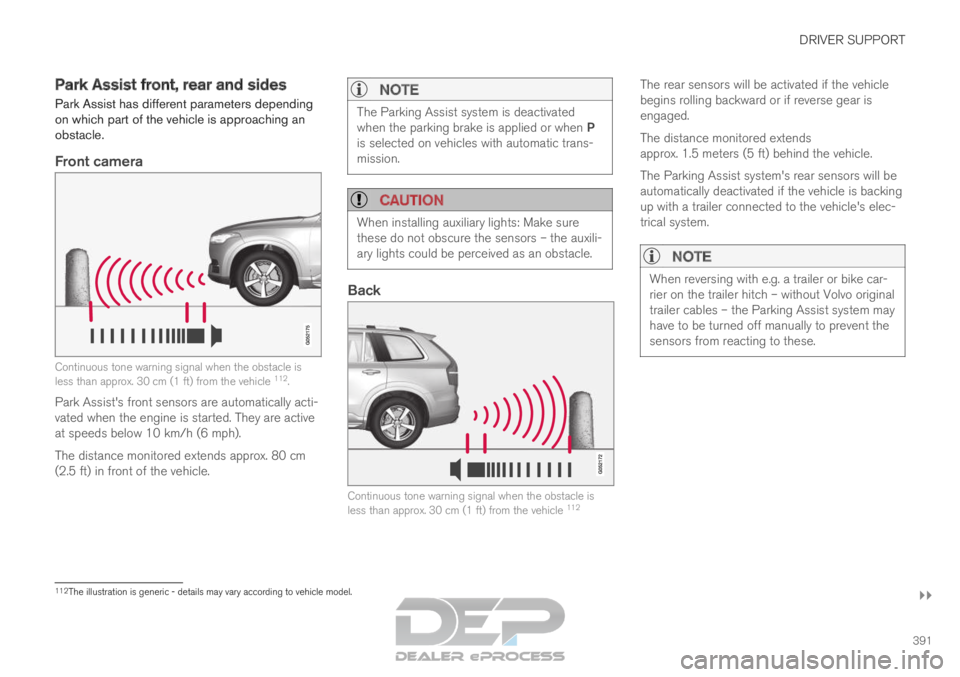
Front camera Continuous tone warning signal when the obstacle is
less than approx. 30 cm (1 ft) from the vehicle
112
.
Park Assist's front sensors are automatically acti-
vated when the engine is started. They are active
at speeds below 10 km/h (6 mph).
The distance monitored extends approx. 80 cm
(2.5 ft) in front of the vehicle.
NOTE The Parking Assist system is deactivated
when the parking brake is applied or when P
is selected on vehicles with automatic trans-
mission.
CAUTION
When installing auxiliary lights: Make sure
these do not obscure the sensors – the auxili-
ary lights could be perceived as an obstacle.
Back
Continuous tone warning signal when the obstacle is
less than approx. 30 cm (1 ft) from the vehicle
112The rear sensors will be activated if the vehicle
begins rolling backward or if reverse gear is
engaged.
The distance monitored extends
approx. 1.5 meters (5 ft) behind the vehicle.
The Parking Assist system's rear sensors will be
automatically deactivated if the vehicle is backing
up with a trailer connected to the vehicle's elec-
trical system.
NOTE
When reversing with e.g. a trailer or bike car-
rier on the trailer hitch – without Volvo original
trailer cables – the Parking Assist system may
have to be turned off manually to prevent the
sensors from reacting to these.
112
The illustration is generic - details may vary according to vehicle mode\
l.
Page 395 of 697
DRIVER SUPPORT
* Option/accessory.393
Park Assist limitations
Park Assist may not be able to detect all condi-
tions in all situations and functionality may there-
fore be limited in certain cases.
The driver should be aware of the following limi-
tations for Park Assist:
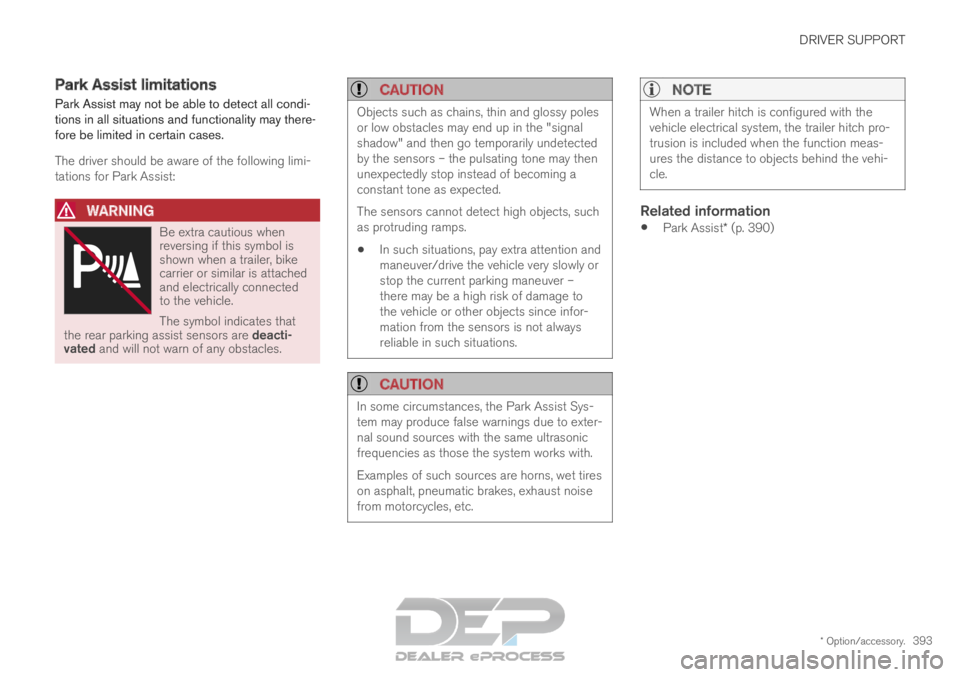
WARNING Be extra cautious when
reversing if this symbol is
shown when a trailer, bike
carrier or similar is attached
and electrically connected
to the vehicle.
The symbol indicates that
the rear parking assist sensors are deacti-
vated and will not warn of any obstacles.
CAUTION Objects such as chains, thin and glossy poles
or low obstacles may end up in the "signal
shadow" and then go temporarily undetected
by the sensors – the pulsating tone may then
unexpectedly stop instead of becoming a
constant tone as expected.
The sensors cannot detect high objects, such
as protruding ramps.
In such situations, pay extra attention and
maneuver/drive the vehicle very slowly or
stop the current parking maneuver –
there may be a high risk of damage to
the vehicle or other objects since infor-
mation from the sensors is not always
reliable in such situations.
CAUTION In some circumstances, the Park Assist Sys-
tem may produce false warnings due to exter-
nal sound sources with the same ultrasonic
frequencies as those the system works with.
Examples of such sources are horns, wet tires
on asphalt, pneumatic brakes, exhaust noise
from motorcycles, etc.
NOTE When a trailer hitch is configured with the
vehicle electrical system, the trailer hitch pro-
trusion is included when the function meas-
ures the distance to objects behind the vehi-
cle.
Related information
Park Assist* (p. 390)
Page 401 of 697

DRIVER SUPPORT
}}
399
Park Assist Camera trajectory lines
The Park Assist Camera uses trajectory lines
and fields on the screen to indicate the vehicle's
position in relation to its immediate surround-
ings. Example
119
of trajectory lines.
The trajectory lines show the anticipated trajec-
tory for the vehicle's outermost dimensions based
on the current position of the steering wheel to help simplify parallel parking, backing into tight
spaces or attaching a trailer.
The lines on the screen are projected as if they
were painted lines on the ground behind the
vehicle and are directly affected by the way in
which the steering wheel is turned. This enables
the driver to see path the vehicle will take, even if
he/she turns the steering wheel.
These lines also indicate the outermost limits that
any object (towbar, rearview mirrors, corners of
the body, etc.) extends out from the vehicle.
NOTE
When reversing with a trailer that is not
electrically connected to the vehicle, the
screen guide lines show the path the
vehicle will take – not the trailer.
The screen does not show guide lines
when a trailer is electrically connected to
the vehicle's electrical system.
Guide lines are not shown when zooming
in.
CAUTION
Bear in mind that when the rearward
camera view is selected, the screen only
shows the area behind the vehicle – pay
attention to the sides and front of the
vehicle when steering while reversing.
The same applies to the reverse – pay
attention to what is happening with the
rear parts of the vehicle when the front
camera view is selected.
Note that the guide lines show the short-
est path – pay extra attention to ensure
that the vehicle sides do not come in
contact with/travel over anything when
steering while driving forward or that the
vehicle front moves toward/over anything
when steering while reversing. 119
The illustration is generic - details may vary according to vehicle mode\
l.
Page 402 of 697

||DRIVER SUPPORT
* Option/accessory.
400
Trajectory lines in 360° view* 360° view with trajectory lines
119
.
In the 360° view, trajectory lines are shown
behind, in front of, or to the sides of the vehicle,
depending on the direction of travel.
When driving forward: Front lines
When backing up: Side lines and rear lines.
When the front or rear camera is selected, the
trajectory lines will be shown regardless of the
vehicle's direction of travel.
With a side camera selected, the trajectory lines
will only be shown if the vehicle is backing up.Trajectory lines for a towbar* Towbar with trajectory line
119
. Towbar
- activate trajectory lines for towbar.
Zoom
- zoom in/out.The camera can help make hitching a trailer eas-
ier by showing an anticipated trajectory line for
the towbar's path toward the trailer.
1.
Tap Towbar (1).
>
The trajectory line for the towbar's antici-
pated path toward the vehicle will appear
and the vehicle's trajectory lines will dis-
appear.
Trajectory lines cannot be displayed for
both the vehicle and the towbar at the
same time.
2. Tap Zoom (2) for a close-up view for more
precise maneuvering.
>
The camera will zoom in.
Related information
Park Assist Camera* (p. 396) 119
The illustration is generic - details may vary according to vehicle mode\
l.
Page 405 of 697

DRIVER SUPPORT
}}
403
Park Assist Camera limitations
The Park Assist Camera may not be able to
detect all conditions in all situations and func-
tionality may therefore be limited.
The driver should be aware of the following limi-
tations for the Park Assist Camera:
WARNING Be extra cautious when
reversing if this symbol is
shown when a trailer, bike
carrier or similar is attached
and electrically connected
to the vehicle.
The symbol indicates that
the rear parking assist sensors are deacti-
vated and will not warn of any obstacles.
NOTE A bike carrier and other accessories mounted
on the rear of the vehicle can obscure the
camera's view.
Blind sectors There are "blind" sectors between the cameras' fields of
vision.
With 360° view selected, objects/obstacles may
not be detected if they are located in the "joints"
where the edges of the individual camera views
meet.
WARNING
Even if it seems as though only a fairly small
section of the screen image is obstructed, this
may mean that a relatively large sector is hid-
den and obstacles there may not be detected
until they are very near the vehicle.
Defective cameraIf a camera sector is dark and
contains this symbol, this indi-
cates that the camera is not
functioning properly.
See the following illustration for
an example. The vehicle's left-side camera is malfunctioning.
Dark camera sector
A dark camera sector may also be displayed in
the following situations, but without the defective
camera symbol:
a door is open
the tailgate is open
a rearview mirror is folded in
Lighting conditionsThe camera image is automatically adjusted
according to the current lighting conditions. This
Page 410 of 697

DRIVER SUPPORT
408Parking with Park Assist Pilot
Park Assist Pilot (PAP 124
) helps the driver park
using three different steps. The function can also
help the driver pull out of a parking space.
NOTE The PAP function measures the space and
steers the vehicle – the driver's role is to:
keep close watch of the area around the
vehicle
follow the instructions on the center dis-
play
change gears (reverse/forward) – a
"ping" sound indicates when the driver
should change gears
regulate and maintain a safe speed
apply the brakes and stop. Information about the actions required by the
driver are provided in the center display using
symbols, graphics and/or text.
PAP can be activated if the following criteria have
been met after the engine is started:
No trailer is hitched to the vehicle
Your vehicle's speed is lower than 30 km/h
(20 mph).
NOTE The distance between the vehicle and parking
spots should be 0.5-1.5 meters (1.6-5.0 ft)
when PAP is looking for parking.
ParkingPAP parks the vehicle using the following steps:
1. The system searches for and measures
potential parking spaces.
2. The vehicle is steered while it is backing into the parking space.
3. The vehicle is positioned in the parking space (the driver may be prompted to shift
gears).
Searching for and measuring potential
parking spots
The function can be activated
in the center display's Function
view.
It can also be accessed from
the camera views. Parallel parking overview.
Perpendicular parking overview.
To do so: 124
Park Assist Pilot