height VOLVO XC90 TWIN ENGINE 2019 Owner's Manual
[x] Cancel search | Manufacturer: VOLVO, Model Year: 2019, Model line: XC90 TWIN ENGINE, Model: VOLVO XC90 TWIN ENGINE 2019Pages: 697, PDF Size: 10.33 MB
Page 466 of 697
STARTING AND DRIVING
* Option/accessory.
464 Leveling control settings*
Turn off leveling control before lifting the vehicle
with a jack to help avoid problems with the
pneumatic suspension.
The vehicle can be lowered or raised to make it
easier to load or for passengers to get in and
out.
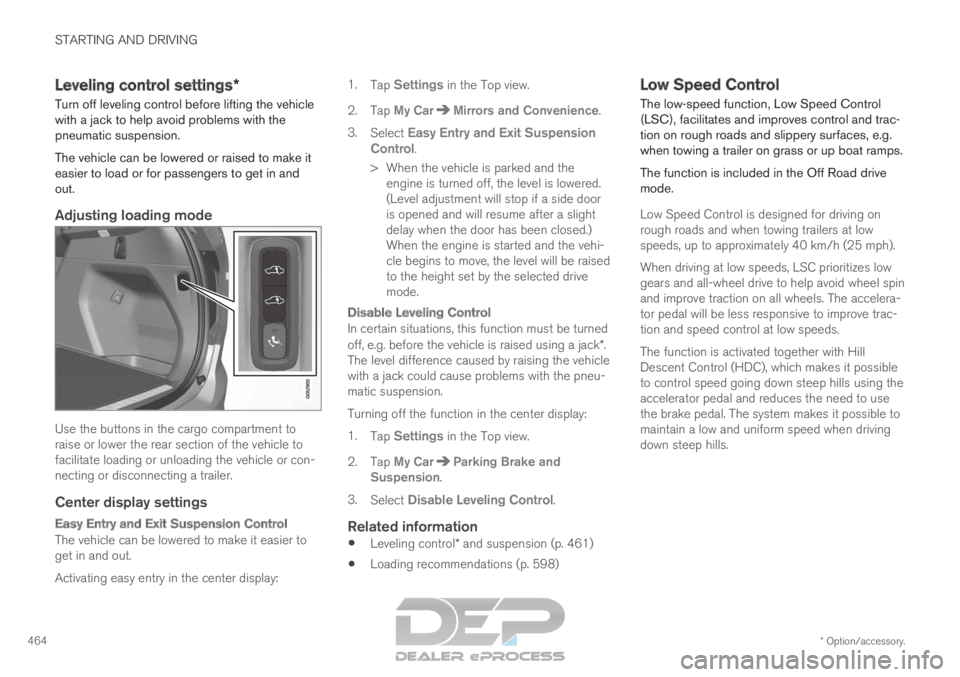
Adjusting loading mode Use the buttons in the cargo compartment to
raise or lower the rear section of the vehicle to
facilitate loading or unloading the vehicle or con-
necting or disconnecting a trailer.
Center display settings
Easy Entry and Exit Suspension Control
The vehicle can be lowered to make it easier to
get in and out.
Activating easy entry in the center display: 1.
Tap Settings in the Top view.
2.
Tap My Car Mirrors and Convenience
.
3. Select Easy Entry and Exit Suspension
Control.
>
When the vehicle is parked and the
engine is turned off, the level is lowered.
(Level adjustment will stop if a side door
is opened and will resume after a slight
delay when the door has been closed.)
When the engine is started and the vehi-
cle begins to move, the level will be raised
to the height set by the selected drive
mode.
Disable Leveling Control
In certain situations, this function must be turned
off, e.g. before the vehicle is raised using a jack*.
The level difference caused by raising the vehicle
with a jack could cause problems with the pneu-
matic suspension.
Turning off the function in the center display:
1. Tap Settings in the Top view.
2.
Tap My Car Parking Brake and
Suspension .
3. Select Disable Leveling Control.
Related information
Leveling control* and suspension (p. 461)
Loading recommendations (p. 598) Low Speed Control
The low-speed function, Low Speed Control
(LSC), facilitates and improves control and trac-
tion on rough roads and slippery surfaces, e.g.
when towing a trailer on grass or up boat ramps.
The function is included in the Off Road drive
mode.
Low Speed Control is designed for driving on
rough roads and when towing trailers at low
speeds, up to approximately 40 km/h (25 mph).
When driving at low speeds, LSC prioritizes low
gears and all-wheel drive to help avoid wheel spin
and improve traction on all wheels. The accelera-
tor pedal will be less responsive to improve trac-
tion and speed control at low speeds.
The function is activated together with Hill
Descent Control (HDC), which makes it possible
to control speed going down steep hills using the
accelerator pedal and reduces the need to use
the brake pedal. The system makes it possible to
maintain a low and uniform speed when driving
down steep hills.
Page 474 of 697
STARTING AND DRIVING
472Preparing for a long trip
It is important to have the vehicle's systems and
equipment checked carefully before driving long
distances.
Check that:
the engine is running properly and that fuel
consumption is normal
there are no leaks (fuel, oil or other fluid)
the brake pedal is functioning optimally
all lights are working ‒ adjust the headlight
height if the vehicle is carrying a heavy load
tire tread depth and air pressure are at cor-
rect levels. Change to snow tires when driv-
ing in areas where there is a risk of snowy or
icy roads
the start battery is sufficiently charged
the wiper blades are in good condition
Related information
Checking tire pressure (p. 567)
Filling washer fluid (p. 662)
Winter driving (p. 472)
Economical driving (p. 467)
Vehicle modem settings (p. 545)
Loading recommendations (p. 598)
Driving with a trailer (p. 483)
Pilot Assist (p. 316)
Speed limiter (p. 283)
Tire sealing system (p. 582) Winter driving
It is important to check the vehicle before driving
in cold/snowy conditions to make sure it can be
driven safely.
Before the cold season arrives: Make sure the engine coolant contains 50%
antifreeze. This mixture helps protect the
engine from frost erosion down to
approx. -35 °C (-31 °F). Do not mix different
types of antifreeze as this could pose a
health risk.
Keep the fuel tank well filled to prevent con-
densation from forming.
Check the viscosity of the engine oil. Oil with
low viscosity (thinner oil) improves cold-
weather starting and reduces fuel consump-
tion when driving with a cold engine.
CAUTION Low-viscosity oil should not be used with hard
driving or in hot weather.
Check the condition and charge level of the
start battery. Cold weather places greater
demands on the start battery and reduces its
capacity.
Use washer fluid containing antifreeze to
help prevent ice from forming in the washer
fluid reservoir.
Page 565 of 697
WHEELS AND TIRES
}}
563
Tread wear indicator
The tread wear indicator shows the status of the
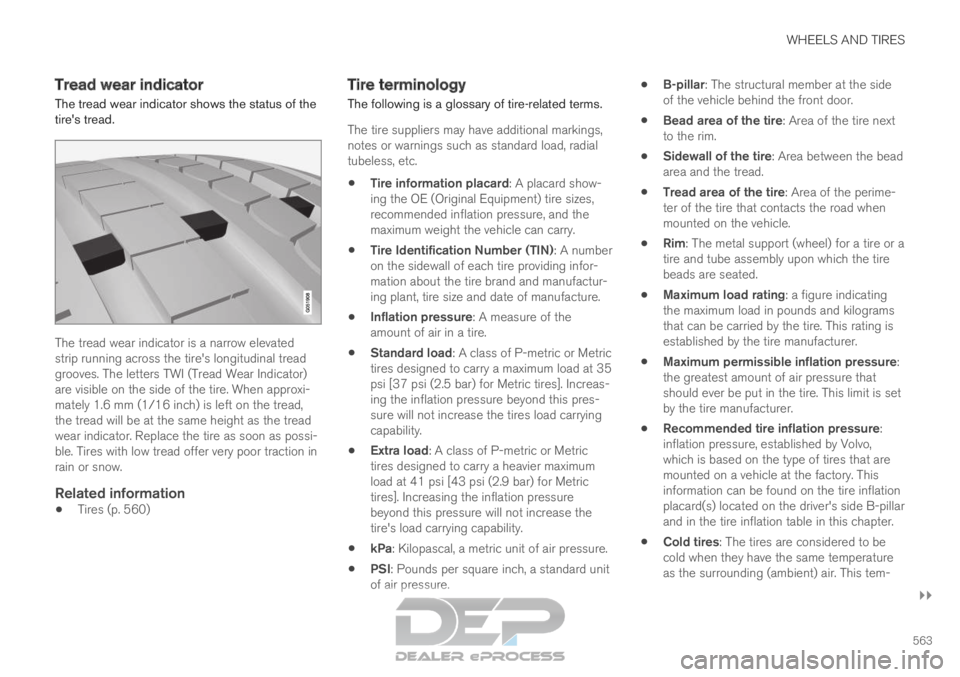
tire's tread. The tread wear indicator is a narrow elevated
strip running across the tire's longitudinal tread
grooves. The letters TWI (Tread Wear Indicator)
are visible on the side of the tire. When approxi-
mately 1.6 mm (1/16 inch) is left on the tread,
the tread will be at the same height as the tread
wear indicator. Replace the tire as soon as possi-
ble. Tires with low tread offer very poor traction in
rain or snow.
Related information
Tires (p. 560) Tire terminology
The following is a glossary of tire-related terms.
The tire suppliers may have additional markings,
notes or warnings such as standard load, radial
tubeless, etc.
Tire information placard: A placard show-
ing the OE (Original Equipment) tire sizes,
recommended inflation pressure, and the
maximum weight the vehicle can carry.
Tire Identification Number (TIN): A number
on the sidewall of each tire providing infor-
mation about the tire brand and manufactur-
ing plant, tire size and date of manufacture.
Inflation pressure: A measure of the
amount of air in a tire.
Standard load: A class of P-metric or Metric
tires designed to carry a maximum load at 35
psi [37 psi (2.5 bar) for Metric tires]. Increas-
ing the inflation pressure beyond this pres-
sure will not increase the tires load carrying
capability.
Extra load: A class of P-metric or Metric
tires designed to carry a heavier maximum
load at 41 psi [43 psi (2.9 bar) for Metric
tires]. Increasing the inflation pressure
beyond this pressure will not increase the
tire's load carrying capability.
kPa: Kilopascal, a metric unit of air pressure.
PSI: Pounds per square inch, a standard unit
of air pressure.
B-pillar: The structural member at the side
of the vehicle behind the front door.
Bead area of the tire: Area of the tire next
to the rim.
Sidewall of the tire: Area between the bead
area and the tread.
Tread area of the tire: Area of the perime-
ter of the tire that contacts the road when
mounted on the vehicle.
Rim: The metal support (wheel) for a tire or a
tire and tube assembly upon which the tire
beads are seated.
Maximum load rating: a figure indicating
the maximum load in pounds and kilograms
that can be carried by the tire. This rating is
established by the tire manufacturer.
Maximum permissible inflation pressure:
the greatest amount of air pressure that
should ever be put in the tire. This limit is set
by the tire manufacturer.
Recommended tire inflation pressure:
inflation pressure, established by Volvo,
which is based on the type of tires that are
mounted on a vehicle at the factory. This
information can be found on the tire inflation
placard(s) located on the driver's side B-pillar
and in the tire inflation table in this chapter.
Cold tires: The tires are considered to be
cold when they have the same temperature
as the surrounding (ambient) air. This tem-
Page 566 of 697
||WHEELS AND TIRES
564
perature is normally reached after the vehicle
has been parked for at least 3 hours.
Related information
Tires (p. 560) Tire sidewall designations
The following information can be found on a
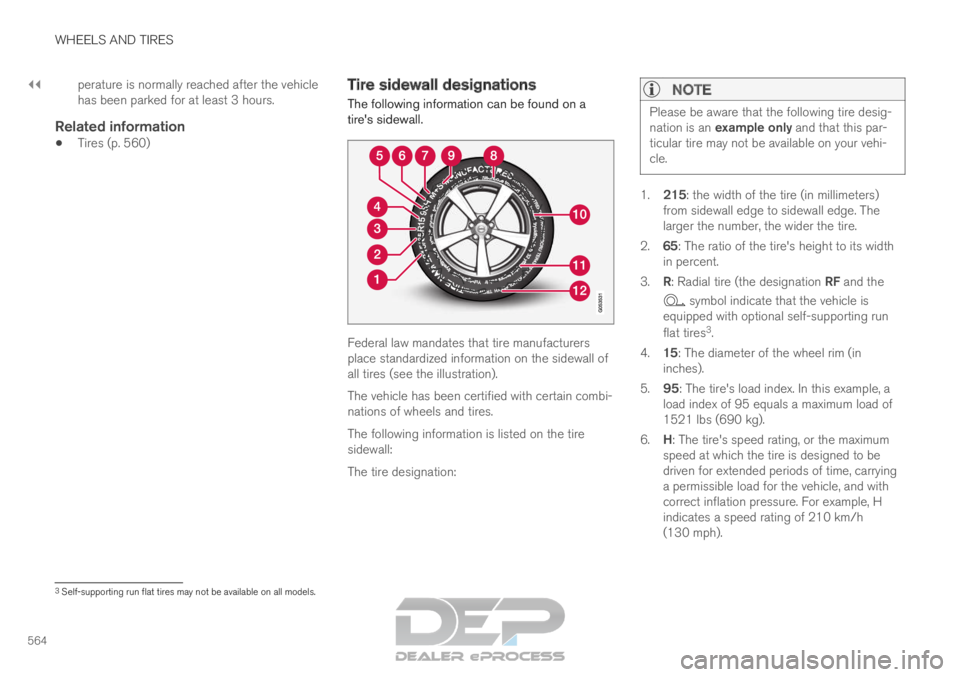
tire's sidewall. Federal law mandates that tire manufacturers
place standardized information on the sidewall of
all tires (see the illustration).
The vehicle has been certified with certain combi-
nations of wheels and tires.
The following information is listed on the tire
sidewall:
The tire designation:
NOTE Please be aware that the following tire desig-
nation is an example only and that this par-
ticular tire may not be available on your vehi-
cle.
1.
215: the width of the tire (in millimeters)
from sidewall edge to sidewall edge. The
larger the number, the wider the tire.
2. 65: The ratio of the tire's height to its width
in percent.
3. R: Radial tire (the designation RF and the symbol indicate that the vehicle is
equipped with optional self-supporting run
flat tires 3
.
4. 15: The diameter of the wheel rim (in
inches).
5. 95: The tire's load index. In this example, a
load index of 95 equals a maximum load of
1521 lbs (690 kg).
6. H: The tire's speed rating, or the maximum
speed at which the tire is designed to be
driven for extended periods of time, carrying
a permissible load for the vehicle, and with
correct inflation pressure. For example, H
indicates a speed rating of 210 km/h
(130 mph). 3
Self-supporting run flat tires may not be available on all models.
Page 601 of 697
LOADING, STORAGE AND PASSENGER COMPARTMENT
* Option/accessory.599
WARNINGIn a head-on collision at a speed of 50 km/h
(30 mph), an unsecured object weighing 20
kg (44 pounds) can reach a projectile weight
equivalent to 1000 kg (2200 pounds).
WARNING
If objects are loaded higher than the upper
edge of the side windows, leave a 10 cm (4
in.) space between the objects and the win-
dow. Objects placed closer to this could
impede the function of the inflatable curtain
concealed inside the headlining.
WARNING
Always secure the load. Otherwise, it may shift
during heavy braking and injure people in the
vehicle.
Cover sharp edges and sharp corners with
something soft.
Turn off the engine and apply the parking
brake when loading/unloading long objects.
Otherwise, it is possible for the load to reach
the gear lever or gear selector and move it to
a drive position – which could cause the vehi-
cle to begin rolling.
Extra cargo space
The rear seat backrests can be folded down to
increase cargo compartment space and simplify
loading. If the rear seat backrests are folded down, make sure that no objects loaded into the
vehicle prevent the WHIPS system for the front
seats from functioning correctly.
Raising/lowering the rear end of the
vehicle*
The rear end of the vehicle can be lowered or
raised for easier loading or to facilitate attaching
a trailer*.
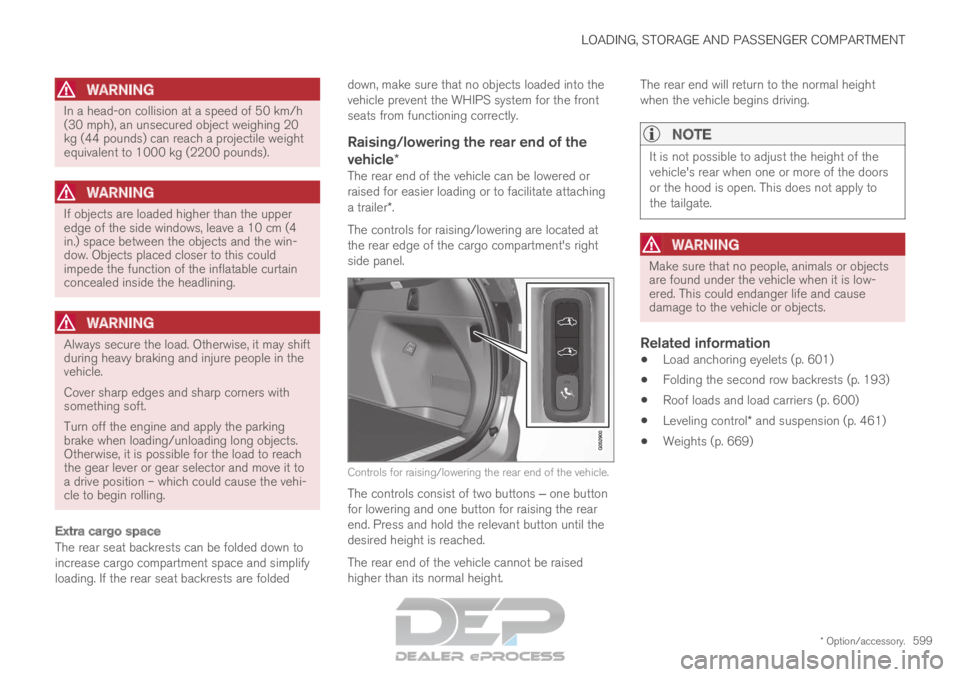
The controls for raising/lowering are located at
the rear edge of the cargo compartment's right
side panel. Controls for raising/lowering the rear end of the vehicle.
The controls consist of two buttons ‒ one button
for lowering and one button for raising the rear
end. Press and hold the relevant button until the
desired height is reached.
The rear end of the vehicle cannot be raised
higher than its normal height. The rear end will return to the normal height
when the vehicle begins driving.
NOTE It is not possible to adjust the height of the
vehicle's rear when one or more of the doors
or the hood is open. This does not apply to
the tailgate.
WARNING
Make sure that no people, animals or objects
are found under the vehicle when it is low-
ered. This could endanger life and cause
damage to the vehicle or objects.
Related information
Load anchoring eyelets (p. 601)
Folding the second row backrests (p. 193)
Roof loads and load carriers (p. 600)
Leveling control* and suspension (p. 461)
Weights (p. 669)
Page 669 of 697

SPECIFICATIONS
}}
* Option/accessory. 667
Dimensions
The vehicle's length, height, etc. are shown in
the table. Dimensions
mminches
A
Ground clear-
ance A 227 8.9
B Wheelbase 2984 117.5 C Length 4950 194.9
D Load length, floor, folded
backrest B 2040
1260
C 80.3
49.6
C Dimensions
mminches
E
Load length,
floor 761/898
D
1220 E
554 F 30.0/35.4
D
48.0 E
21.8 F
F Height G
1776 69.9
G Load height 816 32.1 Dimensions
mminches
H
Wheel track,
front H 1665
I
1673 J 65.6
I
65.9 J
Wheel track,
front K 1668
I
1676 J 65.7
I
66.0 J
Page 684 of 697
INDEX
682G Gasoline grade
476
Gauge fuel gauge
87
Gear selector positions automatic transmission 449
Glass laminated/reinforced 166
Glove compartment 597
Gracenote® 521
Grocery bag holders 600
Gross vehicle weight 669
Guide lines for Park Assist Camera 399
H Handbrake
442, 443
Hand wash
651
Hard disk space 548
Hazard warning flashers 161
HDC 466
HD radio 505
Head restraint 195 Head-up display
142
activate and deactivate
143
cleaning 646
replacing windshield 621
settings 144
store position 144, 186, 187
Heated washer nozzles 176
Heater 239
auxiliary heater 239
parking heater 239
Heating Seats 217, 218
steering wheel 219, 220
windows 223, 225
Height adjustment 461, 464
high beams 156, 157
High engine temperature 479
Hill Descent Control 465, 466, 467
activate with function button 467
Hill Start Assist 447
Hill Start Assist (HSA) 447
Hoisting the vehicle 618
Hold vehicle function 471
HomeLink® 489
programming 490
use 491 HomeLink® remote control
programmable 489
Home safe lighting 161
Honk 200
Hood, opening 620
Horn 200
Hybrid battery 631
Charging 417
Hybrid battery gauge 88
Hybrid gauge 87
Hybrid mode 454, 460
I IAQS (Interior Air Quality System) 208
IC (Inflatable Curtain)
60
ID, Volvo 26
Identification number 38
Ignition mode 437, 438
Immobilizer 257
Electronic immobilizer 257
Indicator symbols 94
Individual drive mode 454
Infant seats 67
Inflatable curtain 60