seats VOLVO XC90 TWIN ENGINE 2019 Owner's Manual
[x] Cancel search | Manufacturer: VOLVO, Model Year: 2019, Model line: XC90 TWIN ENGINE, Model: VOLVO XC90 TWIN ENGINE 2019Pages: 697, PDF Size: 10.33 MB
Page 72 of 697

||SAFETY
70
WARNING
A small child's head represents a consider-
able part of its total weight and its neck is
still very weak. Volvo recommends that
children up to age 4 travel, properly
restrained, facing rearward. In addition,
Volvo recommends that children should
ride rearward facing, properly restrained, as
long as possible.
Convertible child seats should be installed
in the rear seat only.
A rear-facing convertible seat should not
be positioned behind the driver's seat
unless there is adequate space for safe
installation.
2.
Attach the seat belt to the convertible seat
according to the child restraint manufactur-
er's instructions. Fasten the seat belt.
3. Fasten the seat belt by inserting the latch
plate into the buckle (lock) until a distinct
click is audible.
4.
Pull the shoulder section of the seat belt out
as far as possible to activate the belt's auto-
matic locking function.
NOTE The locking retractor will automatically
release when the seat belt is unbuckled and
allowed to retract fully.
5. Press the convertible seat firmly in place, let
the seat belt retract and pull it taut. A sound
from the seat belt retractor's automatic lock-
ing function will be audible at this time and is
normal. The seat belt should now be locked
in place. Pull out the shoulder section of the seat belt.
6. Push and pull the convertible seat along the
seat belt path to ensure that it is held
securely in place by the seat belt.
Page 73 of 697
SAFETY
}}71
WARNING It should not be possible to move the child
restraint more than 2.5 cm (1 in.) in any direc-
tion along the seat belt path.
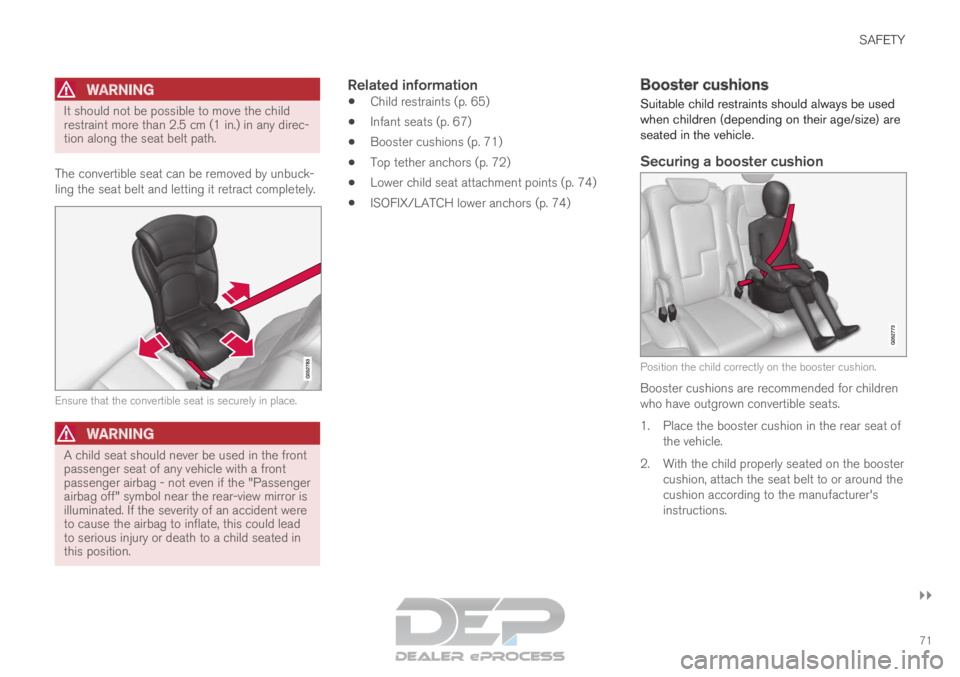
The convertible seat can be removed by unbuck-
ling the seat belt and letting it retract completely. Ensure that the convertible seat is securely in place.
WARNING
A child seat should never be used in the front
passenger seat of any vehicle with a front
passenger airbag - not even if the "Passenger
airbag off" symbol near the rear-view mirror is
illuminated. If the severity of an accident were
to cause the airbag to inflate, this could lead
to serious injury or death to a child seated in
this position.
Related information
Child restraints (p. 65)
Infant seats (p. 67)
Booster cushions (p. 71)
Top tether anchors (p. 72)
Lower child seat attachment points (p. 74)
ISOFIX/LATCH lower anchors (p. 74) Booster cushions
Suitable child restraints should always be used
when children (depending on their age/size) are
seated in the vehicle.
Securing a booster cushion Position the child correctly on the booster cushion.
Booster cushions are recommended for children
who have outgrown convertible seats.
1.
Place the booster cushion in the rear seat of
the vehicle.
2. With the child properly seated on the booster cushion, attach the seat belt to or around the
cushion according to the manufacturer's
instructions.
Page 74 of 697

||SAFETY
72
3. Fasten the seat belt by inserting the latch
plate into the buckle (lock) until a distinct
click is audible. Positioning the seat belt.
4. Ensure that the seat belt is pulled taut and
fits snugly around the child.
WARNING
The hip section of the three-point seat
belt must fit snugly across the child's
hips, not across the stomach.
The shoulder section of the three-point
seat belt should be positioned across the
chest and shoulder.
The shoulder belt must never be placed
behind the child's back or under the arm.
Related information
Child restraints (p. 65)
Convertible seats (p. 69)
Infant seats (p. 67)
Top tether anchors (p. 72)
Lower child seat attachment points (p. 74)
ISOFIX/LATCH lower anchors (p. 74) Top tether anchors
Your Volvo is equipped with child restraint top
tether anchorages for all three seating positions
in the rear seat. They are located on the rear
side of the backrests.
Child restraint anchorages Top tether anchors and symbols on the rear side of the
second row backrests. There is no symbol for the center
anchor position.
Page 76 of 697

SAFETY
74Lower child seat attachment points
The vehicle is equipped with lower child restraint
attachment points in the second row of seats.
The lower child seat attachment points are
intended for use with certain rear-facing child
restraints.
Always follow the manufacturer's installation
instructions when attaching a child seat to the
lower child seat attachment points.
Location of child seat attachment
points Location of the child seat attachment points in the sec-
ond row of seats.
The child seat attachment points in the second
row of seats are located on the rear section of
the front seat floor rails.
Related information
Child restraints (p. 65)
Top tether anchors (p. 72)
ISOFIX/LATCH lower anchors (p. 74) ISOFIX/LATCH lower anchors
Lower anchors for ISOFIX/LATCH-equipped
child seats are located in the second row, out-
board seats, hidden below the backrest cush-
ions.
Using the ISOFIX/LATCH lower child
seat anchors Location of the ISOFIX/LATCH anchors
Symbols on the seat back upholstery mark the
ISOFIX/LATCH anchor positions as shown. To
access the anchors, kneel on the seat cushion
and locate the anchors by feel. Always follow your
child seat manufacturer's installation instructions,
and use both ISOFIX/LATCH lower anchors and
top tethers whenever possible.
Page 77 of 697

SAFETY
75
To access the anchors
1. Put the child restraint in position.
2. Kneel on the child restraint to press downthe seat cushion and locate the anchors by
feel.
3. Fasten the attachment on the child restraint's lower straps to the ISOFIX/LATCH
lower anchors.
4. Firmly tension the lower child seat straps according to the manufacturer's instructions.
WARNING Volvo's ISOFIX/LATCH anchors conform to
FMVSS/CMVSS standards. Always refer to
the child restraint system's manual for weight
and size ratings.
NOTE
The rear center seat is not equipped with
ISOFIX/LATCH lower tether anchors. If a
child restraint is used in this seat, attach
the restraint's upper anchor strap (if
equipped with these) to the top tether
anchor point for this strap and secure the
child restraint with the vehicle's center
seat belt.
Always follow your child seat manufactur-
er's installation instructions, and use both
ISOFIX/LATCH lower anchors and top
tethers whenever possible. Fasten the attachment correctly to the ISOFIX/LATCH
lower anchors.WARNING
Be sure to fasten the attachment cor-
rectly to the anchor (see the illustration).
If the attachment is not correctly fas-
tened, the child restraint may not be
properly secured in the event of a colli-
sion.
The ISOFIX/LATCH lower child restraint
anchors are only intended for use with
child seats positioned in the outboard
seating positions. These anchors are not
certified for use with any child restraint
that is positioned in the center seating
position. When securing a child restraint
in the center seating position, use only
the vehicle's center seat belt.
Related information
Child restraints (p. 65)
Top tether anchors (p. 72)
ISOFIX/LATCH lower anchors (p. 74)
Page 85 of 697
DISPLAYS AND VOICE CONTROL
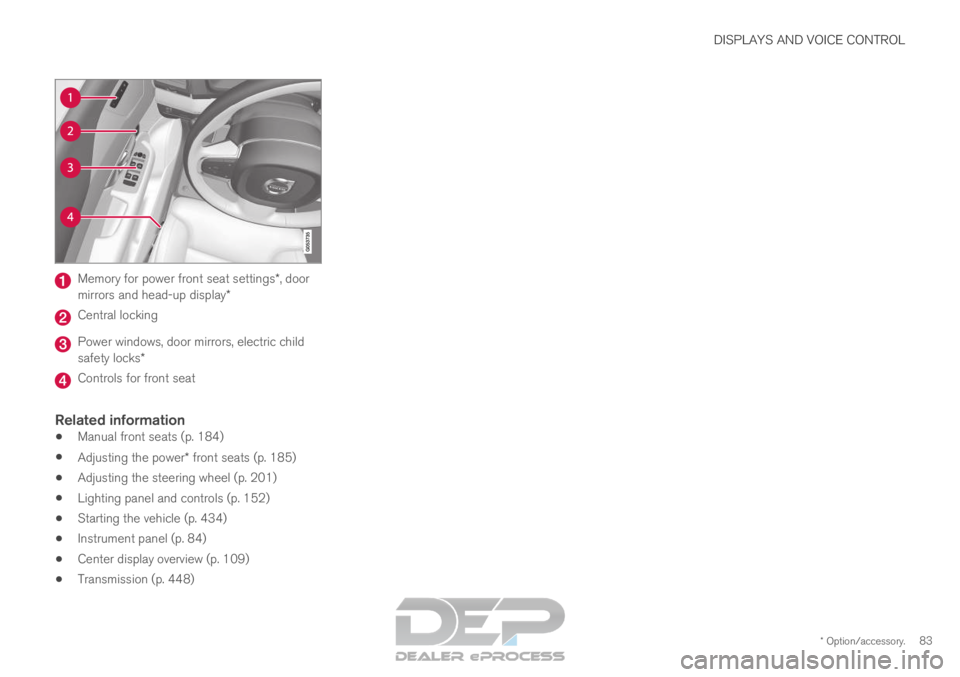
* Option/accessory.83Memory for power front seat settings*, door
mirrors and head-up display* Central locking
Power windows, door mirrors, electric child
safety locks*
Controls for front seat
Related information
Manual front seats (p. 184)
Adjusting the power* front seats (p. 185)
Adjusting the steering wheel (p. 201)
Lighting panel and controls (p. 152)
Starting the vehicle (p. 434)
Instrument panel (p. 84)
Center display overview (p. 109)
Transmission (p. 448)
Page 92 of 697
||DISPLAYS AND VOICE CONTROL
90
This calculation is based on average fuel con-
sumption during the last 30 km (20 miles) and
the amount of fuel remaining in the tank.
When the gauge displays "----", there is not
enough fuel remaining to calculate the remaining
mileage. Refuel as soon as possible.
NOTE
This may vary if your driving style changes.
An economical driving style will generally
increase how far you can drive on a certain
amount of fuel.
Distance to discharged batteryThe gauge shows the approximate dis-
tance that can be driven with the
remaining current in the hybrid battery.
When the gauge displays "----", there is little
charge remaining in the battery and distance
cannot be reliably calculated.
This calculation is based on average consump-
tion with a normally loaded vehicle in normal driv-
ing conditions, and takes into account whether
the air conditioning is on or off. Changing drive
modes from
Hybrid to Pure may increase the
calculated distance because Pure mode has
reduced climate control settings (ECO Climate).
NOTE This may vary if your driving style changes.
An economical driving style will generally
increase how far you can drive on a certain
amount of fuel.
Starting values for fully charged hybrid
battery
Because it is difficult to predict driving style and
other factors that affect the range of electric
motors, Volvo uses a starting value when the
vehicle is fully charged. This starting value pro-
vides an "up to" amount instead of a prediction
on the range of the electric current in the motor.
The difference in starting value between
Hybrid
and
Pure is because the vehicle is permitted to
use more current from the hybrid battery in Pure
mode, and because the vehicle switches to ECO
Climate.
Mileage when using electric motor
To achieve the longest possible mileage when
using the electric motor, the driver of an electric
vehicle also needs to think about conserving
electricity. The more electricity consumers
(stereo, heated windows/mirrors/seats, very cold
air from climate control system, etc.) that are
active, the shorter the potential mileage.
NOTE In addition to high electrical consumption in
the passenger compartment, rapid accelera-
tion, sudden braking, high speeds, heavy
loads, low ambient temperatures and driving
up hills can reduce possible driving distance.
Tourist - alternative speedometerThe alternative digital speedometer makes it eas-
ier to drive in countries where speed limit signs
are shown in a different measurement unit than
the one shown in the vehicle's gauges.
When used, the digital speed is displayed in the
opposite unit to that shown in the analog speed-
ometer. If mph is used in the analog speedome-
ter, the equivalent speed in km/h will be shown
in the digital speedometer.
Related information
Displaying trip data in the instrument panel
(p. 91)
Resetting the trip odometer (p. 92)
Displaying trip statistics in the center display
(p. 92)
Instrument panel (p. 84)
Changing system units of measurement
(p. 132)
Page 138 of 697
||DISPLAYS AND VOICE CONTROL
* Option/accessory.
136
System Sub-categories
Driver Profile
Date and Time
System Languages and Units
Privacy and Data
Keyboard Layouts
Voice Control
*
Factory Reset
System Information
Related information
Center display overview (p. 109)
Changing settings in the center display's Top
view (p. 132)
Resetting center display settings (p. 134) Driver profiles
Many of the vehicle's settings can be custom-
ized to the driver's personal preferences and
saved in one or more driver profiles.
These personal settings are automatically saved
in the active driver profile. Each key can be linked
to one driver profile. When the linked key is used,
the vehicle is customized to the specific settings
of that driver profile.
Which settings are saved in driverprofiles?
Many of the settings made in the vehicle will be
automatically stored in the active driver profile if
the profile is not protected. The vehicle has set-
tings that can be made either personal or global.
The personal settings are saved in driver profiles.
Settings that can be saved in a driver profile
include, among other things, screens, mirrors,
front seats, navigation*, audio and media system,
language and voice control.
Some settings are global settings. These settings
can be changed but are not saved to a specific
driver profile. Changes to global settings affect all
profiles.
Global settings
Global settings and parameters do not change
when driver profiles are changed. They remain
the same regardless of which driver profile is cur-
rently active. Keyboard layout is an example of a global setting.
If driver profile X is used to add additional key-
board languages, these languages will also be
available for driver profile Y. The settings for key-
board layout are not saved to a specific driver
profile - the settings are global.
Personal settings
If driver profile X has been used to e.g., set the
brightness for the center display, driver profile Y
will not be affected by this setting. It will only be
saved to driver profile X because brightness set-
ting is a personal setting.
Related information
Selecting a driver profile (p. 137)
Changing a driver profile's name (p. 137)
Linking a remote key to a driver profile
(p. 138)
Protecting a driver profile (p. 138)
Resetting driver profile settings (p. 139)
Table of settings in the center display
(p. 135)
Page 147 of 697
DISPLAYS AND VOICE CONTROL
}}
* Option/accessory. 145
Calibrating the horizontal position
If the windshield or display unit has been
replaced, the head-up display's horizontal posi-
tion may need to be calibrated. Calibration means
that the projected image is rotated clockwise or
counterclockwise.
1.
Tap Settings in the center display's Top
view.
2.
Select My Car Displays Head-Up
Display Options Head-Up Display
Calibration .
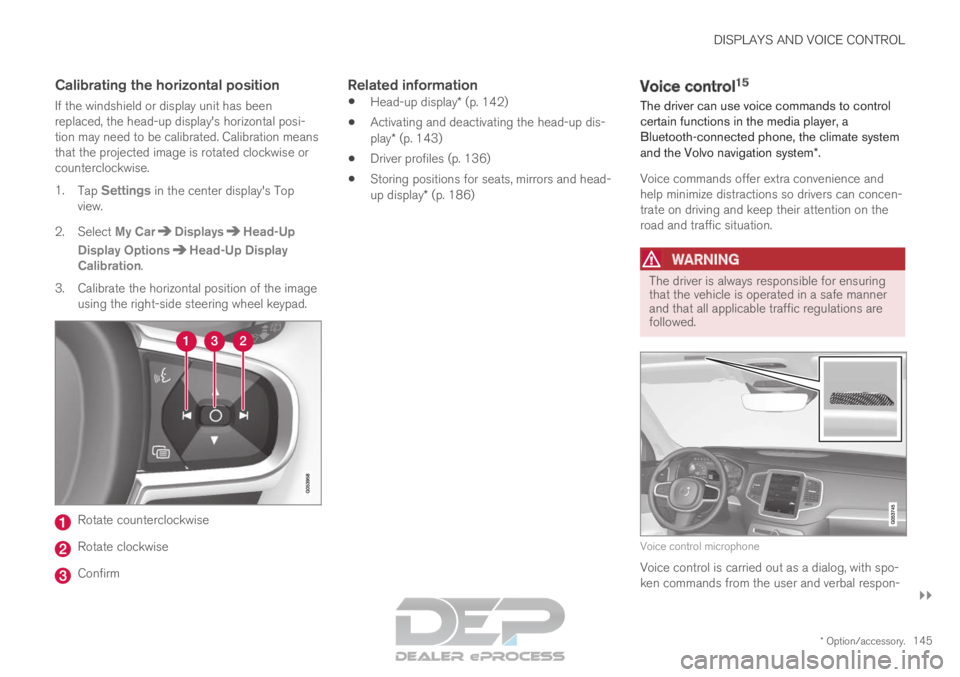
3.
Calibrate the horizontal position of the image
using the right-side steering wheel keypad. Rotate counterclockwise
Rotate clockwise
Confirm
Related information
Head-up display* (p. 142)
Activating and deactivating the head-up dis-
play* (p. 143)
Driver profiles (p. 136)
Storing positions for seats, mirrors and head-
up display* (p. 186) Voice control
15
The driver can use voice commands to control
certain functions in the media player, a
Bluetooth-connected phone, the climate system
and the Volvo navigation system*.
Voice commands offer extra convenience and
help minimize distractions so drivers can concen-
trate on driving and keep their attention on the
road and traffic situation.
WARNING The driver is always responsible for ensuring
that the vehicle is operated in a safe manner
and that all applicable traffic regulations are
followed.
Voice control microphone
Voice control is carried out as a dialog, with spo-
ken commands from the user and verbal respon-
Page 165 of 697
LIGHTING
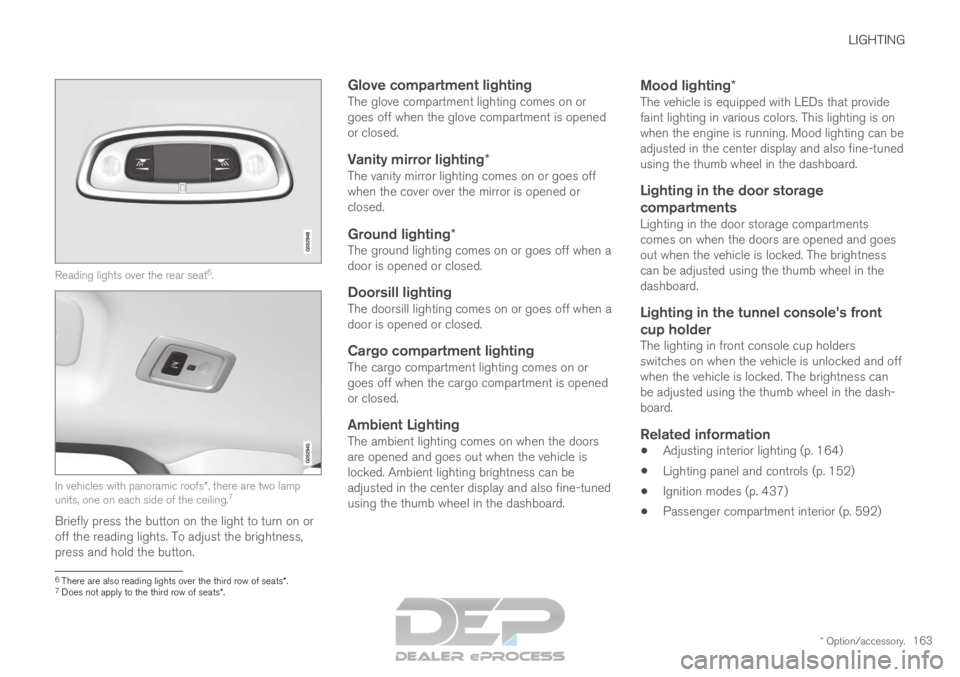
* Option/accessory.163Reading lights over the rear seat
6
. In vehicles with panoramic roofs*, there are two lamp
units, one on each side of the ceiling. 7
Briefly press the button on the light to turn on or
off the reading lights. To adjust the brightness,
press and hold the button.
Glove compartment lightingThe glove compartment lighting comes on or
goes off when the glove compartment is opened
or closed.
Vanity mirror lighting*The vanity mirror lighting comes on or goes off
when the cover over the mirror is opened or
closed.
Ground lighting*The ground lighting comes on or goes off when a
door is opened or closed.
Doorsill lightingThe doorsill lighting comes on or goes off when a
door is opened or closed.
Cargo compartment lightingThe cargo compartment lighting comes on or
goes off when the cargo compartment is opened
or closed.
Ambient LightingThe ambient lighting comes on when the doors
are opened and goes out when the vehicle is
locked. Ambient lighting brightness can be
adjusted in the center display and also fine-tuned
using the thumb wheel in the dashboard.
Mood lighting*The vehicle is equipped with LEDs that provide
faint lighting in various colors. This lighting is on
when the engine is running. Mood lighting can be
adjusted in the center display and also fine-tuned
using the thumb wheel in the dashboard.
Lighting in the door storage
compartments
Lighting in the door storage compartments
comes on when the doors are opened and goes
out when the vehicle is locked. The brightness
can be adjusted using the thumb wheel in the
dashboard.
Lighting in the tunnel console's front cup holder
The lighting in front console cup holders
switches on when the vehicle is unlocked and off
when the vehicle is locked. The brightness can
be adjusted using the thumb wheel in the dash-
board.
Related information
Adjusting interior lighting (p. 164)
Lighting panel and controls (p. 152)
Ignition modes (p. 437)
Passenger compartment interior (p. 592) 6
There are also reading lights over the third row of seats*.
7 Does not apply to the third row of seats*.