tires VOLVO XC90 TWIN ENGINE 2019 Owner's Manual
[x] Cancel search | Manufacturer: VOLVO, Model Year: 2019, Model line: XC90 TWIN ENGINE, Model: VOLVO XC90 TWIN ENGINE 2019Pages: 697, PDF Size: 10.33 MB
Page 572 of 697
||WHEELS AND TIRES
* Option/accessory.
570 pressure telltale. When the system detects a mal-
function, the telltale will flash for approximately
one minute and then remain continuously illumi-
nated. This sequence will continue upon subse-
quent vehicle start-ups as long as the malfunc-
tion exists. When the malfunction indicator is illu-
minated, the system may not be able to detect or
signal low tire pressure as intended.
TPMS malfunctions may occur for a variety of
reasons, including the installation of replacement
or alternate tires or wheels on the vehicle that
prevent the TPMS from functioning properly.
Always check the TPMS malfunction telltale after
replacing one or more tires or wheels on your
vehicle to ensure that the replacement or alter-
nate tires and wheels allow the TPMS to con-
tinue to function properly.
Messages in the instrument panelIf tire pressure is too low, the low tire pressure
warning symbol is shown in the instrument panel
along with a message.
Tire pressure low Check tires, calibrate
after fill
Tire pressure system Temporarily
unavailable
Tire pressure system Service required
To keep in mind
Always calibrate the system after changing
wheels or adjusting tire pressure. See the tire
pressure placard on the driver's side B pillar
for Volvo-recommended tire pressures.
If you switch to a tire of another size than the
factory-mounted tires, the system must be
calibrated for these tires to avoid false warn-
ings.
If a spare wheel 8
is used, it is possible that
the tire pressure monitoring system will not
work correctly due to the differences
between the wheels.
The system does not replace the need for
regular tire inspection and maintenance.
It is not possible to deactivate the tire pres-
sure monitoring system.
WARNING
Incorrect inflation pressure could lead to
tire failure, which could cause the driver
to lose control of the vehicle.
The system cannot predict sudden tire
damage.
Related information
Recommended tire pressure (p. 569)
Viewing tire pressure status in the center
display* (p. 572)
Action when warned of low tire pressure
(p. 573)
Calibrating the tire pressure monitoring sys-
tem* (p. 571) 8
Not available on all models.
Page 573 of 697
WHEELS AND TIRES
}}
* Option/accessory. 571
Calibrating the tire pressure
monitoring system*
In order for the tire pressure monitoring system 9
to function correctly, tire pressure reference val-
ues must be set correctly. This must be done
each time the tires are changed or the tire pres-
sure is adjusted.
For example, when driving with a heavy load or at
high speeds (over 160 km/h (100 mph)), tire
pressure should be adjusted to the Volvo-recom-
mended tire pressure values. The system should
then be recalibrated.
1.
Switch off the ignition.
2. Inflate the tire to the correct inflation pres- sure; see the tire pressure placard on the
driver's side B pillar for recommended pres-
sures for factory-mounted tires.
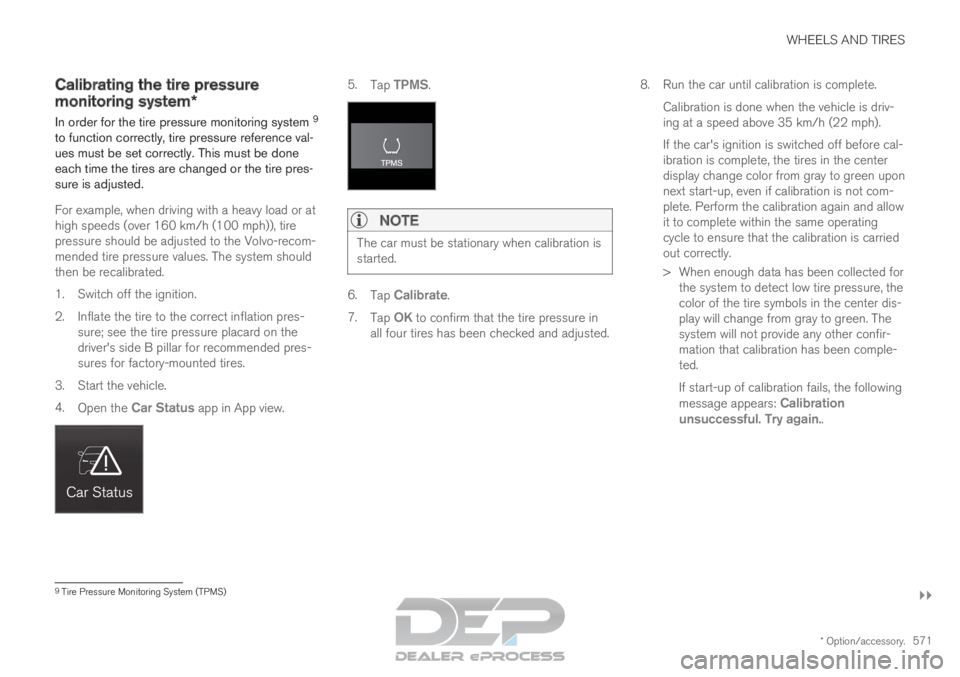
3. Start the vehicle.
4. Open the Car Status app in App view. 5.
Tap TPMS.NOTE The car must be stationary when calibration is
started.
6.
Tap Calibrate.
7. Tap OK to confirm that the tire pressure in
all four tires has been checked and adjusted. 8.
Run the car until calibration is complete.
Calibration is done when the vehicle is driv-
ing at a speed above 35 km/h (22 mph).
If the car's ignition is switched off before cal-
ibration is complete, the tires in the center
display change color from gray to green upon
next start-up, even if calibration is not com-
plete. Perform the calibration again and allow
it to complete within the same operating
cycle to ensure that the calibration is carried
out correctly.
> When enough data has been collected for the system to detect low tire pressure, the
color of the tire symbols in the center dis-
play will change from gray to green. The
system will not provide any other confir-
mation that calibration has been comple-
ted.
If start-up of calibration fails, the following
message appears: Calibration
unsuccessful. Try again.. 9
Tire Pressure Monitoring System (TPMS)
Page 574 of 697
||WHEELS AND TIRES
* Option/accessory.
572
NOTE Always remember to calibrate the Tire Pres-
sure Monitoring System when the wheels
have been changed or the tire inflation pres-
sure has been corrected according to the tire
pressure decal or tire inflation pressure table.
If correct reference values have not been set,
the system cannot issue low tire pressure
alerts correctly.
The vehicle must be stationary with the
engine running to access the calibration but-
ton and to start the calibration process.
WARNING
The exhaust gases contain carbon monoxide,
which is invisible and odorless but very poi-
sonous. For this reason, always perform the
calibration procedure outdoors or in a work-
shop with exhaust gas evacuation equipment.
Related information
Recommended tire pressure (p. 569)
Adjusting tire pressure (p. 568)
Viewing tire pressure status in the center
display* (p. 572)
Action when warned of low tire pressure
(p. 573)
Tire pressure monitoring system* (p. 569) Viewing tire pressure status in the
center display*
With the system for tire pressure monitoring 10
,
tire pressure status can be viewed in the center
display.
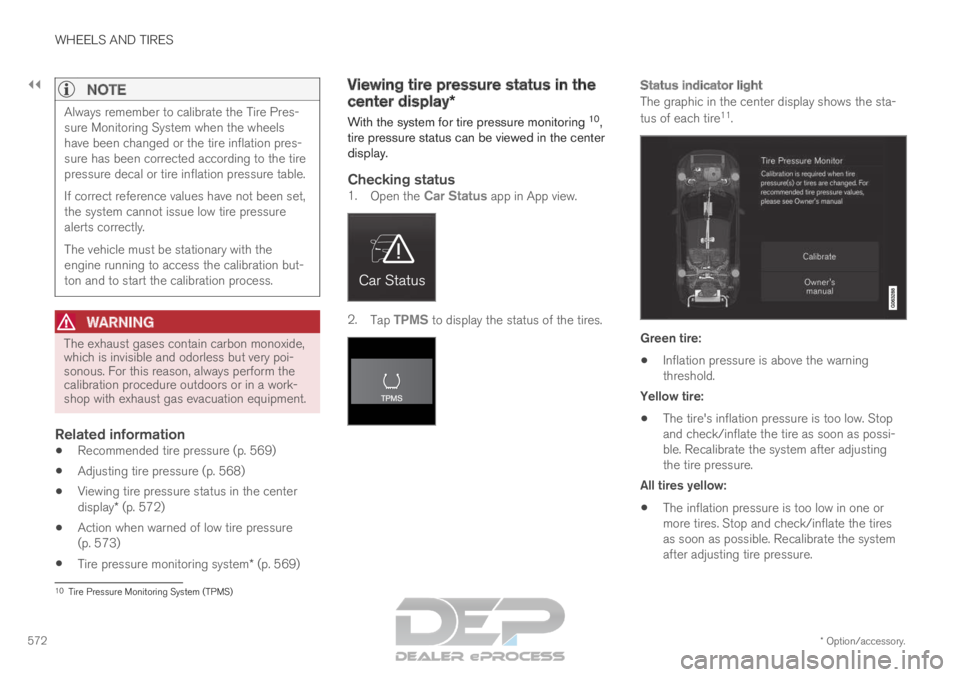
Checking status1. Open the Car Status app in App view. 2.
Tap TPMS to display the status of the tires.
Status indicator light
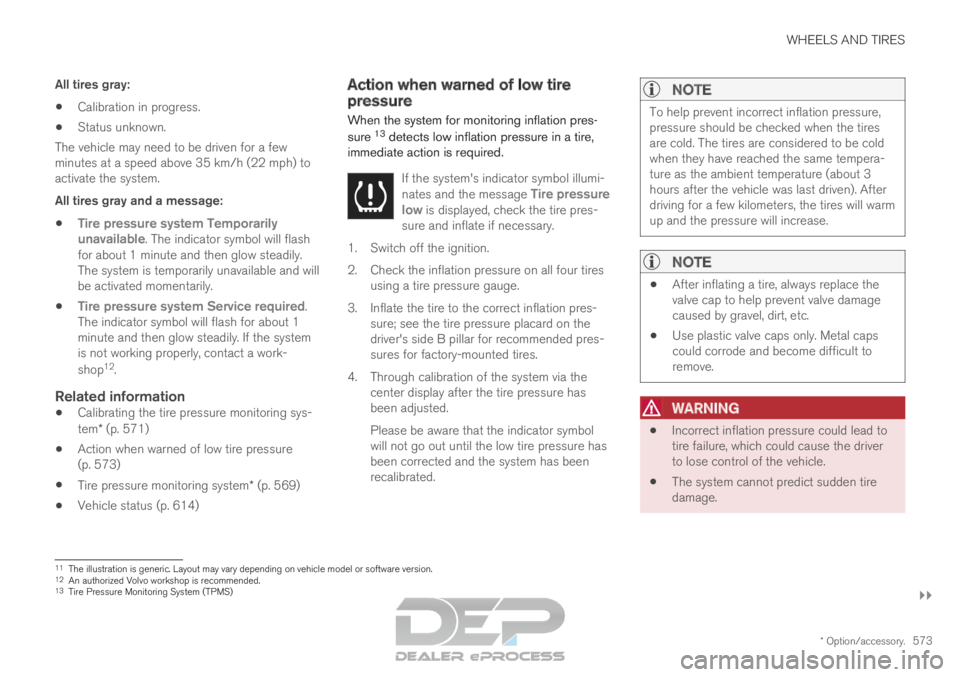
The graphic in the center display shows the sta-
tus of each tire 11
. Green tire:
Inflation pressure is above the warning
threshold.
Yellow tire:
The tire's inflation pressure is too low. Stop
and check/inflate the tire as soon as possi-
ble. Recalibrate the system after adjusting
the tire pressure.
All tires yellow:
The inflation pressure is too low in one or
more tires. Stop and check/inflate the tires
as soon as possible. Recalibrate the system
after adjusting tire pressure. 10
Tire Pressure Monitoring System (TPMS)
Page 575 of 697
WHEELS AND TIRES
}}
* Option/accessory. 573
All tires gray:
Calibration in progress.
Status unknown.
The vehicle may need to be driven for a few
minutes at a speed above 35 km/h (22 mph) to
activate the system.
All tires gray and a message:
Tire pressure system Temporarily
unavailable. The indicator symbol will flash
for about 1 minute and then glow steadily.
The system is temporarily unavailable and will
be activated momentarily.
Tire pressure system Service required.
The indicator symbol will flash for about 1
minute and then glow steadily. If the system
is not working properly, contact a work-
shop 12
.
Related information
Calibrating the tire pressure monitoring sys-
tem* (p. 571)
Action when warned of low tire pressure
(p. 573)
Tire pressure monitoring system* (p. 569)
Vehicle status (p. 614) Action when warned of low tire
pressure
When the system for monitoring inflation pres-
sure 13
detects low inflation pressure in a tire,
immediate action is required.
If the system's indicator symbol illumi-
nates and the message Tire pressure
low is displayed, check the tire pres-
sure and inflate if necessary. 1. Switch off the ignition.
2.
Check the inflation pressure on all four tires
using a tire pressure gauge.
3. Inflate the tire to the correct inflation pres- sure; see the tire pressure placard on the
driver's side B pillar for recommended pres-
sures for factory-mounted tires.
4. Through calibration of the system via the center display after the tire pressure has
been adjusted.
Please be aware that the indicator symbol
will not go out until the low tire pressure has
been corrected and the system has been
recalibrated.
NOTE To help prevent incorrect inflation pressure,
pressure should be checked when the tires
are cold. The tires are considered to be cold
when they have reached the same tempera-
ture as the ambient temperature (about 3
hours after the vehicle was last driven). After
driving for a few kilometers, the tires will warm
up and the pressure will increase.
NOTE
After inflating a tire, always replace the
valve cap to help prevent valve damage
caused by gravel, dirt, etc.
Use plastic valve caps only. Metal caps
could corrode and become difficult to
remove.
WARNING
Incorrect inflation pressure could lead to
tire failure, which could cause the driver
to lose control of the vehicle.
The system cannot predict sudden tire
damage. 11
The illustration is generic. Layout may vary depending on vehicle model \
or software version.
12 An authorized Volvo workshop is recommended.
13 Tire Pressure Monitoring System (TPMS)
Page 576 of 697

||WHEELS AND TIRES
* Option/accessory.
574
Related information
Recommended tire pressure (p. 569)
Adjusting tire pressure (p. 568)
Calibrating the tire pressure monitoring sys-
tem* (p. 571)
Viewing tire pressure status in the center
display* (p. 572)
Tire pressure monitoring system* (p. 569)
Inflate tires with the compressor included in
the tire sealing system (p. 587) When changing wheels
The wheels can be changed, e.g. to switch to
snow tires or spare tires. Follow the applicable
instructions for removing and installing the
wheel.
Changing to tires of another dimensionMake sure that the tire dimension is approved for
use on the vehicle.
If you change to tires of another dimension, con-
tact an authorized Volvo workshop to update the
vehicle's software. A software update may be
necessary when changing to tires of larger/
smaller dimensions or when changing to or from
snow tires.
Related information
Removing a wheel (p. 576)
Installing a wheel (p. 578)
Tool kit (p. 574)
Snow tires (p. 581)
Spare wheel (p. 579)
Wheel bolts (p. 575) Tool kit
Tools for e.g. towing or changing wheels are
provided in the vehicle's cargo compartment.
The foam block under the cargo compartment
floor contains the towing eyelet, the tire sealing
system, the tool for removing plastic wheel bolt
covers and the tool for removing the locking
wheel bolts.
If the vehicle is equipped with a spare wheel*
14
, a
jack, lug wrench, and a package with
disposable gloves and a bag for the damaged
wheel are also provided.
Related information
When changing wheels (p. 574)
Jack* (p. 575) 14
Not available on all models.
Page 577 of 697
WHEELS AND TIRES
}}
* Option/accessory. 575
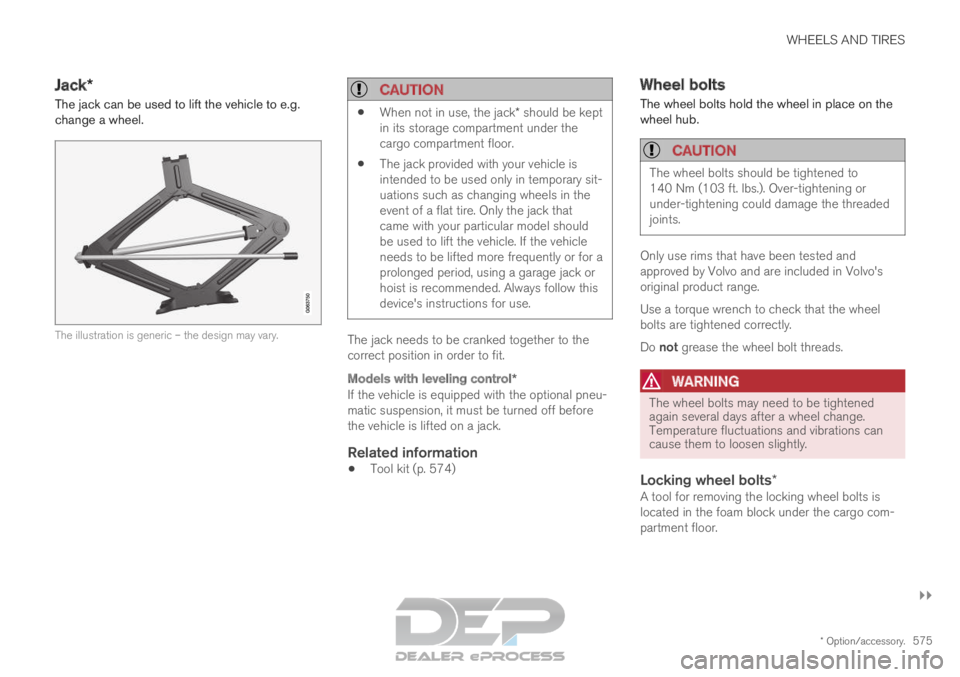
Jack*
The jack can be used to lift the vehicle to e.g.
change a wheel. The illustration is generic – the design may vary.
CAUTION
When not in use, the jack* should be kept
in its storage compartment under the
cargo compartment floor.
The jack provided with your vehicle is
intended to be used only in temporary sit-
uations such as changing wheels in the
event of a flat tire. Only the jack that
came with your particular model should
be used to lift the vehicle. If the vehicle
needs to be lifted more frequently or for a
prolonged period, using a garage jack or
hoist is recommended. Always follow this
device's instructions for use. The jack needs to be cranked together to the
correct position in order to fit.
Models with leveling control*
If the vehicle is equipped with the optional pneu-
matic suspension, it must be turned off before
the vehicle is lifted on a jack.
Related information
Tool kit (p. 574) Wheel bolts
The wheel bolts hold the wheel in place on the
wheel hub.
CAUTION The wheel bolts should be tightened to
140 Nm (103 ft. lbs.). Over-tightening or
under-tightening could damage the threaded
joints.
Only use rims that have been tested and
approved by Volvo and are included in Volvo's
original product range.
Use a torque wrench to check that the wheel
bolts are tightened correctly.
Do not grease the wheel bolt threads.
WARNING
The wheel bolts may need to be tightened
again several days after a wheel change.
Temperature fluctuations and vibrations can
cause them to loosen slightly.
Locking wheel bolts*A tool for removing the locking wheel bolts is
located in the foam block under the cargo com-
partment floor.
Page 578 of 697

||WHEELS AND TIRES
* Option/accessory.
576
Related information
Removing a wheel (p. 576)
Installing a wheel (p. 578) Removing a wheel
Instructions for removing a wheel when chang-
ing wheels. Wheel changes must always be car-
ried out correctly.
CAUTION
When not in use, the jack* should be kept
in its storage compartment under the
cargo compartment floor.
The jack provided with your vehicle is
intended to be used only in temporary sit-
uations such as changing wheels in the
event of a flat tire. Only the jack that
came with your particular model should
be used to lift the vehicle. If the vehicle
needs to be lifted more frequently or for a
prolonged period, using a garage jack or
hoist is recommended. Always follow this
device's instructions for use.
WARNING
Apply the parking brake and put the gear
selector in the Park (P) position.
Block the wheels standing on the ground,
use rigid wooden blocks or large stones.
Check that the jack is not damaged, the
threads are properly lubricated and it is
free from dirt.
Be sure the jack is on a firm, level, non-
slippery surface and that it is upright and
not leaning.
The jack must correctly engage in the
jack attachment.
No objects should be placed between the
base of the jack and the ground, or
between the jack and the attachment bar
on the vehicle.
Never let anyone remain in the vehicle
when it is raised on a jack.
If a tire must be changed near passing
traffic, make sure all passengers move to
a safe location.
Use a jack intended for the vehicle when
changing a tire. For any other job, use
stands to support the vehicle.
Never crawl under or allow any part of
your body to be extended under a vehicle
supported by a jack.
Page 579 of 697

WHEELS AND TIRES
}}
* Option/accessory. 577
1.
Turn on the vehicle's hazard warning flashers
if a wheel change must be performed in an
area with traffic.
2. Apply the parking brake and put the gear selector in P.
For vehicles with Leveling Control*: If the
vehicle is equipped with pneumatic suspen-
sion, this must be switched off before the
vehicle is lifted with the jack*.
3. Take out the jack*, lug wrench* and tool for
removing the plastic covers, which are
stowed in the foam block. Tool for removing the plastic covers on the wheel bolts.
4. Place chocks in front of and behind the
wheels that are still on the ground. For exam-
ple, use heavy wooden blocks or large
stones. 5.
Using the lug wrench*, screw the towing eye
into place as far as possible according to the
instructions.
CAUTION The towing eyelet must be screwed into the
lug wrench* as far as possible.
6. Remove the plastic covers from the wheel
bolts using the designated tool.
7.
With the vehicle still on the ground, use the
lug wrench/towing eye to loosen the wheel
bolts ½-1 turn by pressing downward (coun-
terclockwise). 8. When hoisting the vehicle, it is important that
the jack* or garage lift arms are positioned
on the designated points under the vehicle.
The triangle markings on the plastic cover
indicate where the jack attachment points/
lifting points are located. There are two jack
attachment points on each side of the vehi-
cle. There is a groove for the jack at each
attachment point. 9. Position the jack under the attachment point
being used, ensuring that the surface is firm,
flat and not slippery.
Page 580 of 697

||WHEELS AND TIRES
* Option/accessory.
578 10. Crank it up until it is properly aligned and it is
in contact with the vehicle's jack attachment
point. Make sure the top of the jack (or the
garage lift arms) is correctly positioned in the
attachment point, with the bump on the top
of the jack in the recess in the attachment
point and the base positioned vertically under
the attachment point.
11. Turn the jack so that the crank is as far as possible from the side of the vehicle, which
will position the jack's arms perpendicular to
the vehicle's direction of movement.
12. Raise the vehicle until the wheel to be changed can move freely. Unscrew the wheel
bolts and lift off the wheel.
Related information
Leveling control settings* (p. 464)
When changing wheels (p. 574)
Hoisting the vehicle (p. 618)
Jack* (p. 575)
Tool kit (p. 574)
Installing a wheel (p. 578) Installing a wheel
Instructions for installing a wheel during a wheel
change.
NOTE The jack provided with your vehicle is
intended to be used only in temporary situa-
tions such as changing wheels in the event of
a flat tire. Only the jack that came with your
particular model should be used to lift the
vehicle. If the vehicle needs to be lifted more
frequently or for a prolonged period, using a
garage jack or hoist is recommended. Always
follow this device's instructions for use.
WARNING
Apply the parking brake and put the gear
selector in the Park (P) position.
Block the wheels standing on the ground,
use rigid wooden blocks or large stones.
Check that the jack is not damaged, the
threads are properly lubricated and it is
free from dirt.
Be sure the jack is on a firm, level, non-
slippery surface and that it is upright and
not leaning.
The jack must correctly engage in the
jack attachment.
No objects should be placed between the
base of the jack and the ground, or
between the jack and the attachment bar
on the vehicle.
Never let anyone remain in the vehicle
when it is raised on a jack.
If a tire must be changed near passing
traffic, make sure all passengers move to
a safe location.
Use a jack intended for the vehicle when
changing a tire. For any other job, use
stands to support the vehicle.
Never crawl under or allow any part of
your body to be extended under a vehicle
supported by a jack.
Page 581 of 697
WHEELS AND TIRES
}}
* Option/accessory. 579
1.
Clean the contact surfaces between the
wheel and the wheel hub.
2. Lift the wheel into place. Tighten the wheel bolts securely.
Do not grease the wheel bolt threads.
3. Lower the vehicle so that the wheel cannot rotate.
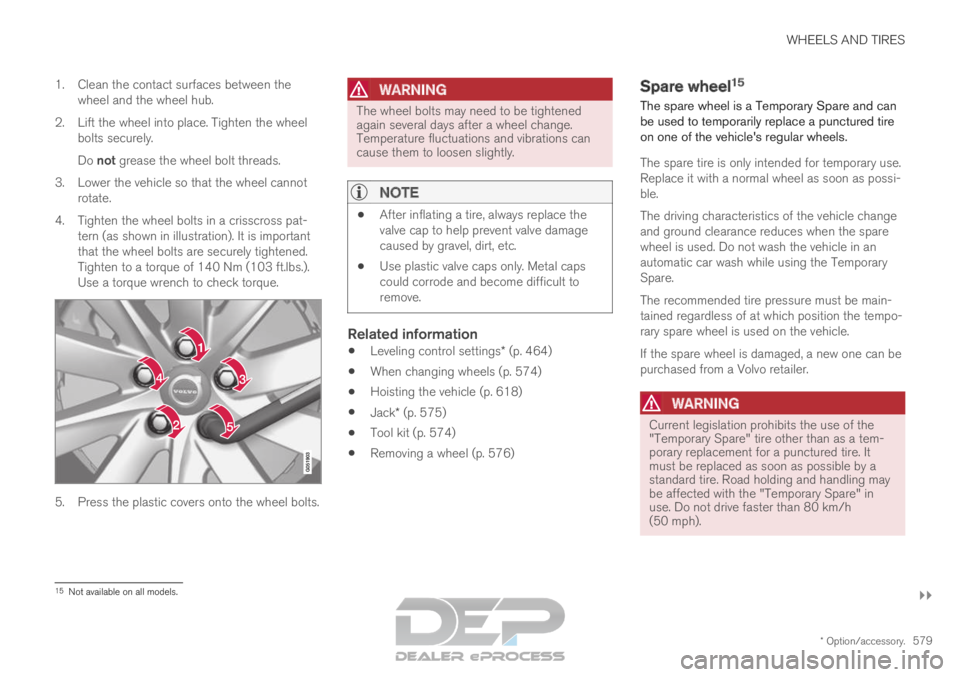
4. Tighten the wheel bolts in a crisscross pat- tern (as shown in illustration). It is important
that the wheel bolts are securely tightened.
Tighten to a torque of 140 Nm (103 ft.lbs.).
Use a torque wrench to check torque. 5. Press the plastic covers onto the wheel bolts.
WARNING The wheel bolts may need to be tightened
again several days after a wheel change.
Temperature fluctuations and vibrations can
cause them to loosen slightly.
NOTE
After inflating a tire, always replace the
valve cap to help prevent valve damage
caused by gravel, dirt, etc.
Use plastic valve caps only. Metal caps
could corrode and become difficult to
remove.
Related information
Leveling control settings* (p. 464)
When changing wheels (p. 574)
Hoisting the vehicle (p. 618)
Jack* (p. 575)
Tool kit (p. 574)
Removing a wheel (p. 576) Spare wheel
15
The spare wheel is a Temporary Spare and can
be used to temporarily replace a punctured tire
on one of the vehicle's regular wheels.
The spare tire is only intended for temporary use.
Replace it with a normal wheel as soon as possi-
ble.
The driving characteristics of the vehicle change
and ground clearance reduces when the spare
wheel is used. Do not wash the vehicle in an
automatic car wash while using the Temporary
Spare.
The recommended tire pressure must be main-
tained regardless of at which position the tempo-
rary spare wheel is used on the vehicle.
If the spare wheel is damaged, a new one can be
purchased from a Volvo retailer.
WARNING Current legislation prohibits the use of the
"Temporary Spare" tire other than as a tem-
porary replacement for a punctured tire. It
must be replaced as soon as possible by a
standard tire. Road holding and handling may
be affected with the "Temporary Spare" in
use. Do not drive faster than 80 km/h
(50 mph).
15
Not available on all models.