climate control VOLVO XC90 TWIN ENGINE 2019 Workshop Manual
[x] Cancel search | Manufacturer: VOLVO, Model Year: 2019, Model line: XC90 TWIN ENGINE, Model: VOLVO XC90 TWIN ENGINE 2019Pages: 697, PDF Size: 10.33 MB
Page 241 of 697
CLIMATE CONTROL
239
Heater
The heater helps the engine and passenger
compartment reach the correct temperature
before and while driving.
The heater has two sub-functions: Parking heater - heats the passenger com-
partment as needed when the parking cli-
mate's preconditioning is activated.
Auxiliary heater - heats the passenger com-
partment and engine while driving.
The heater is a high-voltage coolant heater and is
mounted in the front right-side wheel housing.
Battery and chargingThe heater is powered by the vehicle's hybrid bat-
tery. If the charge level in the hybrid battery is too
low, the heater will switch off automatically and a
message will be displayed in the instrument
panel.
NOTE Make sure that the battery has sufficient
charge if the heater must be used.
Related information
Climate (p. 204) Parking heater
The parking heater heats the passenger com-
partment as needed before driving if precondi-
tioning is activated.
The parking heater is one of two sub-functions of
the vehicle's heater. The heater is mounted in the
front right-side wheel housing.
The parking heater starts automatically if the
parking climate's preconditioning is activated and
the passenger compartment needs to be heated.
It switches off automatically when a set timer
time or the heater's maximum run time expires, or
if the car is restarted.
The heater's maximum running time is 40
minutes. Additional heater
The auxiliary heater helps heat the passenger
compartment and engine while driving.
The auxiliary heater is one of two sub-functions
of the vehicle's heater. The heater is mounted in
the front right-side wheel housing.
The auxiliary heater is started and controlled
automatically when extra heat is required while
the vehicle is being driven.
It switches off automatically when the ignition is
switched off.
Page 242 of 697
CLIMATE CONTROL
240Activating and deactivating the
auxiliary heater
The auxiliary heater helps heat the passenger
compartment and engine while driving.
It is possible to set whether automatic start for
the auxiliary heater should be activated or deacti-
vated.
1.
Tap Settings in the Top view in the center
display.
2. Tap Climate.
3. Select Additional Heater to activate/deac-
tivate automatic start for the auxiliary heater.
NOTE If automatic start of the auxiliary heater is
deactivated, this may impair comfort in the
passenger compartment since the climate
system then does not have a heat source dur-
ing electrical operation.
Page 456 of 697
STARTING AND DRIVING
* Option/accessory.
454 Starting and stopping the
combustion engine in Twin Engine
vehicles
An advanced control system determines the dis-
tance that the vehicle can be driven on the com-
bustion engine, electric motor, or both at the
same time. When driving on only the electric
motor, the vehicle may automatically start the
combustion engine due to outside circumstan-
ces, e.g. low ambient temperatures. This is com-
pletely normal. The combustion engine will also
always start when the hybrid battery is nearly
fully discharged.
Climate settings at low temperaturesAt low ambient temperatures, the combustion
engine will sometimes start automatically to help
achieve the desired passenger compartment
temperature and air quality. The amount of time
the combustion engine is running can be affec-
ted by:
lowering the temperature
reducing blower speed
activating Pure drive mode.
Using the electric motor in hot or cold
weather
At very low or high ambient temperatures, the
electric motor's driving range and power may be
reduced and affect how often the combustion
engine automatically starts.
Emission control systemTo help ensure that the emission control system
functions optimally, the combustion engine will
run for several minutes after it is started. The
amount of time the combustion engine needs to
be used varies depending on the temperature of
the three-way catalytic converter.
WARNING California Proposition 65
Operating, servicing and maintaining a pas-
senger vehicle can expose you to chemicals
including engine exhaust, carbon monoxide,
phthalates, and lead, which are known to the
State of California to cause cancer and birth
defects or other reproductive harm. To mini-
mize exposure, avoid breathing exhaust, do
not idle the engine except as necessary, serv-
ice your vehicle in a well ventilated area and
wear gloves or wash your hands frequently
when servicing your vehicle. For more infor-
mation go to www.P65Warnings.ca.gov/
passenger-vehicle.
Related information
Drive systems (p. 453)
Economical driving (p. 467)
Using the electric motor only (p. 469)
Drive modes (p. 454) Drive modes
Drive modes affect the vehicle's driving charac-
teristics in different ways to enhance and sim-
plify the driving experience in certain types of sit-
uations.
Drive modes enable easy access to the vehicle's
many functions and settings in different driving
situations. The following systems are adapted to
help optimize driving characteristics in each drive
mode:
Steering
Engine/transmission/all-wheel drive
Brakes
Pneumatic suspension* and shock absorbers
Instrument panel
Climate control settings
Select the drive mode that is best suited to the
current driving conditions. Keep in mind that not
all drive modes are available in all situations.
Page 457 of 697
STARTING AND DRIVING
}}
455
Available drive modes
WARNING Keep in mind that the vehicle does not emit
any engine noise when using the electric
motor and may therefore be difficult to detect
for children, pedestrians, cyclists or animals.
This is particularly true at low speeds, e.g. in
parking lots.
WARNING
Do not leave the vehicle in an unventilated
area with a drive mode activated and the com-
bustion engine switched off. The engine will
start automatically if the charge level in the
hybrid battery is low and the resulting exhaust
gases can be very harmful to people and ani-
mals.
HYBRID
This is the default mode in which the electric
motor and combustion engine work together.
The vehicle starts in Hybrid mode. The control
system uses both the electric motor and the gas-
oline engine - separately or in tandem - and cal-
culates optimal utilization with regard to perform-
ance, fuel consumption and comfort. At high
speeds, ground clearance is automatically low-
ered 3
to reduce air resistance. Driving capacity on
the electric motor alone is determined by factors such as the hybrid battery's charge level, the
need for heat/cooling in the passenger compart-
ment, etc.
If there is sufficient charge in the battery, it is
possible to drive solely on electric power. When
the accelerator pedal is pressed, only the electric
motor will be activated until the battery reaches a
certain charge level. Above this level, the current
in the battery cannot supply the power requested
by the accelerator pedal and the combustion
engine will start.
When the hybrid battery's charge level is low, the
combustion engine will start more frequently to
save the remaining current in the battery. Charge
the hybrid battery from a 120-240 volt outlet
using a charging cable, or activate
Charge in
Function view to reset the option of only using
the electric motor.
This drive mode is designed for low energy con-
sumption with an optimized mix between the
electric motor and gasoline engine, without com-
promising on climate comfort or driving experi-
ence. When faster acceleration is requested by
the driver, the electric driveline will be utilized to
help provide maximum additional power. The
vehicle also monitors the driving conditions and
automatically engages all-wheel drive if neces-
sary. All-wheel drive and extra electric power are
always available regardless of the battery's
charging status.
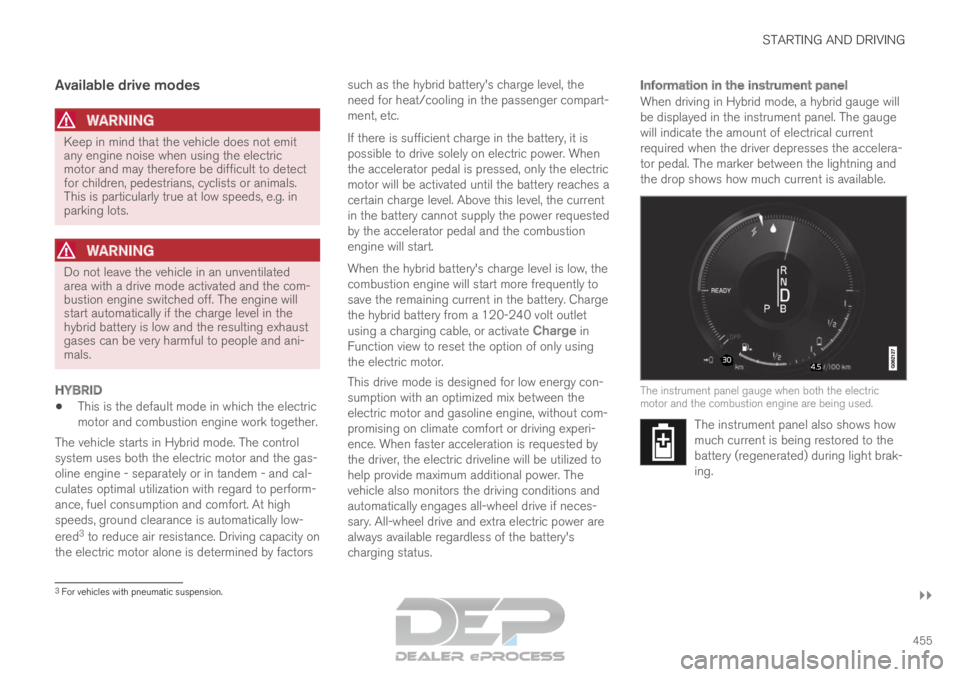
Information in the instrument panel
When driving in Hybrid mode, a hybrid gauge will
be displayed in the instrument panel. The gauge
will indicate the amount of electrical current
required when the driver depresses the accelera-
tor pedal. The marker between the lightning and
the drop shows how much current is available. The instrument panel gauge when both the electric
motor and the combustion engine are being used.
The instrument panel also shows how
much current is being restored to the
battery (regenerated) during light brak-
ing. 3
For vehicles with pneumatic suspension.
Page 458 of 697
||STARTING AND DRIVING
456
PURE
Uses the electric motor only, with the lowest
possible energy consumption and carbon
dioxide emissions.
This drive mode maximizes the use of the hybrid
battery. Ground clearance is lowered 3
to reduce
air resistance and certain climate system func-
tions are reduced to provide the longest possible
driving distance using only electricity.
Pure mode is available when the hybrid battery is
sufficiently charged. Even in Pure mode, the com-
bustion engine will start if the charge level in the
battery gets too low. The combustion engine will
also start
if the vehicle's speed goes above 125 km/h
(78 mph)
if the driver requests more power than the
electric motor can provide
if factors such as cold weather affect the
system or components.
This drive mode is optimized for maximum driving
distance with electric propulsion and is primarily
intended for use in city driving. Pure helps pro-
vide the lowest possible consumption even when
the hybrid battery is fully discharged. ECO climate
is activated to control the climate in the passen-
ger compartment, and in slippery road conditions
slightly more wheel spin may be permitted before
all-wheel drive is automatically activated.
ECO Climate
In Pure mode, ECO climate is automatically acti-
vated in the passenger compartment to help
reduce energy consumption.
NOTE When the
Pure drive mode is activated, set-
tings for certain climate system and electricity
consuming functions are reduced. Some of
these settings can be reset manually, but full
functionality will only be restored by leaving
Pure mode or adapting the Individual drive
mode to full climate system functionality. If condensation forms on the windows, tap the
max defroster button, which will function normally.
OFF ROAD
Maximizes the vehicle's ability to traverse dif-
ficult terrain or poor roads.
In this mode, ground clearance 3
is high, steering
is light, and all-wheel drive and Hill Descent
Control are activated.
This drive mode is only available at low speeds,
up to 40 km/h (25 mph). If this speed is excee-
ded, Off road mode will be cancelled and AWD
mode will be activated instead. All-wheel drive requires both the combustion and
electric motor to be in continuous operation,
which results in higher fuel consumption.
In Off road mode, a compass will be displayed
between the speedometer and the tachometer in
the instrument panel. The permissible speed
range will be shown in the speedometer.
3
For vehicles with pneumatic suspension.
Page 460 of 697
||STARTING AND DRIVING
458
INDIVIDUAL
Customizes drive mode to personal preferen-
ces.
Select one of the drive modes as a basis and
adjust the settings to achieve your preferred driv-
ing characteristics. These settings will be stored
in your driver profile.
Individual drive mode is only available if it has
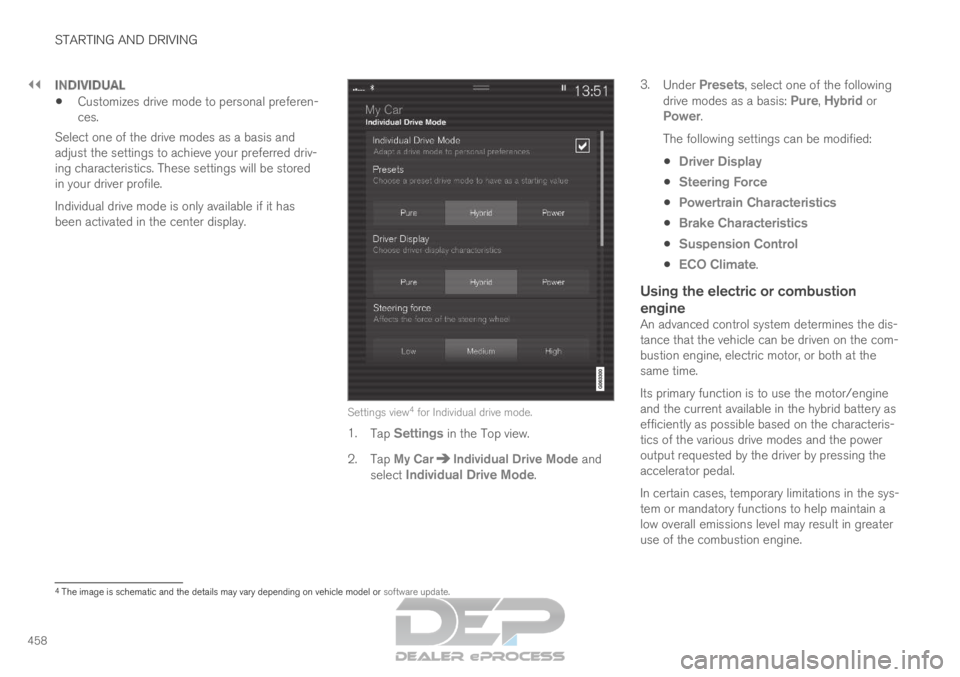
been activated in the center display. Settings view
4
for Individual drive mode.
1. Tap Settings in the Top view.
2.
Tap My Car Individual Drive Mode
and
select Individual Drive Mode. 3.
Under Presets, select one of the following
drive modes as a basis: Pure, Hybrid or Power.
The following settings can be modified:
Driver Display
Steering Force
Powertrain Characteristics
Brake Characteristics
Suspension Control
ECO Climate.
Using the electric or combustion
engine
An advanced control system determines the dis-
tance that the vehicle can be driven on the com-
bustion engine, electric motor, or both at the
same time.
Its primary function is to use the motor/engine
and the current available in the hybrid battery as
efficiently as possible based on the characteris-
tics of the various drive modes and the power
output requested by the driver by pressing the
accelerator pedal.
In certain cases, temporary limitations in the sys-
tem or mandatory functions to help maintain a
low overall emissions level may result in greater
use of the combustion engine. 4
The image is schematic and the details may vary depending on vehicle mod\
el or software update.
Page 470 of 697
||STARTING AND DRIVING
* Option/accessory.
468
Preconditioning
Whenever possible, precondition the vehicle
before driving by connecting the charging
cable to an electrical outlet.
Avoid parking the vehicle somewhere where
the interior will become too hot or too cold
while the vehicle is parked. If possible, park
the vehicle in a climate-controlled garage.
During a short drive after passenger com-
partment preconditioning, turn off the pas-
senger compartment fan or the air condition-
ing in a hot climate.
If preconditioning is not possible when it is
cold outside, use seat and steering wheel
heating first. Avoid heating the entire pas-
senger compartment to reduce the amount
of current being taken from the hybrid bat-
tery.
Driving
Choose the Pure drive mode to help mini-
mize electric power consumption.
Maintain a steady speed and a generous fol-
lowing distance to traffic ahead to minimize
braking. This drive mode has the lowest
power consumption.
Balance energy requirements using the
accelerator pedal. Use the indicator on the
instrument panel to see available electric
power and avoid starting the combustion
engine unnecessarily. The electric motor is more effective than the combustion engine,
especially at low speeds.
When braking is necessary, brake gently
using the brake pedal. This will help recharge
the hybrid battery. A regenerative function is
integrated in the brake pedal and can be
augmented by the electric motor's braking
capacity when the gear selector is in mode
B.
Higher speeds increase energy consumption
- air resistance increases with speed.
Activate the Hold function in the Function
view at high speeds when traveling farther
than is possible using the hybrid battery's
capacity.
Whenever possible, avoid using the Charge
function to charge the hybrid battery. Charg-
ing the battery using the combustion engine
increases fuel consumption and carbon diox-
ide emissions.
In a cold climate, reduce heating of the wind-
shield/rear window, mirrors, seats and the
steering wheel.
Maintain the correct pressure in the tires and
check pressure regularly.
The type of tires used could affect energy
consumption - consult a retailer for advice on
suitable tires.
Remove unnecessary items from the vehicle
- the heavier the load, the higher the fuel
consumption.
Roof loads increase air resistance and
increase fuel consumption. Remove roof
boxes, ski racks, etc. that are not in use.
Avoid driving with the windows open.
Do not keep the vehicle still on an upward
gradient by using the accelerator pedal. Use
the brakes instead.
Related information
Drive-E ‒ purer driving pleasure (p. 27)
Energy distribution in hybrid mode using map
data* (p. 460)
Factors affecting electric motor range
(p. 469)
Using the electric motor only (p. 469)
Hybrid gauge (p. 87)
Checking tire pressure (p. 567)
Page 472 of 697
||STARTING AND DRIVING
470
Factors the driver cannot control
There are several outside conditions that affect
range to varying degrees:
the current traffic situation
driving short distances
topography
ambient temperature and headwinds
road conditions and road surface.
The following table shows the approximate rela-
tionship between ambient temperature and driv-
ing range with normal climate settings and with
climate settings turned off.
Up to a certain limit, warmer ambient tempera-
tures increase the electric motor's driving range. Ambient tem-
perature
Climate set-
tings turned
offNormal cli-
mate set-
tings
30 °C (86 °F) 95 %
80 %
20 °C (68 °F) 100 % 90%
10 °C (50 °F) 90 % 80 %
0 °C (32 °F) 80 % 60 %
-10 °C (14 °F) 70 % 40 %
Factors the driver can control
The driver should be aware that the following fac-
tors help conserve energy and improve driving
range:
charging the battery regularly
preconditioning
Pure drive mode
climate control settings
speed and acceleration
the
Hold function
tires and tire pressure.
The following table shows the approximate rela-
tionship between constant speed and driving
range. Driving at a lower constant speed helps
increase the electric motor's driving range. Constant speed
100 km/h (62 mph)
50 %
80 km/h (50 mph) 70 %
60 km/h (37 mph) 90 %
50 km/h (31 mph) 100 %
NOTE
The figures shown in the tables pertain to
a new vehicle.
None of the figures are absolute and are
affected by e.g. driving style, environment
and other conditions.
Related information
Using the electric motor only (p. 469)
Economical driving (p. 467)
"Hold" and "Charge" functions (p. 471)
Drive modes (p. 454)
Page 563 of 697

WHEELS AND TIRES
}}
561
imprinted on the sidewall of the tire. The last four
digits in the series is the Department of
Transportation (DOT) stamp and indicates the
week and year the tire was manufactured. The
tire in the illustration has 0717 as the last four
digits, which means it was manufactured week 7
of 2017.
Tire ageTires degrade over time, even when they are not
being used. It is recommended that tires gener-
ally be replaced after 6 years of normal service.
Heat caused by hot climates, frequent high load-
ing conditions or Ultra Violet (U.V.) exposure can
accelerate the aging process. The temporary
spare
2
should also be replaced at 6-year inter-
vals, even if it has never been used. A tire with
e.g., visible cracks or discoloration should be
replaced immediately.
Tire economy
Maintain correct tire pressure.
Avoid fast starts, hard braking and tire
screeching.
Tire wear increases with speed.
Correct front wheel alignment is very impor-
tant.
Unbalanced wheels impair tire economy and
driving comfort.
Tires must maintain the same direction of
rotation throughout their lifetime.
When replacing tires, the tires with the most
tread should be mounted on the rear wheels
to reduce the chance of oversteer during
hard braking.
Hitting curbs or potholes can damage the
tires and/or wheels permanently.
Tire rotationYour vehicle has no required tire rotation. Driving
style, tire pressure, climate and road conditions
affect how quickly the tires age and exhibit signs
of wear. Maintaining the correct tire pressure
helps keep tread wear evenly distributed.
To help prevent differences in tread depth and
wear patterns forming on the tires, the front and
rear wheels should be rotated, i.e. the front tires
moved to the rear and the rear tires moved to the
front. Ideally, tire rotation should be done the first
time after approximately 5000 km (ca
3100 miles) and thereafter at 10,000 km
(approx. 6200 miles) intervals.
If you have any questions regarding tread depth,
Volvo recommends consulting an authorized
Volvo workshop. If significant differences in wear
(> 1 mm difference in tread depth) between the
tires have already occurred, the least worn tires
should always be mounted on the rear wheels. A
front-wheel skid (understeer) is usually easier to control than a rear-wheel skid (oversteer). If the
front wheels skid, the vehicle will continue in a
straight line instead of the rear wheels skidding
to the side, which could cause you to completely
lose control of the vehicle. It is therefore impor-
tant that the rear wheels never lose grip before
the front wheels.
Storing wheels and tiresWhen storing complete wheels (tires mounted on
rims), they should be suspended off the floor or
placed on their sides on the floor.
Tires not mounted on rims should be stored on
their sides or standing upright, but should not be
suspended.
CAUTION
Tires should preferably be stored in a cool,
dry, dark place, and should never be stored in
close proximity to solvents, gasoline, oils, etc.
2
Not available on all models.
Page 568 of 697
WHEELS AND TIRES
566Uniform Tire Quality Grading
ALL PASSENGER VEHICLE TIRES MUST
CONFORM TO FEDERAL SAFETY REQUIRE-
MENTS IN ADDITION TO THESE GRADES.
Quality grades can be found, where applica-
ble, on the tire sidewall between the tread
shoulder and maximum section width. For
example:
Treadwear 200 Traction AA Temperature A
TREADWEARThe treadwear grade is a comparative rating
based on the wear rate of the tire when tested
under controlled conditions on a specified gov-
ernment test course. For example, a tire graded
150 would wear one and one half (1 ½) times as
well on the government course as a tire graded
100. The relative performance of tires depends
upon the actual conditions of their use, however,
and many depart significantly from the norm due
to variation in driving habits, maintenance practi-
ces and differences in road characteristics and
climate.
TRACTIONThe traction grades, from highest to lowest, are
AA, A, B, and C, as measured under controlled
conditions on specified government test surfaces
of asphalt and concrete. A tire marked C may
have poor traction performance.
WARNING The traction grade assigned to this tire is
based on braking (straight-ahead) traction
tests and is not a measure of cornering (turn-
ing) traction.
TEMPERATUREThe temperature grades are A (the highest), B,
and C, representing the tire's resistance to the
generation of heat and its ability to dissipate heat
when tested under controlled conditions on a
specified indoor laboratory test wheel. Sustained
high temperature can cause the material of the
tire to degenerate and reduce tire life, and exces-
sive temperature can lead to sudden tire failure.
The grade C corresponds to a minimum level of
performance that all passenger vehicle tires must
meet under the Federal Motor Safety Standard
No. 109. Grades B and A represent higher levels
of performance on the laboratory test wheel than
the minimum required by law.
WARNING
The temperature grade for this tire is estab-
lished for a tire that is properly inflated and
not overloaded. Excessive speed, under-infla-
tion, or excessive loading, either separately or
in combination, can cause heat buildup and
tire failure.
Related information
Tires (p. 560)
Tire sidewall designations (p. 564)