seats VOLVO XC90 TWIN ENGINE 2019 Manual PDF
[x] Cancel search | Manufacturer: VOLVO, Model Year: 2019, Model line: XC90 TWIN ENGINE, Model: VOLVO XC90 TWIN ENGINE 2019Pages: 697, PDF Size: 10.33 MB
Page 596 of 697
LOADING, STORAGE AND PASSENGER COMPARTMENT
* Option/accessory.
594 Electrical outlets
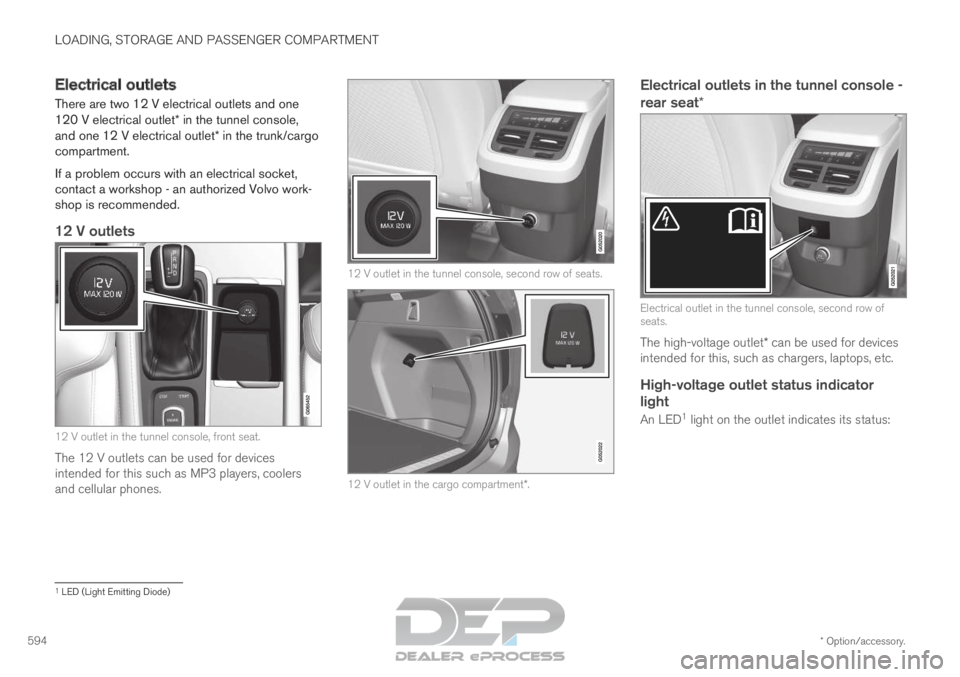
There are two 12 V electrical outlets and one
120 V electrical outlet* in the tunnel console,
and one 12 V electrical outlet* in the trunk/cargo
compartment.
If a problem occurs with an electrical socket,
contact a workshop - an authorized Volvo work-
shop is recommended.
12 V outlets 12 V outlet in the tunnel console, front seat.
The 12 V outlets can be used for devices
intended for this such as MP3 players, coolers
and cellular phones. 12 V outlet in the tunnel console, second row of seats.
12 V outlet in the cargo compartment*.
Electrical outlets in the tunnel console -
rear seat* Electrical outlet in the tunnel console, second row of
seats.
The high-voltage outlet* can be used for devices
intended for this, such as chargers, laptops, etc.
High-voltage outlet status indicator
light
An LED 1
light on the outlet indicates its status: 1
LED (Light Emitting Diode)
Page 600 of 697

LOADING, STORAGE AND PASSENGER COMPARTMENT
* Option/accessory.
598 Sun visors
In the ceiling in front of the driver and front pas-
senger, there are sun visors that can be lowered
and angled to the side as necessary.
The illustration is generic – the design may vary.
The mirror lighting* comes on automatically when
the cover is lifted up.
The mirror frame has a holder for e.g. cards or
tickets.
Related information
Passenger compartment interior (p. 592) Cargo compartment
The vehicle has a flexible cargo compartment
that makes it possible to carry and secure large
objects.
The cargo compartment capacity can be consid-
erably increased by folding down the backrests in
the second and third rows* of seats. To make
loading and unloading easier, the rear section of
the vehicle can be raised and lowered using the
level control function*. Use the load anchoring
eyelets or grocery bag holders to help secure
objects in place, and the retractable cargo com-
partment cover* to help conceal objects in the
cargo compartment.
If the vehicle is equipped with a temporary spare
tire, this is secured to the cargo compartment
floor under the cover. The towing eyelet and tire
sealing system are located under the cargo com-
partment floor.
Related information
Loading recommendations (p. 598)
Grocery bag holders (p. 600)
Load anchoring eyelets (p. 601)
Installing and removing the cargo compart-
ment cover* (p. 601) Loading recommendations
There are a number of things to consider when
carrying loads in or on the vehicle.
Load-carrying capacity is determined by the vehi-
cle's curb weight. The total weight of all passen-
gers and any installed accessories reduces the
vehicle's load-carrying capacity by the corres-
ponding amount.
WARNING The vehicle's driving characteristics change
depending on the weight and position of the
load.
Loading the cargo compartment/trunk
Position objects so they are pressing against
the rear seat backrests.
Distribute the load evenly.
Heavy objects should be positioned as low
as possible. Avoid placing heavy objects on
folded-down seat backrests.
Cover sharp corners with a soft cloth or simi-
lar to help prevent damage to the upholstery.
Use the load anchoring eyelets and tension-
ing straps or similar to secure all objects.
Page 601 of 697
LOADING, STORAGE AND PASSENGER COMPARTMENT
* Option/accessory.599
WARNINGIn a head-on collision at a speed of 50 km/h
(30 mph), an unsecured object weighing 20
kg (44 pounds) can reach a projectile weight
equivalent to 1000 kg (2200 pounds).
WARNING
If objects are loaded higher than the upper
edge of the side windows, leave a 10 cm (4
in.) space between the objects and the win-
dow. Objects placed closer to this could
impede the function of the inflatable curtain
concealed inside the headlining.
WARNING
Always secure the load. Otherwise, it may shift
during heavy braking and injure people in the
vehicle.
Cover sharp edges and sharp corners with
something soft.
Turn off the engine and apply the parking
brake when loading/unloading long objects.
Otherwise, it is possible for the load to reach
the gear lever or gear selector and move it to
a drive position – which could cause the vehi-
cle to begin rolling.
Extra cargo space
The rear seat backrests can be folded down to
increase cargo compartment space and simplify
loading. If the rear seat backrests are folded down, make sure that no objects loaded into the
vehicle prevent the WHIPS system for the front
seats from functioning correctly.
Raising/lowering the rear end of the
vehicle*
The rear end of the vehicle can be lowered or
raised for easier loading or to facilitate attaching
a trailer*.
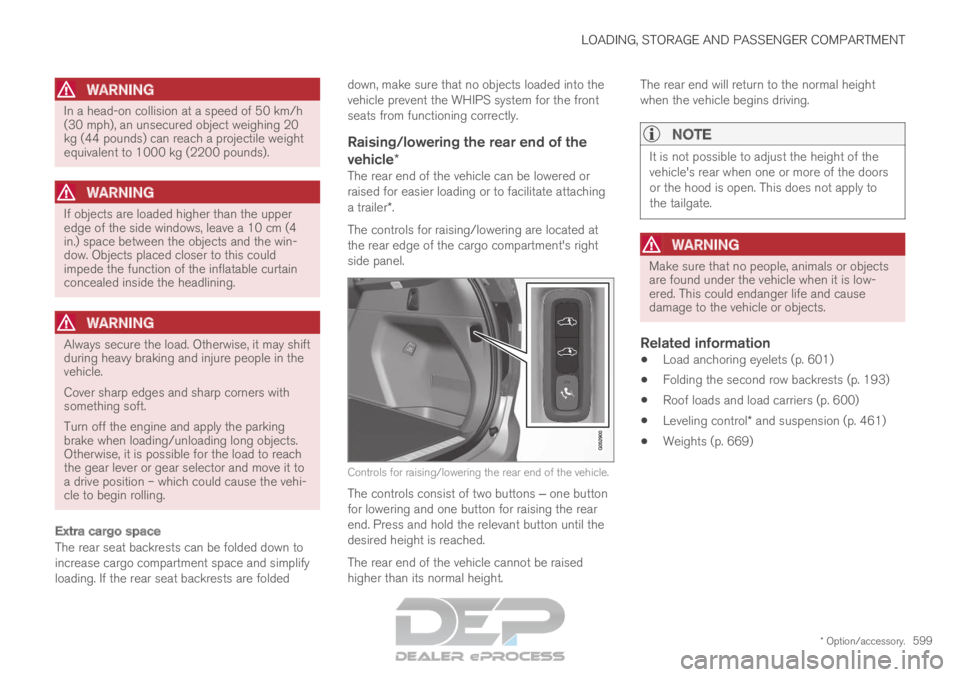
The controls for raising/lowering are located at
the rear edge of the cargo compartment's right
side panel. Controls for raising/lowering the rear end of the vehicle.
The controls consist of two buttons ‒ one button
for lowering and one button for raising the rear
end. Press and hold the relevant button until the
desired height is reached.
The rear end of the vehicle cannot be raised
higher than its normal height. The rear end will return to the normal height
when the vehicle begins driving.
NOTE It is not possible to adjust the height of the
vehicle's rear when one or more of the doors
or the hood is open. This does not apply to
the tailgate.
WARNING
Make sure that no people, animals or objects
are found under the vehicle when it is low-
ered. This could endanger life and cause
damage to the vehicle or objects.
Related information
Load anchoring eyelets (p. 601)
Folding the second row backrests (p. 193)
Roof loads and load carriers (p. 600)
Leveling control* and suspension (p. 461)
Weights (p. 669)
Page 605 of 697

LOADING, STORAGE AND PASSENGER COMPARTMENT
}}
603 Grasp the handle and pull the cover out and
above the side panels in the cargo compart-
ment. Pull the cover to its end position.
With the cover completely open (covering the
cargo compartment), press the attaching
pins at the end of the cover into the grooves
on the side panels and release the cover
slightly while pressing the handle lightly
downward to hook the pins into the grooves.
>
The cover will be secured in the fully open
position.
CAUTION Do not place objects on top of the cargo
compartment cover.
WARNING
In 7-seat models - never have a cargo com-
partment cover mounted when there are pas-
sengers in the rear seats. This could lead to
serious injury in the event of a collision.
Loading mode From the fully retracted position - grasp the
handle and pull the cover up and over the
side panels in the cargo compartment. Pull to
the end position and press the attaching pins
at the end of the cover into the grooves in
the side panels of the vehicle. (If the cover is
already fully open, see next section.)
From the fully open position - grasp the han-
dle and press the cover's attaching pins
down into the grooves in the side panels and
then release.
>
Retract the cover until it stops in the parti-
ally retracted position. If your hands are full: In the fully open position, push the cover's
handle slightly upward with e.g. your elbow.
>
The cover will retract until it stops in
the partially retracted position.
To fully open the cover from the partially retrac-
ted position:
1.
Grasp the handle and pull the cover out as
far as possible.
2. Let the cover retract slightly and press the handle slightly downward.
> The cover will be secured in the fully openposition.
Page 606 of 697

||LOADING, STORAGE AND PASSENGER COMPARTMENT
* Option/accessory.
604
Retracting the cover
1. From the fully opened position:
Lift the cover's handle and pull it rearward to
release the cover's attaching pins from the
grooves. Let the cover retract.
From the partially retracted position:
Grasp the handle and pull the cover out of
the groves to the fully open position. Lift the
handle and pull it rearward to release the
cover's attaching pins from the grooves. Let
the cover retract.
2. Let the cover retract with its attaching pins above the side panels until it stops in the
fully retracted position.
Related information
Installing and removing the cargo compart-
ment cover* (p. 601) Installing and removing the steel
cargo grid*
The steel cargo grid helps prevent loads or pets
in the cargo compartment from being thrown for-
ward into the passenger compartment. For safety reasons, the steel grid must always be
installed and secured correctly.
WARNING
Under no circumstances may a person be in
the cargo compartment when the vehicle is
moving. Heavy braking or a collision could
lead to serious injury.
The steel grid consists of the grid itself and two
separate mounting brackets. Each of the mount- ing brackets has a screw cover and two plastic
sleeves for the grid.
WARNING The steel cargo grid may only be used in the
rear position described here. The ceiling
attachment points behind the front seats are
not intended to anchor the steel grid.
WARNING
For safety reasons, the third-row seats
4
must
be folded down when the steel cargo grid is
mounted in the vehicle.
CAUTION The steel cargo grid and the cargo compart-
ment cover cannot be mounted at the same
time.
Installation1. Fold down the rear seats and lift in the steel
grid through one of the rear doors or the tail-
gate. The curved (convex) side of the grid
should face toward the cargo compartment
and the hooks on each side of the grid
should face upward. The mounting brackets
and plastic sleeves are not needed in this
step. 4
7-seat models only.
Page 608 of 697

LOADING, STORAGE AND PASSENGER COMPARTMENT
* Option/accessory.
606 Installing and removing the cargo
net*
The cargo net helps prevent objects in the cargo
compartment from entering the passenger com-
partment in the event of a sudden stop or hard
braking.
The cargo net is attached at four points. For safety reasons, the cargo net must always be
mounted and secured according to the following
description.
The net is made of strong nylon weave and can
be attached in two different locations in the vehi-
cle:
Rear mounting - behind the second row of
seats.
Front mounting - behind the front seats.
WARNING Objects in the cargo compartment must
always be securely anchored, even with a cor-
rectly installed cargo net.
Installing the cargo net
WARNING
All of the cargo net's upper consoles, hooks
and straps must be securely mounted and
attached before the net is used.
Never use the net if it is damaged.
NOTE
With front mounting, the cargo net is most
easily installed via a rear door.
1. Fold out the cargo net and make sure that
the upper rod folds out and locks into posi-
tion.
2.
Insert one of the net's hooks into the front or
rear ceiling mounting point with the strap
lock facing you. 3. Insert the net's other upper hook into the
ceiling mounting point on the opposite side.
The telescopic spring-loaded hooks make
mounting easier.
Make sure that the net's hooks are pushed
forward as far as possible into their respec-
tive mounting points.
Page 609 of 697
LOADING, STORAGE AND PASSENGER COMPARTMENT
607
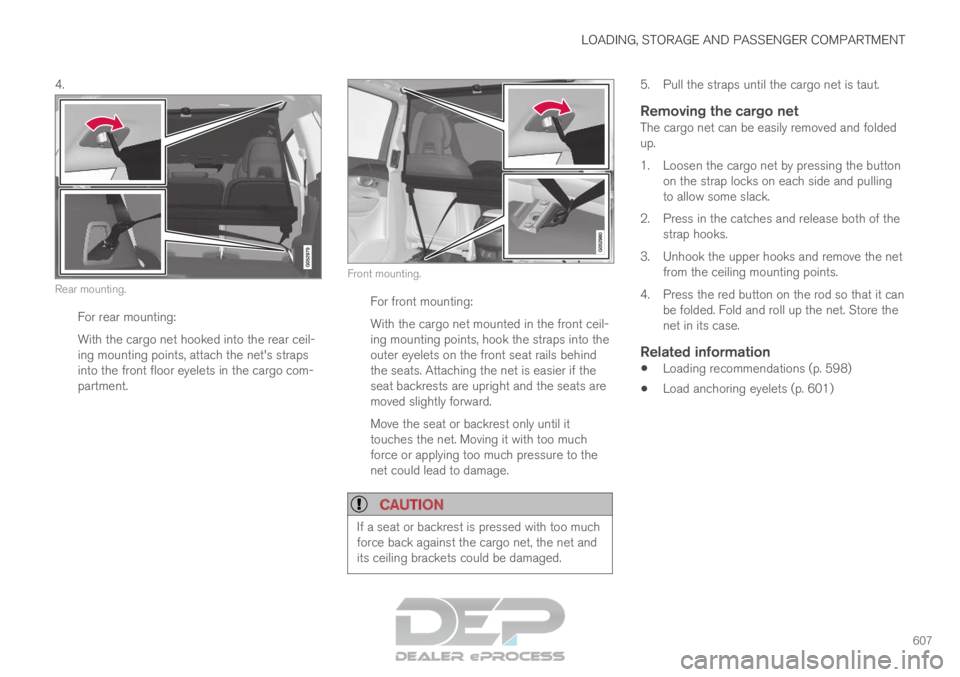
4.
Rear mounting.
For rear mounting:
With the cargo net hooked into the rear ceil-
ing mounting points, attach the net's straps
into the front floor eyelets in the cargo com-
partment. Front mounting.
For front mounting:
With the cargo net mounted in the front ceil-
ing mounting points, hook the straps into the
outer eyelets on the front seat rails behind
the seats. Attaching the net is easier if the
seat backrests are upright and the seats are
moved slightly forward.
Move the seat or backrest only until it
touches the net. Moving it with too much
force or applying too much pressure to the
net could lead to damage.
CAUTION If a seat or backrest is pressed with too much
force back against the cargo net, the net and
its ceiling brackets could be damaged. 5. Pull the straps until the cargo net is taut.
Removing the cargo netThe cargo net can be easily removed and folded
up.
1. Loosen the cargo net by pressing the button
on the strap locks on each side and pulling
to allow some slack.
2. Press in the catches and release both of the strap hooks.
3. Unhook the upper hooks and remove the net from the ceiling mounting points.
4. Press the red button on the rod so that it can be folded. Fold and roll up the net. Store the
net in its case.
Related information
Loading recommendations (p. 598)
Load anchoring eyelets (p. 601)
Page 637 of 697
MAINTENANCE AND SERVICE
}}
635
Fuse pliers are provided on the inside of the fuse
box cover to assist in removing and inserting
fuses.
There are also spaces for several extra fuses in
the fusebox.
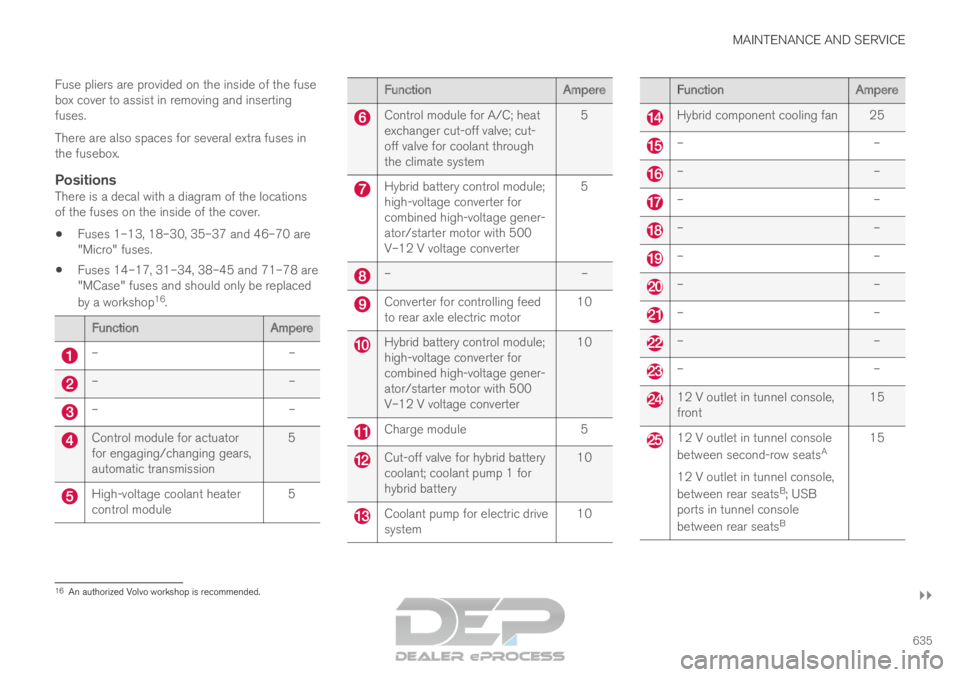
PositionsThere is a decal with a diagram of the locations
of the fuses on the inside of the cover.
Fuses 1–13, 18–30, 35–37 and 46–70 are
"Micro" fuses.
Fuses 14–17, 31–34, 38–45 and 71–78 are
"MCase" fuses and should only be replaced
by a workshop 16
. Function
Ampere–
––
––
–Control module for actuator
for engaging/changing gears,
automatic transmission
5High-voltage coolant heater
control module
5 Function
Ampere Control module for A/C; heat
exchanger cut-off valve; cut-
off valve for coolant through
the climate system
5 Hybrid battery control module;
high-voltage converter for
combined high-voltage gener-
ator/starter motor with 500
V–12 V voltage converter
5 –
– Converter for controlling feed
to rear axle electric motor
10 Hybrid battery control module;
high-voltage converter for
combined high-voltage gener-
ator/starter motor with 500
V–12 V voltage converter
10 Charge module
5 Cut-off valve for hybrid battery
coolant; coolant pump 1 for
hybrid battery
10 Coolant pump for electric drive
system
10 Function
Ampere Hybrid component cooling fan 25
–
– –
– –
– –
– –
– –
– –
– –
– –
– 12 V outlet in tunnel console,
front
15 12 V outlet in tunnel console
between second-row seats
A
12 V outlet in tunnel console,
between rear seats B
; USB
ports in tunnel console
between rear seats B15
16
An authorized Volvo workshop is recommended.
Page 641 of 697
MAINTENANCE AND SERVICE
}}
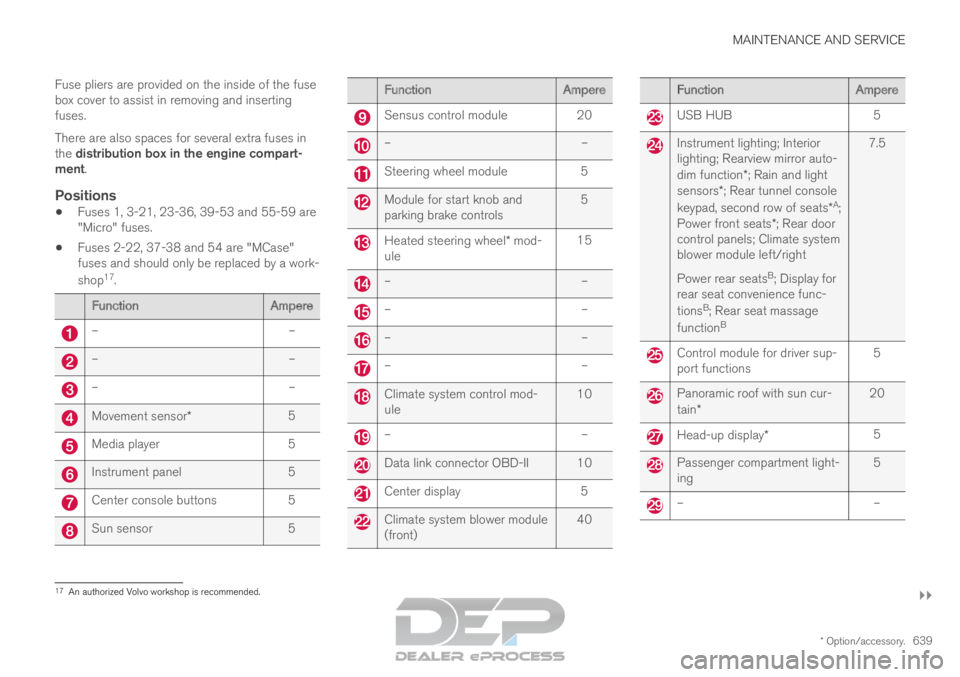
* Option/accessory. 639
Fuse pliers are provided on the inside of the fuse
box cover to assist in removing and inserting
fuses.
There are also spaces for several extra fuses in
the distribution box in the engine compart-
ment.
Positions
Fuses 1, 3-21, 23-36, 39-53 and 55-59 are
"Micro" fuses.
Fuses 2-22, 37-38 and 54 are "MCase"
fuses and should only be replaced by a work-
shop 17
. Function
Ampere–
––
––
–Movement sensor*
5Media player
5Instrument panel
5Center console buttons
5Sun sensor
5 Function
Ampere Sensus control module
20 –
– Steering wheel module
5 Module for start knob and
parking brake controls
5 Heated steering wheel* mod-
ule 15 –
– –
– –
– –
– Climate system control mod-
ule
10 –
– Data link connector OBD-II 10
Center display
5 Climate system blower module
(front)
40 Function
Ampere USB HUB
5 Instrument lighting; Interior
lighting; Rearview mirror auto-
dim function*; Rain and light
sensors*; Rear tunnel console
keypad, second row of seats* A
;
Power front seats *; Rear door
control panels; Climate system
blower module left/right
Power rear seats B
; Display for
rear seat convenience func-
tions B
; Rear seat massage
function B 7.5 Control module for driver sup-
port functions
5 Panoramic roof with sun cur-
tain*
20 Head-up display*
5 Passenger compartment light-
ing
5 –
–17
An authorized Volvo workshop is recommended.
Page 642 of 697
||MAINTENANCE AND SERVICE
* Option/accessory.
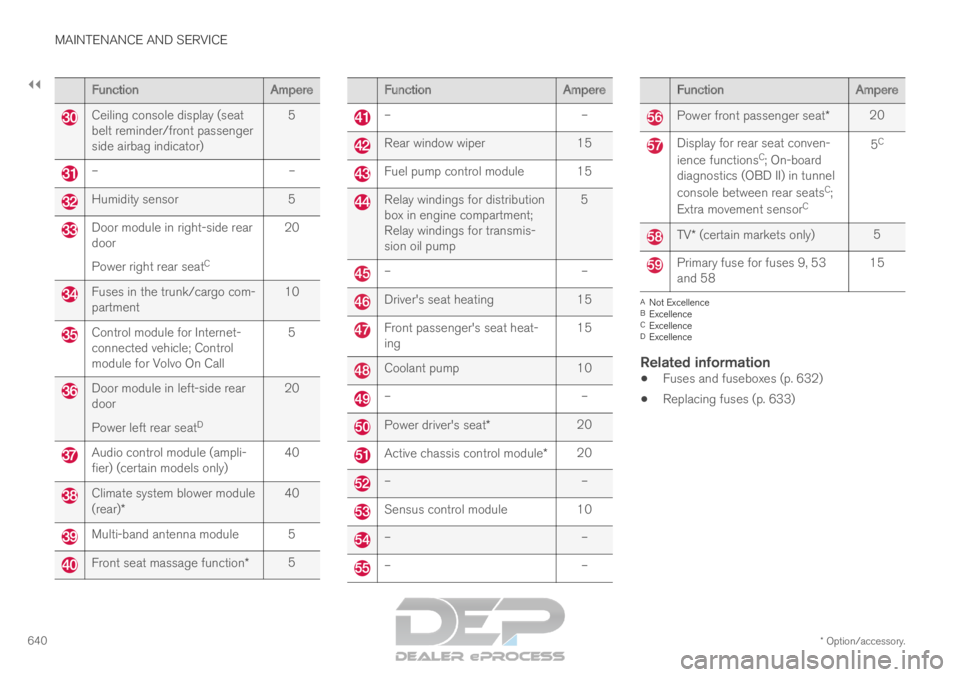
640 Function
AmpereCeiling console display (seat
belt reminder/front passenger
side airbag indicator)
5–
–Humidity sensor
5Door module in right-side rear
door
Power right rear seat
C20 Fuses in the trunk/cargo com-
partment
10Control module for Internet-
connected vehicle; Control
module for Volvo On Call
5Door module in left-side rear
door
Power left rear seat
D20 Audio control module (ampli-
fier) (certain models only)
40Climate system blower module
(rear)*
40Multi-band antenna module 5
Front seat massage function*
5 Function
Ampere –
– Rear window wiper
15 Fuel pump control module 15
Relay windings for distribution
box in engine compartment;
Relay windings for transmis-
sion oil pump
5 –
– Driver's seat heating
15 Front passenger's seat heat-
ing
15 Coolant pump
10 –
– Power driver's seat*
20 Active chassis control module*
20 –
– Sensus control module
10 –
– –
– Function
Ampere Power front passenger seat*
20 Display for rear seat conven-
ience functions
C
; On-board
diagnostics (OBD II) in tunnel
console between rear seats C
;
Extra movement sensor C5
C TV* (certain markets only)
5 Primary fuse for fuses 9, 53
and 58
15 A
Not Excellence
B Excellence
C Excellence
D Excellence
Related information
Fuses and fuseboxes (p. 632)
Replacing fuses (p. 633)