ABS VOLVO XC90 TWIN ENGINE 2019 Owners Manual
[x] Cancel search | Manufacturer: VOLVO, Model Year: 2019, Model line: XC90 TWIN ENGINE, Model: VOLVO XC90 TWIN ENGINE 2019Pages: 697, PDF Size: 10.33 MB
Page 41 of 697
YOUR VOLVO
}}
39
Volvo Structural Parts Statement
Volvo is one of the leading companies for carsafety.
Volvo engineers and manufactures vehiclesdesigned to help protect vehicle occupants in theevent of a collision.
Volvos are designed to absorb the impact of acollision. This energy absorption system including,but not limited to, structural components such asbumper reinforcement bars, bumper energyabsorbers, frames, rails, fender aprons, A-pillars,B-pillars and body panels must work together tomaintain cabin integrity and protect the vehicleoccupants.
The supplemental restraint system including butnot limited to air bags, side curtain air bags, anddeployment sensors work together with theabove components to provide proper timing forair bag deployment.
Due to the above, Volvo Car USA does not sup-port the use of aftermarket, alternative or any-thing other than original Volvo parts for collisionrepair.
Volvo Car USA also recommends using Volvo-approved replacement glass. The use of after-market glass, particularly a windshield, can havean adverse effect on collision avoidance andadvanced lighting systems.
In addition Volvo does not support the use or re-use of structural components from an existing
vehicle that has been previously damaged.Although these parts may appear equivalent, it isdifficult to tell if the parts have been previouslyreplaced with non-OE parts or if the part hasbeen damaged as a result of a prior collision. Thequality of these used parts may also have beenaffected due to environmental exposure.
Related information
Data recording (p. 33)
Driver distraction
A driver has a responsibility to do everythingpossible to ensure his or her own safety and thesafety of passengers in the vehicle and otherssharing the roadway. Part of this responsibility isavoiding distractions, including performing activi-ties that are not directly related to controlling thevehicle in the driving environment.
Your new Volvo is, or can be, equipped with fea-ture-rich entertainment and communication sys-tems. These include hands-free cellular tele-phones, navigation systems, and multipurposeaudio systems. You may also own other portableelectronic devices for your own convenience.When used properly and safely, they enrich thedriving experience. Improperly used, any of thesecould cause a distraction.
For all of these systems, we want to provide thefollowing warning that reflects the strong Volvoconcern for your safety. Never use these devicesor any feature of your vehicle in a way that dis-tracts you from the task of driving safely. Distrac-tion can lead to a serious accident. In addition tothis general warning, we offer the following guid-ance regarding specific new features that may befound in your vehicle:
Page 45 of 697
SAFETY
}}
* Option/accessory.43
Safety during pregnancy
It is important that seat belts are worn correctlyduring pregnancy and that pregnant driversadjust their seating position accordingly.
Seat belt
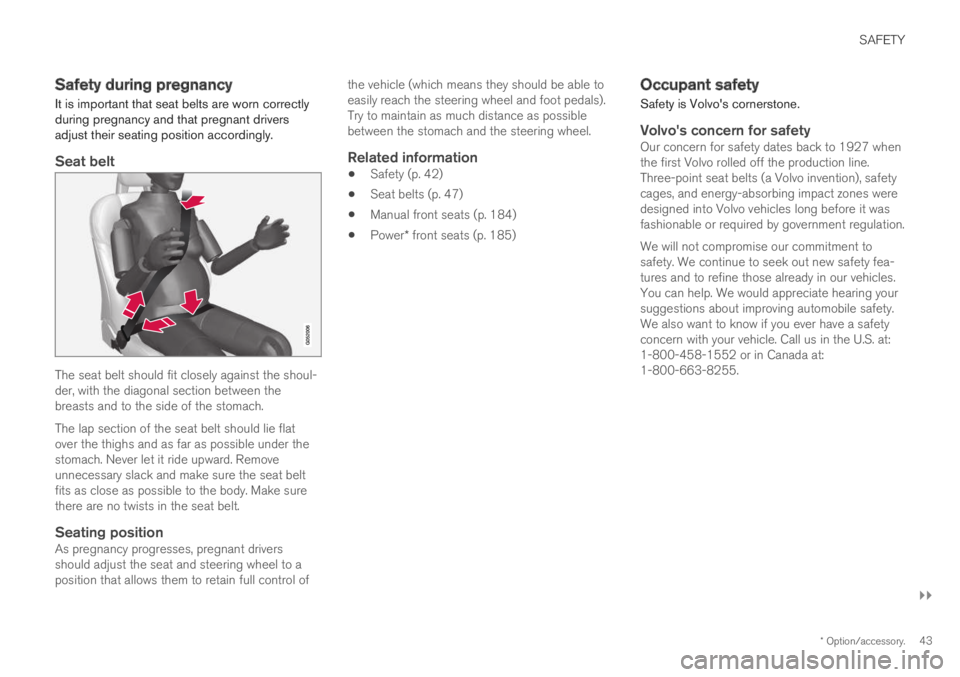
The seat belt should fit closely against the shoul-der, with the diagonal section between thebreasts and to the side of the stomach.
The lap section of the seat belt should lie flatover the thighs and as far as possible under thestomach. Never let it ride upward. Removeunnecessary slack and make sure the seat beltfits as close as possible to the body. Make surethere are no twists in the seat belt.
Seating position
As pregnancy progresses, pregnant driversshould adjust the seat and steering wheel to aposition that allows them to retain full control of
the vehicle (which means they should be able toeasily reach the steering wheel and foot pedals).Try to maintain as much distance as possiblebetween the stomach and the steering wheel.
Related information
Safety (p. 42)
Seat belts (p. 47)
Manual front seats (p. 184)
Power* front seats (p. 185)
Occupant safety
Safety is Volvo's cornerstone.
Volvo's concern for safety
Our concern for safety dates back to 1927 whenthe first Volvo rolled off the production line.Three-point seat belts (a Volvo invention), safetycages, and energy-absorbing impact zones weredesigned into Volvo vehicles long before it wasfashionable or required by government regulation.
We will not compromise our commitment tosafety. We continue to seek out new safety fea-tures and to refine those already in our vehicles.You can help. We would appreciate hearing yoursuggestions about improving automobile safety.We also want to know if you ever have a safetyconcern with your vehicle. Call us in the U.S. at:1-800-458-1552 or in Canada at:1-800-663-8255.
Page 48 of 697
||
SAFETY
46
Related information
Safety (p. 42)
Reporting safety defects (p. 44)
Occupant safety (p. 43)
Whiplash Protection System
The Whiplash Protection System (WHIPS) isdesigned to help reduce the risk of whiplash-type injuries. The system consists of energyabsorbing backrests and seat cushions as wellas specially designed head restraints in the frontseats.
WHIPS is activated in the event of a rear-endcollision and adapted to the angle and speed ofthe collision and to the characteristics of the col-liding vehicle.
When WHIPS is activated, the front seat back-rests move rearward and the seat cushions movedownward to change the seating positions of thedriver and front seat passenger. This movementhelps absorb some of the forces that could resultin whiplash.
WARNING
WHIPS is a supplement to the seat belt.Always wear your seat belt.
WARNING
Do not attempt to alter or repair the seat orWHIPS on your own. Volvo recommends con-tacting an authorized Volvo workshop.
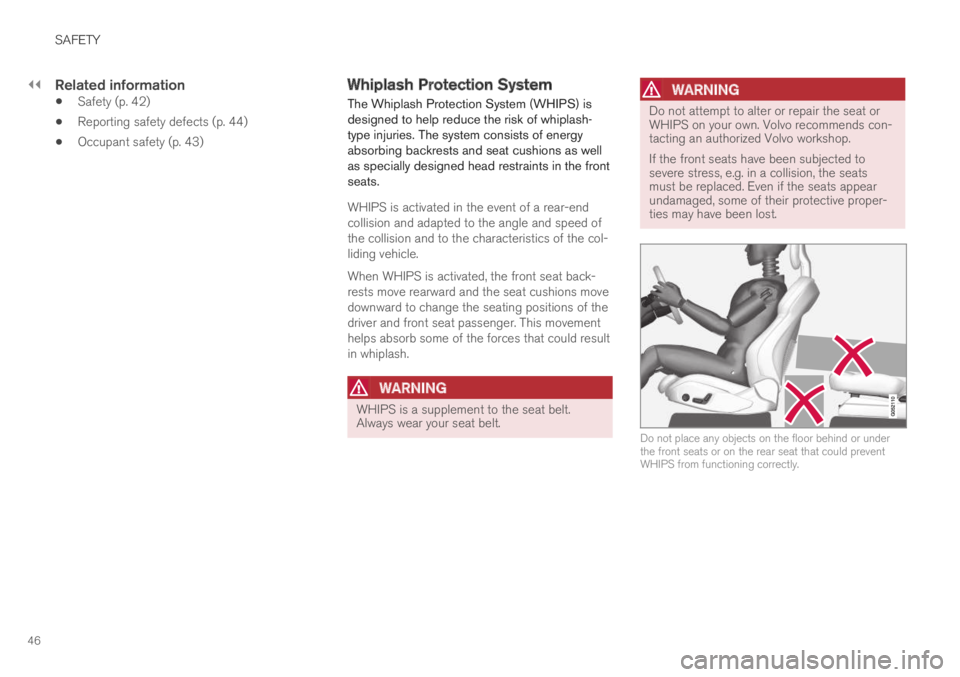
If the front seats have been subjected tosevere stress, e.g. in a collision, the seatsmust be replaced. Even if the seats appearundamaged, some of their protective proper-ties may have been lost.
Do not place any objects on the floor behind or underthe front seats or on the rear seat that could preventWHIPS from functioning correctly.
Page 65 of 697

SAFETY
}}63
2.
Do not move the vehicle farther than abso-
lutely necessary.
WARNING When the vehicle is in safety mode, it should
not be towed behind another vehicle. It should
be towed from the site on a tow truck. Volvo
recommends towing the vehicle directly to an
authorized Volvo workshop.
Related information
Safety mode (p. 61)
Starting the vehicle (p. 434)
Recovery (p. 489) Child safety
Children should always be seated safely when
traveling in the vehicle.
General informationVolvo recommends the proper use of restraint
systems for all occupants including children.
Remember that, regardless of age and size, a
child should always be properly restrained in a
vehicle.
Your vehicle is also equipped with ISOFIX/
LATCH attachments, which make it more conven-
ient to install child seats.
Some restraint systems for children are designed
to be secured in the vehicle by lap belts or the
lap portion of a lap-shoulder belt. Such child
restraint systems can help protect children in
vehicles in the event of an accident only if they
are used properly. However, children could be
endangered in a crash if the child restraints are
not properly secured in the vehicle. Failure to fol-
low the installation instructions for your child
restraint can result in your child striking the vehi-
cle's interior in a sudden stop.
Holding a child in your arms is NOT a suitable
substitute for a child restraint system. In an acci-
dent, a child held in a person's arms can be
crushed between the vehicle's interior and an
unrestrained person. The child could also be
injured by striking the interior, or by being ejected
from the vehicle during a sudden maneuver or impact. The same can also happen if the infant or
child rides unrestrained on the seat. Other occu-
pants should also be properly restrained to help
reduce the chance of injuring or increasing the
injury of a child.
All states and provinces have legislation govern-
ing how and where children should be carried in
a vehicle. Find out the regulations existing in your
state or province. Recent accident statistics have
shown that children are safer in rear seating
positions than front seating positions when prop-
erly restrained. A child restraint system can help
protect a child in a vehicle. Here's what to look
for when selecting a child restraint system:
It should have a label certifying that it meets
applicable Federal Motor Vehicle Safety Stand-
ards (FMVSS 213) - or in Canada, CMVSS 213.
Make sure the child restraint system is approved
for the child's height, weight and development -
the label required by the standard or regulation,
or instructions for infant restraints, typically pro-
vide this information.
In using any child restraint system, we urge you
to carefully look over the instructions that are
provided with the restraint. Be sure you under-
stand them and can use the device properly and
safely in this vehicle. A misused child restraint
system can result in increased injuries for both
the infant or child and other occupants in the
vehicle.
Page 97 of 697
DISPLAYS AND VOICE CONTROL
}}95 Symbol
Meaning A
B
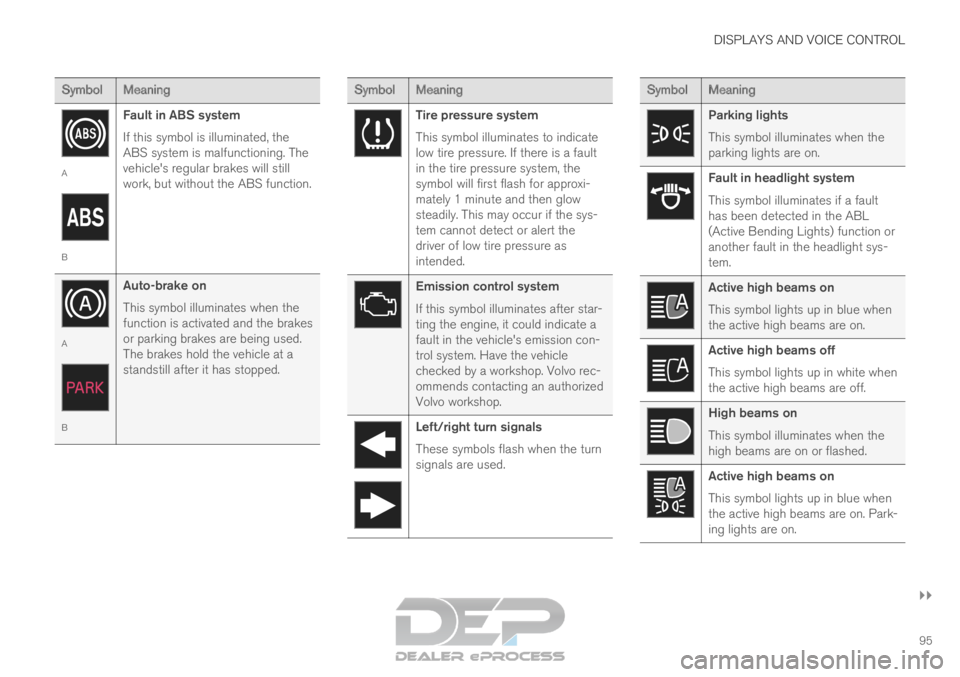
Fault in ABS system
If this symbol is illuminated, the
ABS system is malfunctioning. The
vehicle's regular brakes will still
work, but without the ABS function. A
B
Auto-brake on
This symbol illuminates when the
function is activated and the brakes
or parking brakes are being used.
The brakes hold the vehicle at a
standstill after it has stopped. Symbol
Meaning Tire pressure system
This symbol illuminates to indicate
low tire pressure. If there is a fault
in the tire pressure system, the
symbol will first flash for approxi-
mately 1 minute and then glow
steadily. This may occur if the sys-
tem cannot detect or alert the
driver of low tire pressure as
intended.
Emission control system
If this symbol illuminates after star-
ting the engine, it could indicate a
fault in the vehicle's emission con-
trol system. Have the vehicle
checked by a workshop. Volvo rec-
ommends contacting an authorized
Volvo workshop.
Left/right turn signals
These symbols flash when the turn
signals are used. Symbol
Meaning Parking lights
This symbol illuminates when the
parking lights are on.
Fault in headlight system
This symbol illuminates if a fault
has been detected in the ABL
(Active Bending Lights) function or
another fault in the headlight sys-
tem.
Active high beams on
This symbol lights up in blue when
the active high beams are on.
Active high beams off
This symbol lights up in white when
the active high beams are off.
High beams on
This symbol illuminates when the
high beams are on or flashed.
Active high beams on
This symbol lights up in blue when
the active high beams are on. Park-
ing lights are on.
Page 114 of 697
DISPLAYS AND VOICE CONTROL
112Handling the center display
Many of the vehicle's functions and features can
be controlled and adjusted from the center dis-
play. The center display is a touchscreen that
reacts to taps and other gestures.
Using the center display's touchscreenThe touchscreen reacts differently depending on
whether the user taps, drags or swipes the
screen. It is possible to e.g. move between differ- ent views, mark objects, scroll in a list and move
apps by touching the screen in various ways.
An infrared light curtain just above the surface of
the screen enables the screen to detect when a
finger is directly in front of the screen. This tech-
nology makes it possible to use the screen even
while wearing gloves.
Two people can interact with the screen at the
same time, e.g. to adjust climate system settings
for both the driver and passenger sides.
CAUTION Do not use sharp objects on the screen as
this could cause scratches.
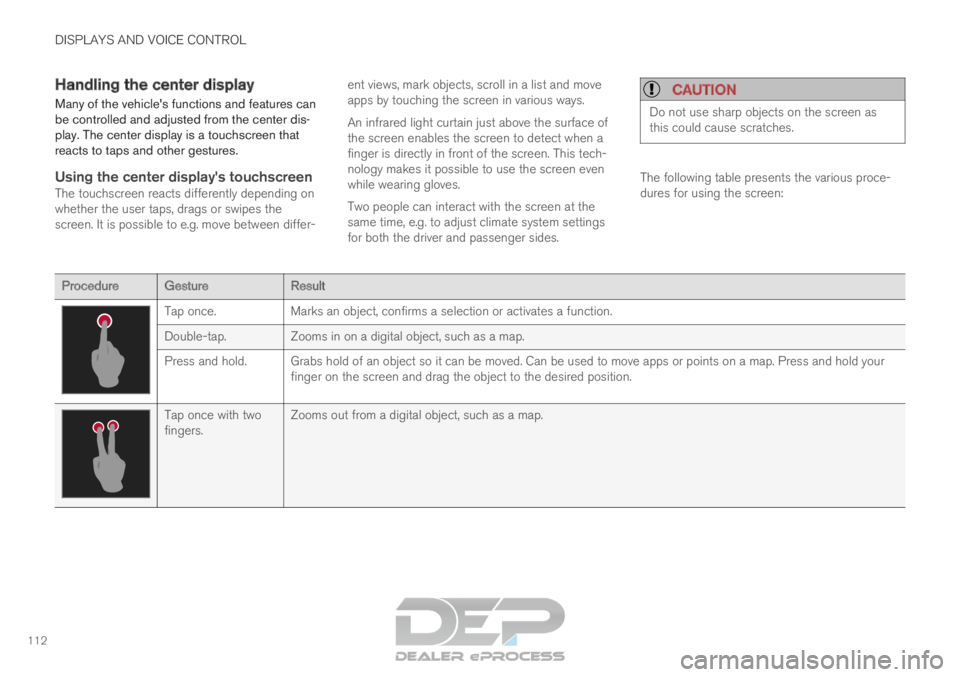
The following table presents the various proce-
dures for using the screen:
Procedure
Gesture Result Tap once.
Marks an object, confirms a selection or activates a function.
Double-tap.
Zooms in on a digital object, such as a map.
Press and hold. Grabs hold of an object so it can be moved. Can be used to move apps or \
points on a map. Press and hold your finger on the screen and drag the object to the desired position. Tap once with two
fingers.
Zooms out from a digital object, such as a map.
Page 162 of 697
||LIGHTING
160
The rear fog light turns off automatically when
the ignition is switched off or when the steering
wheel lever lighting ring is in position
or
.
NOTE
Regulations concerning rear fog light use vary
from country to country.
Related information
Lighting panel and controls (p. 152)
Ignition modes (p. 437) Brake lights
The brake lights are automatically illuminated
when braking.
The brake lights illuminate when the brake pedal
is depressed. They also illuminate when the
brakes are automatically applied by one of the
driver support systems.
Related information
Emergency brake lights (p. 160)
Brake functions (p. 438) Emergency brake lights
The emergency brake lights are activated to
warn following vehicles of hard braking.
This function causes an additional taillight on
each side of the vehicle to illuminate.
The emergency brake lights are activated in the
event of hard braking or if the ABS system is
activated and the vehicle is traveling at a high
speed.
After the driver decelerates to a low speed and
then releases the brake, the brake lights resume
their normal brightness.
Related information
Brake lights (p. 160)
Brakes (p. 439)
Hazard warning flashers (p. 161)
Page 217 of 697
CLIMATE CONTROL
}}
* Option/accessory. 215
Climate system controls
The climate system functions are controlled from
physical buttons on the center console, the cen-
ter display, and the climate panel on the rear
side of the tunnel console.
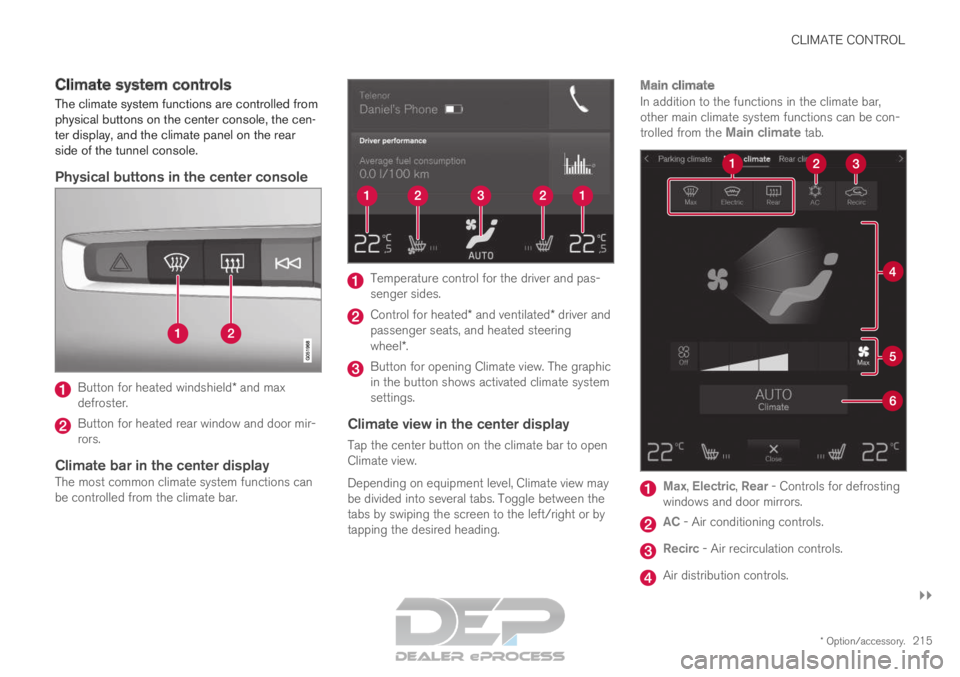
Physical buttons in the center console Button for heated windshield* and max
defroster. Button for heated rear window and door mir-
rors.
Climate bar in the center displayThe most common climate system functions can
be controlled from the climate bar. Temperature control for the driver and pas-
senger sides.
Control for heated* and ventilated* driver and
passenger seats, and heated steering
wheel*. Button for opening Climate view. The graphic
in the button shows activated climate system
settings.
Climate view in the center display
Tap the center button on the climate bar to open
Climate view.
Depending on equipment level, Climate view may
be divided into several tabs. Toggle between the
tabs by swiping the screen to the left/right or by
tapping the desired heading.
Main climate
In addition to the functions in the climate bar,
other main climate system functions can be con-
trolled from the
Main climate tab. Max
, Electric, Rear - Controls for defrosting
windows and door mirrors. AC
- Air conditioning controls.
Recirc
- Air recirculation controls.
Air distribution controls.
Page 441 of 697
STARTING AND DRIVING
}}
439
Brakes
The brake pedal is used to apply the vehicle's
regular brakes, which are part of the brake sys-
tem.
The vehicle is equipped with two brake circuits. If
one brake circuit is damaged, the brake pedal will
go down further when depressed. More pressure
will then be required from the driver for normal
braking effect.
WARNING
The power brakes only work when the electric
motor or combustion engine is running.
If the brake pedal is used when the engine is
switched off, greater pressure must be applied to
brake the vehicle.
In very hilly areas or when driving with a heavy
load, gear position B can be used to augment the
brakes with engine braking.
Use the Off Road drive mode to increase the
engine braking effect when driving on steep
downgrades at low speeds.
Anti-lock brakesThe vehicle is equipped with an Anti-lock Braking
System (ABS), which helps prevent the wheels
from locking and helps maintain steering control
when braking. Vibrations may be felt from the brake pedal when ABS is operating, which is nor-
mal.
After the vehicle is started, a brief test of the
ABS system is automatically performed when the
driver releases the brake pedal. An additional
automatic test of the system may be performed
when the vehicle is traveling at a low speed. Dur-
ing the test, the brake pedal may feel as though it
is pulsating.
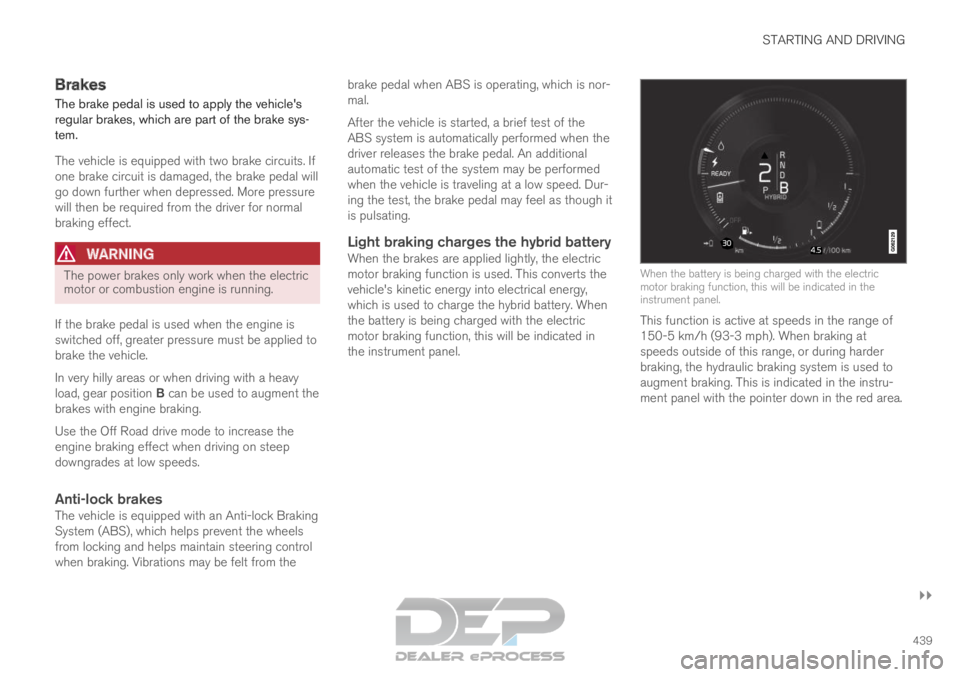
Light braking charges the hybrid batteryWhen the brakes are applied lightly, the electric
motor braking function is used. This converts the
vehicle's kinetic energy into electrical energy,
which is used to charge the hybrid battery. When
the battery is being charged with the electric
motor braking function, this will be indicated in
the instrument panel.
When the battery is being charged with the electric
motor braking function, this will be indicated in the
instrument panel.
This function is active at speeds in the range of
150-5 km/h (93-3 mph). When braking at
speeds outside of this range, or during harder
braking, the hydraulic braking system is used to
augment braking. This is indicated in the instru-
ment panel with the pointer down in the red area.
Page 442 of 697
||STARTING AND DRIVING
440
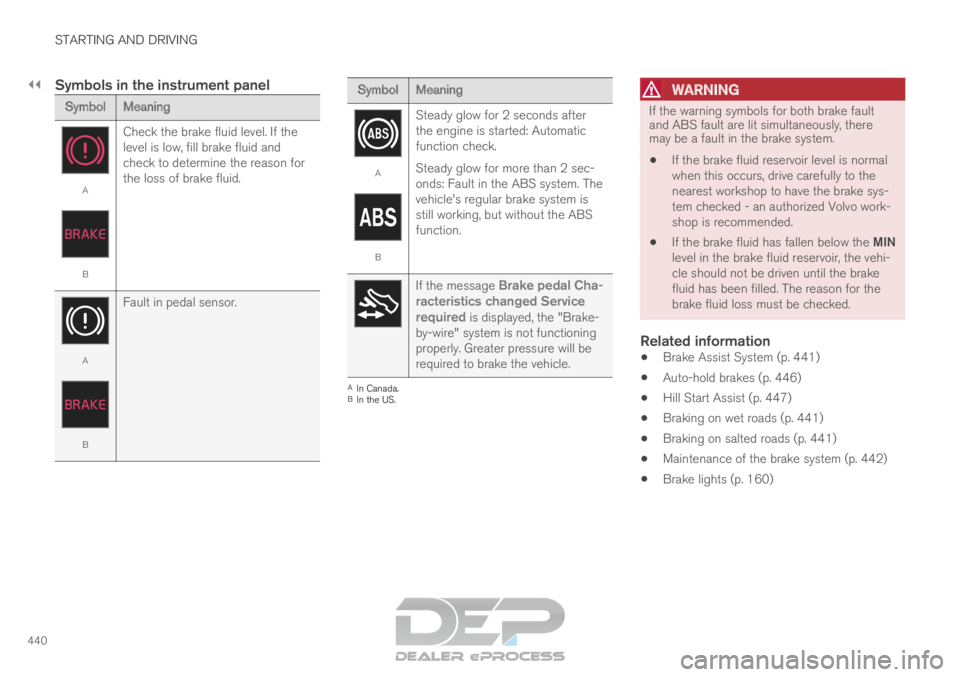
Symbols in the instrument panel
Symbol
Meaning A
B
Check the brake fluid level. If the
level is low, fill brake fluid and
check to determine the reason for
the loss of brake fluid. A
B
Fault in pedal sensor. Symbol
Meaning A
B
Steady glow for 2 seconds after
the engine is started: Automatic
function check.
Steady glow for more than 2 sec-
onds: Fault in the ABS system. The
vehicle's regular brake system is
still working, but without the ABS
function. If the message Brake pedal Cha-
racteristics changed Service
required is displayed, the "Brake-
by-wire" system is not functioning
properly. Greater pressure will be
required to brake the vehicle. A
In Canada.
B In the US.WARNING If the warning symbols for both brake fault
and ABS fault are lit simultaneously, there
may be a fault in the brake system.
If the brake fluid reservoir level is normal
when this occurs, drive carefully to the
nearest workshop to have the brake sys-
tem checked - an authorized Volvo work-
shop is recommended.
If the brake fluid has fallen below the MIN
level in the brake fluid reservoir, the vehi-
cle should not be driven until the brake
fluid has been filled. The reason for the
brake fluid loss must be checked.
Related information
Brake Assist System (p. 441)
Auto-hold brakes (p. 446)
Hill Start Assist (p. 447)
Braking on wet roads (p. 441)
Braking on salted roads (p. 441)
Maintenance of the brake system (p. 442)
Brake lights (p. 160)