light VOLVO XC90 TWIN ENGINE HYBRID 2017 Owners Manual
[x] Cancel search | Manufacturer: VOLVO, Model Year: 2017, Model line: XC90 TWIN ENGINE HYBRID, Model: VOLVO XC90 TWIN ENGINE HYBRID 2017Pages: 584, PDF Size: 14.2 MB
Page 382 of 584
STARTING AND DRIVING
380
Braking effect after a collision
In certain types of collisions, the vehicle's brakesare applied to help prevent or mitigate a secon-dary collision.
Maintaining control of the vehicle after a collisionmay be difficult. To help avoid or mitigate theeffect of a secondary collision, the brakes areapplied automatically to help bring the vehicle toa stop.
The brake lights and hazard warning flashers willbe activated and the flashers will remain on afterthe vehicle has come to a standstill. The parkingbrake will then be applied automatically.
In a situation where stopping the vehicle may notbe desirable, the driver can override this systemby pressing the accelerator pedal.
This feature can only function if the brake systemis intact after the collision.
Related information
•Brake functions (p. 378)
•Airbag system (p. 71)
•Rear Collision Warning (RCW) (p. 338)
Emergency brake lights
The emergency brake lights activate in the eventof hard braking/rapid deceleration at most nor-mal driving speeds or if the ABS system is acti-vated. This function causes an additional taillighton each side of the vehicle to illuminate to helpalert vehicles traveling behind.
Once the emergency brake lights have been acti-vated, if the driver releases the brake pedal, thebrake lights will return to their normal function.
Related information
•Brakes (p. 376)
•Hazard warning flashers (p. 151)
•Brake lights (p. 151)
Hill Descent Control (HDC)
HDC is a type of low-speed automatic enginebrake and makes it possible to increase ordecrease the vehicle's speed on steep downhillgradients using only the accelerator pedal, with-out applying the brakes.
HDC is integrated into the Off Road drivemode.
HDC is particularly useful when driving downsteep hills with rough surfaces, and where theroad may have slippery patches.
WARNING
HDC does not function in all situations, and isa supplementary braking aid. The driver hasfull responsibility for driving in a safe manner.
Function
HDC allows the vehicle to roll forward or inreverse at very low speed with enhanced enginebraking. However, speed can be adjusted withthe accelerator pedal. When the acceleratorpedal is released, the vehicle will return to verylow speed.
The driver can use the brakes to slow or stop thevehicle at any time.
HDC is activated along with Low Speed Control(LSC), which together make driving on slipperysurfaces at low speeds easier.
Page 383 of 584

STARTING AND DRIVING
* Option/accessory, for more information, see Introduction.381
When HDC and LSC are activated, this changesthe response from the accelerator pedal andengine.
Activating HDC
This function can be activated in different ways,depending on how the vehicle is equipped.
Using the drive mode control *
Select the Off Road drive mode to activate thefunction.
Select a different drive mode to turn HDC off. Ifthis is done while the vehicle is on a steep down-grade, engine braking will decrease gradually.
From the center display's Function view
Models without the drive modecontrol have a button for HillDescent Control in the centerdisplay's Function view.
•Tap the button to activate. A light in the but-ton illuminates when the function is acti-vated.
NOTE
The function is deactivated when driving athigher speeds and must be reactivated atlower speeds if so desired.
Related information
•Brake functions (p. 378)
•Low Speed Control (LSC) (p. 428)
•Drive modes (p. 420)
Hill Start Assist
Hill Start Assist (HSA) helps prevent the vehiclefrom rolling backwards when starting up a hill. Ifyou are backing up a hill, HSA helps prevent thevehicle from rolling forward.
HSA makes it easier to start or back up on a hillby retaining pressure on the brake pedal for sev-eral seconds after the pedal has been released inorder to keep the vehicle at a standstill.
The brakes will be released after several secondsor when the driver presses the accelerator pedal.
HSA is available even if the Auto-hold brakingfunction is turned off.
Related information
•Brake functions (p. 378)
•Auto-hold brake function (p. 379)
Page 384 of 584

STARTING AND DRIVING
382
Parking brake
The electric parking brake helps to keep thevehicle stationary when it is parked.
Parking brake control in the tunnel console between thefront seats
NOTE
•A faint sound from the parking brake'selectric motor can be heard when theparking brake is being applied. Thissound can also be heard during the auto-matic function check of the parkingbrake.
•The brake pedal will move slightly whenthe electric parking brake is applied orreleased.
If the vehicle is not moving when the parkingbrake is applied, only the rear wheels are affec-
ted. If it is applied while the vehicle is moving, thenormal brakes are used on all four wheels. Thebrakes will only be applied on the rear wheelsonce the vehicle has stopped.
Related information
•Brake functions (p. 378)
•Using the parking brake (p. 382)
•Parking brake malfunctions (p. 384)
Using the parking brake
The electric parking brake helps to keep thevehicle stationary when it is parked.
Applying the parking brake
1.Put the gear selector in P.
2.Press firmly on the brake pedal.
3. Pull up the control.
> The symbol in the instrument panelflashes while the parking brake is beingapplied and glows steadily when the park-ing brake has been fully applied.
4. Release the brake pedal and ensure that thevehicle is stationary.
Page 387 of 584
STARTING AND DRIVING
}}
385
Before a long distance trip
It is always worthwhile to have your vehiclechecked by a trained and qualified Volvo servicetechnician before driving long distances. Yourretailer will also be able to supply you with bulbs,fuses, spark plugs and wiper blades for your usein the event that problems occur.
As a minimum, the following items should bechecked before any long trip:
•Check that engine runs smoothly and thatfuel consumption and the oil level are normal.
•Before leaving on a trip, fill the fuel tank andmake sure the hybrid battery is fully charged.During the trip, make a habit of refueling reg-ularly.
•Check for fuel, oil, and fluid leakage.
•Check condition of drive belts.
•Check state of the battery's charge.
•Examine tires carefully and replace thosethat are worn. Also, check tire inflation pres-sure.
•The brakes, front wheel alignment, and steer-ing gear should be checked by a trained andqualified Volvo service technician only.
•Check all lights, including high beams.
•Reflective warning triangles are legallyrequired in some states/provinces.
•Have a word with a trained and qualifiedVolvo service technician if you intend to drive
in countries where it may be difficult toobtain the correct fuel.
•Consider your destination. If you will be driv-ing through an area where snow or ice arelikely to occur, consider using snow tires.
Driving economically
Better driving economy can be obtained bythinking ahead, avoiding rapid starts and stopsand adjusting the speed of your vehicle to imme-diate traffic conditions.
Driving economically with the XC90 T8
Twin Engine Plug-in Hybrid
Plan your driving in order to utilize the electricmotor as much as possible.
An energy-conserving driving style lowers currentconsumption from the hybrid battery and helpsincrease electric driving range.
Charging
•Charge the hybrid battery regularly using thecharging cable. Whenever possible, begin adrive with a fully charged battery.
•Check the location of charging points.
•Where possible, choose parking spaces withcharging points.
Page 389 of 584
STARTING AND DRIVING
}}
387
Driving through standing water
The vehicle should be driven with extreme cau-tion if it is necessary to drive through standingwater.
The vehicle can be driven through water up to adepth approximately level with the floor at walk-ing speed to help prevent water from enteringthe differential and/or the transmission or dam-aging electrical components.
•If possible, check the depth of the waterbefore driving through it. Take particular carewhen driving through flowing water.
•Before driving through water, always selectthe Off Road drive mode to ensure that thegasoline engine is running and to maximizeground clearance.
•After driving through water, apply the brakesand check that they are functioning correctly.
•Clean the electrical connections for trailerwiring after driving in mud or water.
•When driving through water, maintain lowspeed and do not stop in the water.
CAUTION
•Damage may occur to the engine, trans-mission, electrical components, etc. if thevehicle is driven through water higherthan its floor level. Be aware that wavescreated by other vehicles could cause thelevel to temporarily be above the vehicle'sfloor level.
•Damage to any components due to waterabove the floor level, vapor lock or insuffi-cient oil is not covered under warranty.
•If the engine has been stopped while thevehicle is in water, do not attempt torestart it. Have the vehicle towed out ofthe water and inspected by a trained andqualified Volvo service technician.
WARNING
•Avoid driving through standing or rushingwater. Doing so can be dangerous and itmay also be difficult to determine theactual depth of the water.
•If water cannot be avoided, after drivingthrough the water, press lightly on thebrake pedal to ensure that the brakes arefunctioning normally. Water or mud canmake the brake linings slippery, resultingin delayed braking effect.
Related information
•Towing recommendations (p. 389)
Overheating the engine andtransmission
In demanding driving conditions, such as whentransporting heavy loads, driving in mountainousareas or in very hot weather there is a risk ofoverheating the engine or transmission.
•The engine's output may be slightly limited ifthere is a risk of overheating.
•Remove e.g., auxiliary lights mounted in frontof the grille in hot weather.
•If the temperature of the engine coolantbecomes too high, the warning symbol willilluminate and the message Enginetemperature/Stop safely will be displayed.Stop the vehicle as soon as possible in asafe place and let the engine idle for severalminutes.
•If the message Engine temperature/Hightemperature Turn off engine or Enginecoolant/Stop safely is displayed, stopsafely and turn off the engine.
•If the transmission begins to overheat, analternative gear shifting program will beselected. An integrated protective functionwill also by activated, the warning symbol willilluminate and the message TransmissionwarmHigh temperature Reduce speedor Transmission warmStop safely, waitfor cooling will be displayed in the instru-ment panel.
Page 390 of 584
||
STARTING AND DRIVING
388
•The air conditioning may be switched offtemporarily.
•After a prolonged period of driving, do notturn off the engine immediately after stop-ping.
•The engine cooling fan commonly continuesto run for several minutes after the enginehas been turned off.
WARNING
The cooling fan (located at the front of theengine compartment, behind the radiator) maystart or continue to operate (for up to6 minutes) after the engine has beenswitched off.
Related information
•Driving with a trailer (p. 397)
•Before a long distance trip (p. 385)
Winter driving
Check your vehicle before the approach of coldweather.
The following advice is worth noting:
•Make sure that the engine coolant contains50 percent antifreeze. Any other mixture willreduce freeze protection. This gives protec-tion against freezing down to –31 °F(–35 °C). The use of "recycled" antifreeze isnot approved by Volvo. Different types ofantifreeze must not be mixed.
•Volvo recommends using only genuine Volvoantifreeze in your vehicle's radiator.
•Try to keep the fuel tank well filled – thishelps prevent the formation of condensationin the tank. In addition, in extremely coldweather conditions it is worthwhile to addfuel line de-icer before refueling.
•The viscosity of the engine oil is important.Oil with low viscosity (thinner oil) improvescold-weather starting as well as decreasingfuel consumption while the engine is warm-ing up. Full synthetic 0W-30 oil is recom-mended for driving in areas with sustainedlow temperatures.
•The load placed on the battery is greater dur-ing the winter since the windshield wipers,lighting, etc., are used more often. Moreover,the capacity of the battery decreases as thetemperature drops. In very cold weather, apoorly charged battery can freeze and be
damaged. It is therefore advisable to checkthe state of charge more frequently andspray an anti-rust oil on the battery posts.
•Volvo recommends the use of snow tires onall four wheels for winter driving.
•To prevent the washer fluid reservoir fromfreezing, add washer solvents containingantifreeze. This is important since dirt is oftensplashed on the windshield during winterdriving, requiring the frequent use of thewashers and wipers. Volvo Washer Solventshould be diluted as follows: Down to 14 °F(–10 °C): 1 part washer solvent and 4 partswater Down to 5 °F (–15 °C): 1 part washersolvent and 3 parts water Down to 0 °F(–18 °C): 1 part washer solvent and 2 partswater Down to –18 °F (–28 °C): 1 partwasher solvent and 1 part water.
•Use Volvo Teflon Lock Spray in the locks.
•Avoid using de-icing sprays as they cancause damage to the locks.
Related information
•Snow tires and chains (p. 485)
Page 391 of 584
STARTING AND DRIVING
}}
389
Towing eyelet
When used, the towing eyelet should always besecurely attached in the openings on the rightside of the front and rear bumpers. There arecovers over these attachment points.
Using the towing eyelet
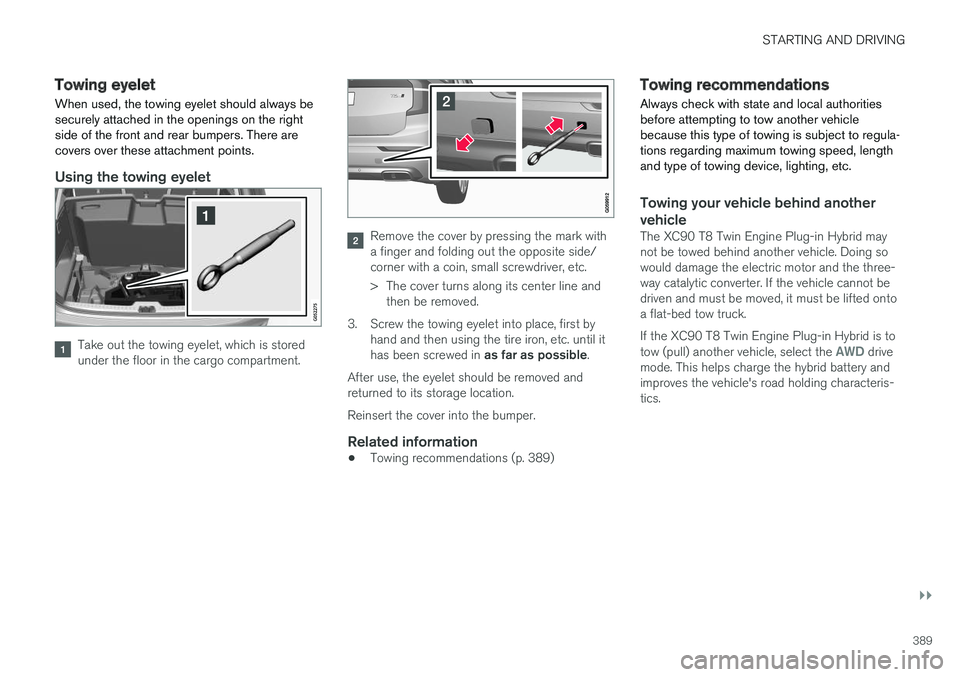
Take out the towing eyelet, which is storedunder the floor in the cargo compartment.
Remove the cover by pressing the mark witha finger and folding out the opposite side/corner with a coin, small screwdriver, etc.
>The cover turns along its center line andthen be removed.
3. Screw the towing eyelet into place, first byhand and then using the tire iron, etc. until ithas been screwed in as far as possible.
After use, the eyelet should be removed andreturned to its storage location.
Reinsert the cover into the bumper.
Related information
•Towing recommendations (p. 389)
Towing recommendations
Always check with state and local authoritiesbefore attempting to tow another vehiclebecause this type of towing is subject to regula-tions regarding maximum towing speed, lengthand type of towing device, lighting, etc.
Towing your vehicle behind another
vehicle
The XC90 T8 Twin Engine Plug-in Hybrid maynot be towed behind another vehicle. Doing sowould damage the electric motor and the three-way catalytic converter. If the vehicle cannot bedriven and must be moved, it must be lifted ontoa flat-bed tow truck.
If the XC90 T8 Twin Engine Plug-in Hybrid is totow (pull) another vehicle, select the AWD drivemode. This helps charge the hybrid battery andimproves the vehicle's road holding characteris-tics.
Page 393 of 584

STARTING AND DRIVING
391
Fuel
Volvo recommends the use of detergent gaso-line to control engine deposits.
Deposit control gasoline (detergent
additives)
Detergent gasoline is effective in keeping injec-tors and intake valves clean. Consistent use ofdeposit control gasolines will help ensure gooddrivability and fuel economy. If you are not surewhether the gasoline contains deposit controladditives, check with the service station operator.
NOTE
Volvo does not recommend the use of exter-nal fuel injector cleaning systems.
Unleaded fuel
Each Volvo has a three-way catalytic converterand must use only unleaded gasoline. U.S. andCanadian regulations require that pumps deliver-ing unleaded gasoline be labeled "UNLEADED".Only these pumps have nozzles which fit yourvehicle's filler inlet. It is unlawful to dispense lea-ded fuel into a vehicle labeled "unleaded gaso-line only". Leaded gasoline damages the three-way catalytic converter and the heated oxygensensor system. Repeated use of leaded gasolinewill lessen the effectiveness of the emission con-trol system and could result in loss of emissionwarranty coverage. State and local vehicle
inspection programs will make detection of mis-fueling easier, possibly resulting in emission testfailure for misfueled vehicles.
NOTE
Some U.S. and Canadian gasolines contain anoctane enhancing additive called methyl-cyclopentadienyl manganese tricarbonyl(MMT). If such fuels are used, your EmissionControl System performance may be affected,and the Check Engine Light (malfunctionindicator light) located on your instrumentpanel may light. If this occurs, please returnyour vehicle to a trained and qualified Volvoservice technician for service.
Gasoline containing alcohol and ethers,
"Oxygenated fuels"
Some fuel suppliers sell gasoline containing"oxygenates" which are usually alcohols orethers. In some areas, state or local laws requirethat the service pump be marked indicating useof alcohols or ethers. However, there are areas inwhich the pumps are unmarked. If you are notsure whether there is alcohol or ethers in thegasoline you buy, check with the service stationoperator. To meet seasonal air quality standards,some areas require the use of "oxygenated" fuel.
Volvo allows the use of the following "oxygen-ated" fuels; however, the octane ratings listedmust still be met.
Alcohol – Ethanol
Fuels containing up to 10% ethanol by volumemay be used. Ethanol may also be referred to asEthyl alcohol, or "Gasohol".
Ethers – MTBE: Fuels containing up to15% MTBE may be used.
Methanol
Do not use gasolines containing methanol(methyl alcohol, wood alcohol). This practice canresult in vehicle performance deterioration andcan damage critical parts in the fuel system. Suchdamage may not be covered under the NewVehicle Limited Warranty.
Related information
•Octane rating (p. 392)
•Opening/closing the fuel filler door (p. 393)
Page 395 of 584
STARTING AND DRIVING
}}
393
Opening/closing the fuel filler door
The fuel tank has a filling system that does nothave a cover.
Opening/closing the fuel filler door
An arrow next to the fuel pumpsymbol in the instrument panelindicates the side of the vehiclewhere the fuel filler door islocated.
1. Press the button on the lighting panel.
>Pressure equalization in the fuel tank cau-ses a slight delay before the fuel fillerdoor opens. Fuel tank Fuel lid isopening will be displayed in the instru-ment panel, followed by Fuel tank Readyfor refueling.
2.After refueling, close the fuel filler door bypressing lightly.
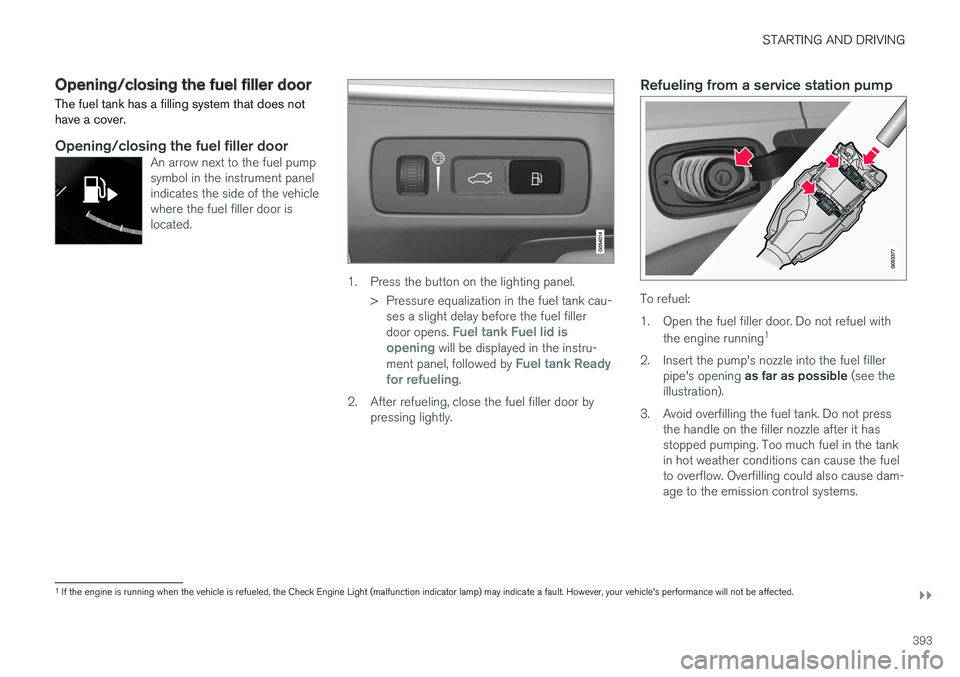
Refueling from a service station pump
To refuel:
1.Open the fuel filler door. Do not refuel with
the engine running1
2. Insert the pump's nozzle into the fuel fillerpipe's opening as far as possible (see theillustration).
3. Avoid overfilling the fuel tank. Do not pressthe handle on the filler nozzle after it hasstopped pumping. Too much fuel in the tankin hot weather conditions can cause the fuelto overflow. Overfilling could also cause dam-age to the emission control systems.
1If the engine is running when the vehicle is refueled, the Check Engine Light (malfunction indicator lamp) may indicate a fault. However, your vehicle's performance will not be affected.
Page 400 of 584

||
STARTING AND DRIVING
398
CAUTION
The maximum trailer weights listed are onlyapplicable for altitudes up to 3,280 ft(1000 m) above sea level. With increasingaltitude the engine power and therefore thecar's climbing ability are impaired because ofthe reduced air density, so the maximumtrailer weight has to be reduced accordingly.The weight of the vehicle and trailer must bereduced by 10% for every further 3,280 ft(1,000 m) (or part thereof). When towing5,000 lbs (2,250 kg) hill inclination is restric-ted to 14%.
WARNING
•Bumper-attached trailer hitches must notbe used on Volvos, nor should safetychains be attached to the bumper.
•Trailer hitches attaching to the vehiclerear axle must not be used.
•Never connect a trailer's hydraulic brakesystem directly to the vehicle brake sys-tem, nor a trailer's lighting system directlyto the vehicle lighting system. Consultyour nearest authorized Volvo retailer forcorrect installation.
•When towing a trailer, the trailer's safetychains or wire must be correctly fastenedto the attachment points provided in thetrailer hitch on the vehicle. The safetychain or wire must never be fastened toor wound around the towing ball.
Trailer cable
An adapter is required if the vehicle's trailer hitchhas a 13-pin connector and the trailer has 7 pins.Use an adapter cable approved by Volvo. Makesure the cable does not drag on the ground.
Related information
•Detachable trailer hitch (p. 398)
•Trailer Stability Assist (TSA) (p. 399)
•Weights (p. 563)
Detachable trailer hitch
Volvo recommends the use of Volvo trailerhitches that are specially designed for the vehi-cle.
Ball holder
Cotter pin
Hitch assembly
Locking bolt
Safety wire attachment
Installing the ball holder
1. If necessary, remove the cotter pin from thelocking bolt and slide the locking bolt out ofthe hitch assembly.
2. Slide the ball holder into the hitch assembly.