isofix VOLVO XC90 TWIN ENGINE HYBRID 2017 Owners Manual
[x] Cancel search | Manufacturer: VOLVO, Model Year: 2017, Model line: XC90 TWIN ENGINE HYBRID, Model: VOLVO XC90 TWIN ENGINE HYBRID 2017Pages: 584, PDF Size: 14.2 MB
Page 4 of 584
2
INTRODUCTION
Contacting Volvo14
Volvo On Call Roadside Assistance14
Additional information about your vehicle14
General information about the XC90T8 Twin Engine Plug-in Hybrid16
Volvo and the environment20
Owner's manual and the environment21
IntelliSafe—driver support21
Sensus22
Owner's manual in mobile devices25
Options, accessories and the On-board Diagnostic (OBDII) socket 26
Finding owner's information27
Driver distraction29
Volvo Structural Parts Statement30
Crash event data31
Volvo ID32
Center display overview33
Changing center display settings35
Using the center display keyboard36
Function view buttons41
Navigating in the center display's views43
Symbols in the center display status bar48
Changing settings in different typesof apps49
Using the center display50
Using the owner's manual54
On-board digital owner's manual56
Navigating in the digital owner's manual57
Glass59
Technician certification59
SAFETY
General safety information62
Occupant safety62
Reporting safety defects63
Recall information64
Safety during pregnancy64
Whiplash protection system65
Seat belts66
Seat belt pretensioners67
Buckling and unbuckling seat belts67
Door and seat belt reminders70
Airbag system71
Driver/passenger side airbags71
Occupant weight sensor74
Side impact airbags77
Inflatable curtains78
Safety mode79
Starting or moving a vehicle in safetymode80
Child safety81
Child restraints83
Infant seats84
Convertible seats86
Booster cushions89
ISOFIX/LATCH lower anchors90
Lower child seat attachment points91
CONTENTS
Page 83 of 584
SAFETY
}}
81
Child safety
Children should always be seated safely whentraveling in the vehicle.
General information
Volvo recommends the proper use of restraintsystems for all occupants including children.Remember that, regardless of age and size, achild should always be properly restrained in avehicle.
Your vehicle is also equipped with ISOFIX/LATCH attachments, which make it more conven-ient to install child seats.
Some restraint systems for children are designedto be secured in the vehicle by lap belts or thelap portion of a lap-shoulder belt. Such childrestraint systems can help protect children invehicles in the event of an accident only if theyare used properly. However, children could beendangered in a crash if the child restraints arenot properly secured in the vehicle. Failure to fol-low the installation instructions for your childrestraint can result in your child striking the vehi-cle's interior in a sudden stop.
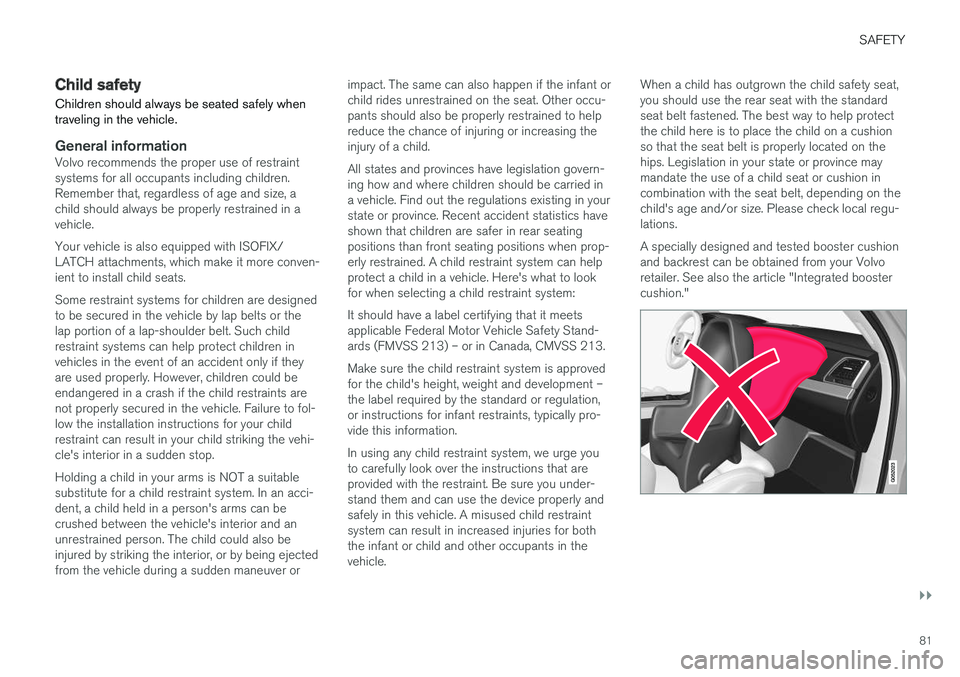
Holding a child in your arms is NOT a suitablesubstitute for a child restraint system. In an acci-dent, a child held in a person's arms can becrushed between the vehicle's interior and anunrestrained person. The child could also beinjured by striking the interior, or by being ejectedfrom the vehicle during a sudden maneuver or
impact. The same can also happen if the infant orchild rides unrestrained on the seat. Other occu-pants should also be properly restrained to helpreduce the chance of injuring or increasing theinjury of a child.
All states and provinces have legislation govern-ing how and where children should be carried ina vehicle. Find out the regulations existing in yourstate or province. Recent accident statistics haveshown that children are safer in rear seatingpositions than front seating positions when prop-erly restrained. A child restraint system can helpprotect a child in a vehicle. Here's what to lookfor when selecting a child restraint system:
It should have a label certifying that it meetsapplicable Federal Motor Vehicle Safety Stand-ards (FMVSS 213) – or in Canada, CMVSS 213.
Make sure the child restraint system is approvedfor the child's height, weight and development –the label required by the standard or regulation,or instructions for infant restraints, typically pro-vide this information.
In using any child restraint system, we urge youto carefully look over the instructions that areprovided with the restraint. Be sure you under-stand them and can use the device properly andsafely in this vehicle. A misused child restraintsystem can result in increased injuries for boththe infant or child and other occupants in thevehicle.
When a child has outgrown the child safety seat,you should use the rear seat with the standardseat belt fastened. The best way to help protectthe child here is to place the child on a cushionso that the seat belt is properly located on thehips. Legislation in your state or province maymandate the use of a child seat or cushion incombination with the seat belt, depending on thechild's age and/or size. Please check local regu-lations.
A specially designed and tested booster cushionand backrest can be obtained from your Volvoretailer. See also the article "Integrated boostercushion."
Page 85 of 584
SAFETY
}}
83
Child restraints
Suitable child restraints should always be usedwhen children travel in the vehicle.
Child restraint systems
Infant seat
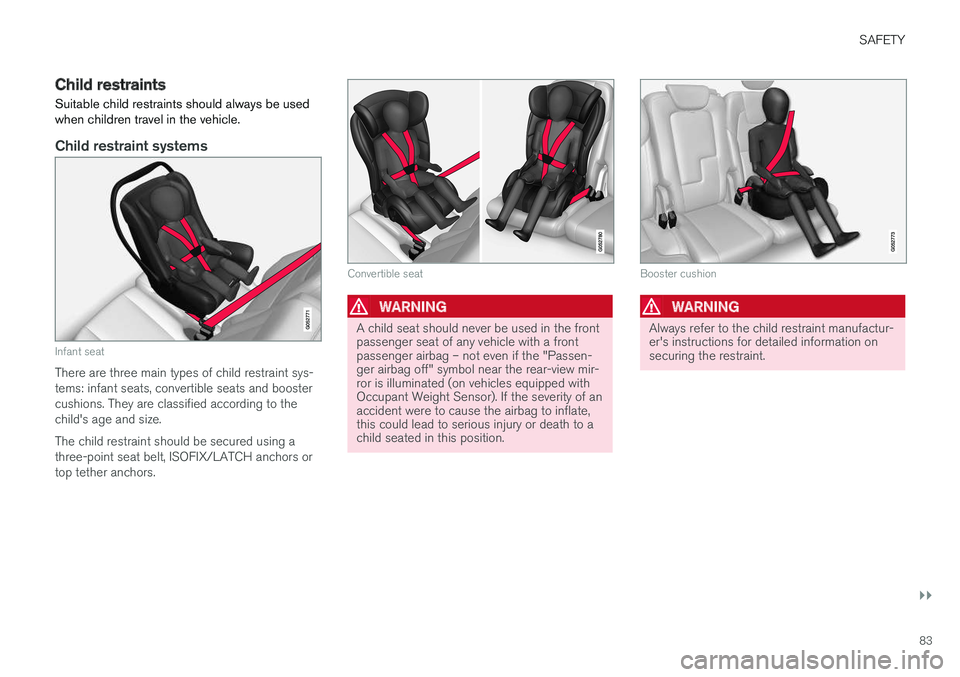
There are three main types of child restraint sys-tems: infant seats, convertible seats and boostercushions. They are classified according to thechild's age and size.
The child restraint should be secured using athree-point seat belt, ISOFIX/LATCH anchors ortop tether anchors.
Convertible seat
WARNING
A child seat should never be used in the frontpassenger seat of any vehicle with a frontpassenger airbag – not even if the "Passen-ger airbag off" symbol near the rear-view mir-ror is illuminated (on vehicles equipped withOccupant Weight Sensor). If the severity of anaccident were to cause the airbag to inflate,this could lead to serious injury or death to achild seated in this position.
Booster cushion
WARNING
Always refer to the child restraint manufactur-er's instructions for detailed information onsecuring the restraint.
Page 88 of 584
||
SAFETY
86
NOTE
The locking retractor will automaticallyrelease when the seat belt is unbuckled andallowed to retract fully.
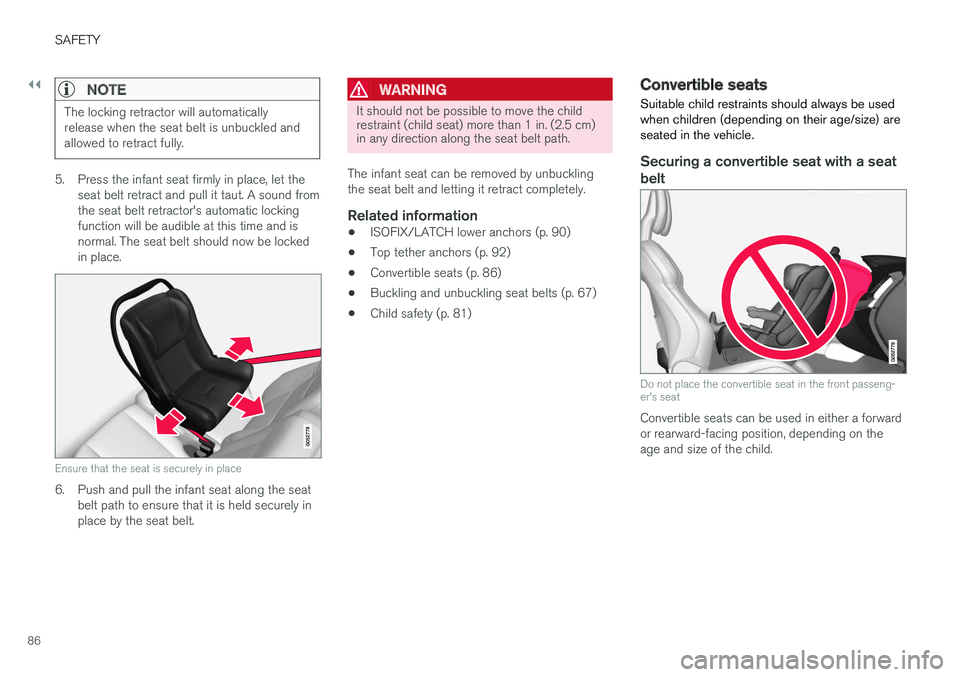
5. Press the infant seat firmly in place, let theseat belt retract and pull it taut. A sound fromthe seat belt retractor's automatic lockingfunction will be audible at this time and isnormal. The seat belt should now be lockedin place.
Ensure that the seat is securely in place
6. Push and pull the infant seat along the seatbelt path to ensure that it is held securely inplace by the seat belt.
WARNING
It should not be possible to move the childrestraint (child seat) more than 1 in. (2.5 cm)in any direction along the seat belt path.
The infant seat can be removed by unbucklingthe seat belt and letting it retract completely.
Related information
•ISOFIX/LATCH lower anchors (p. 90)
•Top tether anchors (p. 92)
•Convertible seats (p. 86)
•Buckling and unbuckling seat belts (p. 67)
•Child safety (p. 81)
Convertible seats
Suitable child restraints should always be usedwhen children (depending on their age/size) areseated in the vehicle.
Securing a convertible seat with a seat
belt
Do not place the convertible seat in the front passeng-er's seat
Convertible seats can be used in either a forwardor rearward-facing position, depending on theage and size of the child.
Page 90 of 584
||
SAFETY
88
NOTE
The locking retractor will automaticallyrelease when the seat belt is unbuckled andallowed to retract fully.
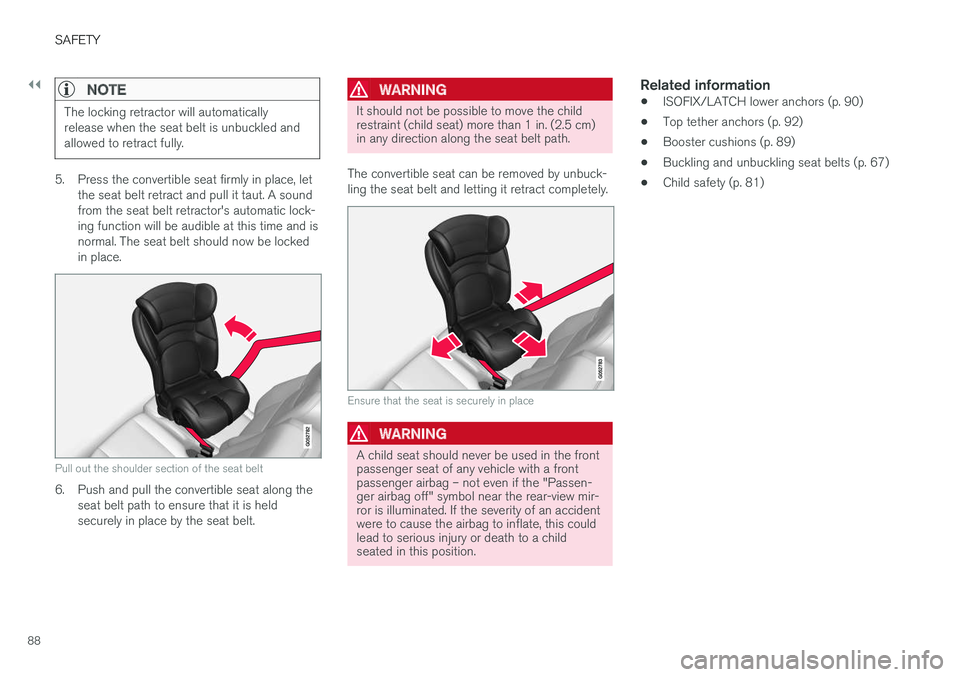
5. Press the convertible seat firmly in place, letthe seat belt retract and pull it taut. A soundfrom the seat belt retractor's automatic lock-ing function will be audible at this time and isnormal. The seat belt should now be lockedin place.
Pull out the shoulder section of the seat belt
6. Push and pull the convertible seat along theseat belt path to ensure that it is heldsecurely in place by the seat belt.
WARNING
It should not be possible to move the childrestraint (child seat) more than 1 in. (2.5 cm)in any direction along the seat belt path.
The convertible seat can be removed by unbuck-ling the seat belt and letting it retract completely.
Ensure that the seat is securely in place
WARNING
A child seat should never be used in the frontpassenger seat of any vehicle with a frontpassenger airbag – not even if the "Passen-ger airbag off" symbol near the rear-view mir-ror is illuminated. If the severity of an accidentwere to cause the airbag to inflate, this couldlead to serious injury or death to a childseated in this position.
Related information
•ISOFIX/LATCH lower anchors (p. 90)
•Top tether anchors (p. 92)
•Booster cushions (p. 89)
•Buckling and unbuckling seat belts (p. 67)
•Child safety (p. 81)
Page 91 of 584
SAFETY
* Option/accessory, for more information, see Introduction.89
Booster cushions
Securing a booster cushion
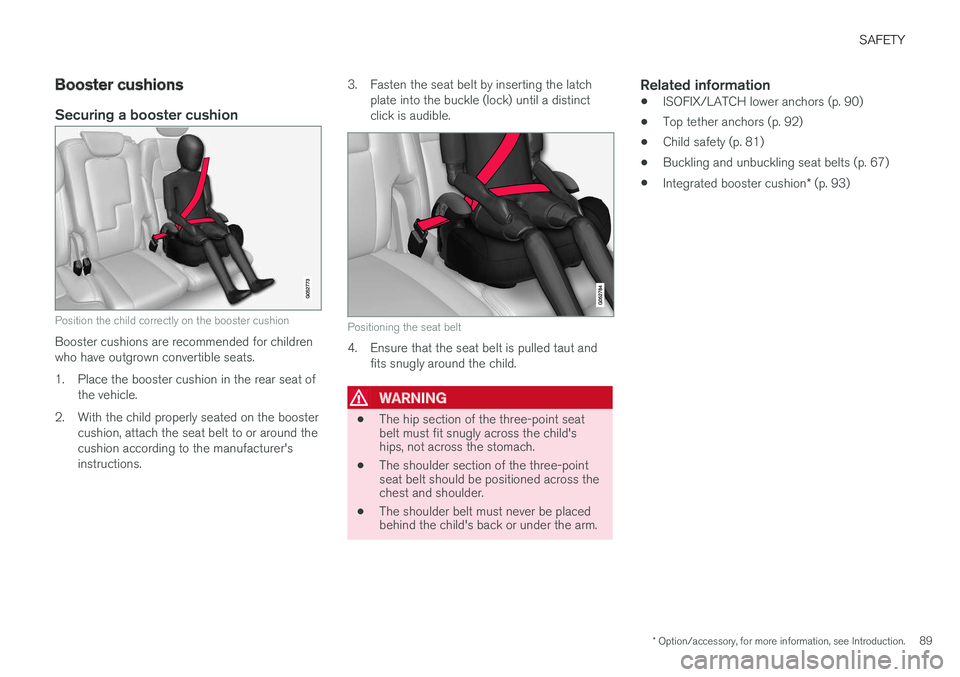
Position the child correctly on the booster cushion
Booster cushions are recommended for childrenwho have outgrown convertible seats.
1.Place the booster cushion in the rear seat ofthe vehicle.
2. With the child properly seated on the boostercushion, attach the seat belt to or around thecushion according to the manufacturer'sinstructions.
3. Fasten the seat belt by inserting the latchplate into the buckle (lock) until a distinctclick is audible.
Positioning the seat belt
4. Ensure that the seat belt is pulled taut andfits snugly around the child.
WARNING
•The hip section of the three-point seatbelt must fit snugly across the child'ships, not across the stomach.
•The shoulder section of the three-pointseat belt should be positioned across thechest and shoulder.
•The shoulder belt must never be placedbehind the child's back or under the arm.
Related information
•ISOFIX/LATCH lower anchors (p. 90)
•Top tether anchors (p. 92)
•Child safety (p. 81)
•Buckling and unbuckling seat belts (p. 67)
•Integrated booster cushion* (p. 93)
Page 92 of 584
SAFETY
90
ISOFIX/LATCH lower anchors
Lower anchors for ISOFIX/LATCH-equippedchild seats are located in the second row, out-board seats, hidden below the backrest cush-ions.
Lower anchors for ISOFIX/LATCH-equippedchild seats are located in the rear, outboardseats, hidden below the backrest cushions.
Using the ISOFIX/LATCH lower child
seat anchors
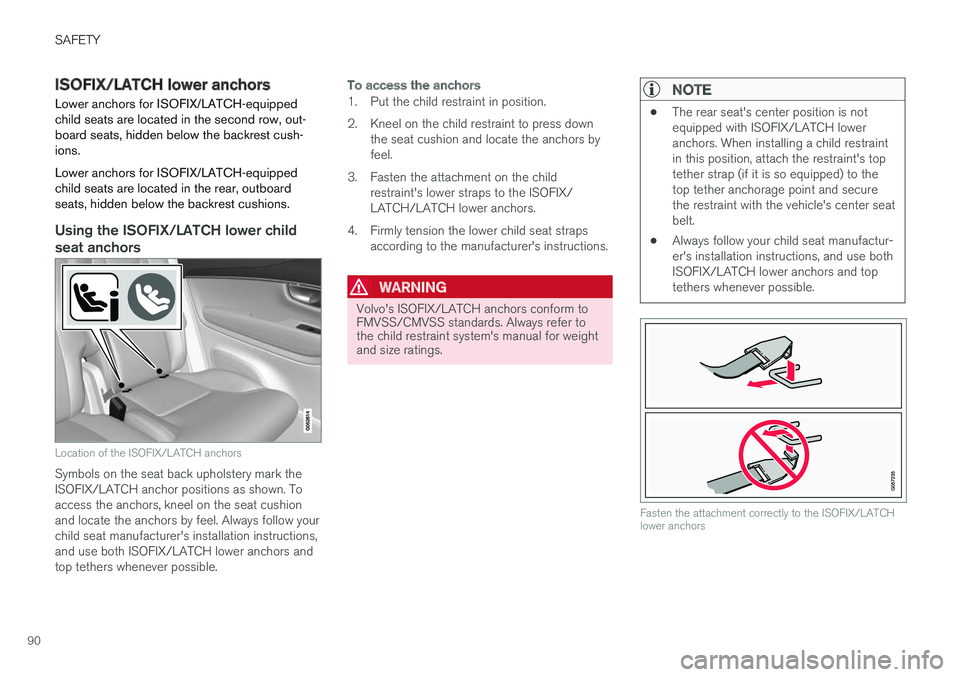
Location of the ISOFIX/LATCH anchors
Symbols on the seat back upholstery mark theISOFIX/LATCH anchor positions as shown. Toaccess the anchors, kneel on the seat cushionand locate the anchors by feel. Always follow yourchild seat manufacturer's installation instructions,and use both ISOFIX/LATCH lower anchors andtop tethers whenever possible.
To access the anchors
1. Put the child restraint in position.
2. Kneel on the child restraint to press downthe seat cushion and locate the anchors byfeel.
3. Fasten the attachment on the childrestraint's lower straps to the ISOFIX/LATCH/LATCH lower anchors.
4. Firmly tension the lower child seat strapsaccording to the manufacturer's instructions.
WARNING
Volvo's ISOFIX/LATCH anchors conform toFMVSS/CMVSS standards. Always refer tothe child restraint system's manual for weightand size ratings.
NOTE
•The rear seat's center position is notequipped with ISOFIX/LATCH loweranchors. When installing a child restraintin this position, attach the restraint's toptether strap (if it is so equipped) to thetop tether anchorage point and securethe restraint with the vehicle's center seatbelt.
•Always follow your child seat manufactur-er's installation instructions, and use bothISOFIX/LATCH lower anchors and toptethers whenever possible.
Fasten the attachment correctly to the ISOFIX/LATCHlower anchors
Page 93 of 584
SAFETY
}}
91
WARNING
•Be sure to fasten the attachment cor-rectly to the anchor (see the illustration).If the attachment is not correctly fas-tened, the child restraint may not beproperly secured in the event of a colli-sion.
•The ISOFIX/LATCH lower child restraintanchors are only intended for use withchild seats positioned in the outboardseating positions. These anchors are notcertified for use with any child restraintthat is positioned in the center seatingposition. When securing a child restraintin the center seating position, use onlythe vehicle's center seat belt.
Related information
•Top tether anchors (p. 92)
Lower child seat attachment points1
The vehicle is equipped with lower attachmentpoints for child seats in the second row of seats.
The lower attachment points are intended for usewith rear-facing child restraints.
Always follow the child restraint manufacturer'sinstallation instructions when attaching a childrestraint to these attachment points.
Location
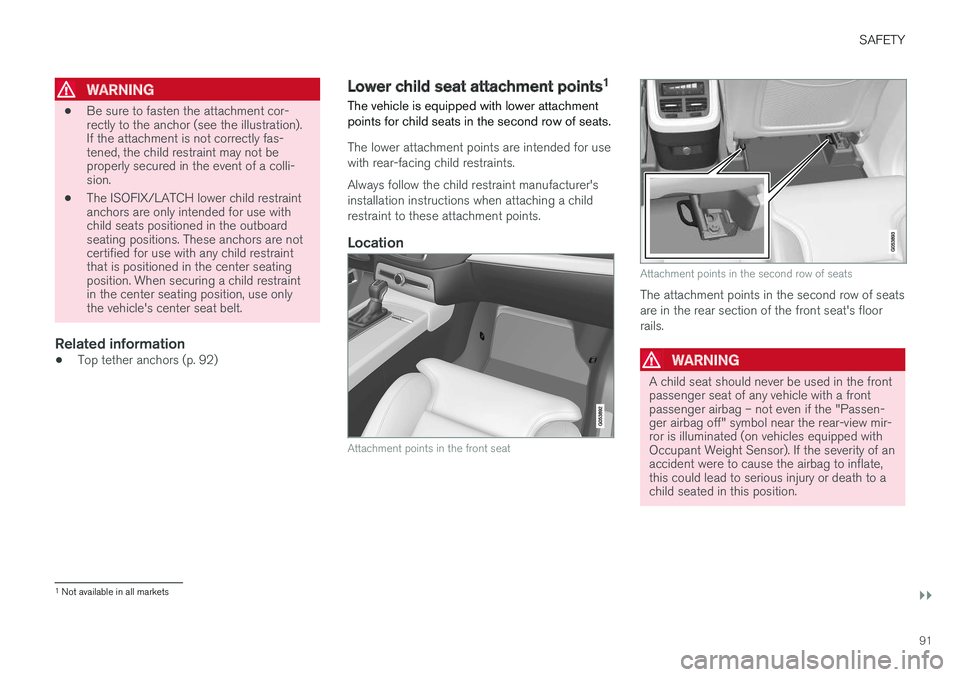
Attachment points in the front seat
Attachment points in the second row of seats
The attachment points in the second row of seatsare in the rear section of the front seat's floorrails.
WARNING
A child seat should never be used in the frontpassenger seat of any vehicle with a frontpassenger airbag – not even if the "Passen-ger airbag off" symbol near the rear-view mir-ror is illuminated (on vehicles equipped withOccupant Weight Sensor). If the severity of anaccident were to cause the airbag to inflate,this could lead to serious injury or death to achild seated in this position.
1Not available in all markets
Page 94 of 584
||
SAFETY
92
Related information
•Child restraints (p. 83)
•ISOFIX/LATCH lower anchors (p. 90)
•Occupant weight sensor (p. 74)
Top tether anchors
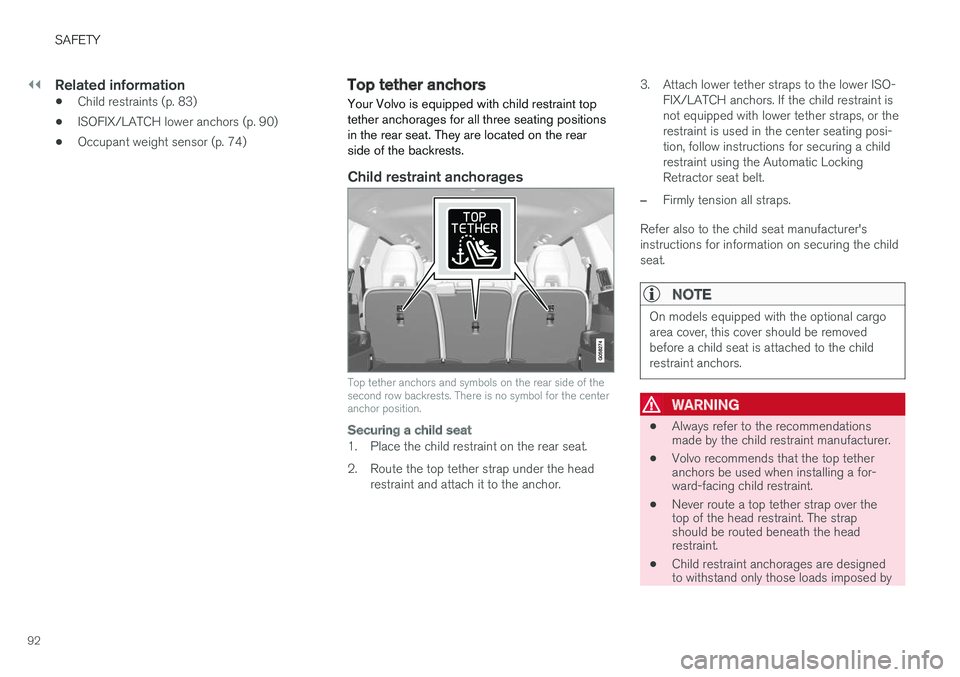
Your Volvo is equipped with child restraint toptether anchorages for all three seating positionsin the rear seat. They are located on the rearside of the backrests.
Child restraint anchorages
Top tether anchors and symbols on the rear side of thesecond row backrests. There is no symbol for the centeranchor position.
Securing a child seat
1. Place the child restraint on the rear seat.
2. Route the top tether strap under the headrestraint and attach it to the anchor.
3. Attach lower tether straps to the lower ISO-FIX/LATCH anchors. If the child restraint isnot equipped with lower tether straps, or therestraint is used in the center seating posi-tion, follow instructions for securing a childrestraint using the Automatic LockingRetractor seat belt.
–Firmly tension all straps.
Refer also to the child seat manufacturer'sinstructions for information on securing the childseat.
NOTE
On models equipped with the optional cargoarea cover, this cover should be removedbefore a child seat is attached to the childrestraint anchors.
WARNING
•Always refer to the recommendationsmade by the child restraint manufacturer.
•Volvo recommends that the top tetheranchors be used when installing a for-ward-facing child restraint.
•Never route a top tether strap over thetop of the head restraint. The strapshould be routed beneath the headrestraint.
•Child restraint anchorages are designedto withstand only those loads imposed by
Page 574 of 584

INDEX
572
Brakes
auto-hold 379
Brake system
Brake pad inspection 377
fluid 566
general information 376, 378, 380
Bulbs 534
replacing 530
specifications 536
C
Camera
driver support systems322
limitations323
Camera, Park Assist 362, 364, 366, 367
Capacity weight484, 563
Cargo area, steel grid225
Cargo area cover227
Cargo compartment
fuses527
raising/lowering the level218
Cargo net223
Cargo space218
Car wash547
Catalytic converter394
CD, USB, iPod, AUX, Bluetooth, Recents,
Library, Shuffle, Similar, Change device, Pri-
mary Audio Default Language, Subtitle, Pri-
mary Subtitle Default Language, Video,
DivX® VOD459
CD player 459
Cell phone
hands-free 448
Pairing 449
Cell phone voice control 126
Center display
changing settings 35
cleaning 552
keyboard 36
navigating in 43
overview 33
screen in the center console 50
symbols in the status bar 48
Chains 485
Changing a wheel 487
Charging cable
hybrid battery 405
Child restraints
recalls and registration 83
Child restraint systems 83
booster cushions 89
convertible seats 86
infant seats 84
ISOFIX/LATCH anchors90
top tether anchors92
Child safety81
booster cushions89
child restraint systems83, 91
convertible seats86
infant seats84
Child safety locks257
Child seats
lower attachment points91
City safety326, 334
City Safety
crossing traffic331
detecting objects329
limitations334
rear collision warning338
symbols and messages337
troubleshooting332
City Safety, On/Off328
City Safety™
Multi Target332
Cleaning
exterior547
interior550
Clean Zone Interior Package197
Climate system199
air distribution212, 213, 215
air filter198