warning YAMAHA AEROX50 2004 Owner's Manual
[x] Cancel search | Manufacturer: YAMAHA, Model Year: 2004, Model line: AEROX50, Model: YAMAHA AEROX50 2004Pages: 84, PDF Size: 0.96 MB
Page 58 of 84
PERIODIC MAINTENANCE AND MINOR REPAIR
6
ZAUM0061
EAU03118
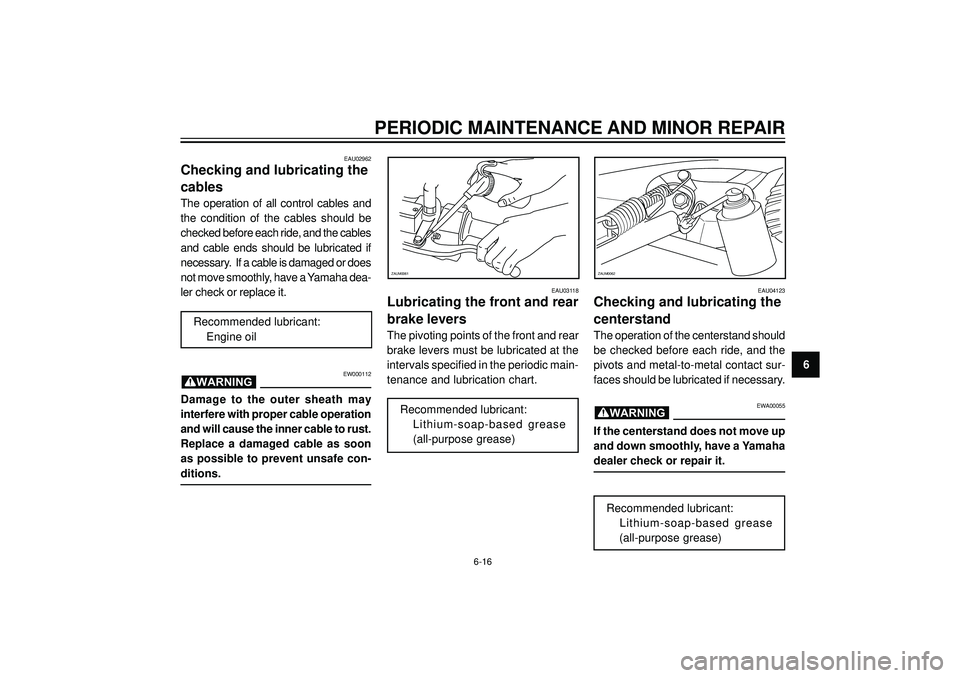
Lubricating the front and rear
brake levers
The pivoting points of the front and rear
brake levers must be lubricated at the
intervals specified in the periodic main-
tenance and lubrication chart.
Recommended lubricant:
Lithium-soap-based grease
(all-purpose grease)
ZAUM0062
EAU04123
Checking and lubricating the
centerstand
The operation of the centerstand should
be checked before each ride, and the
pivots and metal-to-metal contact sur-
faces should be lubricated if necessary.
EWA00055
If the centerstand does not move up
and down smoothly, have a Yamaha
dealer check or repair it.
Recommended lubricant:
Lithium-soap-based grease
(all-purpose grease)
WARNING
6-16
EAU02962
Checking and lubricating the
cables
The operation of all control cables and
the condition of the cables should be
checked before each ride, and the cables
and cable ends should be lubricated if
necessary. If a cable is damaged or does
not move smoothly, have a Yamaha dea-
ler check or replace it.
Recommended lubricant:
Engine oil
EW000112
Damage to the outer sheath may
interfere with proper cable operation
and will cause the inner cable to rust.
Replace a damaged cable as soon
as possible to prevent unsafe con-
ditions.
WARNING
Page 59 of 84
PERIODIC MAINTENANCE AND MINOR REPAIR
6
EAU02939
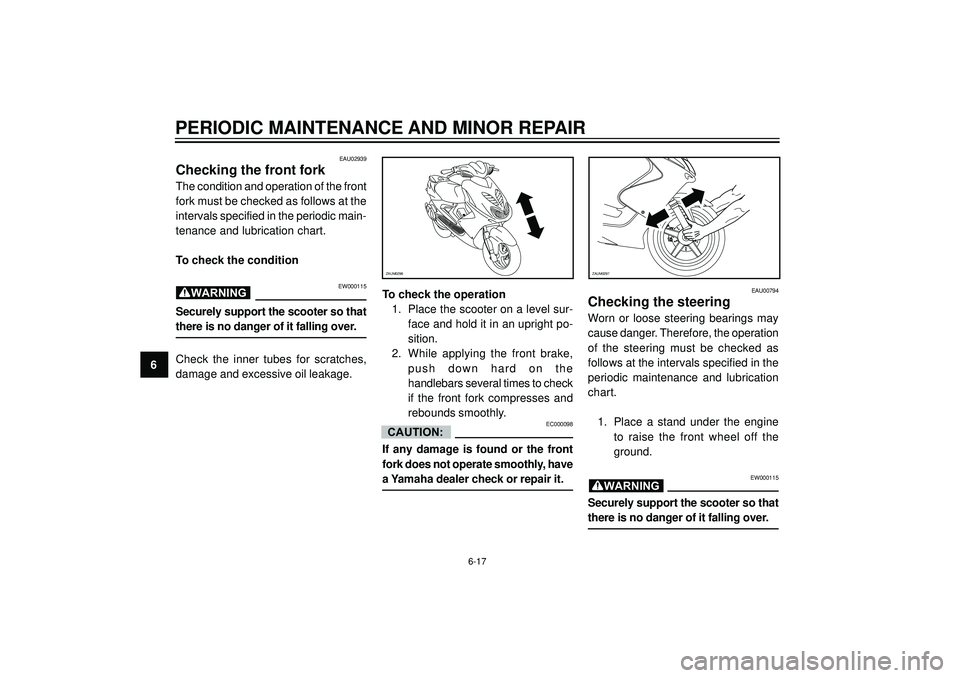
Checking the front fork
The condition and operation of the front
fork must be checked as follows at the
intervals specified in the periodic main-
tenance and lubrication chart.
To check the condition
EW000115
Securely support the scooter so that
there is no danger of it falling over.
Check the inner tubes for scratches,
damage and excessive oil leakage.
WARNINGTo check the operation
1. Place the scooter on a level sur-
face and hold it in an upright po-
sition.
2. While applying the front brake,
push down hard on the
handlebars several times to check
if the front fork compresses and
rebounds smoothly.
EC000098
If any damage is found or the front
fork does not operate smoothly, have
a Yamaha dealer check or repair it.
CAUTION:
EAU00794
Checking the steering
Worn or loose steering bearings may
cause danger. Therefore, the operation
of the steering must be checked as
follows at the intervals specified in the
periodic maintenance and lubrication
chart.
1. Place a stand under the engine
to raise the front wheel off the
ground.
EW000115
Securely support the scooter so that
there is no danger of it falling over.
WARNING
6-17
ZAUM0296ZAUM0297
Page 61 of 84
PERIODIC MAINTENANCE AND MINOR REPAIR
64. If the electrolyte is at or below the
minimum level mark, add distilled
water to raise it to the maximum
level mark.
EW000116
•Electrolyte is poisonous and
dangerous since it contains
sulfuric acid, which causes
severe burns. Avoid any con-
tact with skin, eyes or clothing
and always shield your eyes
when working near batteries. In
case of contact, administer the
following FIRST AID.
•EXTERNAL: Flush with
plenty of water.
•INTERNAL: Drink large
quantities of water or milk
and immediately call a
physician.
•EYES: Flush with water for 15
minutes and seek prompt
medical attention.
•Batteries produce explosive
hydrogen gas. Therefore, keep
sparks, flames, cigarettes, etc.,
away from the battery and
provide sufficient ventilation
when charging it in an enclosed
space.
•KEEP THIS AND ALL BATTE-
RIES OUT OF THE REACH OF
CHILDREN.
EC000100
Use only distilled water, as tap water
contains minerals that are harmful
to the battery.
5. Check and, if necessary, tighten
the battery lead connections and
correct the breather hose routing.
WARNING
CAUTION:
To store the battery
1. If the scooter will not be used for
more than one month, remove the
battery, fully charge it, and then
place it in a cool, dry place.
2. If the battery will be stored for
more than two months, check the
specific gravity of the electrolyte
at least once a month and fully
charge the battery whenever
necessary.
3. Fully charge the battery before
installation.
4. After installation, make sure that
the battery leads are properly
connected to the battery terminals
and that the breather hose is
properly routed, in good condition,
and not obstructed.
EC000099
If the breather hose is positioned in
such a way that the frame is exposed
to electrolyte or gas expelled from
the battery, the frame could suffer
structural and external damages.
CAUTION:
6-19
Page 62 of 84
PERIODIC MAINTENANCE AND MINOR REPAIR
6
1
ZAUM0282
1. Fuse
EAU01307
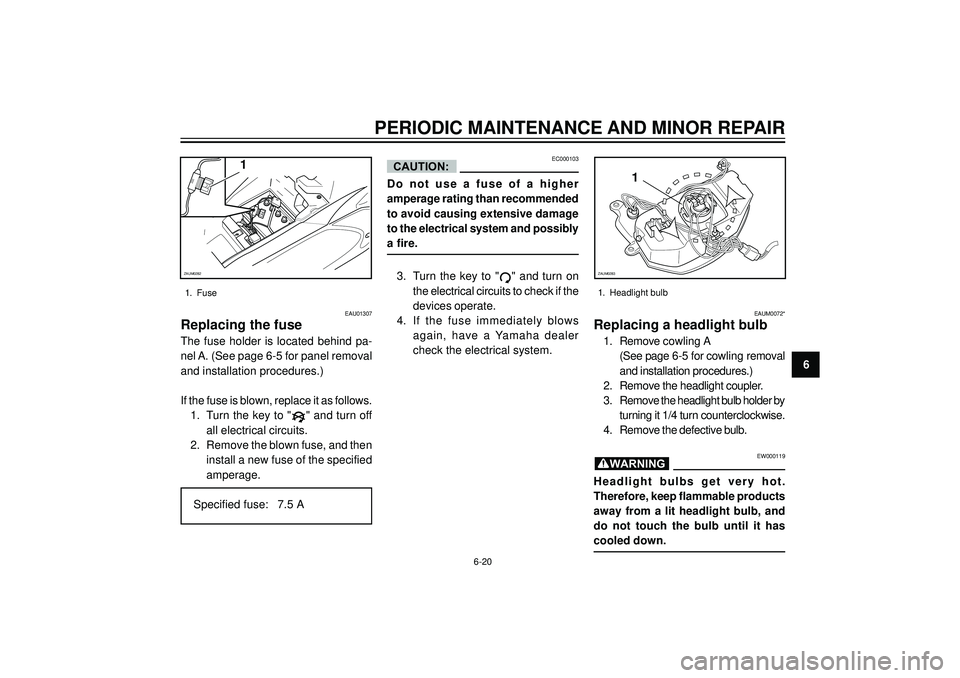
Replacing the fuse
The fuse holder is located behind pa-
nel A. (See page 6-5 for panel removal
and installation procedures.)
If the fuse is blown, replace it as follows.
1. Turn the key to "
" and turn off
all electrical circuits.
2. Remove the blown fuse, and then
install a new fuse of the specified
amperage.
Specified fuse: 7.5 A
EC000103
Do not use a fuse of a higher
amperage rating than recommended
to avoid causing extensive damage
to the electrical system and possibly
a fire.
3. Turn the key to "
" and turn on
the electrical circuits to check if the
devices operate.
4. If the fuse immediately blows
again, have a Yamaha dealer
check the electrical system.
CAUTION:
EAUM0072*
Replacing a headlight bulb
1. Remove cowling A
(See page 6-5 for cowling removal
and installation procedures.)
2. Remove the headlight coupler.
3. Remove the headlight bulb holder by
turning it 1/4 turn counterclockwise.
4. Remove the defective bulb.
EW000119
Headlight bulbs get very hot.
Therefore, keep flammable products
away from a lit headlight bulb, and
do not touch the bulb until it has
cooled down.
1
ZAUM0283
1. Headlight bulb
WARNING
6-20
Page 65 of 84

PERIODIC MAINTENANCE AND MINOR REPAIR
6
EAU03363
Troubleshooting charts
Starting problems or poor engine performance
EW000125
Keep away open flames and do not smoke while checking or working on the fuel system.
WARNING
Check the fuel level in
the fuel tank.
1. FuelThere is enough fuel.
There is no fuel.Check the compression.
Supply fuel.
Operate the electric starter.
2. CompressionThere is compression.
There is no compression.Check the ignition.
Have a Yamaha dealer
check the vehicle.
Remove the spark plugs
and check the electrodes.
3. IgnitionWet
DryWipe off with a dry cloth and correct the
spark plug gaps, or replace the spark plugs.
Have a Yamaha dealer check the vehicle.The engine does not start.
Check the battery.Open the throttle halfway and operate
the electric starter.
Operate the electric starter.
4. BatteryThe engine turns over
quickly.
The engine turns over
slowly.The battery is good.
Check the electrolyte and battery
lead connections, and charge the
battery if necessary.The engine does not start.
Have a Yamaha dealer
check the vehicle.
The engine does not start.
Check the compressoin.
6-23
Page 66 of 84
PERIODIC MAINTENANCE AND MINOR REPAIR
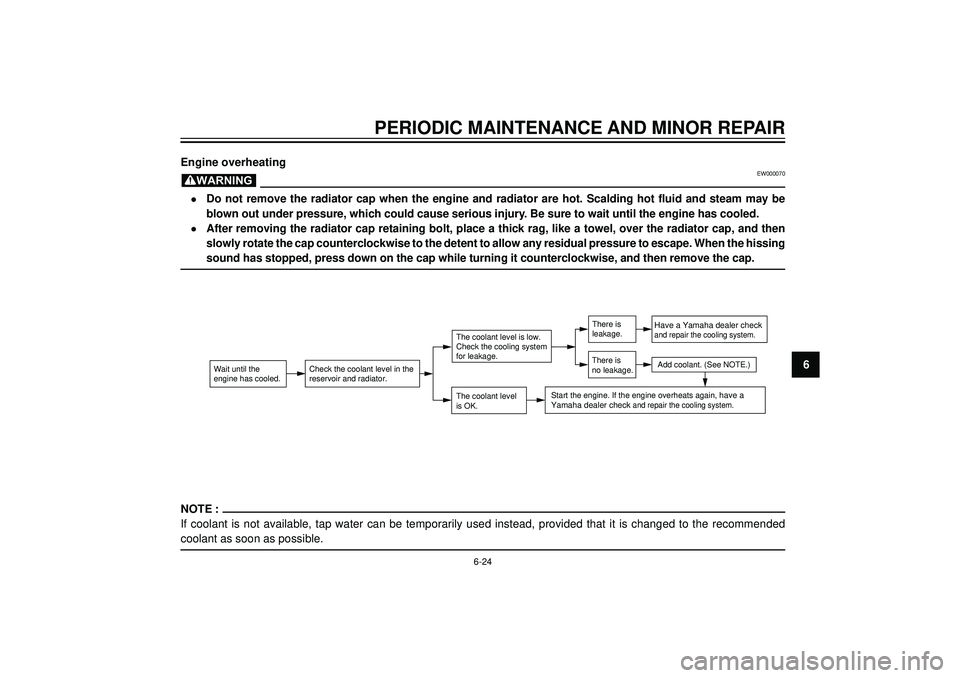
6 Engine overheating
EW000070
•Do not remove the radiator cap when the engine and radiator are hot. Scalding hot fluid and steam may be
blown out under pressure, which could cause serious injury. Be sure to wait until the engine has cooled.
•After removing the radiator cap retaining bolt, place a thick rag, like a towel, over the radiator cap, and then
slowly rotate the cap counterclockwise to the detent to allow any residual pressure to escape. When the hissing
sound has stopped, press down on the cap while turning it counterclockwise, and then remove the cap.
NOTE :
If coolant is not available, tap water can be temporarily used instead, provided that it is changed to the recommended
coolant as soon as possible.
WARNING
Wait until the
engine has cooled.Check the coolant level in the
reservoir and radiator.
The coolant level
is OK.
The coolant level is low.
Check the cooling system
for leakage.
Have a Yamaha dealer checkand repair the cooling system.
Add coolant. (See NOTE.)
Start the engine. If the engine overheats again, have a
Yamaha dealer check and repair the cooling system.
There is
leakage.
There is
no leakage.
6-24
Page 71 of 84
SCOOTER CARE AND STORAGE
7After cleaning
1. Dry the scooter with a chamois or
an absorbing cloth.
2. Use a chrome polish to shine
chrome, aluminum and stainless-
steel parts, including the exhaust
system. (Even the thermally
induced discoloring of stainless-
steel exhaust systems can be
removed through polishing.)
3. To prevent corrosion, it is
recommended to apply a corro-
sion protection spray on all metal,
including chrome- and nickel-
plated, surfaces.
4. Use spray oil as a universal
cleaner to remove any remaining
dirt.
5. Touch up minor paint damage
caused by stones, etc.
6. Wax all painted surfaces.
7. Let the scooter dry completely
before storing or covering it.
EWA00002
•Make sure that there is no oil or
wax on the brakes or tires. If
necessary, clean the brake discs
and brake linings with a regular
brake disc cleaner or acetone,
and wash the tires with warm
water and a mild detergent.
•Before operating the scooter
test its braking performance and
cornering behavior.
ECA00013
•Apply spray oil and wax sparingly
and make sure to wipe off any
excess.
•Never apply oil or wax to any
rubber and plastic parts, but treat
them with a suitable care product.
•Avoid using abrasive polishing
compounds as they will wear
away the paint.
NOTE :
Consult a Yamaha dealer for advice on
what products to use.
Storage
Short-term
Always store your scooter in a cool, dry
place and, if necessary, protect it
against dust with a porous cover.
ECA00015
•Storing the scooter in a poorly
ventilated room or covering it
with a tarp, while it is still wet,
will allow water and humidity to
seep in and cause rust.
•To prevent corrosion, avoid
damp cellars, stables (because
of the presence of ammonia)
and areas where strong
chemicals are stored.
WARNING
CAUTION:
CAUTION:
7-3
Page 72 of 84
SCOOTER CARE AND STORAGE
7 Long-term
Before storing your scooter for several
months:
1. Follow all the instructions in the
"Care" section of this chapter.
2. Drain the carburetor float chamber
by loosening the drain bolt; this will
prevent fuel deposits from building
up. Pour the drained fuel into the fuel
tank.
3. Fill up the fuel tank and add fuel
stabilizer (if available) to prevent the
fuel tank from rusting and the fuel
from deteriorating.
4. Perform the following steps to protect
the cylinder, piston rings, etc. from
corrosion.
a. Remove the spark plug cap
and spark plug.
b. Pour a teaspoonful of engine oil
into the spark plug bore.c. Install the spark plug cap onto
the spark plug, and then place
the spark plug on the cylinder
head so that the electrodes are
grounded. (This will limit
sparking during the next step.)
d. Turn the engine over several
times with the starter. (This will
coat the cylinder wall with oil.)
e. Remove the spark plug cap
from the spark plug, and then
install the spark plug and the
spark plug cap.
EWA00003
To prevent damage or injury from
sparking, make sure to ground the
spark plug electrodes while turning
the engine over.
5. Lubricate all control cables and
the pivoting points of all levers and
pedals as well as of the sidestand/
centerstand.6. Check and, if necessary, correct
the tire air pressure, and then lift
the scooter so that both of its
wheels are off the ground.
Alternatively, turn the wheels a
little every month in order to
prevent the tires from becoming
degraded in one spot.
7. Cover the muffler outlet with a
plastic bag to prevent moisture
from entering it.
8. Remove the battery and fully
charge it. Store it in a cool, dry
place and charge it once a month.
Do not store the battery in an
excessively cold or warm place
(less than 0 °C or more than 30
°C). For more information on
storing the battery, see page 6-19.
NOTE :
Make any necessary repairs before
storing the scooter.
WARNING
7-4
Page 77 of 84
SPECIFICATIONS
8
Electrical:
Ignition system type C.D.I
Charging system Flywheel magneto
Battery
Model GM4-3B, YB4L-B, FB4L-B
Voltage/capacity 12 V / 4 Ah
Headlight type:Bulb
Bulbs (voltage/wattage x quantity):
Headlight 12V, 35W/35Wx1
Brake/brake light 12V, 5W/21Wx1
Turn signal light
Front 12V, 10Wx2
Rear 12V, 10Wx2
Meter lights 12V, 1,2Wx2
High beam indicator light 12V, 2Wx1
Turn signal indicator light 12V, 2Wx1
Oil warning light 12V, 2Wx1
Temperature indicator light 12V, 1,2Wx1
Fuses:
Main fuse 7.5 A
8-3