battery YAMAHA AEROX50 2004 Owners Manual
[x] Cancel search | Manufacturer: YAMAHA, Model Year: 2004, Model line: AEROX50, Model: YAMAHA AEROX50 2004Pages: 84, PDF Size: 0.96 MB
Page 16 of 84
2
DESCRIPTION
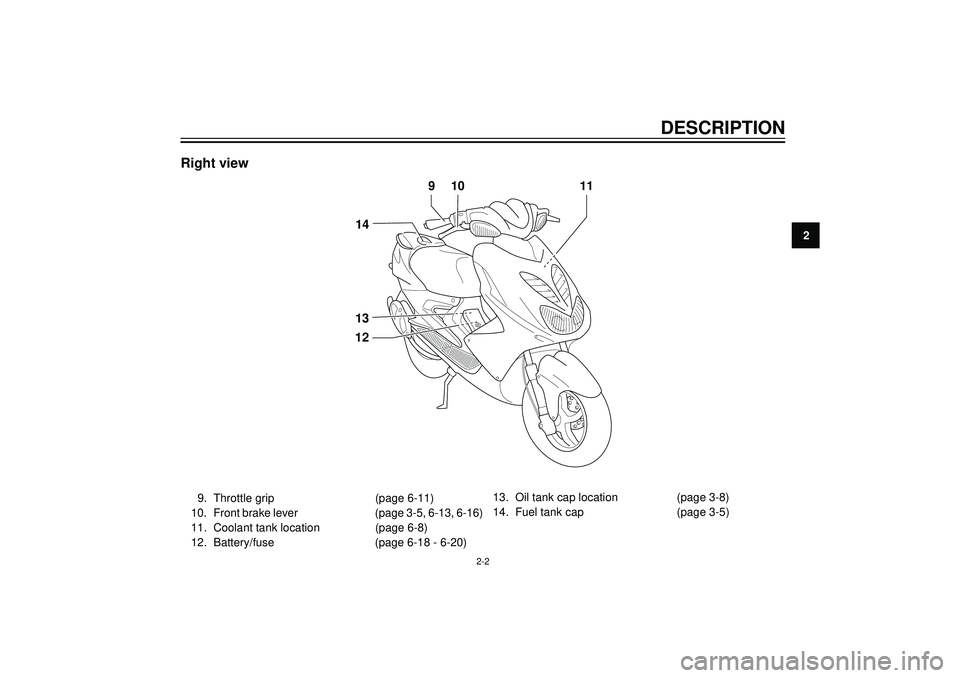
Right view
910
14 11
1213
9. Throttle grip (page 6-11)
10. Front brake lever (page 3-5, 6-13, 6-16)
11. Coolant tank location (page 6-8)
12. Battery/fuse (page 6-18 - 6-20)
2-2
13. Oil tank cap location (page 3-8)
14. Fuel tank cap (page 3-5)
Page 34 of 84
4
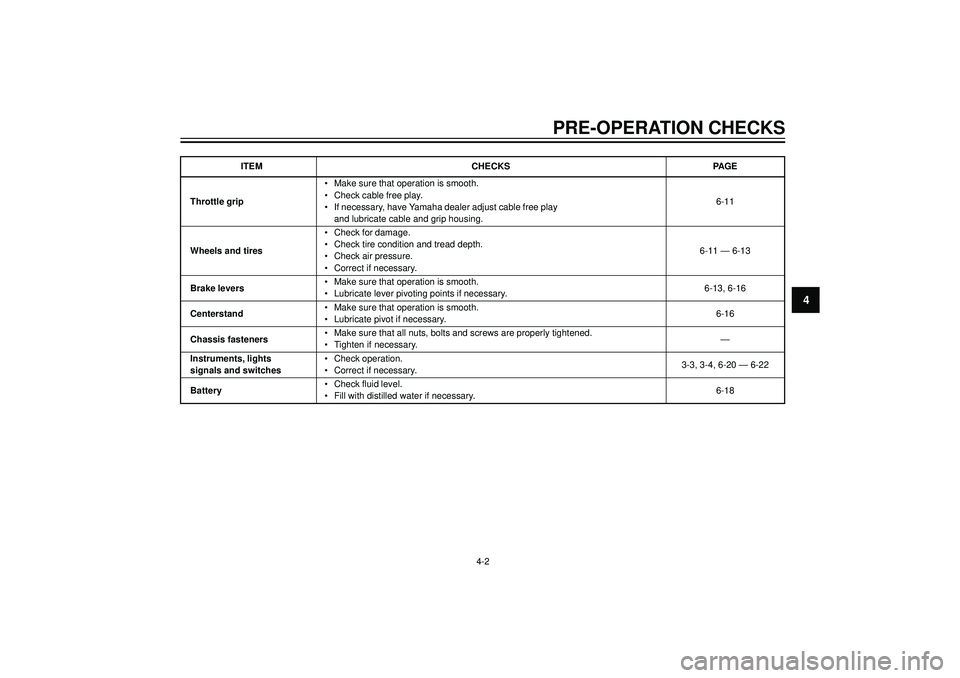
PRE-OPERATION CHECKS
ITEM CHECKS PAGE
• Make sure that operation is smooth.
Throttle grip• Check cable free play.
6-11
• If necessary, have Yamaha dealer adjust cable free play
and lubricate cable and grip housing.
• Check for damage.
Wheels and tires• Check tire condition and tread depth.
6-11 — 6-13
• Check air pressure.
• Correct if necessary.
Brake levers• Make sure that operation is smooth.
6-13, 6-16
• Lubricate lever pivoting points if necessary.
Centerstand• Make sure that operation is smooth.
6-16
• Lubricate pivot if necessary.
Chassis fasteners• Make sure that all nuts, bolts and screws are properly tightened.
—
• Tighten if necessary.
Instruments, lights• Check operation.
3-3, 3-4, 6-20 — 6-22
signals and switches• Correct if necessary.
Battery• Check fluid level.
6-18
• Fill with distilled water if necessary.
4-2
Page 37 of 84
OPERATION AND IMPORTANT RIDING POINTS
5
EAU01118
EW000129
•Become thoroughly familiar
with all operating controls and
their functions before riding.
Consult a Yamaha dealer
regarding any control or
function that you do not
thoroughly understand.
•Never start the engine or
operate it in a closed area for
any length of time. Exhaust fu-
mes are poisonous, and
inhaling them can cause loss of
consciousness and death
within a short time. Always
make sure that there is
adequate ventilation.
•For safety, always start the
engine with the centerstand
down.
WARNING
CAUTION:
CAUTION:
PUSH
OPEN
ZAUM0253
5-1
EAU00415*
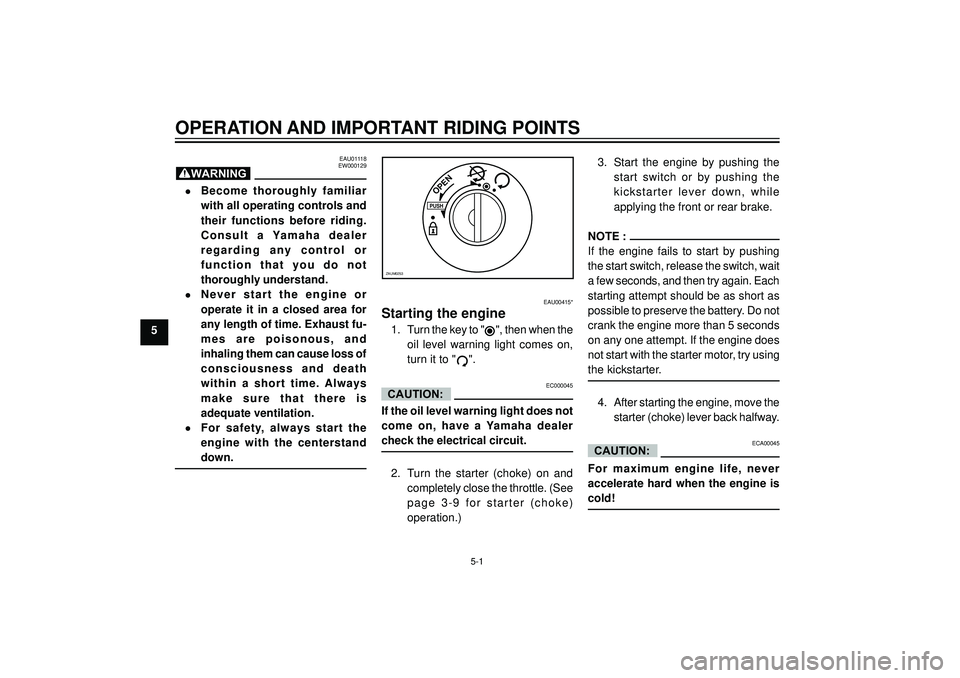
Starting the engine
1. Turn the key to "", then when the
oil level warning light comes on,
turn it to "
".
EC000045
If the oil level warning light does not
come on, have a Yamaha dealer
check the electrical circuit.
2. Turn the starter (choke) on and
completely close the throttle. (See
page 3-9 for starter (choke)
operation.)3. Start the engine by pushing the
start switch or by pushing the
kickstarter lever down, while
applying the front or rear brake.
NOTE :
If the engine fails to start by pushing
the start switch, release the switch, wait
a few seconds, and then try again. Each
starting attempt should be as short as
possible to preserve the battery. Do not
crank the engine more than 5 seconds
on any one attempt. If the engine does
not start with the starter motor, try using
the kickstarter.
4. After starting the engine, move the
starter (choke) lever back halfway.
ECA00045
For maximum engine life, never
accelerate hard when the engine is
cold!
Page 42 of 84
EAU00462
PERIODIC MAINTENANCE AND MINOR REPAIR
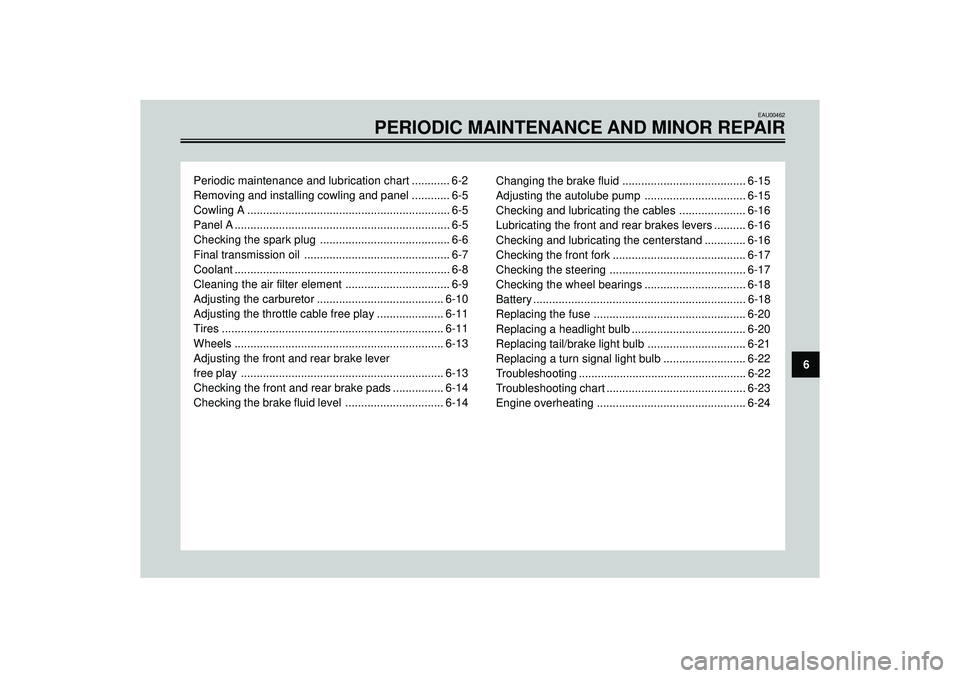
Periodic maintenance and lubrication chart ............ 6-2
Removing and installing cowling and panel ............ 6-5
Cowling A ................................................................ 6-5
Panel A .................................................................... 6-5
Checking the spark plug ......................................... 6-6
Final transmission oil .............................................. 6-7
Coolant .................................................................... 6-8
Cleaning the air filter element ................................. 6-9
Adjusting the carburetor ........................................ 6-10
Adjusting the throttle cable free play ..................... 6-11
Tires ...................................................................... 6-11
Wheels .................................................................. 6-13
Adjusting the front and rear brake lever
free play ................................................................ 6-13
Checking the front and rear brake pads ................ 6-14
Checking the brake fluid level ............................... 6-14
6 Changing the brake fluid ....................................... 6-15
Adjusting the autolube pump ................................ 6-15
Checking and lubricating the cables ..................... 6-16
Lubricating the front and rear brakes levers .......... 6-16
Checking and lubricating the centerstand ............. 6-16
Checking the front fork .......................................... 6-17
Checking the steering ........................................... 6-17
Checking the wheel bearings ................................ 6-18
Battery ................................................................... 6-18
Replacing the fuse ................................................ 6-20
Replacing a headlight bulb .................................... 6-20
Replacing tail/brake light bulb ............................... 6-21
Replacing a turn signal light bulb .......................... 6-22
Troubleshooting ..................................................... 6-22
Troubleshooting chart ............................................ 6-23
Engine overheating ............................................... 6-24
Page 44 of 84
PERIODIC MAINTENANCE AND MINOR REPAIR
6
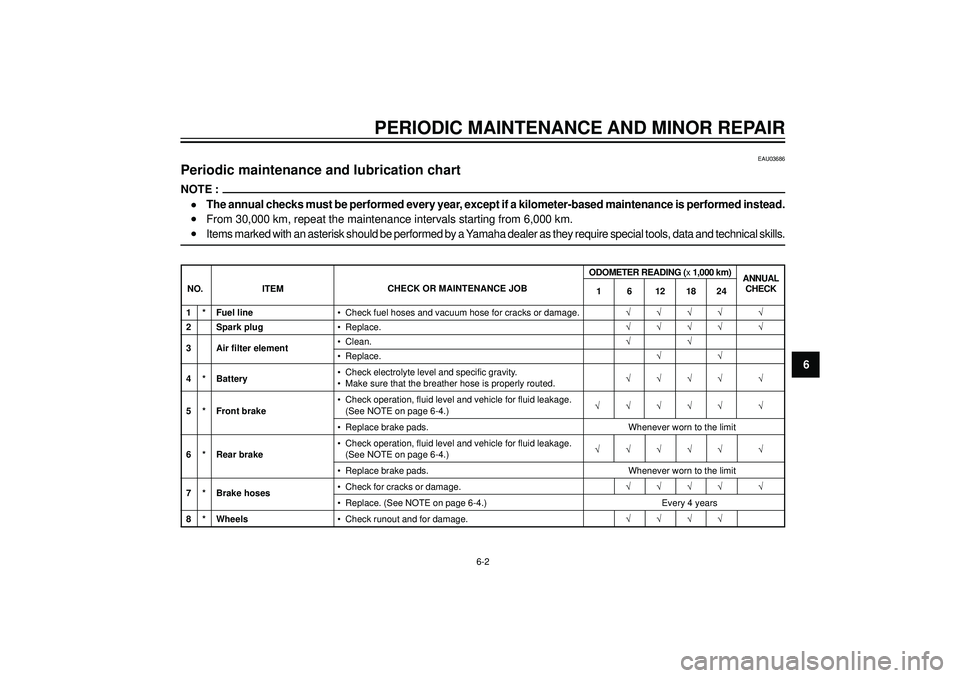
1 * Fuel line• Check fuel hoses and vacuum hose for cracks or damage.√√√√ √
2 Spark plug• Replace.√√√√ √
3 Air filter element• Clean.√√• Replace.√√
4 * Battery• Check electrolyte level and specific gravity.
√√√√ √
• Make sure that the breather hose is properly routed.
• Check operation, fluid level and vehicle for fluid leakage.
√√√√√ √
5 * Front brake(See NOTE on page 6-4.)
• Replace brake pads. Whenever worn to the limit
• Check operation, fluid level and vehicle for fluid leakage.
√√√√√ √
6 * Rear brake(See NOTE on page 6-4.)
• Replace brake pads. Whenever worn to the limit
7 * Brake hoses• Check for cracks or damage.√√√√ √• Replace. (See NOTE on page 6-4.) Every 4 years
8 * Wheels• Check runout and for damage.√√√√
EAU03686
Periodic maintenance and lubrication chart
NOTE :
•The annual checks must be performed every year, except if a kilometer-based maintenance is performed instead.
•From 30,000 km, repeat the maintenance intervals starting from 6,000 km.
•Items marked with an asterisk should be performed by a Yamaha dealer as they require special tools, data and technical skills.
ODOMETER READING (x 1,000 km)
NO. ITEMCHECK OR MAINTENANCE JOB
1
ANNUAL
CHECK
6121824
6-2
Page 60 of 84

PERIODIC MAINTENANCE AND MINOR REPAIR
6
EAU01144
Checking the wheel bearings
The front and rear wheel bearings must
be checked at the intervals specified in
the periodic maintenance and
lubrication chart. If there is play in the
wheel hub or if the wheel does not turn
smoothly, have a Yamaha dealer check
the wheel bearings.
1
ZAUM0281
1. Battery
EAUM0049
Battery
A poorly maintained battery will corrode
and discharge quickly. The electrolyte
level, battery lead connections and
breather hose routing should be
checked before each ride and at the
intervals specified in the periodic main-
tenance and lubrication chart.
To check the electrolyte level
1. Place the scooter on a level sur-
face and hold it in an upright posi-
tion.
NOTE :
Make sure that the scooter is positioned
straight up when checking the
electrolyte level.
2. Remove panel A. (See page 6-5
for panel removal and installation
procedures.)
3. Check the electrolyte level in the
battery.
NOTE :
The electrolyte should be between the
minimum and maximum level marks.
1
2+UPPER
LOWER
ZAUM0106
1. Maximum level
2. Minimum level
6-18
2. Hold the lower ends of the front
fork legs and try to move them
forward and backward. If any free
play can be felt, have a Yamaha
dealer check or repair the
steering.
Page 61 of 84
PERIODIC MAINTENANCE AND MINOR REPAIR
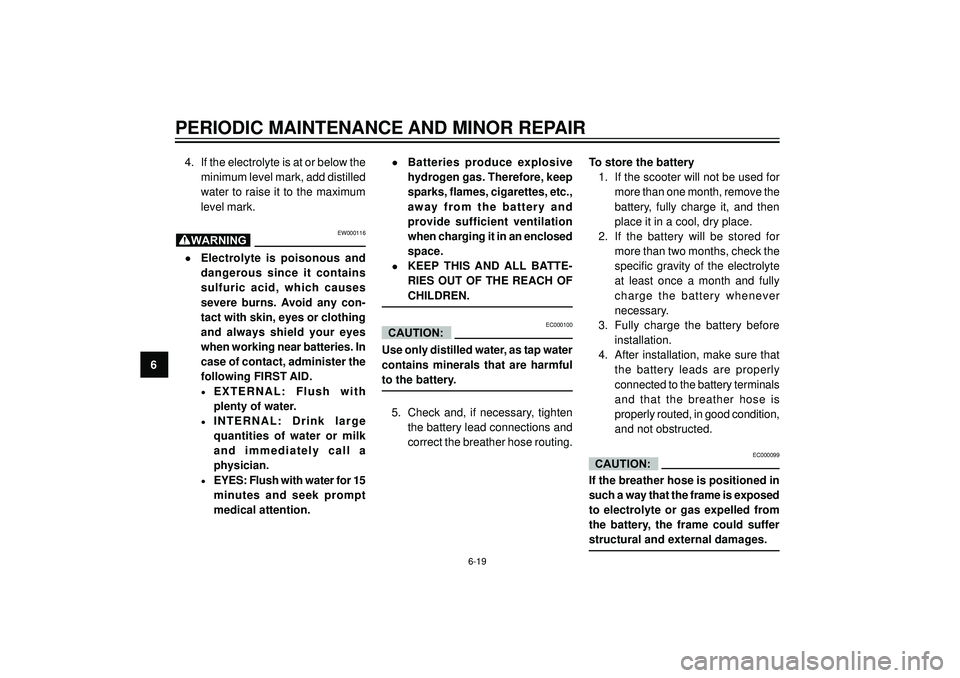
64. If the electrolyte is at or below the
minimum level mark, add distilled
water to raise it to the maximum
level mark.
EW000116
•Electrolyte is poisonous and
dangerous since it contains
sulfuric acid, which causes
severe burns. Avoid any con-
tact with skin, eyes or clothing
and always shield your eyes
when working near batteries. In
case of contact, administer the
following FIRST AID.
•EXTERNAL: Flush with
plenty of water.
•INTERNAL: Drink large
quantities of water or milk
and immediately call a
physician.
•EYES: Flush with water for 15
minutes and seek prompt
medical attention.
•Batteries produce explosive
hydrogen gas. Therefore, keep
sparks, flames, cigarettes, etc.,
away from the battery and
provide sufficient ventilation
when charging it in an enclosed
space.
•KEEP THIS AND ALL BATTE-
RIES OUT OF THE REACH OF
CHILDREN.
EC000100
Use only distilled water, as tap water
contains minerals that are harmful
to the battery.
5. Check and, if necessary, tighten
the battery lead connections and
correct the breather hose routing.
WARNING
CAUTION:
To store the battery
1. If the scooter will not be used for
more than one month, remove the
battery, fully charge it, and then
place it in a cool, dry place.
2. If the battery will be stored for
more than two months, check the
specific gravity of the electrolyte
at least once a month and fully
charge the battery whenever
necessary.
3. Fully charge the battery before
installation.
4. After installation, make sure that
the battery leads are properly
connected to the battery terminals
and that the breather hose is
properly routed, in good condition,
and not obstructed.
EC000099
If the breather hose is positioned in
such a way that the frame is exposed
to electrolyte or gas expelled from
the battery, the frame could suffer
structural and external damages.
CAUTION:
6-19
Page 65 of 84

PERIODIC MAINTENANCE AND MINOR REPAIR
6
EAU03363
Troubleshooting charts
Starting problems or poor engine performance
EW000125
Keep away open flames and do not smoke while checking or working on the fuel system.
WARNING
Check the fuel level in
the fuel tank.
1. FuelThere is enough fuel.
There is no fuel.Check the compression.
Supply fuel.
Operate the electric starter.
2. CompressionThere is compression.
There is no compression.Check the ignition.
Have a Yamaha dealer
check the vehicle.
Remove the spark plugs
and check the electrodes.
3. IgnitionWet
DryWipe off with a dry cloth and correct the
spark plug gaps, or replace the spark plugs.
Have a Yamaha dealer check the vehicle.The engine does not start.
Check the battery.Open the throttle halfway and operate
the electric starter.
Operate the electric starter.
4. BatteryThe engine turns over
quickly.
The engine turns over
slowly.The battery is good.
Check the electrolyte and battery
lead connections, and charge the
battery if necessary.The engine does not start.
Have a Yamaha dealer
check the vehicle.
The engine does not start.
Check the compressoin.
6-23
Page 72 of 84
SCOOTER CARE AND STORAGE
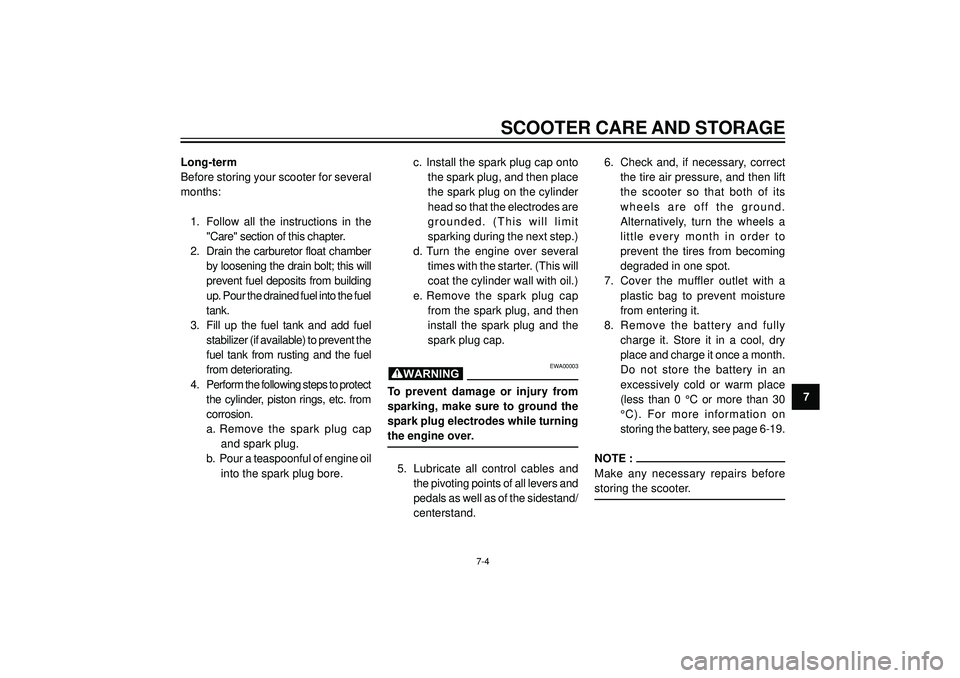
7 Long-term
Before storing your scooter for several
months:
1. Follow all the instructions in the
"Care" section of this chapter.
2. Drain the carburetor float chamber
by loosening the drain bolt; this will
prevent fuel deposits from building
up. Pour the drained fuel into the fuel
tank.
3. Fill up the fuel tank and add fuel
stabilizer (if available) to prevent the
fuel tank from rusting and the fuel
from deteriorating.
4. Perform the following steps to protect
the cylinder, piston rings, etc. from
corrosion.
a. Remove the spark plug cap
and spark plug.
b. Pour a teaspoonful of engine oil
into the spark plug bore.c. Install the spark plug cap onto
the spark plug, and then place
the spark plug on the cylinder
head so that the electrodes are
grounded. (This will limit
sparking during the next step.)
d. Turn the engine over several
times with the starter. (This will
coat the cylinder wall with oil.)
e. Remove the spark plug cap
from the spark plug, and then
install the spark plug and the
spark plug cap.
EWA00003
To prevent damage or injury from
sparking, make sure to ground the
spark plug electrodes while turning
the engine over.
5. Lubricate all control cables and
the pivoting points of all levers and
pedals as well as of the sidestand/
centerstand.6. Check and, if necessary, correct
the tire air pressure, and then lift
the scooter so that both of its
wheels are off the ground.
Alternatively, turn the wheels a
little every month in order to
prevent the tires from becoming
degraded in one spot.
7. Cover the muffler outlet with a
plastic bag to prevent moisture
from entering it.
8. Remove the battery and fully
charge it. Store it in a cool, dry
place and charge it once a month.
Do not store the battery in an
excessively cold or warm place
(less than 0 °C or more than 30
°C). For more information on
storing the battery, see page 6-19.
NOTE :
Make any necessary repairs before
storing the scooter.
WARNING
7-4
Page 77 of 84
SPECIFICATIONS
8
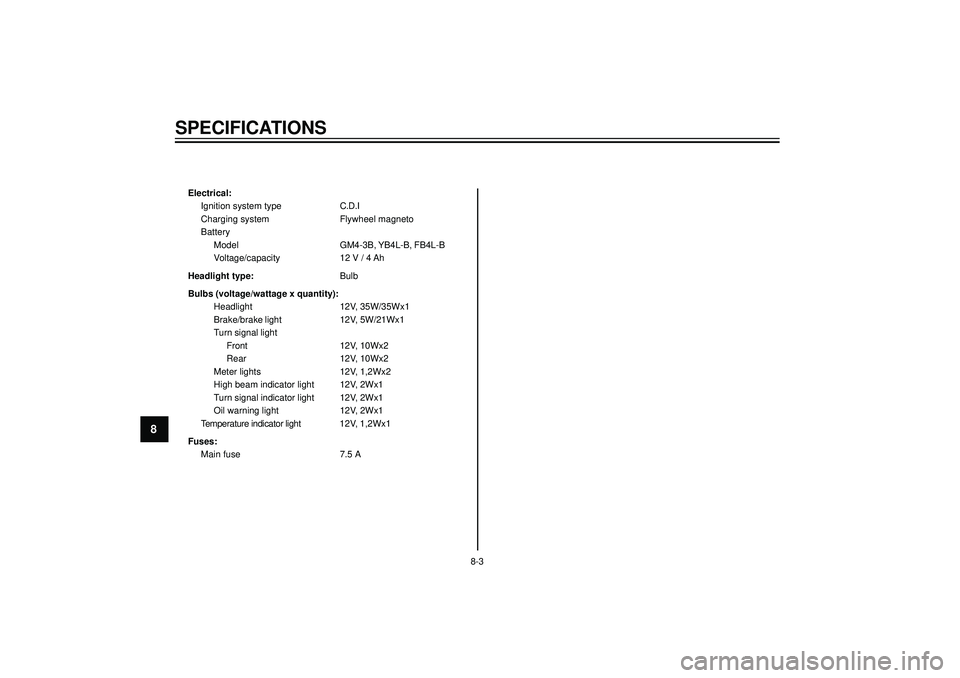
Electrical:
Ignition system type C.D.I
Charging system Flywheel magneto
Battery
Model GM4-3B, YB4L-B, FB4L-B
Voltage/capacity 12 V / 4 Ah
Headlight type:Bulb
Bulbs (voltage/wattage x quantity):
Headlight 12V, 35W/35Wx1
Brake/brake light 12V, 5W/21Wx1
Turn signal light
Front 12V, 10Wx2
Rear 12V, 10Wx2
Meter lights 12V, 1,2Wx2
High beam indicator light 12V, 2Wx1
Turn signal indicator light 12V, 2Wx1
Oil warning light 12V, 2Wx1
Temperature indicator light 12V, 1,2Wx1
Fuses:
Main fuse 7.5 A
8-3