maintenance YAMAHA AEROX50 2014 Owner's Guide
[x] Cancel search | Manufacturer: YAMAHA, Model Year: 2014, Model line: AEROX50, Model: YAMAHA AEROX50 2014Pages: 78, PDF Size: 4.05 MB
Page 62 of 78
PERIODIC MAINTENANCE AND ADJUSTMENT
6-27
68. Connect the headlight coupler.
9. Install the cowling.
10. Have a Yamaha dealer adjust the
headlight beam if necessary.
EAU24134
Replacing the tail/brake light
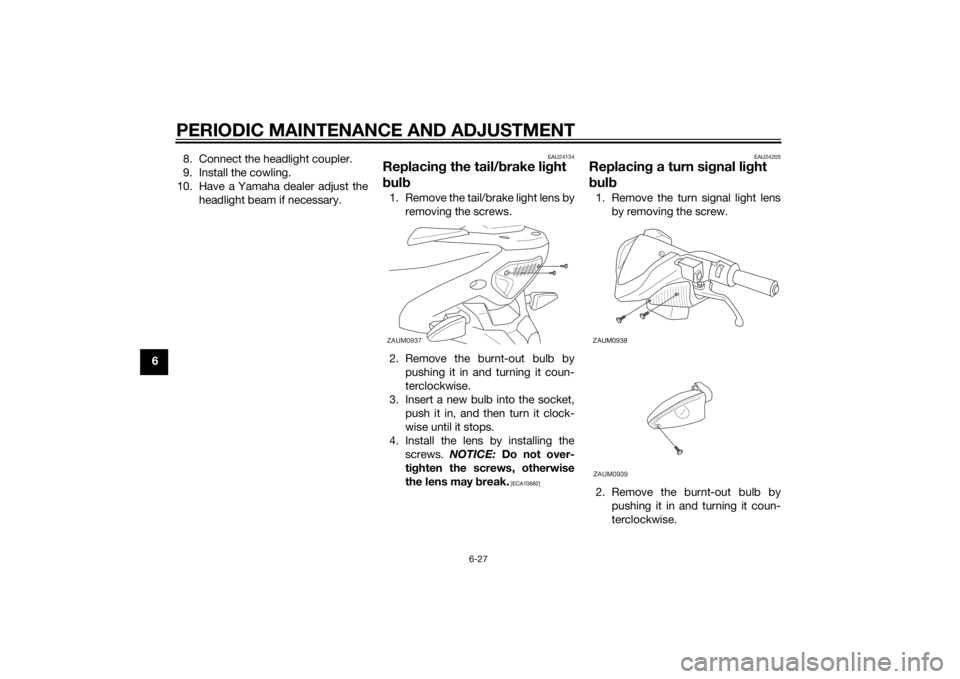
bulb1. Remove the tail/brake light lens by
removing the screws.
2. Remove the burnt-out bulb by
pushing it in and turning it coun-
terclockwise.
3. Insert a new bulb into the socket,
push it in, and then turn it clock-
wise until it stops.
4. Install the lens by installing the
screws. NOTICE: Do not over-
tighten the screws, otherwise
the lens may break.
[ECA10682]EAU24205
Replacing a turn signal light
bulb1. Remove the turn signal light lens
by removing the screw.
2. Remove the burnt-out bulb by
pushing it in and turning it coun-
terclockwise.
ZAUM0937
ZAUM0938ZAUM0939
U1GBE0E0.book Page 27 Wednesday, June 26, 2013 4:04 PM
Page 63 of 78
PERIODIC MAINTENANCE AND ADJUSTMENT
6-28
6 3. Insert a new bulb into the socket,
push it in, and then turn it clock-
wise until it stops.
4. Install the lens by installing the
screw. NOTICE: Do not over-
tighten the screw, otherwise the
lens may break.
[ECA11192]EAU24331
License plate lightIf the license plate light does not come
on, have a Yamaha dealer check the
electrical circuit or replace the bulb.
EAU45465
Replacing the auxiliary light
bulb (for CHE)If the auxiliary light bulb burns out, re-
place it as follows.
1. Place the vehicle on the center-
stand.
2. Remove cowling A. (See page
6-6.)
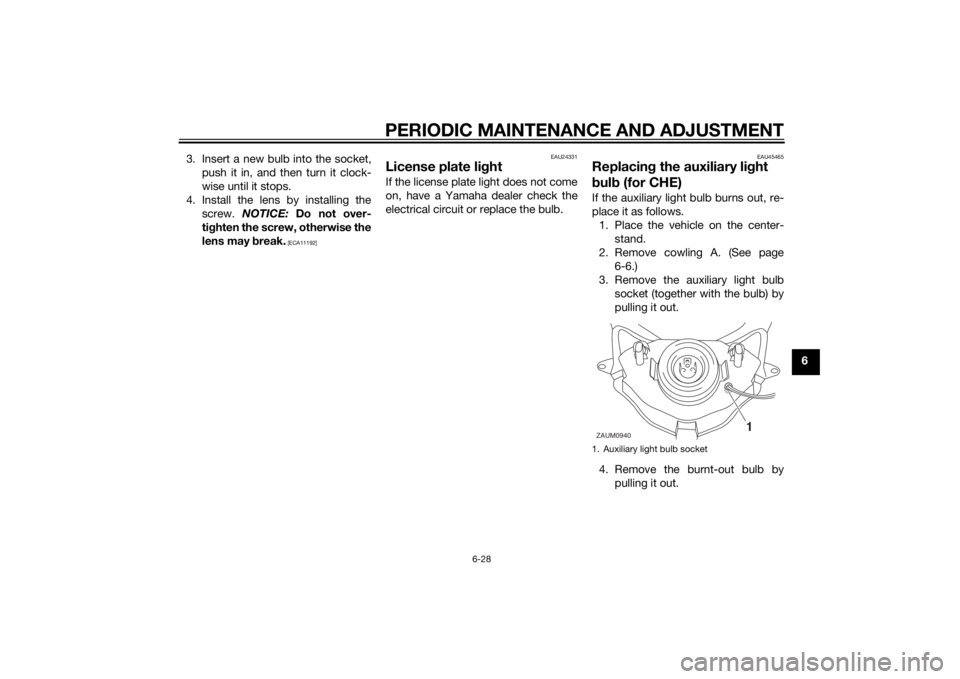
3. Remove the auxiliary light bulb
socket (together with the bulb) by
pulling it out.
4. Remove the burnt-out bulb by
pulling it out.1. Auxiliary light bulb socketZAUM0940
1
U1GBE0E0.book Page 28 Wednesday, June 26, 2013 4:04 PM
Page 64 of 78
PERIODIC MAINTENANCE AND ADJUSTMENT
6-29
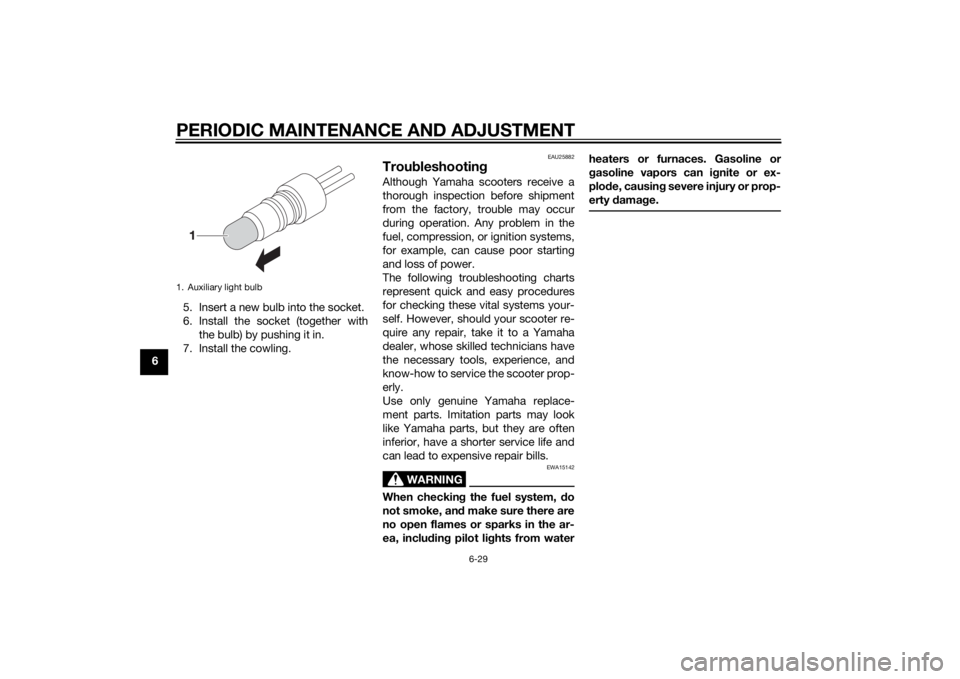
65. Insert a new bulb into the socket.
6. Install the socket (together with
the bulb) by pushing it in.
7. Install the cowling.
EAU25882
TroubleshootingAlthough Yamaha scooters receive a
thorough inspection before shipment
from the factory, trouble may occur
during operation. Any problem in the
fuel, compression, or ignition systems,
for example, can cause poor starting
and loss of power.
The following troubleshooting charts
represent quick and easy procedures
for checking these vital systems your-
self. However, should your scooter re-
quire any repair, take it to a Yamaha
dealer, whose skilled technicians have
the necessary tools, experience, and
know-how to service the scooter prop-
erly.
Use only genuine Yamaha replace-
ment parts. Imitation parts may look
like Yamaha parts, but they are often
inferior, have a shorter service life and
can lead to expensive repair bills.
WARNING
EWA15142
When checking the fuel system, do
not smoke, and make sure there are
no open flames or sparks in the ar-
ea, including pilot lights from waterheaters or furnaces. Gasoline or
gasoline vapors can ignite or ex-
plode, causing severe injury or prop-
erty damage.
1. Auxiliary light bulbU1GBE0E0.book Page 29 Wednesday, June 26, 2013 4:04 PM
Page 65 of 78
PERIODIC MAINTENANCE AND ADJUSTMENT
6-30
6
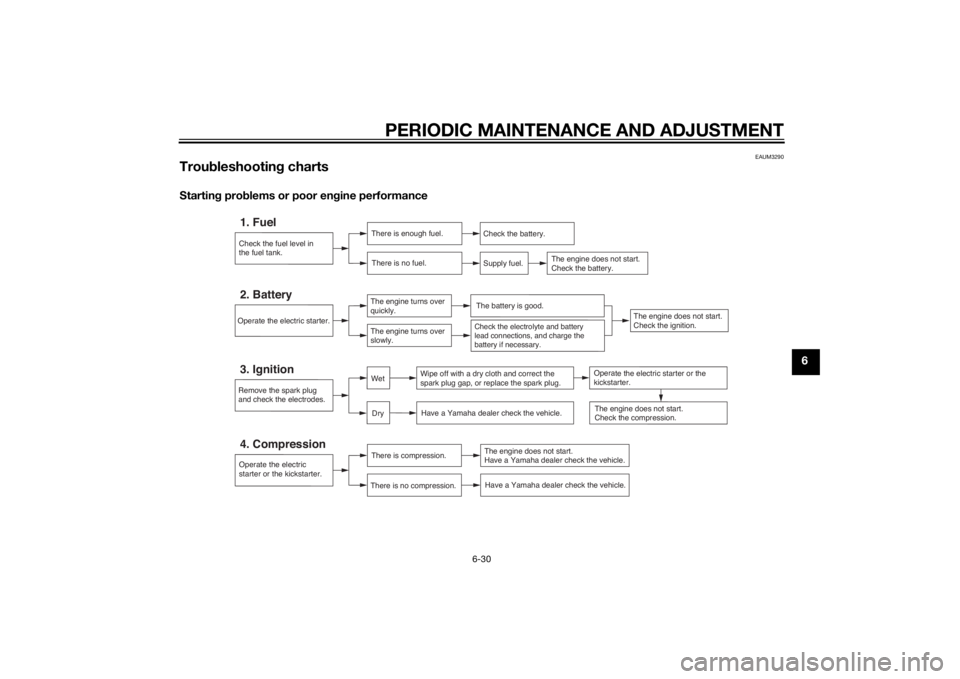
EAUM3290
Troubleshooting chartsStarting problems or poor engine performance
Check the fuel level in
the fuel tank.1. Fuel
There is enough fuel.
There is no fuel.
Check the battery.
Supply fuel.
The engine does not start.
Check the battery.
4. Compression
There is compression.
There is no compression.
The engine does not start.
Have a Yamaha dealer check the vehicle.Have a Yamaha dealer check the vehicle.
Remove the spark plug
and check the electrodes.3. Ignition
Wipe off with a dry cloth and correct the
spark plug gap, or replace the spark plug.
Have a Yamaha dealer check the vehicle.
The engine does not start.
Check the compression.
Operate the electric starter.2. Battery
The engine turns over
quickly.
The engine turns over
slowly.
The battery is good.
DryWet
The engine does not start.
Check the ignition.
Operate the electric
starter or the kickstarter.
Check the electrolyte and battery
lead connections, and charge the
battery if necessary.
Operate the electric starter or the
kickstarter.
U1GBE0E0.book Page 30 Wednesday, June 26, 2013 4:04 PM
Page 66 of 78
PERIODIC MAINTENANCE AND ADJUSTMENT
6-31
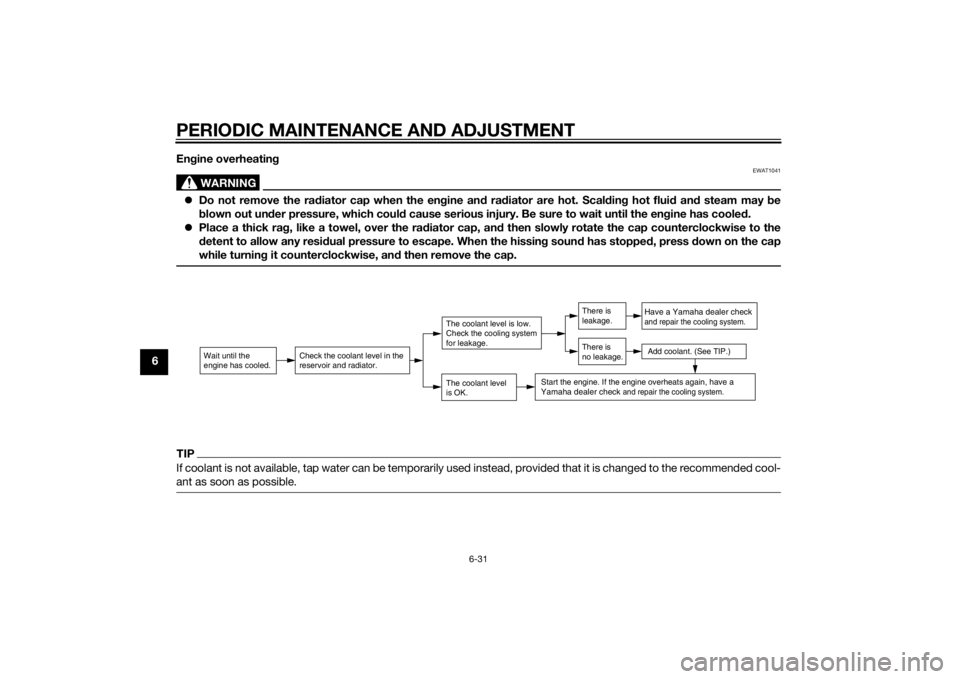
6Engine overheating
WARNING
EWAT1041
Do not remove the radiator cap when the engine and radiator are hot. Scalding hot fluid and steam may be
blown out under pressure, which could cause serious injury. Be sure to wait until the engine has cooled.
Place a thick rag, like a towel, over the radiator cap, and then slowly rotate the cap counterclockwise to the
detent to allow any residual pressure to escape. When the hissing sound has stopped, press down on the cap
while turning it counterclockwise, and then remove the cap.TIPIf coolant is not available, tap water can be temporarily used instead, provided that it is changed to the recommended cool-
ant as soon as possible.
Wait until the
engine has cooled.
Check the coolant level in the
reservoir and radiator.
The coolant level
is OK.The coolant level is low.
Check the cooling system
for leakage.
Have a Yamaha dealer checkand repair the cooling system.Add coolant. (See TIP.)
Start the engine. If the engine overheats again,
have a
Yamaha dealer check
and repair the cooling system.
There is
leakage.
There is
no leakage.
U1GBE0E0.book Page 31 Wednesday, June 26, 2013 4:04 PM
Page 75 of 78

INDEX
AAcceleration and deceleration ................ 5-2
Air filter element and check hose,
replacing and cleaning ....................... 6-13
Auxiliary light bulb, replacing ............... 6-28BBattery .................................................. 6-23
Brake fluid, changing............................ 6-20
Brake fluid level, checking.................... 6-18
Brake lever, front .................................... 3-7
Brake lever, rear ..................................... 3-7
Brake levers, lubricating ....................... 6-21
Braking ................................................... 5-3CCables, checking and lubricating ......... 6-20
Care ........................................................ 7-1
Catalytic converter ............................... 3-10
Centerstand, checking and
lubricating........................................... 6-21
Coolant ................................................. 6-12
Coolant temperature warning light ......... 3-2
Cowling and panel, removing and
installing ............................................... 6-6DDimmer switch........................................ 3-7EEngine break-in ...................................... 5-4
Engine oil ................................................ 6-9
Engine trouble warning light ................... 3-3FFinal transmission oil ............................ 6-11
Front and rear brake lever free play,
checking ............................................. 6-17
Front and rear brake pads, checking ... 6-18Front fork, checking ............................. 6-22
Fuel ........................................................ 3-8
Fuel consumption, tips for reducing ...... 5-3
Fuel level warning light........................... 3-2
Fuel tank cap.......................................... 3-8
Fuse, replacing..................................... 6-25
HHandlebar switches ............................... 3-6
Headlight bulb, replacing ..................... 6-26
High beam indicator light ....................... 3-2
Horn switch ............................................ 3-7IIdentification numbers ........................... 9-1
Indicator lights and warning lights ......... 3-2KKickstarter ............................................ 3-10LLicense plate light ................................ 6-28MMain switch/steering lock ...................... 3-1
Maintenance and lubrication, periodic... 6-3
Maintenance, emission control
system ................................................. 6-2
Matte color, caution ............................... 7-1
Model label............................................. 9-1
Multi-function display............................. 3-3PParking ................................................... 5-4
Part locations ......................................... 2-1SSafe-riding points................................... 1-5
Safety information .................................. 1-1
Seats .................................................... 3-11
Spark plug, checking ............................. 6-7Specifications ......................................... 8-1
Starting a cold engine............................. 5-1
Starting off .............................................. 5-2
Start switch ............................................. 3-7
Steering, checking ................................ 6-23
Storage ................................................... 7-4
Storage compartment........................... 3-12
TTail/brake light bulb, replacing ............. 6-27
Throttle grip and cable, checking and
lubricating ........................................... 6-20
Throttle grip free play, checking ........... 6-14
Tires ...................................................... 6-15
Troubleshooting .................................... 6-29
Troubleshooting charts ......................... 6-30
Turn signal indicator light ....................... 3-2
Turn signal light bulb, replacing............ 6-27
Turn signal switch ................................... 3-7VValve clearance..................................... 6-14
Vehicle identification number ................. 9-1WWheel bearings, checking .................... 6-23
Wheels .................................................. 6-17
U1GBE0E0.book Page 1 Wednesday, June 26, 2013 4:04 PM