engine oil YAMAHA AEROX50 2018 User Guide
[x] Cancel search | Manufacturer: YAMAHA, Model Year: 2018, Model line: AEROX50, Model: YAMAHA AEROX50 2018Pages: 78, PDF Size: 4.36 MB
Page 46 of 78
Periodic maintenance and adjustment
6-11
62. Release the button, and the oil
change indicator will go off.
EAUT1563
Final transmission oilThe final transmission case must be
checked for oil leakage before each
ride. If any leakage is found, have a
Yamaha dealer check and repair the
scooter. In addition, the final transmis-
sion oil must be changed as follows at
the intervals specified in the periodic
maintenance and lubrication chart.
1. Start the engine, warm it up by rid-
ing the scooter for several min-
utes, and then stop the engine.
2. Place the scooter on the center-
stand.
3. Place an oil pan under the final
transmission case to collect the
used oil.
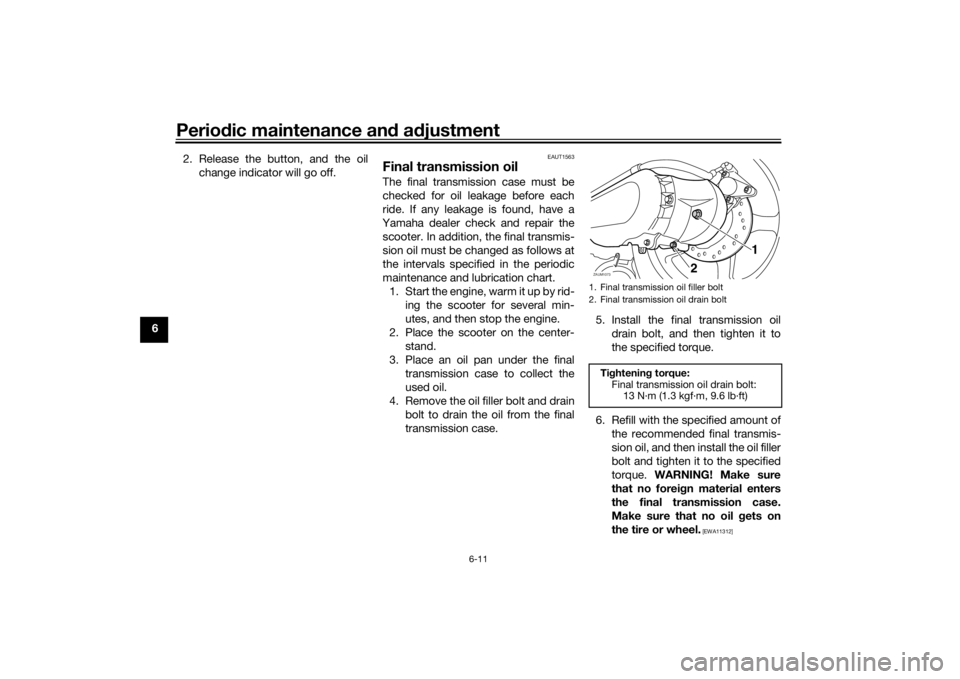
4. Remove the oil filler bolt and drain
bolt to drain the oil from the final
transmission case.5. Install the final transmission oil
drain bolt, and then tighten it to
the specified torque.
6. Refill with the specified amount of
the recommended final transmis-
sion oil, and then install the oil filler
bolt and tighten it to the specified
torque. WARNING! Make sure
that no foreign material enters
the final transmission case.
Make sure that no oil gets on
the tire or wheel.
[EWA11312]
1. Final transmission oil filler bolt
2. Final transmission oil drain boltTightening torque:
Final transmission oil drain bolt:
13 N·m (1.3 kgf·m, 9.6 lb·ft)ZAUM1073
2
1
U1GBE1E0.book Page 11 Tuesday, October 17, 2017 11:45 AM
Page 47 of 78
Periodic maintenance and adjustment
6-12
6 7. Check the final transmission case
for oil leakage. If oil is leaking,
check for the cause.
EAU20071
CoolantThe coolant level should be checked
before each ride. In addition, the cool-
ant must be changed at the intervals
specified in the periodic maintenance
and lubrication chart.
EAUM3182
To check the coolant level
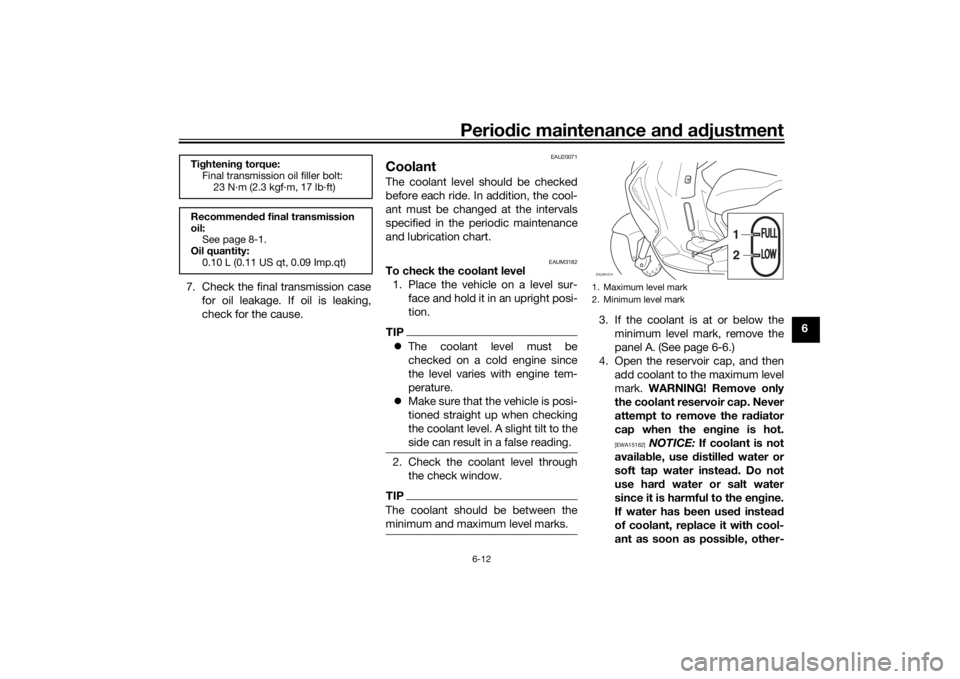
1. Place the vehicle on a level sur-
face and hold it in an upright posi-
tion.TIPThe coolant level must be
checked on a cold engine since
the level varies with engine tem-
perature.
Make sure that the vehicle is posi-
tioned straight up when checking
the coolant level. A slight tilt to the
side can result in a false reading.2. Check the coolant level through
the check window.TIPThe coolant should be between the
minimum and maximum level marks.
3. If the coolant is at or below the
minimum level mark, remove the
panel A. (See page 6-6.)
4. Open the reservoir cap, and then
add coolant to the maximum level
mark. WARNING! Remove only
the coolant reservoir cap. Never
attempt to remove the radiator
cap when the engine is hot.
[EWA15162]
NOTICE: If coolant is not
available, use distilled water or
soft tap water instead. Do not
use hard water or salt water
since it is harmful to the engine.
If water has been used instead
of coolant, replace it with cool-
ant as soon as possible, other-
Tightening torque:
Final transmission oil filler bolt:
23 N·m (2.3 kgf·m, 17 lb·ft)
Recommended final transmission
oil:
See page 8-1.
Oil quantity:
0.10 L (0.11 US qt, 0.09 Imp.qt)
1. Maximum level mark
2. Minimum level markZAUM1074
1
2
FULLFULLLOWLOW
U1GBE1E0.book Page 12 Tuesday, October 17, 2017 11:45 AM
Page 66 of 78
Scooter care and storage
7-1
7
EAU37834
Matte color cautionNOTICE
ECA15193
Some models are equipped with
matte colored finished parts. Be
sure to consult a Yamaha dealer for
advice on what products to use be-
fore cleaning the vehicle. Using a
brush, harsh chemical products or
cleaning compounds when cleaning
these parts will scratch or damage
their surface. Wax also should not
be applied to any matte colored fin-
ished parts.
EAU26096
CareWhile the open design of a scooter re-
veals the attractiveness of the technol-
ogy, it also makes it more vulnerable.
Rust and corrosion can develop even if
high-quality components are used. A
rusty exhaust pipe may go unnoticed
on a car, however, it detracts from the
overall appearance of a scooter. Fre-
quent and proper care does not only
comply with the terms of the warranty,
but it will also keep your scooter look-
ing good, extend its life and optimize
its performance.
Before cleaning
1. Cover the muffler outlet with a
plastic bag after the engine has
cooled down.
2. Make sure that all caps and cov-
ers as well as all electrical cou-
plers and connectors, including
the spark plug cap, are tightly in-
stalled.
3. Remove extremely stubborn dirt,
like oil burnt onto the crankcase,
with a degreasing agent and a
brush, but never apply such prod-ucts onto seals, gaskets and
wheel axles. Always rinse the dirt
and degreaser off with water.
Cleaning
NOTICE
ECA10784
Avoid using strong acidic wheel
cleaners, especially on spoked
wheels. If such products are
used on hard-to-remove dirt, do
not leave the cleaner on the af-
fected area any longer than in-
structed. Also, thoroughly rinse
the area off with water, immedi-
ately dry it, and then apply a cor-
rosion protection spray.
Improper cleaning can damage
plastic parts (such as cowlings,
panels, windshields, headlight
lenses, meter lenses, etc.) and
the mufflers. Use only a soft,
clean cloth or sponge with wa-
ter to clean plastic. However, if
the plastic parts cannot be thor-
oughly cleaned with water, di-
luted mild detergent with water
may be used. Be sure to rinse
U1GBE1E0.book Page 1 Tuesday, October 17, 2017 11:45 AM
Page 69 of 78
Scooter care and storage
7-4
7
EAU36564
StorageShort-term
Always store your scooter in a cool, dry
place and, if necessary, protect it
against dust with a porous cover. Be
sure the engine and the exhaust sys-
tem are cool before covering the
scooter.NOTICE
ECA10821
Storing the scooter in a poorly
ventilated room or covering it
with a tarp, while it is still wet,
will allow water and humidity to
seep in and cause rust.
To prevent corrosion, avoid
damp cellars, stables (because
of the presence of ammonia)
and areas where strong chemi-
cals are stored.Long-term
Before storing your scooter for several
months:
1. Follow all the instructions in the
“Care” section of this chapter.2. Fill up the fuel tank and add fuel
stabilizer (if available) to prevent
the fuel tank from rusting and the
fuel from deteriorating.
3. Perform the following steps to
protect the cylinder, piston rings,
etc. from corrosion.
a. Remove the spark plug cap
and spark plug.
b. Pour a teaspoonful of engine
oil into the spark plug bore.
c. Install the spark plug cap onto
the spark plug, and then place
the spark plug on the cylinder
head so that the electrodes are
grounded. (This will limit spark-
ing during the next step.)
d. Turn the engine over several
times with the starter. (This will
coat the cylinder wall with oil.)
e. Remove the spark plug cap
from the spark plug, and then
install the spark plug and the
spark plug cap. WARNING! To
prevent damage or injury
from sparking, make sure to
ground the spark plug elec-
trodes while turning the en-
gine over.
[EWA10952]
4. Lubricate all control cables and
the pivoting points of all levers and
pedals as well as of the side-
stand/centerstand.
5. Check and, if necessary, correct
the tire air pressure, and then lift
the scooter so that both of its
wheels are off the ground. Alterna-
tively, turn the wheels a little every
month in order to prevent the tires
from becoming degraded in one
spot.
6. Cover the muffler outlet with a
plastic bag to prevent moisture
from entering it.
7. Remove the battery and fully
charge it. Store it in a cool, dry
place and charge it once a month.
Do not store the battery in an ex-
cessively cold or warm place [less
than 0 °C (30 °F) or more than 30
°C (90 °F)]. For more information
on storing the battery, see page
6-23.TIPMake any necessary repairs before
storing the scooter.
U1GBE1E0.book Page 4 Tuesday, October 17, 2017 11:45 AM
Page 70 of 78

Specifications
8-1
8
Dimensions:Overall length:
1870 mm (73.6 in)
Overall width:
700 mm (27.6 in)
Overall height:
1155 mm (45.5 in)
Seat height:
815 mm (32.1 in)
Wheelbase:
1275 mm (50.2 in)
Ground clearance:
130 mm (5.12 in)
Minimum turning radius:
2.0 m (6.56 ft)Weight:Curb weight:
101 kg (223 lb)Engine:Combustion cycle:
4-stroke
Cooling system:
Liquid cooled
Valve train:
SOHC
Number of cylinders:
Single cylinder
Displacement:
49 cm³
Bore × stroke:
38.0 × 43.5 mm (1.50 × 1.71 in)
Compression ratio:
12.0 : 1Starting system:
Electric starter and kickstarter
Lubrication system:
Wet sump
Engine oil:Recommended brand:
YAMALUBE
Type:
SAE 10W-40
Recommended engine oil grade:
API service SG type or higher, JASO
standard MA
Engine oil quantity:
Periodic oil change:
0.78 L (0.82 US qt, 0.69 Imp.qt)Final transmission oil:Type:
SAE 10W-30 type SE motor oil
Quantity:
0.10 L (0.11 US qt, 0.09 Imp.qt)Coolant quantity:Coolant reservoir (up to the maximum level
mark):
0.26 L (0.27 US qt, 0.23 Imp.qt)
Radiator (including all routes):
0.52 L (0.55 US qt, 0.46 Imp.qt)Air filter:Air filter element:
Oil-coated paper elementFuel:Recommended fuel:
Premium unleaded gasoline (Gasohol (E10)
acceptable)Fuel tank capacity:
6.0 L (1.58 US gal, 1.32 Imp.gal)
Fuel reserve amount:
1.0 L (0.26 US gal, 0.22 Imp.gal)
Fuel injection:Throttle body:
ID mark:
10BKSpark plug(s):Manufacturer/model:
NGK/CR7E
Spark plug gap:
0.7–0.8 mm (0.028–0.031 in)Clutch:Clutch type:
Dry, centrifugal, shoeDrivetrain:Primary reduction ratio:
1
Final drive:
Gear
Secondary reduction ratio:
52/13 × 44/12 (14.666)
Transmission type:
V-belt automatic
Operation:
Centrifugal automatic typeChassis:Frame type:
Underbone
Caster angle:
27.0 °
Trail:
85 mm (3.3 in)
U1GBE1E0.book Page 1 Tuesday, October 17, 2017 11:45 AM
Page 75 of 78

10-1
10
Index
AAcceleration and deceleration ................ 5-2
Air filter element and check hose,
replacing and cleaning ....................... 6-13
Auxiliary light bulb, replacing ............... 6-26BBattery .................................................. 6-23
Brake fluid, changing............................ 6-19
Brake fluid level, checking.................... 6-18
Brake lever, front .................................... 3-7
Brake lever, rear ..................................... 3-7
Brake levers, lubricating ....................... 6-20
Braking ................................................... 5-3CCables, checking and lubricating ......... 6-19
Care ........................................................ 7-1
Catalytic converter ............................... 3-10
Centerstand, checking and
lubricating........................................... 6-21
Coolant ................................................. 6-12
Coolant temperature warning light ......... 3-2
Cowling and panel, removing and
installing ............................................... 6-6DData recording, vehicle........................... 9-2
Diagnostic connector ............................. 9-2
Dimmer switch........................................ 3-6EEngine break-in ...................................... 5-4
Engine oil ................................................ 6-9
Engine trouble warning light ................... 3-3FFinal transmission oil ............................ 6-11Front and rear brake lever free play,
checking ............................................ 6-17
Front and rear brake pads, checking ... 6-17
Front fork, checking ............................. 6-21
Fuel ........................................................ 3-8
Fuel consumption, tips for reducing ...... 5-3
Fuel level warning light........................... 3-2
Fuel tank cap.......................................... 3-7
Fuse, replacing..................................... 6-24
HHandlebar switches ............................... 3-6
Headlight bulb, replacing ..................... 6-25
High beam indicator light ....................... 3-2
Horn switch ............................................ 3-6IIdentification numbers ........................... 9-1
Indicator lights and warning lights ......... 3-2KKickstarter ............................................ 3-10LLicense plate light ................................ 6-28MMain switch/steering lock ...................... 3-1
Maintenance and lubrication, periodic... 6-3
Maintenance, emission control
system ................................................. 6-2
Matte color, caution ............................... 7-1
Model label............................................. 9-1
Multi-function display............................. 3-3PParking ................................................... 5-4
Part locations ......................................... 2-1SSafe-riding points................................... 1-5Safety information................................... 1-1
Seats ..................................................... 3-11
Spark plug, checking .............................. 6-7
Specifications ......................................... 8-1
Starting a cold engine............................. 5-1
Starting off .............................................. 5-2
Start switch ............................................. 3-6
Steering, checking ................................ 6-22
Storage ................................................... 7-4
Storage compartment........................... 3-12
TTail/brake light bulb, replacing ............. 6-27
Throttle grip and cable, checking and
lubricating ........................................... 6-20
Throttle grip free play, checking ........... 6-14
Tires ...................................................... 6-15
Troubleshooting .................................... 6-28
Troubleshooting charts ......................... 6-29
Turn signal indicator light ....................... 3-2
Turn signal light bulb, replacing............ 6-27
Turn signal switch ................................... 3-6VValve clearance..................................... 6-14
Vehicle identification number ................. 9-1WWheel bearings, checking .................... 6-22
Wheels .................................................. 6-16
U1GBE1E0.book Page 1 Tuesday, October 17, 2017 11:45 AM