YAMAHA BANSHEE 350 2001 Manuale de Empleo (in Spanish)
BANSHEE 350 2001
YAMAHA
YAMAHA
https://www.carmanualsonline.info/img/51/49375/w960_49375-0.png
YAMAHA BANSHEE 350 2001 Manuale de Empleo (in Spanish)
Page 66 of 264
4-13
EBU00071
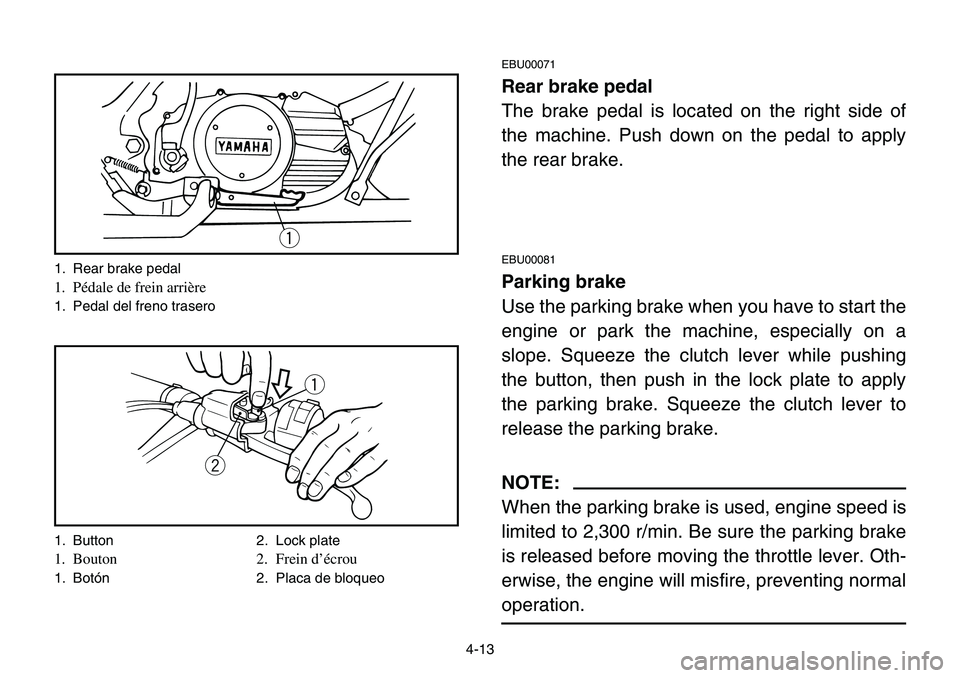
Rear brake pedal
The brake pedal is located on the right side of
the machine. Push down on the pedal to apply
the rear brake.
EBU00081
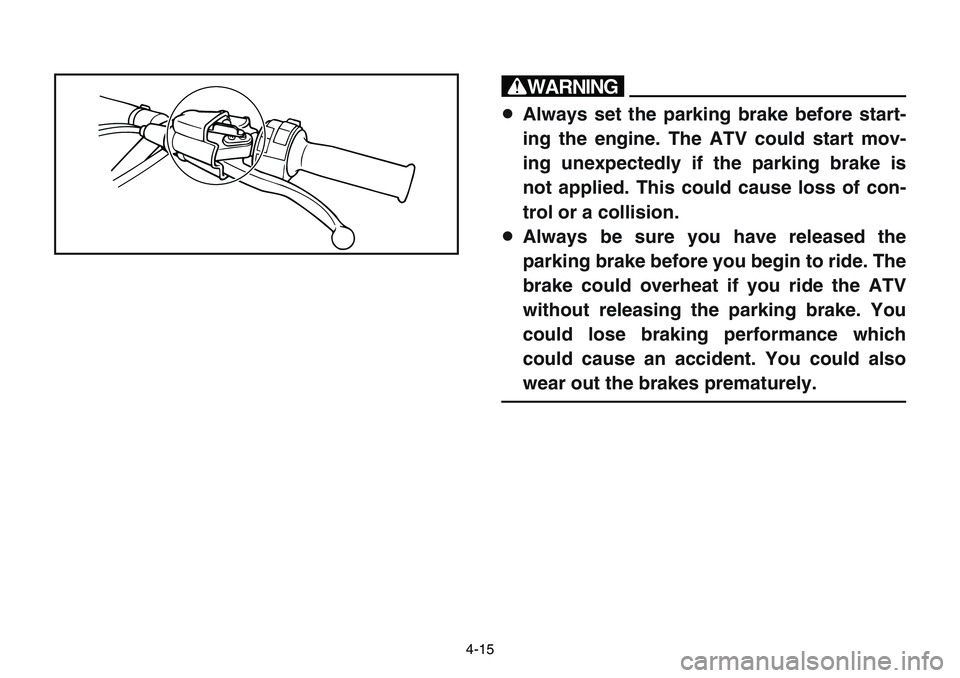
Parking brake
Use the parking brake when you have to start the
engine or park the machine, especially on a
slope. Squeeze the clutch lever while pushing
the button, then push in the lock plate to apply
the parking brake. Squeeze the clutch lever to
release the parking brake.
NOTE:
When the parking brake is used, engine speed is
limited to 2,300 r/min. Be sure the parking brake
is released before moving the throttle lever. Oth-
erwise, the engine will misfire, preventing normal
operation.
q
q
w
1. Rear brake pedal
1. Pédale de frein arrière
1. Pedal del freno trasero
1. Button 2. Lock plate
1. Bouton 2. Frein d’écrou
1. Botón 2. Placa de bloqueo
Page 68 of 264
4-15
w
8Always set the parking brake before start-
ing the engine. The ATV could start mov-
ing unexpectedly if the parking brake is
not applied. This could cause loss of con-
trol or a collision.
8Always be sure you have released the
parking brake before you begin to ride. The
brake could overheat if you ride the ATV
without releasing the parking brake. You
could lose braking performance which
could cause an accident. You could also
wear out the brakes prematurely.
Page 70 of 264
4-17
EBU00082
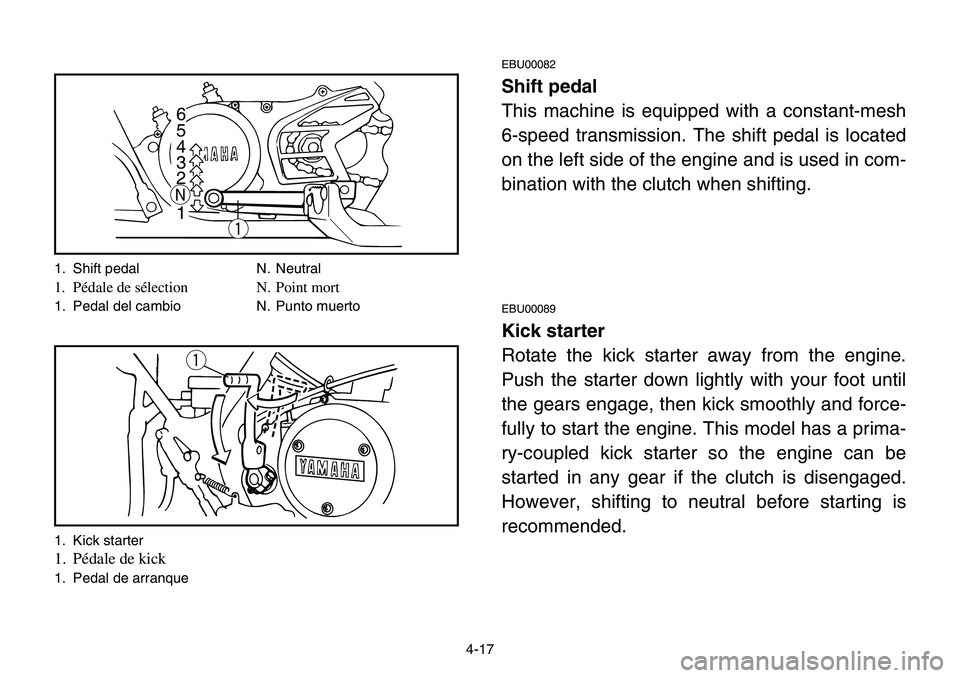
Shift pedal
This machine is equipped with a constant-mesh
6-speed transmission. The shift pedal is located
on the left side of the engine and is used in com-
bination with the clutch when shifting.
EBU00089
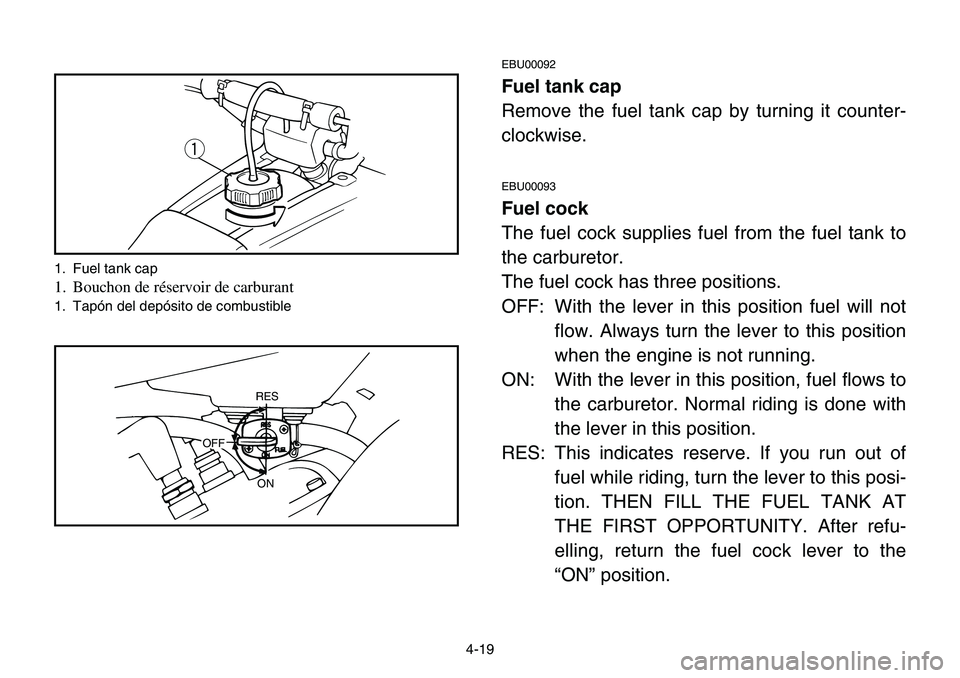
Kick starter
Rotate the kick starter away from the engine.
Push the starter down lightly with your foot until
the gears engage, then kick smoothly and force-
fully to start the engine. This model has a prima-
ry-coupled kick starter so the engine can be
started in any gear if the clutch is disengaged.
However, shifting to neutral before starting is
recommended.
N
1
q
2 3 4 5 6
q
1. Shift pedal N. Neutral
1. Pédale de sélection N. Point mort
1. Pedal del cambio N. Punto muerto
1. Kick starter
1. Pédale de kick
1. Pedal de arranque
Page 72 of 264
4-19
EBU00092
Fuel tank cap
Remove the fuel tank cap by turning it counter-
clockwise.
EBU00093
Fuel cock
The fuel cock supplies fuel from the fuel tank to
the carburetor.
The fuel cock has three positions.
OFF: With the lever in this position fuel will not
flow. Always turn the lever to this position
when the engine is not running.
ON: With the lever in this position, fuel flows to
the carburetor. Normal riding is done with
the lever in this position.
RES: This indicates reserve. If you run out of
fuel while riding, turn the lever to this posi-
tion. THEN FILL THE FUEL TANK AT
THE FIRST OPPORTUNITY. After refu-
elling, return the fuel cock lever to the
“ON” position.
q
RES
ON
OFF
1. Fuel tank cap
1. Bouchon de réservoir de carburant
1. Tapón del depósito de combustible
Page 74 of 264
4-21
EBU00094
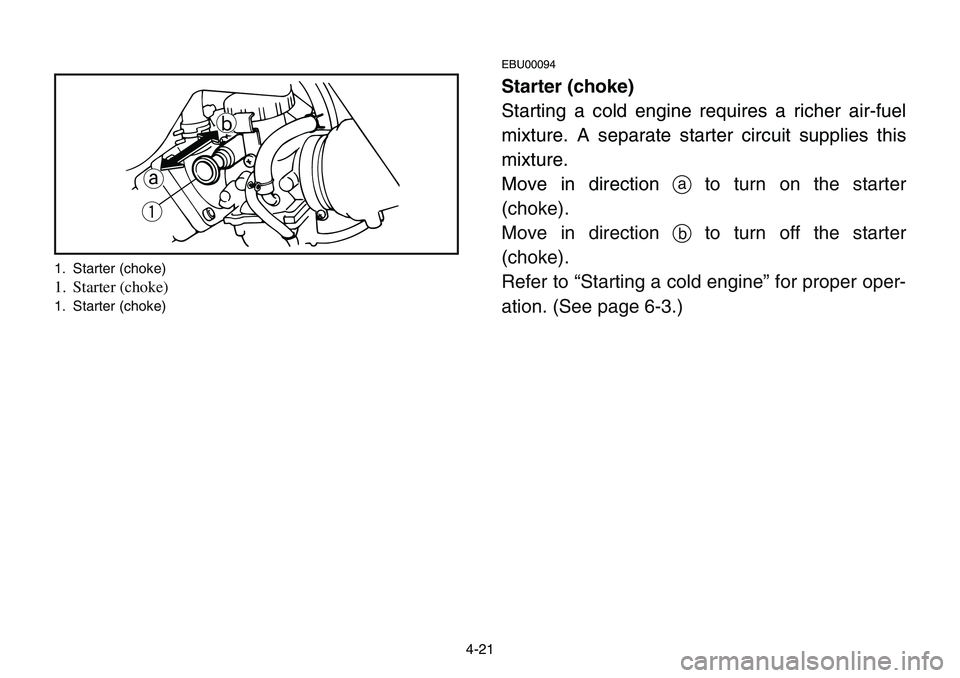
Starter (choke)
Starting a cold engine requires a richer air-fuel
mixture. A separate starter circuit supplies this
mixture.
Move in direction ato turn on the starter
(choke).
Move in direction bto turn off the starter
(choke).
Refer to “Starting a cold engine” for proper oper-
ation. (See page 6-3.)
q
a
b
1. Starter (choke)
1. Starter (choke)
1. Starter (choke)
Page 100 of 264
5-13
w
8Do not overfill the fuel tank. Fuel expands
when it heats up. If the fuel tank is over-
filled, fuel could spill out due to heat from
the engine or the sun.
8Be careful not to spill fuel, especially on
the engine or exhaust pipe which can
cause a fire and severe injury. Wipe up any
spilled fuel immediately.
8Do not refuel right after the engine has
been running and is still very hot.
8Be sure the fuel tank cap is closed secure-
ly.
Page 102 of 264
5-15
EBU00132
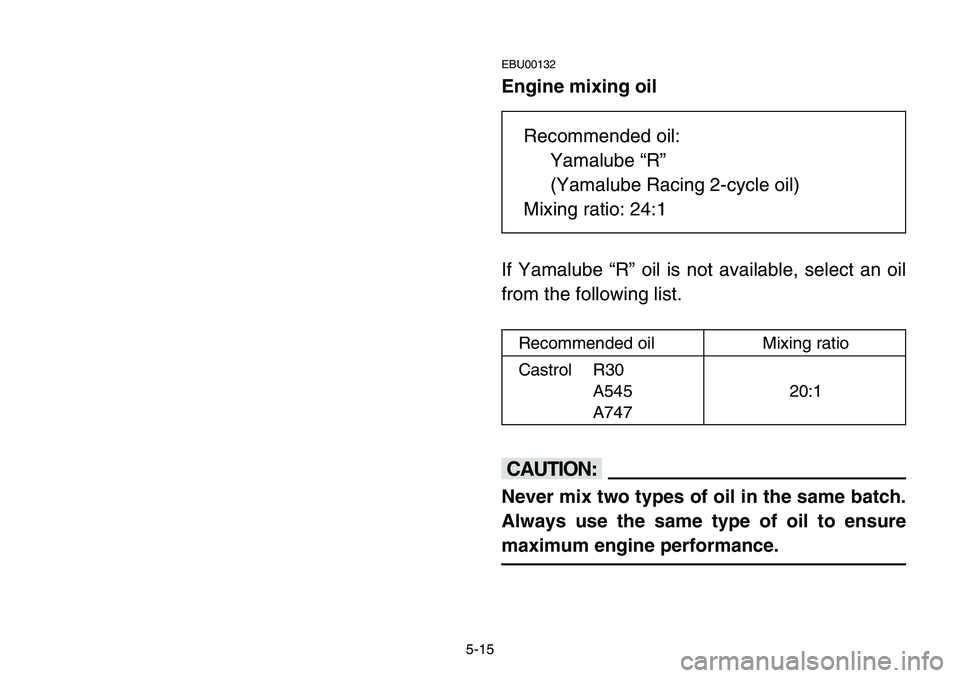
Engine mixing oil
If Yamalube “R” oil is not available, select an oil
from the following list.
cC
Never mix two types of oil in the same batch.
Always use the same type of oil to ensure
maximum engine performance.
Recommended oil:
Yamalube “R”
(Yamalube Racing 2-cycle oil)
Mixing ratio: 24:1
Recommended oil Mixing ratio
Castrol R30
A545 20:1
A747
Page 104 of 264
5-17
EBU00490
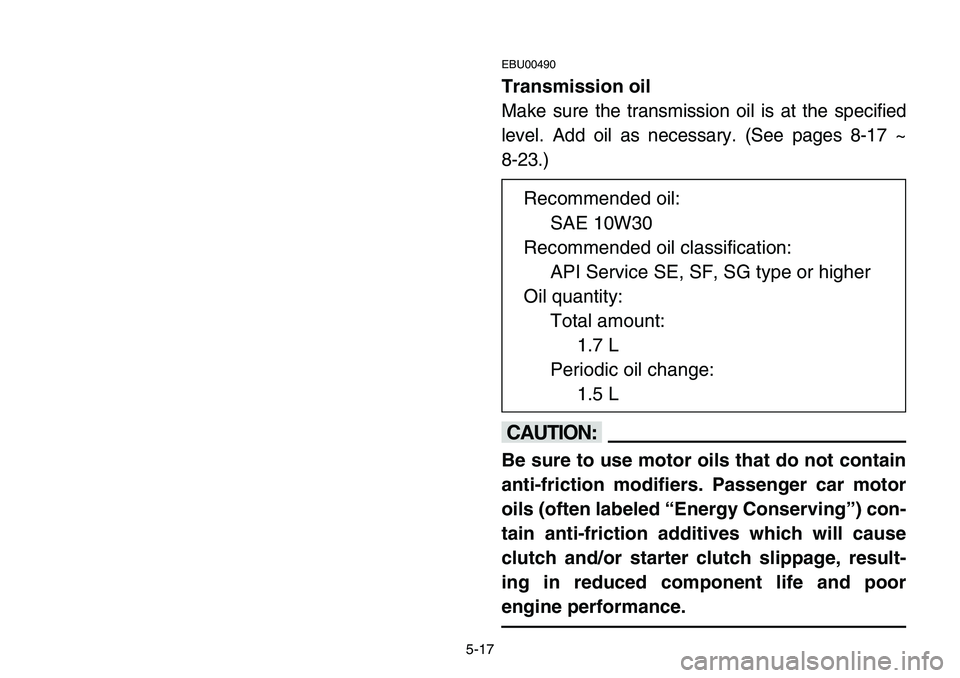
Transmission oil
Make sure the transmission oil is at the specified
level. Add oil as necessary. (See pages 8-17 ~
8-23.)
cC
Be sure to use motor oils that do not contain
anti-friction modifiers. Passenger car motor
oils (often labeled “Energy Conserving”) con-
tain anti-friction additives which will cause
clutch and/or starter clutch slippage, result-
ing in reduced component life and poor
engine performance.
Recommended oil:
SAE 10W30
Recommended oil classification:
API Service SE, SF, SG type or higher
Oil quantity:
Total amount:
1.7 L
Periodic oil change:
1.5 L
Page 108 of 264
5-21
EBU00153
Lights
Check the headlight and taillight to make sure
they are in working condition. Repair as neces-
sary for proper operation.
EBU00155
Switches
Check the operation of the headlight switch,
engine stop switch and any other switches.
Repair as necessary for proper operation.
Page 120 of 264
6-3
EBU00512
Starting a cold engine
w
Always make sure all control cables work
smoothly before you begin riding in cold
weather. If the control cables are frozen or
do not work smoothly, you could be unable
to control the ATV, which could lead to an
accident or collision.
1. Set the parking brake.
2. Turn the fuel cock to “ON”.
3. Turn the main switch to “ON” and the engine
stop switch to “RUN”.
4. Shift the transmission into neutral.
5. Use the starter (choke) in reference to the
figure: