fuel YAMAHA BANSHEE 350 2006 Manuale de Empleo (in Spanish)
[x] Cancel search | Manufacturer: YAMAHA, Model Year: 2006, Model line: BANSHEE 350, Model: YAMAHA BANSHEE 350 2006Pages: 400, tamaño PDF: 3.59 MB
Page 152 of 400
6-25
EBU00212
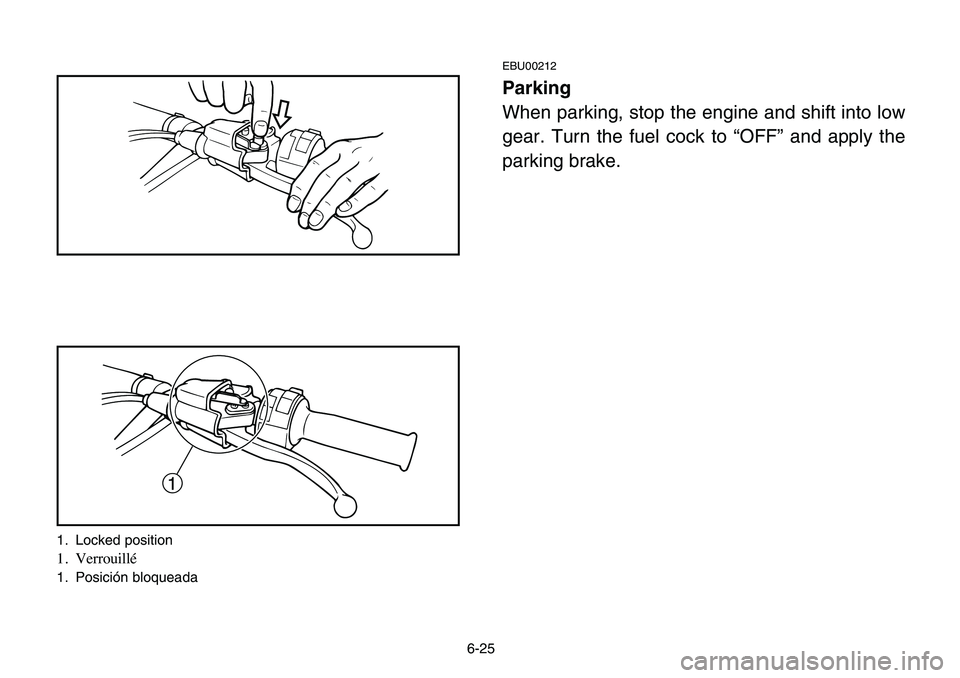
Parking
When parking, stop the engine and shift into low
gear. Turn the fuel cock to “OFF” and apply the
parking brake.
1
1. Locked position
1. Verrouillé
1. Posición bloqueada
Page 252 of 400
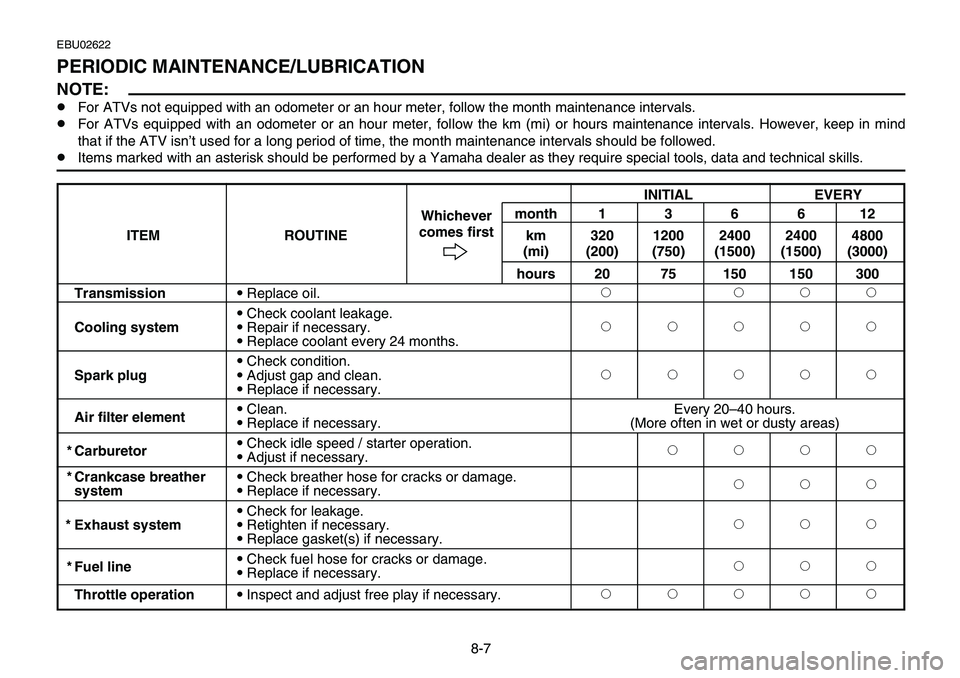
8-7INITIAL EVERY
month 1 3 6 6 12
ITEM ROUTINEWhichever
km 320 1200 2400 2400 4800 comes first
(mi) (200) (750) (1500) (1500) (3000)
hours 20 75 150 150 300
Transmission9Replace oil.2222
9Check coolant leakage.
Cooling system9Repair if necessary.22222
9Replace coolant every 24 months.
9Check condition.
Spark plug9Adjust gap and clean.22222
9Replace if necessary.
Air filter element9Clean. Every 20–40 hours.
9Replace if necessary. (More often in wet or dusty areas)
* Carburetor9Check idle speed / starter operation.
2222
9Adjust if necessary.
* Crankcase breather9Check breather hose for cracks or damage.
222
system9Replace if necessary.
9Check for leakage.
* Exhaust system9Retighten if necessary.222
9Replace gasket(s) if necessary.
* Fuel line9Check fuel hose for cracks or damage.
222
9Replace if necessary.
Throttle operation9Inspect and adjust free play if necessary.22222
EBU02622
PERIODIC MAINTENANCE/LUBRICATION
NOTE:
8For ATVs not equipped with an odometer or an hour meter, follow the month maintenance intervals.
8For ATVs equipped with an odometer or an hour meter, follow the km (mi) or hours maintenance intervals. However, keep in mind
that if the ATV isn’t used for a long period of time, the month maintenance intervals should be followed.
8Items marked with an asterisk should be performed by a Yamaha dealer as they require special tools, data and technical skills.
Page 296 of 400
8-51
EBU03004
Carburetor settings
In extremely cold weather, it is necessary to
change the carburetor settings to maintain opti-
mum engine performance and to prevent engine
damage.
w
8Improperly servicing or adjusting the car-
buretors could cause malfunction with the
possibility of an accident or the carbure-
tors could leak fuel, which would be a fire
hazard.
8Carburetor adjustments should only be
performed by a Yamaha dealer. Do not
attempt to perform these procedures
unless you have mechanical knowledge
and the necessary tools.
8Do not perform this procedure while the
engine is hot. Place a rag under each car-
buretor to catch any fuel. Wipe up any
spilled fuel completely.
8After servicing the carburetors, always
check throttle operation before operating
the ATV to make sure it is working correctly.
Page 300 of 400
8-55
Changing the settings of the carburetors
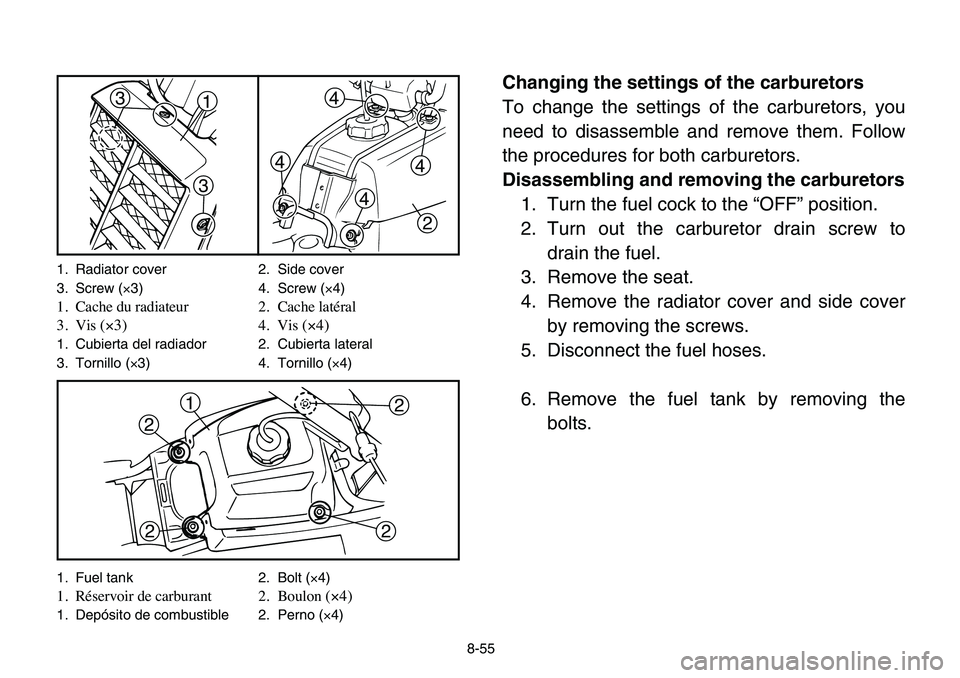
To change the settings of the carburetors, you
need to disassemble and remove them. Follow
the procedures for both carburetors.
Disassembling and removing the carburetors
1. Turn the fuel cock to the “OFF” position.
2. Turn out the carburetor drain screw to
drain the fuel.
3. Remove the seat.
4. Remove the radiator cover and side cover
by removing the screws.
5. Disconnect the fuel hoses.
6. Remove the fuel tank by removing the
bolts.
13
3
2 4
4
4
4
1
2
2 2
2
1. Radiator cover 2. Side cover
3. Screw (×3) 4. Screw (×4)
1. Cache du radiateur 2. Cache latéral
3. Vis
(×3)4. Vis (×4)
1. Cubierta del radiador 2. Cubierta lateral
3. Tornillo (×3) 4. Tornillo (×4)
1. Fuel tank 2. Bolt (×4)
1. Réservoir de carburant 2. Boulon (×4)
1. Depósito de combustible 2. Perno (×4)
Page 310 of 400
8-65
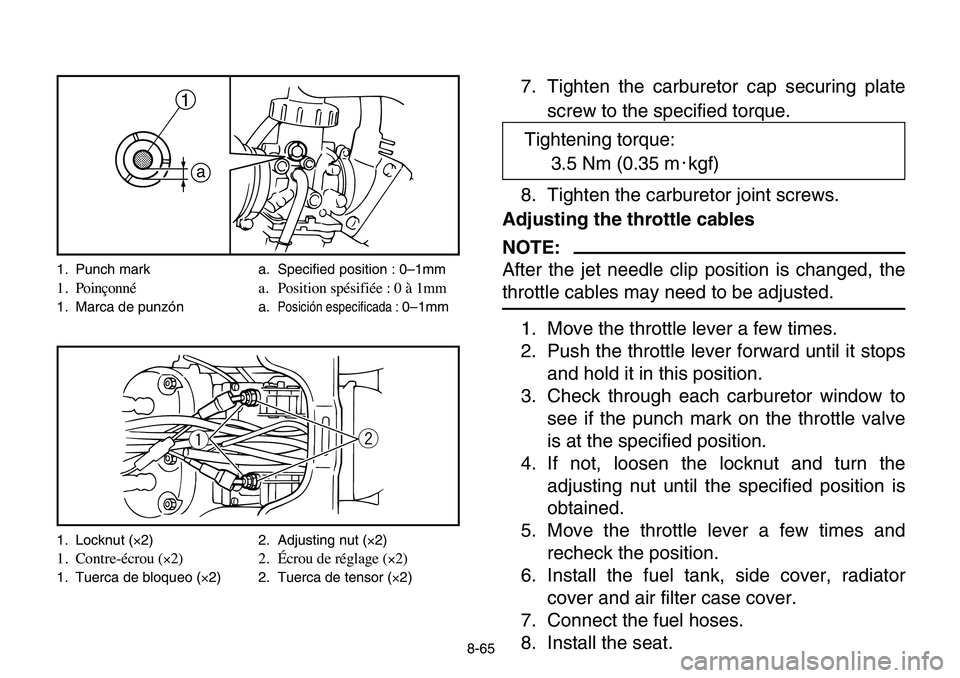
7. Tighten the carburetor cap securing plate
screw to the specified torque.
8. Tighten the carburetor joint screws.
Adjusting the throttle cables
NOTE:
After the jet needle clip position is changed, the
throttle cables may need to be adjusted.
1. Move the throttle lever a few times.
2. Push the throttle lever forward until it stops
and hold it in this position.
3. Check through each carburetor window to
see if the punch mark on the throttle valve
is at the specified position.
4. If not, loosen the locknut and turn the
adjusting nut until the specified position is
obtained.
5. Move the throttle lever a few times and
recheck the position.
6. Install the fuel tank, side cover, radiator
cover and air filter case cover.
7. Connect the fuel hoses.
8. Install the seat.
a
1
wq
1. Punch mark a. Specified position : 0–1mm
1. Poinçonné a. Position spésifiée : 0 à 1mm
1. Marca de punzón a.Posición especificada : 0–1mm
1. Locknut (×2) 2. Adjusting nut (×2)
1. Contre-écrou (×2) 2. Écrou de réglage (×2)
1. Tuerca de bloqueo (×2) 2. Tuerca de tensor (×2)
Tightening torque:
3.5 Nm (0.35 m0kgf)
Page 360 of 400
8-115
EBU00413
Troubleshooting
Although Yamaha machines receive a rigid
inspection before shipment from the factory,
trouble may occur during operation.
Any problem in the fuel, compression, or ignition
systems can cause poor starting and loss of
power. The troubleshooting chart describes a
quick, easy procedure for making checks. If your
machine requires any repair, take it to a Yama-
ha dealer.
The skilled technicians at a Yamaha dealership
have the tools, experience, and know-how to
properly service your machine. Use only gen-
uine Yamaha parts on your machine. Imitation
parts may look like Yamaha parts, but they are
often inferior. Consequently, they have a shorter
service life and can lead to expensive repair
bills.
Page 362 of 400
8-117
w
Do not smoke when checking the fuel sys-
tem. Fuel can ignite or explode, causing
severe injury or property damage. Make sure
there are no open flames or sparks in the
area, including pilot lights from water
heaters or furnaces.
Page 364 of 400

8-119
EBU00440
Troubleshooting chart
Starting problems or poor engine performance
Check fuel flow
1. Fuel
Check if there is
fuel in the fuel
tank
2. Compression
Kick the kick starter
to see if there is
compression
3. Ignition
Remove plugs and
check electrodes
WetWipe clean with
dry cloth
DryAttach plug cap and
ground to chassisKick the kick
starter stronglySpark weak
Spark goodIgnition system normal
No spark
Ask a Yamaha dealer to inspect
Adjust plug gap or
replace plug(s)
There is compressonCompression normal
Ask a Yamaha dealer to inspectNo compression
There is fuelTurn the fuel
cock to “OFF”
Remove the
fuel pipeNo fuelFuel cock clogged
Some fuelTurn the fuel
cock to “RES”Restart engine
No fuelSupply fuel
Clean fuel cock
Page 376 of 400
9-7
EBU00529
B. STORAGE
Long term storage (60 days or more) of your
machine will require some preventive proce-
dures to guard against deterioration. After thor-
oughly cleaning the machine, prepare for stor-
age as follows:
1. Drain the fuel tank, fuel lines and carbure-
tor float bowls.
2. Remove the spark plugs, pour about one
tablespoon of SAE 10W30 or 20W40
motor oil in the spark plug holes and rein-
stall the spark plugs. Ground the spark
plug wires and turn the engine over several
times to coat the cylinder walls with oil.
3. Clean the drive chain thoroughly and lubri-
cate it. (See page 8-95 for details.)
Reinstall the chain or store it in a plastic
bag tied to frame for safekeeping.
4. Lubricate all control cables.
Page 380 of 400
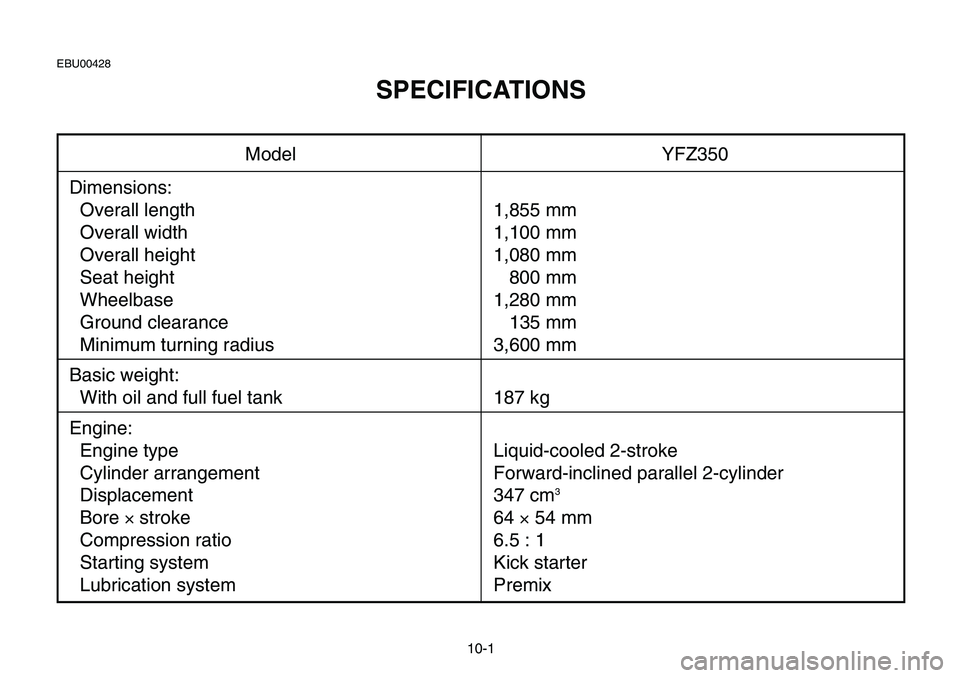
10-1
Model YFZ350
Dimensions:
Overall length 1,855 mm
Overall width 1,100 mm
Overall height 1,080 mm
Seat height 800 mm
Wheelbase 1,280 mm
Ground clearance 135 mm
Minimum turning radius 3,600 mm
Basic weight:
With oil and full fuel tank 187 kg
Engine:
Engine type Liquid-cooled 2-stroke
Cylinder arrangement Forward-inclined parallel 2-cylinder
Displacement 347 cm
3
Bore× stroke 64 ×54 mm
Compression ratio 6.5 : 1
Starting system Kick starter
Lubrication system Premix
EBU00428
SPECIFICATIONS