YAMAHA BANSHEE 350R 2003 User Guide
BANSHEE 350R 2003
YAMAHA
YAMAHA
https://www.carmanualsonline.info/img/51/49377/w960_49377-0.png
YAMAHA BANSHEE 350R 2003 User Guide
Page 101 of 398
5-5
EBU01095
Front and rear brakes
Brake lever and brake pedal
8Check that there is no free play in the brake
lever. If there is free play, have a Yamaha
dealer adjust it. Check for correct brake pedal
height. If the pedal height is incorrect, have a
Yamaha dealer adjust it. (See pages 8-81–
8-83.)
8Check the operation of the lever and pedal.
They should move smoothly and there should
be a firm feeling when the brakes are applied.
If not, have the machine inspected by a Yama-
ha dealer.
Brake fluid level
Check the brake fluid level.
Add fluid if necessary. (See pages 8-75–8-79.)
Recommended brake fluid: DOT 4
5FK-9-64-4~5 4/8/02 1:21 PM Page 44
Page 103 of 398
5-7
Brake fluid leakage
Check to see if any brake fluid is leaking out of
the pipe joints or brake fluid reservoirs. Apply the
brakes firmly for one minute. If there is any leak-
age, the brake system should be inspected by a
Yamaha dealer.
Brake operation
Test the brakes at slow speed after starting out
to make sure they are working properly. If the
brakes do not provide proper braking perfor-
mance, inspect the brake pads for wear. (See
page 8-73.)
5FK-9-64-4~5 4/8/02 1:21 PM Page 46
Page 105 of 398
5-9
w
Always check the brakes at the start of every
ride. Do not ride the ATV if you find any prob-
lem with the brakes or you could lose braking
ability, which could lead to an accident. If a
problem cannot be corrected by the adjust-
ment procedures provided in this manual,
have a Yamaha dealer check for the cause.
5FK-9-64-4~5 4/8/02 1:21 PM Page 48
Page 119 of 398
5-23
EBU00991
Lights
Check the headlights and tail/brake light to make
sure they are in working condition. Repair as
necessary for proper operation.
EBU01082
Switches
Check the operation of all switches. Repair as
necessary for proper operation.
5FK-9-64-4~5 4/8/02 1:21 PM Page 62
Page 131 of 398
6-3
EBU00512
Starting a cold engine
w
Always make sure all control cables work
smoothly before you begin riding in cold
weather. If the control cables are frozen or
do not work smoothly, you could be unable
to control the ATV, which could lead to an
accident or collision.
1. Set the parking brake.
2. Turn the fuel cock to “ON”.
3. Turn the main switch to “ON” and the engine
stop switch to “RUN”.
4. Shift the transmission into neutral.
5. Use the starter (choke) in reference to the
figure:
5FK-9-64-6 4/8/02 1:22 PM Page 4
Page 137 of 398
6-9
EBU00180
Starting a warm engine
To start a warm engine, refer to the “Starting a
cold engine” section. The starter (choke) should
not be used. The throttle should be opened
slightly.
EBU00538
Warming up
To get maximum engine life, always warm up
the engine before starting off. Never accelerate
hard with a cold engine! To see whether or not
the engine is warm, check if it responds to the
throttle normally with the starter (choke) turned
off.
NOTE:
When the parking brake is used, engine speed
is limited to 2,300 r/min. Be sure the parking
brake is released before moving the throttle
lever. Otherwise, the engine will misfire, pre-
venting normal operation.
5FK-9-64-6 4/8/02 1:22 PM Page 10
Page 147 of 398
6-19
EBU00208
To decelerate
When slowing down or stopping, release the
throttle and apply the brakes smoothly and
evenly. As you slow down, shift to a lower gear.
Be sure that the engine has sufficiently slowed
before engaging a lower gear. Improper use of
the brakes or shifting can cause the tires to lose
traction, reducing control and increasing the
possibility of an accident.
w
Make sure the engine has sufficiently slowed
before shifting to a lower gear. Engaging a
lower gear when the engine speed is too
high could make the wheels stop rotating.
This could cause loss of control, an accident
and injury. It could also cause engine or
drive train damage.
5FK-9-64-6 4/8/02 1:22 PM Page 20
Page 153 of 398
6-25
EBU00212
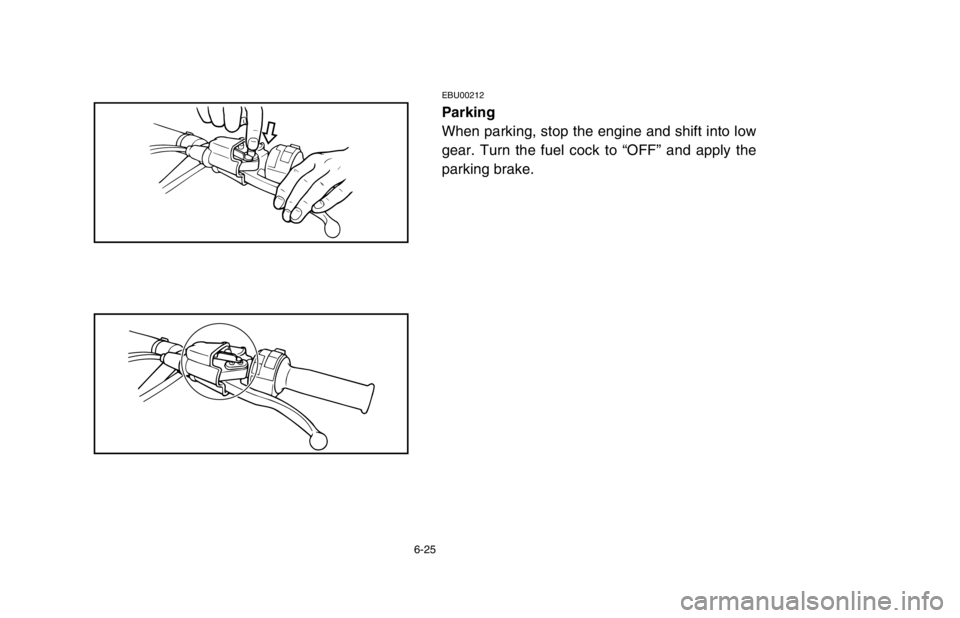
Parking
When parking, stop the engine and shift into low
gear. Turn the fuel cock to “OFF” and apply the
parking brake.
5FK-9-64-6 4/8/02 1:22 PM Page 26
Page 155 of 398
6-27
EBU00993
Parking on a slope
w
Avoid parking on hills or other inclines.
Parking on a hill or other incline could cause
the ATV to roll out of control, increasing the
chance of an accident. If you must park on
an incline, put the machine in low gear, apply
the parking brake, and block the front and
rear wheels with rocks or other objects.
Do not park the ATV at all on hills that are so
steep you could not walk up them easily.
1. Bring the machine to a stop by applying the
brakes in low gear.
2. Stop the engine and release the clutch
lever.
3. With the front and rear brakes applied, apply
the parking brake and slowly release the
brake pedal.
5FK-9-64-6 4/8/02 1:22 PM Page 28
Page 201 of 398
7-35
Select a large, flat area off-road to become
familiar with your ATV. Make sure that this area
is free of obstacles and other riders. You should
practice control of the throttle, brakes, shifting
procedures, and turning techniques in this area
before trying more difficult terrain. Always avoid
riding on paved surfaces: the ATV is designed
for off-road use only, and handling maneuvers
are more difficult to perform on pavement.
Set the parking brake and follow the instruction
on page 6-3 to start the engine. Once it has
warmed up you are ready to begin riding your
ATV. As you get on the ATV, be sure not to
accidentally move the shift pedal. Remember
that the engine and exhaust pipe will be hot
when riding and afterwards; do not allow skin or
clothing to come in contact with these compo-
nents.
5FK-9-64-7 4/8/02 1:24 PM Page 36