brakes YAMAHA BLASTER 200 2002 Manuale de Empleo (in Spanish)
[x] Cancel search | Manufacturer: YAMAHA, Model Year: 2002, Model line: BLASTER 200, Model: YAMAHA BLASTER 200 2002Pages: 368, tamaño PDF: 4.89 MB
Page 233 of 368

7-67
CROSSING THROUGH SHALLOW WATER
The ATV can be used to cross slow moving,
shallow water of up to a maximum of 35 cm in
depth. Before entering the water, choose your
path carefully. Enter where there is no sharp
drop off, and avoid rocks or other obstacles
which may be slippery or upset the ATV. Drive
slowly and carefully.
w
Never operate this ATV in fast flowing water
or in water deeper than that specified in your
Owner’s Manual. Remember that wet brakes
may have reduced stopping ability. Test your
brakes after leaving water. If necessary,
apply them several times to let friction dry
out the linings. If the ATV is operated
through deep or fast flowing water, the tires
may float, causing loss of traction and loss
of control, which could lead to an accident.
5KJ-62 (7 shou) 4/23/01 3:06 PM Page 68
Page 235 of 368
7-69
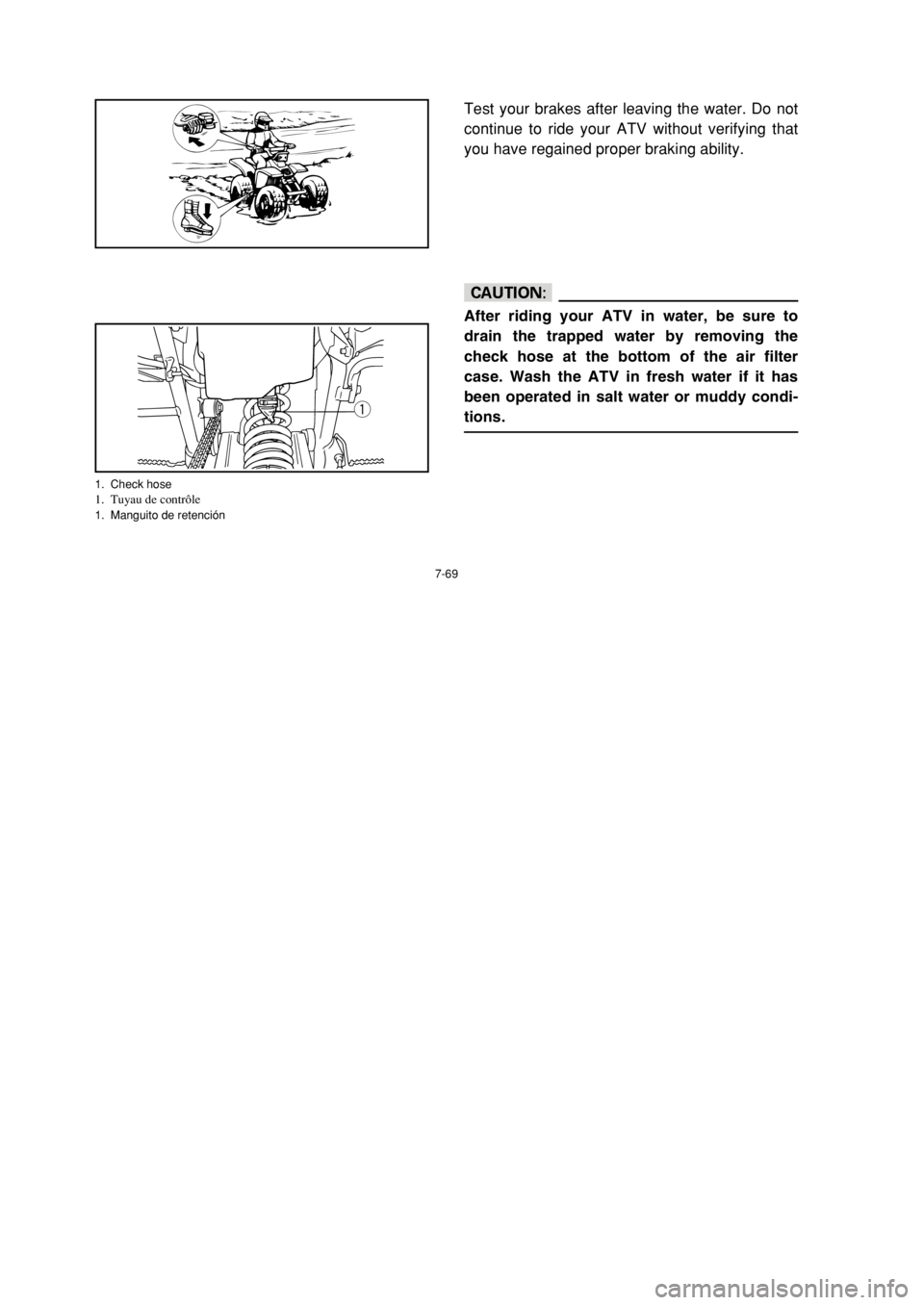
Test your brakes after leaving the water. Do not
continue to ride your ATV without verifying that
you have regained proper braking ability.
cC
After riding your ATV in water, be sure to
drain the trapped water by removing the
check hose at the bottom of the air filter
case. Wash the ATV in fresh water if it has
been operated in salt water or muddy condi-
tions.
q
1. Check hose1. Tuyau de contrôle1. Manguito de retención
5KJ-62 (7 shou) 4/23/01 3:06 PM Page 70
Page 239 of 368
7-73
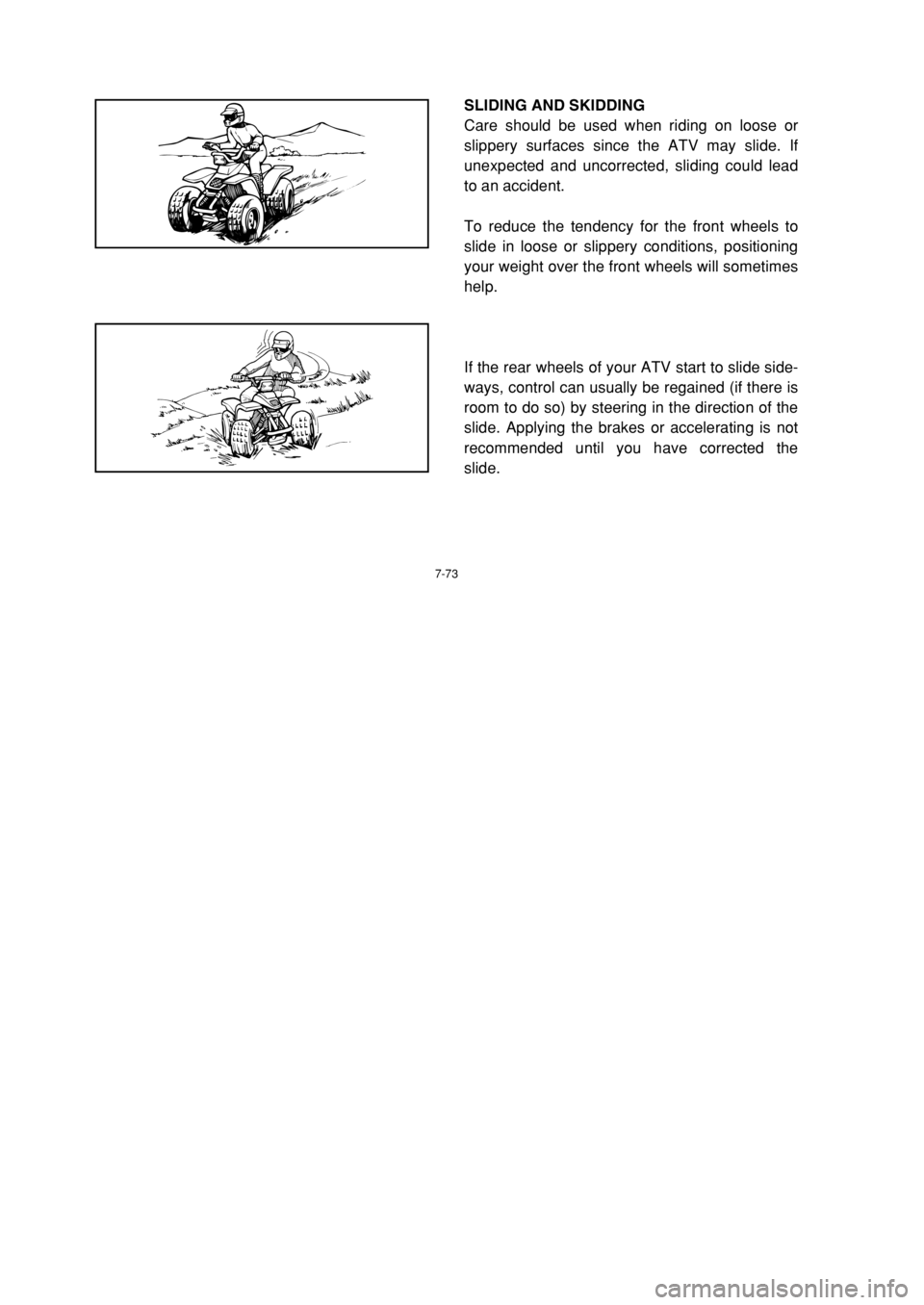
SLIDING AND SKIDDING
Care should be used when riding on loose or
slippery surfaces since the ATV may slide. If
unexpected and uncorrected, sliding could lead
to an accident.
To reduce the tendency for the front wheels to
slide in loose or slippery conditions, positioning
your weight over the front wheels will sometimes
help.
If the rear wheels of your ATV start to slide side-
ways, control can usually be regained (if there is
room to do so) by steering in the direction of the
slide. Applying the brakes or accelerating is not
recommended until you have corrected the
slide.
5KJ-62 (7 shou) 4/23/01 3:06 PM Page 74
Page 245 of 368

7-79
8If your ATV starts to slide sideways:
Steer in the direction of the slide if you have
the room.
Applying the brakes or accelerating is not rec-
ommended until you have corrected the slide.
(See pages 7-73 ~ 7-75.)
8If your ATV can’t make it up a hill you are try-
ing to climb:
Turn the ATV around if you still have forward
speed. If not, stop, dismount on the uphill side
of the ATV and physically turn the ATV
around. If the ATV starts to slip backwards
DO NOT USE THE REAR BRAKE - the ATV
may tip over on top of you. Dismount the ATV
on the uphill side. (See pages 7-47 ~ 7-57.)
5KJ-62 (7 shou) 4/23/01 3:06 PM Page 80
Page 247 of 368

7-81
8If your ATV is traversing a sloping surface:
Be sure to ride with your weight positioned
towards the uphill side of the ATV to maintain
proper balance. If the ATV starts to tip, steer
down the hill (if there are no obstacles in your
way) to regain balance. If you discover that
the ATV is going to tip over, dismount on the
uphill side. (See pages 7-63 ~ 7-65.)
8If your ATV encounters shallow water:
Ride slowly and carefully through slow mov-
ing water, watching for obstacles. Be sure to
let water drain from the ATV and CHECK
YOUR BRAKES FOR PROPER OPERATION
when you come out of the water. Do not con-
tinue to ride your ATV until you have regained
adequate braking ability. (See pages 7-67 ~
7-69.)
5KJ-62 (7 shou) 4/23/01 3:06 PM Page 82
Page 301 of 368

8-53
4. Tighten the locknut.
w
Operating with improperly serviced or
adjusted brakes could cause loss of braking
ability, which could lead to an accident.
After servicing:
8Make sure the brakes operate smoothly
and that the free play is correct.
8Make sure the brakes do not drag.
Replacement of brake components requires
professional knowledge. These procedures
should be performed by a Yamaha dealer.
q
1. Adjusting nut1.Écrou de réglage1. Tuerca de ajuste
5KJ-62 (8 shou) 4/23/01 3:08 PM Page 54
Page 303 of 368
8-55
EBU00595
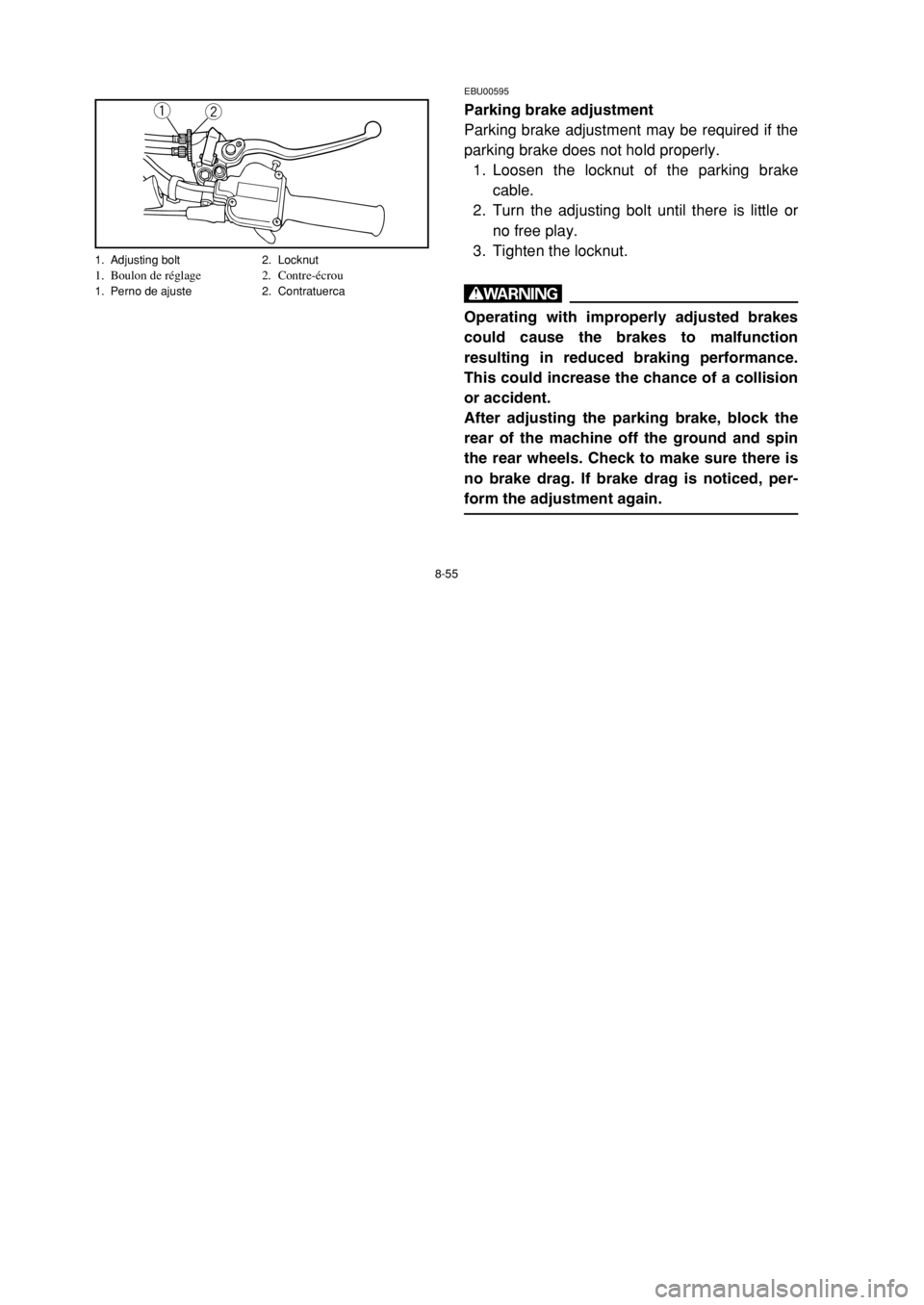
Parking brake adjustment
Parking brake adjustment may be required if the
parking brake does not hold properly.
1. Loosen the locknut of the parking brake
cable.
2. Turn the adjusting bolt until there is little or
no free play.
3. Tighten the locknut.
w
Operating with improperly adjusted brakes
could cause the brakes to malfunction
resulting in reduced braking performance.
This could increase the chance of a collision
or accident.
After adjusting the parking brake, block the
rear of the machine off the ground and spin
the rear wheels. Check to make sure there is
no brake drag. If brake drag is noticed, per-
form the adjustment again.
wq
1. Adjusting bolt 2. Locknut1. Boulon de réglage 2. Contre-écrou1. Perno de ajuste 2. Contratuerca
5KJ-62 (8 shou) 4/23/01 3:08 PM Page 56
Page 341 of 368

9-3
cC
Excessive water pressure may cause water
seepage and deterioration of wheel bearings,
brakes, transmission seals and electrical
devices. Many expensive repair bills have
resulted from improper high pressure deter-
gent applications such as those available in
coin-operated car washers.
4. Once the majority of the dirt has been hosed
off, wash all surfaces with warm water and
mild, detergent-type soap. An old tooth-
brush or bottle brush is handy for hard-to-
get-at places.
5. Rinse the machine off immediately with
clean water and dry all surfaces with a
chamois, clean towel or soft absorbent
cloth.
6. Dry the chain and lubricate it to prevent rust.
5KJ-62 (9 shou ~) 4/23/01 3:09 PM Page 4
Page 343 of 368

9-5
7. Clean the seat with a vinyl upholstery clean-
er to keep the cover pliable and glossy.
8. Automotive type wax may be applied to all
painted and chrome plated surfaces. Avoid
combination cleaner-waxes. Many contain
abrasives which may mar the paint or pro-
tective finish.
When finished, start the engine and let it idle for
several minutes.
w
Wet brakes may have reduced stopping abili-
ty, increasing the chance of an accident.
Test the brakes after washing. Apply the
brakes several times at slow speeds to let
friction dry out the linings.
5KJ-62 (9 shou ~) 4/23/01 3:09 PM Page 6