engine YAMAHA BLASTER 200 2006 Owner's Manual
[x] Cancel search | Manufacturer: YAMAHA, Model Year: 2006, Model line: BLASTER 200, Model: YAMAHA BLASTER 200 2006Pages: 388, PDF Size: 7.56 MB
Page 134 of 388
6-5
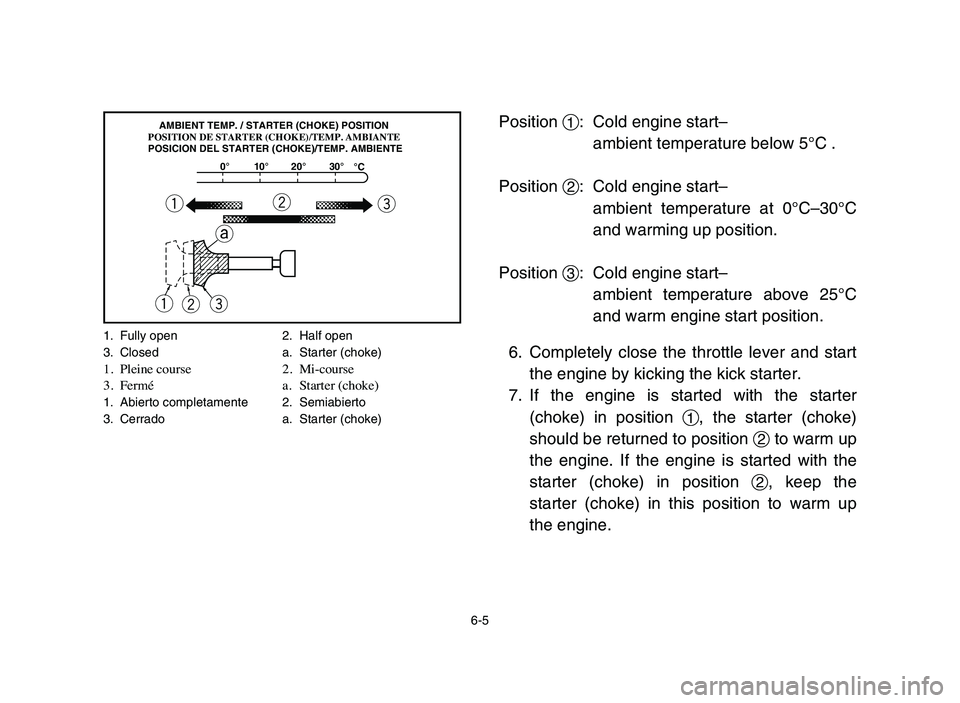
Position 1: Cold engine start–
ambient temperature below 5°C .
Position 2: Cold engine start–
ambient temperature at 0°C–30°C
and warming up position.
Position 3: Cold engine start–
ambient temperature above 25°C
and warm engine start position.
6. Completely close the throttle lever and start
the engine by kicking the kick starter.
7. If the engine is started with the starter
(choke) in position 1, the starter (choke)
should be returned to position 2to warm up
the engine. If the engine is started with the
starter (choke) in position 2, keep the
starter (choke) in this position to warm up
the engine.
e q
0°10°20°30°
°C AMBIENT TEMP. / STARTER (CHOKE) POSITION
POSITION DE STARTER (CHOKE)/TEMP. AMBIANTE
POSICION DEL STARTER (CHOKE)/TEMP. AMBIENTE
w
e q
wa
1. Fully open 2. Half open
3. Closed a. Starter (choke)
1. Pleine course 2. Mi-course
3. Fermé a. Starter (choke)
1. Abierto completamente 2. Semiabierto
3. Cerrado a. Starter (choke)
5VM-9-63-03 3/29/05 4:02 PM Page 8
Page 136 of 388
6-7
8. Continue warming up the engine until it idles
smoothly and return the starter (choke) to
position 3before riding.
cC
See the “Engine break-in” section prior to
operating engine for the first time.
5VM-9-63-03 3/29/05 4:02 PM Page 10
Page 138 of 388
6-9
EBU00180
Starting a warm engine
To start a warm engine, refer to the “Starting a
cold engine” section. The starter (choke) should
not be used. The throttle should be opened
slightly.
EBU00182
Warming up
To get maximum engine life, always warm up
the engine before starting off. Never accelerate
hard with a cold engine! To see whether or not
the engine is warm, check if it responds to the
throttle normally with the starter (choke) turned
off.
5VM-9-63-03 3/29/05 4:02 PM Page 12
Page 142 of 388
6-13
cC
8Do not coast for long periods with the
engine off, and do not tow the machine a
long distance. Even in neutral position,
the transmission is only properly lubri-
cated when the engine is running.
Inadequate lubrication may cause dam-
age.
8Always use the clutch when changing
gears. The engine, transmission and
drive train are not designed to withstand
the shock of forced shifting and can be
damaged by shifting without the clutch.
5VM-9-63-03 3/29/05 4:02 PM Page 16
Page 144 of 388
6-15
EBU00204
To start out and accelerate:
1. Release the throttle lever.
cC
Always close the throttle while shifting
gears. Otherwise, damage to the engine and
drive train may result.
2. Pull the clutch lever to disengage the clutch.
3. Shift into first gear.
4. Open the throttle gradually and at the same
time, release the clutch lever slowly.
5. Once the machine has attained adequate
speed, release the throttle, and at the same
time, quickly pull in the clutch lever.
6. Shift into second gear. (be careful not to
shift into neutral)
5VM-9-63-03 3/29/05 4:02 PM Page 18
Page 148 of 388
6-19
EBU00208
To decelerate:
When slowing down or stopping, release the
throttle and apply the brakes smoothly and
evenly. As you slow down, shift to a lower gear.
Be sure that the engine has sufficiently slowed
before engaging a lower gear. Improper use of
the brakes or shifting can cause the tires to lose
traction, reducing control and increasing the
possibility of an accident.
w
Make sure the engine has sufficiently slowed
before shifting to a lower gear. Engaging a
lower gear when the engine speed is too
high could make the wheels stop rotating.
This could cause loss of control, an accident
and injury. It could also cause engine or
drive train damage.
5VM-9-63-03 3/29/05 4:02 PM Page 22
Page 150 of 388
6-21
EBU02092
Engine break-in
There is never a more important period in the
life of your machine than the period between
zero and 20 hours.
For this reason, we ask that you carefully read
the following material. Because the engine is
brand new, you must not put an excessive load
on it for the first several hours of running. During
the first 20 hours, the various parts in the engine
wear and polish themselves to the correct oper-
ating clearances.
During this period, prolonged full throttle opera-
tion or any condition which might result in exces-
sive engine heating must be avoided. However,
momentary (2–3 seconds maximum) full throttle
operation under load does not harm the engine.
5VM-9-63-03 3/29/05 4:02 PM Page 24
Page 152 of 388
6-23
Each full throttle acceleration sequence should
be followed with a substantial rest period for the
engine by cruising at lower r/min so the engine
can rid itself of the temporary build up of heat.
If any abnormality is noticed during this period,
consult a Yamaha dealer.
0–10 hours:
Avoid continuous operation above half throttle.
Allow a cooling off period of five to ten minutes
after every hour of operation. Vary the speed of
the machine from time to time. Do not operate it
at one set throttle position.
10–20 hours:
Avoid prolonged operation above 3/4 throttle.
Rev the machine freely through the gears but do
not use full throttle at any time.
After break-in:
Avoid prolonged full throttle operation. Vary
speeds occasionally.
5VM-9-63-03 3/29/05 4:02 PM Page 26
Page 154 of 388
6-25
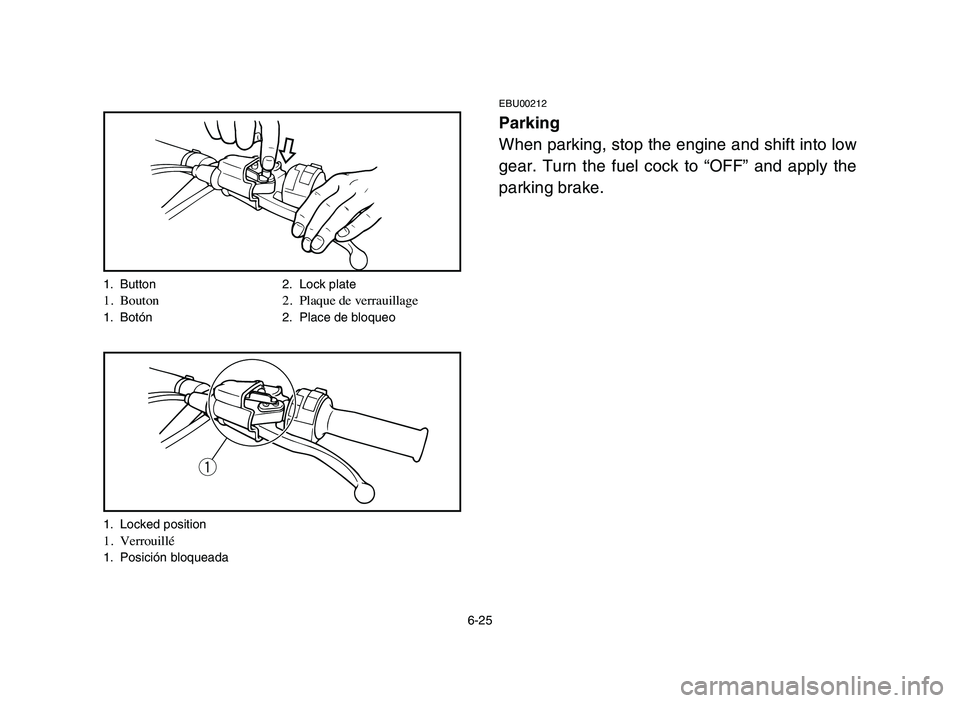
EBU00212
Parking
When parking, stop the engine and shift into low
gear. Turn the fuel cock to “OFF” and apply the
parking brake.
1. Button 2. Lock plate1. Bouton 2. Plaque de verrauillage1. Botón 2. Place de bloqueo
1. Locked position
1. Verrouillé1. Posición bloqueada
q
5VM-9-63-03 3/29/05 4:02 PM Page 28
Page 156 of 388
6-27
EBU01175
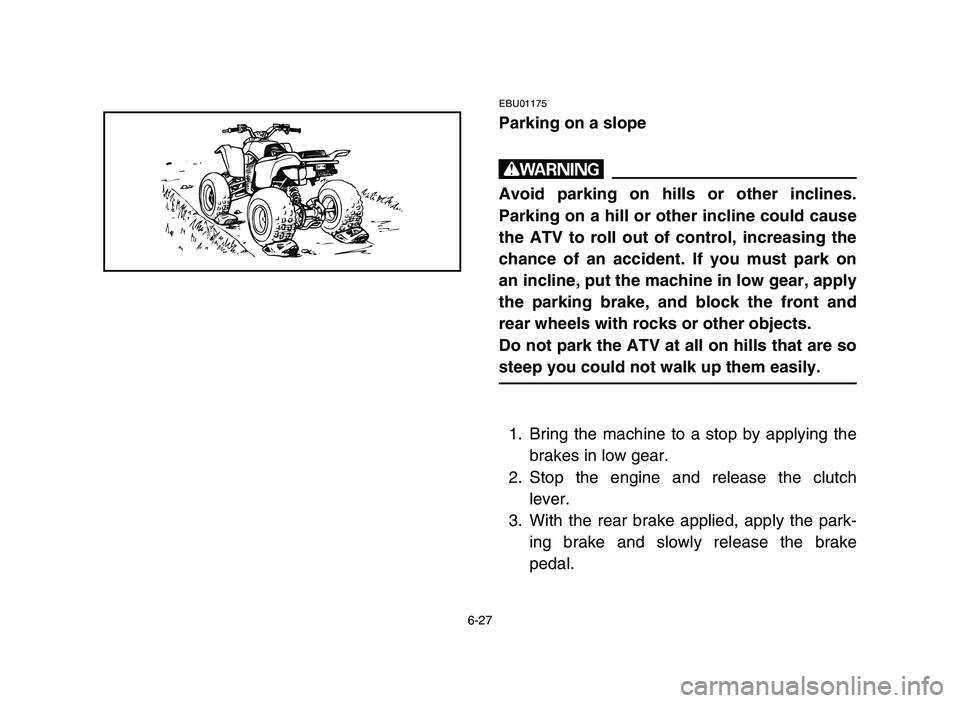
Parking on a slope
w
Avoid parking on hills or other inclines.
Parking on a hill or other incline could cause
the ATV to roll out of control, increasing the
chance of an accident. If you must park on
an incline, put the machine in low gear, apply
the parking brake, and block the front and
rear wheels with rocks or other objects.
Do not park the ATV at all on hills that are so
steep you could not walk up them easily.
1. Bring the machine to a stop by applying the
brakes in low gear.
2. Stop the engine and release the clutch
lever.
3. With the rear brake applied, apply the park-
ing brake and slowly release the brake
pedal.
5VM-9-63-03 3/29/05 4:02 PM Page 30