engine oil YAMAHA BT1100 2004 User Guide
[x] Cancel search | Manufacturer: YAMAHA, Model Year: 2004, Model line: BT1100, Model: YAMAHA BT1100 2004Pages: 96, PDF Size: 3.32 MB
Page 49 of 96
EAU00462
1. Engine oil filler cap
PERIODIC MAINTENANCE AND MINOR REPAIR
1
NOTE:
Make sure that the motorcycle is posi-
tioned straight up when checking the oil
level. A slight tilt to the side can result in a
false reading.
2. Start the engine, warm it up for sever-
al minutes, and then turn it off.
3. Wait a few minutes until the oil set-
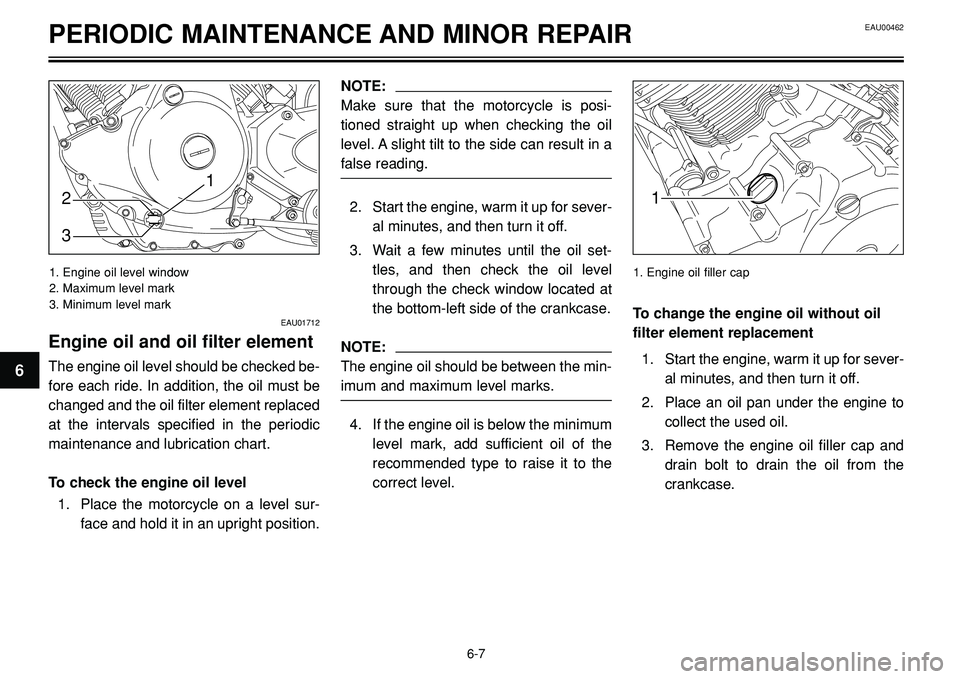
tles, and then check the oil level
through the check window located at
the bottom-left side of the crankcase.
NOTE:
The engine oil should be between the min-
imum and maximum level marks.
4. If the engine oil is below the minimum
level mark, add sufficient oil of the
recommended type to raise it to the
correct level.To change the engine oil without oil
filter element replacement
1. Start the engine, warm it up for sever-
al minutes, and then turn it off.
2. Place an oil pan under the engine to
collect the used oil.
3. Remove the engine oil filler cap and
drain bolt to drain the oil from the
crankcase.
6-7
6
2
31
EAU01712
Engine oil and oil filter element
The engine oil level should be checked be-
fore each ride. In addition, the oil must be
changed and the oil filter element replaced
at the intervals specified in the periodic
maintenance and lubrication chart.
To check the engine oil level
1. Place the motorcycle on a level sur-
face and hold it in an upright position.
1. Engine oil level window
2. Maximum level mark
3. Minimum level mark
Page 50 of 96
EAU00462PERIODIC MAINTENANCE AND MINOR REPAIR
EC000072
•In order to prevent clutch slippage
(since the engine oil also lubri-
cates the clutch), do not mix any
chemical additives with the oil or
use oils of a higher grade than
“CD”. In addition, do not use oils
labeled "ENERGY CONSERVING II"
or higher.
•Make sure that no foreign material
enters the crankcase.
CAUTION:6. Start the engine, and then let it idle for
several minutes while checking it for
oil leakage. If oil is leaking, immedi-
ately turn the engine off and check for
the cause.
NOTE:
After the engine is started, the engine oil
level warning light should go off if the oil
level is sufficient.
EC000067
If the oil level warning light flickers or
remains on, immediately turn the
engine off and have a Yamaha dealer
check the vehicle.
7. Turn the engine off, and then check
the oil level and correct it if neces-
sary.
NOTE:
Have a Yamaha dealer replace the oil filter
element when necessary.
CAUTION:
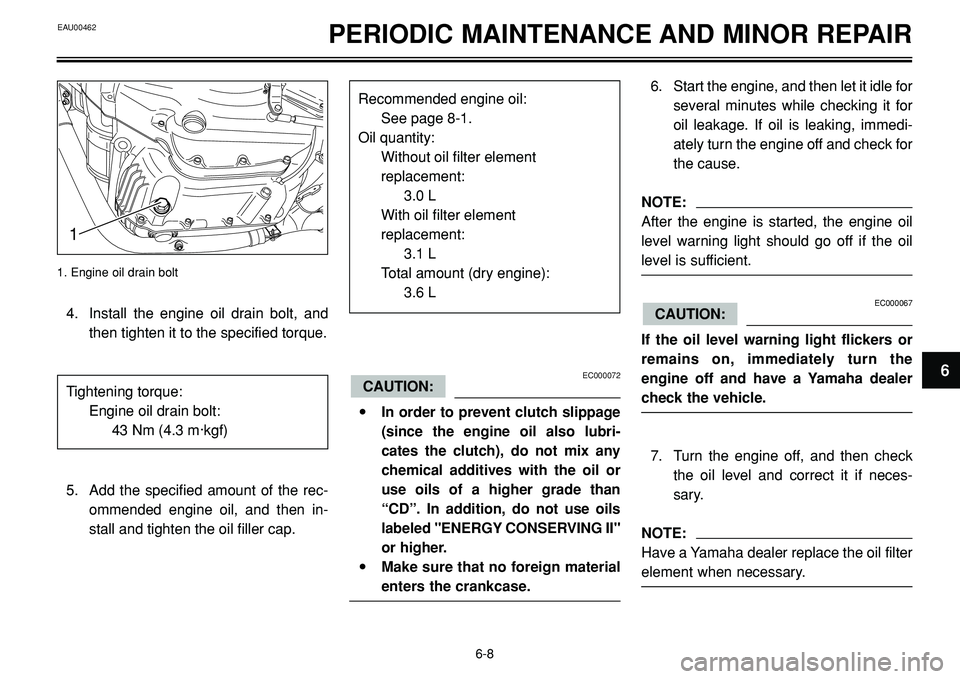
1. Engine oil drain bolt
6-8
6
1
4. Install the engine oil drain bolt, and
then tighten it to the specified torque.
5. Add the specified amount of the rec-
ommended engine oil, and then in-
stall and tighten the oil filler cap. Tightening torque:
Engine oil drain bolt:
43 Nm (4.3 m·kgf)
Recommended engine oil:
See page 8-1.
Oil quantity:
Without oil filter element
replacement:
3.0 L
With oil filter element
replacement:
3.1 L
Total amount (dry engine):
3.6 L
Page 51 of 96
EAU00462PERIODIC MAINTENANCE AND MINOR REPAIR
3
1 2
To check the final gear oil level
1. Place the motorcycle on a level sur-
face and hold it in an upright position.
NOTE:
•The final gear oil level must be
checked on a cold engine.
•Make sure that the motorcycle is posi-
tioned straight up when checking the
oil level. A slight tilt to the side can
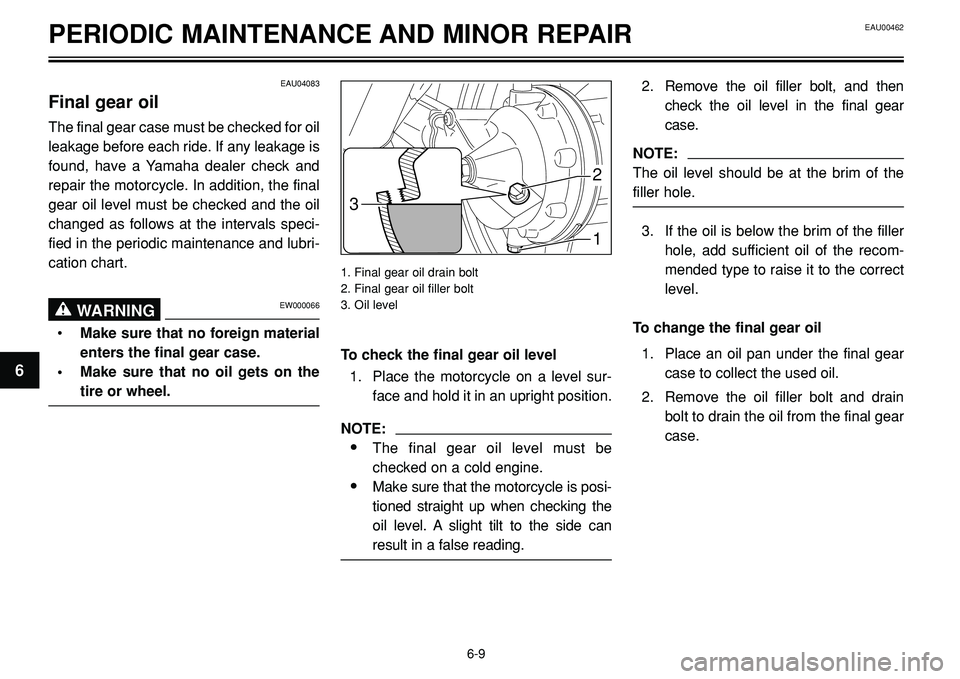
result in a false reading.2. Remove the oil filler bolt, and then
check the oil level in the final gear
case.
NOTE:
The oil level should be at the brim of the
filler hole.
3. If the oil is below the brim of the filler
hole, add sufficient oil of the recom-
mended type to raise it to the correct
level.
To change the final gear oil
1. Place an oil pan under the final gear
case to collect the used oil.
2. Remove the oil filler bolt and drain
bolt to drain the oil from the final gear
case.
6-9
6
1. Final gear oil drain bolt
2. Final gear oil filler bolt
3. Oil level
EAU04083
Final gear oil
The final gear case must be checked for oil
leakage before each ride. If any leakage is
found, have a Yamaha dealer check and
repair the motorcycle. In addition, the final
gear oil level must be checked and the oil
changed as follows at the intervals speci-
fied in the periodic maintenance and lubri-
cation chart.
EW000066WARNING0
•Make sure that no foreign material
enters the final gear case.
• Make sure that no oil gets on the
tire or wheel.
Page 64 of 96
EAU00462PERIODIC MAINTENANCE AND MINOR REPAIR
EAU02962
Checking and lubricating the
cables
The operation of all control cables and the
condition of the cables should be checked
before each ride, and the cables and cable
ends should be lubricated if necessary. If a
cable is damaged or does not move
smoothly, have a Yamaha dealer check or
replace it.
EW000112WARNING0
Damage to the outer sheath may inter-
fere with proper cable operation and
will cause the inner cable to rust.
Replace a damaged cable as soon as
possible to prevent unsafe conditions.
EAU03209
Checking and lubricating the
throttle grip and cable
The operation of the throttle grip and the
condition of the throttle cable should be
checked before each ride, and the cable
should be lubricated or replaced if neces-
sary.
NOTE:
Since the throttle grip must be removed to
access the throttle cable end, the throttle
grip and the cable should always be lubri-
cated at the same time.
1. Remove the throttle grip by removing
the screws.
2. Disconnect the throttle cable, hold it
up, and then apply several drops of
oil to the cable end, allowing it to trick-
le into the sheath.
3. Connect the throttle cable, and then
grease the inside of the throttle grip
housing.4. Grease the metal-to-metal contact
surface of the throttle grip, and then
install the grip by installing the
screws.
6-22
6
Recommended lubricant:
Engine oil
Recommended lubricant:
Throttle cable:
Engine oil
Throttle grip housing
and grip:
Lithium-soap-based grease
(all-purpose grease)
Page 80 of 96
MOTORCYCLE CARE AND STORAGE
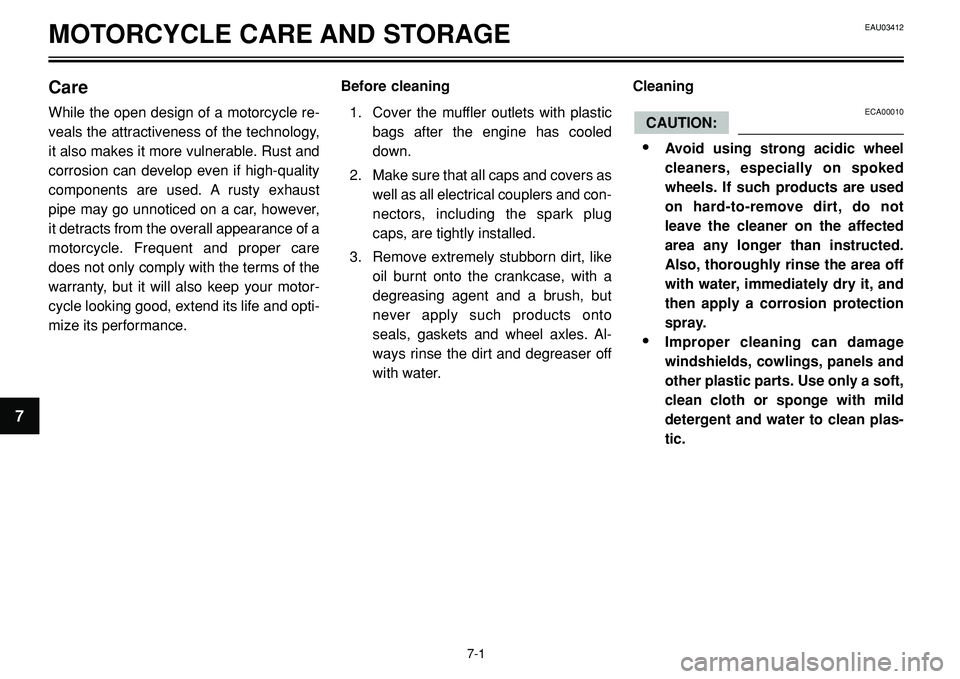
Care
While the open design of a motorcycle re-
veals the attractiveness of the technology,
it also makes it more vulnerable. Rust and
corrosion can develop even if high-quality
components are used. A rusty exhaust
pipe may go unnoticed on a car, however,
it detracts from the overall appearance of a
motorcycle. Frequent and proper care
does not only comply with the terms of the
warranty, but it will also keep your motor-
cycle looking good, extend its life and opti-
mize its performance.Before cleaning
1. Cover the muffler outlets with plastic
bags after the engine has cooled
down.
2. Make sure that all caps and covers as
well as all electrical couplers and con-
nectors, including the spark plug
caps, are tightly installed.
3. Remove extremely stubborn dirt, like
oil burnt onto the crankcase, with a
degreasing agent and a brush, but
never apply such products onto
seals, gaskets and wheel axles. Al-
ways rinse the dirt and degreaser off
with water.CleaningECA00010
•Avoid using strong acidic wheel
cleaners, especially on spoked
wheels. If such products are used
on hard-to-remove dirt, do not
leave the cleaner on the affected
area any longer than instructed.
Also, thoroughly rinse the area off
with water, immediately dry it, and
then apply a corrosion protection
spray.
•Improper cleaning can damage
windshields, cowlings, panels and
other plastic parts. Use only a soft,
clean cloth or sponge with mild
detergent and water to clean plas-
tic.
CAUTION:
EAU03412
7-1
7
Page 83 of 96
MOTORCYCLE CARE AND STORAGE
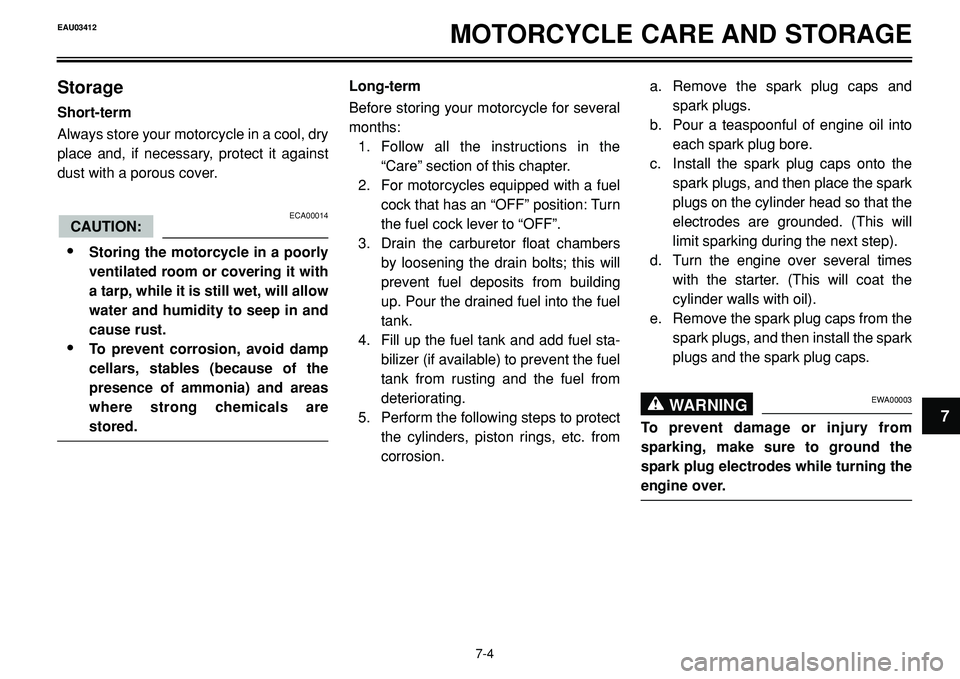
Storage
Short-term
Always store your motorcycle in a cool, dry
place and, if necessary, protect it against
dust with a porous cover.
ECA00014
•Storing the motorcycle in a poorly
ventilated room or covering it with
a tarp, while it is still wet, will allow
water and humidity to seep in and
cause rust.
•To prevent corrosion, avoid damp
cellars, stables (because of the
presence of ammonia) and areas
where strong chemicals are
stored.
CAUTION:Long-term
Before storing your motorcycle for several
months:
1. Follow all the instructions in the
“Care” section of this chapter.
2. For motorcycles equipped with a fuel
cock that has an “OFF” position: Turn
the fuel cock lever to “OFF”.
3. Drain the carburetor float chambers
by loosening the drain bolts; this will
prevent fuel deposits from building
up. Pour the drained fuel into the fuel
tank.
4. Fill up the fuel tank and add fuel sta-
bilizer (if available) to prevent the fuel
tank from rusting and the fuel from
deteriorating.
5. Perform the following steps to protect
the cylinders, piston rings, etc. from
corrosion.a. Remove the spark plug caps and
spark plugs.
b. Pour a teaspoonful of engine oil into
each spark plug bore.
c. Install the spark plug caps onto the
spark plugs, and then place the spark
plugs on the cylinder head so that the
electrodes are grounded. (This will
limit sparking during the next step).
d. Turn the engine over several times
with the starter. (This will coat the
cylinder walls with oil).
e. Remove the spark plug caps from the
spark plugs, and then install the spark
plugs and the spark plug caps.
EWA00003WARNING0
To prevent damage or injury from
sparking, make sure to ground the
spark plug electrodes while turning the
engine over.
7-4
7
EAU03412
Page 86 of 96
SPECIFICATIONSEAU01038
8-1
8
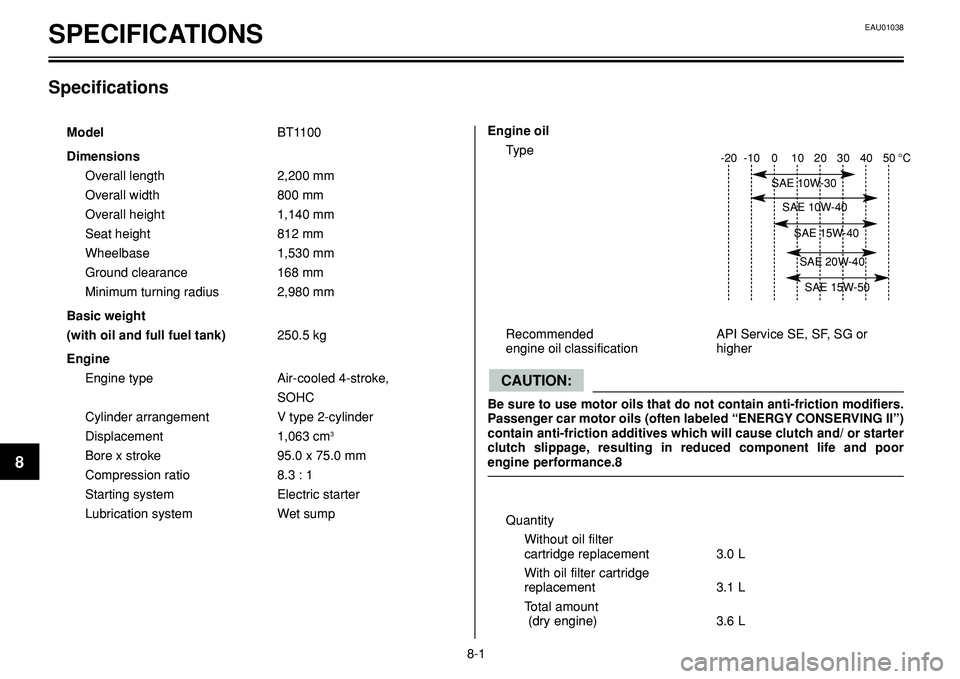
Specifications
ModelBT1100
Dimensions
Overall length 2,200 mm
Overall width 800 mm
Overall height 1,140 mm
Seat height 812 mm
Wheelbase 1,530 mm
Ground clearance 168 mm
Minimum turning radius 2,980 mm
Basic weight
(with oil and full fuel tank)250.5 kg
Engine
Engine type Air-cooled 4-stroke,
SOHC
Cylinder arrangement V type 2-cylinder
Displacement 1,063 cm
3
Bore x stroke 95.0 x 75.0 mm
Compression ratio 8.3 : 1
Starting system Electric starter
Lubrication system Wet sumpEngine oil
Ty p e
Recommended API Service SE, SF, SG or
engine oil classification higher
Be sure to use motor oils that do not contain anti-friction modifiers.
Passenger car motor oils (often labeled “ENERGY CONSERVING II”)
contain anti-friction additives which will cause clutch and/ or starter
clutch slippage, resulting in reduced component life and poor
engine performance.8
Quantity
Without oil filter
cartridge replacement 3.0 L
With oil filter cartridge
replacement 3.1 L
Total amount
(dry engine) 3.6 L
CAUTION:
-20-10 0 1020304050°C
SAE 10W-30
SAE 10W-40
SAE 20W-40
SAE 15W-50
SAE 15W-40
Page 94 of 96
INDEX
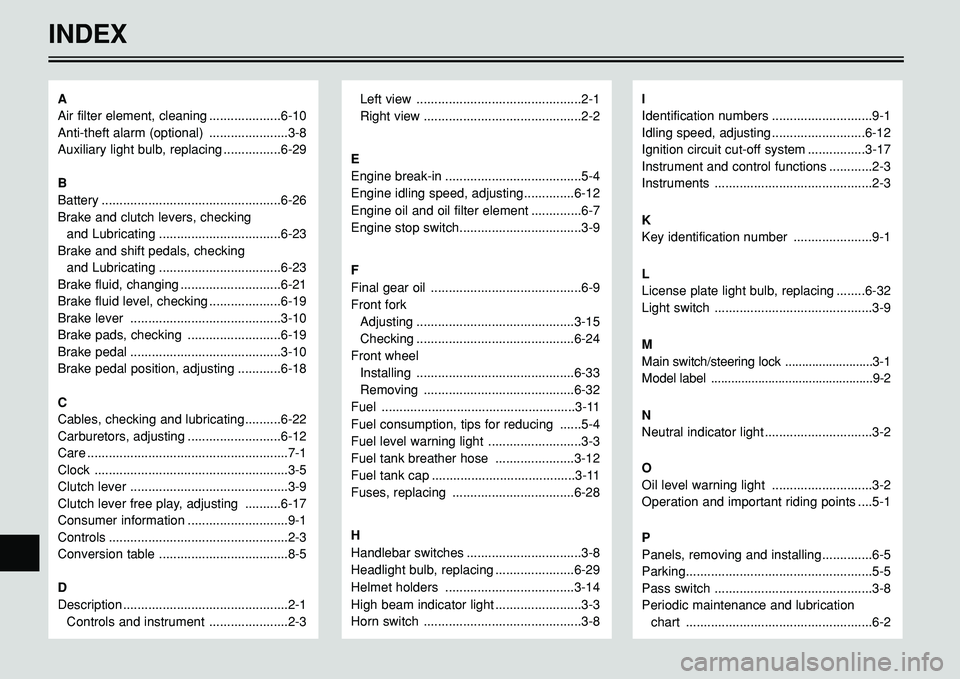
A
Air filter element, cleaning ....................6-10
Anti-theft alarm (optional) ......................3-8
Auxiliary light bulb, replacing ................6-29
B
Battery ..................................................6-26
Brake and clutch levers, checking
and Lubricating ..................................6-23
Brake and shift pedals, checking
and Lubricating ..................................6-23
Brake fluid, changing ............................6-21
Brake fluid level, checking ....................6-19
Brake lever ..........................................3-10
Brake pads, checking ..........................6-19
Brake pedal ..........................................3-10
Brake pedal position, adjusting ............6-18
C
Cables, checking and lubricating..........6-22
Carburetors, adjusting ..........................6-12
Care ........................................................7-1
Clock ......................................................3-5
Clutch lever ............................................3-9
Clutch lever free play, adjusting ..........6-17
Consumer information ............................9-1
Controls ..................................................2-3
Conversion table ....................................8-5
D
Description ..............................................2-1
Controls and instrument ......................2-3Left view ..............................................2-1
Right view ............................................2-2
E
Engine break-in ......................................5-4
Engine idling speed, adjusting..............6-12
Engine oil and oil filter element ..............6-7
Engine stop switch..................................3-9
F
Final gear oil ..........................................6-9
Front fork
Adjusting ............................................3-15
Checking ............................................6-24
Front wheel
Installing ............................................6-33
Removing ..........................................6-32
Fuel ......................................................3-11
Fuel consumption, tips for reducing ......5-4
Fuel level warning light ..........................3-3
Fuel tank breather hose ......................3-12
Fuel tank cap ........................................3-11
Fuses, replacing ..................................6-28
H
Handlebar switches ................................3-8
Headlight bulb, replacing ......................6-29
Helmet holders ....................................3-14
High beam indicator light ........................3-3
Horn switch ............................................3-8I
Identification numbers ............................9-1
Idling speed, adjusting ..........................6-12
Ignition circuit cut-off system ................3-17
Instrument and control functions ............2-3
Instruments ............................................2-3
K
Key identification number ......................9-1
L
License plate light bulb, replacing ........6-32
Light switch ............................................3-9
M
Main switch/steering lock ..........................3-1
Model label ................................................9-2
N
Neutral indicator light ..............................3-2
O
Oil level warning light ............................3-2
Operation and important riding points ....5-1
P
Panels, removing and installing..............6-5
Parking....................................................5-5
Pass switch ............................................3-8
Periodic maintenance and lubrication
chart ....................................................6-2