Air YAMAHA FJR1300A 2014 Owner's Manual
[x] Cancel search | Manufacturer: YAMAHA, Model Year: 2014, Model line: FJR1300A, Model: YAMAHA FJR1300A 2014Pages: 118, PDF Size: 3.29 MB
Page 90 of 118
PERIODIC MAINTENANCE AND ADJUSTMENT
6-23
6
EAU37914
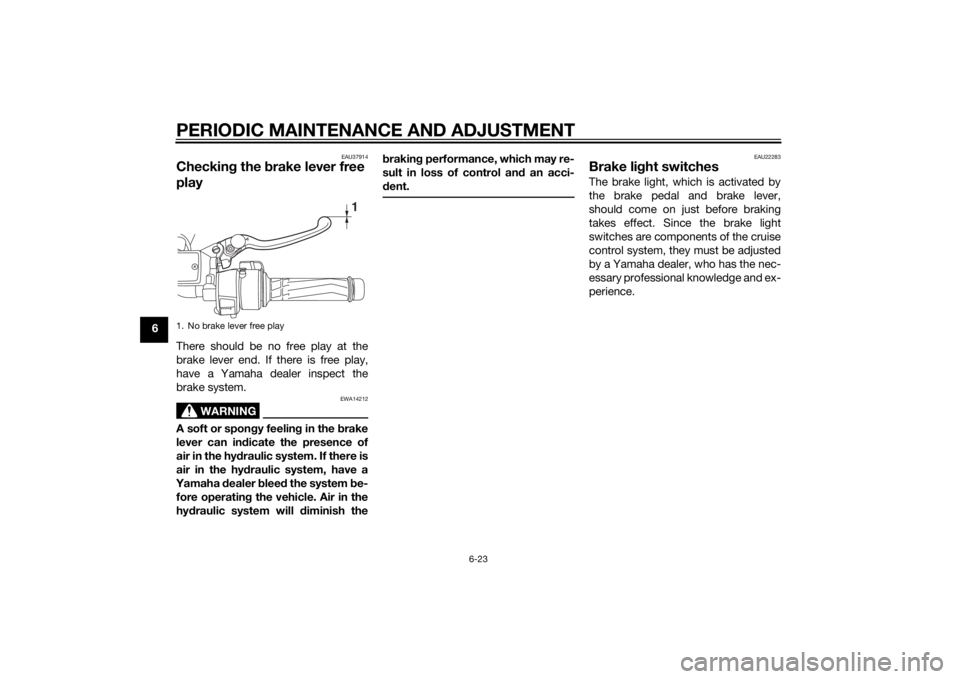
Checking the brake lever free
playThere should be no free play at the
brake lever end. If there is free play,
have a Yamaha dealer inspect the
brake system.
WARNING
EWA14212
A soft or spon gy feelin g in the b rake
lever can in dicate the presence of
air in the hy draulic system. If there is
air in the hy draulic system, have a
Yamaha dealer blee d the system be-
fore operatin g the vehicle. Air in the
hy draulic system will diminish the b
rakin g performance, which may re-
sult in loss of control and an acci-
d ent.
EAU22283
Brake li ght switchesThe brake light, which is activated by
the brake pedal and brake lever,
should come on just before braking
takes effect. Since the brake light
switches are components of the cruise
control system, they must be adjusted
by a Yamaha dealer, who has the nec-
essary professional knowledge and ex-
perience.
1. No brake lever free play
1
U1MCE1E0.book Page 23 Thursday, August 8, 2013 9:03 AM
Page 92 of 118
PERIODIC MAINTENANCE AND ADJUSTMENT
6-25
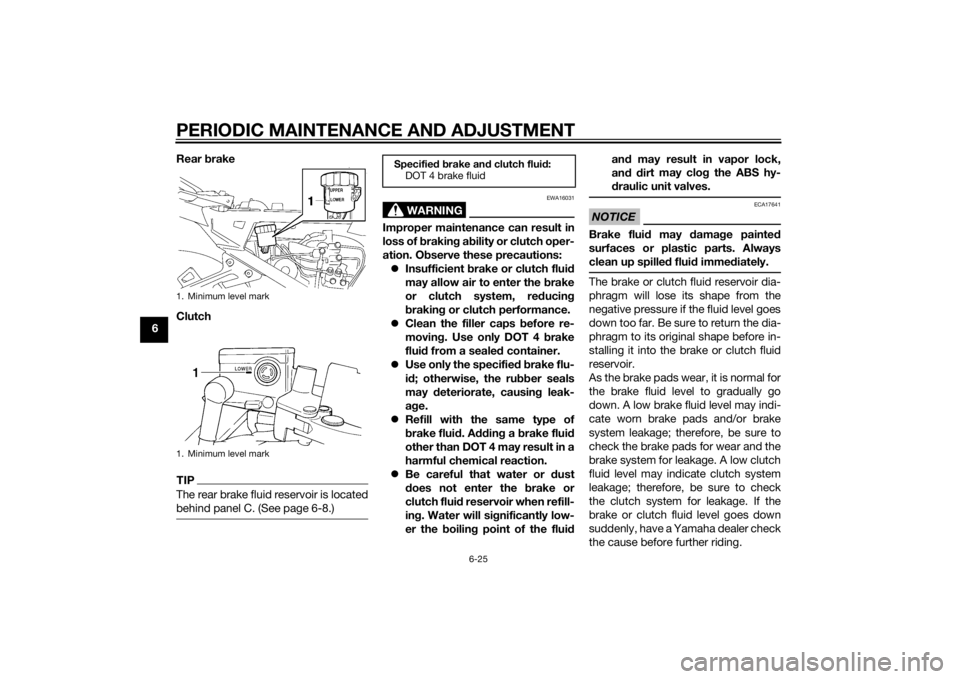
6Rear
brake
Clutch
TIPThe rear brake fluid reservoir is located
behind panel C. (See page 6-8.)
WARNING
EWA16031
Improper maintenance can result in
loss of brakin g a bility or clutch oper-
ation. O bserve these precautions:
Insufficient brake or clutch flui d
may allow air to enter the brake
or clutch system, red ucing
b rakin g or clutch performance.
Clean the filler caps before re-
movin g. Use only DOT 4 b rake
flui d from a seale d container.
Use only the specified b rake flu-
i d ; otherwise, the ru bber seals
may deteriorate, causin g leak-
a g e.
Refill with the same type of
brake flui d. A ddin g a brake flui d
other than DOT 4 may result in a
harmful chemical reaction.
Be careful that water or dust
d oes not enter the brake or
clutch flui d reservoir when refill-
in g. Water will si gnificantly low-
er the boilin g point of the flui dan
d may result in vapor lock,
an d d ir
t may clo g the ABS hy-
d raulic unit valves.
NOTICE
ECA17641
Brake flui d may damag e painted
surfaces or plastic parts. Always
clean up spille d flui d imme diately.The brake or clutch fluid reservoir dia-
phragm will lose its shape from the
negative pressure if the fluid level goes
down too far. Be sure to return the dia-
phragm to its original shape before in-
stalling it into the brake or clutch fluid
reservoir.
As the brake pads wear, it is normal for
the brake fluid level to gradually go
down. A low brake fluid level may indi-
cate worn brake pads and/or brake
system leakage; therefore, be sure to
check the brake pads for wear and the
brake system for leakage. A low clutch
fluid level may indicate clutch system
leakage; therefore, be sure to check
the clutch system for leakage. If the
brake or clutch fluid level goes down
suddenly, have a Yamaha dealer check
the cause before further riding.
1. Minimum level mark
1. Minimum level mark
Specifie d b rake an d clutch flui d:
DOT 4 brake fluid
U1MCE1E0.book Page 25 Thursday, August 8, 2013 9:03 AM
Page 95 of 118
PERIODIC MAINTENANCE AND ADJUSTMENT
6-28
6
EAU23215
Checking an d lu bricatin g the
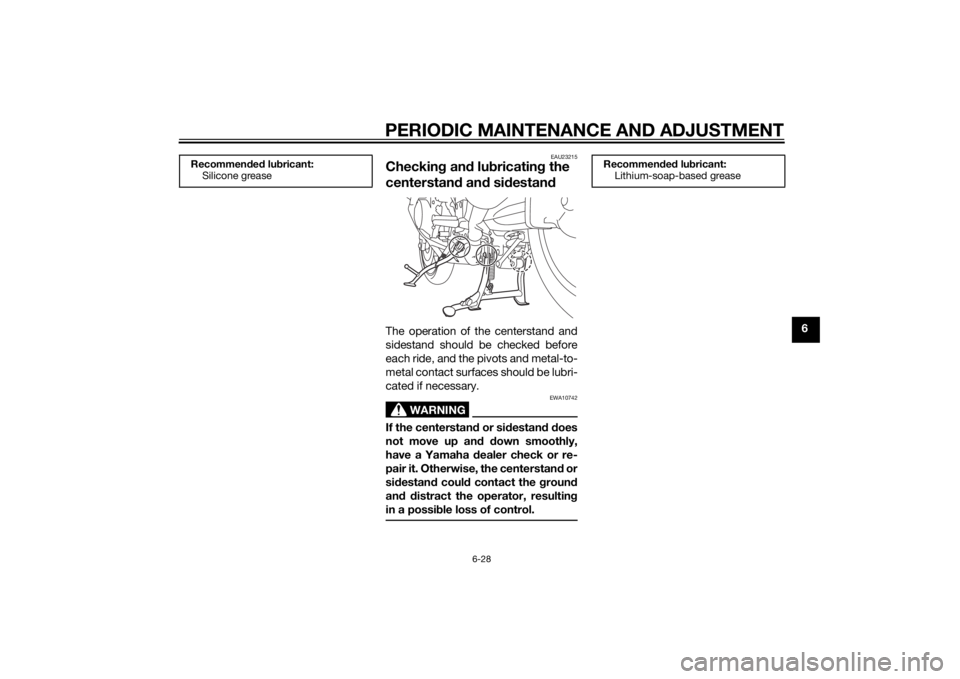
centerstan d an d si destan dThe operation of the centerstand and
sidestand should be checked before
each ride, and the pivots and metal-to-
metal contact surfaces should be lubri-
cated if necessary.
WARNING
EWA10742
If the centerstan d or si destan d d oes
not move up an d d own smoothly,
have a Yamaha d ealer check or re-
pair it. Otherwise, the centerstan d or
si destan d coul d contact the groun d
an d d istract the operator, resultin g
in a possib le loss of control.
Recommen ded lu bricant:
Silicone grease
Recommen ded lu bricant:
Lithium-soap-based grease
U1MCE1E0.book Page 28 Thursday, August 8, 2013 9:03 AM
Page 97 of 118
PERIODIC MAINTENANCE AND ADJUSTMENT
6-30
6
NOTICE
ECA10591
If any damag e is foun d or the front
fork does not operate smoothly,
have a Yamaha d ealer check or re-
pair it.
EAU45512
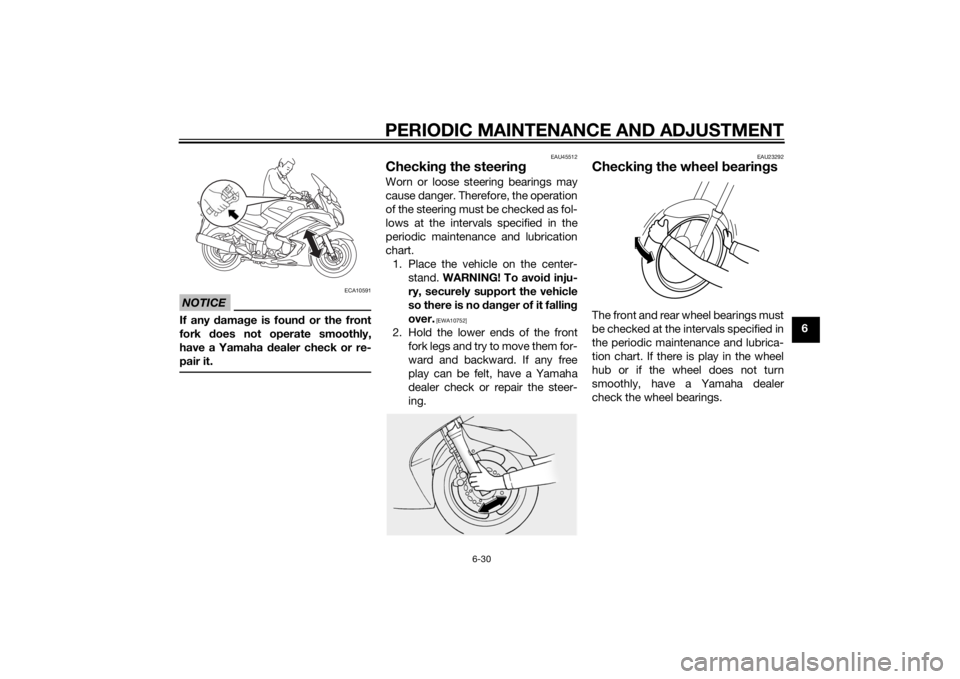
Checkin g the steerin gWorn or loose steering bearings may
cause danger. Therefore, the operation
of the steering must be checked as fol-
lows at the intervals specified in the
periodic maintenance and lubrication
chart.
1. Place the vehicle on the center- stand. WARNING! To avoi d inju-
ry, securely support the vehicle
so there is no dan ger of it fallin g
over.
[EWA10752]
2. Hold the lower ends of the front fork legs and try to move them for-
ward and backward. If any free
play can be felt, have a Yamaha
dealer check or repair the steer-
ing.
EAU23292
Checkin g the wheel bearin gsThe front and rear wheel bearings must
be checked at the intervals specified in
the periodic maintenance and lubrica-
tion chart. If there is play in the wheel
hub or if the wheel does not turn
smoothly, have a Yamaha dealer
check the wheel bearings.
U1MCE1E0.book Page 30 Thursday, August 8, 2013 9:03 AM
Page 103 of 118
PERIODIC MAINTENANCE AND ADJUSTMENT
6-36
6
EAU54501
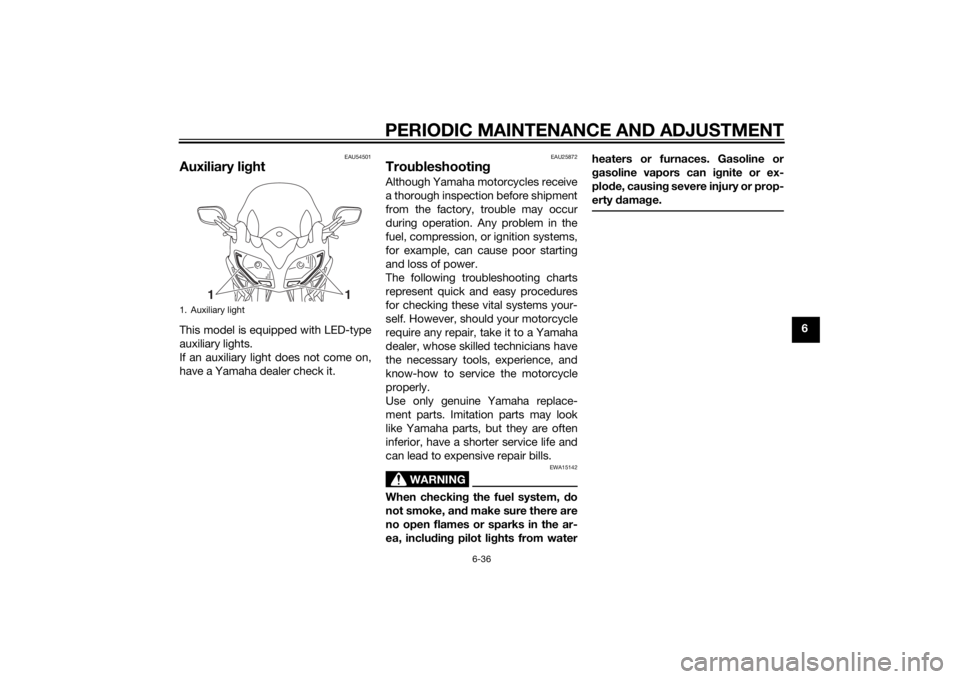
Auxiliary lightThis model is equipped with LED-type
auxiliary lights.
If an auxiliary light does not come on,
have a Yamaha dealer check it.
EAU25872
Trou bleshootin gAlthough Yamaha motorcycles receive
a thorough inspection before shipment
from the factory, trouble may occur
during operation. Any problem in the
fuel, compression, or ignition systems,
for example, can cause poor starting
and loss of power.
The following troubleshooting charts
represent quick and easy procedures
for checking these vital systems your-
self. However, should your motorcycle
require any repair, take it to a Yamaha
dealer, whose skilled technicians have
the necessary tools, experience, and
know-how to service the motorcycle
properly.
Use only genuine Yamaha replace-
ment parts. Imitation parts may look
like Yamaha parts, but they are often
inferior, have a shorter service life and
can lead to expensive repair bills.
WARNING
EWA15142
When checkin g the fuel system, d o
not smoke, an d make sure there are
no open flames or sparks in the ar-
ea, inclu din g pilot li ghts from water heaters or furnaces. Gasoline or
g
asoline vapors can i gnite or ex-
plo de, causin g severe injury or prop-
erty damag e.
1. Auxiliary light
1
1
U1MCE1E0.book Page 36 Thursday, August 8, 2013 9:03 AM
Page 105 of 118
PERIODIC MAINTENANCE AND ADJUSTMENT
6-38
6
En
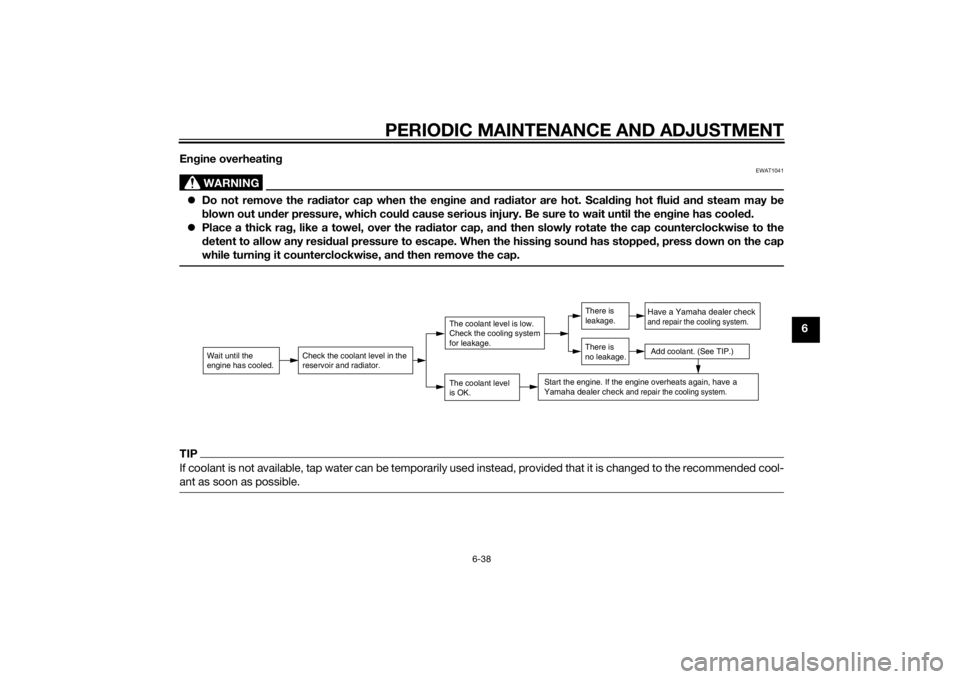
gine overheatin g
WARNING
EWAT1041
Do not remove the ra diator cap when the en gine an d ra diator are hot. Scal din g hot flui d an d steam may be
b lown out un der pressure, which coul d cause serious injury. Be sure to wait until the en gine has coole d.
Place a thick ra g, like a towel, over the ra diator cap, an d then slowly rotate the cap counterclockwise to the
d etent to allow any resi dual pressure to escape. When the hissin g soun d has stoppe d, press down on the cap
while turnin g it counterclockwise, an d then remove the cap.TIPIf coolant is not available, tap water can be temporarily used instead, provided that it is changed to the recommended cool-
ant as soon as possible.
Wait until the
engine has cooled.
Check the coolant level in the
reservoir and radiator.
The coolant level
is OK.The coolant level is low.
Check the cooling system
for leakage.
Have a Yamaha dealer checkand repair the cooling system.Add coolant. (See TIP.)
Start the engine. If the engine overheats again,
have a
Yamaha dealer check
and repair the cooling system.
There is
leakage.
There is
no leakage.
U1MCE1E0.book Page 38 Thursday, August 8, 2013 9:03 AM
Page 109 of 118
MOTORCYCLE CARE AND STORAGE7-4
7
EAU26244
StorageShort-term
Always store your motorcycle in a cool,
dry place and, if necessary, protect it
against dust with a porous cover. Be
sure the engine and the exhaust sys-
tem are cool before covering the mo-
torcycle.NOTICE
ECA10811
Storin g the motorcycle in a
poorly ventilate d room or cover-
in g it with a tarp, while it is still
wet, will allow water an d humi d-
ity to seep in an d cause rust.
To prevent corrosion, avoi d
d amp cellars, sta bles ( because
of the presence of ammonia)
an d areas where stron g chemi-
cals are store d.Lon g-term
Before storing your motorcycle for sev-
eral months: 1. Follow all the instructions in the “Care” section of this chapter. 2. Fill up the fuel tank and add fuel
stabilizer (if available) to prevent
the fuel tank from rusting and the
fuel from deteriorating.
3. Perform the following steps to protect the cylinders, piston rings,
etc. from corrosion.a. Remove the spark plug caps and spark plugs.
b. Pour a teaspoonful of engine oil into each spark plug bore.
c. Install the spark plug caps onto the spark plugs, and then pla-
ce the spark plugs on the cylin-
der head so that the electrodes
are grounded. (This will limit
sparking during the next step.)
d. Turn the engine over several times with the starter. (This will
coat the cylinder walls with oil.)
WARNING! To prevent dam-
a g e or injury from sparkin g,
make sure to groun d the
spark plu g electro des while
turnin g the en gine over.
[EWA10952]
e. Remove the spark plug caps
from the spark plugs, and then
install the spark plugs and the
spark plug caps.
4. Lubricate all control cables and the pivoting points of all levers and
pedals as well as of the side-
stand/centerstand.
5. Check and, if necessary, correct the tire air pressure, and then lift
the motorcycle so that both of its
wheels are off the ground. Alterna-
tively, turn the wheels a little every
month in order to prevent the tires
from becoming degraded in one
spot.
6. Cover the muffler outlets with plastic bags to prevent moisture
from entering them.
7. Remove the battery and fully char- ge it. Store it in a cool, dry place
and charge it once a month. Do
not store the battery in an exces-
sively cold or warm place [less
than 0 °C (30 °F) or more than 30
°C (90 °F)]. For more information
on storing the battery, see page
6-31.
U1MCE1E0.book Page 4 Thursday, August 8, 2013 9:03 AM
Page 110 of 118
MOTORCYCLE CARE AND STORAGE
7-5
7
TIPMake any necessary repairs before
storing the motorcycle.U1MCE1E0.book Page 5 Thursday, August 8, 2013 9:03 AM
Page 111 of 118

SPECIFICATIONS
8-1
8
Dimensions:Overall length:2230 mm (87.8 in)
Overall width:
750 mm (29.5 in)
Overall height: 1325/1455 mm (52.2/57.3 in)
Seat height: 805/825 mm (31.7/32.5 in)
Wheelbase:
1545 mm (60.8 in)
Ground clearance: 130 mm (5.12 in)
Minimum turning radius: 3100 mm (122.0 in)Wei ght:Curb weight:
289 kg (637 lb)Engine:Engine type:
Liquid cooled 4-stroke, DOHC
Cylinder arrangement: Inline 4-cylinder
Displacement: 1298 cm³
Bore × stroke:
79.0 × 66.2 mm (3.11 × 2.61 in)
Compression ratio: 10.80 : 1
Starting system: Electric starter
Lubrication system:
Wet sump
Engine oil:Recommended brand:
YAMALUBE
Type:
SAE 10W-40, 10W-50, 15W-40, 20W-40 or
20W-50
Recommended engine oil grade: API service SG type or higher, JASO
standard MA
Engine oil quantity:
Without oil filter cartridge replacement:3.80 L (4.02 US qt, 3.34 Imp.qt)
With oil filter cartridge replacement:
4.00 L (4.23 US qt, 3.52 Imp.qt)Final gear oil:Type:
Yamaha genuine shaft drive gear oil exclusive to FJR1300/VMAX
Quantity: 0.20 L (0.21 US qt, 0.18 Imp.qt)
Coolin g system:Coolant reservoir capacity (up to the
maximum level mark):
0.25 L (0.26 US qt, 0.22 Imp.qt)
Radiator capacity (including all routes): 2.60 L (2.75 US qt, 2.29 Imp.qt)Air filter:Air filter element:Dry elementFuel:Recommended fuel:
Regular unleaded gasoline only
Fuel tank capacity: 25.0 L (6.61 US gal, 5.50 Imp.gal)
Fuel reserve amount: 5.5 L (1.45 US gal, 1.21 Imp.gal)Fuel injection:Throttle body:ID mark:
1MC1 00Spark plu g(s):Manufacturer/model:
NGK/CPR8EA-9
Spark plug gap:
0.8–0.9 mm (0.031–0.035 in)Clutch:Clutch type:Wet, multiple-discTransmission:Primary reduction ratio:1.563 (75/48)
Final drive: Shaft
–20 –10 0 1020 30 40 50 C
10 30 50 70 90 110
0 130 F
SAE 20W-50SAE 20W-40SAE 15W-40SAE 10W-40SAE 10W-50
U1MCE1E0.book Page 1 Thursday, August 8, 2013 9:03 AM
Page 112 of 118

SPECIFICATIONS
8-2
8
Secondary reduction ratio:2.698 (35/37 x 21/27 x 33/9)
Transmission type: Constant mesh 5-speed
Operation:
Left foot operation
Gear ratio: 1st:
2.529 (43/17)
2nd: 1.773 (39/22)
3rd: 1.348 (31/23)
4th:
1.077 (28/26)
5th: 0.929 (26/28)Chassis:Frame type:
Diamond
Caster angle: 26.00 °
Trail: 109 mm (4.3 in)Front tire:Type:Tubeless
Size: 120/70 ZR17M/C (58W)
Manufacturer/model:
BRIDGESTONE/BT023F F
Manufacturer/model: METZELER/Roadtec Z8
Rear tire:Type:Tubeless
Size:
180/55 ZR17M/C (73W)
Manufacturer/model: BRIDGESTONE/BT023R F
Manufacturer/model: METZELER/Roadtec Z8 CLoa din g:Maximum load:
215 kg (474 lb)
(Total weight of rider, passenger, cargo
and accessories)Tire air pressure (measure d on col d
tires):Loading condition:
0–90 kg (0–198 lb)
Front:
250 kPa (2.50 kgf/cm², 36 psi)
Rear: 290 kPa (2.90 kgf/cm², 42 psi)
Loading condition: 90–215 kg (198–474 lb)
Front:
250 kPa (2.50 kgf/cm², 36 psi)
Rear: 290 kPa (2.90 kgf/cm², 42 psi)
High-speed riding: Front: 250 kPa (2.50 kgf/cm², 36 psi)
Rear: 290 kPa (2.90 kgf/cm², 42 psi)
Front wheel:Wheel type:Cast wheel
Rim size:
17M/C x MT3.50Rear wheel:Wheel type:Cast wheel
Rim size:
17M/C x MT5.50Unifie d b rake system:Operation:
Activated by rear brakeFront brake:Type:
Dual disc brake
Operation: Right hand operation
Specified brake fluid:
DOT 4Rear brake:Type:
Single disc brake
Operation:
Right foot operation
Specified brake fluid: DOT 4Front suspension:Type:
Telescopic fork
Spring/shock absorber type: Coil spring/oil damper
Wheel travel: 135.0 mm (5.31 in)
U1MCE1E0.book Page 2 Thursday, August 8, 2013 9:03 AM