brake YAMAHA FJR1300A 2014 Owner's Manual
[x] Cancel search | Manufacturer: YAMAHA, Model Year: 2014, Model line: FJR1300A, Model: YAMAHA FJR1300A 2014Pages: 118, PDF Size: 3.29 MB
Page 94 of 118
PERIODIC MAINTENANCE AND ADJUSTMENT
6-27
6
EAU44275
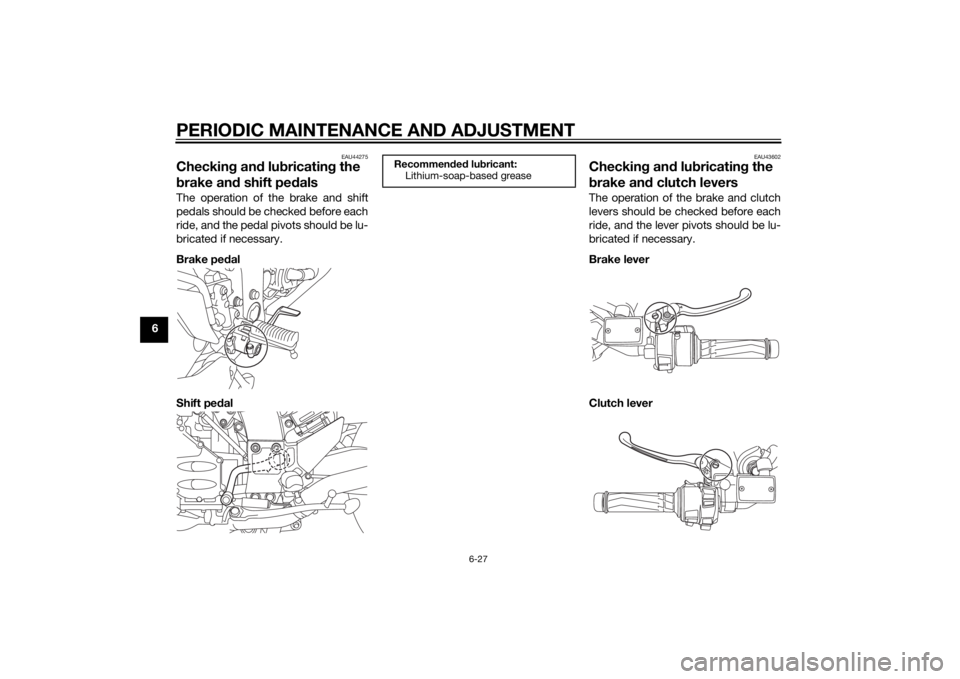
Checking an d lu bricatin g the
b rake an d shift pe dalsThe operation of the brake and shift
pedals should be checked before each
ride, and the pedal pivots should be lu-
bricated if necessary.
Brake pe dal
Shift pe dal
EAU43602
Checkin g an d lu bricatin g the
b rake an d clutch leversThe operation of the brake and clutch
levers should be checked before each
ride, and the lever pivots should be lu-
bricated if necessary.
Brake lever
Clutch lever
Recommen ded lu bricant:
Lithium-soap-based grease
U1MCE1E0.book Page 27 Thursday, August 8, 2013 9:03 AM
Page 96 of 118
PERIODIC MAINTENANCE AND ADJUSTMENT
6-29
6
EAU23252
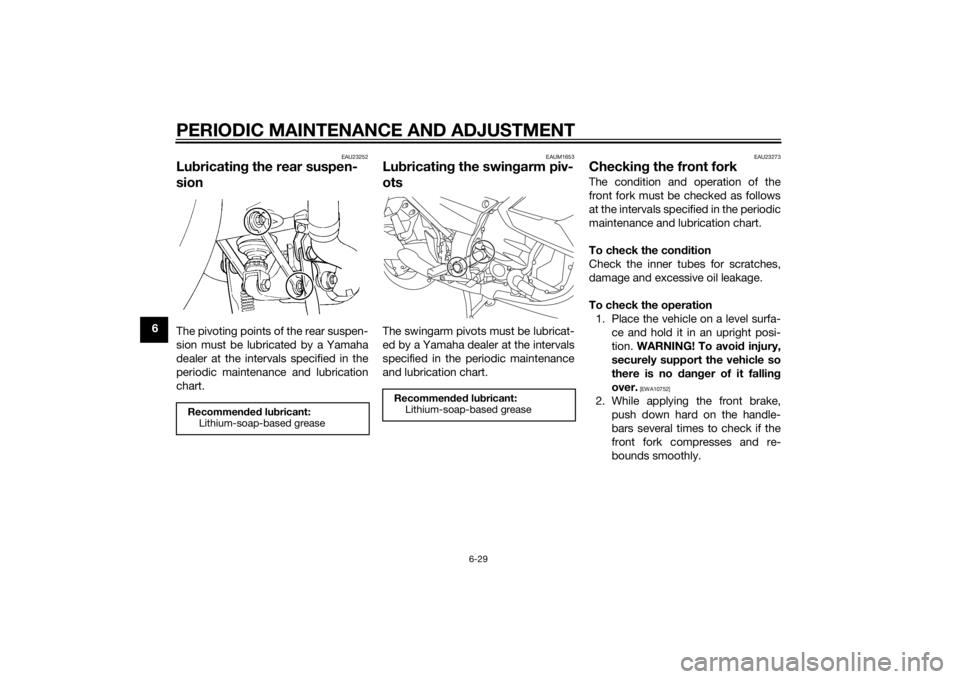
Lubricatin g the rear suspen-
sionThe pivoting points of the rear suspen-
sion must be lubricated by a Yamaha
dealer at the intervals specified in the
periodic maintenance and lubrication
chart.
EAUM1653
Lub ricatin g the swing arm piv-
otsThe swingarm pivots must be lubricat-
ed by a Yamaha dealer at the intervals
specified in the periodic maintenance
and lubrication chart.
EAU23273
Checkin g the front forkThe condition and operation of the
front fork must be checked as follows
at the intervals specified in the periodic
maintenance and lubrication chart.
To check the con dition
Check the inner tubes for scratches,
damage and excessive oil leakage.
To check the operation 1. Place the vehicle on a level surfa- ce and hold it in an upright posi-
tion. WARNING! To avoi d injury,
securely support the vehicle so
there is no dan ger of it fallin g
over.
[EWA10752]
2. While applying the front brake, push down hard on the handle-
bars several times to check if the
front fork compresses and re-
bounds smoothly.
Recommen ded lu bricant:
Lithium-soap-based grease
Recommen ded lu bricant:
Lithium-soap-based grease
U1MCE1E0.book Page 29 Thursday, August 8, 2013 9:03 AM
Page 99 of 118
![YAMAHA FJR1300A 2014 Owners Manual PERIODIC MAINTENANCE AND ADJUSTMENT
6-32
6
key is turne
d to “OFF”, then
connect the positive lea d b efore
connectin g the ne gative lea d.
[ECA16841]
4. After installation, make sure that
the ba](/img/51/49526/w960_49526-98.png "YAMAHA FJR1300A 2014 Owners Manual PERIODIC MAINTENANCE AND ADJUSTMENT
6-32
6
key is turne
d to “OFF”, then
connect the positive lea d b efore
connectin g the ne gative lea d.
[ECA16841]
4. After installation, make sure that
the ba")
PERIODIC MAINTENANCE AND ADJUSTMENT
6-32
6
key is turne
d to “OFF”, then
connect the positive lea d b efore
connectin g the ne gative lea d.
[ECA16841]
4. After installation, make sure that
the battery leads are properly con-
nected to the battery terminals.NOTICE
ECA16531
Always keep the b attery charged .
Storin g a dischar ged battery can
cause permanent battery damag e.
EAU54513
Replacin g the fusesThe fuse boxes and individual fuses
are located under panel A. (See page
6-8.)
If a fuse is blown, replace it as follows.1. Turn the key to “OFF” and turn off the electrical circuit in question.1. Main fuse 1
2. Spare fuse
3. Cruise control fuse
4. Brake light fuse
5. Fuse box
6. Main fuse 2
5
1
3
4
2
2
5
26
1. ABS motor fuse
2. ABS solenoid fuse
3. Fuel injection system fuse
4. Backup fuse (for clock and immobilizer sys-
tem)
5. Electronic throttle valve fuse
6. Headlight fuse
7. Spare fuse
8. Hazard fuse
9. Signaling system fuse
10.Auxiliary DC jack fuse
11.ABS control unit fuse
12.Ignition fuse
13.Right radiator fan fuse
14.Left radiator fan fuse
15.Windshield motor fuse
147
9101112
13
715
817
2
3456
7
U1MCE1E0.book Page 32 Thursday, August 8, 2013 9:03 AM
Page 100 of 118

PERIODIC MAINTENANCE AND ADJUSTMENT
6-33
62. Remove the blown fuse, and then
install a new fuse of the specified
amperage. WARNING! Do not
use a fuse of a hi gher ampera ge
ratin g than recommen ded to
avoi d causin g extensive d am-
a g e to the electrical system an d
possi bly a fire.
[EWA15132]
3. Turn the key to “ON” and turn on
the electrical circuit in question to
check if the device operates.
4. If the fuse immediately blows again, have a Yamaha dealer
check the electrical system.
Specifie d fuses:
Main fuse 1: 50.0 A
Main fuse 2: 30.0 A
Headlight fuse: 25.0 A
Brake light fuse: 1.0 A
Signaling system fuse: 10.0 A
Ignition fuse: 20.0 A
Radiator fan fuse: 10.0 A × 2
Backup fuse: 7.5 A
Hazard fuse: 7.5 A
Fuel injection system fuse: 15.0 A
ABS control unit fuse: 7.5 A
ABS motor fuse: 30.0 A
ABS solenoid fuse: 20.0 A
Cruise control fuse: 1.0 A
Auxiliary DC jack fuse: 3.0 A
Windshield motor fuse: 20.0 A
Electronic throttle valve fuse: 7.5 A
U1MCE1E0.book Page 33 Thursday, August 8, 2013 9:03 AM
Page 101 of 118
PERIODIC MAINTENANCE AND ADJUSTMENT
6-34
6
EAU40362
Headlig ht bul bIf a headlight does not come on, have
a Yamaha dealer check its electrical
circuit or replace the bulb.NOTICE
ECA16581
Do not affix any type of tinte d film or
stickers to the head lig ht lens.
EAU54241
Front turn si gnal li ghtThis model is equipped with LED-type
front turn signal lights.
If a front turn signal light does not
come on, have a Yamaha dealer check
it.
EAU27005
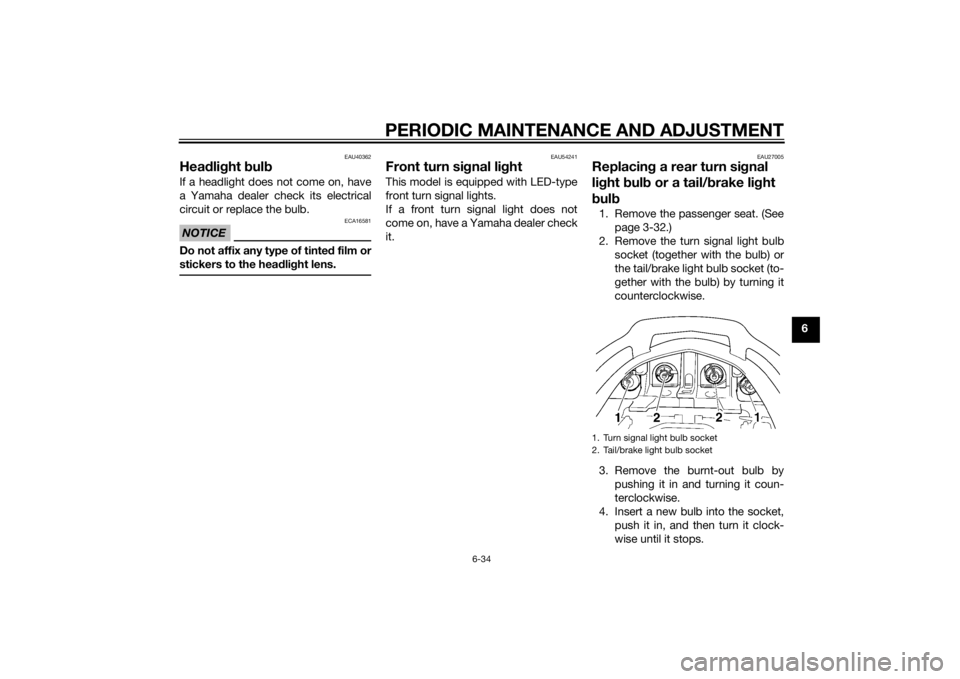
Replacin g a rear turn si gnal
lig ht bul b or a tail/ brake li ght
b ul b1. Remove the passenger seat. (See
page 3-32.)
2. Remove the turn signal light bulb socket (together with the bulb) or
the tail/brake light bulb socket (to-
gether with the bulb) by turning it
counterclockwise.
3. Remove the burnt-out bulb by pushing it in and turning it coun-
terclockwise.
4. Insert a new bulb into the socket, push it in, and then turn it clock-
wise until it stops.1. Turn signal light bulb socket
2. Tail/brake light bulb socket
U1MCE1E0.book Page 34 Thursday, August 8, 2013 9:03 AM
Page 107 of 118
MOTORCYCLE CARE AND STORAGE7-2
7
off any
deter gent resi due usin g
plenty of water, as it is harmful
to plastic parts.
Do not use any harsh chemical
prod ucts on plastic parts. Be
sure to avoi d usin g cloths or
spon ges which have b een in
contact with stron g or a brasive
cleanin g prod ucts, solvent or
thinner, fuel ( gasoline), rust re-
movers or inhi bitors, brake flui d,
antifreeze or electrolyte.
Do not use hi gh-pressure wash-
ers or steam-jet cleaners since
they cause water seepag e and
d eterioration in the followin g ar-
eas: seals (of wheel an d swin g-
arm bearin gs, fork an d b rakes),
electric components (couplers,
connectors, instruments,
switches an d li ghts), breather
hoses an d vents.
For motorcycles equippe d with
a win dshiel d: Do not use stron g
cleaners or har d spon ges as
they will cause dullin g or
sc
ratchin g. Some cleanin g
compoun ds for plastic may
leave scratches on the win d- shiel
d. Test the pro duct on a
small hi dden part of the win d-
shiel d to make sure that it does
not leave any marks. If the win d-
shiel d is scratche d, use a quality
plastic polishin g compoun d af-
ter washing .
After normal useRemove dirt with warm water, a mild
detergent, and a soft, clean sponge,
and then rinse thoroughly with clean
water. Use a toothbrush or bottlebrush
for hard-to-reach areas. Stubborn dirt
and insects will come off more easily if
the area is covered with a wet cloth for
a few minutes before cleaning.
After riding in the rain, near the sea oron salt-sprayed roadsSince sea salt or salt sprayed on roads
during winter are extremely corrosive
in combination with water, carry out
the following steps after each ride in
the rain, near the sea or on salt-
sprayed roads.
TIPSalt sprayed on roads in the winter
may remain well into spring.1. Clean the motorcycle with cold
water and a mild detergent, after
the engine has cooled down.
NOTICE: Do not use warm wa-
ter since it increases the corro-
sive action of the salt.
[ECA10792]
2. After drying the motorcycle, apply a corrosion protection spray on all
metal, including chrome- and
nickel-plated, surfaces to prevent
corrosion.
Windshield cleaningAvoid using any alkaline or strong acid
cleaner, gasoline, brake fluid, or any
other solvent. Clean the windshield
with a cloth or sponge dampened with
a neutral detergent, and after cleaning,
thoroughly wash it off with water. For
additional cleaning, use Yamaha Wind-
shield Cleaner or other quality cleaner.
Some cleaning compounds for plastics
may leave scratches on surfaces of the
U1MCE1E0.book Page 2 Thursday, August 8, 2013 9:03 AM
Page 108 of 118
MOTORCYCLE CARE AND STORAGE
7-3
7windshield. Before using them, make a
test by polishing an area which does
not affect your visibility.
After cleaning
1. Dry the motorcycle with a chamois or an absorbing cloth.
2. Use a chrome polish to shine chrome, aluminum and stainless-
steel parts, including the exhaust
system. (Even the thermally in-
duced discoloring of stainless-
steel exhaust systems can be re-
moved through polishing.)
3. To prevent corrosion, it is recom- mended to apply a corrosion pro-
tection spray on all metal,
including chrome- and nickel-plat-
ed, surfaces.
4. Use spray oil as a universal clean- er to remove any remaining dirt.
5. Touch up minor paint damage caused by stones, etc.
6. Wax all painted surfaces.
7. Let the motorcycle dry completely before storing or covering it.
WARNING
EWA11132
Contaminants on the brakes or tires
can cause loss of control. Make sure that there is no oil or
wax on the brakes or tires.
If necessary, clean the brake
d iscs an d b rake linin gs with a
re gular brake disc cleaner or
acetone, an d wash the tires with
warm water an d a mil d d eter-
g ent. Before ri din g at hi gher
speed s, test the motorcycle’s
b rakin g performance an d cor-
nerin g b ehavior.NOTICE
ECA10801
Apply spray oil an d wax spar-
in gly an d make sure to wipe off
any excess.
Never apply oil or wax to any
rubber an d plastic parts, but
treat them with a suitab le care
prod uct.
Avoi d usin g a brasive polishin g
compoun ds as they will wear
away the paint.
TIP Consult a Yamaha dealer for ad-
vice on what products to use.
Washing, rainy weather or humid
climates can cause the headlight
lens to fog. Turning the headlight
on for a short period of time will
help remove the moisture from the
lens.
U1MCE1E0.book Page 3 Thursday, August 8, 2013 9:03 AM
Page 112 of 118

SPECIFICATIONS
8-2
8
Secondary reduction ratio:2.698 (35/37 x 21/27 x 33/9)
Transmission type: Constant mesh 5-speed
Operation:
Left foot operation
Gear ratio: 1st:
2.529 (43/17)
2nd: 1.773 (39/22)
3rd: 1.348 (31/23)
4th:
1.077 (28/26)
5th: 0.929 (26/28)Chassis:Frame type:
Diamond
Caster angle: 26.00 °
Trail: 109 mm (4.3 in)Front tire:Type:Tubeless
Size: 120/70 ZR17M/C (58W)
Manufacturer/model:
BRIDGESTONE/BT023F F
Manufacturer/model: METZELER/Roadtec Z8
Rear tire:Type:Tubeless
Size:
180/55 ZR17M/C (73W)
Manufacturer/model: BRIDGESTONE/BT023R F
Manufacturer/model: METZELER/Roadtec Z8 CLoa din g:Maximum load:
215 kg (474 lb)
(Total weight of rider, passenger, cargo
and accessories)Tire air pressure (measure d on col d
tires):Loading condition:
0–90 kg (0–198 lb)
Front:
250 kPa (2.50 kgf/cm², 36 psi)
Rear: 290 kPa (2.90 kgf/cm², 42 psi)
Loading condition: 90–215 kg (198–474 lb)
Front:
250 kPa (2.50 kgf/cm², 36 psi)
Rear: 290 kPa (2.90 kgf/cm², 42 psi)
High-speed riding: Front: 250 kPa (2.50 kgf/cm², 36 psi)
Rear: 290 kPa (2.90 kgf/cm², 42 psi)
Front wheel:Wheel type:Cast wheel
Rim size:
17M/C x MT3.50Rear wheel:Wheel type:Cast wheel
Rim size:
17M/C x MT5.50Unifie d b rake system:Operation:
Activated by rear brakeFront brake:Type:
Dual disc brake
Operation: Right hand operation
Specified brake fluid:
DOT 4Rear brake:Type:
Single disc brake
Operation:
Right foot operation
Specified brake fluid: DOT 4Front suspension:Type:
Telescopic fork
Spring/shock absorber type: Coil spring/oil damper
Wheel travel: 135.0 mm (5.31 in)
U1MCE1E0.book Page 2 Thursday, August 8, 2013 9:03 AM
Page 113 of 118

SPECIFICATIONS
8-3
8
Rear suspension:Type:Swingarm (link suspension)
Spring/shock absorber type:
Coil spring/gas-oil damper
Wheel travel: 125.0 mm (4.92 in)Electrical system:Ignition system:
TCI
Charging system: AC magnetoBattery:Model:
GT14B-4
Voltage, capacity: 12 V, 12.0 AhHea dlig ht:Bulb type:
Halogen bulbBul b volta ge, watta ge × quantity:Headlight:
12 V, 60.0 W/55.0 W × 2
Tail/brake light:
12 V, 5.0 W/21.0 W × 2
Front turn signal light: LED
Rear turn signal light: 12 V, 21.0 W × 2
Auxiliary light:
LED
License plate light: 12 V, 5.0 W × 1 Meter lighting:
LED
Neutral indicator light: LED
High beam indicator light:
LED
Oil level warning light: LED
Turn signal indicator light: LED
Engine trouble warning light:
LED
ABS warning light: LED
Cruise control “SET” indicator light: LED
Cruise control “ON” indicator light:
LED
Immobilizer system indicator light: LED
Traction control system indicator/warning
light: LED
Fuses:Main fuse 1:
50.0 A
Main fuse 2: 30.0 A
Headlight fuse: 25.0 A
Brake light fuse:
1.0 A
Signaling system fuse: 10.0 A Ignition fuse:
20.0 A
Radiator fan fuse: 10.0 A × 2
Hazard fuse:
7.5 A
Fuel injection system fuse: 15.0 A
ABS control unit fuse: 7.5 A
ABS motor fuse:
30.0 A
ABS solenoid fuse: 20.0 A
Cruise control fuse: 1.0 A
Auxiliary DC jack fuse:
3.0 A
Backup fuse: 7.5 A
Windshield motor fuse: 20.0 A
Electronic throttle valve fuse:
7.5 A
U1MCE1E0.book Page 3 Thursday, August 8, 2013 9:03 AM
Page 115 of 118

10-1
10
INDEX
AABS....................................................... 3-27
ABS warning light ................................... 3-5
Accessory box ...................................... 3-36
Air filter element, cleaning .................... 6-17
Auxiliary DC jack .................................. 3-45
Auxiliary light ........................................ 6-36BBattery .................................................. 6-31
Brake and clutch fluid levels, checking ............................................. 6-24
Brake and clutch fluids , changing ........ 6-26
Brake and clutch levers, checking and lubricating .................... 6-27
Brake and shift pedals,
checking and lubricating .................... 6-27
Brake lever............................................ 3-26
Brake lever free play, checking ............ 6-23
Brake light switches ............................. 6-23
Brake pedal .......................................... 3-26CCables, checking and lubricating ......... 6-26
Care ........................................................ 7-1
Catalytic converters.............................. 3-31
Centerstand and sidestand, checking and lubricating .................... 6-28
Clutch lever.................................. 3-25, 6-22
Coolant ................................................. 6-16
Cowling vents, opening and closing .... 3-37
Cruise control indicator lights................. 3-4
Cruise control switches ........................ 3-24
Cruise control system............................. 3-6DDimmer/Pass switch............................. 3-24 D-mode (drive mode) ........................... 3-23
EEngine break-in ...................................... 5-3
Engine idling speed, checking ............. 6-18
Engine oil and oil filter cartridge........... 6-12
Engine trouble warning light .................. 3-5FFinal gear oil ......................................... 6-14
Front and rear brake pads, checking ... 6-24
Front fork, adjusting ............................. 3-39
Front fork, checking ............................. 6-29
Front turn signal light ........................... 6-34
Fuel ...................................................... 3-30
Fuel consumption, tips for reducing ...... 5-3
Fuel tank breather/overflow hose ........ 3-31
Fuel tank cap........................................ 3-29
Fuses, replacing ................................... 6-32HHandlebar position, adjusting .............. 3-37
Handlebar switches ............................. 3-23
Hazard switch ...................................... 3-24
Headlight beams, adjusting ................. 3-37
Headlight bulb ...................................... 6-34
High beam indicator light ....................... 3-4
Horn switch .......................................... 3-24IIdentification numbers ........................... 9-1
Ignition circuit cut-off system .............. 3-43
Immobilizer system ................................ 3-1
Immobilizer system indicator light ......... 3-6
Indicator lights and warning lights ......... 3-4LLicense plate light bulb, replacing ....... 6-35
MMain switch/steering lock ....................... 3-2
Maintenance and lubrication, periodic ... 6-4
Maintenance, emission control
system .................................................. 6-3
Matte color, caution................................ 7-1
Menu switch ......................................... 3-24
Model label ............................................. 9-1
Multi-function meter unit ...................... 3-10NNeutral indicator light ............................. 3-4OOil level warning light .............................. 3-4PPanels, removing and installing .............. 6-8
Parking.................................................... 5-4
Part locations.......................................... 2-1RRear suspension, lubricating ................ 6-29
Rear view mirrors .................................. 3-39
Rider seat height, adjusting .................. 3-33SSafety information................................... 1-1
Seats ..................................................... 3-32
Select switch ........................................ 3-25
Shifting.................................................... 5-2
Shift pedal............................................. 3-26
Shock absorber assembly, adjusting ... 3-41
Sidestand.............................................. 3-42
Spark plugs, checking .......................... 6-11
Specifications ......................................... 8-1
Start/Engine stop switch ...................... 3-24
Starting the engine ................................. 5-1
Steering, checking ................................ 6-30
U1MCE1E0.book Page 1 Thursday, August 8, 2013 9:03 AM