battery YAMAHA FX HO 2012 User Guide
[x] Cancel search | Manufacturer: YAMAHA, Model Year: 2012, Model line: FX HO, Model: YAMAHA FX HO 2012Pages: 114, PDF Size: 4.44 MB
Page 94 of 114
Care and storage
88
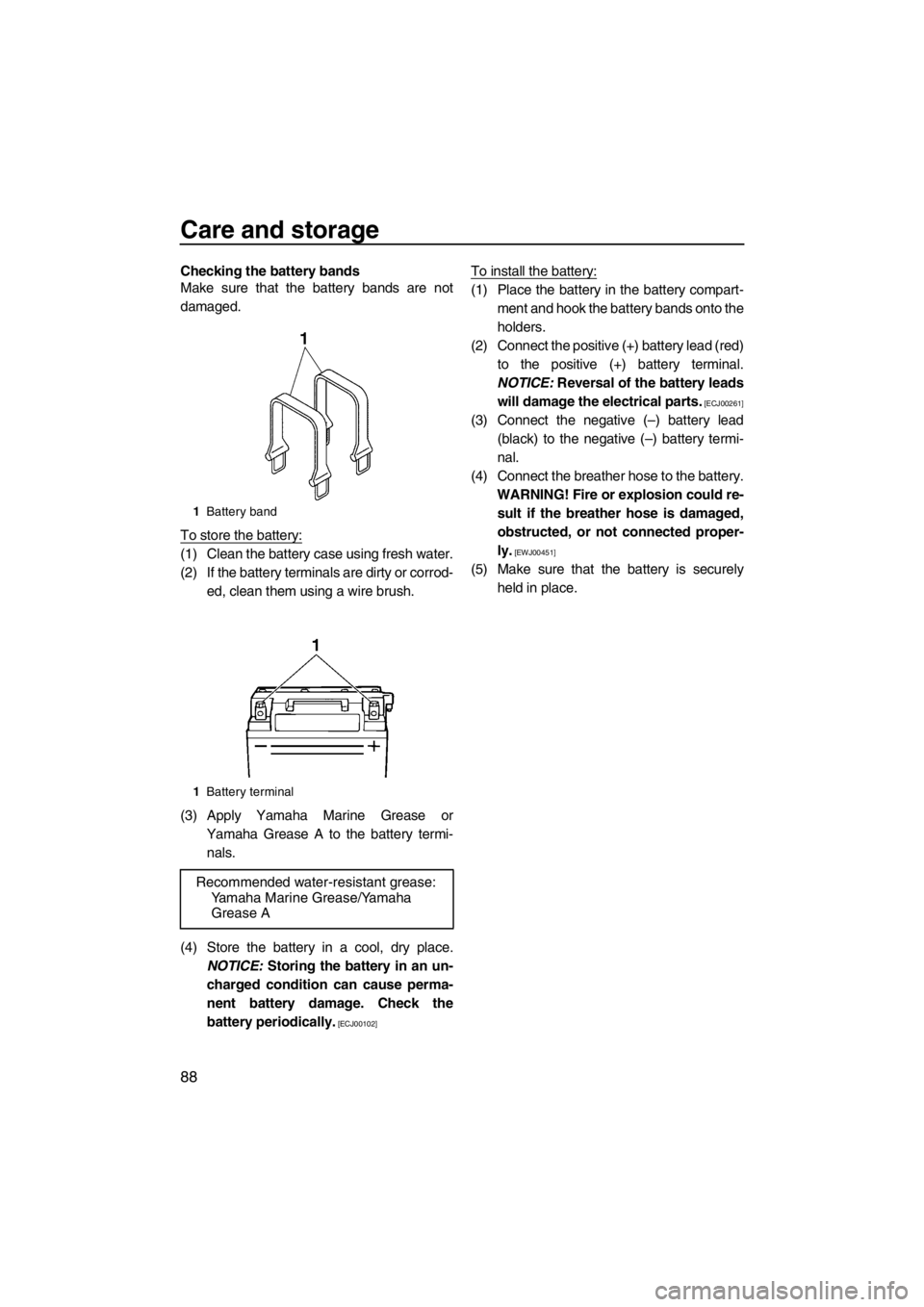
Checking the battery bands
Make sure that the battery bands are not
damaged.
To store the battery:
(1) Clean the battery case using fresh water.
(2) If the battery terminals are dirty or corrod-
ed, clean them using a wire brush.
(3) Apply Yamaha Marine Grease or
Yamaha Grease A to the battery termi-
nals.
(4) Store the battery in a cool, dry place.
NOTICE: Storing the battery in an un-
charged condition can cause perma-
nent battery damage. Check the
battery periodically.
[ECJ00102]
To install the battery:
(1) Place the battery in the battery compart-
ment and hook the battery bands onto the
holders.
(2) Connect the positive (+) battery lead (red)
to the positive (+) battery terminal.
NOTICE: Reversal of the battery leads
will damage the electrical parts.
[ECJ00261]
(3) Connect the negative (–) battery lead
(black) to the negative (–) battery termi-
nal.
(4) Connect the breather hose to the battery.
WARNING! Fire or explosion could re-
sult if the breather hose is damaged,
obstructed, or not connected proper-
ly.
[EWJ00451]
(5) Make sure that the battery is securely
held in place.
1Battery band
1Battery terminal
Recommended water-resistant grease:
Yamaha Marine Grease/Yamaha
Grease A
UF2T70E0.book Page 88 Thursday, December 29, 2011 2:12 PM
Page 99 of 114

Maintenance
93
EJU37062Periodic maintenance chart
The periodic maintenance chart gives general guidelines for periodic maintenance. Have a
Yamaha dealer perform the checks in the following chart. However, maintenance may need to
be performed more frequently depending on your operating conditions. If you have any ques-
tions, consult a Yamaha dealer.
This “ ” mark indicates items to be checked and serviced by a Yamaha dealer.
Item OperationInitial Thereafter every
Page 10
hours50 hours100
hours200
hours
6
months12
months12
months24
months
Spark plugsCheck, clean, replace —
Lubrication pointsLubricate —
Internal engine
componentsSpray lubricant —
Intermediate hous-
ingLubricate —
Fuel systemCheck —
Fuel tankCheck, clean —
Engine idling
speedCheck, adjust —
Throttle shaftCheck —
Water inlet strain-
erCheck, clean —
Bilge strainerClean —
Electric bilge
pump strainerClean —
ImpellerCheck —
Jet thrust nozzle
angleCheck, adjust —
Steering masterCheck, adjust —
Q.S.T.S. mecha-
nismCheck, adjust —
Shift cable and re-
verse gateCheck, adjust —
Stern drain plugsCheck, replace —
BatteryCheck, charge —
Rubber couplingCheck —
Engine mountCheck —
UF2T70E0.book Page 93 Thursday, December 29, 2011 2:12 PM
Page 101 of 114

Specifications
95
EJU34542
Specifications
Watercraft capacity:
Maximum people on board:
3 person
Maximum load capacity:
240 kg (530 lb)
Dimensions:
Length:
3560 mm (140.2 in)
Width:
1230 mm (48.4 in)
Height:
1230 mm (48.4 in)
Dry weight:
FX HO 373 kg (822 lb)
FX Cruiser HO 374 kg (825 lb)
Performance:
Maximum output (according to ISO 8665/SAE
J1228):
132.4 kW@7600 r/min
Maximum fuel consumption:
48.2 L/h (12.7 US gal/h, 10.6 Imp.gal/h)
Cruising range at full throttle:
1.45 hour
Trolling speed:
1300 ±100 r/min
Engine:
Engine type:
Liquid cooled 4-stroke, DOHC
Number of cylinders:
4
Engine displacement:
1812 cm³
Bore & stroke:
86.0 × 78.0 mm (3.39 × 3.07 in)
Compression ratio:
11.0 : 1
Valve clearance-intake (cold):
0.14–0.23 mm (0.0055–0.0091 in)
Valve clearance-exhaust (cold):
0.28–0.37 mm (0.0110–0.0146 in)
Lubrication system:
Wet sump
Cooling system:
Water
Starting system:
ElectricIgnition system:
T.C.I.
Spark plug:
LFR6A
Spark plug gap:
0.8–0.9 mm (0.031–0.035 in)
Battery capacity:
12 V, 19 Ah
Charging system:
Flywheel magneto
Drive unit:
Propulsion system:
Jet pump
Jet pump type:
Axial flow, single stage
Impeller rotation:
Counterclockwise
Jet thrust nozzle angle:
24.0+24.0 °
Jet thrust nozzle trim angle:
-10, -5, 0, 5, 10 °
Fuel and oil:
Recommended fuel:
Regular unleaded gasoline
Minimum octane rating (PON):
86
Minimum octane rating (RON):
90
Recommended engine oil type SAE:
SAE 10W-30, 10W-40, 20W-40, 20W-50
Recommended engine oil grade API:
API SE,SF,SG,SH,SJ,SL
Fuel tank total capacity:
70 L (18.5 US gal, 15.4 Imp.gal)
Engine oil quantity with oil filter replacement:
3.1 L (3.28 US qt, 2.73 Imp.qt)
Engine oil quantity without oil filter replacement:
3.0 L (3.17 US qt, 2.64 Imp.qt)
Engine oil total quantity:
4.3 L (4.55 US qt, 3.78 Imp.qt)
UF2T70E0.book Page 95 Thursday, December 29, 2011 2:12 PM
Page 102 of 114

Trouble recovery
96
EJU34561
Troubleshooting
If you have any trouble with your watercraft, use the troubleshooting chart to check for the pos-
sible cause.
If you cannot find the cause, consult a Yamaha dealer.
EJU42351Troubleshooting chart
Confirm the possible cause and remedy, and then refer to the applicable page.
TROUBLE POSSIBLE CAUSE REMEDY PAGE
Engine does not
start (Starter motor
does not turn over)Yamaha Se-
curity SystemLock mode selected Select unlock mode
27
Engine shut-
off switchClip not in place Install clip
28
Fuse Burned out Replace fuse and
check wiring100
Battery Run down Recharge 86
Poor terminal con-
nectionsTighten as required
86
Terminal corroded Clean or replace 86
Starter motor Faulty Have serviced by
Yamaha dealer—
Engine does not
start (Starter motor
turns over)Throttle lever Squeezed Release 28
Fuel Fuel tank empty Refill as soon as pos-
sible55
Stale or contaminat-
edHave serviced by
Yamaha dealer—
Fuel tank Water or dirt present Have serviced by
Yamaha dealer—
Spark plug Fouled or defective Have serviced by
Yamaha dealer—
Spark plug
capNot connected or
looseHave serviced by
Yamaha dealer—
Connected to wrong
cylinderHave serviced by
Yamaha dealer—
Fuel injec-
tion systemFuel pump faulty Have serviced by
Yamaha dealer—
Throttle lever Faulty Have serviced by
Yamaha dealer—
UF2T70E0.book Page 96 Thursday, December 29, 2011 2:12 PM
Page 106 of 114
Trouble recovery
100
(2) Remove any weeds or debris from
around the jet intake, drive shaft, impel-
ler, jet pump housing, and jet thrust noz-
zle.
If debris is difficult to remove, consult a
Yamaha dealer.
EJU34641Jumping the battery
If the watercraft battery has run down, the en-
gine can be started using a 12-volt booster
battery and jumper cables.
EJU34663Connecting the jumper cables
WARNING
EWJ01250
To avoid battery explosion and serious
damage to the electrical system:
●Do not reverse the polarity of the jumper
cables when connecting to the batteries.
●Do not connect the negative (–) jumper
cable to the negative (–) terminal of the
watercraft battery.
●Do not touch the positive (+) jumper ca-
ble to the negative (–) jumper cable.
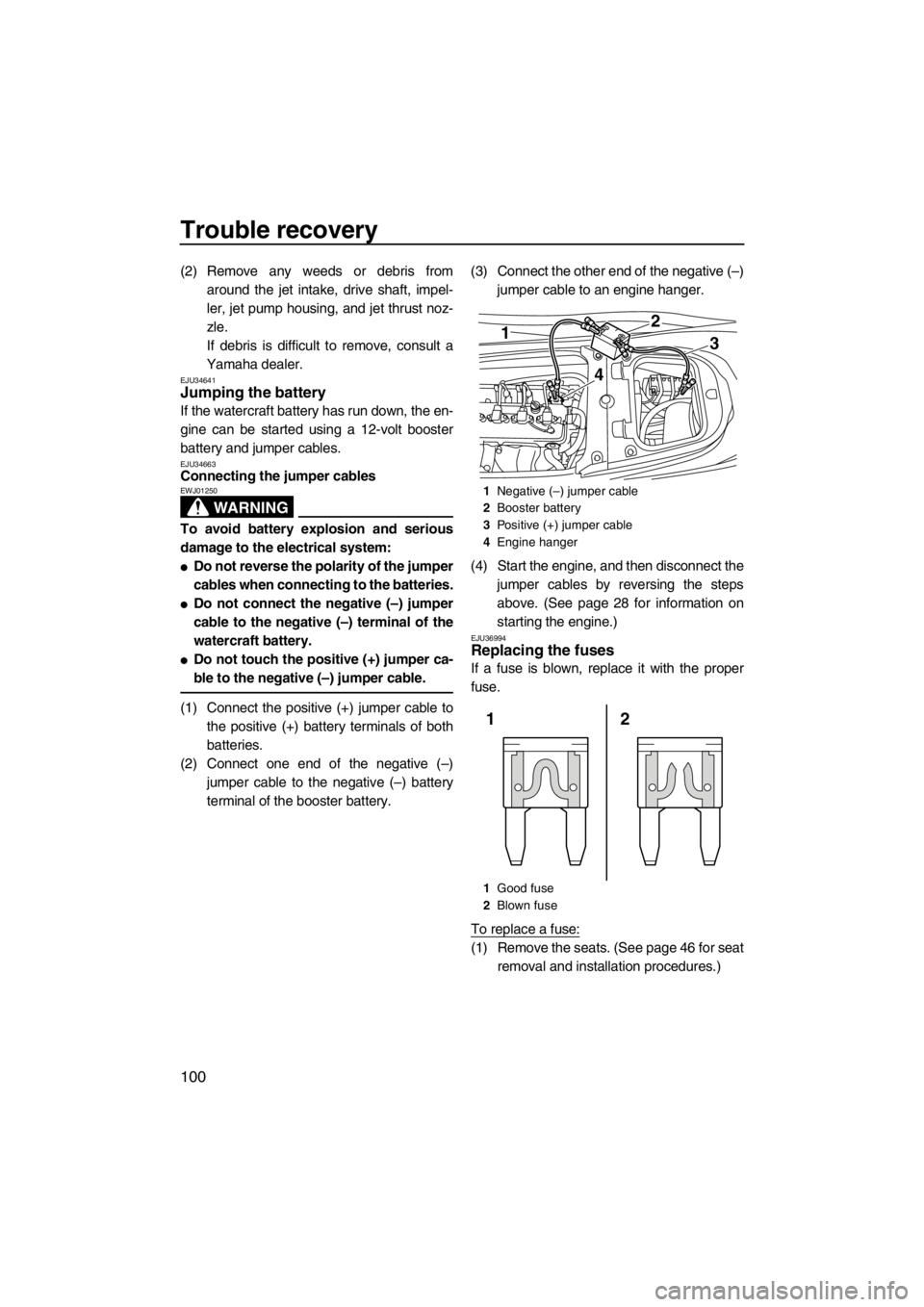
(1) Connect the positive (+) jumper cable to
the positive (+) battery terminals of both
batteries.
(2) Connect one end of the negative (–)
jumper cable to the negative (–) battery
terminal of the booster battery.(3) Connect the other end of the negative (–)
jumper cable to an engine hanger.
(4) Start the engine, and then disconnect the
jumper cables by reversing the steps
above. (See page 28 for information on
starting the engine.)
EJU36994Replacing the fuses
If a fuse is blown, replace it with the proper
fuse.
To replace a fuse:
(1) Remove the seats. (See page 46 for seat
removal and installation procedures.)
1Negative (–) jumper cable
2Booster battery
3Positive (+) jumper cable
4Engine hanger
1Good fuse
2Blown fuse
1
4
3
2
2 1
UF2T70E0.book Page 100 Thursday, December 29, 2011 2:12 PM
Page 107 of 114
Trouble recovery
101
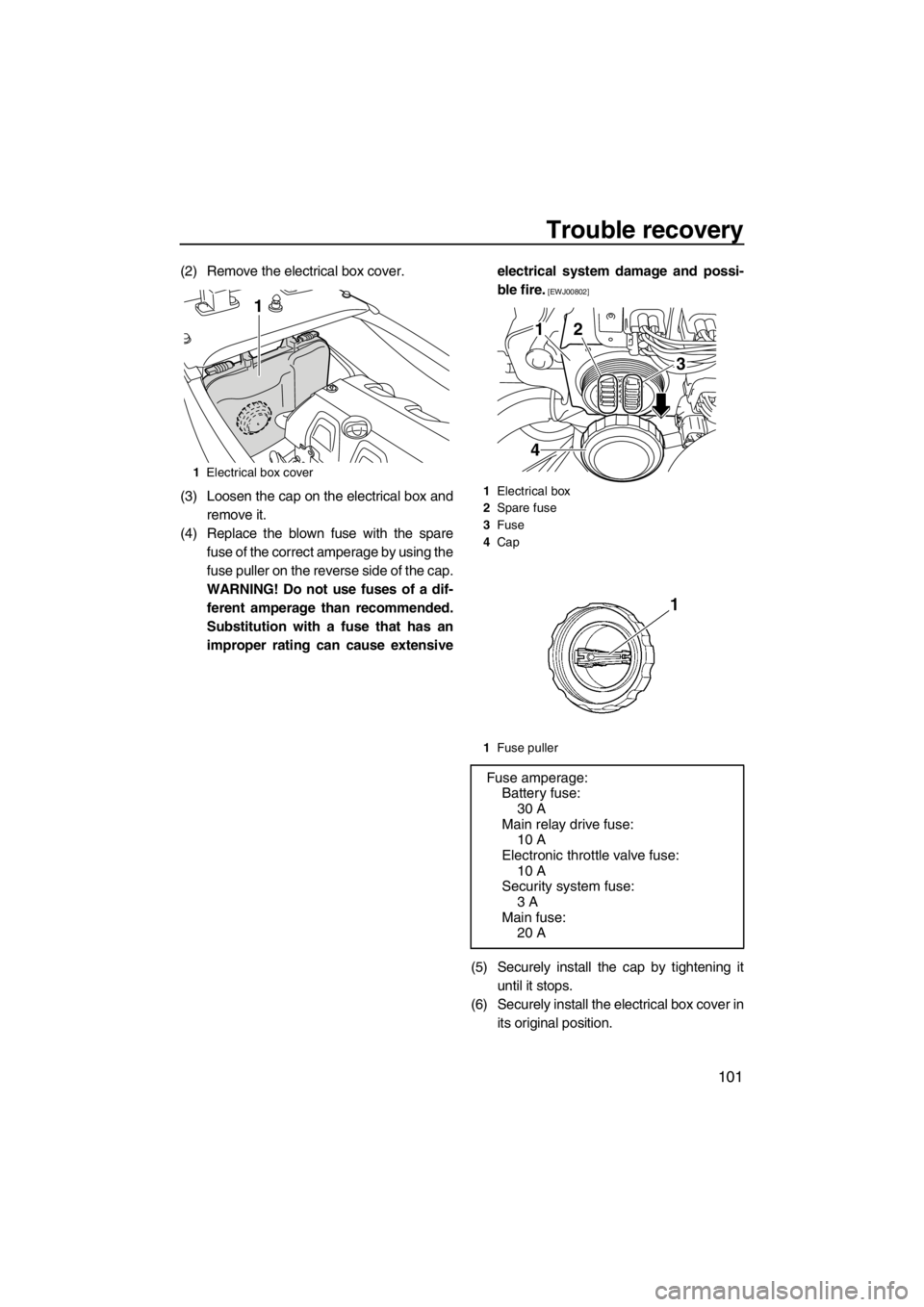
(2) Remove the electrical box cover.
(3) Loosen the cap on the electrical box and
remove it.
(4) Replace the blown fuse with the spare
fuse of the correct amperage by using the
fuse puller on the reverse side of the cap.
WARNING! Do not use fuses of a dif-
ferent amperage than recommended.
Substitution with a fuse that has an
improper rating can cause extensiveelectrical system damage and possi-
ble fire.
[EWJ00802]
(5) Securely install the cap by tightening it
until it stops.
(6) Securely install the electrical box cover in
its original position.
1Electrical box cover
1
1Electrical box
2Spare fuse
3Fuse
4Cap
1Fuse puller
Fuse amperage:
Battery fuse:
30 A
Main relay drive fuse:
10 A
Electronic throttle valve fuse:
10 A
Security system fuse:
3 A
Main fuse:
20 A
1
43 2
UF2T70E0.book Page 101 Thursday, December 29, 2011 2:12 PM
Page 111 of 114

Index
A
Adjustable tilt steering system.................. 30
Adjustable tilt steering system checks ..... 67
After removing the watercraft from the
water ..................................................... 84
Analog speedometer/tachometer ............. 40
B
Battery care .............................................. 86
Battery checks.......................................... 65
Battery, jumping ..................................... 100
Beaching and docking the watercraft ....... 83
Beverage holders ..................................... 52
Bilge pump fuse, replacing ..................... 102
Bilge water check ..................................... 65
Bilge water, draining................................. 58
Bilge water, draining on land .................... 58
Bilge water, draining on water .................. 59
Boarding alone ......................................... 78
Boarding and starting off from a dock ...... 82
Boarding the watercraft ............................ 78
Boarding with passenger(s) ..................... 79
Bow eye ................................................... 48
Bow storage compartment ....................... 49
Builder’s plate............................................. 2
C
Capsized watercraft ................................. 82
Check engine warning.............................. 45
Cleaning ................................................... 89
Cleaning the watercraft ............................ 86
Cleat ......................................................... 48
Cooling water pilot outlet .......................... 30
Cooling water pilot outlet check ............... 71
Craft Identification Number (CIN) ............... 1
Cruise assist............................................. 37
Cruising limitations ................................... 12
D
Digital speedometer ................................. 41
E
Emergency procedures ............................ 99
Engine break-in ........................................ 61
Engine compartment check...................... 64
Engine cover, removing and installing ..... 91
Engine idling speed check ....................... 71
Engine oil ................................................. 57
Engine oil and oil filter .............................. 94Engine oil level check............................... 65
Engine oil requirements ........................... 57
Engine overheat warning ......................... 44
Engine serial number ................................. 1
Engine shut-off cord (lanyard) check ....... 69
Engine shut-off switch .............................. 28
Engine stop switch ................................... 28
Engine unit check ..................................... 65
Enjoy your watercraft responsibly ............ 20
Equipment ................................................ 46
F
Fire extinguisher check ............................ 70
Fire extinguisher holder and cover ........... 54
Fire extinguisher holder, cover, and
band checks.......................................... 70
Flushing the cooling water passages ....... 85
Fuel .......................................................... 55
Fuel level check ....................................... 64
Fuel level meter ........................................ 43
Fuel level warning .................................... 43
Fuel requirements .................................... 55
Fuel system checks .................................. 64
Fuses, replacing ..................................... 100
G
Getting to know your watercraft ............... 72
Glossary, watercraft ................................. 21
Glove compartment .................................. 50
H
Handgrip ................................................... 47
Hazard information ................................... 16
Hood check .............................................. 71
Hour meter/voltmeter ............................... 42
Hull and deck check ................................. 70
I
Identification numbers ................................ 1
Information display ................................... 41
J
Jet intake and impeller, cleaning .............. 99
Jet intake checks ...................................... 70
Jumper cables, connecting .................... 100
L
Labels, important ........................................ 4
Labels, other .............................................. 9
Labels, warning .......................................... 5
Launching the watercraft .......................... 73
UF2T70E0.book Page 1 Thursday, December 29, 2011 2:12 PM