ECU YAMAHA FX HO 2012 Owner's Guide
[x] Cancel search | Manufacturer: YAMAHA, Model Year: 2012, Model line: FX HO, Model: YAMAHA FX HO 2012Pages: 114, PDF Size: 4.44 MB
Page 87 of 114
Operation
81
(4) Attach the engine shut-off cord (lanyard)
to your left wrist, and then attach the clip
to the engine shut-off switch.
(5) Look in all directions, and then start the
engine and operate at trolling speed.
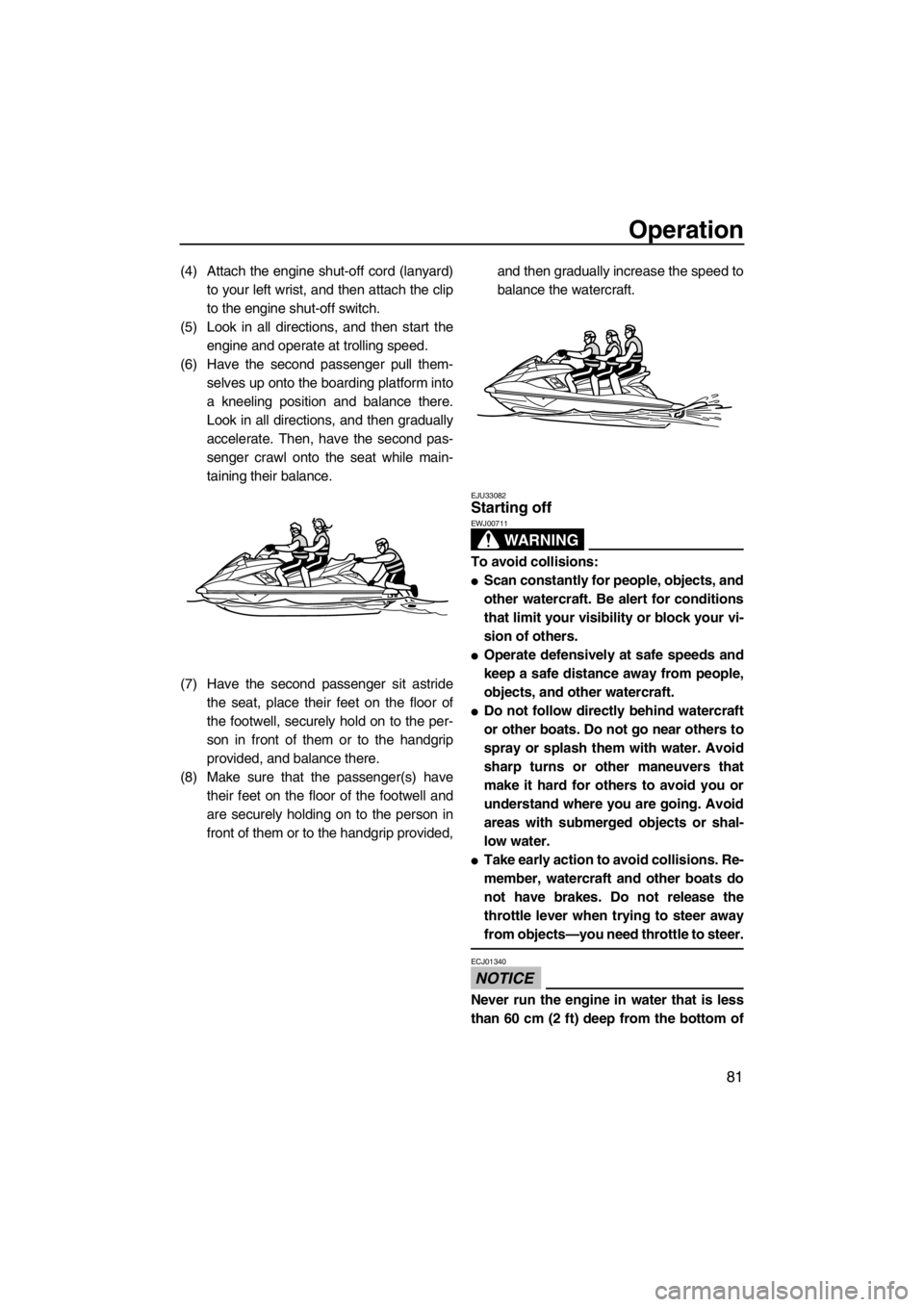
(6) Have the second passenger pull them-
selves up onto the boarding platform into
a kneeling position and balance there.
Look in all directions, and then gradually
accelerate. Then, have the second pas-
senger crawl onto the seat while main-
taining their balance.
(7) Have the second passenger sit astride
the seat, place their feet on the floor of
the footwell, securely hold on to the per-
son in front of them or to the handgrip
provided, and balance there.
(8) Make sure that the passenger(s) have
their feet on the floor of the footwell and
are securely holding on to the person in
front of them or to the handgrip provided,and then gradually increase the speed to
balance the watercraft.
EJU33082Starting off
WARNING
EWJ00711
To avoid collisions:
●Scan constantly for people, objects, and
other watercraft. Be alert for conditions
that limit your visibility or block your vi-
sion of others.
●Operate defensively at safe speeds and
keep a safe distance away from people,
objects, and other watercraft.
●Do not follow directly behind watercraft
or other boats. Do not go near others to
spray or splash them with water. Avoid
sharp turns or other maneuvers that
make it hard for others to avoid you or
understand where you are going. Avoid
areas with submerged objects or shal-
low water.
●Take early action to avoid collisions. Re-
member, watercraft and other boats do
not have brakes. Do not release the
throttle lever when trying to steer away
from objects—you need throttle to steer.
NOTICE
ECJ01340
Never run the engine in water that is less
than 60 cm (2 ft) deep from the bottom of
UF2T70E0.book Page 81 Thursday, December 29, 2011 2:12 PM
Page 91 of 114

Care and storage
85
EJU37145
Post-operation care
WARNING
EWJ00330
Always place the watercraft upright in a
horizontal position when storing it, other-
wise fuel could leak out into the engine or
engine compartment, which could create a
fire hazard.
After using the watercraft, always take it out of
the water, clean it, and store it. Leaving the
watercraft in the water for extended periods
will accelerate the rate of normal deterioration
of the jet pump and hull. Marine organisms
and corrosion are some of the conditions that
can shorten the life of many watercraft com-
ponents.
EJU42220Flushing the cooling water passages
NOTICE
ECJ01310
Do not run the engine over 4000 r/min on
land. Also, do not run the engine for more
than 15 seconds without supplying water,
otherwise the engine could overheat.
Flush the cooling water passages to prevent
them from clogging with salt, sand, or dirt.
(1) Place the watercraft in a horizontal posi-
tion.
(2) Remove the seats and removable water-
tight storage compartment. (See page 46
for seat removal and installation proce-
dures and page 52 for information on the
removable watertight storage compart-
ment.)
(3) Open the stern storage compartment.
(See page 51 for information on the stern
storage compartment.)(4) Connect the garden hose adapter to a
garden hose.
(5) Loosen the flushing hose connector cap
and remove it. Insert the garden hose
adapter into the flushing hose connector
and turn it until it is securely connected.
(6) Connect the garden hose to a water tap.
(7) Make sure that the area around the wa-
tercraft is clear, and then start the engine.
Immediately after the engine starts, fully
turn the water supply on so that water
1Garden hose adapter
1Flushing hose connector
2Flushing hose connector cap
3Garden hose adapter
1
3
2
UF2T70E0.book Page 85 Thursday, December 29, 2011 2:12 PM
Page 92 of 114

Care and storage
86
flows out continually from the jet thrust
nozzle.
(8) Run the engine at idling speed for about
3 minutes watching the engine condition.
If the engine stops while flushing, turn the
water supply off immediately and perform
the procedure again from step 7.
NOTICE: Do not supply water to the
cooling water passages when the en-
gine is not running. The water could
flow back through the muffler into the
engine, causing severe engine dam-
age.
[ECJ00122]
(9) Turn the water supply off.
(10) Discharge the remaining water out of the
cooling water passages by alternately
squeezing and releasing the throttle lever
quickly for 10 to 15 seconds.
(11) Stop the engine.
(12) Remove the garden hose adapter, and
then securely install the flushing hose
connector cap by tightening it until it
stops.
(13) Securely close the stern storage com-
partment.
(14) Securely install the removable watertight
storage compartment and seats in their
original positions.
EJU33735Cleaning the watercraft
(1) Remove the seats. (See page 46 for seat
removal and installation procedures.)(2) Rinse the engine and engine compart-
ment with a small amount of water.
NOTICE: Do not use high-pressure
water when rinsing the engine or en-
gine compartment as severe engine
damage could result.
[ECJ00571]
(3) Drain the water from the engine compart-
ment. (See page 58 for information on
draining the bilge water.)
(4) Wipe the engine and engine compart-
ment with a dry cloth.
(5) Wash down the hull, deck, and jet pump
with fresh water.
(6) Wipe the hull, deck, and jet pump with a
dry cloth.
(7) Wipe all vinyl and rubber components,
such as the seats and engine compart-
ment seals, with a vinyl protectant.
(8) To minimize corrosion, spray metallic
parts of the hull, deck, and engine with a
rust inhibitor.
(9) Allow the engine compartment to air dry
completely before installing the seats.
(10) Securely install the seats in their original
positions.
EJU33686Battery care
If the watercraft will not be used for more than
a month, remove the battery from the water-
craft, check it, and then store it in a cool, dry
place.
WARNING
EWJ00791
Battery electrolyte is poisonous and dan-
gerous, causing severe burns, etc. Elec-
trolyte contains sulfuric acid. Avoid
contact with skin, eyes, or clothing.
Antidotes
External: Flush with water.
Internal: Drink large quantities of water or
milk. Follow with milk of magnesia, beaten
UF2T70E0.book Page 86 Thursday, December 29, 2011 2:12 PM
Page 94 of 114
Care and storage
88
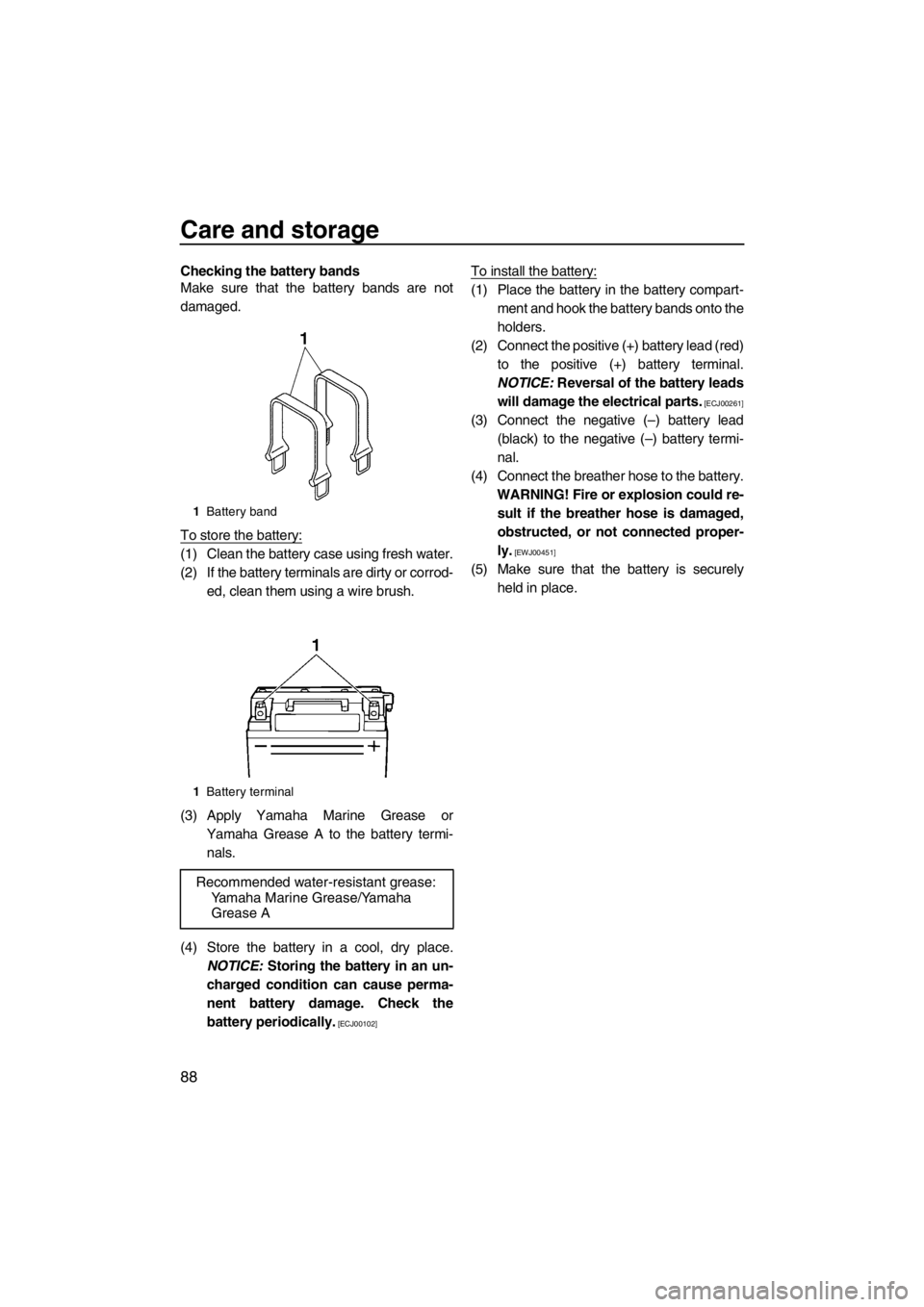
Checking the battery bands
Make sure that the battery bands are not
damaged.
To store the battery:
(1) Clean the battery case using fresh water.
(2) If the battery terminals are dirty or corrod-
ed, clean them using a wire brush.
(3) Apply Yamaha Marine Grease or
Yamaha Grease A to the battery termi-
nals.
(4) Store the battery in a cool, dry place.
NOTICE: Storing the battery in an un-
charged condition can cause perma-
nent battery damage. Check the
battery periodically.
[ECJ00102]
To install the battery:
(1) Place the battery in the battery compart-
ment and hook the battery bands onto the
holders.
(2) Connect the positive (+) battery lead (red)
to the positive (+) battery terminal.
NOTICE: Reversal of the battery leads
will damage the electrical parts.
[ECJ00261]
(3) Connect the negative (–) battery lead
(black) to the negative (–) battery termi-
nal.
(4) Connect the breather hose to the battery.
WARNING! Fire or explosion could re-
sult if the breather hose is damaged,
obstructed, or not connected proper-
ly.
[EWJ00451]
(5) Make sure that the battery is securely
held in place.
1Battery band
1Battery terminal
Recommended water-resistant grease:
Yamaha Marine Grease/Yamaha
Grease A
UF2T70E0.book Page 88 Thursday, December 29, 2011 2:12 PM
Page 98 of 114

Maintenance
92
(3) Lift up the engine cover to remove it.
To install the engine cover:
(1) Place the engine cover in its original posi-
tion, and then push it down.
(2) Install the engine cover screws, and then
tighten them to the specified torque.
(3) Securely install the seats in their original
positions.
1Engine cover
Tightening torque:
Engine cover screw:
4.5 Nm (0.46 kgf-m, 3.3 ft-lb)
1
UF2T70E0.book Page 92 Thursday, December 29, 2011 2:12 PM
Page 107 of 114
Trouble recovery
101
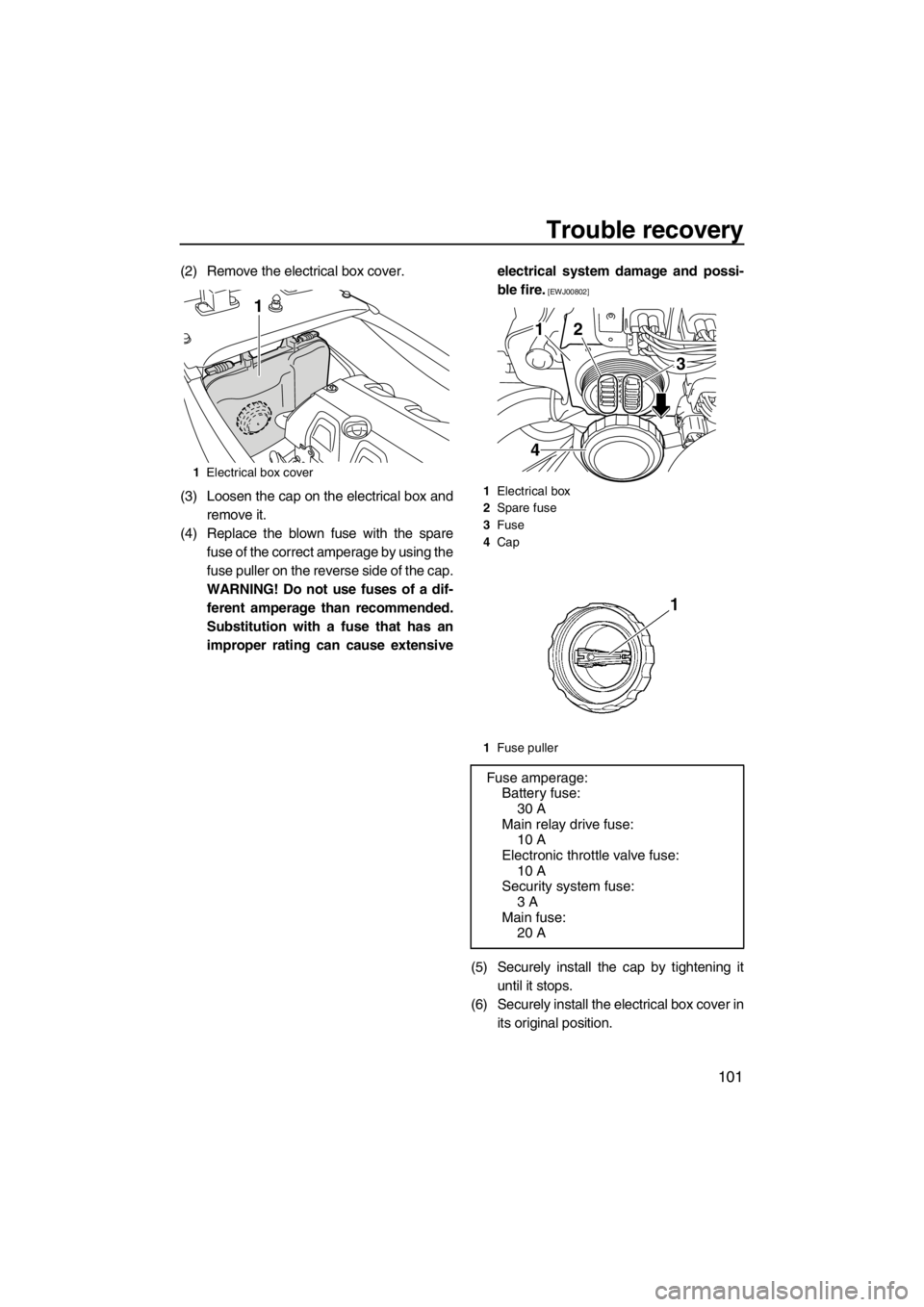
(2) Remove the electrical box cover.
(3) Loosen the cap on the electrical box and
remove it.
(4) Replace the blown fuse with the spare
fuse of the correct amperage by using the
fuse puller on the reverse side of the cap.
WARNING! Do not use fuses of a dif-
ferent amperage than recommended.
Substitution with a fuse that has an
improper rating can cause extensiveelectrical system damage and possi-
ble fire.
[EWJ00802]
(5) Securely install the cap by tightening it
until it stops.
(6) Securely install the electrical box cover in
its original position.
1Electrical box cover
1
1Electrical box
2Spare fuse
3Fuse
4Cap
1Fuse puller
Fuse amperage:
Battery fuse:
30 A
Main relay drive fuse:
10 A
Electronic throttle valve fuse:
10 A
Security system fuse:
3 A
Main fuse:
20 A
1
43 2
UF2T70E0.book Page 101 Thursday, December 29, 2011 2:12 PM
Page 108 of 114
Trouble recovery
102
(7) Securely install the seats in their original
positions.
If the fuse immediately blows again, the elec-
trical system may be defective. If this occurs,
have a Yamaha dealer service the watercraft.
EJU41831Replacing the bilge pump fuse
If the fuse is blown, replace it with the proper
fuse.
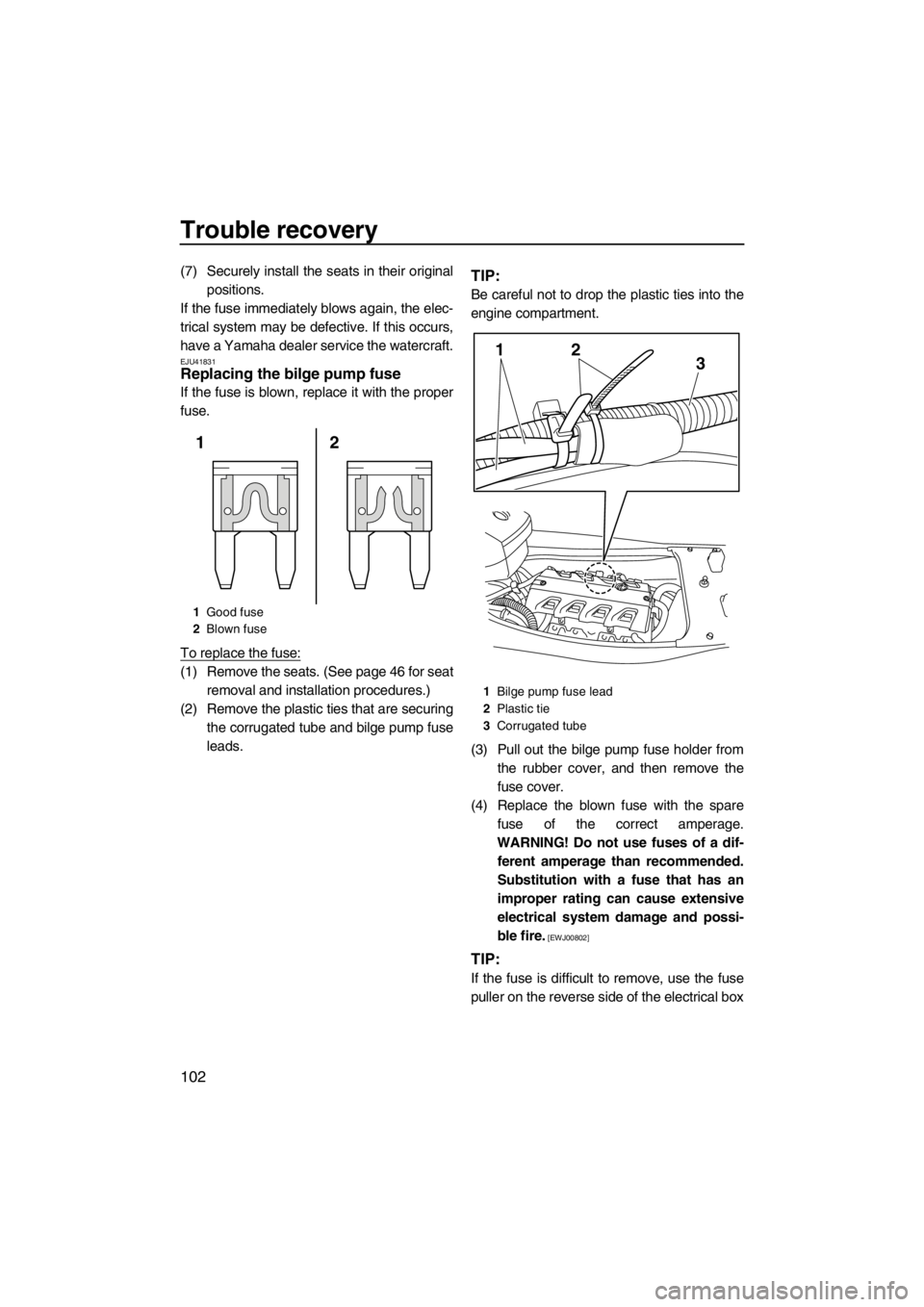
To replace the fuse:
(1) Remove the seats. (See page 46 for seat
removal and installation procedures.)
(2) Remove the plastic ties that are securing
the corrugated tube and bilge pump fuse
leads.
TIP:
Be careful not to drop the plastic ties into the
engine compartment.
(3) Pull out the bilge pump fuse holder from
the rubber cover, and then remove the
fuse cover.
(4) Replace the blown fuse with the spare
fuse of the correct amperage.
WARNING! Do not use fuses of a dif-
ferent amperage than recommended.
Substitution with a fuse that has an
improper rating can cause extensive
electrical system damage and possi-
ble fire.
[EWJ00802]
TIP:
If the fuse is difficult to remove, use the fuse
puller on the reverse side of the electrical box
1Good fuse
2Blown fuse
2 1
1Bilge pump fuse lead
2Plastic tie
3Corrugated tube
213
UF2T70E0.book Page 102 Thursday, December 29, 2011 2:12 PM
Page 109 of 114
Trouble recovery
103
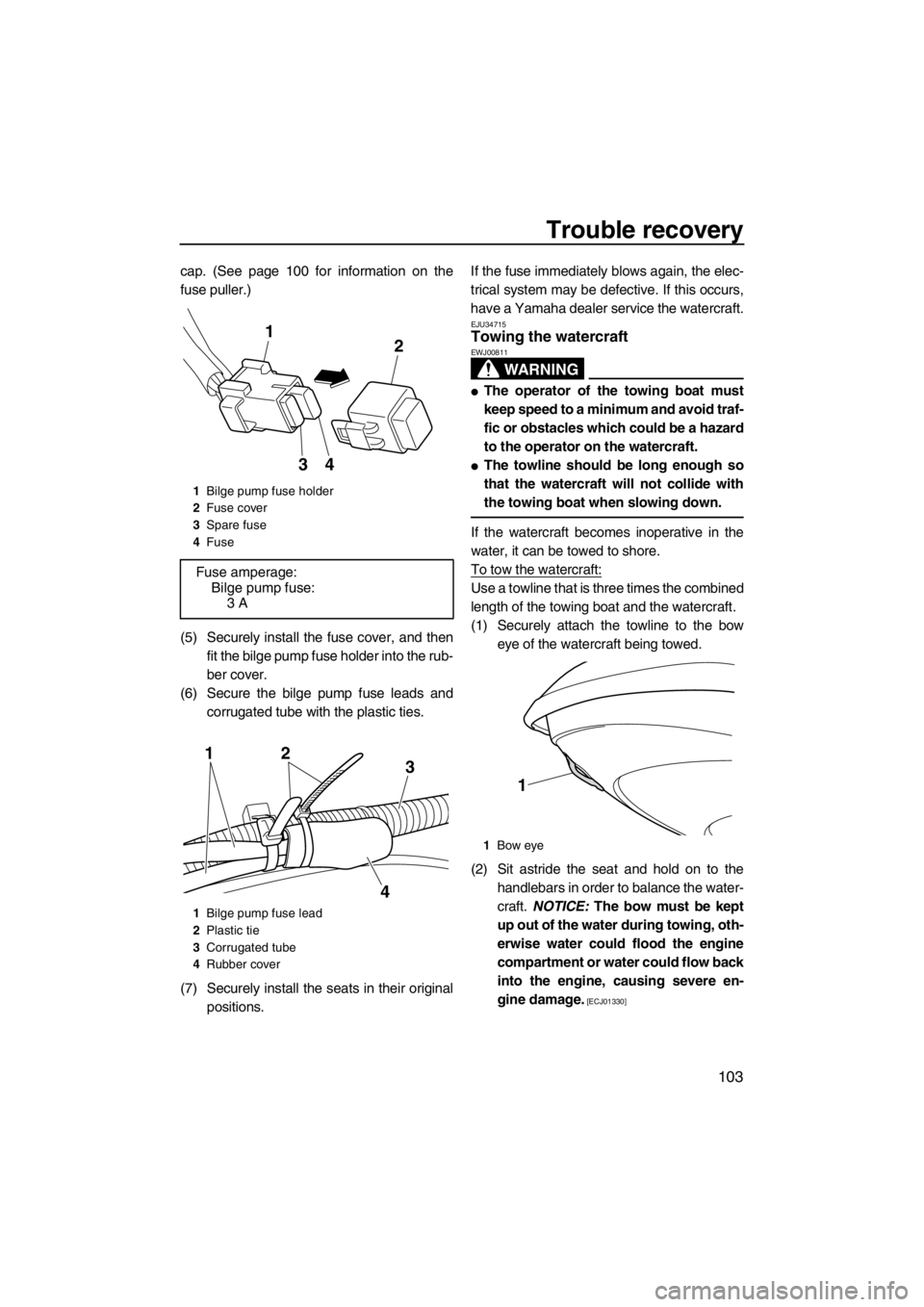
cap. (See page 100 for information on the
fuse puller.)
(5) Securely install the fuse cover, and then
fit the bilge pump fuse holder into the rub-
ber cover.
(6) Secure the bilge pump fuse leads and
corrugated tube with the plastic ties.
(7) Securely install the seats in their original
positions.If the fuse immediately blows again, the elec-
trical system may be defective. If this occurs,
have a Yamaha dealer service the watercraft.
EJU34715Towing the watercraft
WARNING
EWJ00811
●The operator of the towing boat must
keep speed to a minimum and avoid traf-
fic or obstacles which could be a hazard
to the operator on the watercraft.
●The towline should be long enough so
that the watercraft will not collide with
the towing boat when slowing down.
If the watercraft becomes inoperative in the
water, it can be towed to shore.
To tow the watercraft:
Use a towline that is three times the combined
length of the towing boat and the watercraft.
(1) Securely attach the towline to the bow
eye of the watercraft being towed.
(2) Sit astride the seat and hold on to the
handlebars in order to balance the water-
craft. NOTICE: The bow must be kept
up out of the water during towing, oth-
erwise water could flood the engine
compartment or water could flow back
into the engine, causing severe en-
gine damage.
[ECJ01330]
1Bilge pump fuse holder
2Fuse cover
3Spare fuse
4Fuse
Fuse amperage:
Bilge pump fuse:
3 A
1Bilge pump fuse lead
2Plastic tie
3Corrugated tube
4Rubber cover
21
43
213
4
1Bow eye
1
UF2T70E0.book Page 103 Thursday, December 29, 2011 2:12 PM
Page 112 of 114

Index
Learning to operate your watercraft ......... 72
Leaving the watercraft .............................. 74
Limitations on who may operate the
watercraft .............................................. 11
Long-term storage .................................... 89
Low RPM Mode........................................ 35
Lubrication................................................ 89
M
Main components, location of .................. 22
Maintenance............................................. 91
Manufactured date label............................. 2
Model information....................................... 2
Multifunction information center ............... 40
Multifunction information center check ..... 71
N
No-wake mode ......................................... 36
O
Oil pressure warning ................................ 44
Operating in weeded areas ...................... 83
Operating the watercraft........................... 74
Operating the watercraft in reverse or
neutral ................................................... 77
Operating your watercraft......................... 72
Operation requirements ........................... 13
P
Periodic maintenance chart...................... 93
Post-launch checks .................................. 71
Post-operation care .................................. 85
Pre-launch checks.................................... 64
Pre-operation check points ...................... 64
Pre-operation checklist............................. 62
Primary Identification (PRI-ID) number ...... 1
Pull-up cleats (FX Cruiser HO)................. 49
Q
Quick Shift Trim System (Q.S.T.S.) ......... 33
Quick Shift Trim System (Q.S.T.S.)
checks................................................... 67
R
Reboarding grip........................................ 47
Reboarding step ....................................... 47
Recommended equipment ....................... 15
Remote control transmitter ....................... 26
Remote control transmitter check ............ 69
Riding position.......................................... 73
Rustproofing ............................................. 90S
Safe boating rules .................................... 19
Safety equipment check ........................... 70
Seats ........................................................ 46
Shift system.............................................. 32
Shift system checks ................................. 68
Start switch............................................... 28
Starting off ................................................ 81
Starting off from a trailer ........................... 82
Starting the engine on water .................... 73
Steering system ....................................... 29
Steering system checks ........................... 66
Stern drain plug checks ............................ 70
Stern eyes ................................................ 48
Stern storage compartment ...................... 51
Stopping the engine ................................. 74
Stopping the watercraft ............................ 76
Storage compartment checks .................. 69
Storage compartments ............................. 49
Submerged watercraft ............................ 104
Switch checks .......................................... 69
T
Throttle lever ............................................ 29
Throttle lever checks ................................ 68
Tool kit...................................................... 91
Towing the watercraft ............................. 103
Transporting on a trailer ........................... 60
Troubleshooting ....................................... 96
Troubleshooting chart .............................. 96
Turning the watercraft .............................. 75
W
Water separator ....................................... 31
Water separator check ............................. 64
Watercraft characteristics ......................... 16
Watercraft control functions ..................... 26
Watercraft operation functions ................. 32
Watercraft operation modes ..................... 35
Water-skiing ............................................. 18
Watertight storage compartments ............ 52
Y
Yamaha Security System ......................... 27
Yamaha Security System settings ........... 27
UF2T70E0.book Page 2 Thursday, December 29, 2011 2:12 PM