warning YAMAHA FX HO 2013 User Guide
[x] Cancel search | Manufacturer: YAMAHA, Model Year: 2013, Model line: FX HO, Model: YAMAHA FX HO 2013Pages: 116, PDF Size: 5.56 MB
Page 57 of 116
Equipment operation
51
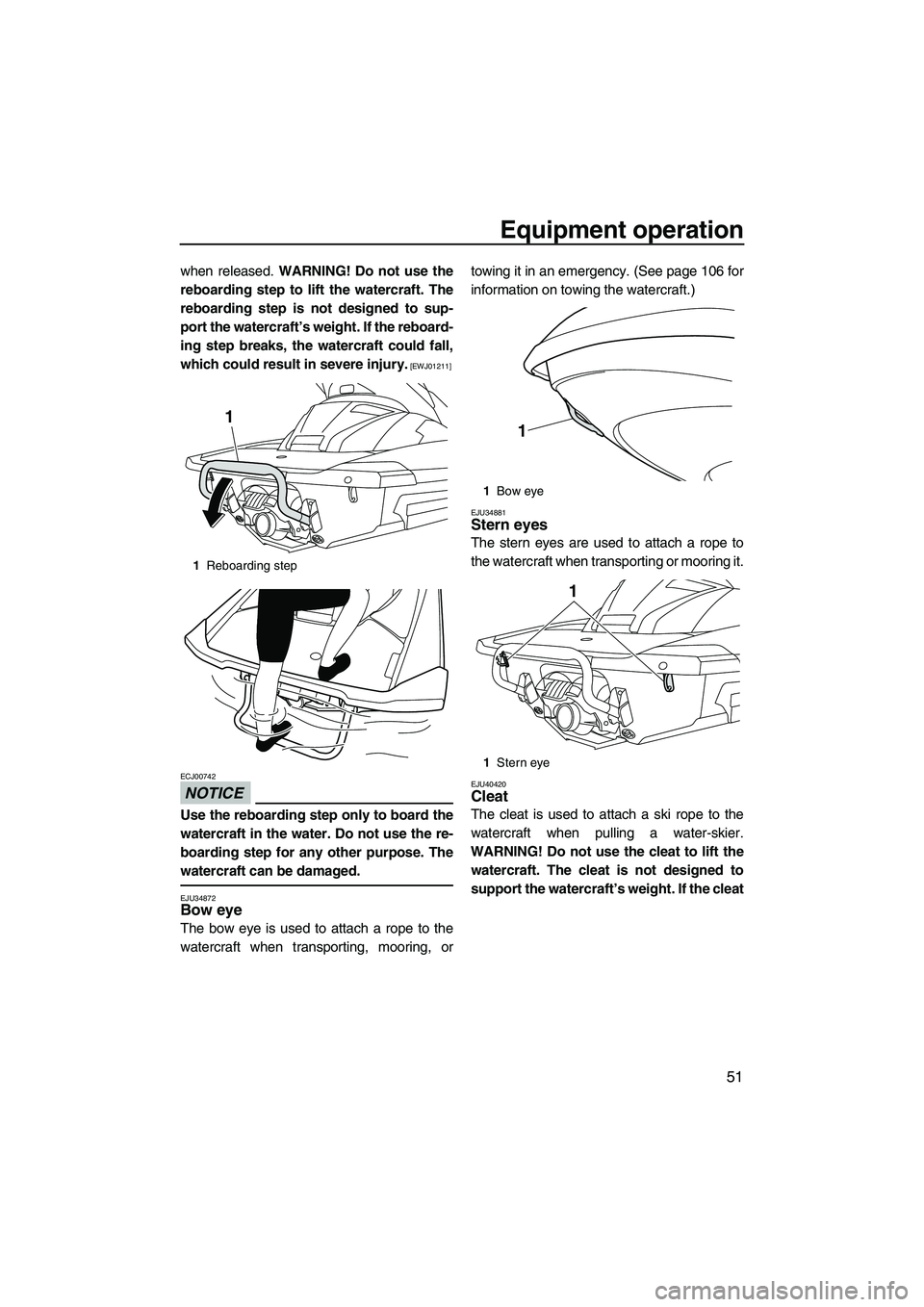
when released. WARNING! Do not use the
reboarding step to lift the watercraft. The
reboarding step is not designed to sup-
port the watercraft’s weight. If the reboard-
ing step breaks, the watercraft could fall,
which could result in severe injury.
[EWJ01211]
NOTICE
ECJ00742
Use the reboarding step only to board the
watercraft in the water. Do not use the re-
boarding step for any other purpose. The
watercraft can be damaged.
EJU34872Bow eye
The bow eye is used to attach a rope to the
watercraft when transporting, mooring, or towing it in an emergency. (See page 106 for
information on towing the watercraft.)
EJU34881Stern eyes
The stern eyes are used to attach a rope to
the watercraft when transporting or mooring it.
EJU40420Cleat
The cleat is used to attach a ski rope to the
watercraft when pulling a water-skier.
WARNING! Do not use the cleat to lift the watercraft. The cleat is not designed to
support the watercraft’s weight. If the cleat
1 Reboarding step
1
1Bow eye
1 Stern eye
1
1
UF2S71E0.book Page 51 Tuesday, August 21, 2012 2:33 PM
Page 58 of 116
![YAMAHA FX HO 2013 User Guide Equipment operation
52
breaks, the watercraft could fall, which
could result in severe injury.
[EWJ01510]
EJU34892
Pull-up cleats (FX Cruiser SHO)
The pull-up cleats are used to attach a rope to
the](/img/51/49770/w960_49770-57.png "YAMAHA FX HO 2013 User Guide Equipment operation
52
breaks, the watercraft could fall, which
could result in severe injury.
[EWJ01510]
EJU34892
Pull-up cleats (FX Cruiser SHO)
The pull-up cleats are used to attach a rope to
the")
Equipment operation
52
breaks, the watercraft could fall, which
could result in severe injury.
[EWJ01510]
EJU34892
Pull-up cleats (FX Cruiser SHO)
The pull-up cleats are used to attach a rope to
the watercraft when mooring it.
To use a pull-up cleat, pull it up. The pull-up
cleat returns automatically to its original posi-
tion when released. WARNING! Do not use
the pull-up cleats to lift the watercraft. The
pull-up cleats are not designed to support
the watercraft’s weight. If the pull-up
cleats break, the watercraft could fall,
which could result in severe injury.
[EWJ00821]
EJU42290
Storage compartments
This watercraft is equipped with the following
storage compartments.
Only the securely closed watertight storage
compartments are waterproof. If you carry ob- jects that must be kept dry, put them in a wa-
terproof bag.
Make sure that the storage compartments are
closed securely before operating the water-
craft.
EJU42210Bow storage compartment
The bow storage compartment is located un-
der the hood.
To open the bow storage compartment:
Pull the hood latch rearward, and then lift up
the rear of the hood.
1
Cleat
1 Pull-up cleat
1
1
1Hood latch
1 Bow storage compartment
Bow storage compartment:
Capacity: 90.0 L (23.8 US gal, 19.8 Imp.gal)
Load limit:
5.0 kg (11 lb)
1
1
UF2S71E0.book Page 52 Tuesday, August 21, 2012 2:33 PM
Page 64 of 116
Operation and handling requirements
58
EJU31822
Fuel requirements EJU42400Fuel
WARNING
EWJ00282
●Gasoline and gasoline vapors are ex-
tremely flammable. To avoid fires and
explosions and to reduce the risk of in-
jury when refueling, follow these in-
structions.
●Gasoline is poisonous and can cause in-
jury or death. Handle gasoline with care.
Never siphon gasoline by mouth. If you
should swallow some gasoline, inhale a
lot of gasoline vapor, or get some gaso-
line in your eyes, see your doctor imme-
diately. If gasoline spills on your skin,
wash with soap and water. If gasoline
spills on your clothing, change your
clothes.
NOTICE
ECJ00321
●Do not use leaded gasoline. Leaded gas-
oline can seriously damage the engine.
●Avoid getting water and contaminants in
the fuel tank. Contaminated fuel can
cause poor performance and engine
damage. Use only fresh gasoline that
has been stored in clean containers.
Gasohol
There are two types of gasohol: gasohol con-
taining ethanol and that containing methanol.
Gasohol containing ethanol can be used if
ethanol content does not exceed 10% and thefuel meets the minimum octane ratings. E-85
is a fuel blend containing 85% ethanol and
therefore must not be used in this watercraft.
All ethanol blends containing more than 10%
ethanol can cause fuel system damage or en-
gine performance problems.
Yamaha does not recommend gasohol con- taining methanol because it can cause fuel
system damage and engine performance
problems.
To fill the fuel tank:
(1) Before refueling, stop the engine. Do not stand or sit on the watercraft. Never refu-
el while smoking, or while in the vicinity of
sparks, open flames, or other sources of
ignition.
(2) Place the watercraft in a well-ventilated area and in a horizontal position.
(3) Remove the seats, and then check the fuel level. (See page 49 for seat removal
and installation procedures.)
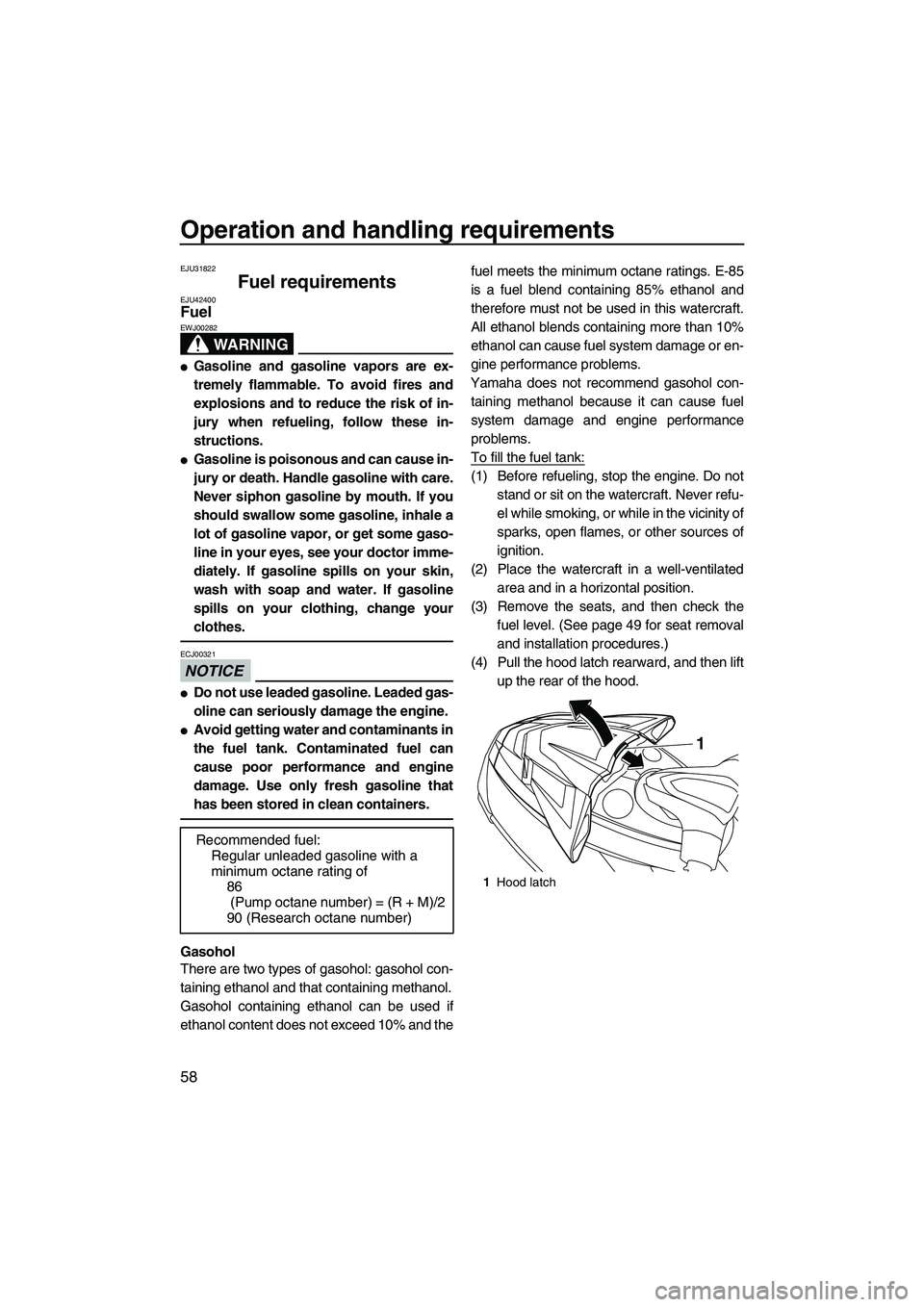
(4) Pull the hood latch rearward, and then lift up the rear of the hood.
Recommended fuel: Regular unleaded gasoline with a
minimum octane rating of86
(Pump octane number) = (R + M)/2
90 (Research octane number)
1Hood latch
1
UF2S71E0.book Page 58 Tuesday, August 21, 2012 2:33 PM
Page 66 of 116
Operation and handling requirements
60
EJU40290
Engine oil requirements EJU41510Engine oil
NOTICE
ECJ00281
Use only 4-stroke engine oil. Usage of 2-
stroke engine oil could result in severe en-
gine damage.
Checking the engine oil level
WARNING
EWJ00340
Engine oil is extremely hot immediately af-
ter the engine is turned off. Coming in con-
tact with or getting any engine oil on your
clothes could result in burns.
NOTICE
ECJ01001
Make sure that debris and water do not en-
ter the oil filler hole. Debris and water in
the engine oil can cause serious engine
damage.
To check the engine oil level:
(1) Place the watercraft in a precisely levelposition on land with the engine stopped.
If the engine was running, allow the en-
gine oil to settle by waiting 5 minutes or
more before checking the oil level.
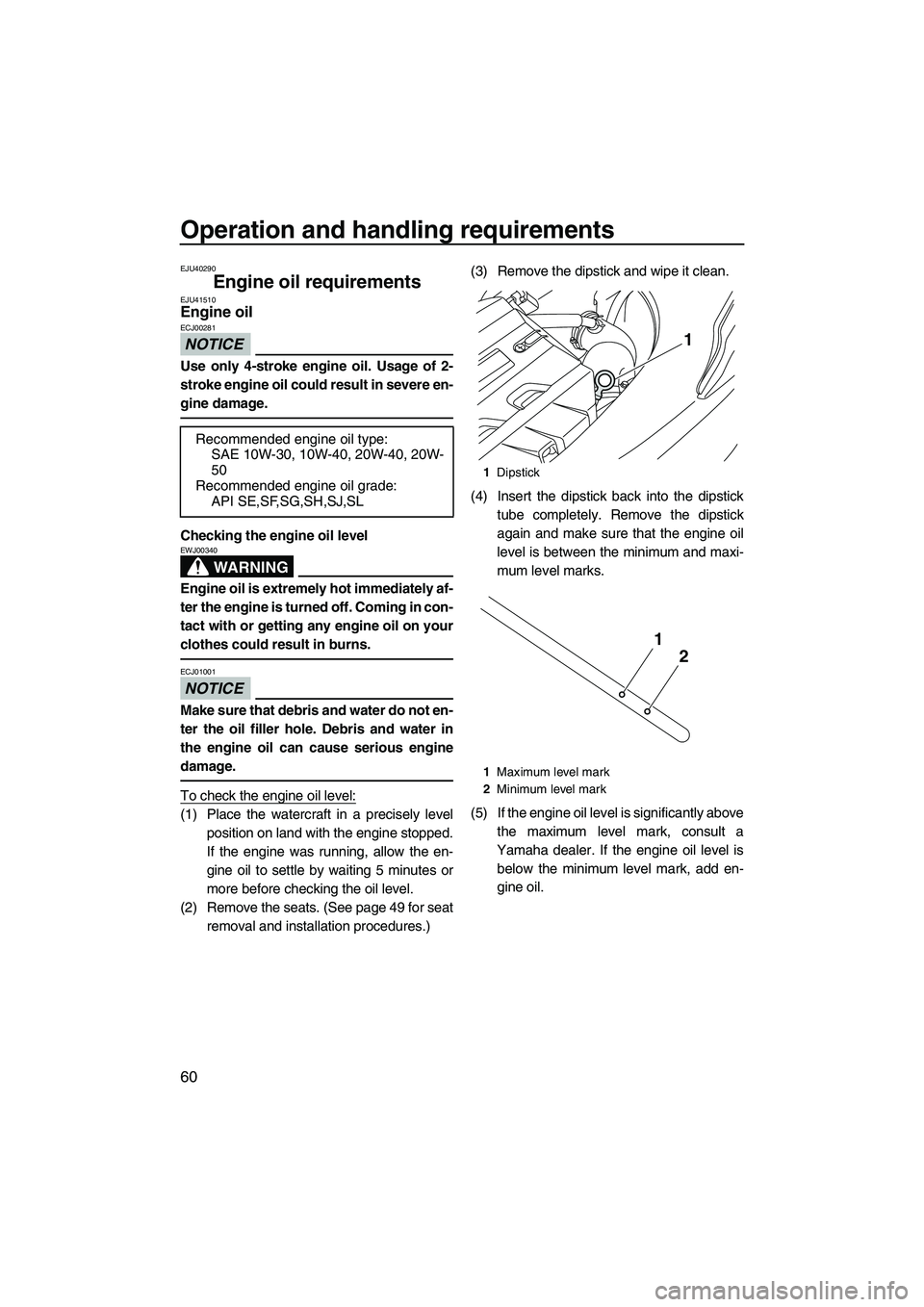
(2) Remove the seats. (See page 49 for seat removal and installation procedures.) (3) Remove the dipstick and wipe it clean.
(4) Insert the dipstick back into the dipstick
tube completely. Remove the dipstick
again and make sure that the engine oil
level is between the minimum and maxi-
mum level marks.
(5) If the engine oil level is significantly above the maximum level mark, consult a
Yamaha dealer. If the engine oil level is below the minimum level mark, add en-
gine oil.
Recommended engine oil type:
SAE 10W-30, 10W-40, 20W-40, 20W-
50
Recommended engine oil grade: API SE,SF,SG,SH,SJ,SL
1Dipstick
1 Maximum level mark
2 Minimum level mark
1
2
1
UF2S71E0.book Page 60 Tuesday, August 21, 2012 2:33 PM
Page 71 of 116
Pre-operation checks
65
EJU31981
WARNING
EWJ00411
Failure to inspect or maintain the watercraft properly increases the possibility of an ac-
cident or damage to the watercraft. Do not operate the watercraft if you find any prob-
lem. If a problem cannot be corrected by the procedures provided in this manual, have
the watercraft inspected by a Yamaha dealer.
EJU41232Pre-operation checklist
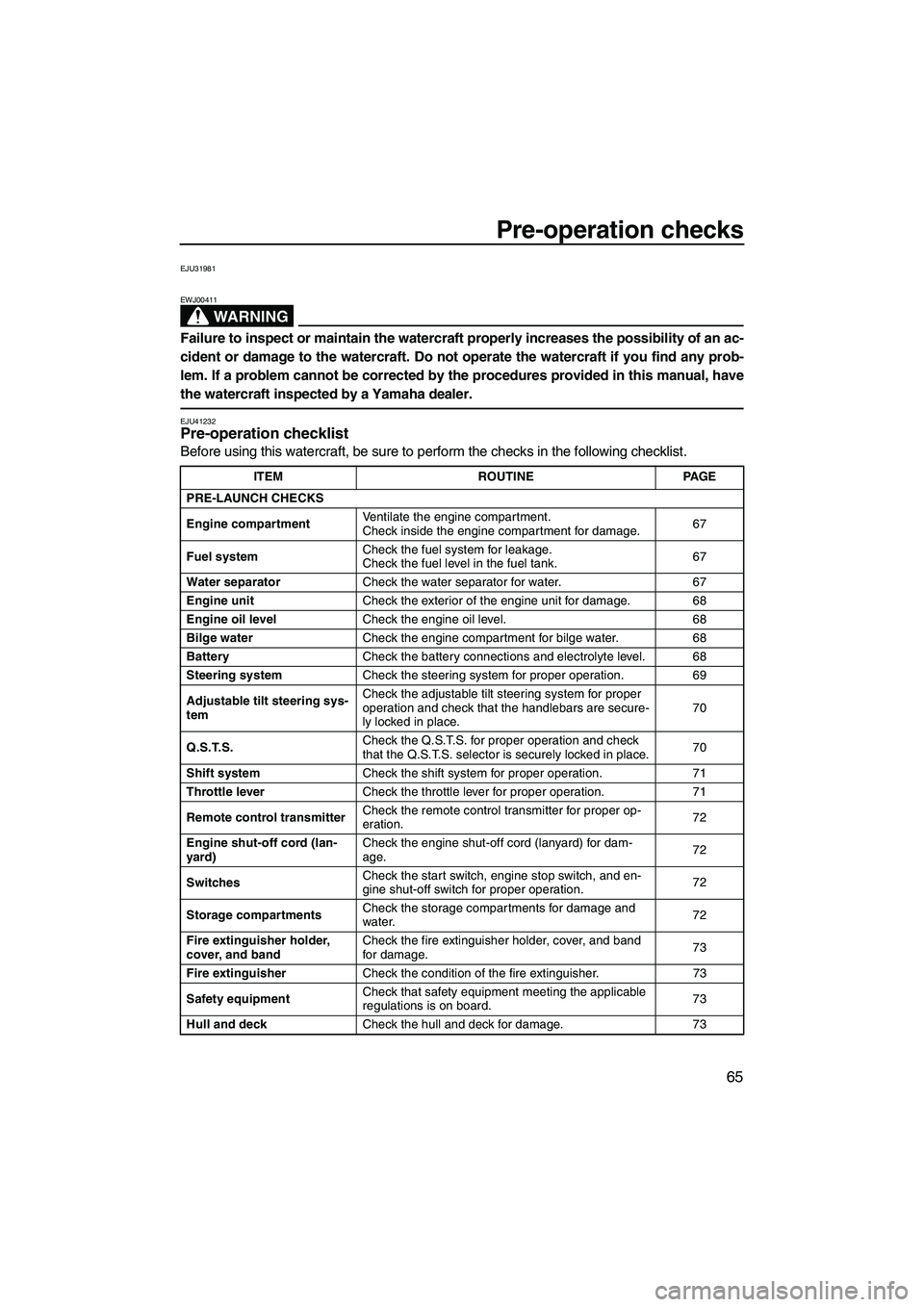
Before using this watercraft, be sure to perform the checks in the following checklist.
ITEM ROUTINEPAGE
PRE-LAUNCH CHECKS
Engine compartment Ventilate the engine compartment.
Check inside the engine compartment for damage.
67
Fuel system Check the fuel system for leakage.
Check the fuel level in the fuel tank.
67
Water separator Check the water separator for water. 67
Engine unit Check the exterior of the engine unit for damage. 68
Engine oil level Check the engine oil level. 68
Bilge water Check the engine compartment for bilge water. 68
Battery Check the battery connections and electrolyte level. 68
Steering system Check the steering system for proper operation. 69
Adjustable tilt steering sys-
tem Check the adjustable tilt steering system for proper
operation and check that the handlebars are secure-
ly locked in place.
70
Q.S.T.S. Check the Q.S.T.S. for proper operation and check
that the Q.S.T.S. selector is securely locked in place.
70
Shift system Check the shift system for proper operation. 71
Throttle lever Check the throttle lever for proper operation. 71
Remote control transmitter Check the remote control transmitter for proper op-
eration.
72
Engine shut-off cord (lan-
yard) Check the engine shut-off cord (lanyard) for dam-
age.
72
Switches Check the start switch, engine stop switch, and en-
gine shut-off switch for proper operation.
72
Storage compartments Check the storage compartments for damage and
water.
72
Fire extinguisher holder,
cover, and band Check the fire extinguisher holder, cover, and band
for damage.
73
Fire extinguisher Check the condition of the fire extinguisher. 73
Safety equipment Check that safety equipment meeting the applicable
regulations is on board.
73
Hull and deck Check the hull and deck for damage. 73
UF2S71E0.book Page 65 Tuesday, August 21, 2012 2:33 PM
Page 73 of 116
Pre-operation checks
67
EJU32281
Pre-operation check points EJU42380Pre-launch checks
Perform the pre-launch checks in the pre-op-
eration checklist while the watercraft is on
land.
To perform the pre-launch checks:
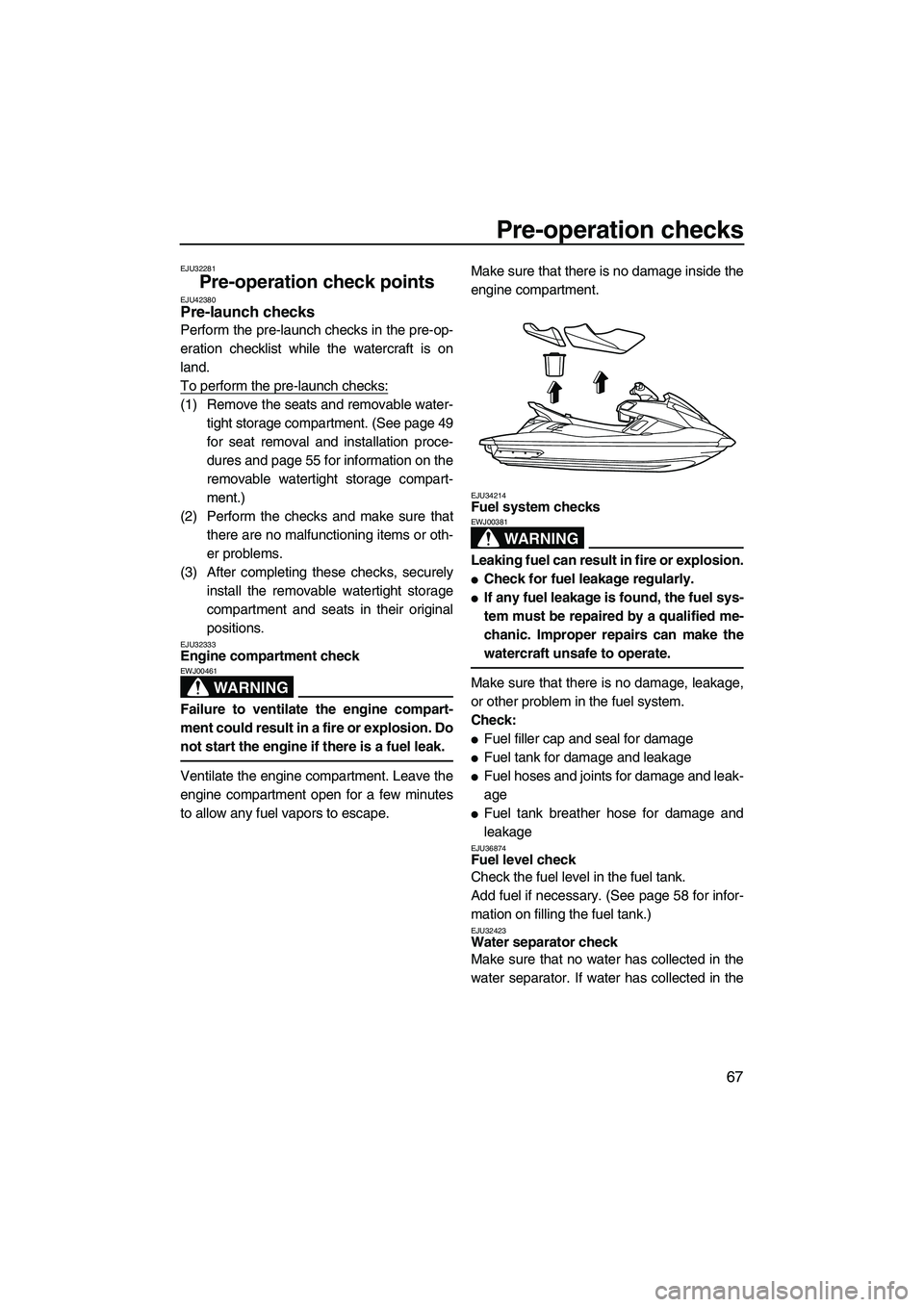
(1) Remove the seats and removable water-tight storage compartment. (See page 49
for seat removal and installation proce-
dures and page 55 for information on the
removable watertight storage compart-
ment.)
(2) Perform the checks and make sure that there are no malfunctioning items or oth-
er problems.
(3) After completing these checks, securely install the removable watertight storage
compartment and seats in their original
positions.
EJU32333Engine compartment check
WARNING
EWJ00461
Failure to ventilate the engine compart-
ment could result in a fire or explosion. Do
not start the engine if there is a fuel leak.
Ventilate the engine compartment. Leave the
engine compartment open for a few minutes
to allow any fuel vapors to escape. Make sure that there is no damage inside the
engine compartment.
EJU34214Fuel system checks
WARNING
EWJ00381
Leaking fuel can result in fire or explosion.
●Check for fuel leakage regularly.
●If any fuel leakage is found, the fuel sys-
tem must be repaired by a qualified me-
chanic. Improper repairs can make the
watercraft unsafe to operate.
Make sure that there is no damage, leakage,
or other problem in the fuel system.
Check:
●Fuel filler cap and seal for damage
●Fuel tank for damage and leakage
●Fuel hoses and joints for damage and leak-
age
●Fuel tank breather hose for damage and
leakage
EJU36874Fuel level check
Check the fuel level in the fuel tank.
Add fuel if necessary. (See page 58 for infor-
mation on filling the fuel tank.)
EJU32423Water separator check
Make sure that no water has collected in the
water separator. If water has collected in the
UF2S71E0.book Page 67 Tuesday, August 21, 2012 2:33 PM
Page 74 of 116
Pre-operation checks
68
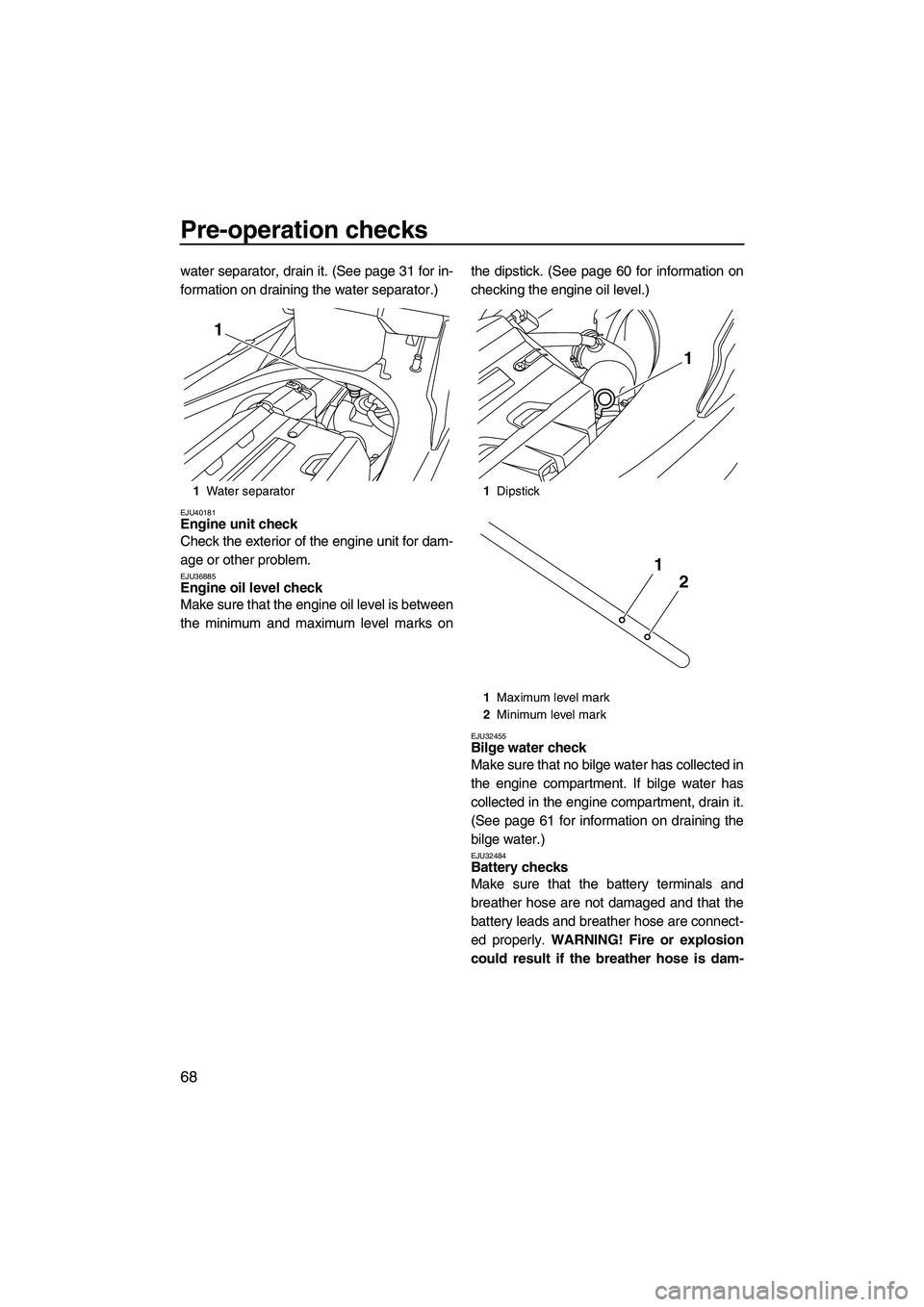
water separator, drain it. (See page 31 for in-
formation on draining the water separator.)
EJU40181Engine unit check
Check the exterior of the engine unit for dam-
age or other problem.
EJU36885Engine oil level check
Make sure that the engine oil level is between
the minimum and maximum level marks onthe dipstick. (See page 60 for information on
checking the engine oil level.)
EJU32455Bilge water check
Make sure that no bilge water has collected in
the engine compartment. If bilge water has
collected in the engine compartment, drain it.
(See page 61 for information on draining the
bilge water.)
EJU32484Battery checks
Make sure that the battery terminals and
breather hose are not damaged and that the
battery leads and breather hose are connect-
ed properly.
WARNING! Fire or explosion
could result if the breather hose is dam-
1 Water separator
1
1Dipstick
1 Maximum level mark
2 Minimum level mark
1
2
1
UF2S71E0.book Page 68 Tuesday, August 21, 2012 2:33 PM
Page 75 of 116
![YAMAHA FX HO 2013 User Guide Pre-operation checks
69
aged, obstructed, or not connected prop-
erly.
[EWJ00451]
Make sure that the electrolyte level is be-
tween the minimum and maximum level
marks. WARNING! Never operate the wa-](/img/51/49770/w960_49770-74.png "YAMAHA FX HO 2013 User Guide Pre-operation checks
69
aged, obstructed, or not connected prop-
erly.
[EWJ00451]
Make sure that the electrolyte level is be-
tween the minimum and maximum level
marks. WARNING! Never operate the wa-")
Pre-operation checks
69
aged, obstructed, or not connected prop-
erly.
[EWJ00451]
Make sure that the electrolyte level is be-
tween the minimum and maximum level
marks. WARNING! Never operate the wa-
tercraft if the battery does not have suffi-
cient power to start the engine or if it
shows any other signs of decreased pow-
er. Loss of battery power may leave you
stranded.
[EWJ01240]
Make sure that the battery is securely held in
place.
EJU32613Steering system checks
Turn the handlebars to the right and left sev-
eral times to make sure that operation is
smooth and unrestricted throughout the whole range, and that the free play is not ex-
cessive.
Turn the handlebars as far as possible to the
right and left to make sure that the jet thrust
nozzle moves as the handlebars are turned,
and that there is no difference between the
1
Breather hose
2 Negative (–) battery terminal: Black lead
3 Positive (+) battery terminal: Red lead
1 Maximum level mark
2 Minimum level mark
23
1
UF2S71E0.book Page 69 Tuesday, August 21, 2012 2:33 PM
Page 77 of 116
Pre-operation checks
71
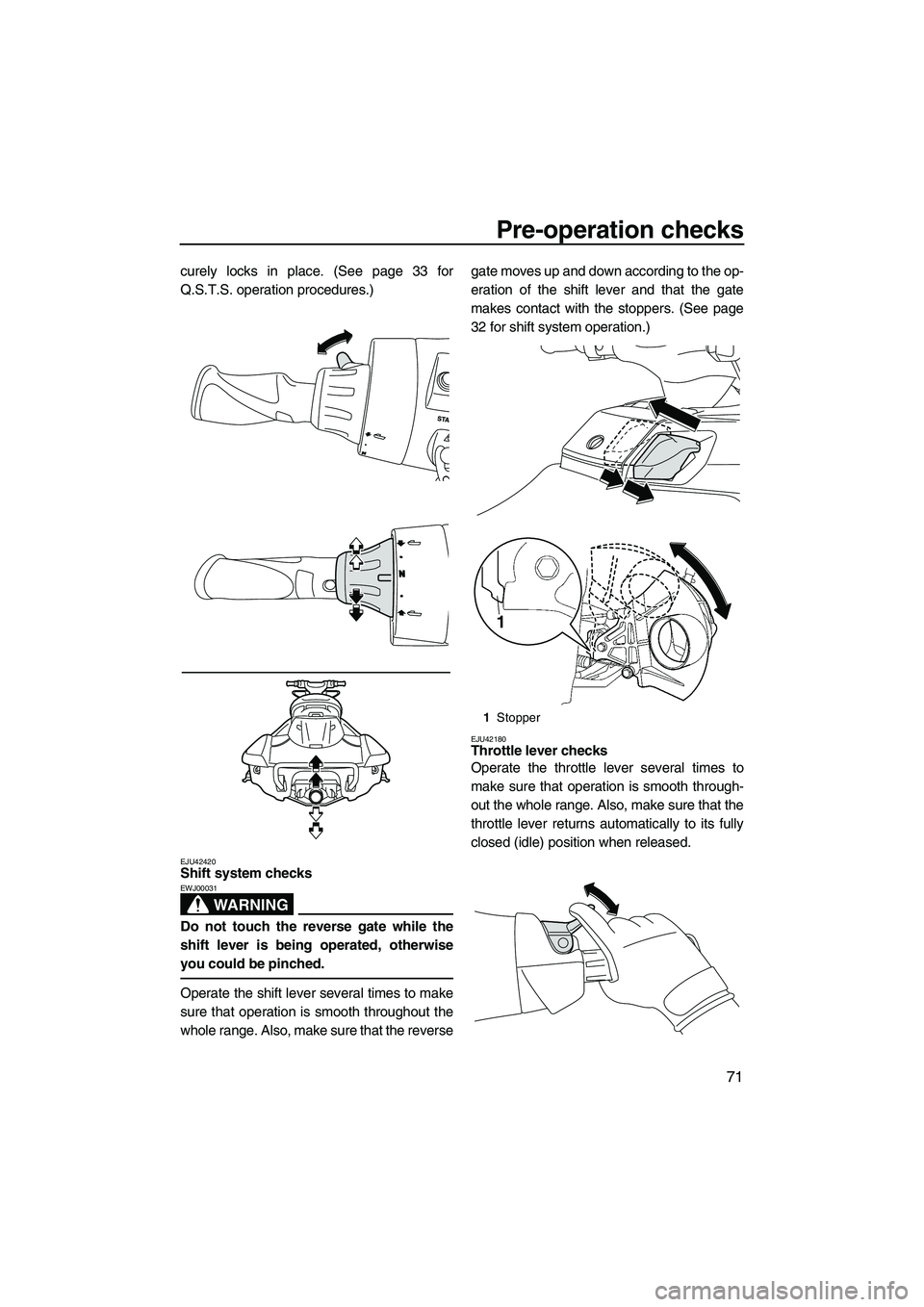
curely locks in place. (See page 33 for
Q.S.T.S. operation procedures.)
EJU42420Shift system checks
WARNING
EWJ00031
Do not touch the reverse gate while the
shift lever is being operated, otherwise
you could be pinched.
Operate the shift lever several times to make
sure that operation is smooth throughout the
whole range. Also, make sure that the reversegate moves up and down according to the op-
eration of the shift lever and that the gate
makes contact with the stoppers. (See page
32 for shift system operation.)
EJU42180Throttle lever checks
Operate the throttle lever several times to
make sure that operation is smooth through-
out the whole range. Also, make sure that the
throttle lever returns automatically to its fully
closed (idle) position when released.
1
Stopper
1
UF2S71E0.book Page 71 Tuesday, August 21, 2012 2:33 PM
Page 78 of 116
Pre-operation checks
72
EJU40112Remote control transmitter check
Make sure that the remote control transmitter
operates properly. (See page 27 for Yamaha
Security System setting procedures and page
35 for Low RPM Mode activation procedures.)
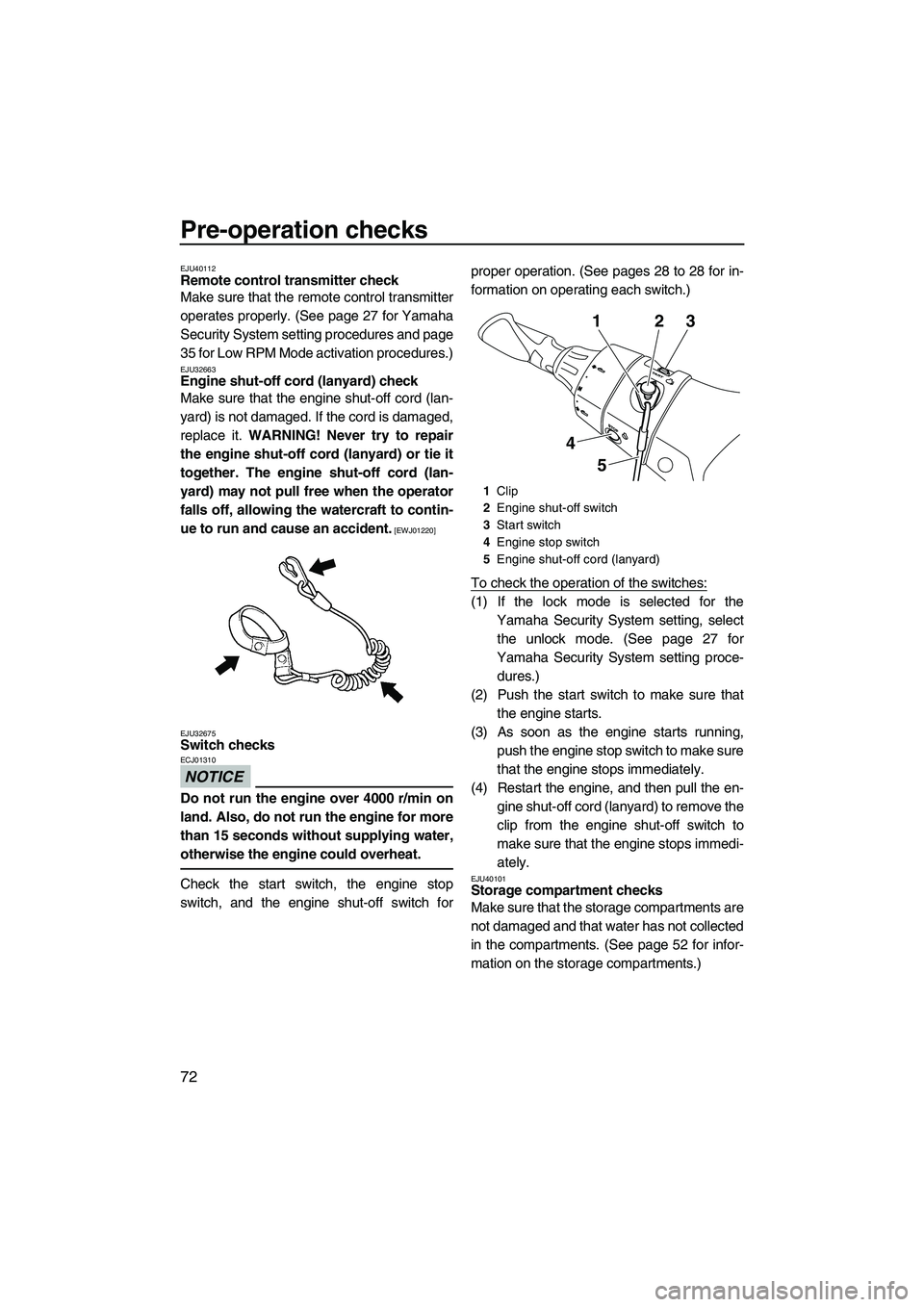
EJU32663Engine shut-off cord (lanyard) check
Make sure that the engine shut-off cord (lan-
yard) is not damaged. If the cord is damaged,
replace it. WARNING! Never try to repair
the engine shut-off cord (lanyard) or tie it
together. The engine shut-off cord (lan-
yard) may not pull free when the operator
falls off, allowing the watercraft to contin-
ue to run and cause an accident.
[EWJ01220]
EJU32675
Switch checks
NOTICE
ECJ01310
Do not run the engine over 4000 r/min on
land. Also, do not run the engine for more
than 15 seconds without supplying water,
otherwise the engine could overheat.
Check the start switch, the engine stop
switch, and the engine shut-off switch for proper operation. (See pages 28 to 28 for in-
formation on operating each switch.)
To check the operation of the switches:
(1) If the lock mode is selected for the
Yamaha Security System setting, selectthe unlock mode. (See page 27 for
Yamaha Security System setting proce- dures.)
(2) Push the start switch to make sure that the engine starts.
(3) As soon as the engine starts running, push the engine stop switch to make sure
that the engine stops immediately.
(4) Restart the engine, and then pull the en- gine shut-off cord (lanyard) to remove the
clip from the engine shut-off switch to
make sure that the engine stops immedi-
ately.
EJU40101Storage compartment checks
Make sure that the storage compartments are
not damaged and that water has not collected
in the compartments. (See page 52 for infor-
mation on the storage compartments.)
1Clip
2 Engine shut-off switch
3 Start switch
4 Engine stop switch
5 Engine shut-off cord (lanyard)
132
5
4
UF2S71E0.book Page 72 Tuesday, August 21, 2012 2:33 PM