water pump YAMAHA FX HO 2013 User Guide
[x] Cancel search | Manufacturer: YAMAHA, Model Year: 2013, Model line: FX HO, Model: YAMAHA FX HO 2013Pages: 116, PDF Size: 5.56 MB
Page 108 of 116
Trouble recovery
102
EJU34623
Emergency procedures EJU34634Cleaning the jet intake and impeller
WARNING
EWJ00782
Before attempting to remove weeds or de-
bris from the jet intake or impeller area,
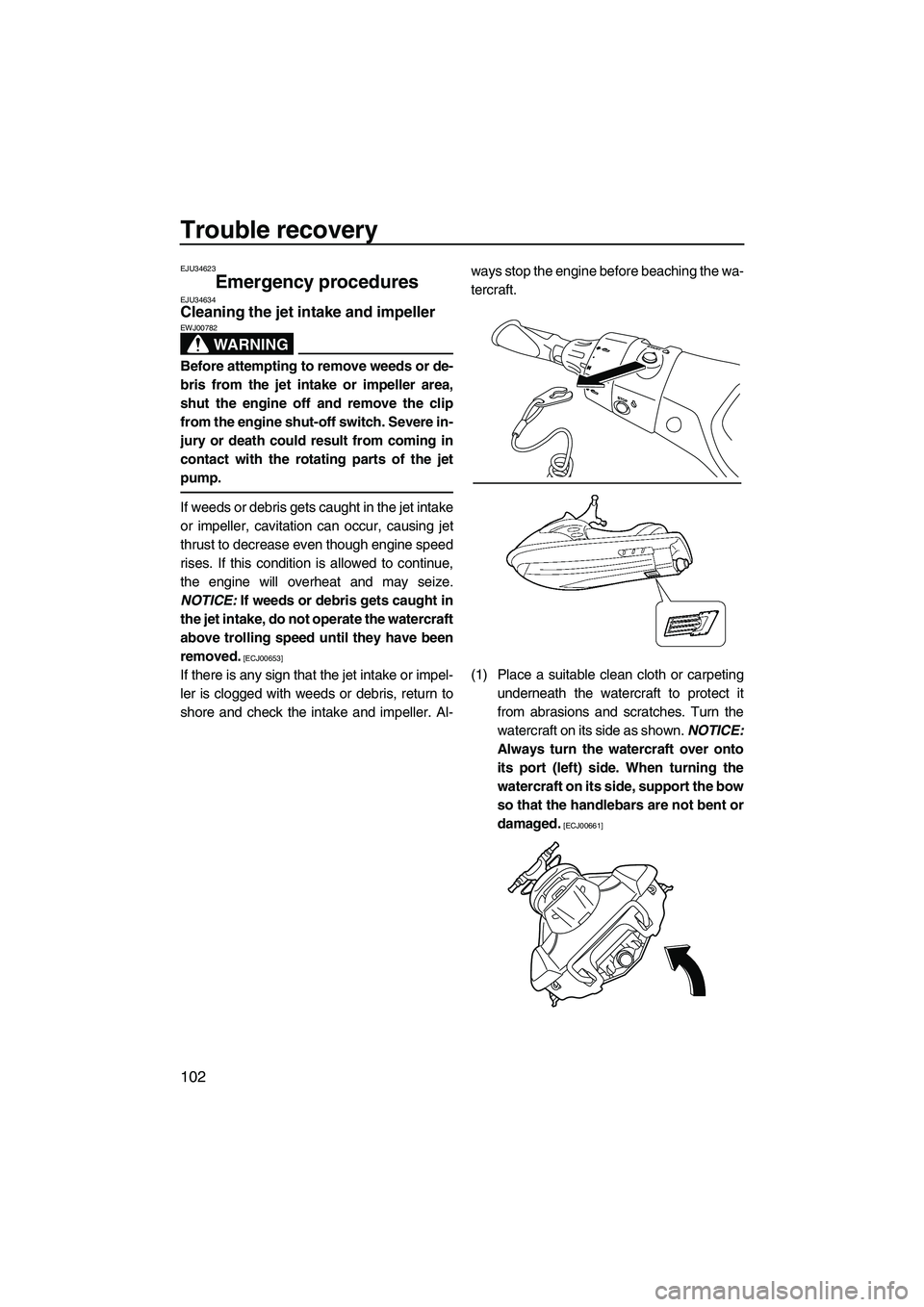
shut the engine off and remove the clip
from the engine shut-off switch. Severe in-
jury or death could result from coming in
contact with the rotating parts of the jet
pump.
If weeds or debris gets caught in the jet intake
or impeller, cavitation can occur, causing jet
thrust to decrease even though engine speed
rises. If this condition is allowed to continue,
the engine will overheat and may seize.
NOTICE: If weeds or debris gets caught in
the jet intake, do not operate the watercraft
above trolling speed until they have been
removed.
[ECJ00653]
If there is any sign that the jet intake or impel-
ler is clogged with weeds or debris, return to
shore and check the intake and impeller. Al- ways stop the engine before beaching the wa-
tercraft.
(1) Place a suitable clean cloth or carpeting
underneath the watercraft to protect it
from abrasions and scratches. Turn the
watercraft on its side as shown. NOTICE:
Always turn the watercraft over onto
its port (left) side. When turning the
watercraft on its side, support the bow
so that the handlebars are not bent or
damaged.
[ECJ00661]
UF2S71E0.book Page 102 Tuesday, August 21, 2012 2:33 PM
Page 109 of 116
Trouble recovery
103
(2) Remove any weeds or debris fromaround the jet intake, drive shaft, impel-
ler, jet pump housing, and jet thrust noz-
zle.
If debris is difficult to remove, consult a
Yamaha dealer.
EJU34641Jumping the battery
If the watercraft battery has run down, the en-
gine can be started using a 12-volt booster
battery and jumper cables.
EJU34663Connecting the jumper cables
WARNING
EWJ01250
To avoid battery explosion and serious
damage to the electrical system:
●Do not reverse the polarity of the jumper
cables when connecting to the batteries.
●Do not connect the negative (–) jumper
cable to the negative (–) terminal of the
watercraft battery.
●Do not touch the positive (+) jumper ca-
ble to the negative (–) jumper cable.
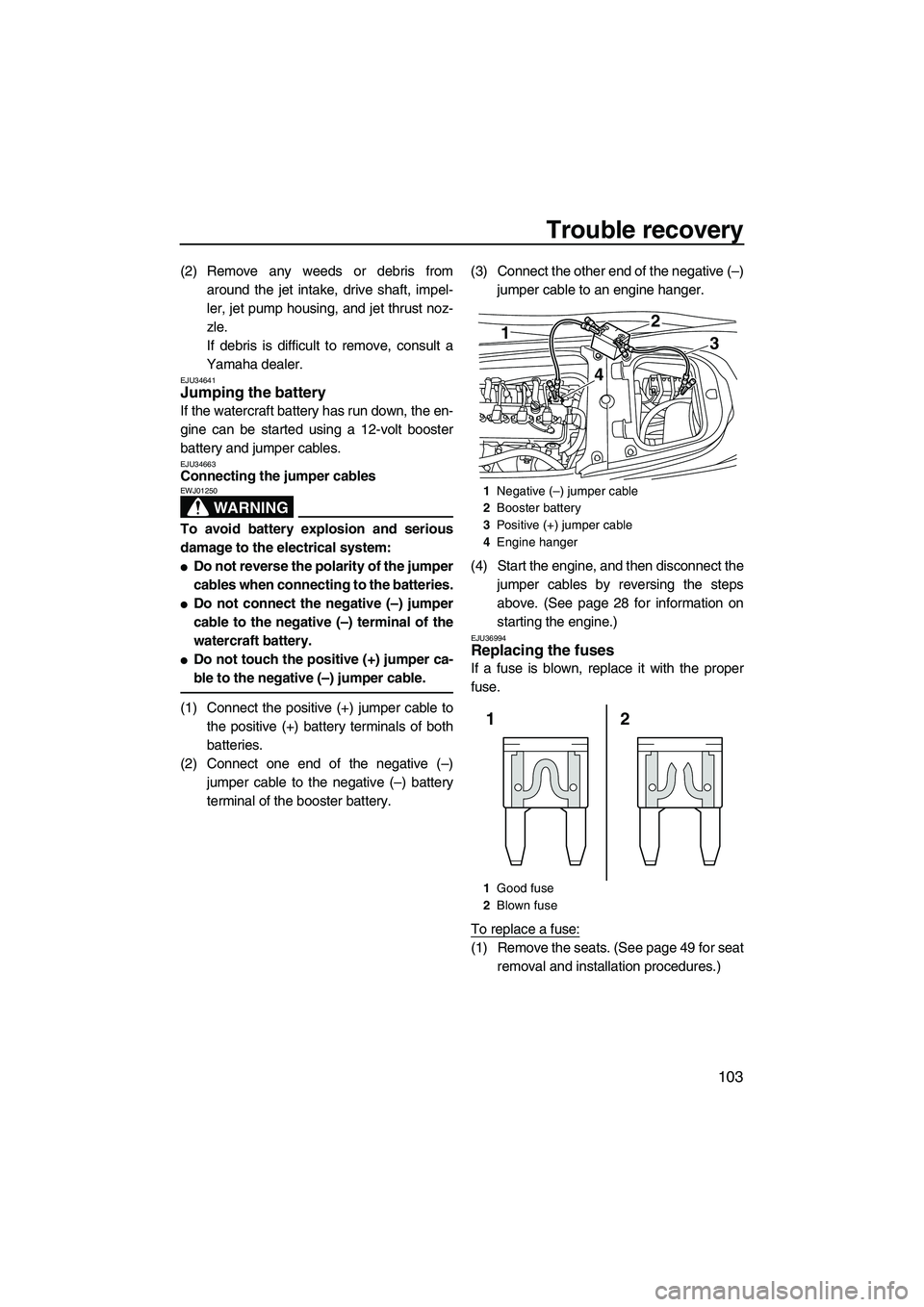
(1) Connect the positive (+) jumper cable to the positive (+) battery terminals of both
batteries.
(2) Connect one end of the negative (–) jumper cable to the negative (–) battery
terminal of the booster battery. (3) Connect the other end of the negative (–)
jumper cable to an engine hanger.
(4) Start the engine, and then disconnect the jumper cables by reversing the steps
above. (See page 28 for information on
starting the engine.)
EJU36994Replacing the fuses
If a fuse is blown, replace it with the proper
fuse.
To replace a fuse:
(1) Remove the seats. (See page 49 for seatremoval and installation procedures.)
1Negative (–) jumper cable
2 Booster battery
3 Positive (+) jumper cable
4 Engine hanger
1 Good fuse
2 Blown fuse
1
4
3
2
2
1
UF2S71E0.book Page 103 Tuesday, August 21, 2012 2:33 PM
Page 111 of 116
Trouble recovery
105
(7) Securely install the seats in their originalpositions.
If the fuse immediately blows again, the elec-
trical system may be defective. If this occurs,
have a Yamaha dealer service the watercraft.
EJU41821Replacing the bilge pump fuse
If the fuse is blown, replace it with the proper
fuse.
To replace the fuse:
(1) Remove the seats and engine cover. (See page 49 for seat removal and instal-
lation procedures and page 94 for engine
cover removal and installation proce-
dures.)
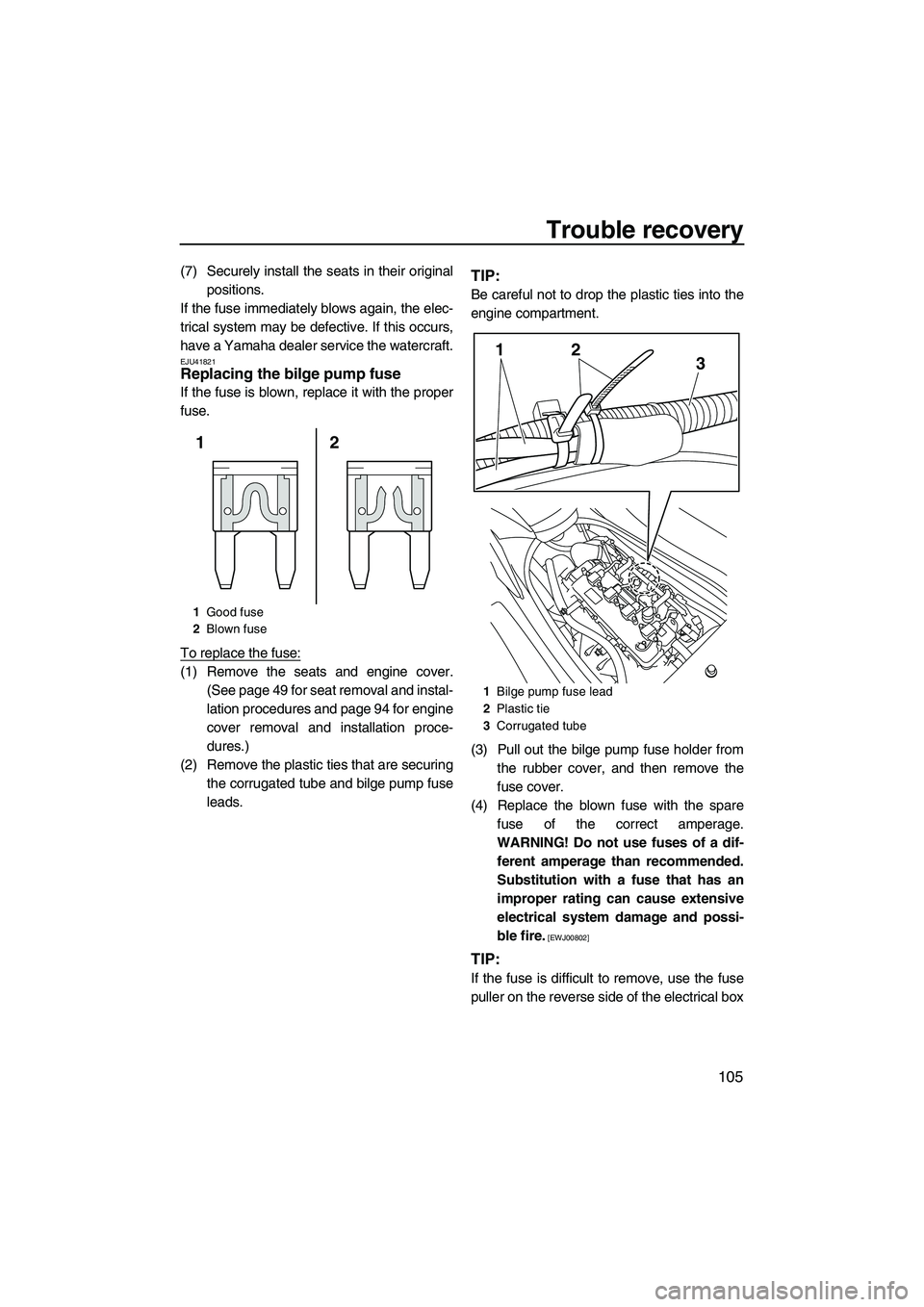
(2) Remove the plastic ties that are securing the corrugated tube and bilge pump fuse
leads.
TIP:
Be careful not to drop the plastic ties into the
engine compartment.
(3) Pull out the bilge pump fuse holder fromthe rubber cover, and then remove the
fuse cover.
(4) Replace the blown fuse with the spare fuse of the correct amperage.
WARNING! Do not use fuses of a dif- ferent amperage than recommended.
Substitution with a fuse that has an
improper rating can cause extensive
electrical system damage and possi-
ble fire.
[EWJ00802]
TIP:
If the fuse is difficult to remove, use the fuse
puller on the reverse side of the electrical box
1 Good fuse
2 Blown fuse
2
1
1 Bilge pump fuse lead
2 Plastic tie
3 Corrugated tube
213
UF2S71E0.book Page 105 Tuesday, August 21, 2012 2:33 PM
Page 112 of 116
Trouble recovery
106
cap. (See page 103 for information on the
fuse puller.)
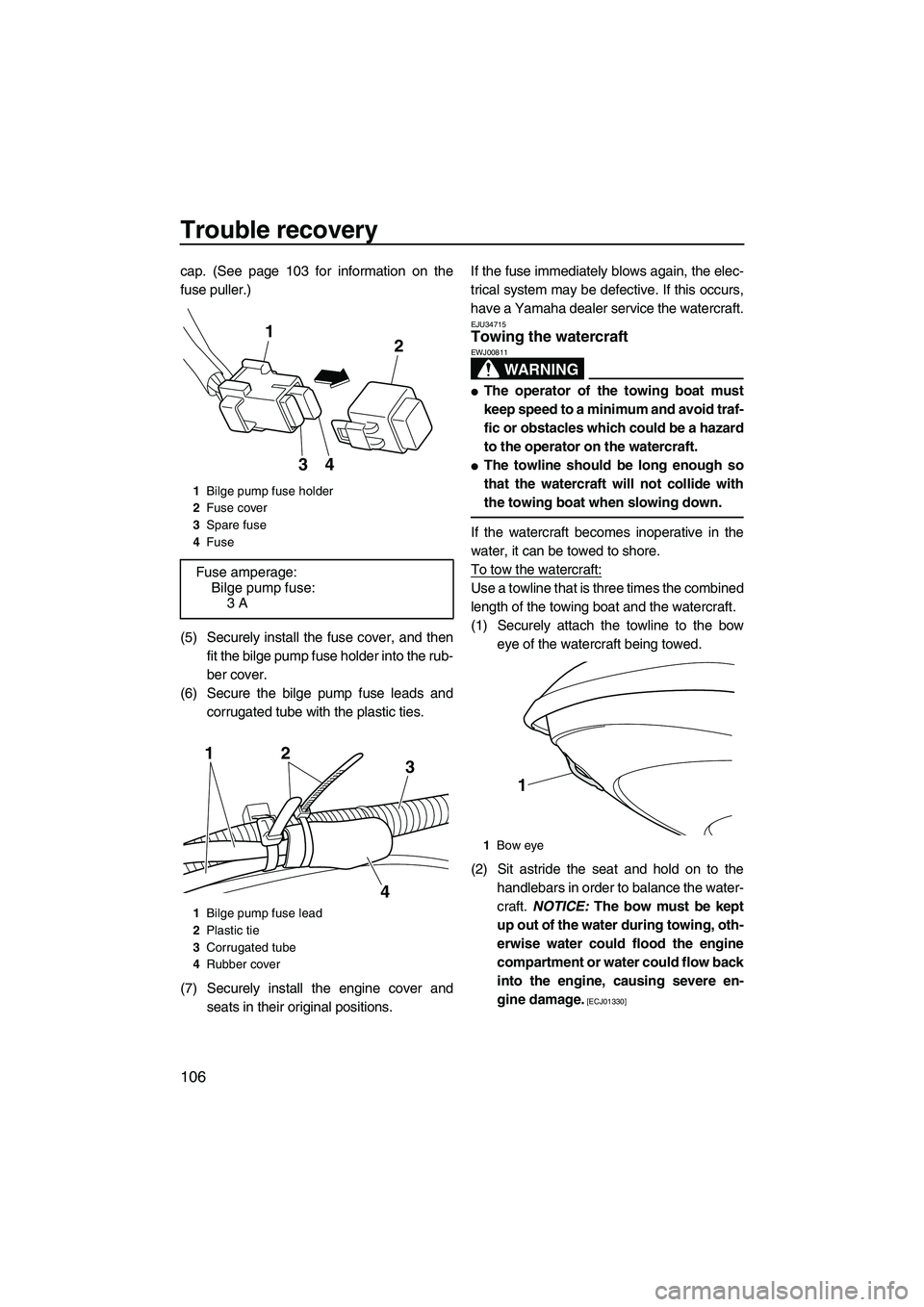
(5) Securely install the fuse cover, and thenfit the bilge pump fuse holder into the rub-
ber cover.
(6) Secure the bilge pump fuse leads and corrugated tube with the plastic ties.
(7) Securely install the engine cover and seats in their original positions. If the fuse immediately blows again, the elec-
trical system may be defective. If this occurs,
have a Yamaha dealer service the watercraft.
EJU34715Towing the watercraft
WARNING
EWJ00811
●The operator of the towing boat must
keep speed to a minimum and avoid traf-
fic or obstacles which could be a hazard
to the operator on the watercraft.
●The towline should be long enough so
that the watercraft will not collide with
the towing boat when slowing down.
If the watercraft becomes inoperative in the
water, it can be towed to shore.
To tow the watercraft:
Use a towline that is three times the combined
length of the towing boat and the watercraft.
(1) Securely attach the towline to the bow
eye of the watercraft being towed.
(2) Sit astride the seat and hold on to the handlebars in order to balance the water-
craft. NOTICE: The bow must be kept
up out of the water during towing, oth-
erwise water could flood the engine
compartment or water could flow back
into the engine, causing severe en-
gine damage.
[ECJ01330]
1 Bilge pump fuse holder
2 Fuse cover
3 Spare fuse
4 Fuse
Fuse amperage:
Bilge pump fuse:3 A
1Bilge pump fuse lead
2 Plastic tie
3 Corrugated tube
4 Rubber cover
21
43
213
4
1Bow eye
1
UF2S71E0.book Page 106 Tuesday, August 21, 2012 2:33 PM
Page 114 of 116
Index
A
Adjustable tilt steering system.................. 30
Adjustable tilt steering system checks ..... 70
After removing the watercraft from the water ..................................................... 87
Analog speedometer/tachometer ............. 40
B
Battery care .............................................. 89
Battery checks.......................................... 68
Battery, jumping ..................................... 103
Beaching and docking the watercraft ....... 86
Beverage holders ..................................... 55
Bilge pump fuse, replacing ..................... 105
Bilge water check ..................................... 68
Bilge water, draining................................. 61
Bilge water, draining on land .................... 61
Bilge water, draining on water .................. 62
Boarding alone ......................................... 81
Boarding and starting off from a dock ...... 85
Boarding the watercraft ............................ 81
Boarding with passenger(s) ..................... 82
Bow eye ................................................... 51
Bow storage compartment ....................... 52
Builder’s plate............................................. 2
C
Capsized watercraft ................................. 85
Check engine warning.............................. 45
Cleaning ................................................... 92
Cleaning the watercraft ............................ 89
Cleat ......................................................... 51
Cooling water pilot outlet check ............... 74
Cooling water pilot outlets ........................ 30
Craft Identification Number (CIN) ............... 1
Cruise assist............................................. 37
Cruising limitations ................................... 12
D
Digital speedometer ................................. 41
E
Emergency procedures .......................... 102
Engine break-in ........................................ 64
Engine compartment check...................... 67
Engine cover, removing and installing ..... 94
Engine idling speed check ....................... 74
Engine oil ................................................. 60
Engine oil and oil filter .............................. 97 Engine oil level check............................... 68
Engine oil requirements ........................... 60
Engine overheat warning ......................... 44
Engine serial number ................................. 1
Engine shut-off cord (lanyard) check ....... 72
Engine shut-off switch .............................. 28
Engine stop switch ................................... 28
Engine unit check ..................................... 68
Enjoy your watercraft responsibly ............ 20
Equipment ................................................ 49
F
Fire extinguisher check ............................ 73
Fire extinguisher holder and cover ........... 57
Fire extinguisher holder, cover,
and band checks................................... 73
Flushing the cooling water passages ....... 88
Fuel .......................................................... 58
Fuel level check ....................................... 67
Fuel level meter ........................................ 43
Fuel level warning .................................... 44
Fuel requirements .................................... 58
Fuel system checks .................................. 67
Fuses, replacing ..................................... 103
G
Getting to know your watercraft ............... 75
Glossary, watercraft ................................. 21
Glove compartment .................................. 53
H
Handgrip ................................................... 50
Hazard information ................................... 16
Hood check .............................................. 74
Hour meter/voltmeter ............................... 42
Hull and deck check ................................. 73
I
Identification numbers ................................ 1
Information display ................................... 41
J
Jet intake and impeller, cleaning ............ 102
Jet intake checks ...................................... 73
Jumper cables, connecting .................... 103
L
Labels, important ........................................ 4
Labels, other .............................................. 9
Labels, warning .......................................... 5
Launching the watercraft .......................... 76
UF2S71E0.book Page 1 Tuesday, August 21, 2012 2:33 PM